← The Jordan Harbinger Show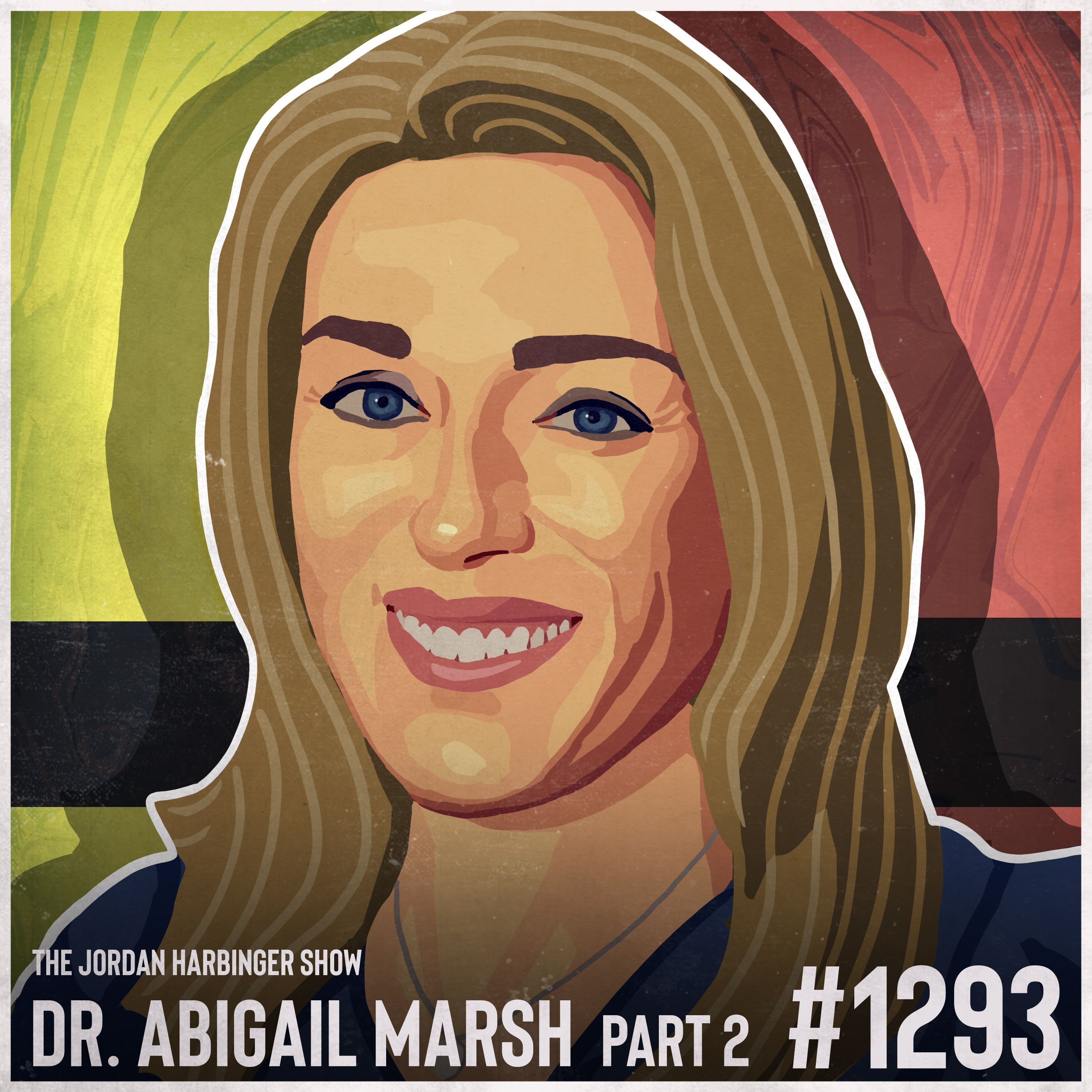
The Jordan Harbinger Show
1293: Abigail Marsh | How Fear Separates Saints from Psychopaths Part 2
01:04:00
Loading summary
Transcript163 lines
- [00:02]
Jordan Harbinger
This episode is brought to you by Progressive Insurance. Do you ever find yourself playing the budgeting game? Well, with the Name youe Price Tool from Progressive, you can find options that fit your budget and potentially lower your bills. Try it@progressive.com, progressive Casualty Insurance Company and affiliates. Price and coverage match limited by state law, not available in all states.
- [00:22]
Dr. Abigail Marsh
When it's time to scale your business, it's time for Shopify. Get everything you need to grow the way you want. Like all the way. Stack more sales with the best converting checkout on the planet. Track your cha chings from every channel right in one spot and turn real time reporting into big time opportunities. Take your business to a whole new level. Switch to Shopify. Start your free trial today.
- [00:50]
Jordan Harbinger
Coming up next on the Jordan Harbinger
- [00:52]
Dr. Abigail Marsh
Show, Most of the world's atrocities are not committed by psychopathic people. They're committed by groups of people who, you know, have very different opinions about what is right and what is wrong and both believe that they're totally justified in aggression to make sure that their viewpoint wins out and the other one doesn't.
- [01:13]
Jordan Harbinger
Welcome to the show. I'm Jordan Harbinger. On the Jordan Harbinger show, we decode the stories, secrets and skills of the world's most fascinating people and turn their wisdom into practical advice that you can use to impact your own life and those around you. Our mission is to help you become a better informed, more critical thinker through long form conversations with a variety of amazing folks, from spies to CEOs, athletes to authors, thinkers to performers, even the occasional former cult member, mafia enforcer or drug trafficker, maybe a former jihadi here and there. If you're new to the show or you want to tell your friends about the show, I suggest our episode starter packs. These are collections of some of our favorite episodes on topics like persuasion and negotiation, psychology and geopolitics, disinformation, China, North Korea, crime and cults and more. That'll help listeners get a taste of everything we do here on the show. Just visit jordanharbinger.com start or search for us in your Spotify app to get started today. Part two with Dr. Abigail Marsh. We're talking psychopathy and altruism. Fascinating. If you haven't heard part one yet, go back and do that. Otherwise, here we go with part two of our conversation with Abigail Marsh. Do you foresee a time when neuroscience can predict altruistic or psychopathic tendencies? You mentioned brain scans can't quite do it, but once FMRI fits into your hat, can you Just have kindergarteners wear this for a week and be like, oh, watch out for little Jordan. The thing is lighting up a little bit in areas where it's not supposed to.
- [02:32]
Dr. Abigail Marsh
I mean, that was what people were going for for a long time. You know, the ability to detect any kind of psychological disorder from a brain scan at an individual level. We're not there yet. You know, it's hard to know because the problem is an MRI is just showing you where blood flow is changing in the brain. It's not measuring actual activity in neurons, and it's not measuring activity in neurotransmitter systems. Like, is this dopamine? Is it serotonin? And so it's just missing a lot that's happening. And so, you know, it's so expensive now that maybe it could sort of serve as an additional measurement of risk. But we're a long way from being able to diagnose anybody using a brain scan.
- [03:11]
Jordan Harbinger
Yeah, so these are like satellites that show clouds, but you can't tell if it's raining underneath a cloud. You can just see the clouds.
- [03:17]
Dr. Abigail Marsh
Yeah, yeah, that's a good metaphor.
- [03:19]
Jordan Harbinger
They probably can tell with satellites, but this is my analogy, and people are gonna have to deal with it. What would be the ethical implications of that, though? Like, okay, it's sort of Minority Report ish, isn't it? Like, okay, we know that these two kids at this school have psychopathic traits, but they're currently just kindergarteners and they're nice and they play with everybody. And then it's like when that kid pushes someone down on the playground, it's like, aha, we knew it. But when the other kid does it, it's like, well, they're four. Whatever. Who cares? They do that. That's what four year olds do.
- [03:48]
Dr. Abigail Marsh
Well, yes. I mean, that is the big risk. However, it's only a risk if you just assume these traits are immutable and every other psychological disorder can be treated. And so why would these be uniquely immutable? And in fact, the evidence is they can be changed, they can be improved. And this weird pessimism people have about psychopathy and other personality disorders is. Is just like the Kitty Genovese story or the Zimbardo studies. Right? This weirdly pessimistic view of human nature that is not really relevant to reality. They're totally treatable. You know, for example, I don't know if people know this about borderline personality disorder, which is another, you know, disorder that makes people very antisocial in some cases. If you get the Gold standard. I think it's called DBT therapy. Especially starting young, because you can diagnose it in the teens is when it usually emerges. I think the success rate for not being diagnosable with borderline something like five years later is like 60 or 70%. It's, like, really treatable. Yeah, but people are just weirdly pessimistic about these things. So I think that the pessimism is totally unwarranted. But right now, we're not even really trying to treat psychopathy. And so, like, da, da. We're not. It's like, it's. We're in the minority report situation. But if we try to treat it, it turns out it actually works. I can't tell you how many people with psychopathy I've talked to who don't want to be this way anymore. They're like, this isn't working for my life. I finally figured out. And not everybody figures this out, but a lot of people are like, I finally figured out that, like, the way I'm acting, like I'm the problem, it's me. You know, to paraphrase Taylor Swift, I seem to be causing problems in my own life, and I want to get out of this rut. I want to get out of this behavior spiral, and I just don't know how.
- [05:19]
Jordan Harbinger
That's a great point because I think back again to Amber, the little seducer. I don't think we brought up her example specifically, but this is a little girl who. She would want, like a handbag or something, so she would just go find a man to buy it for her. And then she didn't care that she was 14 and he was 25 and is going to go to prison for this. She'd be just like, whatever, I want this purse. And that's behavior that's obviously going to catch up with her. And she's going to be like, oh, just because you don't care doesn't mean you're not going to feel the consequences of just sleeping with random dudes for handbags throughout your entire childhood.
- [05:47]
Dr. Abigail Marsh
Exactly. And you're probably not going to figure it out in your teens and early twenties. Right. That's not the sort of apex of good decision making or emotional insight in most people's lives. And so, you know, Emmy Thomas called her 20s her playground stage, where her behavior was at its absolute worst. Because, you know, you know, people are get carried away. But yeah, by the time you hit your late 20s and 30s. Absolutely. People who are living this kind of lifestyle are pretty consistently gonna realize that this is leading me nowhere. This is not the kind of life I wanna lead. It's not the kind of person I wanna be. It's not working for me. And, you know, I will be the one who benefits the most if I get treatment.
- [06:23]
Jordan Harbinger
I don't know. So there's face blindness, right? Where you just forget people's face and you meet them every time and it's like you've never seen them before. I assume that's not with your parents, but, like, with most new people that you meet.
- [06:34]
Dr. Abigail Marsh
Oh, totally. With your parents. Absolutely. Spouse? Oh, yeah. You learn how to recognize people from, like, particular cues, like their hairline or, like, they have a particular freckle or something. Yeah.
- [06:44]
Jordan Harbinger
Oh, that's insane to me. So basically, you just can't remember anyone's face, including people that you're married to and live with. Wow.
- [06:51]
Dr. Abigail Marsh
The way I show my students how this works is I show them faces of really famous people upside down. And your face recognition software requires that the facial features be in this, like, canonical arrangement in order to, like, turn on. It needs to see two eyes on top of, like, a nosy mouthy thing inside an oval. And if it gets that canonical arrangement of a face, it comes online and it's like, oh, like, let me look through my catalog of faces and I'll figure out who this is. And so looking at upside down faces is kind of resembles what it feels like to have face blindness. They just. You're just like, I don't know, like, who is that? It almost doesn't matter who it is.
- [07:25]
Jordan Harbinger
Yeah. Wow. I can't imagine living like that. That's absolutely wild to me. But then there's the opposite. Super face recognizers. And you can recognize people they saw once years ago, and they actually have to pretend they don't remember people because it would be creepy. I'm not at that level. But I will run into somebody that I went to preschool with and be like, are you Teddy? And they'd be like, how do you know? And I'm like, oh, I think we went to school together. And they're like, I moved out of Michigan when I was 7. And I'm like, good guess. And that it is creepy, but I don't do it with everyone.
- [07:54]
Dr. Abigail Marsh
And they're like, have you been stalking me since then?
- [07:56]
Jordan Harbinger
But it's not like I go to Chipotle and I recognize that person used to live in Manhattan and work out at Equinox. Like, I can't do that. You. You know, But I can do it with somebody Where I'm like, wait, didn't we go to school together in another state 30 years ago? And they're like, I can't believe that you remember that. So that happens to me all the time.
- [08:12]
Dr. Abigail Marsh
That's impressive.
- [08:12]
Jordan Harbinger
And I do have to pretend that I don't remember them. And I'll be like, what was your name again? And they're like, mark. And I'm like, yeah, definitely, I went to your house once when we were kids. But whatever, you know, Like, I don't want to say that right away because it's so weird if I walk in and say, hey, I remember you. We hung out 35 years ago at your house. That's odd.
- [08:30]
Dr. Abigail Marsh
I think you are a super face recognizer.
- [08:32]
Jordan Harbinger
I mean, where's the line?
- [08:33]
Dr. Abigail Marsh
There's a website you can go to and test it.
- [08:36]
Jordan Harbinger
Oh, okay. Well, what's the website?
- [08:38]
Dr. Abigail Marsh
So the researcher is Brad Duchaine. D U C H A I N E I think it's called faceblind.org or something like that. If you look up face blindness, we'll
- [08:47]
Jordan Harbinger
link it into the show notes. I'll have Bob search for this and put it in the show notes. So we'll definitely find that. Because I want to take that test. That's one of the reasons I wrote this down. One, it's amazing. But two, the opposite face blindness thing was crazy for me, but I was like, I don't know. I'm pretty good at this. And even my wife will be like, I'm sure that you don't remember this person that we met in Taiwan. Because a lot of folks, they'll say, like, Asian people all kind of look the same, which is, you know, diet racism, I suppose. But I'm like, no, I remember this old man that I met at a lunch in Taiwan five years ago. And Jen's like, I can't believe that. That you remember all of these people. And I do. I can't always get their names, but I'm like, no, Last time we saw him, he had a blue striped shirt on. And Jen's like, this is so weird that you can do that. It's a fun superpower when it's not creepy, I suppose.
- [09:32]
Dr. Abigail Marsh
Yeah. Well, the differences between our own internal experiences and others are invisible to us. So most of us just go through life assuming that whatever experiences we have internally is the same as other people. So I think a lot of super face recognizers just. It takes them a while to figure out that, like, oh, this facility I have with picking people's faces out and Remembering where I saw them last is. I mean, I think it's pretty normal. And then eventually you're like, actually, other people just can't do this.
- [09:57]
Jordan Harbinger
For me, the sort of weird part was where I'd go, oh, Tom. And they'd go, have we met? And I'm like, yeah, we went to college together. And they're like, what do you mean? And I'm like, you lived on the fifth floor, and I lived on the fourth floor of Hunt House. And they're like, dude, that was in 1997. And we talked, like, zero times or something. And I'm like, yeah, but you were so and so's roommate. Then I was like, oh, I'm making this weird, because normal people would never remember that ever, right?
- [10:23]
Dr. Abigail Marsh
You're trying to be friendly.
- [10:24]
Jordan Harbinger
Yes, but my 20s kind of got rid of that. I mean, I guess then it wasn't 10 years ago, but I picked somebody I went to preschool with, and I'd be like, oh, you know, Teddy, I remember, hey, do you still play soccer? And they're just like, who are you? And why are you talking to me? You know, I can't believe you remember that. Then like you said in the book, you have to pretend you don't remember them, and then you get their name again, but you already knew, and they're like, oh, you go by Theodore now. Okay, well, all right. I have to not call you Teddy, because you'll be like, hey, I haven't been called that since 1984 when we met in preschool.
- [10:55]
Dr. Abigail Marsh
It's so funny because, like, it's not psychopathy at all, but it is a way that you're, like, on the tails of the human distribution. And, like, in order to get along with people, if you're at the tail, you have to kind of act more like people at the middle, and you have to mask. And people with all kinds of brains that are at the tails, like people who have autism, people who are super intelligent. Right. Kids who are, like, really smart at some point are like, if I sound like a walking dictionary, other people are gonna make fun of me and not like me. So I have to just not talk like that. And I have to kind of learn to mask. And that's kind of what people with psychopathy are doing, too. They're like, ah, I sort of figured out that other people have emotions that I don't. So I'm just gonna pretend that I'm different than I am.
- [11:34]
Jordan Harbinger
I was really good friends with this guy. He's a professor now. And I remember when we were in high school, he started shoplifting. And I was like, what are you doing? And he's like, everybody thinks I'm just this really smart guy. And I'm like, yeah, you're literally a genius. I think probably. And he's like, I don't want that. So he started doing all this bad stuff to mask and then he got caught and that was a big problem. But he gave a lecture at a college when we were in high school.
- [11:58]
Dr. Abigail Marsh
Whoa.
- [11:59]
Jordan Harbinger
Physics or something like that. Yeah, so. And it was like, oh, maybe if you don't get arrested for stealing candy from cvs, you might actually make something of yourself. That was kind of like his moment. But yeah, the masking thing, that's very common for so many people. I know we're going to get notes about that. One thing I probably should have asked you earlier is what is the difference between psychopath and somebody who is psychotic? The words are similar enough where I think people like myself actually confuse them.
- [12:25]
Dr. Abigail Marsh
Absolutely. Yeah. I think if we could just throw all these words over and start with new, clearer ones, we happily would, but this is what we're stuck with. So psychopathic refers to somebody who doesn't care about other people. They tend to be aggressive and to be remorseless, Whereas people who are psychotic don't really understand the difference between reality and hallucination or delusion. So there are people with schizophrenia who think that they're being watched by aliens or who think that squirrels are watching them, that sort of thing.
- [12:55]
Jordan Harbinger
One thing I never quite got, and I think I'm just missing the point here, but I'll ask anyways. So if I had the thought I'm being watched by aliens, the other part of my brain would go, that doesn't make any sense. That's probably not right. But I really believe it because I'm psychotic. But it also just doesn't seem right. So not only are they having like this delusional anti reality thing going on in their head, the rational part that would normally talk a normal person out of it is also seemingly missing.
- [13:26]
Dr. Abigail Marsh
Yeah, I mean, there are many tragic things about schizophrenia and other disorders that cause psychosis. And I should also say I have quite a number of family members who have schizophrenia related disorders. So this is something that I know about personally as well as professionally, although I'm not a schizophrenia expert. But there seems to be sort of widespread wiring problems in the brains of people who are psychotic, especially people who have schizophrenia, that, among other things, prevent them from sort of doing that reality checking. They really easily go on tangents and then when their brain goes on a tangent, the normal processes that keep most of our brains, like, working in one direction and following one train of thought just aren't working. Like, they can't sort of prune away the irrelevant thoughts. And so when something not sane creeps into their line of thinking, like the FBI is tracking me through a device in my tooth, they just don't have those good reality monitoring mechanisms.
- [14:21]
Jordan Harbinger
It's scary to interact with people like this. Most people haven't knowingly interacted with somebody like this. But just as a person who has a podcast and is on social media, I would say every quarter I see one of these where somebody's like, jordan, I love your show. And I'm like, oh, thanks. And they're like, I know you're talking with me. And I'm like, I'm talking with a lot of people. You know what I mean? And they're like, no, I know that you're delivering secret codes through your show or something like that. Or they'll say something like, jordan, I really need your help. And I'll say, what do you. What do you mean? And they're like, I am being watched by. Or whatever, fill in the blank, like some sort of thing. And I'm like, have you been screened for mental illness? And they'll be like, I know this sounds crazy, but I'm telling you that I'm not crazy and that this is actually happening. And I feel really bad for these people because it's like when you watch a movie and somebody says, you don't understand. There's a bomb in the back of the car. And everyone's like, calm down, ma', am, calm down. And you're like, no. And you're like. You're screaming at the screen because, you know the main character is right. That's kind of how I feel about these people. Like, they're screaming at everyone who will listen because they're convinced that they're right. And we all know air quotes that they are not actually being watched by the CIA because they're grocery bagger at Target, and there's no reason for that to be the case. Right.
- [15:34]
Dr. Abigail Marsh
It's really tragic if you think about it. Like, they're so sure that government officials have actually been abducted by pod people who are trying to take over the world, and they're one of the few people who know this information and they can stop it. And so as actually happened in Washington, D.C. about 10 years ago, they fly to Washington, D.C. to try to take out the President who has been abducted by a pod person. They're not evil, right? They really genuinely believe that they are trying to save the world.
- [16:02]
Jordan Harbinger
Some people donate kidneys to strangers. I once let someone merge in traffic and I thought about it for an entire week. If you're looking for an easier win than organ donation, well, here are some good ones. We'll be right back. This episode is sponsored in part by Article. Furniture shopping can feel like a total gamble. Article kind of fixes that. We've got a modern Scandinavian vibe at our place. Clean lines, warm neutrals, simple pieces that still feel inviting. And Article really nails that aesthetic. We picked up a leather sofa and a couple accent chairs from them and the first thing I noticed wasn't just how good it looked, it was the build. The sofa had some heft to it, leather felt substantial, smooth edges, sturdy hardware, tight seams. Everything fit together the way it should. You can tell it's made to last. I like that shipping was fast, delivery was smooth. I also like that articles collections are curated so everything pairs well together. Mid century Scandi inspired clean modern lines meaning you can mix and match without needing a degree in interior design. And if you need help, their customer care team is available seven days a week. Plus there's a 30 day satisfaction guarantee. Bottom line, high end look and feel without the nonsense.
- [16:59]
Dr. Abigail Marsh
Article is offering our listeners $50 off your first purchase of $100 or more. To claim, visit Article.com Jordan and the discount will be automatically applied at checkout. That's article.comjordan for $50 off your first purchase of $100 or more.
- [17:15]
Jordan Harbinger
Thanks to HomeServe for sponsoring this episode. Owning a home is awesome until something inevitably breaks. Repairs don't care about timing. They absolutely do not care about your bank account. And did you know that regular homeowner's insurance usually does not cover a lot of the everyday wear and tear stuff. Plumbing fixtures, H vac breakdowns, electrical issues. You're kind of on your own for that. And emergency repairs can get expensive real fast. That's where HomeServe comes in. It's like a subscription for your home for as little as $4.99 a month. They offer different plans that cover various home systems. You pick what fits your needs and budget. If something covered goes wrong, you just call their 24.7hotline and start the repair process. No Frantic Contractor Search They've been helping homeowners for over 20 years. With a national network of over 2,600 local contractors and with 4.5 million customers, a 4.8 out of 5 post repair rating and an A BBB rating. They are legit. If I needed coverage for this kind of thing, HomeServe is absolutely the route I'd go.
- [18:03]
Dr. Abigail Marsh
Help protect your home systems and your wallet with HomeServe.
- [18:06]
Jordan Harbinger
Against covered repairs.
- [18:07]
Dr. Abigail Marsh
Plans start at just $4.99 a month.
- [18:09]
Jordan Harbinger
Go to HomeServe.com to find the plan
- [18:11]
Dr. Abigail Marsh
that's right for you. That's HomeServe.com, not available everywhere.
- [18:15]
Jordan Harbinger
Most plans range between 4.99 to $11.99 a month.
- [18:18]
Dr. Abigail Marsh
Your first year terms apply on covered repairs.
- [18:20]
Jordan Harbinger
Gotta build your network, folks. Gotta dig the well before you're thirsty and build those relationships before you need them. I'm teaching you how to do this. It's a free course that I put together. It's based on some of my KeyNote talks to three letter agencies and corporations. The course itself is free. I don't need your billing information. It really is just something I'm giving out. Cause I already created the bigger version for the suits. You can find it at 6minutenetworking.com now back to part two with Abigail Marshall. This is probably a bad and polarizing example, but there was a guy who went into. Remember that Pizzagate thing where the guy went to the pizza parlor to try to rescue the kids and he was armed and he got arrested. I actually felt bad for that guy because I was like, this guy woke up today and he was like, I am going to sacrifice potentially my life to rescue children. Which is pretty noble. The problem was he was totally brainwashed by Kooky Qanon Media. And there were no children in the basement of this place. And there was no cult drinking their blood. And you're just like, man, that energy would have been really useful somewhere else.
- [19:19]
Dr. Abigail Marsh
Absolutely. And this is the tragedy about so much aggression and objectively antisocial behavior is it's amazing how often it's committed by people who in their own mind are doing absolutely the right thing, or at least a completely understandable thing that anybody else in their shoes would do.
- [19:35]
Jordan Harbinger
This is like every Marvel supervillain, right? It's. Yes. You have the Joker who's like, I just want to see the whole world burn. But then most of the villains and they have a scene in every movie, right, where it's like, I'm evil. You're the one that's destroying the world with your power plants and your plastic toys that you're. And you're like, oh, it's got a point. Like, yeah, maybe we should kill like a few billion people and Start over. I don't know, guys, talking some pretty good sense right now.
- [20:01]
Dr. Abigail Marsh
I mean, most of the world's atrocities are not committed by psychopathic people. They're committed by groups of people who, you know, have very different opinions about what is right and what is wrong, and both believe that they're totally justified and in aggression to make sure that their viewpoint wins out and the other one doesn't.
- [20:17]
Jordan Harbinger
And so as far as the difference between psychopath and psychotic, that makes sense. What about sociopath versus psychopath? Whenever I do an episode like this, I get a one star review from somebody who's like, I'm a first year student in college and we don't use those terms anymore. And you're wrong about all of this and it's like, okay, whatever.
- [20:33]
Dr. Abigail Marsh
Well, definitely listen to them. No, So I will say that the term psychopath or psychopathic is the sort of accepted scientific term now. So there's a whole society of people who study psychopathy. You know, tons of research being put out on psychopathy, accepted scales and measures to assess whether someone is psychopathic. The same is not true for sociopathy. That's basically a term now that is mostly just used by movie makers and authors and things like that. Yeah, it used to mean, I think it used to be the accepted term for somebody who had been diagnosed with antisocial personality disorder, which is in the dsm, which is what psychologists and psychiatrists use to diagnose people. And once upon a time, if you got a diagnosis of aspd, you were considered like a sociopath. But it's been a while since that's been true.
- [21:22]
Jordan Harbinger
Okay, Even today I saw something that was like, this is wrong. It's called this and you gotta use this term. And I was like, I'm not going to replace saying psychopath with someone diagnosed by a professional with aspd, which is blah, like, I'm just not doing that. And neither is anyone else. And you can cry on Reddit as much as you want, but we are not changing these colloquial terms. It's just not happening.
- [21:43]
Dr. Abigail Marsh
Yeah, I mean, psychopathic is a real word. It has a real meaning. Everybody agrees on that. I wish we could just burn the term sociopath and get rid of it, because people still use the term to mean different things. You know, you're worse than somebody who's psychopathic, or maybe you're not as bad, or maybe your problems were due to experiencing trauma or. Anyways, there's a thousand things people use it to mean, but they're all incorrect because it doesn't really have a meaning.
- [22:05]
Jordan Harbinger
Got it. Okay, so let's flip and talk about altruism because I think a lot of people have heard that word but don't even know what that is either. And before we define that, I was actually surprised to learn that America is one of the most altruistic or generous countries. How do they measure that? Because I think a lot of people are like, uh huh, sure bro.
- [22:23]
Dr. Abigail Marsh
I know, right? I mean, it's not cool to love on America too much. I know.
- [22:28]
Jordan Harbinger
No, the trend is America bad everywhere, everything, every time.
- [22:32]
Dr. Abigail Marsh
What's interesting is that when I've published research on Americans being altruistic, I will frequently get emails or comments from people who have moved to America recently from somewhere else and they're the first to say, absolutely, I can't believe how generous and kind people are in the US compared to wherever place I came from. I wasn't expecting that. And it's been a surprising experience. So. And you know, I'm going to give the usual caveat that like there are good and bad people everywhere in the world and like most people have the capacity to be altruistic and they don't use it as much as they could. But you know, like most places, most people are pretty nice. But if you look at altruistic behavior, and here's the problem, is that the kind of altruistic behavior we can measure is altruism for strangers. So that's giving money to charity, that's volunteering surveys where you ask people, have you helped a stranger in the last month? Donating blood, donating organs, donating bone marrow. Those kinds of behaviors, which are measured in nice objective ways you see happen at very high levels in the us not the very highest in the world. The very highest in the world tends to be places, it depends on the behavior. But places like the Netherlands and the
- [23:36]
Jordan Harbinger
Scandinavian countries, I was gonna say these
- [23:38]
Dr. Abigail Marsh
tall white people, big surprise, they're winning the Winter Olympics.
- [23:43]
Jordan Harbinger
Yeah, they're always making the rest of us look bad. Exactly.
- [23:45]
Dr. Abigail Marsh
I know, yeah. So anyways, and the reason that actually makes sense is that wellbeing. So having a high level of life satisfaction, being happy with your life tends to go along with being altruistic. And because they influence each other, people who feel good about how their life is going tend to be more altruistic. And being altruistic makes you feel good about how your life is going. And so places with high levels of well being, you see high levels of altruism. So the Nordic states obviously are way up there. The Us is not as high as we could be in terms of well being, but we're pretty high in the scheme of things. So we are also pretty altruistic.
- [24:17]
Jordan Harbinger
I found kind of shocking acts of hospitality, especially among people who. So to your point, you mentioned like, oh, if you have a high standard of living, you know, people are more altogether. Actually, I've found that a lot of really poor people in America are some of the most altruistic and kind people. Which is almost like, if they could plot altruism against the, the income level, I think you might see like a massive difference. Right. Because if it's like, oh, you make 100 grand a year and you're a 10 in altruism, you might see people who make like 25 grand a year and are a 10 in altruism, which is, you know, four times higher per dollar per year or whatever. Right. Because I see things that are just shocking to me. And I remember when I went to law school, I met a lot of people that were from non wealthy areas and non wealthy families and I was just like, your family's going to let me come and stay with you. And like, what are you. And then he's like, yeah, the problem is we all live in two rooms and like, so you probably don't want to do. And I was just like, why would they offer that? And he's like, oh yeah, we've taken people in who like their car broke down on the highway and we let them sleep in the screen porch because it's storming. And it's like, what? This is insane to me. You know, it's crazy to me that you would let somebody do. And they're like, oh, that's how my parents are. It's how we are down there in the south or whatever. And it's just shocking. So I do see that in the United States we still have a lot of really good people here.
- [25:34]
Dr. Abigail Marsh
Yeah, I mean, I really think that the problem is that people draw too many of their conclusions about like what people are like from media depictions, social media depictions. And if you actually just think about the last 10 interactions you had with real people, I think almost everybody would say, oh, actually they were really nice and people are really friendly. The ones we remember, the ones we're not expecting. Right. So a stranger helping you, you remember because you don't necessarily expect a stranger to care about your well being. But you know, the honest truth is that 90% of the time when somebody gets attacked in a public place, strangers will come to their aid. It's amazing.
- [26:06]
Jordan Harbinger
Yeah, it really is. You described in the book Fear processing as a key differentiator between altruists and psychopaths. Can you unpack how fear responses shape social behavior?
- [26:17]
Dr. Abigail Marsh
Yeah, totally. You know, we tend to think of fear as a negative emotion because we don't enjoy feeling it. But it's a really positive emotion in terms of what it does for us socially. So fear obviously is the emotion that protects us from danger and keeps us from getting killed all the time. And it also is an emotion that tends to draw out help from other people around us. So when you see somebody who's in imminent danger, most people, that kicks in a very strong empathic response and the desire to help them, which is pretty great. People who are psychopathic are characterized by the fact that they don't help people. They're not motivated to help people, at least by a genuine desire to improve their well being. They might help them because they think it might help themselves at some point in the future, which is fine, but it's not because they're motivated by genuine compassion. One of the reasons they don't seem to help people in danger as much is because they don't seem to feel fear strongly themselves. This seems to be one of the core developmental characteristics of psychopathy. Very early in life, they have a very low response to danger and threat, don't feel a strong sense of fear. If anything, they feel sort of excitement in those situations. What that means is that when you encounter somebody else who's feeling afraid, it's sort of like you're colorblind about that experience, right? You look at them and you hear their voice and you think, what could they possibly be feeling? And so it doesn't elicit that strong sense of compassion and empathy and desire to help from you. And what's interesting about people who are very altruistic, even though they are often stereotyped as being totally fearless and impervious to risk and danger, in fact, they're really sensitive to fear. And one of the ways that we know this is that when we, for example, measure their brains in a brain scanning study, we see that their brains respond even more strongly to the sight, for example, of somebody else who's afraid. They're better at recognizing that fear than a typical person and they report more of a desire to help when they see people who are afraid.
- [28:12]
Jordan Harbinger
I find this quite interesting. The whole idea of extreme altruism as well. I'd love for you to talk about that. Because extreme altruism, we all want to be altruistic. In some way. Well, maybe not all. Many of us do. But I have to admit, my altruism, not completely real. I want something in return, even if it's just good feelings or I want to pat myself on the back or look like a good person in front of, I don't know, my friends and family. That's kind of like the truth, unfortunately. You know, like, oh, I totally donate a kidney, but I will tell everyone. I will never shut up about this, I'm not gonna do it, and then just not say anything. Come on.
- [28:45]
Dr. Abigail Marsh
Would you actually donate a kidney to somebody?
- [28:47]
Jordan Harbinger
I think I probably would, yeah. My wife probably wouldn't let me do it. I think she'd be like, are you crazy? We have little kids. You could die. But, yeah, I do know that somebody will die without my kidney, and I only really need one. Right. So I don't know. It seems like I should donate it. It seems like a lot of us should do that. But, yeah. I actually have already talked to my wife about this, and she's like, no, you're an idiot.
- [29:08]
Dr. Abigail Marsh
You've already talked to your wife about maybe donating kidney?
- [29:11]
Jordan Harbinger
Yeah. And she was like, why would you do that? That's so ridiculous. So I shouldn't say everybody wants to be altruistic. I just think it seems almost like the moral imperative. Like, there is somebody who's going to die this week because they don't have a kidney, and I'm a perfect match for them, and I don't even need that other thing. Right. I have two. I'm collecting them all.
- [29:27]
Dr. Abigail Marsh
That's the strong argument. Absolutely.
- [29:29]
Jordan Harbinger
So it's almost like, oh, how can you live with yourself? You didn't donate a kidney. What's wrong with you? You're just gonna let that guy die? Yeah, I don't know him. Right. That's, I guess, what most people think. I don't know him.
- [29:38]
Dr. Abigail Marsh
Absolutely. And that reflects the sense of actually caring about the welfare of people out there who you don't even know, which is pretty awesome, actually, in theory. Nobody would ever donate a kidney to a stranger if they didn't care about the welfare of that stranger. Now, it's pretty common for people to say, well, people, you know, the reason they're really doing it is, for example, because they're just hoping to get lots of admiration and acclaim from their friends.
- [30:00]
Jordan Harbinger
It's part of it. It's not the whole reason. It's just part of it.
- [30:03]
Dr. Abigail Marsh
Well, it's certainly not from any of the altruistic kidney donors that I've Worked with. And I've interviewed, oh, gosh, probably over a hundred at this point. And it's amazing how many of them really rarely talk about it with anybody. In fact, the very first altruistic kidney donor on record in the United States who donated to a complete stranger insisted on keeping her identity private for a very long time. Until I wrote my book, it had never been revealed what her name was and what her identity was because she really didn't want to claim for it. She was a Buddhist priest, I believe, and a mom and felt like, you know, she really had a duty to help more than she was in the world. And she didn't have a lot of time because she was a working mom and she didn't have a lot of money because she was, you know, clergy. When she realize that there are so many people out there who are, you know, really, really ill and likely to die soon because they lack a kidney, she thought, well, that's definitely something I can do. And so she had to try. A couple times, a couple different donation centers turned her down because really? Yeah, it wasn't allowed at the time. It was literally not allowed to donate a kidney to a stranger because a lot of people working in transplantation just assume that anybody who wanted to give a stranger their kidney had to be crazy. Why would anybody do this if they weren't actually crazy or hoping to get
- [31:16]
Jordan Harbinger
paid or was gonna track them down and demand money or something like that or whatever? Yeah, interesting. No, I don't even need admiration from other people. I feel like I'm almost trying to prove something to myself by doing something like that. I think, you know, it's like, oh, look, never think ever again. Never have any doubt that you're a good person. You donated a kidney to that poor schlep. He was gonna croak, you know?
- [31:36]
Dr. Abigail Marsh
But only good people care about being good people. It's a little bit of a tautology, I think, you know?
- [31:41]
Jordan Harbinger
Well, that makes me feel better. All right, I'm off the hook then. Thanks.
- [31:44]
Dr. Abigail Marsh
That's right. You don't need to do anything.
- [31:46]
Jordan Harbinger
Nope. I'm all set now. Fear takes a shortcut in the brain. It bypasses logic, goes straight to the amygdala. Kind of like how I bypass cooking and go straight to takeout. And here are some shortcuts that help support the show. We'll be right back. This episode is sponsored in part by NordVPN. I travel a lot. That means airports, hotels, random public wi FI networks. And I'm logging into email, banking, work, accounts, stuff I don't want exposed. And that's why I use NordVPN access a lot of content online. I mean, they want you to download movies and watch them, right? It creates a secure connection that helps you protect your private data, passwords, bank details, your online identity, especially when you're on public Wi fi. Those networks are goldmine for bad actors. NORDVPN helps shut that down. And hey, if the hotel doesn't like you downloading movies, they won't know what you're doing. If you're using NordVPN I also love you can switch your virtual location with a click. That's useful if you want to watch sporting events or content that's not available in your region. It can even help you compare prices for flights, hotels and subscriptions in different countries. Plus, NordVPN has threat protection, which helps block malware and phishing sites before they become a problem. One account works on up to 10 devices. I have it on every computer, my house, my phone, my iPad, everything. It's premium cybersecurity for about the price of a cup of coffee per month.
- [32:53]
Dr. Abigail Marsh
To get the best discount off your
- [32:55]
Jordan Harbinger
NORDVPN plan, go to nordvpn.com jordanharbinger Our
- [32:59]
Dr. Abigail Marsh
link will also give you four extra months on the two year plan. There's no risk with Nord's 30 day money back guarantee. The link is in the Podcast Episode description box.
- [33:07]
Jordan Harbinger
This episode is also sponsored by Drip Drop. I am big on staying hydrated. I've got what Jen lovingly calls a walnut sized bladder. It's not even true. I just drink a lot of liquid so I'm basically doing laps to the bathroom all day. But all jokes aside, hydration makes a huge difference in how I feel, energy, focus, even mood. And it makes sense. Your body's mostly water, right? The thing I learned the hard way though is that water alone is not always enough. Especially if you're traveling, working out, just running around all day. I'm going to the day desert. I'm hiking in the heat. That's why I keep Drip Drop on hand. It's not an only for athletes thing. Drip Drop is doctor Developed proven fast hydration helps your body and mind work better. Which is exactly what 2026 me needs for long work days, workouts, flights, everything in between. Drip Drop uses science based formulas for rapid hydration so you feel results fast while getting three times the electrolytes of leading sports drinks and they got zero sugar. Plus that has six key electrolytes, 15 essential vitamins and nutrients and no sugar or artificial sweeteners. It actually tastes great. I'm a lemon, lime and fruit punch guy. Morning, midday slump, post workout plus subscription options so you don't run out. Of course.
- [34:03]
Dr. Abigail Marsh
Right now, Drip Drop is offering podcast listeners 20% off. Your first order. Go to dripdrop.com and use promo code jordan. That's dripdrop.com promo code jordan for 20% off.
- [34:13]
Jordan Harbinger
If you like this episode of the show, I invite you to do what other smart and considerate listeners do. That is take a moment, support the amazing sponsors who support the show. All the deals and discount codes are clickable and searchable over@jordanharbinger.com deals. If you can't remember the name of a sponsor, you can't find a code. Email us jordanordanharbinger.com we're happy to surface codes for you. It's that important that you support those who support the show. Now back to Abigail Marsh. You mentioned that we do help family more. Is that like an evolutionary thing? Like help my genes make it? That seems like the obvious connection there.
- [34:46]
Dr. Abigail Marsh
Yeah, yeah. I mean, that's part of it. We see this across species as one of the pieces of evidence that it's evolutionary. In the species that do things that look like altruism, like, for example, prairie dogs are a famous example. They will. Or ground squirrels, I think it is. They'll give this alarm call when they see a predator, like a hawk or something, which is a really risky thing to do because it draws the predator's attention to you, the guy making the alarm call. But they'll preferentially do it when their own genetic kin are nearby, for example, you know, so they're mostly helping out their family members. And the vast majority of, for example, kidney donations in every country go to direct family members. And so, you know, I mean, all sorts of evolutionary biologists have worked out the equation as to why we would be motivated to help people who share our genes. And so our genes help themselves by making us motivated to help genetic him. But that's obviously not the end of the story because we help lots of people who aren't our relatives as well.
- [35:43]
Jordan Harbinger
What about reciprocal altruism? You meant. You talk about this in the book as well. I never kind of heard it. It almost sounds like an oxymoron.
- [35:50]
Dr. Abigail Marsh
Yeah, well, it's really kind of another word for cooperation. And reciprocal altruism makes the world go round. It's helping people because you believe that they will probably help you back if you need it in the future. One of the canonical Examples psychologists use is barn raising in farming communities where everybody needs a barn to keep their stuff dry. But nobody can build a barn by themselves. But it's an enormous amount of labor to build a barn. But everybody will just drop everything and help their neighbor build a barn when they need one. Because then they know when it comes time for me to build my barn, well, everybody will drop everything and help me back. So if everybody didn't do this, nobody would have a barn.
- [36:25]
Jordan Harbinger
That's funny. I was talking to an Amish woman. This is years ago. I was actually a younger girl, and I said something like, I was asking about Rumspringa, you know, where they go out, they just go crazy. The Amish people, they wile out. Like, you'll meet a person and you're like, hey, man, you need to slow down. And you find out that they're like, Amish, and this is their first three months of freedom. And you're like, you know, you can die from alcohol poisoning. Like, you gotta chill. And you think frat boys on spring break are bad. Meet an Amish kid on rumspringen. You're gonna be like, oh, my God, I hope God's on your side, pal. You need it.
- [36:56]
Dr. Abigail Marsh
I don't know if God is on rumspring aside, is that part of the issue?
- [37:00]
Jordan Harbinger
No. But anyway, I was asking this girl, I was like, oh, what are you excited about? Or what are you looking forward to? And she's like, there's a barn raising this weekend. And apparently that's just like the electronic Daisy Carnival for Amish people. It's like everyone's together and it's a big event. It's a big fun thing to put together a barn for someone else. And I just thought that was a hilarious thing to be excited about. Right? Not some party that you're going to or a thing you're getting or, like a day or graduate. Nope, Just building that barn. That's the next big thing.
- [37:30]
Dr. Abigail Marsh
I mean, everything we know about wellbeing says that barn raising should do it, right? It's good exercise. It's very social. It contributes to a sense of connectedness with your community. It's helping other people. I mean, there's literally nothing about barn raising that shouldn't improve well being.
- [37:44]
Jordan Harbinger
Yeah. One of our friends was giggling and said, the boys look handsome. I guess probably because they're like, take the shirts off. And they're hammering things in.
- [37:51]
Dr. Abigail Marsh
I mean, they're pretty fit in the Amish community.
- [37:53]
Jordan Harbinger
It's probably just like one big Diet Coke commercial for The Amish community. I don't know.
- [37:58]
Dr. Abigail Marsh
There's an idea that's right.
- [38:01]
Jordan Harbinger
There we go, donating an organ to a stranger. We did a show about organ donation, episode 1253. It is kind of shocking how few people do this unless they are already dead. I don't know. I still can't really wrap my mind around it. In fact, I even asked. I shouldn't out these people, but I asked certain people that were close to me. I was like, hey, are you an organ donor? And they were like, no, you're going to be dead. What do you care?
- [38:23]
Dr. Abigail Marsh
They wouldn't even donate an organ after they're dead.
- [38:25]
Jordan Harbinger
No, no, really. They made all sorts of excuses like, oh, we're probably too old. And, you know, I have this going on and nobody wants a body with that going on. And I'm like, I don't think, you know, your toenail fungus or whatever is going to stop somebody from wanting your liver or your kidneys or your, I don't know, larynx or whatever, you know, I don't think so.
- [38:43]
Dr. Abigail Marsh
Yeah, I think that's just a story. I think there was some other real reason. I mean, a lot of people, I don't understand how this would even work, but there's a lot of fears about organ black markets. And if you're an organ donor on your license, then you're going to wake up in a bathtub full of ice with missing your kidneys. But I sort of feel like the people who run that black market don't care what you checked off on your driver's license. Right. I don't understand the law.
- [39:02]
Jordan Harbinger
Very good point. Well, there's also the idea that we debunked on episode 1253, where people are like, oh, if you're in the hospital and they might be able to save you, but you're an organ donor, maybe they kill you and then they can sell your organs. And it's like, I'm pretty sure that no doctor signed up for that. And there would be a million whistleblowers if people were like, hey, this Jordan guy, totally salvageable, but we could also just take him apart and sell him. And it's like the 100 plus people that are going to be involved in that, somebody's going to say something.
- [39:29]
Dr. Abigail Marsh
On the one hand, we'll say, exactly right. I mean, doctors have a obligation to save their patients and not use their organs for harvesting. I will say, on the other hand, the world of transplantation could be run a lot better. There have been quite a few Big stories in the last couple of years about they're basically self monitoring and they don't do as well as they should and a lot of organs go to waste because of it. And so I would love it if they could get their act together a little bit more so that people could have even more faith in the transplant system. That said, I think most people can be confident the odds that a given person will die in such a way that their organs are even usable is extremely low. Right. I mean, this is vanishingly small because your organs have to be harvested immediately after you die in order to be usable. Because of course the cells start to break down, you know, immediately after death. And so, you know, basically it's things like overdoses for the most part. Very, very few organs are salvageable from people who die of, you know, natural causes or even accidents. And so this is one of the reasons there's a hundred thousand people waiting for a kidney right now in the United States. Ish. Because such a tiny fraction of deaths every year actually even result in usable organs. Nevermind usable organs from somebody who says, yes, you can use my organs.
- [40:45]
Jordan Harbinger
We need an opt out system instead of an opt in system because you get somebody who dies in a car crash and they're 16 and it's like, oh, I didn't check that box on the form because I'm 16 and I wasn't thinking about it. And so those organs all get trashed.
- [40:57]
Dr. Abigail Marsh
I know. And that.
- [40:58]
Joe Loyev
Right.
- [40:58]
Dr. Abigail Marsh
I mean many, many lives can be saved in some cases. And it is a really meaningful thing to think about. I will say 100%. I am absolutely an organ donor on my license. In addition, I have volunteered or I'm signed up for the marrow donor registry, the national marrow donor program.
- [41:12]
Jordan Harbinger
I did that.
- [41:13]
Dr. Abigail Marsh
That's a really great way that people can potentially save the life of stranger for very, very little effort or cost or risk.
- [41:20]
Jordan Harbinger
This is all a little bit tangential, but what I don't get is I signed up for that. It was called be the match or something. That bone mar. I signed up for that in like 2009, 2010. I thought my phone would be ringing by now. It's been 16 years. Not once. I guess that's really hard to match those.
- [41:35]
Dr. Abigail Marsh
It's really hard to match. And there's some groups of people that are sort of more likely to get called on to be a match than others. So the older you get, the less likely they are to want you.
- [41:46]
Jordan Harbinger
I see. I also have a really rare blood
- [41:47]
Dr. Abigail Marsh
type just along with it, along with Everything else in our body, our stem cells don't get better as we get older. And so apparently the best stem cells are made by basically 25 year old men. Men make better stem cells than women for I think they make more. And so those are the people who are the most likely to get called if they are a match. And then different ethnic groups have higher or lower levels of need and things. So the odds are, even if you sign up for Be the Match, I think the odds are the average person is, has like a 1 in 300 chance of ever getting called.
- [42:16]
Jordan Harbinger
Oh, geez. Yeah, well, I mean, that's not that low. I don't know, maybe I'm too old now. Sorry.
- [42:22]
Dr. Abigail Marsh
You never know. I mean, your moment could come. And I know a couple people who've been called by Be the Match and they, you know, bless them. They immediately said, of course I'll do it. And they saved somebody's life.
- [42:32]
Jordan Harbinger
Well, they used to have to drill into your bone and get bone marrow out. Now they sort of draw blood and spin it in a centrifuge and then put the rest of it back in you or something like that. Like, it's really way easier now.
- [42:43]
Dr. Abigail Marsh
It's way easier than people think. Yeah. They give you a couple shots to boost your stem cell production and then basically they do this long blood draw where they extract your blood, spin the stem cells out of it, put your blood back in you, and then you're done.
- [42:55]
Jordan Harbinger
Yeah, just like that. All right, so back to the topic at hand. When did you first realize that fear, and not just empathy, was the central emotion linking both altruism and psychopathy? Because it just seems strange that there's almost like a spectrum of altruism and psychopathy and that they're linked by this one emotional. Well, maybe not one emotional pathway, but one emotion.
- [43:15]
Dr. Abigail Marsh
Yeah, it seems to be an important one. Um, well, I had started out studying adolescents who were psychopathic and just to try to understand what made them tick, because, you know, we need to understand it. If we could help identify and treat these kids, we would save an enormous amount of suffering and pain in society. And again, one of the things we learned about them very early on is that they have a very low sort of fear experience. I worked with one kid who was filling out a questionnaire about their fear experiences, and they didn't feel like the survey questions really captured their experience. And so they wrote underneath one of the questions, I have never experienced fear. Hashtag never. Just to make it completely clear. Yeah. And then what our early research showed is that when you scan their brains and you show them pictures of other people looking afraid, a brain structure called the amygdala doesn't respond in our study really almost at all to images of other people feeling afraid. And I am pretty sure that amygdala response to other people's fear is an empathic response. It's your brain attempting to simulate the emotion of the person that you're looking at. One of my overarching interests is to try to understand why people do help each other, why people do care about each other. And so I thought, well, if I was going to look at the mirror image of people who were psychopathic, who were the most helpful, the most caring people I could imagine, who would that be? And I came up with altruistic kidney donors. It really seems like if anything is altruistic, then that definitely is. And my prediction was that they would look kind of anti psychopathic. And so one of the things at that point that we knew with the most certainty about people who were psychopathic is this low fear responding and low amygdala response to fear. And so we brought in 19 altruistic kidney donors to have their brain scanned at Georgetown, where I work, and showed them the same fearful facial expressions and measured their brain activity. And what we found was that they do look the opposite of people who are psychopathic. They show stronger amygdala response and they're better at recognizing other people's fear, whereas people who are psychopathic are bad at recognizing other people's fear.
- [45:16]
Jordan Harbinger
So does that mean that altruists are better at empathy, or does that just mean that they empathize more when they do care about something? Does that question make sense?
- [45:26]
Dr. Abigail Marsh
Totally. Yeah. Is it a proclivity thing or an ability thing?
- [45:29]
Jordan Harbinger
Yeah. Like do they just turn it up to 11 when they feel sorry for someone or basically empathetic for someone, or do they just feel. Feel more empathetic for everyone?
- [45:37]
Dr. Abigail Marsh
Yeah, it's a little bit of both. So there does seem to be something unusual about empathy for fear in particular, because we did a subsequent study that was measuring people's empathy for strangers, pain or fear. And the way that we measured that was we brought people into the lab and we measured their brain activity while we use a device we call thumb smasher to like bang on their thumbnail. And they got to titrate the exact level of pain that they personally could tolerate. So we weren't doing anything that people weren't okay with in theory. And then in addition, we would cue them when the Pain was about to start. And that sort of moment between getting the cue and waiting for the pain is fear, Right? It's anticipation of something bad about to happen. And then we also scanned the brains of all of our subjects while they were watching exactly the same sequence happening to a stranger. So they were getting that cue. In theory, the stranger's feeling fear and then the pain. And what we found was that very altruistic people show more empathy for strangers experiencing both fear and pain, meaning that the altruist brain activity pattern looks very similar when they're feeling pain and when they're watching a stranger feeling pain. And the same is true for the fear epochs. Then we had one more condition where we asked altruist and then just regular adults, okay, now try to imagine how the stranger who is getting this painful stimulation, imagine how they're feeling. So it was an empathy prompt. There we found that the altruists and the typical adults look identical. Once you ask people to empathize, the altruists don't look different from anybody else, which suggests that the altruists just do empathize with pain. Typical adults, at least if the person is a stranger, they just kind of don't bother unless you tell them to. With fear, it was a little different. The altruist still showed more of an empathic response for fear, even after the prompt. So it seems like for some things, it's ability, and for some things, that's proclivity.
- [47:33]
Jordan Harbinger
What if I want to become more empathetic or altruistic? Can I do anything about that?
- [47:38]
Dr. Abigail Marsh
Absolutely.
- [47:39]
Jordan Harbinger
Okay, tell me how.
- [47:41]
Dr. Abigail Marsh
I mean, the good news and the bad news is that the best way to change your behavior is by changing your behavior. And so, you know, clinical psychologists know this, right? If you want to stop being afraid of something you're afraid of, like heights or whatever, what you have to fix first is your behavior, right? To really change, the behavior comes first, and often the feelings come second. So if you want to get over a phobia, you have to stop avoiding the thing you're phobic of, and that will reduce your fear. If you want to be more altruistic, the best way to start is just by helping people more. And try to pick a way that you like, you know, something that you'll do consistently. So if you're really introverted, maybe the best way to do it is not by going to the soup kitchen and having to interact with people for hours, but if you're really extroverted, maybe that's the right way to do it. And what we think happens then is once you start helping people, the rewards of helping people kick in and you. And because helping people is rewarding, it makes people feel really good and that will motivate you to do it again. And most altruistic people, that's kind of what they say happen is they sort of started small, they realized how much they enjoyed helping people, and then it kind of ratcheted up from there until one day they were donating a kidney.
- [48:49]
Jordan Harbinger
Wow. That's the slippery slope until you're a really good person. Be careful, folks.
- [48:55]
Dr. Abigail Marsh
Yeah, danger man.
- [48:57]
Jordan Harbinger
I want to give an enemy my kidney. So they have that cognitive dissonance until the day they die. But if you'd like to improve your life in a slightly less passive aggressive way, here are some ways to do just that. We'll be right back. Don't forget about our newsletter. Wee BitWiser comes out every Wednesday. Under two minute read. Very practical, very specific, something you can apply right away. If you haven't signed up yet, I invite you to come check it out. It really is a great companion to the show. Jordanharbinger.com News is where you can find it. Now for the rest of my conversation with Abigail Marsh. Do you think technology like social media, do you think that makes people less empathetic over time, or is it context dependent? Like you use a lot of social media, you become an a hole on social media, but then you go out in the real world. You're not screaming at people out of your car window to kill themselves. You only do that on Instagram or whatever.
- [49:48]
Dr. Abigail Marsh
Well, I mean, the best evidence we have is that people who are jerks on social media are also jerks in real life. They're just freer to act jerky on social media because there's no consequence. Because, you know, they can be anonymous and the person that they're being a jerk to, you know, lives far away and can't retaliate or punish them. And if you're a jerk like that in everyday life, you know, like the consequences are going to come back and bite you, which is good. The problem with social media that I think has a real risk for making people less altruistic is that the algorithms amplify negative behavior and make us believe that people are much worse than they are. Like, it's a tiny fraction of people who are acting like jerks on social media, but the algorithms amplify what they say and do. And so they are disproportionately represented in our feeds. And it leads the statistical calculators in our brain to think, oh, people are really jerks. Look how much jerky behavior there is. When in fact it's all just a few people. And that cynicism then kicks in and I worry could cause people to be less altruistic because there's nothing that's, like, worse for being altruistic than being cynical about people.
- [50:51]
Jordan Harbinger
Yeah, it's funny, I just looked into this recently because, well, we get a lot of negative comments less than we get nice comments, of course. But I was like, who are these people? I always wonder who these people are. Like, who's the guy that's on social media posting, you know, oh, you're probably a pedophile, like Jeffrey Epstein, blah, blah, blah, to somebody who's doing a video about, I don't know, like, the protests in Iran, you know, who is this person? And so I started looking this up and researching a little bit and finding evidence, it turns out, and this surprised no one. A huge number of online commenters who are really negative are unemployed men who basically have no purpose in life and a ton of free time.
- [51:28]
Dr. Abigail Marsh
That checks out. Have you heard that incredible story about Sarah Silverman responding to her troll?
- [51:33]
Jordan Harbinger
No, tell me about this.
- [51:34]
Dr. Abigail Marsh
Who fit that exact description. There was a guy who was saying horrific things to her on social media. And instead of, you know, responding back with something snarky, which of course, Sarah Silverman would be very good at doing, she decided to kind of kill him with kindness to respond. Something along the lines of, like, there's no way that you would say something so mean unless you were really hurting. And I see you and I recognize that you must be really hurting. And I wish that I could help. I'm paraphrasing, but it was something like that. They ended up having a long, protracted back and forth. It turns out that's exactly what his deal was. He was out of work. I think he was living, like, in his mom's basement. He had terrible back pain, and he was in pain all the time, which doesn't bring out the best in anybody. And he was just kind of sad and lonely and mad at the world. And after this interaction, he really changed one person. Showing that she actually cared about him instead of just being snarky back changed his outlook and his life in some ways. It's pretty cool story.
- [52:29]
Jordan Harbinger
I love a good snarky retort, but I occasionally do write back like, hey, are you okay? And sometimes I'll, like, two weeks later, you'll get an email that's like, I wrote so Many responses to this, but the truth is, no, actually, I'm not okay. And then you get this, like, really long email, and you're like, yeah. And you get these deep, heartfelt apologies, and you're like, it's fine. I thought about you for, like, 10 minutes and that's why I wrote this email. But, yeah, it is terrible that your parents both died and you lost your job and your degree isn't working for you and, like, you had to move and your dog couldn't come with you. You know, like, yeah, no wonder you were upset at the world and sent me a nasty email for no reason. Like, you can't yell at the other people who are causing you problems. They either don't exist or they're gone. Right. So it's like, yeah, why not?
- [53:14]
Dr. Abigail Marsh
The really gorgeous things about altruism is the ripple effects it creates. You know, there's no act of altruism that doesn't sort of ripple outward in the world in really unexpected ways. And I've heard unbelievable stories of people truly changing their beliefs about people and their own behavior going forward because one person was nicer to them than they expected that they would be.
- [53:32]
Jordan Harbinger
I love that idea. It's easier said than done sometimes when somebody really comes after you. But, yeah, it's very nice to be able to affect any little bit of change like that. And your book challenges, I guess, popular notion that humans are fundamentally selfish. I'm wondering what you think misleads us about human nature. You mentioned before the social media environment where it's like, oh, look how crappy everyone is, or so many people are. Is that sort of in combo with our negativity bias where we remember negative things more? I feel like we hear about that on the show all the time.
- [54:02]
Dr. Abigail Marsh
Absolutely, yeah. Bad is stickier than good. We pay attention to bad things. We remember bad things, you know, often misremember bad things as being worse than they really were. And the other thing is that bad behavior is actually rare. And so when it does happen, it really gets our attention and we remember it really well. So it's this weird paradox of the fact that bad behavior is pretty rare. Makes it even more salient and more memorable. And so then again, the little statistical calculator in our brain misremembers bad behavior as being so much more common than it really is, and it leads us to draw just truly false conclusions about other people.
- [54:33]
Jordan Harbinger
Yeah, you make an interesting point in the book that the brain does this because it's designed for survival but not necessarily for accuracy.
- [54:40]
Dr. Abigail Marsh
No, yeah, exactly. And, you know, avoiding danger is one of the most important things we can do for survival. And so if it is true that you're living in an environment where most people are untrustworthy and dangerous, it's good for you to sort of live your life in a perpetual defensive psychological crouch and be really cynical and not trust other people. But, you know, the reality is that you're missing out on a lot of good, positive things when you live your life that way.
- [55:06]
Jordan Harbinger
My brother, he's a guy I lived with when I was an exchange student, so we're not really blood relatives, but he married a woman from Belarus. And it's interesting, a lot of her, for example, and her friends, they have these beliefs. You really see the difference when somebody grows up in a low trust society, right? So I remember there was a time where I wish I had better context here, but it was like, oh, why don't I send you this from the United States? And she was like, I don't want you to send me anything. And I was like, okay. And then her friend had to explain like, oh, in our culture, if somebody gives you a gift and they're not like really close with you, they want something and they're going to use this against you. And I was like, oh, I was literally just being nice. And she's like, yeah, people don't do that in freaking Belarus. Okay? So don't say you're gonna get someone's kid a gift if you don't know the kid and you're not related. It's weird. It's like a almost predatory. It's like, hey, want to come to my van and have some candy? It's like that level of. And it was just weird. Or like, you know, you're talking with somebody about a problem and they're like, why are you telling me this? And it's like, because we're friends and we're talking about this. And it's like, well, I'm not telling you anything about me. And it's like, because in our culture, people use that against you. And back when we had secret police, they would go and turn around, report it to the state if you said something negative. So we just don't do that unless you're, like, married to them or you grew up together. And it's like, man, I tell people this crap over a drink, like after my drink kicks in, you know, it's just different. The stakes are different.
- [56:32]
Dr. Abigail Marsh
And historically, the US has one of the highest trust, like, generalized trust societies in the world, which is Also one of the reasons that we've tended to be so altruistic. And unfortunately that trust has been dropping over time. So I am a little bit worried about its effect on altruism. But we're still pretty high in the scheme of things, which is nice.
- [56:48]
Jordan Harbinger
But as for the negativity bias, we do tend to remember negative events more. We encode them in higher fidelity. And you mentioned the news environment. I. I looked this up somewhere. There's 17 to 1 coverage of bad events in media, of negative events. I should say that may even be from your book, but I thought that was a pretty shocking ratio. I mean, if you'd said 3 to 1, I'd be like, yeah, 17 to 1. Negative events versus good events.
- [57:11]
Dr. Abigail Marsh
Journalists have told me that reporting on positive things is seen as fluffy and unserious. And so to have cachet as a journalist, like, you need to avoid reporting on things that are too positive. The only, you know, digging into terrible problems and horrible deeds in the world will get you respect from other journalists. And so I do think that is part of the problem.
- [57:30]
Jordan Harbinger
It is, yeah. And it's like, oh, I can't uncover a massive problem. Why don't I just create one out of nothing or out of something smaller?
- [57:37]
Dr. Abigail Marsh
There's one little bastion of hope that still exists in the Washington Post called the Optimists. That's sort of one really fantastic story about somebody doing something nice per week. And I recommend people could read that as an antidote to some of the other news sources.
- [57:52]
Jordan Harbinger
Even if negative events are more rare now, they're just going to get covered more because that's what gets, gets clicks and engagement and attention. I've heard that people who read a lot of news or consume lots of news media, they have worse mental health. And I'm not just talking about, like teenage girls on Instagram. I mean, just anybody who consumes a lot of news. Mental health takes a dive.
- [58:09]
Dr. Abigail Marsh
Yeah, I've seen that too. You know, I remember trying to dig into whether it was a truly causal pattern. And I don't know how much evidence there is for that, but there definitely is an association between watching more news and having worse mental health. Yeah, because it's mostly bad stuff.
- [58:24]
Jordan Harbinger
Before we go here, I'd love to hear what you think of the effective altruism movement. Do you know about this? Of course.
- [58:29]
Dr. Abigail Marsh
Oh, yeah, definitely.
- [58:31]
Jordan Harbinger
Basically, the idea, it's sort of a tech bro idea. I know that's not totally fair, but it's like, I have to make as much money now as I can. Because then I can donate a percentage of it. So if I make a billion dollars off of my social media platform, I can donate 100 million of it. And look how much good I've done. And it kind of doesn't matter about anything else that I've done. Am I getting this right? Essentially, yeah.
- [58:55]
Dr. Abigail Marsh
I mean, that's the current manifestation of it. The original idea with effective altruism is just that you should donate your money in ways that do the most good. Right? You should give in ways that have the biggest impact. And so whereas, for example, it might cost $50,000 in the United States to donate to an organization that trains guide dogs to train one dog to help a person with blindness get around, which P.S. i think is. I personally think is a great cause. I think those are absolutely wonderful organizations. But an effective altruist might say that is a bad way to spend your money because for that same amount of money, you could donate to an organization that cures guinea worm in a developing country and prevent blindness in multiple people rather than just helping that one person. And so they would say that's what you should do. And it's turned into, I do think, kind of a weird tech bro situation where now you're supposed to be earning billions of dollars so that you can give the most effectively, which is to prevent some untold disaster from happening 10,000 years from now in the future. I personally think there's nothing wrong with wanting to use your money to do the most good. And so there are organizations like GiveWell that are, you know, demonstrated to sort of create the most impact for each dollar given. And I think that's great. I do think that the idea of giving that way is only appealing to a subset of people. And I don't think that people who don't find that kind of very impersonal, sort of highly logical, you know, sort of optimized altruism that compelling should worry too much about it. I think any way that you give to help other people is a mitzvah, and you should just do it.
- [60:26]
Jordan Harbinger
Abigail Marsh, thank you so much for coming on the show. I really appreciate it.
- [60:30]
Dr. Abigail Marsh
It's been a pleasure.
- [60:33]
Jordan Harbinger
You're about to hear a preview from Joe Loyev, a man who robbed 30 banks across California, but says the ro real crime scene was his childhood, where his Pentecostal preacher father beat him over a hundred times before he turned 15.
- [60:45]
Joe Loyev
For 14 months, I robbed 30 banks, sometimes several in one day. I lost all sense that my life was going to be long at all. I just wanted to grab the loot and get the hell out of dodge as fast as possible and go spend it and have fun. That was my ethos. And so I did. Because all the crimes I did and all the violence I did, and starting with my dad. When my mother died, we had received a lot of love from her and everything like that. It's just too much for him. And when he gets angry now, he gets brutal. Like, he may have socked me. He may have choked me. He may have done all those things, beat me with a bat. He wants us dead. He's using the dead language. He could kill us or I could kill myself. But this is like, it's just a tough time for me to try and process the grief myself. And beyond being brutal, brutalized, I don't believe I have a future. So there's nothing inside of me like, oh, I got to protect my future. I better get a job. I start. Better start saving money for the future. None of that. Because a trauma is so intense, you're only looking at surviving the next day in front of you. You know, in fact, I'm not made for society. They have all these moralities, but they're too timid for me. I've seen past the curtain. Like, I become in my heart, like little sociopath looking at like, you guys are falling for the Okie doke. And I'm not the guy who falls for the Okie doke. I'm the guy who stabs the Okie doke and says, get the hell out of my way. I'm not buying it. Right. Once upon a time, Joe Lawyer couldn't handle his emotional shit. And so now I'm a criminal. I'm a bad guy.
- [62:14]
Jordan Harbinger
In this episode, Joe unpacks the unsettling rapture he felt in the middle of a robbery. And the exact moment, seven years in solitary forced him to confront what he'd been running from his whole life. And the turning point that finally redirected everything. It's not what you'd expect. Check out episodes 1264 and 1265 of the Jordan Harbinger show. Fear. It turns out the emotion we think makes us weak might actually be the thing that connects us. Psychopaths don't process fear normally. Not their own, not yours. Extreme altruists. They detect fear faster, more intensely, and respond to it. Same brain structure, different tuning. And maybe that's the real takeaway here. Humans aren't fundamentally selfish. We're fundamentally wired for survival. And depending on how that wiring expresses itself through biology, environment, education, security, it can tilt toward harm or toward heroism. The media environment tells us that we're monsters. Negativity bias tells us the world is worse than it is. But the data says something far more nuanced. We're not saints. We're not psychopaths. Most of us are somewhere in the messy middle, capable of both. All things. Abigail Marsh will be in the show notes@jordanharbinger.com, advertisers, deals, discount codes, ways to support the show. All@jordanharbinger.com deals Please consider supporting those who support the show. Don't forget about six minute networking as well. Over at sixminutenetworking.com I'm ordanharbinger on Twitter and Instagram. You can also connect with me on LinkedIn. Like talking with you there too. This show is created in association with Podcast One. My team is Jen Harbinger, Jace Sanderson, Robert Fogarty, Tata Sidlauskis, Ian Baird, and Gabriel Mizrahi. Remember, we rise by lifting others. The fee for the show is you share it with friends when you find something useful or interesting. In fact, the greatest compliment you can give us is to share the show with those you care about. If you know somebody who's interested in psychopathy, altruism, psychology in general, definitely share this episode with them. Hey, in the meantime, I hope you apply what you hear on the show so you can live what you learn. And we'll see you next time. There's another podcast you should check out if you want to stay informed about what's happening around the world without drowning in noise. Check out the President's Daily Brief. It's built for people who want the big stories fast and clear. Think 20 minutes in the morning, then a quick 10 minute update in the afternoon. Just focused coverage of the developments shaping the world right now, from the Middle east and Venezuela to China, Russia and beyond, with an emphasis on what actually has real world consequences for the United States. The show's hosted by Mike Baker, a veteran of the CIA with decades of first hand experience. So you're getting smart analysis from somebody who's been inside the system. You get straightforward context to help you understand what's happening and why it matters. Follow the President's Daily Brief wherever you get your podcasts and stay ahead of the curve. This episode is brought to you by Progressive Insurance. Do you ever find yourself playing the budgeting game? Well, with the name your price tool from Progressive, you can find options that fit your budget and potentially lower your bills. Try it@progressive.com, progressive Casualty Insurance Company and affiliates price and coverage match limited by state law. Not available in all states. This episode is sponsored in part by Something youg Should Know Podcast. Finding a new great podcast shouldn't be this hard, so let me save you some time. If you like the Jordan Harbinger show, you'll probably like Something you Should Know with Mike Carruthers. It's one of those shows that makes you smarter in a practical, useful way. Same curiosity vibe we go for here. Just in a fast, focused format. Mike brings on top experts and asks the exact questions that you'd want to ask and the topics are all over the place in the best way. Recently they've covered things like why we care so much, what other people think, the benefits of laughter, why sports fans get so invested, and what makes people like you or not. The through line is always the same smart ideas you can actually use in real life. Something you should Know has been featured in Apple's Shows We Love and it's got thousands of five star reviews because it's consistently interesting. So if you want another show that scratches that, I want to understand how people in the world really work itch. Search for something you should know. Wherever you get your podcasts, look for the bright yellow light bulb and start listening. You can thank me later.