Loading summary
Transcript64 lines
- [00:05]
Ryan Knudsen
For years, consumers and businesses have been struggling to keep up with the rising costs of everything. Inflation, tariffs and now high energy prices have added up to harsh economic headwinds. This is making life hard for a company like Ikea, which has a stated mission of keeping prices low.
- [00:25]
Juvencio Maestu
It's not that the world is getting more affordable, it's the opposite. And the majority of the people, the the many people are struggling to kind of the end of the month. So that's why affordability and to get value for money, it's even higher in the agenda.
- [00:45]
Ryan Knudsen
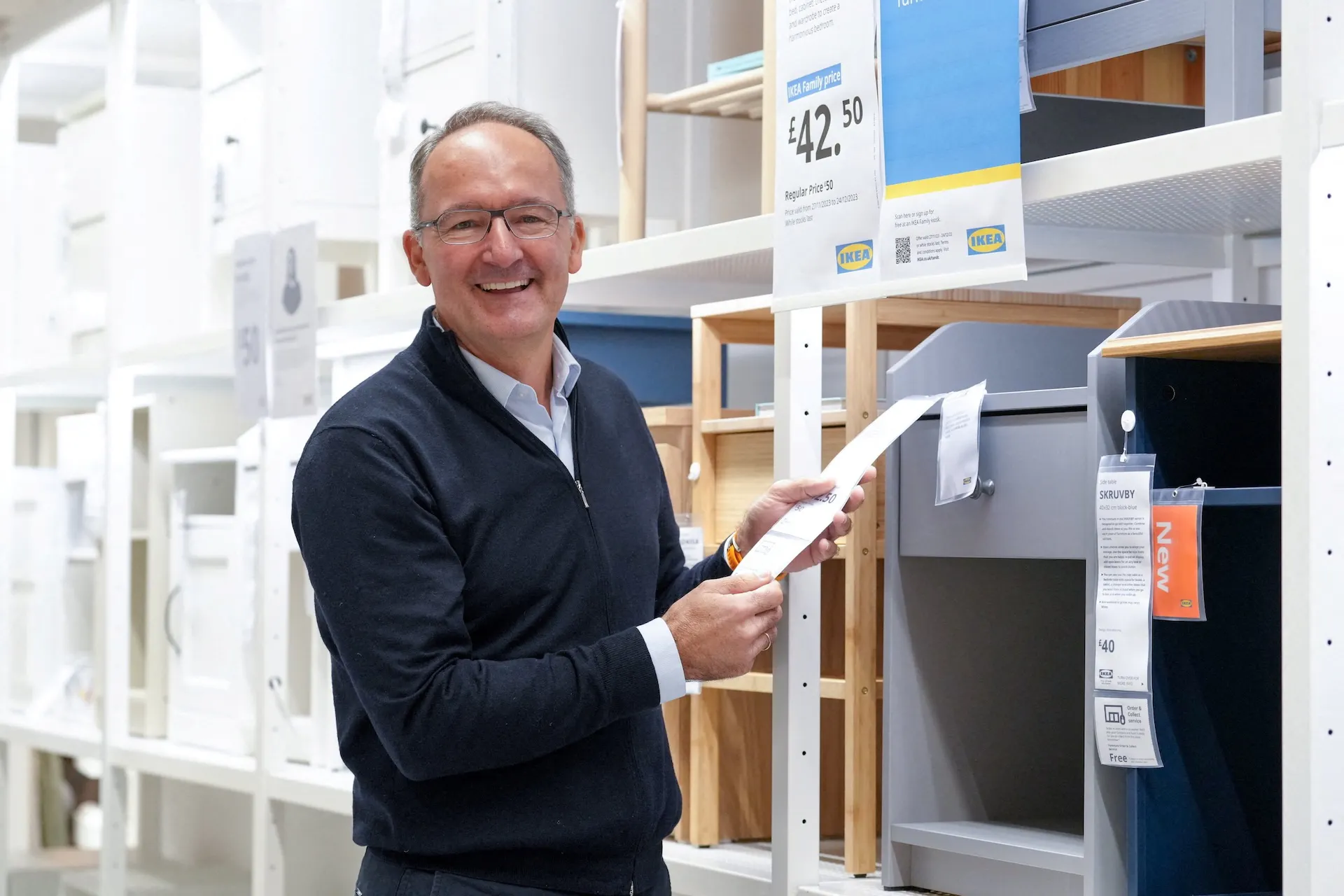
That's Juvencio Maestu, the CEO of the Inka Group, the largest IKEA retailer in the world. Last week I spoke with him about how Ikea is meeting its customers at this moment.
- [00:58]
Juvencio Maestu
We have a say normally that we sell umbrellas in Ikea and we normally reduce the price of the umbrella when it's actually raining. So we like to do a bit the opposite because it's in the times that you have to really stretch yourself to be closer to the customer.
- [01:18]
Ryan Knudsen
Lowering prices for umbrellas when it's raining. In the world of capitalism, it's kind of counterintuitive. The challenge before Juvencio is making sure IKEA can deliver on its promise of affordable prices while still keeping the company profitable. Welcome to the Journal, our show about money, business and power. I'm Ryan knudsen. It's Thursday, April 30th. Coming up on the show, a conversation on staying affordable in unpredictable times with IKEA's Juvencio Maestu. Foreign.
- [02:01]
SAP Advertiser
This episode is presented by SAP. Your company's ambitions can't be held back by long implementation, surprise costs or empty AI promises. SAP Grow AI Cloud ERP gets you live fast, keeps pricing predictable and delivers built in AI that gets results the first day, not someday. All on a single platform that's easy to manage, industry ready and designed to scale with your business. Bring it with SAP Grow AI Cloud ERP for any size business. SAP.com grow for adults with Crohn's disease
- [02:32]
Tremphya Advertiser
or ulcerative colitis symptoms. Every choice matters. Tremphya offers self injection or intravenous infusion from the start. Tremphya is administered as injections under the skin or infusions through a vein every four weeks followed by injections under the skin every four or eight weeks. If your doctor decides that you can self inject Tremphya, proper training is required. Tremphya is a prescription medicine used to treat adults with moderately to severely active Crohn's disease and adults with moderately to severely active ulcerative colitis, serious allergic reactions, increased risk of infections or lower ability to fight them and liver problems may occur before treatment. Get checked for infections and tuberculosis. Tell your doctor if you have an infection, flu like symptoms or need a vaccine. Explore what's possible. Ask your doctor about tremphya today. Call 1-1-800-526-7736 to learn more or visit tremphiaradio.com.
- [03:38]
Ryan Knudsen
In 2001, Juvencio Maestu got his first job at Ikea. He was a store manager in Spain, where he's from. He worked his way up the ranks over the last 25 years, running Ikea India and becoming CFO. Last November, Juvencio became CEO of the Inca Group, the retail franchise in charge of around 90% of IKEA's sales. Since the pandemic, Juvencio has had a front row seat to the difficulties facing retail and he's been in charge of leading Ikea through it. The first challenge Ikea had to face was inflation. As inflation rose in 2022 and 2023, Ikea had to make the uncomfortable decision to raise prices. But then in 2024, when inflation was still pretty high, Ikea and all of its 12 franchises decided to lower prices by around 10%. Juvencio told me that that decision cost his company about 2 billion euros in revenue.
- [04:34]
Juvencio Maestu
We could have chosen to keep 2 billion in the bottom line, but we decided to pass 2 billion to the many consumers. And the point was that we came from the COVID crisis, from the war in Spain, Ukraine, from the challeng the supply chain and then the whole industry and the whole society was increasing the cost and then we were not immune to that and we were suffering also that. And then at some point we said we need to reverse this cycle, we need to cycle with the many people because we are pretty anchored in the vision where we have.
- [05:11]
Ryan Knudsen
Juvencio says that that's what cutting the price of umbrellas when it's raining looks like. In practice.
- [05:16]
Juvencio Maestu
We give the mandate to every store money in the world. Feel free to reduce the price of the umbrella. Why? Because it's a signal that we need to be closer to the many consumers when they need the most rather than take advantage of that. And then of course you have to find the formula and the business model that you can keep a healthy company going on. We are not maximizing benefits, we are maximizing low price for the consumers. And then of course we have to operate a company that is healthy in the long term.
- [05:50]
Interviewer (Wall Street Journal Reporter)
So Ikea made these price cuts and drew in more shoppers, but it also resulted in sales falling by about 5%. I mean, you mentioned that you have to do this and maintain a healthy business, but how healthy is it for a business for sales to fall?
- [06:09]
Juvencio Maestu
Yeah, that was in year 24. In year 25, we managed to increase both the number of customers as well as increasing the top line. So we increased 1.3% in both. We achieved 4.1 million visits online, but also we achieved 736 million physical visits to Ikea store. So our physical visits increase. So in 24, it was a conscious decision because normally the price reduction we did were not compensating fully the top line, but it was by design. And we are really happy we are able to take that decision.
- [06:52]
Ryan Knudsen
In 2025, Ikea and the rest of the global economy got another big shock when President Trump instituted a wide range of tariffs. If you recall, the administration put tariffs on nearly everything coming into the United States. And on top of that, Trump put an additional 25% tariffs on upholstered wooden furniture products and kitchen cabinets. In response, IKEA increased the price of its products by around 9% on average.
- [07:19]
Interviewer (Wall Street Journal Reporter)
How difficult of a decision was that?
- [07:21]
Juvencio Maestu
It's very difficult. The same that when you have this aftermath of the COVID situation, it was painful when everything goes up. It was painful at that time to assert that we had to increase prices. That's why in 24, we decided, as we discussed before, to reverse the whole thing and to reduce prices by 2 billion euros across the many markets in the world. And then it's difficult to find the here and now balance. But this is what we are paid for.
- [07:56]
Interviewer (Wall Street Journal Reporter)
So now most of President Trump's tariffs have been rolled illegal by the Supreme Court, although he's trying to reimplement them through different legal justifications. And then there's also a pretty significant tariff on furniture that still remains in place. So how are you planning for that as a business in this environment, when tariffs are kind of on and on again, off again,
- [08:19]
Juvencio Maestu
you cannot lead a company in the short term. And then that's what I said before. You need to keep, really the determination to keep offering lower prices in US and in other markets happening all over. That's why on the short term, we are normally not panicking in increasing up or decreasing down. So we are trying to wait and to see how things develop and to take step by step. And the reality is that it was right that we didn't increase that much. And now this is also consistent with the situation we have. And this has been seen in a positive way by the consumer in us. In other markets, the IKEA is citing with the many when they need the most.
- [09:07]
Ryan Knudsen
Another thing I wanted to ask about was the war in Iran. In response to attacks by the US and Israel, Iran has closed off the Strait of Hormuz, cutting off a vital supply of oil to the global economy and sending energy prices skyrocketing. But Juvencio told me that this challenge has been a lot easier to manage. In fact, IKEA has been able to kind of shrug it off because of how much it's invested in renewable energy. Can you take me back to the
- [09:34]
Interviewer (Wall Street Journal Reporter)
moment when you first saw that the Strait of Hormuz was going to close? What was the first thing that ran through your mind?
- [09:40]
Juvencio Maestu
The first thing.
- [09:41]
Columbia Advertiser
Here we go again.
- [09:42]
Juvencio Maestu
That was the first after so many crises. But it's a good reminder that the importance of finding the merging point in between sustainability and affordability. Why do I say this? For example, in Ingka, we have committed to invest 7.5 billion euros in renewable energy, mostly powered by solar and wind. And then we have invested already 4.2 billion. And then when we had the crisis and the war in Ukraine, that the oil Europe at that time was depending too much on the oil coming from Russia. And then the prices went up massively. And because we were producing energy ourselves, it was a kind of a macro hedging, so we didn't have the impact of high cost of energy.
- [10:39]
Interviewer (Wall Street Journal Reporter)
What energy does IKEA produce itself?
- [10:41]
Juvencio Maestu
It's the. Basically it's electricity from wind and from solar. We produce double that the energy we consume today. So this energy that we give back to, to the grid, but also the renewable heating and cooling, which is normally the highest CO2 emissions, so heating and cooling there. So we have invested massively in retrofitting existing buildings to have renewable heating and cooling. And also any new building has to come with that. So what is happening? So when the cost of the energy goes up, then it doesn't go up for us because we are self sufficient, but also we plug in energy, excess of energy, we produce double than we consume. We plug it to the, to the, to the grid.
- [11:30]
Interviewer (Wall Street Journal Reporter)
So with this, this latest energy shock with the closing of the street of Hormuz, was that a bigger deal just for the cost, for the pressure to put on your consumers rather than the pressure it put on IKEA specifically, for instance?
- [11:42]
Juvencio Maestu
No, of course, indirectly. This is from the energy point of view. And then with oil goes high, it's not only energy. Oil is used for many other components in the world. And then it's affecting the food system with the fertilize is affecting the transport of the containers with the fuel consumption of the boats. So at the end of the day, oil is also affecting overall economies in general.
- [12:10]
Ryan Knudsen
After the break, we talk about the stores and I asked Cuvincio what his favorite item from the Ikea restaurant is. And here's a hint, it's not the meatballs. We'll be right back.
- [12:38]
Chef Meilin
As a chef, I know flavor doesn't begin in the kitchen. It begins on the land. And West Home's nature led Australian Wagyu is a story written in the landscape of northern Australia. Cooking is storytelling. And West Home Wagyu carries a story of northern Australia itself. Raw, powerful, and deeply authentic. It's a testament to the passion and care raised in the rhythm of Northern Australia. I'm chef Meilin from 88 Club in Los Angeles, and I invite you to visit westhome.com maitland to learn more and taste a story only West Home nature led Australian wagyu can tell. That's W E S T H o l m e.comm e I L I n.
- [13:30]
Ryan Knudsen
You've worked at Ikea for a
- [13:32]
Interviewer (Wall Street Journal Reporter)
very long time, so you must have a lot of experience with this, which is what is your favorite item on the Ikea restaurant menu?
- [13:41]
Juvencio Maestu
The care restaurant. You know what, everybody's tempted to say the meatballs, but I would say the hot dog. Why? Because it reminds me two important things. One is the importance of keeping good quality with low price. And the Ikea hot dog is an icon for low price. But also I was lucky fortunate to spend time with Imbar Kampra, the founder. And we used to spend days starting at 5 in the morning until 10 in the evening, walking the store and discussing topics with only a couple of hot dogs in the middle of the day. So it reminds me the importance of being grounded in reality.
- [14:26]
Interviewer (Wall Street Journal Reporter)
One thing that we've been reporting on the Wall Street Journal is that there is the way the American consumer is changing is that there's actually a lot more wealthy Americans than there used to be. And some of the stratification that you're seeing in the economy is because there are more wealthy consumers. And so a lot of businesses are trying to tailor their offerings to those wealthy consumers. Are you seeing that also in your stores? And are you trying to change any of your offerings to try to go after more affluent customers?
- [14:57]
Juvencio Maestu
I like to say that for us, the big KPI is not top line in revenue. And then as a consequence, Bottom line in profit. The big KPI is in how many homes. We are present in how many homes. Why? Because to deliver to the vision or a better life for the many people, it's the many that you need to give an answer to. And the many people are normally struggling to come to an end of the month. So it can be very tempting to compensate cost with higher prices. But that's why we have in our DNA that we started with a price and then based on that, you have to design the rest of the cost structure of the company. It's important we don't deviate from that.
- [15:51]
Interviewer (Wall Street Journal Reporter)
So you're not trying to like add new offerings at the higher end of the market?
- [15:56]
Juvencio Maestu
No, what we add is we try to increase the value for money and also to increase the quality at a lower price. What a value for money. And I keep insisting I was fortunate to live in Asia as well. And then I said before, when you have money, when you don't have money, you need long lasting articles because you have to give more value to the little money you have. So that's why you need to combine quality and low price.
- [16:35]
Interviewer (Wall Street Journal Reporter)
IKEA historically has these massive stores that are out on the edges of big cities that are oftentimes like you need to, you need to dedicate like half a day to go out there. But now in the recent years, Ikea has been opening up smaller stores, more in urban centers. Can you talk a bit about that strategy? Why are you doing that?
- [16:52]
Juvencio Maestu
Yeah, we are doing, as I said before, we are operating an Omnichannel Company. 30% of the IKEA sales are online today, which is remarkable, that number. But in an Omni Channel world, the IKEA store will be at the backbone of ikea. Why? Because the IKEA store is cementing the inspiration, is cementing the life at home, is cementing the experience. Again, we will keep having the big blue stores, the big ones that we will mention. But also we are opening a smaller site in city centers and we are doing across all the world. And then what we try to do is to make a mix in an area in a big city where you can have big IKEA stores and medium sized IKEA stores, but also with good services and good that no matter how you shop with Ikea that you can have the services available for you.
- [17:55]
Interviewer (Wall Street Journal Reporter)
What do you think the city stores need to have? Because I recall that IKEA has opened some and closed some over the past few years. So like what is the balance that you're trying, like, what are you finding? Doesn't work when you try to have sex.
- [18:07]
Juvencio Maestu
Our founder used to say that we have to reward the mistakes. I said to him, imbar, what about? Because he was very, very proud in saying we have to reward and to give a price to the people who made mistakes. And then tell me more. Can we allow too many mistakes? And he said, you have to do many mistakes, but don't do the same mistake twice. He used to say, the point here is that of course we have been trying and then it took some years until we have found the model. So every mistake is a massive source of learning and inspiration.
- [18:43]
Interviewer (Wall Street Journal Reporter)
What were some of the mistakes with that earlier expansion into.
- [18:46]
Juvencio Maestu
Yeah, the mistake, for example, that we ended up with small selection of cash and carry articles because we take the assumption that you go to the finish center. Okay, everybody can look around and they can order with the app online. Yeah, we did that. And then customers were asking, okay, I want to still take product from here. So they mistake.
- [19:09]
Interviewer (Wall Street Journal Reporter)
Why do I have to buy this online? There's a plate right here. Can I not just bring it home? I need it.
- [19:13]
Juvencio Maestu
Exactly. So what is the right balance or range allocation was one. The second one is the size too small was cheaper from the real estate, but it was not good enough. And then what is the right balance? But also it's all the operations in order to secure that, you can end up with the right click and collect, for example, customer. Also, some of them can order online and you can collect in the source. So it's mixing the operation. It's basically an operational part that we have found now.
- [19:44]
Ryan Knudsen
So you realize that you need the
- [19:46]
Interviewer (Wall Street Journal Reporter)
stories inside the cities to still be a bit bigger than they had been initially.
- [19:50]
Juvencio Maestu
Exactly. It had to be a bit bigger. And then we have found a right formula.
- [19:54]
Interviewer (Wall Street Journal Reporter)
Now, how much of the furniture in your house is from IKEA?
- [19:59]
Juvencio Maestu
Around. I've done 14 moves in my life. I've been in many places with IKEA.
- [20:03]
Interviewer (Wall Street Journal Reporter)
That's a lot of trips to IKEA.
- [20:05]
Juvencio Maestu
Exactly. But around 50%, 56% I would say is IKEA and around 40% is not. And there is always things that remain with us. For example, beds. The mattresses in IKEA are phenomenal. Or for example, the wardrobes, for example, the kitchen. In any of the 14 houses I have lived, you will always find this type of furniture.
- [20:32]
Interviewer (Wall Street Journal Reporter)
Why isn't 100% of what you own in your house from Ikea?
- [20:35]
Juvencio Maestu
No, because of course you also want to add some personality that is complementing. And I am not a fundamentalist. 100% has to 60%. I feel good enough.
- [20:52]
Interviewer (Wall Street Journal Reporter)
So my last question is, one of the things that the founder of Ikea, I think famously told your predecessor in this job was that you need to be thinking 200 years out into the future. If you were to think, do you think that way 200 years into the
- [21:09]
Ryan Knudsen
future and if so, what are you
- [21:10]
Interviewer (Wall Street Journal Reporter)
seeing 200 years out for IKEA?
- [21:12]
Juvencio Maestu
Yeah. First, nobody knows what is going to happen in 200 years, but it was actually pretty much ingrained in Imber's mindset that you need to be obsessed and determined to keep the low chain thinking. And you know what, regardless how the robotics work, how AI will work, in which planet will be living, regardless of
- [21:37]
Interviewer (Wall Street Journal Reporter)
all the things Ikea stores on Mars,
- [21:39]
Juvencio Maestu
it would be fantastic. But regardless of all the things, there are fundamental things that I believe will not change. A that the home will be the most important place in the world. One, two, the importance of having affordable and fantastic furniture to make your life better. Whatever is that furnishing. And third is the human connection that is needed. Because in the more we develop technology in the world, the more we need to develop the relationship and the human connection. And these three things, I think they will never change.
- [22:22]
Interviewer (Wall Street Journal Reporter)
Juvencio, thank you for this human connection that we've had today from across the Atlantic Ocean.
- [22:28]
Juvencio Maestu
Thank you, Ray. I have pleasure talking with you. Take care.
- [22:31]
Interviewer (Wall Street Journal Reporter)
All right, take care.
- [22:34]
Ryan Knudsen
That's all for today. Thursday, April 30 the Journal is a co production of Spotify and the Wall Street Journal. If you like our show, follow us on Spotify or wherever you get your podcasts route every weekday afternoon. Thanks for listening. See you tomorrow.
- [22:53]
Columbia Advertiser
You can't reason with the sun. Trust us, we've tried. This summer, it's time to put that angry ball of fire on mute. Columbia's Omnishade technology is engineered to protect you from the sun's harsh rays that can burn and damage your skin. The sun is relentless, but so is our gear. Level up your summer@columbia.com to spend more time outside and less time slathering on aloe lotion. You're welcome, Columbia Engineered for whatever.