Loading summary
Transcript61 lines
- [00:05]
Ryan Knus
This interview was filmed at the Wall Street Journal's Future of Everything event in New York. You can watch the interview on Spotify. Artificial intelligence is seemingly everywhere. In our workplaces, our schools, our homes, our doctor's offices, and even for some of us, our love lives. Joanna Stern is an Emmy Award winning tech journalist. And throughout 2025, she decided to let AI and robots take over every aspect of her life as research for her new book which is called I Am Not a Robot. It comes out later this month. Today we're going to sit down and talk about whether AI is living up to its promises and the impact it's having on our human lives. And given that this is a live taping of the Journal podcast, please cue the theme. Live from the Wall Street Journal's Future of Everything in New York. Welcome to the Journal, our show about money, business and power. I'm Ryan Knus. Coming up on the show, Joanna Stern on her year of AI.
- [01:15]
Amazon Health AI
Amazon Health AI presents painful thoughts.
- [01:20]
Cold Sore Internet Searcher
Why did I search the Internet for answers to my cold sore problem? Now I'm stuck down a rabbit hole filled with images of alarmingly graphic source in various detail of ooze. I can clear my search history, but I can never unsee that.
- [01:38]
Amazon Health AI
Don't go down the rabbit hole. Amazon Health AI gets you the right care fast. Healthcare just got less painful. Amazon Health AI presents painful thoughts.
- [01:51]
Cold Sore Internet Searcher
Why did I search the Internet for answers to my cold sore problem? Now I'm stuck down a rabbit hole filled with images of alarmingly graphic source in various stages of oo. I can clear my search history, but I can never unsee that.
- [02:08]
Amazon Health AI
Don't go down the rabbit hole. Amazon Health AI gets you the right care fast. Healthcare just got less painful.
- [02:22]
Ryan Knus
So the title of your book is I am not a robot. And I'm not just going to take your word for it. To prove that you are not a robot, I need you to look at all these images and tell me which ones include bicycles.
- [02:36]
Joanna Stern
All of them. And a bridge.
- [02:37]
Ryan Knus
Okay, good.
- [02:37]
Joanna Stern
And a traffic light.
- [02:40]
Ryan Knus
So you let AI and robots take over your life for a year. Why did you decide to do this?
- [02:46]
Joanna Stern
Project insanity. So the only answer you have to be really insane person to do this.
- [02:52]
Ryan Knus
You're just like, the robot apocalypse is coming, but not soon enough. Let's bring it faster.
- [02:57]
Joanna Stern
Let me tell everyone what the future looks like. And that's really actually the answer to the question is that we are living in this time where every AI or tech executive is telling us that AI is going to change the world. It is going to change education, it is going to change health care, it is going to change business and work and all these parts of our lives. I just thought, what does that mean when they say that? I wanted to understand in the real fabric of our real lives, how is AI1 already making a difference and what does the future look like? And I know we're going to get to this, but I didn't define AI just as generative AI. I think most people here in this audience and most listeners to this podcast are using some form of generative AI.
- [03:42]
Ryan Knus
Generative, I mean, like the chat bots.
- [03:44]
Joanna Stern
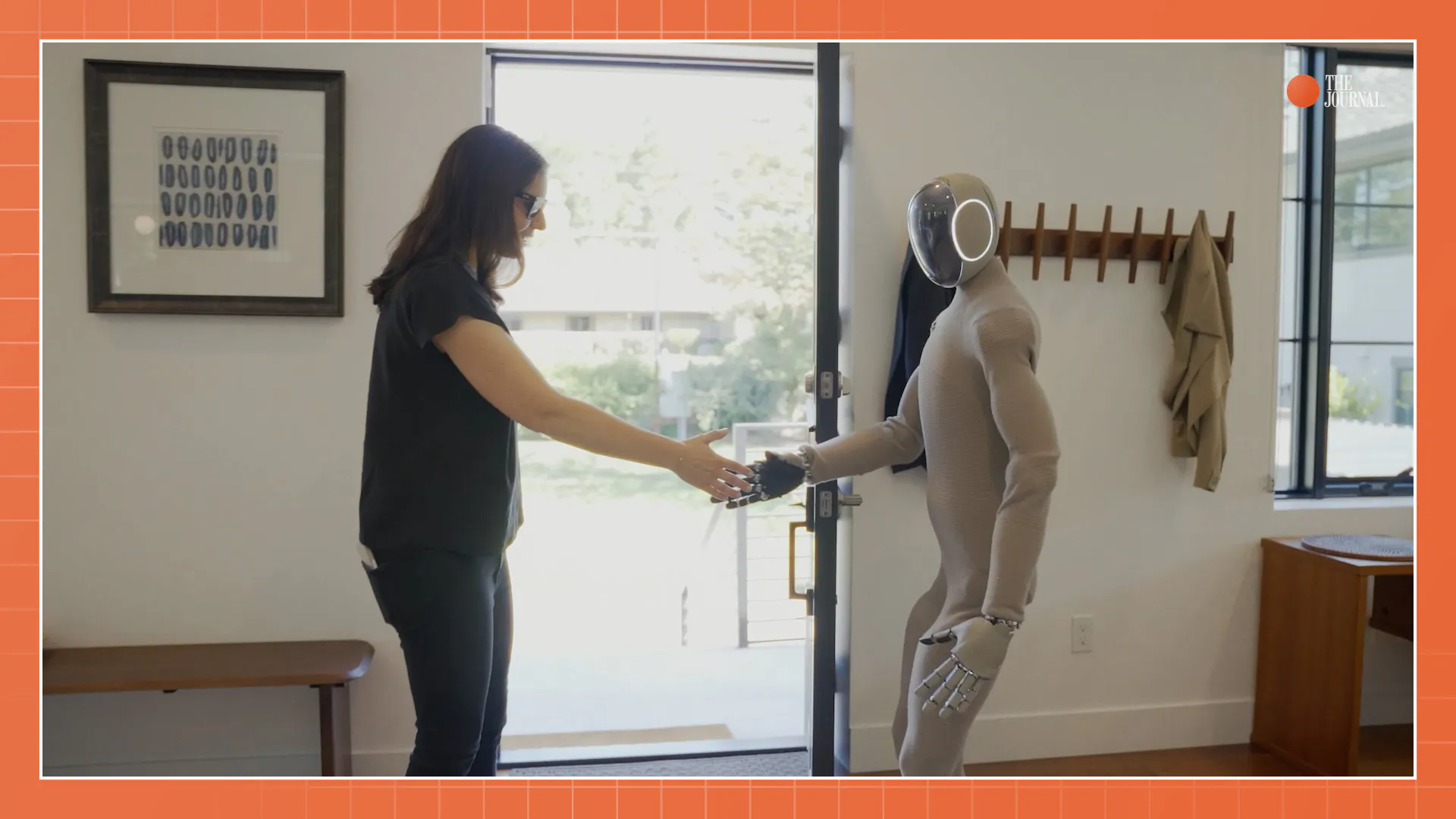
Exactly. And I wanted to go a step further because we are hearing a lot about humanoid robots. We are seeing self driving cars enter our streets city by city. Truly, every week Waymo is announcing a new city. And these are all forms of AI. These are machines that make decisions, that can see the world, hear the world and make decisions for us, just as some of those chatbots. So I wanted to really expand that definition. Personally, I didn't expand the definition. The definition of AI is actually that. But right now I think we just hear AI, AI, AI, we think chatbot.
- [04:17]
Ryan Knus
So you've covered technology for almost 20 years. How does this new technology compare to past new transformative technologies?
- [04:26]
Joanna Stern
I mean, that was another reason I wanted to write this book and why I wanted to take this on is I do believe that right now we are at this next transformational technological shift. We lived it. I lived it. You lived it through the smartphone. We lived it even before that, through the beginning of the Internet. And I say in the introduction of the book, imagine in 1995, somebody taps you on the shoulder and says, actually in a few years, you are going to shop, you're going to buy your pants on something called the Internet.
- [04:56]
Ryan Knus
You're going to buy your pants on your phone.
- [04:58]
Joanna Stern
You're going to buy pants on a phone and they're going to be like, what are you talking about? Right? You're going to get maps that way. You're going to only communicate through this, through texts and a thing called emojis. This whole idea would have been crazy. And I wanted to know, is this that moment for AI where we look back at this moment and we say, actually, machines are going to do everything. They're going to drive you around, they're going to do your dishes in your house, they are going to be your assistant at work. In fact, you're not even going to have coworkers because they're just going to be working with all these AI agents. And so I wanted to know, are we living at that moment? And either I'm really right or I'm really wrong. We'll know in five years, 10 years, I think.
- [05:36]
Ryan Knus
So this is not a comprehensive list, but you let AI be your doctor, your driver, your colleague, your housekeeper, your therapist, your lover. Of all of those roles, what was it the best at?
- [05:50]
Joanna Stern
It was not lover, not because I don't want to get divorced. But I would say that the big overarching one is as an assistant at work. I would say that that one has persisted and is clearly evolved very much as the models have evolved over the last few years as really being something to lean on and improve your work performance and your efficiency at work. Another one, as I talk a lot about in the book, is wearables. I really believe AI wearables are going to be something that's going to. We haven't gotten yet mainstream, but I wear the meta Ray Ban sunglasses a lot. I use the AI that's integrated in them, but I also use them as cameras.
- [06:31]
Ryan Knus
You also wore one of the AI bracelets that listened to everything that you did, took notes, sent reminders. How useful was that?
- [06:38]
Joanna Stern
That was really useful. But I did wear it for most of last year and I did take it off because I just did not love the idea. Well, first, let me explain how it works. There are a number of these AI wearables that are out there right now. They could be pins, they can be bracelets. People are making necklaces, all sorts of things that you can put all over your body. And they have a tiny microphone, and it functions really like a little surveillance device. It records everything you say throughout the day or your meeting. It then sends that to the app. That app sends it to the cloud to transcribe it. And then the AI is making sense of it, summarizing it or putting it in a to do list. Right. You said something during the day. Like, I. It turns out I say, I'm going to do a lot of things during the day, especially in my home. And I'm like, oh, I'm going to call the plumber about that. Definitely, you know, oh, I'm going to do that. And then I don't do it.
- [07:30]
Ryan Knus
So you have another person guilting you later.
- [07:32]
Joanna Stern
Exactly, exactly. Or like, it's actually very good for marriages. I will say, it's great for marriages. And somebody say, like, you said that. I swear you said that. And then it's like, no, actually, the transcript said, no, I didn't say that.
- [07:46]
Ryan Knus
Does it capture your tone of voice? Though.
- [07:50]
Joanna Stern
And this was shockingly creepy, but shockingly useful because I would open the app and be like, oh, yeah, I said I was going to do that. I said I was going to do that. And we were sitting actually out there and I said I was going to do something and I had to put it on my to do list. I wrote it down and with this kind of passive listening, I wouldn't have to do that. And the AI can make sense of it and keep you on track just like a real assistant. And so are we going to make that privacy sacrifice? That's a lot of questions, but did I see a lot of use out of it? Yes.
- [08:20]
Ryan Knus
What were some of the things it was the worst at?
- [08:26]
Joanna Stern
Well, first of all, it's called I am not a robot, but the actual robots in this book are quite dumb.
- [08:33]
Ryan Knus
You had a laundry bot. That was really terrible.
- [08:35]
Joanna Stern
The laundry bot was really terrible. Really? Really. But it's gotten better since. But in the book it only folded T shirts. And as I say, if you only wear T shirts, you've got a real problem.
- [08:49]
Ryan Knus
So not for me. One of my favorite fails that you wrote about in the book was the day that you tried to use AI autoresponses for all of your responses. And when your wife texted you, can you please come downstairs and help make lunch for the kids? Apple Intelligence suggested, and you sent this, sorry, I have other plans.
- [09:15]
Joanna Stern
This was a great example of me having to realize that I could not have AI take over every part of my life if I didn't want to end up divorced, jobless. Every other bad thing happened to me because also in that same section, it suggested things I should write back to my boss, who at the time was Emma Tucker at the Journal. And I was like, there's just no way I can send this to her. There's just no way. And so I had to step in as a human and say, I'm going to make this decision to not just send a passive aggressive note back to my boss about something.
- [09:46]
Ryan Knus
One of the areas, it seems like it shows a lot of promise is on the medical front. You have a big section in your book and also a passage of which was published in the Journal, I think over the weekend about getting a mammogram because you've got breast cancer history. Can you talk about that experience and what you learned from AI in the medical field?
- [10:05]
Joanna Stern
This was one of the areas I really wanted to dig into because we always hear from many tech CEOs that one of the biggest promises of AI is that it's going to cure all disease and it is going to make the health care system better and it is just going to solve so many things about the way we deal with our, our bodies and our medicine. One of the things I did was keep this log of everything that was wrong with me for the year. If I had a rash, if I had the flu, if my kids had something, if my dog had something, every time something happened, I would ask ChatGPT to diagnose. I kept a log of that to compare how it would actually diagnose. But one of the really interesting things was when I went to go get my mammogram or I had known I wanted to do this around radiology because radiology has actually been one of the first areas of medicine to adopt AI many years ago by just using the data sets of the imagery that we have in X rays, mammograms, et cetera, to then match with what the diagnosis was and be able to do these big, deep, deep learning sets and image recognition over this is cancer, this isn't, this is benign, this is malignant, or this is suspicious. And being able to look at these things in a deeper way at a pixel level that humans cannot do when they're looking at this stuff. And so I went to go get my mammogram and breast ultrasound read at Mount Sinai by AI but actually, anyone who's really going now to Mount Sinai is getting their imaging, at least in the breast unit read by AI And I think that's one really important way to think about how AI is affecting our lives is that even if you aren't using it or actively using it, it's impacting your.
- [11:53]
Ryan Knus
And do you think it's making. I mean, is it going to replace the radiologists or is it just making them sharper?
- [11:58]
Joanna Stern
So in this case, it's making them sharper. And one of the reasons I also love that chapter is there was a prediction by Geoffrey Hinton, who's one of the godfathers of AI he made this prediction. He said, no doubt, I'm paraphrasing, but no doubt within next five years, we're not going to have radiologists. We're just not going to need these doctors. And that obviously did not happen yet. Yet. But even now, when you talk to these radiologists first, they are absolutely using it as a second opinion. And they say it makes them better at what they're doing. They are more confident in their decisions. And what happens in the chapter to me is that my breast ultrasound, the AI flagged a few things on it, and it made the doctor think twice about it. And she sent me for some extra imaging, and we're still watching one of those spots. But that made her feel, you know what? I'm going to look at that. Because the AI really knows what tumors look like and really knows what something that might be malignant versus benign looks like.
- [13:00]
Ryan Knus
And you also wrote that you think that if this technology had been around when your mom was going through this, it could have actually saved her a significant amount of what turned out to be potentially unnecessary treatment.
- [13:09]
Joanna Stern
Yeah. My mom had breast cancer three times, and she believes the second time it was already there. I mean, they basically said they could spot it on the first time. They did the first. Looking back at those tests, looking back at those. And the radiologists basically missed it. And so AI would not have likely missed it. Now, of course, AI can miss things and so can humans. And that really ends up being the part of what Dr. Margulies, who's this amazing doctor at Mount Sinai, says is we have to work hand in hand. Is the AI catching cancers that the human misses? Yes. Is the human catching cancers that the AI misses? Yes. But both of these things together make us better at this job.
- [13:52]
Ryan Knus
After the break, Joanna Stern on her biggest fears about AI.
- [14:06]
ServiceNow Announcer
AI is moving fast across the enterprise, but without visibility, it's just chaos. Different tools, different models, different teams using AI in completely different ways. ServiceNow turns that chaos into control. With the AI control tower, you see all your AI across the business in one place, what it's doing, what it's done, and what it's about to do. So you stay in control. To put AI to work for people, visit ServiceNow.com
- [14:37]
Ollie Probiotics Announcer
this episode is brought to you by Ollie. In the world of health and wellness, a new launch. To note Ollie's precise probiotics. Each formula uses clinically studied strains designed to support your gut microbiome in a targeted, intentional way. These Daily capsules are 3 in 1 blends for digestive and immune health with added support for skin stress or metabolism, depending on individual needs. Available at walmart or ollie.com these statements have not been evaluated by the Food and Drug Administration. This product is not intended to diagnose, treat, cure, or prevent any disease.
- [15:14]
Ryan Knus
One area of transformation that's really profound and a little bit concerning is what it's doing to homework. You enrolled in a college course and had AI do your work for you. How good was it?
- [15:32]
Joanna Stern
I mean, it would have gotten me through college. It's gotten a lot of people through college and high school. Right now.
- [15:38]
Ryan Knus
The thing that's so concerning about it though, is this idea that you write about. Like, if you are letting AI think for you, there's the atrophy of cognition. How big of a problem do you think that is going to be if we have a generation of students that are outsourcing the hard work of thinking and the learning that comes from that process?
- [16:01]
Joanna Stern
This is one of my biggest fears in the book. And I get to this towards the end, and I really think that I have more fear for the next generations in AI than ours. And I think we're already starting to see that with some of the generations or those that are graduating school now and having a hard time even finding jobs. Right, because they feel there's data that shows that a lot of those entry level jobs are now the tasks are being done by AI. So we're already seeing an effect this next generation. Then there's the idea that this next generation might not even have the deep cognitive critical thinking skills once they get to that job. Will they need them? That's a big question. But our jobs, for instance, I don't remember a ton of what I learned in college, specifics about history, political science. I remembered some of the basics, obviously. But what I really feel like I learned in college and high school was the ability to think critically, to structure arguments. To be able to be a journalist, we had to ask great questions. We have to be able to package those questions into a story that makes sense after we do our reporting. All of that's critical thinking that can now be done by a bot. How do we learn that if we're doing that?
- [17:20]
Ryan Knus
One of the takeaways that I had from reading your book that I was kind of sort of startled by is like, the things that AI is really bad at, like chores and laundry and stuff like that. That's what I want it to do. But the thing that it's really good at that I don't want it to do is writing. You talk to this student who, and a lot of students will say things like this, that that's one area that they don't let it actually write the essay, but it takes. And you also didn't let AI write your book. But it takes like fortitude and will you have to make a decision to not let it do the thing that it's good at, while it's also sucking at the stuff that we want it to be good at.
- [17:55]
Joanna Stern
Right. And I was just telling you backstage, why did I write a book and would I ever do it again? Writing A book was a very grueling process. As a thinker and as a writer, you have to figure out how to structure these chapters. You need to figure out what am I putting in? How do I keep people through this story is this interesting? It pushed me as a journalist and as a writer and the creator. I was like, I'm happy I did this because it was a new challenge in my life. If we don't have those challenges, how do we keep growing? If AI can just keep doing and checking off those challenges, what happens to us?
- [18:33]
Ryan Knus
You have an 8 year old and a 4 year old. I have a 3 year old and a 1 year old. I think a lot about how this technology is going to transform their lives. After you went through this year, have you thought about limits that you're going to set for them or areas that you're going to encourage them?
- [18:50]
Joanna Stern
My kids are terrible examples in a way because they were inundated with this stuff. But also I think on the flip side, they learned so many important AI lessons that adults need to learn. One of my favorites in the book is that I'll tell two stories. One of my favorites in the book is that he, my older son, had a praying mantis and the praying mantis got. We didn't know what happened, it just started turning brown. And so I said, let's ask ChatGPT what's happening with the praying mantis. So we fire up ChatGPT, we do the live video voice mode and ChatGPT confidently tells my son that this praying mantis is pregnant. And he is so excited that this praying mantis is pregnant. I'm obviously not, because we already had invested quite a bit into this praying mantis and it's terrarium. But he calls my dad and he's like, I'm going to be a grandpa too. Grandpa. The praying mantis is pregnant. And then what happens? Two days later, the praying mantis dies. Okay, the praying mantis was never pregnant. And this was a really. I was not happy it died. To be clear, please don't come after me PETA like this. I was not happy it died. But this was really important to learn about hallucinations and that these AIs do not always tell the truth. And even though they are extremely confident in telling you that your praying mantis is pregnant, they don't actually know that. Right? And so that was a really important lesson that I think my kids and all of our kids need to start to learn even at a young age. Because the more they think everything that the AI oracle Takes as truth is a bad thing. I will say the other thing is that Sora OpenAI Sora Rest in peace.
- [20:39]
Ryan Knus
The Video Generation App.
- [20:40]
Joanna Stern
The Video Generation App. I showed a lot of those videos to my kids when they first started coming out. We did a lot of generations of hamsters. My little son, we tell a lot of stories about a family of hamsters. And he has a very good eye now for what is AI generated. Now things are going to get so good that none of us will be able to tell what is AI generated. But already at four years old, he is questioning what he sees, whether it be on, like, Netflix or whatever. He's like, that's AI. That's definitely AI, you know, and of course, it's like a cat flying out of a window. Like, he gets that. But I think that nine lives, though,
- [21:18]
Ryan Knus
I mean, I don't know.
- [21:20]
Joanna Stern
But like, just. Just those two things alone to start instilling in our kids of, like, things are not always what AI says to be true. And not everything you see is going to be real. And it's going. And we have to make these questions, they're digital literacy, but they're. They're just more than that at this point.
- [21:39]
Ryan Knus
The last question I've got time for is that you wrote that I wanted to talk about the love chapter, which you're gonna have to just buy the book if you want to hear about the love scene. But you wrote that the idea that my kids generation might have their own first love in the form of a machine designed to pander to their every need. Nothing I've reported on in this book terrifies me more. Why was that the most terrifying thing?
- [22:00]
Joanna Stern
Human relationships have to have friction. They just naturally do, right? Humans are complicated. AI will tell us everything we want to hear. It is a mirror of ourselves in some ways. And if we raise kids that think that all interaction is just going to be easy and these things should pander to us, then that's not life. That's not a human experience.
- [22:24]
Ryan Knus
All right, Joanna, thank you so much for your time.
- [22:25]
Joanna Stern
Thank you guys so much.
- [22:29]
Ryan Knus
That's all for today. Monday, May 11. The Journal is a co production of Spotify and the Wall Street Journal. If you like our show, follow us on Spotify or wherever you get your podcasts. We're out every weekday afternoon. Thanks for listening. See you tomorrow.
- [22:49]
Amazon Quick Announcer
Your teams spend more time searching for information than using it. Amazon Quick changes that one intelligent assistant that connects all your company's data and turns answers into action instantly. Aws.com quic.