← The Leadership Dance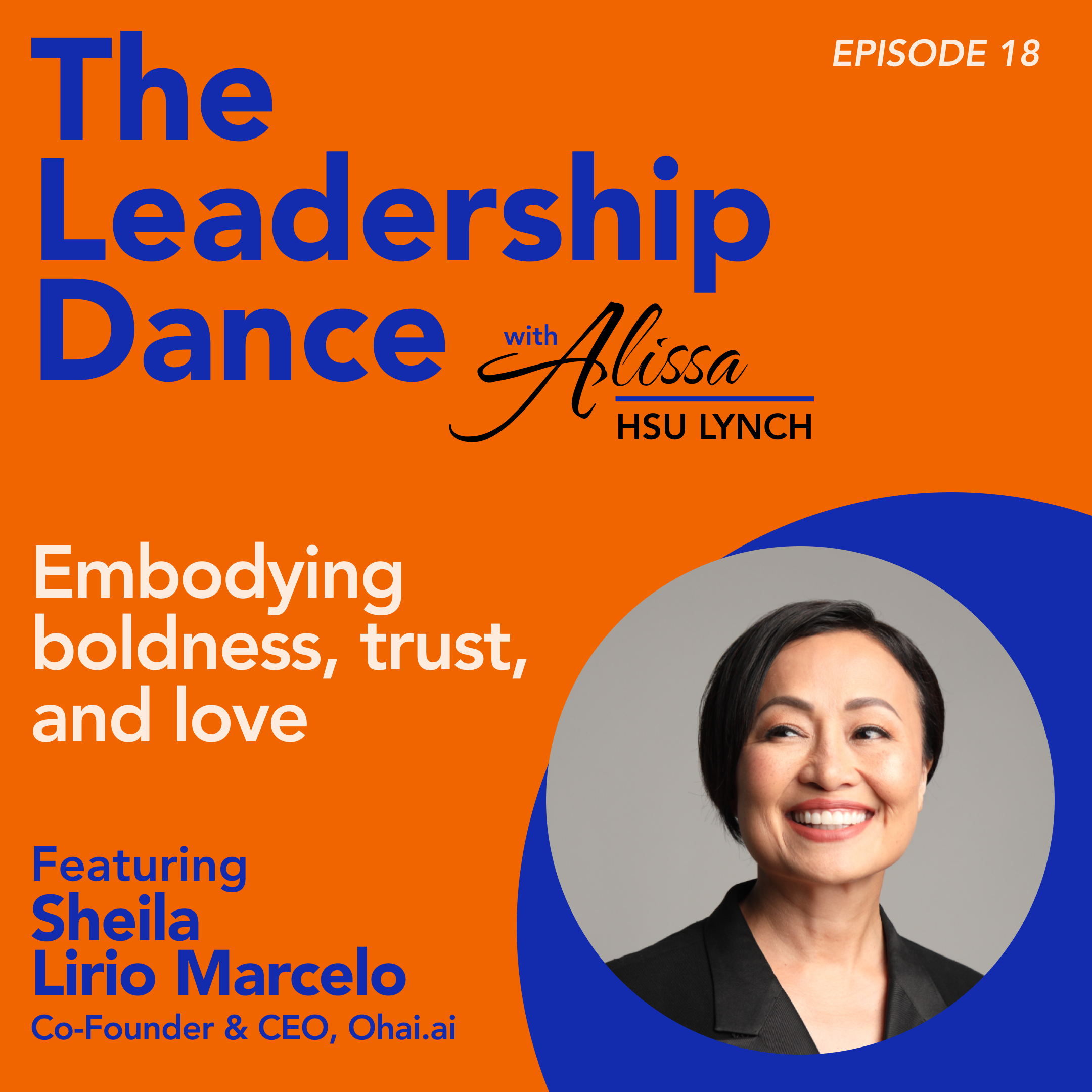
The Leadership Dance
Ep. 18: Embodying boldness, trust, and love, with Sheila Lirio Marcelo
00:33:08
Tune in for this dynamic discussion about leading boldly, trusting in yourself, and living with intention featuring Sheila Lirio Marcelo, the trailblazing founder of Care.com and now the visionary leader behind Ohai.ai, a virtual assistant for...
Loading summary
Transcript68 lines
- [00:01]
Sheila Leirio Marcelo
Your body doesn't lie to you. You know, your body doesn't think about the past or the future. Just is here and now and it tells you the truth. And to trust that truth and trusting that truth. The advice is trust and love. And it's strange to say that and it's the most simple clarity that I have now as a Grown up at 54. Love to really realize that your heart and your body are telling you something, that your mind, it's that journey from here to here, right, that's the hardest and managing that because we become so cerebral, we get so focused on success and what our mind tells us of what we should be. Trust means surrendering. Trust means letting go. Just being, not attaching yourself to things. That's hard when you're young and ambitious. You know, I'm building a company again. I just shared with a friend. I'm still ambitious, but I'm more flowy of allowing and being open to where life takes me and it's just been a joy.
- [00:58]
Alisa Sue Lynch
Welcome back to the Leadership Dance. If you enjoy the show, make sure to share and subscribe so you never miss an episode. I'm Alisa sue lynch and today I'm honored to host my friend, the sensational Sheila Leirio Marcelo. Sheila has more than 20 years of leadership experience in Internet consumer marketplace businesses, including as the co founder and CEO of OHI AI, a cutting edge technology startup leveraging generative AI to improve the lives of families. She was a former venture partner at New Enterprise Associates and a founding board member of TAF, the Asian American Foundation. Sheila previously founded Care.com in 2006 and took it public in 2014. She was chairwoman and CEO until early 2020 when the company was sold to IAC. Among her numerous accolades, she's been recognized on Forbes 50 over 50, Fortune's Top 10 Women Entrepreneurs, and Inc. Magazine's Female Founders 500. She is a Henry Crown Fellow of the Aspen Institute, a Young Global Leader of the World Economic Forum, and a member of the Council on Foreign Relations. Sheila earned her B.A. from Mount Holyoke College and a J.D. and MBA from Harvard University.
- [02:17]
Sheila Leirio Marcelo
Wow.
- [02:18]
Alisa Sue Lynch
And welcome to the podcast, Sheila.
- [02:20]
Sheila Leirio Marcelo
Thank you for having me, Elisa.
- [02:22]
Alisa Sue Lynch
So I wanted to start by talking about entrepreneurship, because entrepreneurship runs in your blood. You grew up in the Philippines in a family that was involved in a number of businesses, from coconut mills to mango and banana plantations to transportation and coal production. What was your childhood like and how did it influence how you approached your career?
- [02:43]
Sheila Leirio Marcelo
Oh my gosh. My childhood was a lot of fun. Six Kids in the family. My parents were elementary school sweethearts and eloped three times. And so they were married at a very young age. And having young entrepreneurial parents, they like to take risk. What was so interesting, though, Lisa, is that when I grew up in the Philippines, it had the narrowest gender gap for Asian countries by the World Economic Forum report. And what that meant was there were a lot of female leaders that we looked up to in business, in government. Corazon Aquino, you know, so my mom was not only a tiger mom, but an incredibly bold entrepreneur, visionary, and really was a strategist with my parents. And my father was incredibly nurturing, warm, and so the typical stereotypes between men and women. I didn't grow up watching that with my parents. And so the feminine and the masculine are strong in me for both. I grew up with four brothers and felt very comfortable. My dad started teaching me math at a very young age along with my older brothers. I think about my leadership skills and where I am today. The fact that I had such incredible parents that didn't pigeonhole us into certain roles has been a real gift in my leadership style. Whether I lead men, women, doesn't matter for me. I'm sort of agnostic to gender. And then my parents were also just visionary and very international. They were very open to many cultures. Went to the United States between 6 and 9 years old when my father, as an entrepreneur, wanted to look at technology to actually expel oil from coconut. Because you had mentioned we were in coal, we were burning the husk of coconut, and my father thought that that was not great for the environment or people's lungs. And so he wanted to find different energy because we did everything with the coconut, everything, processed everything with the coconut, branches, leaves, everything, even the husk, and so extracting oil. But then at 9 then my parents sent me back to the Philippines and sent me to an international school because my parents had the vision to actually make sure that we were raised with a global perspective.
- [04:56]
Alisa Sue Lynch
Wow, that's super interesting. Were you and your siblings actually involved in the family business at all, or was that something you just saw your parents doing?
- [05:05]
Sheila Leirio Marcelo
Definitely. Where? At a young age, I remember being in Texas and they started new businesses, and I spoke English more fluently than my parents. And so they would teach me to answer the phones and take client calls and call vendors. And I was just a very curious child. And so I always wanted my mom to assign me things. And then when we were little, I even remember in the Philippines, they were in trucking and they would talk to us about Trade how you would trade rice to potentially sugar or barter, transportation of something and distribution. And so, you know, when I later learned these things in business school, I was like, wow, I learned all of these things when I was little.
- [05:47]
Alisa Sue Lynch
Yeah, you learned how to negotiate at an early age. So you lived in the United States and Texas from 6 to 9, but then you moved back to the Philippines and then what brought you back to the United States? And can you talk about what was that transition like?
- [06:02]
Sheila Leirio Marcelo
Well, so six to nine, being in Texas, little girl, where honestly, it was an out of body experience because to me, everyone looked alike. And I was first exposed to different races and then went back to the Philippines. My parents gave me a gift before boarding school, a visa, where they sent me to the province for a year to relearn the language. And it allowed me to assimilate back into the Philippine culture, relearn the language. I speak it fluently. And then sent us to boarding school from the ages of 11 up until I graduated high school and then came to the United States for college. So it helped that I went to an American boarding school. I speak the way I speak because I grew up not only in Texas, but maintained speaking American English and then went to Mount Holyoke. But even at Mount Holyoke, the unique experience for me in going back to gender was I didn't really experience discrimination for being a woman or girl as much at all, actually in the Philippines, but then started to read and take political science classes on feminism and started to realize and learn more about what women went through. And I first experienced it actually in the United States, where I hid the fact I got pregnant between my sophomore and junior year in college, and I hid the fact that I was a mom because I was so worried about being judged at work. And I didn't have those concepts or feelings growing up in the Philippines.
- [07:29]
Alisa Sue Lynch
So were you working during college? Or you hid the fact that you already had a child after you graduated?
- [07:34]
Sheila Leirio Marcelo
You know, so what I did is actually, no. So I got pregnant between my sophomore and junior year, and then I had enough credits from high school to potentially skip a year because I did the International baccalaureate in the 80s. But instead I used that semester to actually have the baby in New Haven. And I studied for the LSATs. That was really my focus. Then went back to my senior year at Mount Holyoke and then went on my first job as soon as I graduated. I hid the fact I had gotten into law school. I really wanted to be a lawyer because now I had children. And in that first Job. I hid that. I just was too nervous and conscious that they would judge me.
- [08:12]
Alisa Sue Lynch
Yeah. So take me further into the story. You had your first son during college. I believe you had your second son just after graduating from Harvard Business School, meaning you were pregnant in business school. And I don't know if you know, but I also had my first son while I was in business school and got pregnant with my second after I went back to business school part time. So while I was interviewing for a full time job. So I know that can be challenging just as we're getting started on our careers. How did you manage all of that as a young mom? Did you have support systems around you?
- [08:45]
Sheila Leirio Marcelo
One of the inspirations really, Elisa, around care.com is that I didn't have a ton of support systems. In fact, it was actually I did a J.D. mBA program and so I, it was a four year program. So my fourth year I got pregnant and I remember going up, getting my diploma and I was like in my third trimester and it was hard. And surviving that period was really about sacrifices. Daycare. We didn't have a lot of money, so we were on the WIC program because we were also paying tuition. We had a lot of debt, couldn't afford a lot of things. I remember walking back and forth between the law school and the business school campus and I'm a tropical girl and I just didn't grow up in the winter and you know, crossing the bridge in the middle of winter, it was ice cold. I didn't, I couldn't afford coats and the right proper shoes. And then I just really powered through it and made sacrifices and trying to be a good mother by not getting a lot of sleep, which wasn't great. Didn't exercise as much back then and took care of my health and sacrificed that. And of course later in life I learned the unhealthy things of prioritizing work and making those sacrifices and puts pressure on your body, which isn't great. But of course I learned that later. I also landed in the hospital after my first job. So after litigation consulting, this is in between grad school because now I'm a young mother. I then went on to a telecom consulting firm and I took on a project to travel to six countries in three weeks. And when I got back I was hospitalized. They couldn't figure out I basically had broken out into hives and, and also cold sores around my mouth. And they tested for all these different things, but it also just came down to stress. And so I was in the hospital for Three weeks. And when I got out of there, I started to realize I needed to prioritize my mental health. I started meditating. I did start exercising. Not as much as I'd. I would have loved to, but those days were just such a struggle, at least. I mean, it was so tough raising children, being a young mom, working. My husband was also in social work. They were just tough years.
- [10:51]
Alisa Sue Lynch
Could you afford daycare? Did you, you know, have somebody in your home or what? What was the caregiving situation?
- [10:57]
Sheila Leirio Marcelo
Thankfully, we could afford daycare at the first year of law school, right beside the law school. And then we were able to afford daycare with a lot of debt. The last three years of the program, the kids were at Soldiers Field park daycare. And so that helped out a lot because then I can go to class and then go see the kids, but it was expensive and certainly had a lot of debt. I did work during my graduate school program to afford to help offset tuition and daycare. I worked part time during school on top of the schoolwork. I was a strategy consultant at monitor companies so that then I could have income coming in to help pay for daycare.
- [11:33]
Alisa Sue Lynch
Yeah, I wanted to pick up on the fact that you hid the fact that you were a mom when you first started working. When did that change? And what kind of epiphany, or if any, did you have that made you more comfortable bringing your full self into work?
- [11:48]
Sheila Leirio Marcelo
I think in my first job, I was often anxious and nervous and felt like I didn't feel myself. I could feel my body uncomfortable. I would sweat easily. I just had these sensory, somatic signals that just didn't feel right. And then I moved to a telecom consulting firm, and that felt better. I would say I still was insecure and anxious about being judged, but now this company welcomed the fact. It was actually a college friend of mine, Aisha, who recommended me for this job and always owe her for that because it helped ease me into this. And people knew, and she knew that I was a young mom. So then that felt more comfortable. But then it was now not just people's perceptions, but my own that I needed to manage at least. So here I was, judging myself, underestimating myself, thinking I'm not good enough because I'm a young mother. I can't get the projects because I'm too stressed. And I had to ease all of that. That was part of the stress of landing in the hospital. A lot of the meditation, learning to trust myself and believe in myself that I really had to work on. So it wasn't just the perception of others. But when you feel underestimated, you start to underestimate yourself. And so how you treat others also impacts your leadership style. And so I had to change that as well.
- [13:10]
Alisa Sue Lynch
Yeah, when I first started at Johnson and Johnson, that was right after business school. So I was pregnant with my second and then went out pretty quickly about three months later on maternity leave. And I definitely put pressure on myself to come back earlier than I recommend other people do. I definitely recommend coming back part time, not jumping back full time with two young kids and breastfeeding and trying to prove yourself at work. It was definitely very stressful. But yeah, we, we are strong. Women are strong. We do find a way. So, Sheila, tell us more about your career journey. And you mentioned, you know, some of this learning led to you founding care.com. tell us more about care.com and how has that gone?
- [13:56]
Sheila Leirio Marcelo
Yeah, so as I mentioned, we did daycare. And then the story is that after I graduated, I joined a startup called New Promise that helped families save money for college. I worked around the clock hours as a product manager. And Adam was born after grad school. So I was in a startup while having an infant. And so I begged my parents, because we couldn't afford a nanny to come to the US and help take care of Adam while I was working at the startup. And then my father was carrying him up the stairs and fell and had a heart attack. And so I found myself in my late 20s juggling what we call sandwich or what I call today panini, because it's like presses you with childcare and senior care. And that was really when I started to realize when I was looking for care for both myself, for Adam and my parents, that then I started to realize that, wow, there really aren't many resources. You know, you had Craigslist at most and didn't feel safe. You had the yellow pages going away. The news classifieds were going away to 8 1/2 by 11 at churches in YMCA. Just didn't scale with a little thing that you peeled off a little phone number. So it just wasn't efficient and there weren't a lot of sources for families. And because I had gone through the personal experience myself, I was like, you know, I wrote a business plan in business school. I taught two courses there, Information Age Business and Women Building Business. I took like a one year to teach it at hbs. And I remember creating Internet business plans. And I had written one on what is now Zillow, like Metro Move, which is a marketplace that matched real estate so in my mind, I was like, well, wait, if we can match families and people to find real estate, could we match them to find caregivers? And that's really where it dawned on me, given my personal experience. And so started care.com amazing.
- [15:50]
Alisa Sue Lynch
Tell us how successful it was. Cause it was extremely successful.
- [15:54]
Sheila Leirio Marcelo
I mean, it was a lot of hard work. We started in 2006, grew it, and then took it public in 2014. We raised a couple hundred million dollars and then I ran it public for six and a half years and then sold it to iac. So I learned a lot of things. We bought at the time, I think 12 companies. And then I learned to take a company public, run a public company, and then also raise money while being public. It's called a pipe. And then took it private, so sold it. So to me though, it was a difficult journey. I have no regrets. Learned so much and probably the most important thing and my co founders and I always talk about I'm actually seeing them all for a me in a couple of days. We're all still in touch. Is how important the mission was to us in our lives. And part of the reason we were there together for 13 and a half years is because we believe so much in helping families. And so the gift that I get is I'm still on planes, I travel around and people stop me and ask me about cure.com and so it's soul filling.
- [16:53]
Alisa Sue Lynch
Well, you have helped my family many times. Definitely have found caregiving when J and J had a daycare center. But then once our kids aged out of that, we had to find people to help take care of them after school and definitely used care.com for that. And moving recently even just to find people to come clean the house.
- [17:14]
Sheila Leirio Marcelo
Yeah.
- [17:14]
Alisa Sue Lynch
So it's still going strong. So that's wonderful. So you recently launched a new venture in 2024 called Ohi AI. Can you share more about Ohi? Who is it for? How does it work?
- [17:28]
Sheila Leirio Marcelo
Yes, it's a virtual assistant or what I like to call an operating system for families. The hero of the product is the calendar and the schedule and managing conflicts. I came up with the idea actually back in 2015 when I was still running care. I made up a product called myadam, which is named after my youngest son. Because I was juggling schedules with my husband trying to figure out, oh, picture day and birthday party presents and after school activities that, you know, when you drop off your kid to soccer and it never matches up the school calendar and you think they have soccer that afternoon but actually it ended earlier than school vacation. So there were just a lot of things or even just pickup at school. My husband and I didn't coordinate and they would be the last child, you know, so a lot of these things that I knew families considered part of their care role for their children. And so. But the technology wasn't ready Lisa. So I actually paused it. And then when I saw the technology, February 2023, my team showed it to me and built something to actually teach developers on how to use generative AI to use agentic. I was like, wait, the tech can now help. It can complete tasks for families. So the exciting thing about the product now is it helps with calendar conflicts, reminders to do list. It can scan documents and pictures and put it on your calendar, paper based notes. It can scan emails. So we have ELISA high AI and you can forward it to all your activities, reads all the emails. So even the 11 page newsletter with 8 size font from the school, we read it, we put the events on the calendar and we integrated instacart, we help with groceries. So it's just an exciting product now to just get the mental cognitive load freed up for parents so they could just enjoy their families. They can have regular meals, they can focus on nutrition, they can consistently read a book at night instead of constantly running around taking care of the mundane administrative tasks for families.
- [19:30]
Alisa Sue Lynch
Yeah, what an amazing example of agentic AI, which is of course the hot term which you, you saw coming before many others did just in, in the benefits of it. Everything you talked about like freeing up your time to do higher level tasks or tasks that you prefer to do versus all the mundane stuff. So that's really incredible.
- [19:49]
Sheila Leirio Marcelo
Yeah, this has always been in my heart. You know, Melinda Gates launched an inaugural care summit last year and they asked me to help open it. And some of the people on my panel called me the og, the original gangster. Right. And I know I'm dating myself, but I realize, Elisa, that care, the care economy, is still in my heart and has always been back then. My good friend AI Jinpoo is an advocate for caregivers. We used to always say care is the work that makes all work possible because you can kind of build bridges or fix the roads to get people to work, but if you don't have care at home, then you can't go to work. So it's a care infrastructure. I'm doing the same thing at Ohio. I always say to people, you know, it takes 4.8 hours of unpaid labor, happens at home that the mom works on if we freed up that one. Just one hour of unpaid labor. That's a trillion dollars of GDP per year. Forget the fact that we don't get equal pay at work. Imagine that we're also working an additional close to five hours at home with unpaid labor. That is real labor, even though we're taking care of our families. But if we made that more productive, and I know AI is being used for productivity at work, why not solve productivity at home to drive the economy? So this has just been consistently still in my heart. So my work wasn't done.
- [20:59]
Alisa Sue Lynch
Yeah, I'd love to see you pouring your energy into this. It's much needed in the world.
- [21:03]
Sheila Leirio Marcelo
Thank you.
- [21:04]
Alisa Sue Lynch
So Sheila, throughout your career, you have successfully navigated the challenges of being a Filipina female leader in the tech and VC industries, which are known for their bro cultures. Did you face any barriers you had to overcome in your career? And as you think about advice that you would give to other women aspiring to leadership roles, what would you say?
- [21:23]
Sheila Leirio Marcelo
In the early days, there weren't as many women raising money or building consumer facing female focused products like care.com so the challenges were needle in a haystack of finding believers, finding champions and sponsors. And I found them, many of them in men because those were the only most of the investors. I was very fortunate, however, to run into Patricia Nakash of Trinity Ventures. It was amazing, was on my board for many years. But the combination of Nick Mime, Tony Florence, Samesh Dash, I just go on and on about the list of people that just was in my life supporting and believing in the mission. And without that, I think it's difficult. But the proximity of the issues of care really, you know, should overcome gender. And a lot of my advocacy was really focused on let's not label care as a women's issue. And that was on me too. Like again, I can't underestimate myself. I have to make sure in my influence, in my voice, that people understand that this is a societal issue for all, not just women, even though it's stereotyped as a women focused business. So I had to conquer that. I had to conquer my own self mentally. I had to conquer my audience, I had to influence, I had to find my voice. And that's advice I would give a lot of young women is just believe, believe. Often I give the advice of two words, authentic boldness or authentically bold, whichever one you want to take. But like be yourself, don't have to hide the fact that I was a young mom. That was a huge learning for me. So that I could feel comfortable in my somatic, in my body and my energy and in my mind. And that builds confidence. And then the boldness of taking risk in something that I believe in and finding my voice and advocating for that. So back then it was really hard, but what was. And I mentioned Melinda Gates and such an honor to have her, like, she's visionary around this. To look around the audience last year and now there are like 3, 400 people in the industry. That's huge. So that gave me comfort that even though the road was hard about 16 years ago, the fact that there's so many people now building in the care economy of entrepreneurs and VCs, it's very gratifying to me.
- [23:43]
Alisa Sue Lynch
You are the OG. Sheila, you mentioned finding your own voice. And you know, we often talk about figuring out what your superpowers are and owning that. When you think about what your superpowers are, what do you think would describe those?
- [24:00]
Sheila Leirio Marcelo
To blend. Back to your question of my upbringing. And I think it's a blend of my mom and my dad getting to know myself and my self awareness. I can vacillate from being super soft, warm and nurturing. And you know, people call me a love bug and I'm charismatic in that way and I like to give a lot of hugs. And if I get close to you, you let me kiss you, I will kiss you. And my dad did that. And so that is sort of my leadership style. I'm very close to people. I can be intimate around their lives and their families and they trust me. At the same time, I've got this lawyerly side that is bold, that is assertive. You know, I used to be aggressive, but I backed down to assertive and finding that so I can be both. When I was younger, I kept being insecure that it was like, is that a chameleon style? And I realized I just can bring my whole self and that every human has a complexity that is beautiful and embracing all parts of me that I call opposing forces. I could be both nurturing and also demanding. I can be debating with you and at the same time empathizing with you. So that those opposing forces, those gray areas, is the beauty of humanity and how we need to kind of be present and appear every day and love who we are entirely.
- [25:22]
Alisa Sue Lynch
Yeah, I love that and completely agree that we all have so many different stories that make up who we are. And you know, we do need to sort of reconcile all of those stories. I'm curious though, do you feel you tailor certain parts of yourself Depending on the situation. I'm assuming that makes sense.
- [25:43]
Sheila Leirio Marcelo
I can be nuanced, but what I've learned through the years is to have a consistent stability of coming into my own, irrespective of who I'm talking to and having that balance of my nurturing, but yet my confident assertiveness. How do you balance that? How do you balance showing up who you are, whoever you're talking to? I can be nuanced. You know, now that I'm 54, I feel like I'm just appearing more and more me, and I'm just being.
- [26:15]
Alisa Sue Lynch
Yeah, we care less as we get older, which I think is a good thing.
- [26:19]
Sheila Leirio Marcelo
Exactly.
- [26:20]
Alisa Sue Lynch
So this is hard to believe, but you recently became a grandmother.
- [26:25]
Sheila Leirio Marcelo
Yes.
- [26:26]
Alisa Sue Lynch
Congratulations.
- [26:27]
Sheila Leirio Marcelo
Thank you. Thank you.
- [26:29]
Alisa Sue Lynch
Do you have a special name that they call you?
- [26:32]
Sheila Leirio Marcelo
Oh, yes. So in Tagalog, Lola is grandmother in the Filipino language. And my sister was already Lola for her grandchildren, Erina. And so then I said, well, it's gonna get confusing for her, so why not call me Loli? And my nickname when I was young was Eli. Cause my siblings couldn't pronounce sh, so they would call me Hila, Hila, Hila. And so my parents just added a Y is very Filipino to kind of make up nicknames. And so Loli just felt like it was a fit because the E part in my life was always my nickname. And Ron, my husband, is Poppy. So we're Lollipoppy, Lollipop.
- [27:10]
Alisa Sue Lynch
Oh, that's so cute.
- [27:11]
Sheila Leirio Marcelo
Very cute. Very cute. Yes. And Cecilia Anita Marcelo. And she's five months old. She's so cute. Yeah.
- [27:20]
Alisa Sue Lynch
How much time do you get to spend with her these days?
- [27:23]
Sheila Leirio Marcelo
I make it a point to always have it on my calendar. To see her every week. Yes. And to hold her and play with her. And very special. And I love my daughter in law. So proud of her. She's being an amazing mother.
- [27:35]
Alisa Sue Lynch
What has been the most surprising thing about having a grandchild or of becoming a grandmother?
- [27:41]
Sheila Leirio Marcelo
I've heard it from friends. It's like the best gift in life. Like you get your kids, but the kids come with a lot of responsibility. And you get the best from a grandchild of the joys of playing, but you get to give them back. It's such a joy. And it's also seeing a child of your kids. It's very emotional. It's very, very emotional. It was my husband's birthday last night and we went to go see a plane. We saw our two boys and they came with us and the two of them were Chit chatting and Ryan's 33 and Adam is 25 and you know, my manager's 15 year old. Like we did. We did a good job. Very proud of our boys.
- [28:19]
Alisa Sue Lynch
Yes, you did. I'm looking forward to that day. My two boys are 20. Oh, I better get their ages right. 26 and 27 now.
- [28:28]
Sheila Leirio Marcelo
Wow.
- [28:30]
Alisa Sue Lynch
So someday, someday we'll, we'll have grandchildren as well, I hope. Yeah, no pressure.
- [28:36]
Sheila Leirio Marcelo
There's going to be so much fun. You're going to have so much fun.
- [28:39]
Alisa Sue Lynch
So you talked a lot about meditating. Are you still doing meditation? And am I correct that you went to Bali over the holidays for a retreat?
- [28:48]
Sheila Leirio Marcelo
Oh, no, I didn't actually join.
- [28:51]
Alisa Sue Lynch
Oh, you didn't like it?
- [28:52]
Sheila Leirio Marcelo
I really wanted to though. Okay, but back to your question on meditation. I, I do Transcendental meditation twice a day. I do it 20 minutes in the morning, 20 minutes in the afternoon. I often describe it as like giving yourself a big hug twice a day. It's amazing. I highly recommend that everybody does it.
- [29:10]
Alisa Sue Lynch
And have you gotten your family into it as well?
- [29:12]
Sheila Leirio Marcelo
My husband is starting, but he's not there yet around Transcendental Meditation. But he is there around meditation? Yes. And the boys, I've always taught breath work since they were young. They do a 4, 7, 8. So they're shorter breath work of meditative breath work, but not the kind of depth and length that I do.
- [29:32]
Alisa Sue Lynch
Can you explain the Transcendental Meditation?
- [29:34]
Sheila Leirio Marcelo
Yeah, sure. You can go to tm.org and you usually find a practitioner or guru or guide. They give you a word, a made up word that's either two or three syllables and you cannot share this word with anyone in the world. It is your special word and you keep it. And it's not exactly a mantra because it doesn't mean anything. So it's just a made up word. So the way that I often describe it is because you're doing it twice a day for 20 minutes. Each time you're letting your thoughts for 20 minutes go and you're replacing it with this word. And what happens is because you're not judging your thoughts, doesn't matter what's going through. If you're planning your day, you're angry or you're trying to calm down, or you've got a whole to do list going, doesn't matter, don't judge it. All you're saying is those are just thoughts and I'm going to replace it by this simple made up word that means nothing. And so what it does is it lightens the day, throughout the day, because you're practicing this of what thoughts go in your head to not judge yourself. And you replace it with something light and it's beautiful. And so you start to realize you can replace any of your thoughts. And we have choices every day, Lisa, around positive thoughts. When we can say, hey, this is a moment that's triggering me. I can either go with it and start to be angry, or I can learn compassion because I'm deciding a different path. And that level of calmness that you can manage throughout the day is a daily practice that you do twice a day.
- [31:10]
Alisa Sue Lynch
Thank you for sharing that. Wonderful. So last question. What advice would you give to younger Sheila, who was maybe just starting college, about staying true to yourself and navigating your career?
- [31:23]
Sheila Leirio Marcelo
That your body doesn't lie to you. You know, your body doesn't think about the past or the future. Just is here and now and it tells you the truth. And to trust that truth and trusting that truth. The advice is trust in love. And it's strange to say that. And it's the most simple clarity that I have now as a Grown up at 54. Love to really realize that your heart and your body are telling you something. That your mind, it's that journey from here to here. Right. That's the hardest. And managing that because we become so cerebral, we get so focused on success and what our mind tells us of what we should be. Trust means surrendering. Trust means letting go. Just being not attaching yourself to things. That's hard when you're young and ambitious. You know, I'm building a company again. I just shared with a friend. I'm still ambitious, but I'm more flowy of allowing and being open to where life takes me. And it's just been a joy. I have no regrets of the younger Sheila. I think she had to go figure that out to learn the lessons that trusting in love is really the key.
- [32:26]
Alisa Sue Lynch
I love that. Thank you for sharing that. And definitely the body does not lie. It will break down as you learned.
- [32:33]
Sheila Leirio Marcelo
That's right.
- [32:34]
Alisa Sue Lynch
And tell you when it's too much. So that's wonderful. Trust and love. So, Sheila, it's been amazing to hear about your leadership dance and about how you're continuing to change the lives of families around the world. I am so impressed by you and want to thank you for joining the podcast. Thank you for having me like, follow and share the Leadership Dance where we explore how to choreograph the career of your dreams and chat with visionary leaders who are breaking barriers in the arts and business worlds. Until next time. Keep dancing.