← The Leadership Dance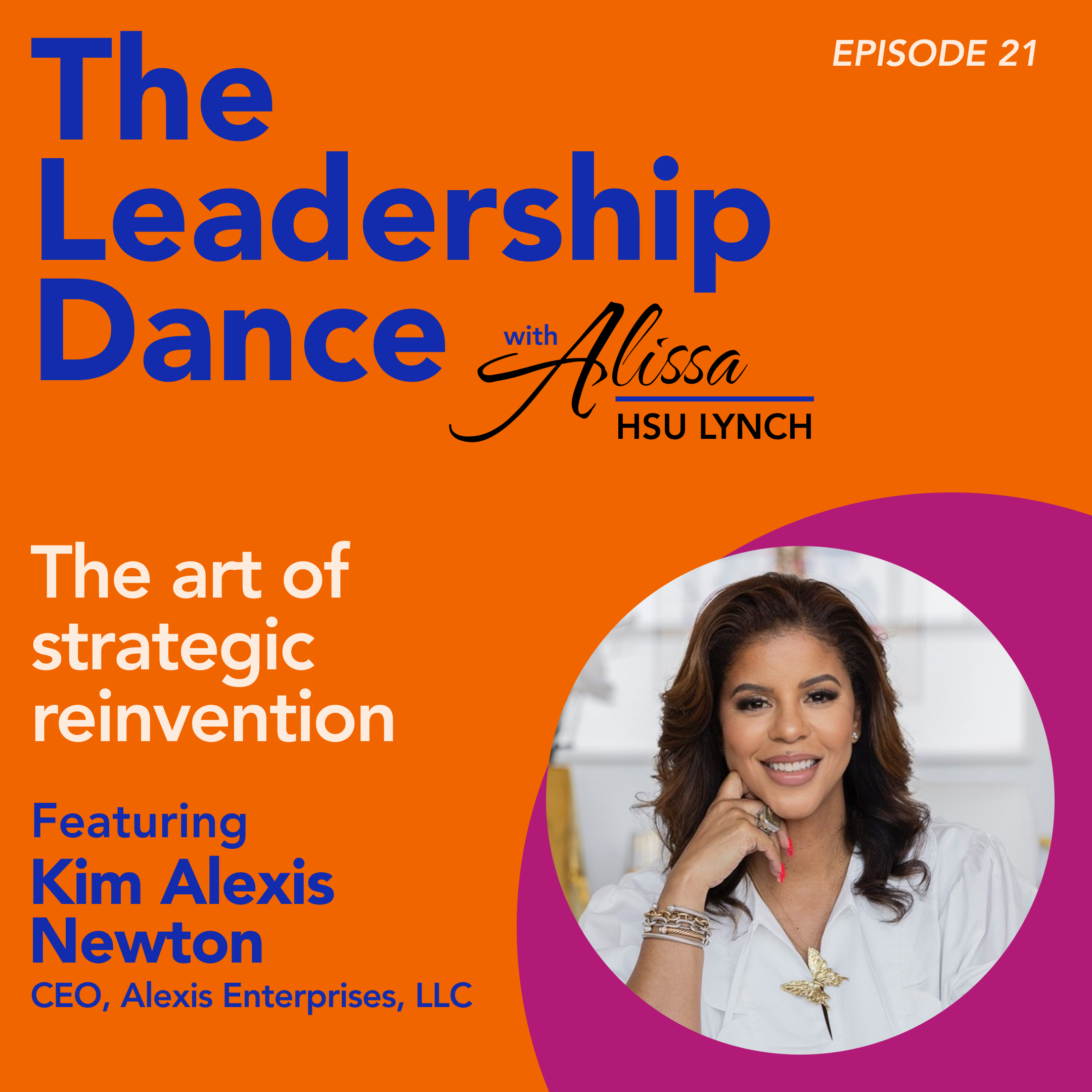
The Leadership Dance
Ep. 21: The art of strategic reinvention, with Kim Alexis Newton
00:28:40
Step into a conversation that explores the power of reinvention, the courage to disrupt your own path, and the art of weaving creativity into leadership. In this episode, Kim Alexis Newton—board director, entrepreneur, fine artist, and former...
Loading summary
Transcript44 lines
- [00:01]
Kim Alexis Newton
You know, maybe this is not the time to go back to corporate. Maybe it's time to follow my own dreams and start this business and also just own this idea of being an artist. So that moment really fueled for me that, yes, I can sell my artwork and somebody's going to appreciate it. And then two, that I should start this business, that it can bring comfort to a lot of other people.
- [00:23]
Alisa Sue Lynch
And now tell me about Michelle Obama's quilt.
- [00:26]
Kim Alexis Newton
Yeah, so that happened a couple years later after I started the business. I was actually at a baby shower and we have a mutual friend. So Michelle Obama came to the baby shower and at the baby shower, I had to get up and tell my story. My dear friend who was throwing the shower had bought one of my gift quilts to give away at the shower. So she asked me to introduce myself and so I did. And while we were playing shower games, Michelle was sitting next to me and we had this great conversation and she was telling me that she was knitting and she wanted to know more about my quilt quilting. And we just talked for several minutes about it and she goes, you know, I think I want to commission you to do a quilt for my daughters. And I was like, well, absolutely.
- [01:08]
Alisa Sue Lynch
Hi there and welcome to the Leadership Dance where we explore the art of leadership with trailblazers in business and the arts. If you enjoy this show, make sure to share and subscribe wherever you get your podcasts. I'm Alisa sue lynch and today I'm excited to speak with Kim Alexis Newton. Kim is a board director, author, entrepreneur and fine artist with a passion for leadership and innovation. A former Hallmark executive, Kim led a $1 billion business and ran global strategy across a $4 billion portfolio. She was recently named to Board Prospect's list of 100 Black board members making a difference and advises several women led startups. Kim is the founder of Alexis Enterprises, home to her art studio, Alexis Gift Quilts, which sold over $1 million in sales in its first nine months, and the intentional paws project, which helps women embrace paws as a strategy for growth. Her fine art quilts are owned by Oprah Winfrey and Michelle Obama. With deep expertise in strategy, branding and transformation, Kim combines creative and analytical thinking to drive powerful results for herself and others. As a self proclaimed dream defender, she lives in Leawood, Kansas with her husband Nikki and her daughter Piper. I can't wait to have this conversation.
- [02:35]
Kim Alexis Newton
Kim, thank you so much for having me. Exciting, exciting to be here.
- [02:39]
Alisa Sue Lynch
So I wanted to start by asking you, what was your childhood like and what did you dream of Becoming when you were younger.
- [02:47]
Kim Alexis Newton
The good news about my childhood is I had a great childhood. My mother was a teacher, my dad worked in corporate America. And I literally call my dad my left brain. And my mom is my right brain. She's like all the things creative and curiosity and all that. And my dad was like the full analytical side of me. And my dad worked for IBM, so that used to stand for I've been moved. I lived in six cities and went to four different schools by the time I was eight years old. I haven't met a stranger. I am very comfortable getting to know people and I think that's just something I conquered very early. My parents divorced when I was 7. We lived in Connecticut and we all moved back to California, which is where I was born and was mostly raised. I had two households and I was very happy. My parents were great at co parenting, so really, really lucky to have a great childhood. You know, I thought about like, what is it that I wanted to do? And I found a letter that I wrote. I wanted to start my own greeting card company. When I was 12, I wrote a whole little business plan and a letter about how I was going to start my own business and it was going to be a greeting card company. So I actually thought I wanted to do something entrepreneurial and creative. And then I ended up at Hallmark for 20 years.
- [04:08]
Alisa Sue Lynch
So your dreams came true?
- [04:11]
Kim Alexis Newton
A little different, but yes.
- [04:13]
Alisa Sue Lynch
So you actually spent over two decades at Hallmark leading a $1 billion business driving global strategy. What pivotal moment or realization led you to leave corporate America after so many years?
- [04:26]
Kim Alexis Newton
It was actually pretty rare. It wasn't rare at Hallmark, but it was rare in corporate to stay at the same company. I was at Hallmark for 23 years. I moved to Kansas City thinking I would only be here for two years, which is where Hallmark is headquartered. And I had a fantastic career. I really can't complain. It was great. All things marketing, corporate strategy. I had many, many careers and lives there, which is what attracted me to the business. But about 20 years in, nothing was wrong necessarily, but it just didn't feel quite right. And now reflecting on it, I probably overstayed. That's the way I talk about it. I overstayed. But in that moment, I just felt like I wasn't meeting my own potential. It was very comfortable. My career was just fine. I was continuing to smash the goals that I put in place for myself. But I very intentionally did three things. When I realized I didn't feel like I was meeting my own potential, I exploded my network. That was very important. I think when you get complacent or comfortable, you can just maneuver around the same people. I really wanted to disrupt that, so I exploded my network. And I wanted to know more people and value more people outside of the business than the business that I was running and that I was in. I started to embrace the things that I loved. So I started quilting again. And I really looked for experiences and people that would make me think differently about my life. And that's actually how I joined the Henry Crown Fellowship, which was a very important inflection point for me because it asked the question, why? Why was I willing to think differently about my life? And it was that reflection that really got me to, you know, I'm ready to do something different and do something else. And so ultimately I wanted to disrupt myself. I mean, that's where I landed.
- [06:19]
Alisa Sue Lynch
I love how you describe that disrupting yourself. And I wanted to comment on a few things. So Henry Crown Fellowship, we were both part of that. And that's actually where we met. So I feel so fortunate to have met you through that. And you talked about exploding your network. And it made me think that when I was at JJ for 20 years and decided to leave, I sort of raised my head and said, wow, I have no network outside of jj because in a large multinational corporation, you spend a lot of time developing your internal network. How do you actually explode your network?
- [06:55]
Kim Alexis Newton
So I think, you know, especially from a corporate perspective, there are other ways to get it done. But I looked for people with similar interests and groups with similar interests. I joined the Executive Leadership Council, which was African Americans in corporate America. And that exposed me to hundreds and hundreds of other African Americans in top leadership. I joined Network of Executive Women. I looked for industry specific opportunities to network because I really didn't know what I wanted to do. A lot of people had left Hallmark, but I hadn't kept up the relationship. So I rekindled some of those relationships. And I'm gonna talk about Mindy Grossman. She is like my corporate crush. I had a couple of them. She was actually speaking on a stage at an event, and I just went up to her afterward and I was like, you know, you're somebody I wanna know. And she just handed me her card and she was willing to talk to me. So it doesn't always have to be so orchestrated. It really can be rooted in the industry or people that you admire the. But I think it just takes the intention of saying, I'm going to invest in relationships, which means that you have to De. Invest in something. Right?
- [08:04]
Alisa Sue Lynch
Yeah. Those are great tips. Thank you for sharing those. So I'm curious, how has your definition of leadership evolved from your time in the corporate world to your current roles now as an entrepreneur and a board director?
- [08:17]
Kim Alexis Newton
I think that is a really great question. I think that when you are in a corporate environment, it really revolves around guiding teams within kind of a structure or a hierarchy and emphasizing alignment. And you're all about the corporate goals and corporate vision and adherence and developing culture. Right. And how you thrive inside of that particular culture. You know, how good are you at politics and the norms and all of those components. Emotional intelligence and understanding your role and the role of your team within this hierarchy. Right. And so how you get good at that is practice and awareness and all of that. And I think for me, when I switched to entrepreneurial life, people are like, so how's this entrepreneurship thing going? I'm like, well, you're looking ahead of supply chain and head of product development and head of hr, all those things, especially when you're starting out. So the definition is really less about authority and your ability to thrive in culture. It's really about, how are you creating vision and adaptability and your form of culture, and what are you doing through your personal influence? You know, I have to get people to work for me. I have to build business relationships if I want to grow my business. And so really, it is about personal influence. It's about that adaptability. It's about innovation and thinking about how you might do things differently and making sure that you are deciding quickly and building resilience. You know, I think those are all skills that are heavily used when you're relying on yourself and you're building a vision for your own company.
- [10:04]
Alisa Sue Lynch
Absolutely. And you make me just remember how much complexity there is in leading within corporate America. Everything you talked about, setting an example, being a role model, mentoring other women, that's also the leadership that you demonstrate.
- [10:19]
Kim Alexis Newton
Thank you. Thank you.
- [10:20]
Alisa Sue Lynch
So, Kim, you are a talented quilter, and I have one of your beautiful gift quilts. It's a joyous dancer and so vibrant. I want to know, how did you start quilting, and how did you later evolve that passion for quilting into a successful business?
- [10:39]
Kim Alexis Newton
Well, I appreciate the question. I didn't mention this, but when I was in undergrad, I went to a small HBCU Historically Black college and university, Fisk University, which is where my dad went and insisted that I go. And I interned in accounting. And I learned that I didn't want to work one day in Accounting, but I'm still a major in accounting. So about three years in with this new insight, I decided, you know, I want to intern in something else. So I ended up actually working in the government. I was a speechwriter, and I stayed with my grandmother for the summer. And my grandmother was a quilter, and we made a quilt together. We're both in the same sorority. I didn't say, hey, grandma, I want to learn how to quilt. It was kind of like it was something that I wanted to do with her because she was interested in it. I would come home as a college student and work on this quilt with my grandmother. But once I left that and came to Hallmark after grad school, I met a quilt artist, and she used to do storytelling quilts. She taught me, and I would lay down what I wanted to remember. That's really how it started for me. The example I always give was one of my first quilts, says it's a woman looking in the mirror, and she's in underwear, and it has lace all on it and everything. And it says, the heart of a woman will never be found in the arms of a man. It was about self love and not losing yourself and not putting expectations for your own happiness on other people. And I was like, I never want to lose that. Right? So I want to lay it down, because quilts are things that can last beyond a lifetime. I have quilts from my great great great grandmother. Now that I'm the quilter in the family, everybody sends me the old quilt. But to me, jewelry and quilts are things that people keep as heirlooms. Right. And so they don't go away.
- [12:29]
Alisa Sue Lynch
Kim, that's such a wonderful memory with your grandmother and such an amazing way to start quilting. Now in your business, you have a variety of different types of quilts. Can you talk about your original quilts versus the ones that you manufacture at scale? Like, how did you come to that realization that you needed to do both?
- [12:49]
Kim Alexis Newton
I made quilts on my own, obviously, as I shared, and I would lay down what I would want to remember, but people would offer to buy them, and I didn't want to sell them. And so that's where the idea of manufacturing quilts came in, because I was like, I can touch more people. And I actually wrote a business plan for. It took me 15 years to actually do it, but I did write a business plan for manufacturing quilts with words and images, storytelling quilts, because people don't quilt anymore. So I thought it would be a great way to, you know, continue storytelling Quilts and having meaningful gifts. I grew up in the gifts business, know a lot about how to add emotion to a category. And, you know, that's. That's the thing that I decided to do. It was when I left corporate that I actually called my. I mentioned Mindy Grossman, one of my corporate crushes. And she asked me, you know, what I was doing with my time. And I told her I was an artist and I was quilting more. She said, oh, well, you don't look like a quilter. Kim, show me one of your quilts. And I showed it to her, and she said, oh, Kim, I have to buy this for Oprah for her birthday. I kind of, like, laughed out loud, and I'm like, oh, no, no, no, no. I'll make you a quilt for Oprah. I will make you one. And she said, no, no, no. I want this one. So I decided that I would sell my first quilt. So that's actually how I sold my art quilts. It was kind of the validation that I needed that, you know, maybe this is not the time to go back to corporate. Maybe it's time to follow my own dreams and start this business and also just own this idea of being an artist. So that moment really fueled for me that, yes, I can sell my artwork and somebody's going to appreciate it. And then two, that I should start this business, that it can bring comfort to a lot of other people.
- [14:36]
Alisa Sue Lynch
And now tell me about Michelle Obama's quilt.
- [14:38]
Kim Alexis Newton
Yeah, so that happened many a couple years later, after I started the business. I was actually at a baby shower, and we have a mutual friend. So Michelle Obama came to the baby shower, and at the baby shower, I had to get up and tell my story. My dear friend who was throwing the shower had bought one of my gift quilts to give away at the shower. So she asked me to introduce myself, and so I did. And while we were playing shower games, Michelle was sitting next to me, and we had this great conversation. And she was telling me that she was knitting and she wanted to know more about my quilting. And we just talked for several minutes about it, and she goes, you know, I think I want to commission you to do a quilt for my daughters. And I was like, well, absolutely. And so that's how that happened. I told her I wasn't a portrait artist, but what story did she want to tell? And so she told me that she wanted her daughters to know that no one had ever been through what they've been through, and no one's going to love you. Like your sister. And she was very proud that they were very good friends. And so I did a piece called Cut from the Same Cloth. It's one of my favorite pieces, for sure, but I definitely felt like Forrest Gump in that moment.
- [15:45]
Alisa Sue Lynch
So can you tell us more about your creative process? What does it look like from concept to completion?
- [15:51]
Kim Alexis Newton
Sure. So first, I'll talk about the artwork. And some people get confused about my art quilts or my gift quilts. You get it perfectly, which is wonderful. But I think one of the ways I differentiate them is when I'm doing my artwork that is with my hands, and I am thinking about myself and the lessons that I'm seeing in the world, how I see the world. My mission is to kind of create something that affirms human spirits, but it's an emotional journey. Right. I want to support emotional journeys. When I'm doing the gift quilts. They are manufactured in India. I work with designers. It's a very different process, but I'm thinking about other people, so I'm thinking about situations where people might need comfort or something that, you know, ties a bond between someone who's giving the gift and the person who's receiving it. So I'm definitely thinking about other people versus my artwork. So my artwork usually just starts with something that I see that I want to bring to life that can be inspired by fabric. It can be inspired by an image or, again, a lesson. And then I back into all the other pieces. I take hours and hours and hours. I mean, it takes hours of planning. And I use batik fabrics, and so I have to put the colors together. I usually like color stories. And then it gets quilted, which I can quilt myself, but I like to take it to a longarm quilter. That's a big $20,000 machine, and it just goes a lot better. But I art direct that process. For my gift quilts, I usually start with, again, an occasion. So for my gift quilts, I have quilts to encourage, quilts to heal, quilts to celebrate, and quilts of faith. So I think about, you know, those occasions and situations. For instance, the quilt that you have, it says, I fixed my horizon and hung the sun where it suited me better. And it. And she's dancing. Right. It's graceful, but it is about transformation and creating your own destiny. And I felt like that was an important message because there's so many people who are in transition. You can manage the transition. The transition doesn't have to manage you. Right. And so I did a bunch of research up Front, and people were like, you know, I really want to hear things that I don't normally hear. So they didn't want cliche, you know, sayings or anything like that. They wanted things that made them think deeply or made them think of someone else. And so I usually just work with my designer and I art direct exactly what I want it to look like. And I have two or three designers I work with. All of that takes a really long time, and it can take me anywhere from 80 hours to 100 hours, depending on how big it is.
- [18:31]
Alisa Sue Lynch
You are incredibly talented, and that's fascinating to hear about your artistic process. So speaking of that, in what ways does your artistic practice inform or enhance your approach to business? So what does creative agility look like to you?
- [18:47]
Kim Alexis Newton
Art and any kind of creative outlet is just a set of decisions. And so when you are making art, you shouldn't be necessarily influenced by the rules, right? You should be influenced by your instincts. You should be influenced by your ability to trust yourself for it not to be perfect. And I think that creative agility is actually a muscle. And so when you are in a creative process and you're allowing yourself to make mistakes or you're allowing yourself not to see things as mistakes, I think that can really help you in governance, for example, or in business decisions where you start to build some muscle memory, some expertise, you prepare yourself. Experimentation and iteration are definitely skills that you need creatively, but also things that you have to bring into the business world. And I think also just resilience and patience and willingness to take risks. All of those things are very, very important. I think if you're trying to build something innovative, if you're trying to do something different, if you're trying to scale, I think all of those are really important.
- [20:08]
Alisa Sue Lynch
I love that, and I agree with you 100%. So I think people can learn and practice creative agility and improvisation. It can be scary because you don't necessarily feel like you're in control of the process, but that is part of the process. Trusting yourself and just testing and learning and iterating. All of that improvisation you talked about before, I think we can all get better at that. And it's needed in business. Otherwise, you're doing things the same way they've always been done.
- [20:39]
Kim Alexis Newton
A lot of the artists that were great artists that I talked to, they never wanted to do the same thing twice. It's about bringing something to life that somebody hasn't seen before. And I really appreciated that.
- [20:52]
Alisa Sue Lynch
So, Kim, you and I are similar in that we've both left our corporate full time operating roles and now we are doing a lot of different things. So my question for you is, how do you answer the question, what do you do?
- [21:07]
Kim Alexis Newton
I actually love the question now. But, you know, when I left corporate and I decided to do a number of things, I didn't know what was going to hit. So, you know, I worked on my artwork, I started this business, I wrote a book, and I just didn't know what was going to work. And the good news is they all kind of did. So I had to embrace the fact that I have a portfolio lifestyle. So I usually start with, I have a portfolio lifestyle. And it does depend on who I'm talking to, how I describe the portfolio. But I do tell people the range of things that I do because I think it's important to define ourselves more than just one job. For example, an exercise I did have to do because I was. I did grow up in corporate America. It was like, why am I doing all of these things? What is my purpose? And they all had to kind of align. And so I decided that my purpose is I help people in organizations meet their full potential. It's something I'm very, very passionate about. And everything that I do aligns to that. And I support people on the emotional journeys of life. If I'm on stage, I definitely introduce this idea of being a dream defender because I defend my own dreams every day. This meeting people's potential really has to do with having a disposition of being kind of a wise guide and pouring confidence into people, pouring emotional support into people. And so that's something I have to do for myself and something I love to do for other people. I had to define my purpose as.
- [22:47]
Alisa Sue Lynch
A part of the process that is so powerful. I want to just respond to something you said, though, because after I left Google and started building my portfolio life, I got very busy doing a lot of different things. I'm following in your footsteps. So I'm writing a book now. I have this podcast and I feel much more creative these days. But I have a neighbor who every time I would see him would say, you're the busiest retired person I've ever seen.
- [23:13]
Kim Alexis Newton
Right.
- [23:13]
Alisa Sue Lynch
And in my mind I would get irritated because I'm like, I'm not retired. I don't feel retired.
- [23:18]
Kim Alexis Newton
I kind of agree with you because retired means that you have left that thing that fed you not only intellectually but also physically, that you are no longer running as hard. I think the challenge with a portfolio lifestyle is just energy. We only have so much Energy. And so what are you going to put it in? Is the ultimate question every day.
- [23:42]
Alisa Sue Lynch
So I know during your transition you wrote a book and you now have a project called the Intentional Pause Project. Can you tell us more about that and what is your vision with it?
- [23:54]
Kim Alexis Newton
It's called the Intentional Pause Project because it doesn't just stop with a book. I wrote a workbook. And I will tell you, I never had the aspiration to write a book. Not a book book or a workbook or anything. But I am rooted in need. And so it was something that I was seeing in a lot of women and men that I was mentoring, but mostly in women. When I would talk to them, they were very ambitious. They were always setting the next set of goals and just getting after them. But then they'd reach the goals and then they would go set another set of goals and they would go after those. But all the time extremely overwhelmed and not very fulfilled. And I thought it was fascinating. And I think that's what I was feeling. One, I'm not alone. That's very comforting. But this is fascinating. You know, you're exhausted and overwhelmed, but you just continue to achieve, achieve, achieve. And where I landed with that is that a lot of people do what they should do and not always pausing to think about what they could do. And I led corporate strategy, and before that I led strategy for the largest business unit at Hallmark. And so I had a lot of strategy background. And I also did the operational planning, so the day to day planning. And I was like, you know, this is really personal strategy. But I started with research. I researched 400ambitious women just to make sure that I wasn't alone. And found out that 91% would say that they were ambitious, you know, unapologetically ambitious. But 87% were extremely overwhelmed, more personally than professionally, but also professionally overwhelmed. But only 36% were following their dreams, which I thought was fascinating. And I found out that women needed permission to pause, permission to be still. And I always tell people, this is not about a spa day, because I'm really good at spa days. I don't know about you, but I'm really good at that. This is really about pausing long enough to be able to connect your heart and your head, get out of your head, listen to your heart. And that can take some time. And then tools to help navigate. That's what they wanted. What is it that I really, really want. And then strategies to fight fear. By far the number one reason why people weren't doing their dreams is because they were Afraid. And so I'd say the thing that was differentiating about my little process is that I help people build the emotional plan that's needed to follow your dreams. I think we're good at goals, which, you know, you can definitely achieve goals and not follow your dreams, but you can't follow your dreams without goals. And how do you help people fight fear? It is definitely rooted in making sure that they don't give up and being aware of the emotional side of things. We see it in corporate America all the time. They're like culture eats strategy for lunch. Well, why would it be any different with a personal transformation? We don't spend time on our own personal culture and our emotional side, and so we end up giving up. I think it's really important to be still figure out what you want to do and then take time to develop a plan about how you're going to manage the emotional side of it.
- [27:02]
Alisa Sue Lynch
And where can people find your book?
- [27:05]
Kim Alexis Newton
Yeah, so it's on my website, which is just my name, kimalexis Newton.com and it's also on my Gift Quilts website, which is Alexis Gift Quilts.
- [27:14]
Alisa Sue Lynch
Okay, so our last question. What advice would you give to your younger self about navigating your career while staying true to yourself?
- [27:23]
Kim Alexis Newton
I think I would tell myself to do it sooner. We tend to want to have so much experience before we go and try things. I believe I started my business in divine time. I do think that I feel like everything I learned in corporate really helped me scale quickly. But at the same time, I feel like I could have learned what I learned in corporate America a lot faster. I should have taken the job that was outside the company, even if it didn't pay as much. I should have insisted that I take the role and I had a great career, but I would have just tried to move through it a little faster and not necessarily at everyone else's rate, but a little bit more at my rate.
- [28:04]
Alisa Sue Lynch
So, Kim, this has been incredible to hear how you're blending both your analytical and creative sides. And I'm also just so impressed by how everything you've done throughout your life seems to all be coming together in what you're doing now in your portfolio life. So congratulations on all of that.
- [28:22]
Kim Alexis Newton
Thank you so much.
- [28:24]
Alisa Sue Lynch
Like follow and Share the Leadership Dance, where we explore how to choreograph the career of your dreams and chat with visionary leaders who are breaking barriers in the arts and business worlds. Until next time, keep dancing.