Loading summary
Transcript57 lines
- [00:01]
A
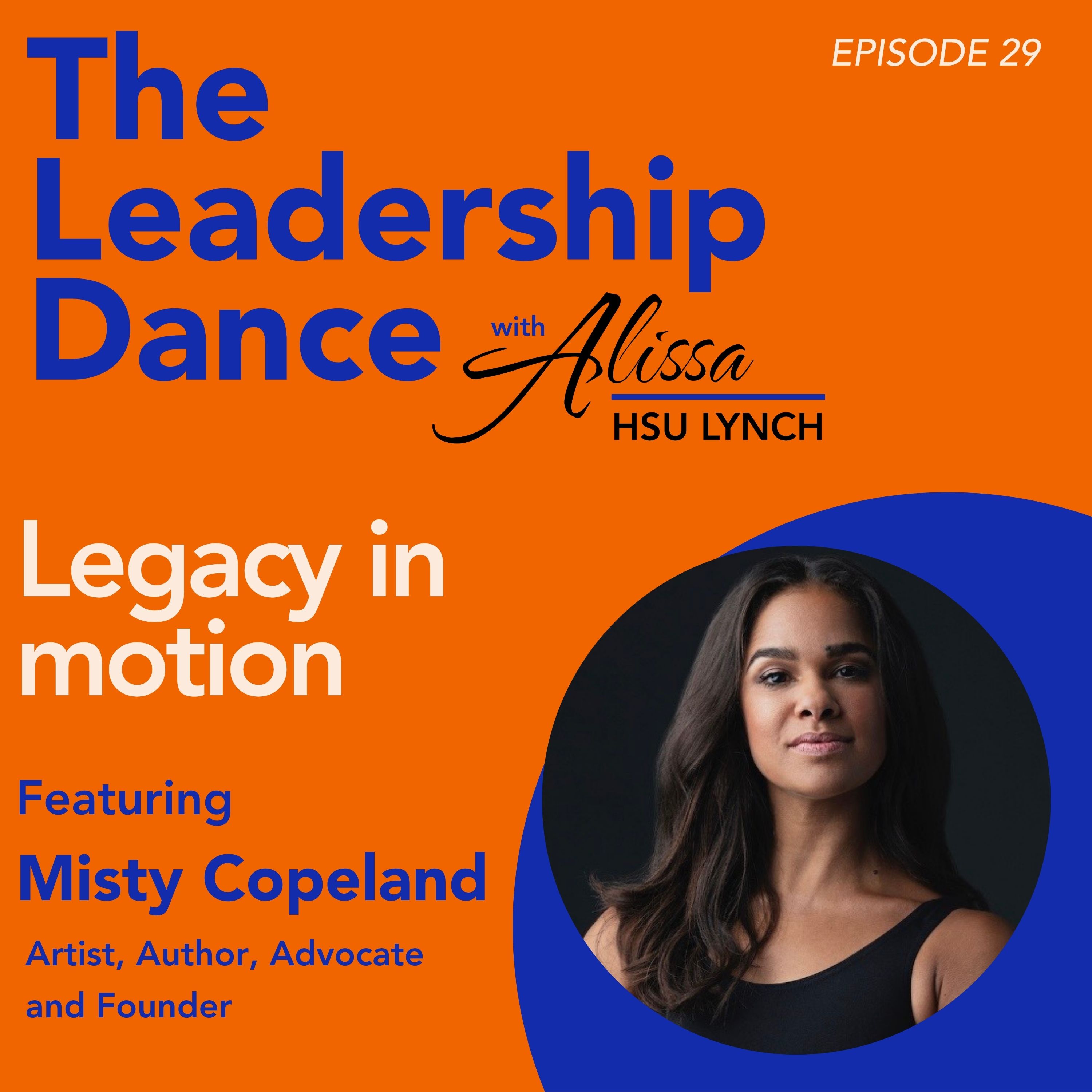
Hello and welcome to the Leadership Dance Podcast, where we explore the art of leadership with trailblazers in business and the arts. If you enjoy this show, subscribe, share and give it a five star rating. And if you're listening to this episode, also check out our YouTube channel, Heladership Dance. I'm your host, Alicia sue lynch, and today I'm joined by the one and only Misty Copeland. Misty is a trailblazing artist and advocate who has forever changed the face of ballet. She made history in 2015 as the first African American woman ever promoted to principal dancer at American Ballet Theater, inspiring millions of people around the world. Named One of Time's 100 Most Influential People, Misty is also a bestselling author, producer, and founder of the Misty Copeland foundation, dedicated to expanding diversity and access in dance. This fall, she bid farewell to ABT in a historic gala performance, a celebration of her artistry, resilience, and lasting impact. I'm so excited you're here, Misty.
- [01:11]
B
Thank you so much for having me. I'm really, really excited, especially just days after, to be able to come in and speak to you.
- [01:18]
A
So that's what I want to start with, is talking about that absolutely amazing ABT gala that marked both your return to the stage and your final vow to an incredible career. You prepared for months to get in shape, and it was really a magical, unforgettable evening. Tell us more about the whole process leading up to it and how it felt to be back on stage at Lincoln center with so many people cheering you on.
- [01:45]
B
Wow. You know, it was not an easy decision for me, and maybe that's a little shocking for some people, but, you know, I've clearly enjoyed my career and this incredible journey. You know, it's gone beyond my wildest dreams. You know, just getting to American Ballet Theater was the goal. And then, you know, when I was given, you know, so many opportunities by Kevin McKenzie, artistic director throughout my journey, you know, it started to change what I thought was possible for me in my career. And so, you know, performance and being in the studio, all of that has been such a huge part of why I do what I do. During the pandemic, it was my 20th anniversary celebrating with the company, and Kevin McKenzie, I remember him saying, you know, what are we gonna do? We still weren't sure if the company was gonna be on stage and performing and what that would look like, but he was like, but your 20th anniversary is coming up. What are we going to do? Are we going to do a big celebration? I was like, no, I don't really want to. I don't know, I just never felt the need for those types of celebrations. And so when it came to my farewell, I really didn't want to have one. You know, I just. It was really difficult for me to really kind of step into it and feel confident and that I was ready to do it. You know, I took five years off from the stage and really wanted to focus on things, to me, that are equally, if not more important than the work that I do performing on stage, you know, through my foundation and the production company and, you know, all of it with the goal of bringing dance to more people, to making it more. More inclusive. And so, yeah, the preparation was interesting. First, it was convincing myself that I, you know, should do it. And it really did take me five years to get to that place of feeling like, this isn't about me, which I think in my career, it's like I've continued to come back to that. This isn't about me. To me, this is a moment to say thank you. It's a moment of reverence, of gratitude for the company, for all of the incredible people who have poured into me, for the audiences who continue to show up for me, for the black community, for the dance community. And so I think once I kind of got my head in that space, then it was like, okay, let's do this, let's get on board. And then physically, it was a whole other story. 43 now, but, you know, stepping back onto into the studio after five years and having a baby, and it was extremely challenging, but also beautiful, you know, learning my new body as a dancer, which is what makes it so interesting and exciting, I think, as a dancer, like our body, I mean, you know, your body's constantly changing and evolving, not just as, like, a woman, but as a dancer, like, from day to day, it can change. And so I love challenges. I love challenges. So to be able to explore my body in new ways and think like, well, how am I going to get to the goal when my body can't do what it once did or used to it doing? So it was quite an interesting journey to get there. And I ended up with some injuries that I was dealing with, but I wouldn't change the night at all.
- [05:08]
A
Yes, well, you were so beautiful on stage, and I never had the opportunity to see you dance beforehand, but it was just so incredible to be there that night. And I know you were in a lot of pain, but you couldn't tell at all. And the love, the love that was present in that full house at Lincoln Center. And then particularly the 15 minute standing ovation at the end was. I mean, we were all in tears and just feeling like we were witnessing history happening with you and Calvin performing Romeo and Juliet for the first time together, and all the people coming on stage to hug you and give you flowers, that huge pile of flowers that you had. And then at the very end, your son and your husband coming on stage. How did that feel? Did he ever see you dance before?
- [06:03]
B
That was Jackson's first time seeing me dance and seeing me perform on a stage. You know, it was actually at Gilliam Murphy's Farewell this past summer that I decided I wanted him to come on stage. You know, definitely very private when it comes to my personal life and with my husband. And so both Olu and I, my husband, we never imagined that Jackson would be on a stage, like, I mean, not in life. Like, he loves dance and who knows, maybe he'll be a performer, but in terms of, like, with me and my career. And then I stood on the stage, I gave Gillian flowers at her amazing farewell, and her son Axel came on stage and I just burst into tears and I just thought, I don't care what Olu says. Jackson's coming on this stage just to have that experience, to witness it. And it's just such a unique career that we have the opportunity to be a part of. And so that was when I made that decision, and I don't regret it at all. I mean, I feel like he's a. I really feel like he changed that night, like he grew up or something. The next morning, Alou and I were saying, a star is born.
- [07:13]
A
He was a natural on stage. I have to remark that he came on stage, he wasn't daunted at all with all the people on the stage and a house full of people. He was like, loving the gold confetti coming down, trying to catch it. Really cute. So, yes, I think another star is born.
- [07:31]
B
I know. I was really shocked. I actually said to my husband, as they were walking towards me, I was like, why aren't you holding his hand? And he said he wouldn't let me. He wanted to do this on his own. He wanted to give you the flowers. So it was really special.
- [07:44]
A
So Misty, at the gala, you had Oprah, Debbie Allen, your first ballet teacher, Cynthia Bradley there, and just so much love for you for your final performance. What did that feel like in the moment and at the end?
- [07:59]
B
Yeah, it was overwhelming. I mean, you know, I've been to all the farewells of all the great dancers at abt, and it's always such an emotional and magical time. So it's just kind of. It's strange to be in that position yourself when you've watched it for so many years. But it meant everything to have these people that have been huge impacts in my life and just really big parts of my journey. Desmond Richardson and Lauren Anderson and Virginia Johnson, all of these. Alicia Graf, Mac, all of these incredible people from specifically the black dance world. I was very proud and happy that they could be on the stage receiving their flowers as well, because I've not done this alone. And, you know, having Debbie and having Oprah there, like, these are women that have opened the door for me to have a voice and to have a platform. And so it was just really special to be celebrating this evening, not just for me, but for so many who have gotten me here.
- [09:13]
A
It was magical. So as you reflect on your ballet career, are there moments that stand out to you, whether it's working with a particular choreographer, an iconic role, or other special memories that you just come back to over and over again?
- [09:29]
B
Well, you know, I feel like going through the process of preparing for this farewell opened my mind up and made me appreciate the process even more than I already did. And so I think that I'm also always thinking about the friendships and the relationships that I've made. You know, being a part of ABT and being a part of the dance world that are always gonna stay with me. Like those moments in the studio with Kevin or with Irina Kolpakova, you know, with so many of the ballet masters and mistresses, with Susan Jaffe. Actually, I spent so much of my career on and off working with her as a choreographer and as a ballet mist and so many things. Like, in specific, I remember Susan Jaffe saying to me, she had a short stint working as a ballet mistress at abt. Oh, I didn't know that. Yeah. And she. I think she was coaching me on Gamzatti and Labyder, and I was really struggling with, like, the. I guess, finding the confidence and really feeling like this never happens at abt. But I had to audition for the role for Natalia McCarva with kind of competing with, like, another dancer in the company. And I just remember it feeling so unnatural and just not feeling good about myself and just kind of just feeling overwhelmed by, like, outside noise. And I remember Susan saying to me, like, you have so much more control than you think you have, and to not let people's words define you, to not let people's words sink in and Affect you. And that has stuck with me to this day whenever anyone asks me, like, what quote would you. You know, and it's always that. And so it's moments like that you with Irina Kopikova in the studio. But I must say, in terms of, like, just performance and some defining moment in my. In my career, I would say the very first time that I performed the Firebird in New York City at the Metropolitan Opera House, and to see, really, a cultural shift in ballet, and I remember all the work that was put in with me and my then manager, Gil De Squire, that, you know, we really felt it was important that the black community felt seen and included. And so I was spending my days off going to Brooklyn and Harlem and to the Bronx and, like, all these different boroughs and going to public schools and speaking to kids and letting them know, like, you are me, you know, and that I'm not just someone on TV or a poster on the wall. And then to see my Firebird poster, you know, write this massive image in front of the Metropolitan Opera House, and, you know, it was one of those moments where it was like, again, like, that's not me. Like, that's a representation of so many people. And then to see the black community turn out the way they did that night, it was literally a shift in who comes to see ballet to this day. And so that was a moment in time that I will forever remember.
- [12:39]
A
Amazing. Amazing. So at the gala, ABT announced a new initiative, the Misty Copeland Ballet Access Program, focused on offering free tickets to children, families, and seniors in partnership with your foundation, the Misty Copeland Foundation. What inspired you to create your foundation in 2021, and what's the mission and impact you hope to make?
- [13:00]
B
Really, you know, everything that I do is because of an experience that I've had or because, you know, whether it be positive or negative. And how can we either expand on this POS experience or change the reasons that I didn't have a positive experience? And so, in starting ballet at a community center and being really discovered was really the inspiration for starting my foundation. I was given an opportunity and access and a safe environment to explore dance and ballet. For me, it was with the goal in mind to become a professional. My teacher saw me, and she said, I you have all that it takes, and I think this is something that we can do. But for me, I wanted to be able to take all of those incredible assets and tools and skills that I've learned by being a part of the ballet world and give it to these communities that could really benefit from Having it. And for me, it's not about creating future dancers in these communities. It's about creating future leaders. And so that was the idea with our signature program, our first program. It's called Be Bold Ballet Exploration. Ballet offers leadership development. So it's a free ballet class right now. You know, we're still a new foundation. It's only been three years that our program has been up and running, but right now we're in the Bronx, and we're in Harlem, and we were very, you know, intentional about the communities that we chose, you know, that don't have access to dance and specifically ballet. So it's a free ballet class that's being offered at community centers. I wanted to be able to meet these children where they are, to make them feel seen and heard and that they. It's a curriculum that we've created that's been built for them. It's live music in every class. There's two teaching artists in every class. The teachers that look like them, that even come from their neighborhoods. A lot of them live a block away from the community centers that they're teaching at. So we've just been really intentional about, you know, who's serving the children, and I think that's something that the ballet world could learn from.
- [15:08]
A
Yes.
- [15:08]
B
And that, I think, could really play a huge role in seeing a change in the pipeline, in getting more diversity. That I think that when not just the children, but when the parents feel safe and that their children are being seen and protected and can thrive, then you'll see more wanting to be invested and involved. And so this, to me, I never imagined I would find as fulfilling of work that I've felt throughout my career performing on stage. And I do, you know, with this work in the foundation, and it just makes complete sense to be able to take my experiences and give it back to communities that I think could use it.
- [15:53]
A
That's wonderful. What are your ambitions for the foundation, say, five, ten years from now?
- [15:59]
B
There's so many people to serve, and so, you know, well, I'm not looking to have this grow immensely in the next five, 10 years. I want it to be done with thought and care. And right now, we're staying within the communities we're in because we want there to be impact there before we move on. Real impact and trust in us within these communities and that we're not just kind of dropping in and leaving. And so I would love to expand into other places that need it and just to continue to bring dance to different groups of people right now. We just launched a new program this year called Be Bolder, and it's for an older generation of dancers to get to explore dance and all the benefits that come with it. And we're keeping it within the same communities. So you're really kind of getting this full, full experience of what it is for everyone in the community to experience dance. So I hope to just to continue to impact as many people through ballet and through my love of the art form.
- [17:14]
A
Sounds wonderful. How can people get involved?
- [17:18]
B
Mistycopelandfoundation.org you can learn more about us there. We're on social media as well, and I'm misty on point, so you can find out everything there is to know about what I'm doing through my Instagram.
- [17:30]
A
Excellent. So you've now moved from center stage to the boardroom. In addition to the Misty Copeland foundation, you serve on the boards of Lincoln center and the Shed, a cultural arts center. And I'm also incredibly excited that you were unanimously elected to the Board of Trustees of abt, which I also serve on. Congratulations.
- [17:50]
B
Thank you. Thank you so much.
- [17:52]
A
What drew you to these leadership roles, wanting to serve on boards? And how do you hope to shape the future of ballet through the boardroom?
- [18:01]
B
You know, I often just, you know, speak about the importance of representation on stage and seeing yourself reflected. In the last five years, I've felt that being a black body on the stage, to me is no longer enough. And yes, I've seen change and growth, but there's only so much you can do with that platform. And I think to see, to see real change, you've got to have a seat at the table in the room where these decisions are being made. And I think it was. Alex Poots, artistic director of the Shed, was one of the first people that I really had this type of conversation with about what it means to have an artist on the board. And he was actually the first person that extended the offer for me to join the Shed board. And I'm honored to have kind of broken in my teeth there, I guess, with such a forward thinking, forward looking institution as the Shed, and really, I guess, understanding the importance of having the voice of an artist, of a woman, of a woman of color, and then being able to have the experience of an incredible board like Lincoln center and all the history that they have and experience, and hopefully I can bring some of these experiences with me to, to American Ballet Theatre's board. I'm just excited to be able to be a voice for the dancers through my own experiences, but also removing some of my Experiences as well, and coming in with an open mind and not just with a narrow perspective, but at the same time, I think listening to and hearing the dancers and seeing how I can maybe be an opening, you know, I think that maybe a lot of board members don't have any idea of what the perspective of a dancer is and what goes on and that we should. We're all working towards the same goal, you know, So I hope that I can kind of bring some light and opportunity to be, like, a liaison maybe between the dancers and the board. But I'm just so hopeful for the future of dance, period. I mean, I wouldn't be still doing this if I didn't feel that we could do this and have belief in people and belief that people are coming at it from the right place in their hearts and wanting this to be an art form that's sustainable.
- [20:41]
A
You said it that we are all in service of the organization and have the same goals. But it is so critical to have more diverse voices in the boardroom because that is where many decisions get made. So we are really welcoming your perspective.
- [20:56]
B
Thank you.
- [20:58]
A
So, Misty, as someone who's broken so many barriers, how has your definition of leadership evolved over time?
- [21:07]
B
Yeah, it's definitely evolved a lot. You know, it's really interesting to think about. I think just naturally, I've just always kind of gone with my gut and my instincts in terms of, like, making decisions, and I guess that would be considered leadership, but just kind of trusting things that feel right to me and doing the right thing, you know, whether it's even just like extending myself to other dancers and being there for them and thinking about the bigger picture and the whole of the community or of the company or whatever it is. And I remember I was a soloist in the company, and I remember Kevin McKenzie. I was doing a lot of work with the Boys and Girls Club at the time, and I don't know, it was just kind of. It was very busy. I was doing a lot, and I was very excited about the opportunity to be able to speak about dance in different ways. And I remember Kevin saying to me that he was very impressed by the way that I've stepped up as a leader. And then later on, when he promoted me, he said to me that that's one of the greatest qualities that I had as a principal dance, showing leadership skills, which I found so interesting. Like, I just never, you know, it's not something that, I guess as dancers, we're thinking about when we're thinking about what does it take to be a Principal dancer. And you're not, I guess, necessarily thinking of that, but you are a leader, and you have a responsibility to carry an entire company with you on your shoulders in an evening or, you know, even just the way you represent yourself. And I think that all of those things have just happened out of, you know, I don't know, just taking all of the things that art and dance have given me and wanting to give it back in any way I possibly can. And so, I don't know, leadership can. Being sensitive and empathetic and being open and vulnerable and, you know, it's not just about, I think, being, like, tough and strong, that there are so many beautiful ways to show leadership. I think that's how I've evolved as a leader, that I've kind of embraced and accepted all these parts of myself and that they can be leadership skills as well.
- [23:23]
A
So, you know, I'm classically trained in ballet as well. Did not have a professional ballet career, but danced professionally in modern dance. And after I transitioned into business, I realized that there were a lot of things that I learned from dance that were benefiting me as a leader in business. As you think about your career, what have you learned in terms of leadership skills from dance that you apply today or feel are relevant for other people?
- [23:50]
B
I think the way that the ballet class is structured, I think is so brilliant and so beautiful. And I think that everyone should experience this type of, like, setup for themselves in life. And so I think about. It's affected how I approach everything in my life, whether it's sitting down and writing a book, preparing to give speeches on the speaking circuit, or preparing for my day as a mother. It's, I think, having this consistency of routine. It's walking into a space and almost being a blank canvas, but being ready to be open and vulnerable and accepting of what's going to come at you. I mean, as a dancer, that's what we have to do. It's understanding the rigor that you have to put in the work, but not to forget the joy that comes with that. Being sensitive to, I guess, yourself, but also to those around you. Like you're a part of a whole and a community. And all of these things I've learned through dance, and I take them with me into every space that I'm in. I think dancers are some of the strongest people you'll ever meet.
- [25:18]
A
Absolutely.
- [25:19]
B
But at the same time, they're very sensitive. And so it's like finding that balance. And I think that ballet has given me. I think every leader should experience that.
- [25:32]
A
Yes, I think everything you said rings true. And I hope all the business professionals listening to this episode are taking notes.
- [25:42]
B
So.
- [25:43]
A
Transitions can be really hard, especially when you're transitioning from something that you love that is so core to your identity. You will always be a ballerina, but you've already invested in becoming so much more. You're an entrepreneur, an author, founder, producer, spokesperson, mom, and an activist. What are you excited about in particular with this next chapter?
- [26:09]
B
You know, I feel like I've already really kind of tapped into this next chapter over the last five years. So I feel like I've kind of been walking in this journey for some time now, but I'm excited to be able to. To really dive into storytelling in a way that represents, like, the stories I want to hear. I mean, again, I've already been doing it, you know, whether it's through the books that I'm writing and, you know, I've dipped my toe in producing. But we've got a lot of really exciting projects on the horizon that we are using movement and dance to be able to bring even more to storytelling and just the value of. The value of movement and dance in storytelling. But it's exciting just to be able to come at it from a different approach. You know, throughout my career, I've been a vessel, you know, and not necessarily been able to give my own perspective or, you know, whatever it is with the ballets that I'm performing. So to be able to step into this space. And I want to continue performing and dancing, but I want to do things that I want to do and I want to tell stories that I'm excited about and collaborate with artists that I respect and that I've kind of been like, waiting to find the right time to collaborate with. So I'm excited to create. I'm excited to explore and have fun doing it.
- [27:36]
A
Amazing. Amazing. And you're open. It sounds like you're open to where things take you next.
- [27:42]
B
Yeah, I am.
- [27:44]
A
You became a mom during the pandemic to your son, Jackson. How has motherhood changed your perspective on life and what's important to you?
- [27:54]
B
Well, I think it's amazing to not like to have someone else to think about.
- [28:01]
A
Are you saying dancers are self centered?
- [28:03]
B
You know, it's so interesting because I don't think they are, but they have to be. And I've battled with this my whole career is like, you have to focus on yourself. You have to pour into yourself. And it's just. But at the same time, I'm like, oh, I'm so sick of myself. Like, I go through these cycles of, like, okay, I'm in it, I'm in it. And then I'm like, ugh. I'm so sick of just thinking about myself and my body and looking in the mirror all the time. And so to have my son come along and just be like, I don't care about anything that's going on with me. Like, I can just pour into this little human being. I mean, of course there's a balance. You have to take care of yourself in order to be there for someone else. But I think it's taught me even more just, like, patience. And I think I'm already, like, a pretty patient person. But I think that it's really just taught me even more patience and just the beauty in creation. I guess that's maybe why I'm even more excited about it now is having experienced the creation of this amazing little boy and just seeing him evolve. I mean, like I was saying at the top of the show that I felt like he changed overnight after coming on the stage at Lincoln center at the Koch. And just to see this constant evolution, it's changed me in ways I'm sure I don't even realize yet. But I love being a mom. I always knew I would be a mom, but I absolutely love it.
- [29:37]
A
Yeah. And so much more to come.
- [29:39]
B
You're like, just wait.
- [29:41]
A
No, no. It's all so wonderful. All good, all good. So you've described your husband Olu as a grounding force. What have you learned about partnership through your marriage and in life that's helped sustain you through such an extraordinary and public career?
- [29:59]
B
I love that you asked this question. I don't feel like that I've ever really been asked something so focused on the incredible, I don't know, tools and just everything that my husband's given to me. We met when I was just 21. We've been together for 21, about 20ish years.
- [30:18]
A
How did you meet?
- [30:19]
B
We met out at a nightclub here in Manhattan. I was in the midst of my spring season at the Metropolitan Opera House, like a night off, and he was in the middle of getting his law degree at Emory, so it was his last night in New York. He was interning at a law firm. But I guess, I mean, I've been open to relationships, but I watched my mom marry and divorce like five times, and just I had such an unstable upbringing. So it's very interesting, I guess, I don't know, having found my partner so young. We were together for over a decade God, I can't. Maybe 12 years before we were married. But he was just always so patient with me, and he always understood the importance of my career and that he never wanted to kind of get in the way, as he would say. He waited until the day after I was promoted to principal dancer to propose to me because he didn't want any distractions. He's just very thoughtful. But I think he really showed me what true partnership is, and it's collaboration, it's patience and understanding. And, I mean, he's just taught me so much. Like, I run everything by him because I trust him so much. I think he's the most creative and brilliant man, and he's shaped me as a woman and as a businesswoman, and, I mean, he was really the one behind me with the foundation, the importance of doing it. And even on those days, I remember when I was starting out with my philanthropic advisor, Jane Poland, who's an incredible woman, it was just the two of us. And on those days when I'm like, I can't do this. I've got so much going on. And I felt like I was kind of on my own. And Jane was great, but he was like, it's gonna pass. He's like, just think about all the things you've done in your career when you first start out and how difficult it is. You're gonna build a team, and you're gonna trust them. And it's like, I'm here now, and I'm so thankful and grateful that I listened, and I just. I couldn't be more grateful for him and that Jackson has him as an example.
- [32:40]
A
It's so important to have somebody who just believes in you unconditionally and is there for you.
- [32:45]
B
Yes.
- [32:45]
A
So wonderful. In your latest book, Letters to Misty, you share advice on how to move through life with confidence and grace. What advice would you give to the next generation about navigating your career while staying true to yourself?
- [33:02]
B
Surround yourself with people you trust and people that are gonna be there to support you. I think that's been probably like, my super strength throughout my career, is having people in my corner that I can rely on and that I can lean on when I'm exhausted, when I don't believe in myself. You know, with whatever happens, whatever your dreams and goals are, it's so important to have other people that are around you that are going to be a support system to you.
- [33:30]
A
Misty, you are an icon in the ballet world, and honestly, one of one. What do you want your legacy to be now that you're moving to this next chapter.
- [33:42]
B
Yeah. You know, I think that I've spent so much of my career, you know, focused on, as we've been talking about, on, you know, on me and developing myself as a dancer. And, yes, I want people to remember my dancing, but I think that my true legacy and what I want to leave behind is opening the doors for all people to feel like this is something they can do, that ballet is for everyone. Ballet, I think, is no longer just a European art form, but that it's something that everyone can benefit. Being a part of, being exposed to joy dance, it should be a natural part of life.
- [34:32]
A
Great advice. Misty. It's been such a joy to have this conversation with you today. Thank you so much for joining me, and I'm looking forward to partnering with you on the board and looking forward to seeing what you do next.
- [34:43]
B
Thank you so much.
- [34:45]
A
Like, follow and share the Leadership Dance, where we explore how to choreograph the career of your dreams and chat with visionary leaders in the arts and business worlds. Until next time, keep dancing.