← The Listening Post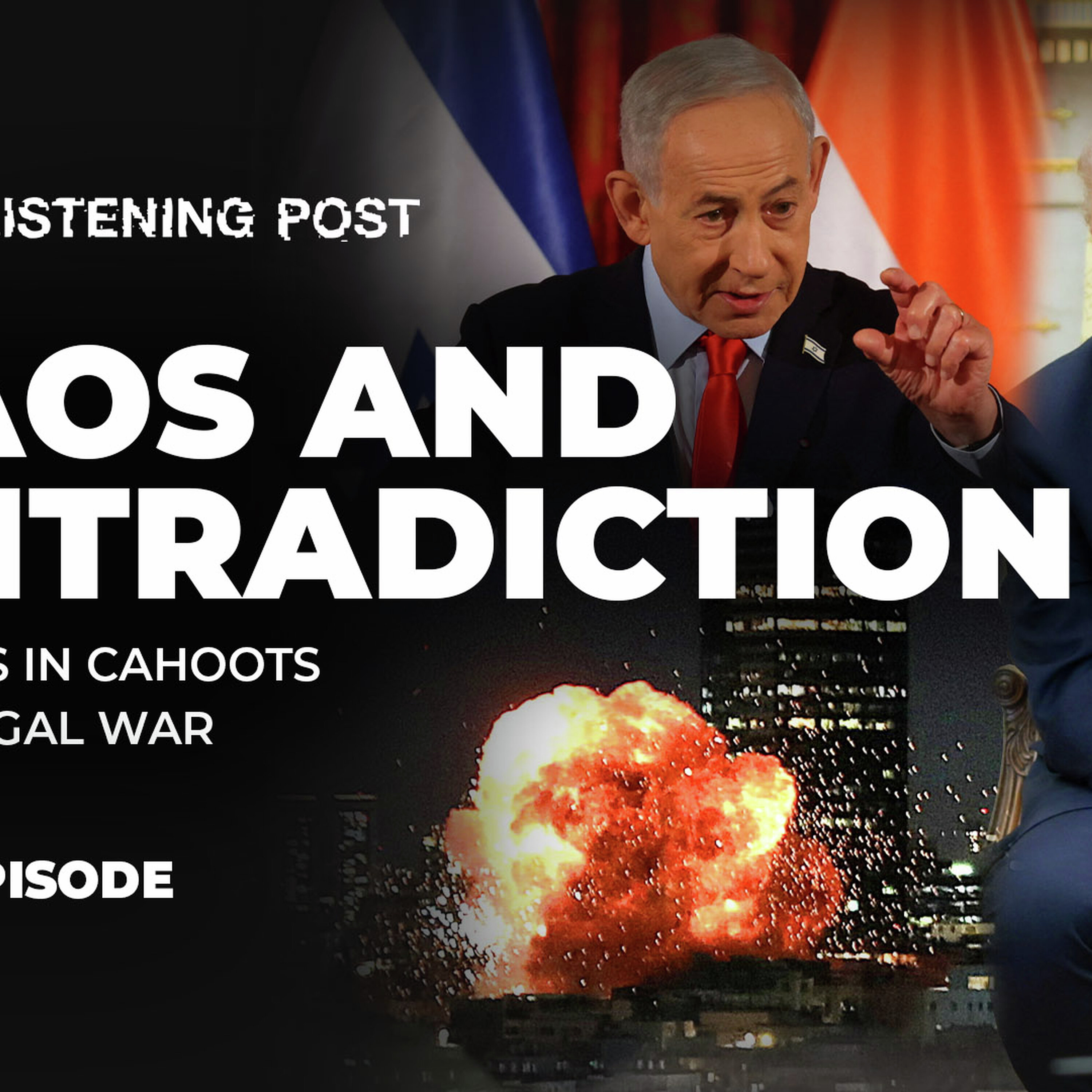
The Listening Post
“A war in search of a strategy” - Trump-Netanyahu's war with Iran | The Listening Post
00:25:24
Loading summary
Transcript56 lines
- [00:01]
Narrator/Host
This week on the take, we're marking one year since a pair of devastating earthquakes hit Turkey and Syria with a new digital interactive. Listen and watch stories of survival, recovery and coping with the grief@al jazeera.com earthquakes again, that's al jazeera.com earthquakes
- [00:28]
Analyst/Commentator
when examining the media side of the attack on Iran and the war that has spread across the Middle east, where does one begin? With the principal actors, the U.S. israel and the Islamic Republic, or the enablers, the American news outlets reporting on the story and sometimes driving it. The Nepo Shah in waiting, Reza Pahlavi, finish the job. And the other voices from the diaspora egging the Americans and the Israelis on. And lest we forget, the West Bank, a Palestinian journalist's take on the Israeli settlers and soldiers and what journalism there is up against. One week into the war that the US And Israel launched against Iran, the casualties now include the Islamic Republic's leader, Ayatollah Ali KHAMENEI, More than 150 schoolgirls in the southern part of the country, as well as Iran's relationship with the Gulf states and the very notion of international law. The Middle east has been engulfed. With missiles crisscrossing in the sky in Washington, the messaging on this war, the justifications offered, keep changing. Even mainstream media outlets in the US the corporate kind that have reliably served as tools of public persuasion in previous American wars, have been struggling with that. So they focus on the tactics rather than the strategic side of this. The cause. Anti war voices are almost completely absent. Iranian representation has been skewed. After his repeated promises that he would be America's peace President Donald Trump has now bombed eight countries from South America to Africa and the Middle East. And however hard he and his partner in war crimes, Benjamin Netanyahu, spin it, that is a tough contradiction to sell to Americans, let alone the rest of the world.
- [02:28]
Political Figure/Voice of Trump Supporter
This is a war in search of a strategy. Eliminate the intolerable threats posed by this sick and sinister regime aimed at toppling the regime. One hour.
- [02:39]
Analyst/Commentator
It is time to end the Islamic
- [02:42]
Political Figure/Voice of Trump Supporter
Republic, destroying the nuclear program.
- [02:44]
Analyst/Commentator
Another hour, we have to prevent Iran
- [02:47]
Political Figure/Voice of Trump Supporter
from getting nukes, creating an Iranian democracy or something. The other hour. There is no coherent strategy. And you can see that's reflected in the media coverage of it.
- [02:58]
Analyst/Commentator
Because in the absence of a strategy, how do you frame a coherent message through the news media? Do you try what Donald Trump did and present yourself as the savior of the Iranian people as you rain missiles down on them?
- [03:13]
Political Figure/Voice of Trump Supporter
When we are finished, take over your government. It will be yours. To take.
- [03:17]
Analyst/Commentator
That's a tough sell. Or do you take the Israeli approach and hit them with an AI modified version of Benjamin Netanyahu telling Iranians in Persian that freedom awaits. But on the messaging, the US and Israel can at least count on this, that many of the messengers in the American media are there to help.
- [03:44]
Critic/Anti-War Commentator
Why is attacking US military bases abroad justified?
- [03:48]
Analyst/Commentator
But because they are, they are attacking us.
- [03:50]
Media Analyst/Journalist
I think that question from the NBC anchor is really the embodiment of how US media can't do a professional and objective job when it comes to foreign policy reporting.
- [04:01]
Analyst/Commentator
Now Iran is firing missiles at Arab countries, and I mean, if any other country did that, I think there'd be a huge human outcry.
- [04:12]
Media Analyst/Journalist
They do a good job on domestic issues. They hold truth to power and question the highest office in the country. But when it comes to US foreign policy, especially in the Middle east, especially with Israel, US mainstream media, the old guards, the gatekeepers, can't do an objective job.
- [04:29]
Expert/Retired Military or Media Critic
The language which we often see in the Western media, particularly the US around Iran, is generally framed in a certain way. Iran is Nazi Germany, essentially. This is not to defend the Iranian regime by any means, but the fact is that the majority of people who are being killed at the moment are Iranian civilians. But ultimately, much of the Western press demonized them without even speaking to them. And this was happening before Iran for two and a half years. Genocide in Gaza and Israeli war crime.
- [05:03]
Analyst/Commentator
The similarities to the Western media's coverage of the Gaza genocide are unmistakable. Take that missile strike on the school in southern Iran that killed more than 160 civilians, most of them schoolgirls aged seven to 12. An attack the UN called the grave violation of humanitarian law. At the time of this recording, neither the US nor Israel had owned up to that attack, which apparently targeted a nearby, nearby barracks of the irgc, Iran's Islamic Revolutionary Guard Corps.
- [05:34]
Expert/Retired Military or Media Critic
Because we don't actually know for a
- [05:36]
Analyst/Commentator
fact yet what happened with that school. The disinformation playbook the Israelis have used in Gaza is now being applied in Iran. And too many Western media outlets have played along.
- [05:48]
Critic/Anti-War Commentator
If this would have happened anywhere else, it would have been on the front cover of every news outlet. And the way that it was reported was that we can't verify what happened.
- [05:58]
Analyst/Commentator
The reports that this may have been an IRGC missile that fell short need
- [06:03]
Critic/Anti-War Commentator
to be taken seriously, really touting this lie, that the IRGC has somehow done this themselves. And we saw this exact same pattern happen in Gaza. And that is what is really just dizzying. The same lazy flattened reporting that we saw in Gaza. When it comes to the war on
- [06:24]
Media Analyst/Journalist
Iran, the coverage has been very skewed, lacks objectivity. It's covered a third person that it's not clear who attacked it, and it's just unthinkable. If a school was attacked, for example, in Israel, or if this was something that Russia had done in Ukraine, the coverage would have been so, so different. And we've seen so many examples of this.
- [06:42]
Narrator/Host
Ukrainian officials say as many as 90 people were taking shelter in the school's base.
- [06:47]
Media Analyst/Journalist
It shows the mainstream media industry in the US Is in the shadows of the foreign policy apparatus in Washington. And it's not just about Iran today or Israel, Gaza. This goes all the way back to, for example, the invasion of Iraq.
- [07:03]
Expert/Retired Military or Media Critic
And much of the American media frames their coverage around that mentality because war is big business, war sells, war gets eyeballs. And there's a reason why the CBS News and others are pivoting towards a much more hawkish, hardline, pro Israel, pro American empire worldview.
- [07:25]
Analyst/Commentator
This operation, which the Pentagon is calling epic fury, is also epically complex. Let's bring in retired Admiral Mark Montgomery, who served 32 years in the Navy as a.
- [07:34]
Expert/Retired Military or Media Critic
Many American media see it like a video game. That's how they portray it. From the graphics on the screen to who they speak to, to interviewing generals. War for them is big business. They love it.
- [07:47]
Analyst/Commentator
In the battle for American hearts and minds, however, the polls show that Donald Trump is losing largely because of two questions that plague him. There's one that goes back decades, that Israel is driving US Policy. Even Fox News addressed that lobbing a question at Benjamin Netanyahu, whose chuckling response will have unsettled more Americans than it convinced. You know, there are people that say, well, the Prime Minister of Israel dragged Donald Trump into it. I want to get your reaction to that. That's ridiculous. Donald Trump is the strongest leader in the world. The other narrative is one of Donald Trump's own making, that he is a peace president who would not start new forever wars.
- [08:35]
Political Figure/Voice of Trump Supporter
My proudest legacy will be that of a peacemaker and unifier.
- [08:40]
Analyst/Commentator
But Trump knows that once he starts a war, he won't get that much flack from legacy news outlets, since supporting American wars of the past is part of their legacy. The pushback is coming from independent voices online and they are attracting audiences from both the liberal left and the MAGA right.
- [09:00]
Political Figure/Voice of Trump Supporter
You had Nick Fueches and Alex Jones on the Internet yesterday, their big, huge right wing hosts. They were almost near tears. This is really a disaster. For their base.
- [09:12]
Analyst/Commentator
You're already there saying, vote Democrat. What the hell's going on here? I think you have to vote Democrat in 26, and I'll tell you why.
- [09:20]
Political Figure/Voice of Trump Supporter
According to Nick Fuentes, Trump is not doing immigration. He's not standing up to the left, really, and he's basically giving the government to Israel. And you see Marco Rubio in a moment of idiotic candor saying, we had to do it because of Israel.
- [09:36]
Analyst/Commentator
We knew that there was going to be an Israeli action. We knew that that would precipitate an attack against American forces.
- [09:41]
Political Figure/Voice of Trump Supporter
The administration later realized what a flub that was and tried to walk it back, but it was too late.
- [09:48]
Critic/Anti-War Commentator
The pushback that we're seeing is coming from within the Make America great Again tent, because this isn't what they were sold, right? They were sold that we wouldn't put our troops in harm's way when we. We know that this is Israel's war.
- [10:04]
Analyst/Commentator
Our government's job is not to look
- [10:05]
Narrator/Host
out for Iran or for Israel.
- [10:07]
Critic/Anti-War Commentator
So Americans are very aware of what is going on here. Unfortunately, you're not hearing from them much on legacy media.
- [10:15]
Analyst/Commentator
One week into this war, what sets it apart, even from something as horrifying as Israel's genocide on Gaza, is the rapid geographical spread of the field of battle. The eight countries hit since the initial attack on Iran, the more than 1300 people killed, the key industries from the oil business to shipping to airline traffic, damaged. With international law already exposed in Gaza, now effectively eviscerated, all in just seven days, news organizations are stretched to their limits, challenged in ways they haven't been before. And the early returns on the journalism do not look promising.
- [10:58]
Critic/Anti-War Commentator
The big strategy here from the Trump administration is just to dizzy all of us. It is very difficult to understand what is going on because it's so chaotic. But we know what this is about. It's about crippling Iran, its infrastructure, its military, crippling it politically. What the US Wants out of Iran is. Is not democracy. The United States wants a client state like it has in Syria, like it has in Lebanon, like it has in other countries. That's what they want in Iran.
- [11:31]
Expert/Retired Military or Media Critic
The language that much of the Western press uses is, we in the west, even if we launch these wars, we are the innocent bystanders. We're just doing our best. It's not easy. Running an empire is very tiring. You know, give us some slack, please, people. But ultimately, the devils are the Hamas leadership of Gaza or the Iranian leadership. It's deeply racist and unacceptable, but not
- [11:58]
Analyst/Commentator
New Staying with Iran the U. S. Israeli bombing campaign has exposed some sharp divisions among Iranians both inside the country and across the diaspora and on Western news outlets. One side of that divide is being amplified far more than the other. Meenakshiravi has been tracking the coverage.
- [12:20]
Narrator/Host
One of the most prominent pro war voices seen across Western media has been Reza Pahlavi, the exiled son of the shah, overthrown in the 1979 revolution. Pahlavi has been interviewed across a range of outlets. Exposure he has used to boost his political profile. Once the operation began, he appeared on Fox News praising President Trump and presenting himself as a successor in waiting.
- [12:43]
Analyst/Commentator
I am leading this transition. I have the support of millions of Iranian people.
- [12:47]
Narrator/Host
A clear pattern has emerged in Western especially American war coverage. Voices advocating U. S. Israeli intervention are being given disproportionate airtime. One of the most prominent among them is Iranian activist Masi Ali Nijad, a polarizing figure.
- [13:02]
Critic/Anti-War Commentator
This is the message that Iranians want me to send to President Trump. Do not leave us alone with this wounded, murderous regime. Finish the job.
- [13:13]
Narrator/Host
The tendency to seek pro intervention, pro war voices is not, however, limited to the diaspora. After the BBC aired a segment featuring three Iranians in Tehran, all of whom expressed support for the military action, Trita Parsi, an Iranian born political analyst based in Washington D.C. had this to say.
- [13:31]
Analyst/Commentator
You had three voices from Iran who seem to all be celebrating and happy about the country getting bombed. I'm sure there are views of that kind, undoubtedly. But to leave the impression that that is the entire viewp inside of Iran is getting close to Iraq level war propaganda and war lies.
- [13:47]
Narrator/Host
Frankly, when the United States and its allies go to war, the media ecosystems around them too often fall into line, building narratives and finding voices that help reframe wars of aggression as wars of liberation.
- [14:00]
Analyst/Commentator
Thanks, Mina. For almost two and a half years now, the eyes of the world have been trained on the Israeli genocide in Gaza. Now there's the Iran story to contend with. Far too little attention has been paid to another territory where Israel exercises near total control, the occupied West Bank. The Israelis have accelerated their policy of fragmenting the west bank, chopping it up and annexing more land. Their soldiers have grown more aggressive. The settlers there, shielded by the army, are more emboldened and violent than ever. Refugee camps have been destroyed. More and more Palestinians are being forced forward from their homes. There are hundreds of new checkpoints and barriers making free movement impossible for citizens and journalists alike. And as in Gaza, Israeli forces have their sights trained on journalists who already do their work. Under dangerous conditions. One journalist who has covered it all is Amid Shahada, a correspondent for Al Arabi tv. Shahada's reporting is bold, frequently fearful, fearlessly putting him in harm's way. We spoke with Amit Shahade about reporting under fire in the West Bank.
- [15:28]
Political Figure/Voice of Trump Supporter
Her.
- [16:19]
Analyst/Commentator
Ishijamil masra fen the coffee ishi lakarius. Mustahil mustache. Moliha. Israel.
- [21:31]
Expert/Retired Military or Media Critic
Whom.
- [21:56]
Analyst/Commentator
Alazaman. Talakatum. Film. And finally, back to Iran and the branding of the US Military operation there as Operation Epic Fury. Did the Pentagon consider how easy it would be for its critics online to take that name and mess with it, to just turn it into Operation Epic Chaos or Epic Failure? And given that so many Americans see the attack on Iran as a way to distract attention away from another story that poses an existential threat to Donald Trump's presidency, why would the administration sign off on a name that could be so simply morphed into Operation Epstein Fury? The people at the White House can bombard Americans with messaging until the cows come home, but in the age of the Internet, there will be return fire. And in this case, it landed.