← The Listening Post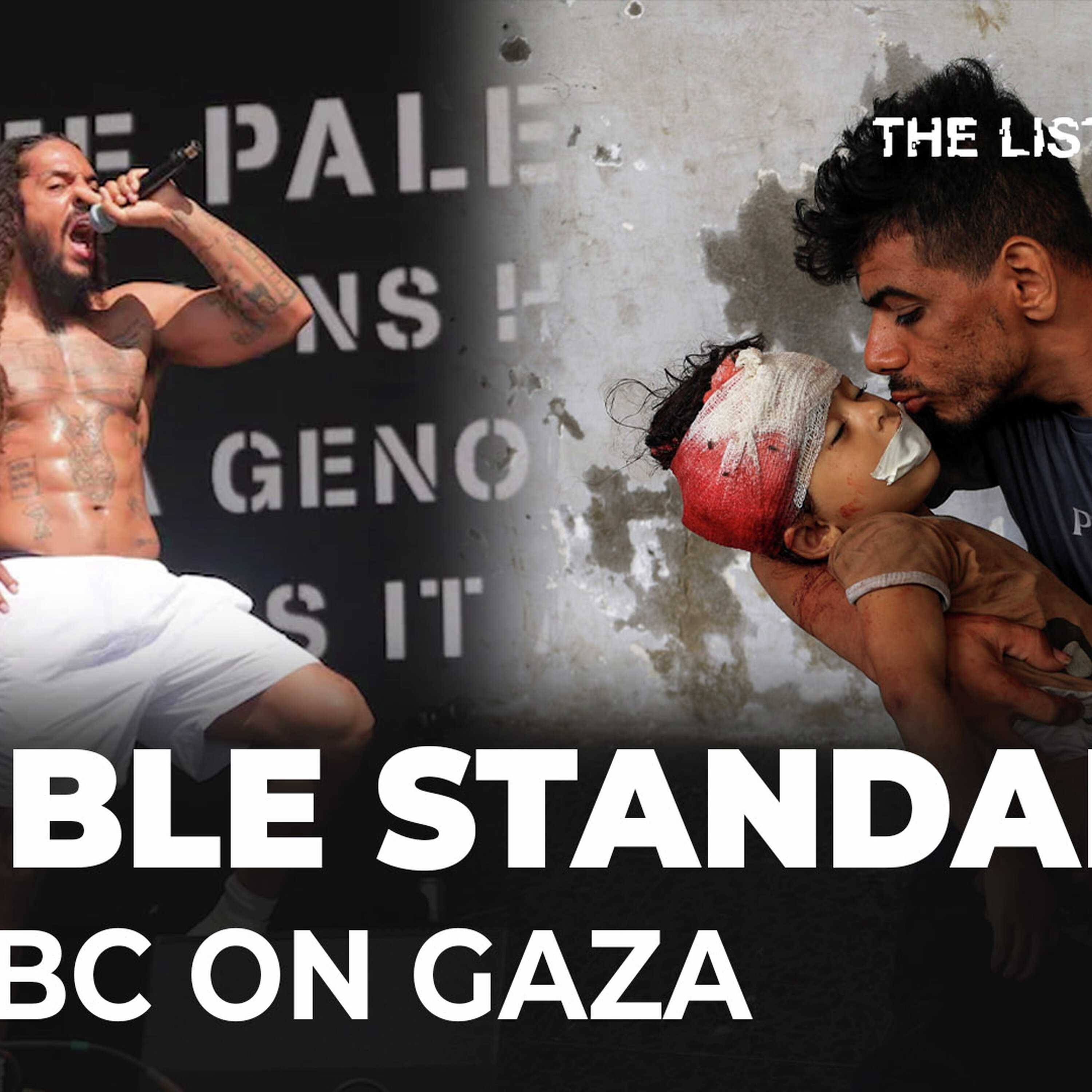
The Listening Post
“Decisions are being made out of fear” BBC and the Gaza double standard | The Listening Post
00:25:48
Loading summary
Transcript55 lines
- [00:00]
Podcast Host
This week on True Crime reports, up to 100,000 children go missing in China every year, a number that links back to the 1970s and the one child policy. This story is about one of those children and the mother who spent decades searching for him. Hear the full story on True Crime Reports. Subscribe and listen wherever you get your podcasts. This week on the Take, we're marking one year since a pair of devastating earthquakes hit Turkey and Syria with a new digital interactive. Listen and watch stories of survival, recovery and coping with the grief@al jazeera.com earthquakes again, that's al jazeera.com earthquakes.
- [00:59]
Narrator
When competing narratives collide on Israel and Gaza, counterculture.
- [01:05]
Analyst
Has struck back in the UK and the BBC's way of reporting the story in Gaza is up against popular opinion as expressed at a music festival. We examine the narrative coming out of Israel. The dehumanization of Palestinians goes beyond the media messaging. It's everywhere. Plus the Muslim mayoral candidate in New York City and the questions he keeps getting asked about Israel.
- [01:44]
Narrator
The stage had been set at Glastonbury, at Britain's biggest music festival. Some pro Palestinian acts stepped up to the microphone, political agendas in hand with messages to deliver about the Israeli genocide in Gaza and the Starmer government's continuing support for its perpetrators. And the BBC, the UK's public broadcaster, was live streaming the event, adding another political element to an already explosive mix. The corporation has been taking a pounding over its coverage of the story in Gaza. The network has consistently muted voices critical of Israel, and when those voices do get heard, the tendency is to make the story about them rather than the genocide that they're talking about. Glastonbury provided a window into the way that most British people see what is happening to Palestinians as an atrocity that must be stopped, thereby exposing British news outlets, the BBC and others that, rather than being the providers of information, have acted like the gatekeepers of it.
- [02:51]
Analyst
In the United Kingdom, like just about any country, power often lies in the form of institutions, political institutions, media ones such as the BBC, and cultural institutions like the Glastonbury Music Festival, which the BBC livestream and aims at British audiences.
- [03:14]
Music Festival Commentator
Glastonbury is one of the largest music festivals in the world, a British institution, 200,000 people, and it's a very political space.
- [03:25]
Media Critic
We saw a sea of Palestine flags at Glastonbury because it's not just a music festival, you know, it's a site of creative expression and political expression.
- [03:35]
Political Commentator
There were a number of artists who used their platform to draw attention to the genocide in Gaza. And one chant in particular, death, Death.
- [03:45]
Reporter
To the idf.
- [03:48]
Political Commentator
Was seized upon by pretty much all of the British media to create a kind of pseudo scandal whose real purpose is to keep the spotlight well away from the facts.
- [04:05]
Analyst
The BBC knew that its coverage of Glastonbury could prove contentious, that Gaza and the Starmer government's continuing support for Israel's war would come up. That is why it chose not to live stream a popular Irish band, Ni Cap, whose pro Palestinian position had already made headlines and caused controversy. It did live stream Bob Villain, however, a British punk act that led that antagonistic chant aimed at the Israeli military that provoked a lot of coverage and plenty of conflation.
- [04:40]
Podcast Host
When people question how on earth could.
- [04:42]
Media Critic
Hitler ever have happened, all you have.
- [04:44]
Podcast Host
To do is point to Glastonbury and.
- [04:46]
Political Commentator
Say, that's how it does evoke some.
- [04:50]
Media Expert
Of the worst moments in human history, shall we say?
- [04:52]
Analyst
The chant was characterized as a threat to all Israelis and not just the armed forces inflicting a genocide on Palestinians in Gaza. The soldiers who have livestreamed, chanted and.
- [05:09]
Media Expert
Celebrated that the government has come down on the BBC and says, this is outrageous. You should have stopped the recording at that moment. I don't like language. Deaf, deaf to anyone. It has to be said, though, this was an institution they were talking about because an awful lot of mischief has been made since that this is calling for death to Israelis or death to Jews. It was death, death to the idf, which is an organization which has committed war crimes and atrocities on a massive scale.
- [05:44]
Music Festival Commentator
The coverage of Bob Villain across some of the tabloids was highly sensationalist and of course inaccurate. You have politicians saying that the problem is now with the BBC, not with the actual violence meted out to innocent Palestinians in Gaza. So the story has been deflected away from one of extreme violence towards one of particular media values. And the extent to which impartiality is being operationalized inside the BBC in the.
- [06:20]
Political Commentator
Same week that questions about some rabble rising chant on a pop music stage are saturating headlines, we have had a High Court judgment that has green lighted the British government's continued sales of weaponry fueling a genocide. Now that is real news. But for most of the other mainstream broadcast and press, the real news is this pseudo debate about whether a particular rabble rising chant is or is an anti Semitic.
- [06:59]
Narrator
As the broadcast rights holder for Glastonbury.
- [07:02]
Analyst
The BBC accidentally found itself at the heart of this story. The same publicly funded organization whose news division has had such a sorry record on the coverage of Gaza over the way its news presenters initially insisted that any interview with a defender of Papa Palestinian rights had to start with this.
- [07:23]
Media Expert
You won't condemn Hamas for killing civilians.
- [07:27]
Analyst
Or clamping down on the same terminology that NGOs have applied to Gaza language the British government shies away from or the Israeli authorities oppose.
- [07:38]
Abdul Jawad Omar
This is a genocide happening in front of our eyes. We have, yeah, we.
- [07:41]
Media Critic
That word is, as you know, incredibly emotive. And the Israelis, as you know, will be saying that they are targeting Hamas only.
- [07:48]
Analyst
There's the disproportionate number of pro Israeli voices on the network's air, while pro Palestinian demonstrators in the hundreds of thousands routinely failed to attract BBC coverage. And most recently a documentary called Medics Under Fire that the BBC hired an independent company to make, but then stuck on its shelf for months after complaints, spurious ones, over a previous documentary on Gaza that had nothing to do with the new one. Another British network, Channel 4, finally stepped in and aired the medics documentary this past week. Like all UK media outlets, Channel 4 has the pro Zionist lobby to contend with. But unlike the BBC, its top executives are not government appointees.
- [08:42]
Media Critic
So the BBC we're seeing right now is a very enfeebled and weak BBC. It does not have a backbone. It gives into influence from lobby groups, complaint campaigns and from the government. And it's very important that the people at the top of the BBC protect their journalists rather than passing down edicts and editorial decisions made on the basis of fear. That's incredibly poor for the journalists there who are trying to do a good job, including the journalists who worked on the Gaza Medics documentary. The BBC itself has thwarted those efforts and has thwarted this very good journalism. And that is because decisions are being made out of fear.
- [09:24]
Media Expert
So let's have a little bit of context here and accept that the BBC has put out some terrific films and done some great reporting. At the top, we have a set of dupes and non entities and they don't know what it means to run a television channel independently. Samir Chah, the chairman, Tim Davy, the Director General, are allowing themselves to be intimidated, to be swept this way and that they are political appointees with no record of public courage. And so they are timorous little wee, little timorous beasties.
- [10:04]
Music Festival Commentator
So the fact that Channel 4 has now decided to run this particular Medics Under Fire documentary, I think it shows that the BBC have got themselves into a real mess and that they don't feel comfortable in showing what is by all accounts a very sober, serious and well researched documentary. About the documented violence against medics in Gaza. I think this is a story about the BBC's cowardice rather than the bravery of other organizations.
- [10:40]
Analyst
Any self respecting news network will come under government pressure on certain stories. As a publicly funded broadcaster, though whose bosses are selected by politicians and can be removed by them, the BBC is on the receiving end of a lot of leverage. One of the ironies in this story. Outside of its indefensible coverage of Israel and Gaza, the BBC remains a valued institution in the uk. It provides coverage of local news that matters to people and their communities. It broadcasts educational programs that families depend on, and it's constantly connecting the British population through cultural events, institutions like Glastonbury. If only the BBC would read the room, the field, the festival and all those flags and reflect what the people are expressing. Instead, it suppresses it.
- [11:40]
Political Commentator
When people are seeing day after day atrocities taking place, there just comes a point where not even the power of the mainstream press and the likes of the BBC is enough to hold sway over public opinion. Maybe we are reaching a kind of critical juncture reflective of the fact that there is something shifting.
- [12:08]
Media Critic
And if people have been watching mainstream media for coverage around Gaza, I'm afraid that they are entirely misinformed because the story has not been accurately told. Maybe they should focus more on actually covering Gaza properly, rather than focusing on Comments made at Glastonbury. 100%.
- [12:33]
Analyst
Across the Atlantic.
- [12:34]
Narrator
Zohran Mamdani has clinched New York City's Democratic nomination for mayor, a result a lot of people did not see coming. And he did it despite some intense media scrutiny over his position on Israel's genocide in Gaza. Tarek Nafa is here with more.
- [12:51]
Reporter
At every stage of his ongoing campaign to become New York mayor, Zahran Mondani has faced a grilling from journalists on one topic in particular.
- [13:01]
Analyst
Does the state of Israel have the right to exist?
- [13:03]
Abdul Jawad Omar
Yes, like all nations, I believe it has a right to exist.
- [13:06]
Reporter
On one network after another. The questions haven't been about his policies, they've been about Israel. The underlying assumption is that Mamdani's criticism of the country's war crimes, or calling Israeli apartheid what it is, is anti Semitic and disqualifies him from leading a city with such a large Jewish population.
- [13:26]
Media Critic
For Jewish voters who are watching right now, who are scared, who aren't sure if you can effectively represent them, what's your message to them tonight?
- [13:34]
Reporter
By now, Mandani's views on this subject are pretty well known. But that hasn't stopped journalists from trying to manufacture some Gotcha moments, including asking him to condemn slogans he never said.
- [13:46]
Abdul Jawad Omar
Do you condemn that phrase? Globalize the intifada? That's not language that I use. I don't believe that the role of the mayor is to police speech.
- [13:55]
Reporter
Past mayors in New York who've always been vocal supporters of Israel were never asked to justify their positions. But unlike Mamdani, none of those mayors were Muslim, which ultimately is what this story is all about.
- [14:10]
Narrator
Thanks, Tarek. Arguments over the language, the terminology used to describe, criticize, and resist the Israeli occupation of Palestinian land had taken place for decades before the genocide that is currently underway. Phrases like from the river to the sea, terms like intifada and now chants like death to the IDF have all been dissected, often misrepresented, but there's been much less attention paid to the language that is normalized within Israel. This goes beyond political and media narratives. It includes online content, songs and chants routinely used to dehumanize Palestinians. To dissect that kind of discourse and to tell us what it's like to be surrounded by it, we are speaking with a Palestinian political analyst, a specialist in cultural studies, Abdul Jawad Omar. He joins us from Ramallah in the West Bank. Mr. Omar, thanks for speaking with us here at the Listening Post today. Let's start with this. We have focused a great deal on the language used by Israeli politicians, used by the Israeli media when it comes to talking about Palestinians. But there's a lot more language out there that's also worth looking at. Can you start by painting us a picture of the broad cultural and narrative landscape in Israel when it comes to people like you Palestinians, how you're perceived by how you are talked about?
- [15:37]
Abdul Jawad Omar
Well, I think in a nutshell, if Palestinians are talked about because many Israelis actually tried to ignore our presence and existence on this land, we are seen through a very particular lens, one of which is that Palestinians are an obstacle towards the realization of this kind of pure ethno supremacist state. Palestinians are seen as some sort of existential threat by just being there, nothing else, not even, you know, raising a political statement or having any sort of political claim. That type of discourse permeates Israeli society to the extent that we can say that Israelis have some sort of revulsion towards Palestinians. And we see that permeate not only through, as you said, the political machine in Israel, its media narrative, but also among many Israelis that we encounter either when, you know, a Palestinian is taken and being beaten up by soldiers, laughed at, sadistically ridiculed, or through this kind of acts of domination that, you know, many Israelis insist on enacting. So that's the cultural prism. Either we don't exist, and if we exist or they see us, it arouses a lot of repulsion, suspicion, and, of course, a lot of paranoia.
- [16:50]
Narrator
You're sitting in Ramallah in the west bank, and you're surrounded by all kinds of messaging from Israeli settlers, the state. It comes in many forms, like this billboard that was erected at the end of last year, which reads no future in Palestine. What is it like to be surrounded by that kind of messaging?
- [17:09]
Abdul Jawad Omar
I mean, it actually arouses mixed feelings. On the one hand, I mean, we see this kind of insecure settler, this unsettled settler that needs to affirm their own presence on the land by planting flags everywhere, by reminding us that there's no future for us, by attacking villages, as if they know or realize somewhere de in their subconscious that they're doing something wrong, but affirming this desire to erase us and disappear us. And of course, that is, on some level, met by Palestinians with some ridicule. It does arouse, you know, kind of an ironic glance. Why are you so sensitive? Why do you need to affirm yourself? The other reaction is, of course, a lot of fear and anxiety because on the one hand, you see this unsettled settler, but you see him also having weapons, you know, roaming around hilltops in the west bank, for instance, and attacking villages, as we saw happening recently in the village of Kufr Malik, where three Palestinians were killed. We see them, you know, coming through and trying to assert the dominance through this exertion of violence as well. Not to mention that we in the west bank are sitting now and watching what is unfolding in terms of the genocide happening at this current moment in Gaza, and, of course, the daily massacres. So there's a lot of fear and anxiety among Palestinians in the West Bank. A lot of fear that this sensitive, vulnerable, unsettled settler that is also impugned and allowed and permitted by the Western powers to continue with the unleashing of violence on Palestinian bodies without any consequences. So that's the two feelings that come across for Palestinians at this current moment when we see banners like there's no future in Palestine.
- [18:50]
Narrator
Take a look at this video from back in 2024, showing a hip hop duo playing a concert at a school in central Israel. Let's start with the lyrics from that song. How common is it for that sort of entertainment, that sort of content to be laid out in front of Israeli kids?
- [19:19]
Abdul Jawad Omar
I think it's it's quite common. And. And we saw that, you know, we. We saw the craze coming across in Israel specifically after October 7, when a lot of these songs came through. They became part of the popular culture. The song Harbor Darbo, I think it's called, actually made it to be the number one in the Billboard charts in Israel itself. The lyrics contains a lot of violent imagery of Israeli punishing Palestinians in Gaza, of Israeli killing. It's full of this need and desire for revenge. And of course, it appropriates a lot of the language, of course, that came from Israeli politicians like Netanyahu. So this is the type of lyrics, I think it's common. We see it, you know, going on in schools. We see that type of incitement happening culturally on multiple levels. It's a popular culture in Israel, and we should remember that these schools, of course, are graduating children, many of whom will actually go and join the Israeli army and will become, you know, policemen and officers capable of actually enacting the violence that they're actually also inciting through these songs. So this is not only about a culture of incitement. It's not only about a culture of punishing the Palestinians and the Arabs that live within the domain of Israel, Israeli power and sovereignty, and within Israel's terror regime that it acts on Palestinian bodies, but also it's a culture of incitement that actually can enact that violence on Palestinian bodies.
- [20:42]
Narrator
Staying with music for a moment. This past week, much of the media and political establishments in the United Kingdom deemed that a certain chant that was heard at the Glastonbury Festival, Death to the idf. They deemed that to be anti Semitic and. And a call for violence against all Israelis. Is that what you were hearing? And if not, why not?
- [21:06]
Abdul Jawad Omar
I think, you know, nobody in Palestine would take seriously the accusation that this is a form of anti Semitism. Because, you know, in our Palestinian context, the very idea that fighting our occupation and fighting against, you know, an Israeli state that wants to continue to capture us, annex land, imprison us, kill us at will, is something that has nothing really to do with the identity of those who are enacting that violence. If, for instance, the French came and colonized Palestine, that we still would resist the French. Palestinians are not motivated by the identity of those who came to Palestine and colonized Palestine. But I think also many Jews who actually have nothing to do with the state of Israel critique it anti Zionist, associating the entire Jewish population with the acts of a military machine that is now enacting and enforcing a Genocide upon Gaza, with videos coming out of Gaza, seeing these soldiers dancing to the destruction of universities in Gaza, or wearing Palestinian women lingerie, or just simply taking pleasure in the amount of violence they're enacting on a daily basis in the Gaza Strip. That is something that is coming across for people. And it should be seen as a normal reaction that that type of military machine that allows this form of unleashing to happen against Palestinian civilians and Palestinians in Gaza specifically, but also in the west bank, would be met by chance of death. And here death means, in a metaphorical sense, death of a machine that maintains a system that is rotten, that is racist, that is denying Palestinians their freedom and liberation. And that's how we in Palestine saw the images coming from the festival in the uk.
- [22:50]
Narrator
All of the pushback that Israel and some of the governments that support it are getting these days. A lot of that has to do with the fact that public opinion about Israel across significant populations around the world has taken a sharp negative turn. Is that how you're seeing it? And are you feeling that in Palestine, in fact?
- [23:11]
Abdul Jawad Omar
I mean, yeah, I mean, we're witnessing it. I think it gives us a lot of hope that the Palestinian message is coming across, that more people are becoming aware of the conditions that Palestinians live under, our yearning for liberations. And I think you're right. I mean, today we're witnessing a change. Perhaps there's still no moral consensus around Palestine, but I think what we can surely say is that Israel, as a central figure, as a moral compass, as a political entity that is supported wholeheartedly by much or large segments of Western society, this dominant Zionist narrative is being displaced. And I think one of the signs for that is the triumph of Zohra Mamdani in New York, where we see somebody who was immersed in pro Palestinian politics, who did not really apologize for his past, and still managing to garner a win in the Democratic primary for mayor in New York City. I think this is significant. I think it shows that also much of the Western public today are not only not as vested in safeguarding Israel, or at least in not looking at Israel as some sort of litmus test for political success in the West. And I think that's what happened in Zahra, that today, you know, being pro Palestinian does not mean that you're excluded from politics. You can engage in politics, you can run for the mayor of New York City, you might even win the elections. And being immersed in pro Palestinian politics does not mean that you're excluded. The idea that, you know, to keep guarding Israel to cover over Israel that you need to go to the extent of sounding nonsensical, of sounding ridiculous, of making arguments that are actually not really grounded in reality. I think that is not anymore something that is actually coming across and this is why we've seen more and more Western elites and political elites going for the criminalization of Palestine action group, criminalization of Palestinian activism more broadly, because they sense that threat, that they're own discourse around Israel has met a certain limit. People are not necessarily convinced by these form of nonsensical and ridiculous statement that people in power are making anymore, trying to cover over what Israel is doing in Gaza when they can see on their phones and of course across their laptops the extent of violence. That is the truth that is coming out. And I think it will be hard for the political class in the west to maintain the dominant narrative of Israel and its place that has been historically secured in the minds and imagination of much of their publics.
- [26:00]
Narrator
As of this moment, we're going to leave it there. Abdul Jawad Omar, thanks so much for speaking with us here at the Listening Post today.
- [26:08]
Abdul Jawad Omar
Thank you for having me.