Loading summary
Transcript71 lines
- [00:00]
Narrator
This week on True crime reports. In 2023, a young woman killed a complete stranger in South Korea because of her obsession with true crime. Is the media responsible? Does true crime harm more than it helps? Hear the full story on True Crime Reports. Subscribe and listen wherever you get your podcasts. This week on the Take, we're marking.
- [00:31]
Reporter 1
One year since a pair of devastating.
- [00:33]
Reporter 2
Earthquakes hit Turkey and Syria with a new digital interactive Listen and watch stories of survival, recovery and coping with the grief@al jazeera.com earthquakes again, that's al jazeera.com.
- [00:51]
Reporter 1
Earthquakes.
- [00:55]
Reporter 2
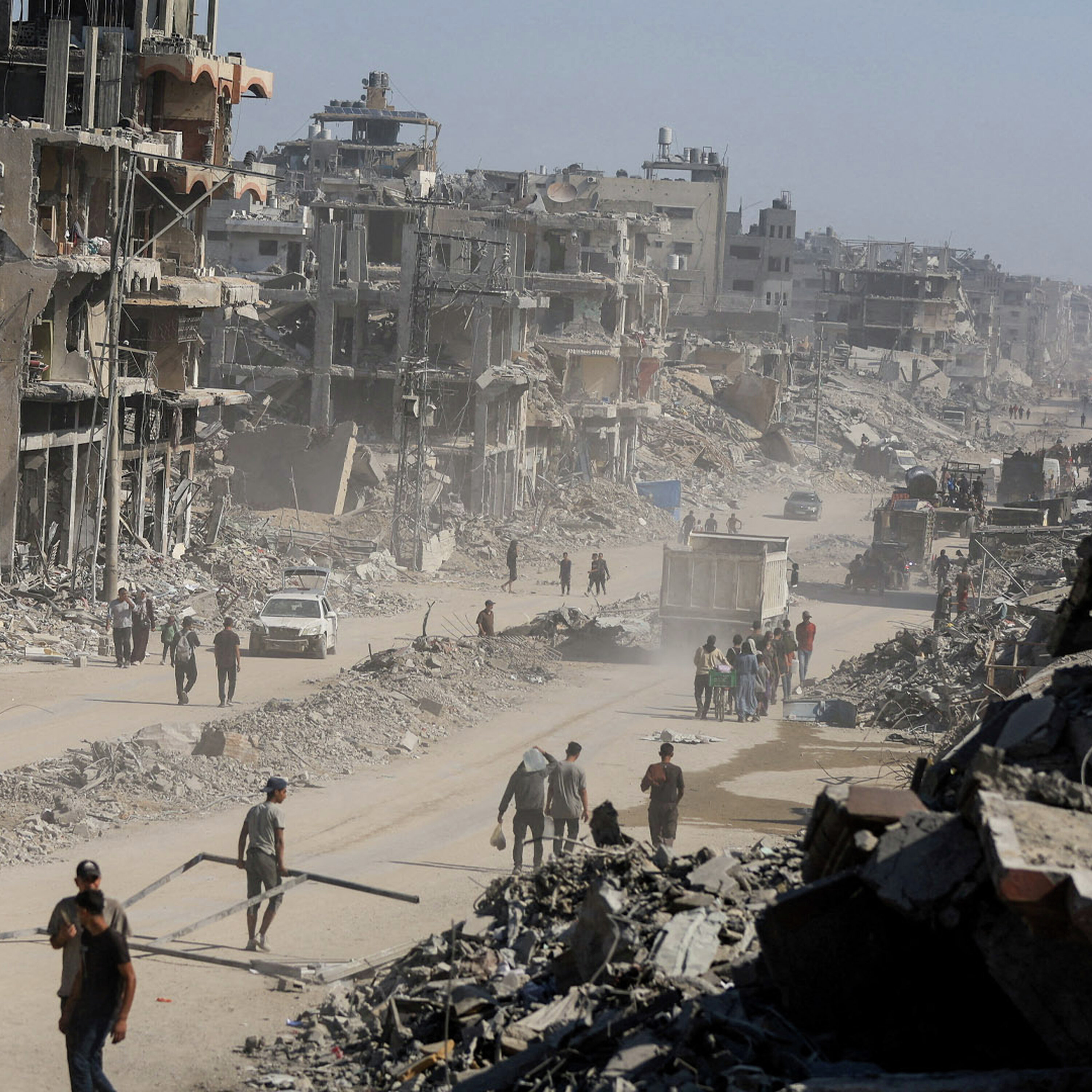
We start with where performative politics meets reality on the ground and the disconnect between what Donald Trump is saying about his ceasefire deal in Gaza and what it has really meant for Palestinians there. So far. Trump failed to win the Nobel Peace Prize, but the Venezuelan politician who did win it is doing her best to make it up to him. His actions have been decisive and move over boys. Make some room for some right wing women American influencers, the pro maga womanisphere the ceasefire in Gaza has been hailed as an historic breakthrough, albeit primarily by its chief architect, Donald Trump, and to a lesser unconvincing extent, by America's allies in Israel. For Palestinians, however, it's a different story. Israeli killings have continued. Tons of humanitarian aid is still blocked at the border, people are still going hungry. Captives have been released, 20 Israelis held in Gaza with 2,000 Palestinians freed from Israeli jails and the reporting on that provided yet another case study in double standards. The that helps explain why Israel was allowed to inflict its genocide on Gaza for so long. The Israeli captives have names, they have faces stories, whereas the Palestinians released go unnamed, their stories go untold. And Israel is still blocking international journalists from entering the genocide zone, which does not bode well for Palestinians. Contrast what's happening in Gaza with the way the ceasefire was announced in Egypt and it's like comparing a horror show to a piece of political theater directed by many of the same actors, politicians who, lest we forget, enabled and empowered the Israelis to commit a genocide in the first place. A ceasefire hanging by a thread over a land covered in an estimated 55 million tons of rubble. More than a million Palestinians living in tents still going hungry with not enough aid trucks getting in Israel's latest pretense for blocking them and threatening to blow up this ceasefire. The bodies of all the dead Israeli captives have not yet been returned. Hamas says it cannot find those 19 bodies in all that rubble to dig them out. In Gaza, where at least 67,000 Palestinians have been killed and tens of thousands more are still missing and presumed dead, but unable to be located either under that same sea of wreckage.
- [03:38]
Analyst 1
This was going to take quite some time because the entire territory has been reduced to a pile of rubble. Hamas doesn't have the heavy equipment and sufficient information to even locate where these corpses are.
- [03:52]
Analyst 2
It's almost as though Netanyahu is deliberately trying to find a pretext to return back to open warfare. Three days just simply isn't enough when Palestinians haven't even been able to recover their own debt.
- [04:05]
Commentator
They don't care about the hostages. It's about occupying Gaza, continuing the genocide. They want to use this so called violation to go back to fighting. Will Trump allow it? It's another question.
- [04:19]
Reporter 2
From the moment it was announced through to its signing in Sharm el Sheikh, Egypt, this ceasefire has had a precarious feel to it. Largely because, fanfare aside, the devil is in the details and this deal has precious few to offer, regardless of how Donald Trump described it.
- [04:37]
Reporter 1
We're going to be signing a document that's going to spell out a lot of rules and regulations and it's very comprehensive.
- [04:45]
Reporter 2
More than 20 countries sent their leaders to attend, including the UK, France and Canada. Politicians posing as peacemakers while their governments still ship weapons to and neither the Israeli Prime Minister nor Hamas's leaders were even in the room. Added up. And what was presented in Egypt was not even a ceasefire agreement. It was a declaration of what should happen rather than an agreement on what will happen. A wish list effectively made in Washington.
- [05:18]
Analyst 1
If you look at the communique that was issued at the Sharma Sheikh summit, it's just one platitude after another. It says absolutely nothing about the substance or content of any peace. It just basically lauds Donald Trump as a great peacemaker and issues a bunch of platitudes about how important peace is, but what that peace is supposed to look like, when it will be achieved, how it might be achieved. There is not a word in the declaration about that.
- [05:50]
Reporter 1
We shouldn't believe that Trump has suddenly been converted to some kind of benevolent overseer of the Israeli Palestinian context. This is a guy who two minutes ago was arming, was aiding and abetting a genocide. The summit in Egypt was clearly the victory celebration that Trump wanted, but Trump has the attention span of a flea. And what's going to be required here is sustained pressure on Netanyahu not to simply resume the genocide now that the hostages are freed. It's unclear whether Trump can do that, but he's not going to get a Nobel Peace Prize for a temporary halt to the genocide that then picks up again.
- [06:34]
Analyst 2
Sharm El Sheikh can probably be best described as a ceremonial moment. It was political posturing for those states involved in this summit. They are actually deeply complicit in what we have seen unfold in the last two years. And I think, if anything, this really sort of assists them. It's a successful PR stunt in terms of assisting themselves as well as Israel in avoiding any kind of accountability, especially once the dust settles and where many of these states and institutions have a lot to account for.
- [07:05]
Reporter 2
Palestinians would put more stock into this ceasefire and its chances of lasting if so many Israelis were not itching for the fighting to continue. They're unconvinced by what Benjamin Netanyahu is saying. Publicly and together, Mr. President, we will achieve this peace. Saluting Donald Trump when everyone knows Trump forced the Prime Minister to sign up to the deal. Netanyahu's Defense Minister, Israel Katz, tweeted that the Israeli military still must destroy Hamas's tunnels in Gaza and that he has ordered it to do so. The far right Finance Minister, Bezalel Smotrich, warned against, quote, short sighted celebrations and the Knesset voting in favor of the ceasefire. The lethal airstrikes continue, including one that killed at least five civilians in Shejaya in Gaza City. And perhaps most concerning of all, the Israelis are still locking the international media out of Gaza, which suggests even more war crimes are coming that they do not want the world to witness.
- [08:10]
Commentator
The fact Israel is preventing international media into Gaza shows us they understand the potential damage of journalists going in there. International media could do research, could talk to people, and this is why Israel is fighting. A petition of the Foreign Press association here in Israel to allow journalists in. They know when Gaza opens to journalists, this will change completely. And the protest and the objection to what Israel did will only grow the opposite from what the Israeli government and the public are maybe hoping.
- [08:46]
Reporter 2
Anyone examining Western media coverage in search of double standards need look no further than the reporting on the latest release of captives. The freeing of 20 Israelis, including soldiers captured in Gaza, has attracted much more coverage, much more empathy, than the 2,000 Palestinians freed from Israeli jails. Profiles and photo galleries of the Israeli captives, most of whom emerged in far better condition after being held in Gaza, where there is a severe shortage of food and medicine, than the Palestinians released from Israeli jails, where there are no shortages at all. And these were not isolated cases of journalistic bias. It was an across the board systemic pattern on the BBC and cnn, in the New York Times, the Washington Post, and Deutsche Welle and news agencies like the Associated Press.
- [09:42]
Commentator
For international media, it's much, much more easy to relate to the Israeli hostages because it was the international campaign.
- [09:48]
Reporter 1
They're holding onto their sons exactly the.
- [09:50]
Reporter 2
Way they usually would hold on to your son.
- [09:52]
Commentator
They're seen as Western citizens who were kidnapped to Gaza, and there was international campaign and support all across the world. Palestinians that are held without a trial is unfortunately something not new that is happening for dozens and dozens of years. And Israel kind of normalized it, the occupation system, both in the west bank and in Gaza. So it doesn't seem as something new as news for most people when it.
- [10:18]
Analyst 2
Comes to Israeli hostages. Western media have often presented those hostages being released in this round as civilians. That completely obfuscates the reality here, which is many of those that have been released are soldiers. And the fact that not only has the Israeli administration tried to present those hostages as civilians, but worse yet, that Western media has parroted that, has been so incredibly detrimental to the decontextualization and obfuscation of facts here, which are that those are legitimate combatants in the context of war.
- [10:52]
Analyst 1
The corpse of a dead Israeli captive meant more to Washington than the lives of many thousands of Palestinian children. I have no doubt that we're going to see a detailed profile of every single Israeli captive in Western media. The Palestinian is at best a statistic. A young autistic Palestinian child seized from the Gaza Strip and kept in the most inhumane conditions. He is, for all intents and purposes, a terrorist. Because it's common for the Western media to ascribe humanity to colonial powers and ascribe only the most sinister motives to their darker victims.
- [11:42]
Reporter 2
All while the Israelis maintain the most inhumane of pressure tactics, capitalizing on Hamas failure, its inability to dig out the last of those Israeli bodies, to keep blocking aid to kill even more Palestinians.
- [12:06]
Reporter 1
The Israeli government shows itself willing to starve Palestinian civilians as a way of getting at Hamas. Hamas says that it's trying to find the bodies. It's that they're hidden in the rubble. Even the US Government seems to believe Hamas. But Israel, rather than trying to pressure Hamas directly, is again trying to pressure Palestinian civilians. That is the essence of a war crime.
- [12:33]
Reporter 2
This year's Nobel Peace Prize went to a Venezuelan opposition leader and not to Donald Trump, who kept telling us he was the most deserving candidate. And the winner, Maria Corinna Machado, has dedicated her victory to the Venezuelan people and to Trump. Meenak Shiravi has more on what her end game might be.
- [12:53]
Narrator
After learning that she had won the Nobel Peace Prize. Maria Corinna Machado went on Fox News to explain why she was dedicating it to Donald Trump.
- [13:01]
Narrator 2
Not only has he been involved in.
- [13:03]
Narrator
Only a few months in solving eight wars, but his actions have been decisive to have Venezuela now at a threshold of freedom. Machado was pandering to Trump, echoing his misleading claim of having ended eight wars and attempting to press Trump to to lean harder on Venezuelan President Nicolas Maduro, who has been in power for 12 years. Machado is the latest of a number of popular Venezuelan opposition politicians to have the tacit backing of the United States. It's a pattern decades in the making. For more than 25 years, Venezuela's left wing government has openly opposed US influence in return, Washington, citing some valid and some exaggerated human rights and political abuses, has imposed economic sanctions on the country. It's also offered its support to opposition candidates. Trump's officials now routinely refer to Venezuela as a narco state and have openly advocated for regime change there. They have an ally in Machado. And while she might be welcomed on US channels, Venezuelan media outlets, which face severe restrictions under Maduro, are of a different view. Telesur ran this headline on Machado. From coup plotter to Nobel Peace Prize.
- [14:14]
Reporter 2
Winner For years, the right wing blogosphere in the US has been male dominated hordes of podcasters and influencers swaying more men into Donald Trump's MAGA movement. But the 2024 election, where the president gained a bigger foothold with women, shone a light on a rising parallel force, the so called womanosphere. Its mission to to rebrand conservative politics as cool and engaging for a female audience. Through YouTube channels, social media and podcasts, conservative women now offer hot takes on pop culture, snippets of everyday life and relationship advice, all spiced with a heaping helping of right wing politics. Like their male counterparts, they frame themselves as anti woke warriors while offering women disillusioned with feminism a more traditional alternative. The listening posts Elettra Scrivo now on the women of MAGA and how they are strategically targeting and luring even more women into the fold.
- [15:18]
Narrator 2
Of all the absurd pronouncements Donald Trump has made, some of the most inflammatory have been about women.
- [15:24]
Reporter 1
I've said that if Ivanka weren't my daughter, perhaps I'd be dating. She turned on a man like a dog. But no, she's crazy as a bedbug.
- [15:31]
Reporter 2
That is one dumb woman. Sorry.
- [15:34]
Reporter 1
I'm sorry women. She's a dummy.
- [15:37]
Narrator 2
Despite the overt objectification and regressiveness in Trump's view of women. His MAGA movement commands substantial female support, including from several women who hold prominent positions within his administration. The first female White House Chief of Staff, Susie Weil.
- [15:54]
Reporter 1
Stand up, please. Suzy Weil.
- [15:56]
Narrator 2
The youngest ever Press Secretary, Caroline Levitt.
- [15:59]
Reporter 1
It's that face, it's that brain. It's those lips, the way they move. They move like she's a machine gun.
- [16:05]
Narrator 2
A female Attorney General, Pam Bondi has.
- [16:08]
Reporter 1
Done an unbelievable job.
- [16:09]
Narrator 2
And a female Secretary of Homeland Security, Christina.
- [16:13]
Reporter 1
She's unbelievable. I was watching her riding yesterday on a horse. She was as good as anybody.
- [16:19]
Expert 1
If you want your movement to be successful, successful, to be popular, to be cool, you need charismatic, smart, funny, attractive women on board. It's often assumed because women aren't hugely visible in the far right, that they aren't present at all, but that's actually never been the case. Women have a really important role in any far right movement which wants to soften its image, which wants to look more palatable, less extreme.
- [16:50]
Expert 2
I don't think there was an intention of, let's, you know, soften the image of the administration. I think it was simply merit based. American women feel empowered knowing that someone like Pam Bondi is the Attorney General, that someone like Tulsi Gabbard is Director of National Intelligence. These are critically important roles for this country. And these women are performing so incredibly well because they're smart, they're capable, they care, they're loyal, they put family and faith first, and they're America first.
- [17:23]
Expert 3
We're seeing women being placed symbolically in their roles as wives and mothers to promote the Trump administration's agenda around supporting nuclear families and creating, quote, pro life policies.
- [17:37]
Expert 2
I love my job as Press Secretary, but nothing compares to being a mom.
- [17:40]
Expert 3
But on the other hand, we're seeing an exposure explosion of the right wing ecosystem of female influencers.
- [17:48]
Narrator 2
Alternative right wing media was once a male dominated field. Increasingly, however, a cohort of women have carved out a space for themselves, the so called womanosphere. Blending Trumpian politics, conspiracy rhetoric, pop culture takes, and a provocative presentation style, they've climbed the YouTube and Spotify charts. There are those like Candace Owens, who lead on conspiracy theories that I would stake my entire professional career on the fact that Brigitte Macron, the current first lady of France, was born a man. Others, like Megyn Kelly, dissect MAGA's core political issues.
- [18:25]
Expert 2
Epstein had a very, very wide web of connections.
- [18:29]
Narrator 2
Then there are those who fill the Make America Healthy Again or Maja space, a movement critical of mainstream medical practices. At the forefront of that is Alex Clark a self defined cut servative. What if the Bible isn't just a spiritual guide but a health manual we've been ignoring? However, no one has quite caught Gen Z female audience's attention like Bret Cooper. After making a name for herself at the conservative media network the Daily Wire, she struck it out on her own. In January, at just 23 years old, she launched a YouTube show weaving her takes on the news with lifestyle content, political insights and celebrity gossip.
- [19:09]
Expert 2
Taylor Swift and Travis Kelce just broke the Internet with their engagement announcement.
- [19:13]
Narrator 2
Cooper's show was a runaway hit. The first episode received 3.4 million views and it now has more than 1.5 million subscribers.
- [19:22]
Expert 3
Brett Cooper she is a figure who is very adept at connecting with her audiences by coming across as authentic, accessible and responsive to her followers. She likes to talk about issues ranging from the use of hormonal birth control, trans issues, and what she attacks as unfiltered wokeness at universities, lesbian dance theorists.
- [19:46]
Expert 2
Or whatever the insane degree is that we want to laugh at today.
- [19:49]
Expert 3
But then she will also talk about the latest scandals happening within the Trump administration and gossip that's happening in Hollywood entertainment and media industries.
- [19:59]
Expert 2
We must talk about part two and now part three, four, five, six and seven of the Blake Lively Justin Baldoni scandal. Brett Cooper really was able to capture Gen Z and meet Gen Z where they're at. She focuses more on cultural commentary and then she combines that with everyday relatability. She's obviously conservative, but she's very strong, she's very independent, she's very educated, she's a powerhouse. So while she has conservative principles and she affirms marriage and faith and motherhood, she also is someone who believes in empowerment for women.
- [20:42]
Narrator 2
And that is precisely where the paradox lies. Many of these women, both online and those within the Trump cabinet, have boosted their career by telling other women to prioritize motherhood over their careers.
- [20:55]
Reporter 2
You can always have a career.
- [20:57]
Expert 2
It is not going anywhere but children, family, your husband, marriages. That is not a renewable resource.
- [21:06]
Narrator 2
Even if not explicitly discouraging them from joining the workforce. The message from right wing women has leaned heavily on emphasizing the importance of traditional gender gender roles. This feeds into a wider disillusionment with, quote, girl boss feminism. The promise that women could balance career, success, personal fulfillment and family often resulted in burnout at home, at work and even in dating. So the target for many of these women who sphere influencers is feminism, its historical achievements and those on the left who represent them. I blame feminists for almost every ill that we have right now, because there.
- [21:46]
Expert 2
Are many women who feel completely disillusioned and betrayed by the Democrat party, by liberalism, by radical feminism and this mentality, this kind of eroding of traditional masculinity and trying to feminize men to a point where men are going through this kind of backlash process because they feel like they have been oppressed and suppressed by feminists who have tried to brainwash American women into thinking that they don't need men, girl, boss, and treat them like crap. And these types of attitudes have led to an entire generation of women who spent their 20s focused on their careers and rejecting men.
- [22:28]
Expert 1
What they essentially mean is that, sure, this stuff might make you more free. Going to the office every day, earning money, not needing to rely on your man for a house, for safety, that might make you more free. Being able to choose when you have a baby or if you have a baby, that might make you more free. But it's not making you more happy. It's explicitly responsible for your lack of happiness.
- [22:51]
Narrator 2
In the 70s, women were given all sorts of lies.
- [22:57]
Narrator
Things that we were.
- [22:57]
Narrator 2
Told were going to improve our lives.
- [23:00]
Expert 2
Make them better, but are we happier?
- [23:07]
Expert 1
They turn the argument back on its head. Essentially, they say, was this really the right sacrifice to make?
- [23:16]
Narrator 2
While it's true that many women are burnt out, 55% compared to 42% of men, according to an American Medical association survey, and they're having fewer children, the problem isn't feminism per se. Rather, it's things like the disproportionate burden of unpaid labor women face or the structural gender inequalities in the workplace. And the antidote to these issues is not selling nostalgia as empowerment.
- [23:42]
Expert 3
Instead of focusing on the solution that governments and societies should support young people in trying to find employment, buying a house, and starting their lives, we're seeing the right instead offer this alternative vision of focusing on building families and sort of retreating into traditional gender roles where women are the homemakers instead of participating in public and civic life.
- [24:12]
Expert 1
I think this demonstrates how for progressives, there needs to be a more concrete and confident argument in favor of women's rights. It's not enough simply to say, well, look how terrible things were back then. That's just increasingly not effective as an argument. This is important for people to remember that simply because we're saying we don't want to go back to the past, it doesn't mean we're saying everything right now as it stands, is perfect.
- [24:40]
Reporter 2
And finally, a Washington Post investigation has revealed how the Israeli government used YouTube ads to rewrite the narrative of Gaza's famine and how YouTube's owners at Google were more than okay with that. This is real footage of Gaza food markets July to August 2025 the post looked into videos like this one put on YouTube by the Israelis of a market in Gaza where the food looked plentiful. It found that the video was shot just after the Israelis had allowed supplies into the strip after months of restrictions and the products were sold at prices most Palestinians simply could not afford. An internal Google email obtained by the Post shows that the company decided the ads did not violate its policies and went further. Staff were told that any future Israeli videos making similar claims about food or famine in Gaza would not violate Google's rules over safety and trust. The message was clear. Google's rules, which can be quite restrictive to, did not apply to Israeli misinformation. They say the truth is the first casualty of war and the people behind YouTube and Google have been accomplices, willing ones in Gaza.