← The Listening Post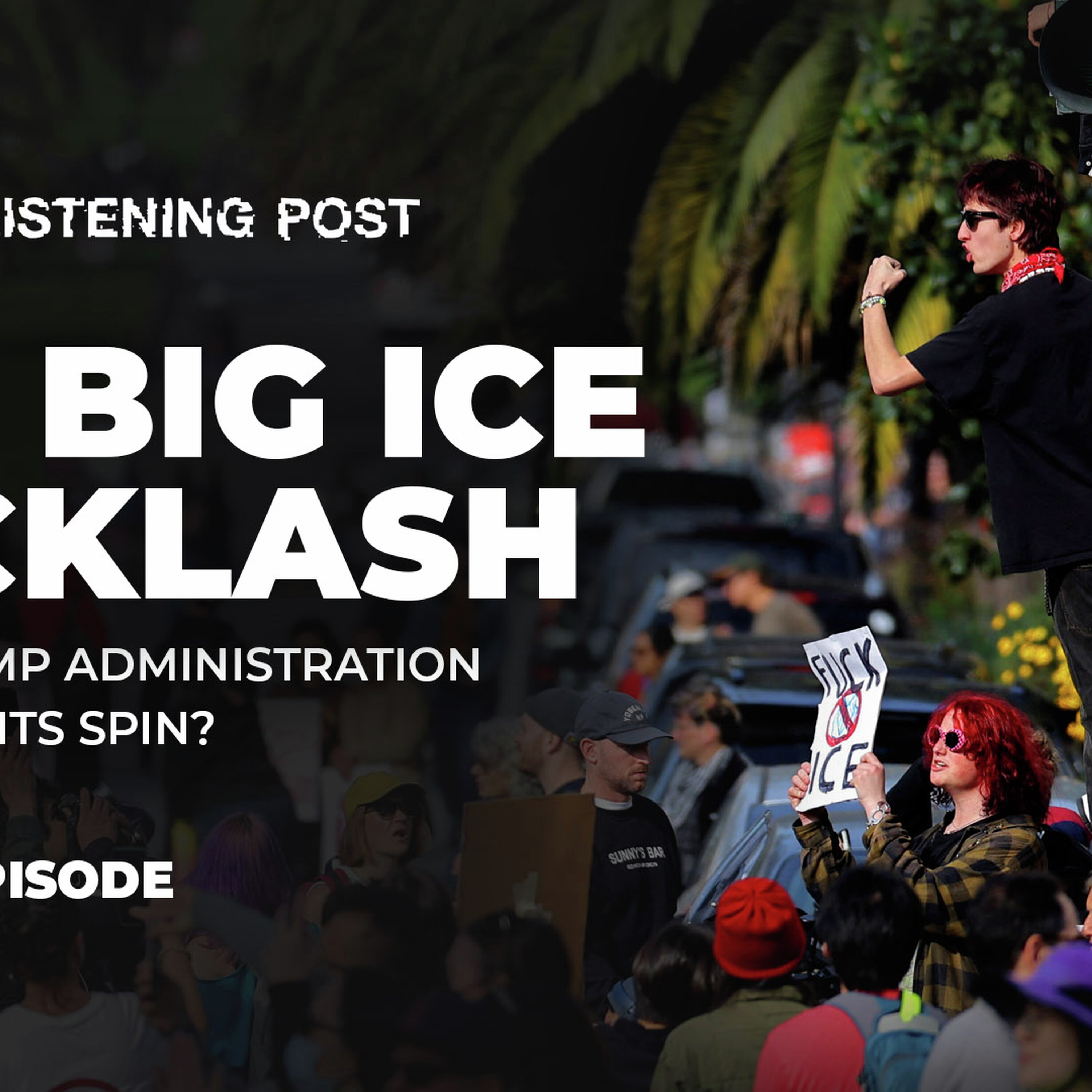
Loading summary
Transcript39 lines
- [00:01]
A
This week on the take, we're marking.
- [00:03]
B
One year since a pair of devastating.
- [00:05]
A
Earthquakes hit Turkey and Syria with a new digital interactive. Listen and watch stories of survival, recovery and coping with the grief@al jazeera.com earthquakes Again, that's al jazeera.com earthquakes it turns out that facts and evidence do matter, even in Donald Trump's America. We examine the aftermath of that shooting in Minneapolis and the protesters who eventually captured the narrative with their phone cameras. An exodus is underway at TikTok. Users in the US are fleeing the app after a corporate takeover. Plus setting the fourth estate. We focus on the media in Bangladesh. As the country prepares to go to.
- [00:57]
C
The polls.
- [01:03]
A
Americans are still coming to grips with what happened in Minnesota. The killing of another protester there at the hands of border control forces. The fallout from Minneapolis to Washington led to an unexpected test of Donald Trump's administration. It has challenged how this White House accounts for its actions, how it responds, shields itself when its authoritarian ways are questioned. The escalation of immigration enforcement also includes a disturbing high tech angle. The feeding of personal health data on a huge scale to border control agents to help them hunt down immigrants. This past week, the White House's approach took a hit. Not because a judge intervened or Congress asserted itself, but because of the evidence captured by people Minnesotans, protesters documenting through their phones what had unfolded on their streets. There was just no spinning it. Not that the Trump administration didn't try. The American people have sent a collective message to the Trump White House. The gaslighting has to stop and we are going to hold them accountable.
- [02:12]
B
1, 2 We do.
- [02:17]
A
That. The two US citizens killed by immigration enforcement officials over the past three weeks, first Renee Goode, then Alex Pretty were not what the Trump administration said they were domestic terrorists and that the spell the narrative has been broken.
- [02:34]
B
You would have to be blind and.
- [02:36]
A
None of you are to notice the.
- [02:37]
D
Massive disconnect happening right there.
- [02:40]
A
All in all, virtually nothing that the administration said in the immediate hours after this killing matched up with what the video showed.
- [02:48]
E
The Trump administration called Alex Preddy a terrorist, an assassin. Stephen Miller smeared him as such. JD Vance boosted and retweeted that this sort of version of language is the state's final attempt at violence. It is to take your sense of reality and to steal it, to pervert it by taking away Americans right to know what's being done in their name, the right to facts.
- [03:14]
F
The administration's instinct, which was to slander Mr. Preddy, wasn't sustainable. An individual approached u. S. Border patrol.
- [03:22]
B
Officers with a 9 millimeter semi automatic handgun.
- [03:25]
F
Going out there to document and record the actions of federal agents, community members who see what happens and instead of hiding, they're going out there to document and to provide assistance to people who are being hurt. People really just was like, you know, this is, this is a bridge too far where they're smearing these people, calling them domestic terrorists, when what happened was clearly not that. And these incidents happening so close together and the administration being so aggressive and demanding that people believe their lies over what you could see with your own eyes was really what really caused that to kind of break through, de escalate a little bit.
- [04:03]
A
A breakthrough that forced Donald Trump to talk about a de escalation in Minnesota. Although there has been no significant withdrawal of the enforcement agencies at workfair, for the president to do that now after investing so much into the border control issue would be like admitting defeat. Just 10 years ago, the annual budget for the Immigration and Customs enforcement agency, or ICE, was less than $6 billion. Last year, Donald Trump pumped another 75 billion into ICE to be spent over the rest of his term, turning the agency into a sprawling military. Its growing number of officers get skimpy training but now roam the country disproportionately, targeting states like Minnesota that vote democrat over republican states with far more immigrants like Florida or Texas. And the organization enjoyed a form of legal immunity that according to the White House was absolutely.
- [05:04]
C
So we have this unholy trinity of no training, no oversight, unlimited funding, effectively and just grotesque violence against innocent people with impunity. There is still no prosecution. There is still no acknowledgment that this was a cold blooded execution and there has been no retraction of the funding. The solution has to be abolishment and prosecution. Anything short of that is compromising with fascism and extremism and it's unacceptable.
- [05:35]
E
I had traveled to Minneapolis right after the killing of Renee Nicole Goode and joined a rapid response network of community residents to monitor their neighborhoods and watch out for ICE agents. Do you have ICE agents putting their phones right in residents faces to scan their faces into this mysterious database recording their license plates? ICE agents following residents to their homes or places of work. The amount of just complete and utter state surveillance in all these cities is shocking and jarring to an unbelievable degree.
- [06:11]
A
The Trump administration does not tend to respond to pressure from social media or mainstream news outlets that the president has consistently maligned like CNN and the New York Times.
- [06:22]
B
CNN is scum and so is Ms. Dnc.
- [06:25]
A
They're Fox News is a different matter. And we saw circumstantial evidence of that last Sunday when the Murdoch owned network uncharacteristically reported that internal dissent was on the rise at the Department of Homeland Security because of the narrative the administration was pushing over the pretty killing. The next day, a Fox anchor suggested heads should roll, one in particular. And before the day was out, one did.
- [06:54]
B
Border Patrol commander Greg Bovino and some.
- [06:58]
A
Not all Border Patrol agents are leaving Minneapolis as soon as tomorrow.
- [07:03]
F
One of the things that Fox has always done is talking to Trump through the tv.
- [07:07]
A
I think the president has to handle it mentally like he is on the ballot.
- [07:12]
F
Trump is an avid Fox News viewer and Fox News host Brian Kilmeade in particular likes to give Trump advice. Media matters. We've call it the Fox Trump feedback loop. And we've been documenting this since his first administration.
- [07:27]
C
Fox News is outstanding at disinformation and pushing a narrative of disinformation. They probably saw that Greg Bobina's popularity was waning, said, hey, we're losing this narrative. It's time to shift gears and get a new face in there. And then, because Trump watches Fox News more than he's actually in the White House, he said, yeah, sure, that's a good idea.
- [07:46]
F
I don't buy for a second that getting rid of any one of these individuals is going to fundamentally change things on the ground, where we've seen entire business districts turned into ghost towns and people afraid to take their children to school. And whether it's Greg Bovino or Tom Homan standing in front of the camera, what we really need is serious policy change.
- [08:07]
A
The Trump administration's reflexive response to the latest shooting smacked of the Orwellian and has Americans quoting that line from the novel 1984. The party told you to reject the evidence of your eyes and ears. It was their final, most essential command. Another dystopian element in the mix is Palantir, the tech giant closely connected to Vice President J.D. vance. It has turned the health data it collects on Americans into a form of mass surveillance, giving it to ICE and other agencies to help them locate and target people.
- [08:46]
C
Palantir is an example of the danger of the fusion of billionaires and politics. And now that they've effectively purchased the White House, there's just a complete blending of the two. This dystopian futuristic tech company is open about violating our personal civil rights. And unless we remove their influence from this, that risk to continue transforming us from a republic into an authoritarian regime remains extremely high.
- [09:15]
A
Because the problem for Any authoritarian state is when the surveillance gets turned its way through the cell phone footage that has proven vital in countering the official lies that followed the killing of Alex Pretty and Renee Goode before him. For all the talk of Pretty carrying a gun, which is legal in the US the more menacing weapon he had may have been his phone. His ability to document the crackdown on the streets. When they know we've seen the truth. Sometimes satire can be as effective in telling a story as journalism can. And comedian Jon Stewart provided an example of that when explaining what the masked men going after those immigrants saw in Pretty. What they may have really feared because he was brandishing a weapon, a handheld aluminum 1080p 60fps weapon of mass illumination. Because there is nothing more dangerous to a regime predicated on lies than witnesses who capture the truth.
- [10:21]
F
The ability of people to record the actions of the Trump administration have been so important. It's also a testament to the courage of people who are out there on the streets. They still believe in the promise of our democracy. I hope that through the power of the people, including the documenting and the protesting, we turn the tide and we prevent the Trump administration from further undermining our democracy. And that's why they're so aggressive towards people filming them. They're scared because they want to lie. Imagine what they're doing behind closed doors where those cameras don't exist. We need that accountability, and the brave people out there with their cameras showing it.
- [11:03]
E
Technology has been used for both evil and horrific ends and beautiful and powerful ends. Forensic technology can separate us, can radicalize us, can make us believe the worst in each other, and yet we've seen how they've incited an inspired revolution, how they've told the truth even when the state insisted insists you believe the opposite. In this moment, we're seeing the best possible ends of what technology can do, and it's helping us tell the truth in the face of a state that insists you see the opposite.
- [11:39]
A
Just days after a consortium of mostly American companies and investors, many of whom have links to President Trump, took over control of TikTok in the U.S. users of the app there say they've encountered all kinds of censorship. Tarek Nafa is here with the details.
- [11:56]
D
Almost immediately after TikTok's ownership changed hands, users were saying that content inconvenient to Donald Trump was being censored. Some creators said they were unable to upload videos about ICE and Palestine, and that when they did, those posts received suspiciously low engagement for a brief period. Some users reported that mentioning the name of convicted paedophile and longtime friend of Donald Trump, Jeffrey Epstein. Indirect messages triggered content warnings TikTok has dismissed allegations of censorship and blamed technical glitches on a power outage at a data center. But the allegation that the company was limiting content led California Governor Gavin Newsom to announce an investigation into whether TikTok is violating state law by censoring content critical of President Trump. The new owners have close ties to the president. They include tech giant Oracle, founded by billionaire Larry Ellison, a longtime ally of Trump, as well as Michael Dell of Dell Technologies, also a Trump supporter. The new ownership and the suspicion of new forms of censorship appears to have led to a mass exodus from the app. One market intelligence firm said that average uninstalls grew by 130% this past week compared with the previous 30 days. And as TikTok seems to be falling out of favor with young people, users have flocked to a new rival called upscrolled, which is backed by the Tech for Palestine incubator. The platform says it has a commitment to no censorship and no shadow bans. The last time we checked, it was the number one downloaded social networking app on Apple's App Store.
- [13:43]
A
Thanks, Tarek. Bangladesh has been going through a year and a half of political turbulence. In August of 2024, the longtime prime minister Sheikh Hasina was forced from power by a student led uprising after years of increasingly authoritarian rule. The initial hope that came with her ouster has since given way to a deep social polarization, political violence and a great deal of fear. With the first post Hasina elections just weeks away, things have been intensifying. Last month rioters set fire to the offices of two of Bangladesh's most influential newspapers, Protom Allo and the Daily Star, while journalists were still inside those buildings. Slander on social media, baseless accusations that were then taken up by the rioters sparked that attack. To get an idea of where Bangladesh now is politically, how it got there and what lies ahead, we spoke with the editor of the Daily Star.
- [14:41]
F
Mahfouz Anamgladesh saw one of the worst episodes of violence targeting medians.
- [14:58]
B
At least three incidents of arson were reported in the capital, including fires. Crowd ascended on the English language dailies office. I mean the attack was most devastating for someone who spent his whole life in ethical journalism in trying to establish a, you know, a journalism of accountability, of authenticity. It was most devastating. It was about 10:15 to 10:30 they attacked Prothumalod and they came to ours about 11:30 to quarter to 12 they set fire and we had our second edition team working in the newsroom and when they realized it they wanted to get out of the building. But they came down a few floors and they saw the fire. I mean it was absolute panic. I mean they were having problems breathing. I was talking to the newsrooms over four and they were telling me Mahafuz bhai, we may not meet again. They were ringing their parents, their wives, their friends and saying maybe they will never meet again. Now people who actually acted and set fire into the building, I don't think none of them are readers of the Daily Star. A they don't read the Daily Star. B I don't think they read English language newspaper. So what motivated them? I think it was well planned. They had their political motivation, financial motivation and there was also idea of demolishing the tradition of liberal journalism, of journalism that supports democracy, of multiplicity of views of dissent in a very big way. I mean our reporting, if it is flawed, somebody can say it. We can be pointed out, we can be criticized. But to burn us down. I think this is most, most unfortunate. We have entered into an era of murder, non procastolic duragacy. Starting with the Hasina era. I think her rule of last 15 years unbroken is epitomized by one act which was called the Digital Security Act. This encapsulates Hasina government's total dominance of dissent. They had 20 provisions for punishment, 14 of which were non bailable. So the whole idea was to create an environment of fear. Society goes into a total period of silence. Some cartoonists were punished, some teachers who made some very innocuous Facebook post were picked up in the middle of the night. I have had 83 cases launched against me by Hasina government. Mr. Motir Rahman, the editor of Protomalo had a murder case allegation against him. Our advertisement were stopped, our revenue dropped by about 40 to 45%. Suddenly none of my reporters were ever allowed to cover PM's events and she personally attacked me on the floor of the parliament. Definitely today we have far more free mainstream media, more investigative stories. Independent thinking is definitely much more prominent than before. But that overriding fear that if I am slightly deviating from the present popular narrative that I might be attacked also exists. To tell you frankly, we sometimes think, think very carefully that should I use this word or that word now this sort of thinking which is really, I would say anti independent media culture also now exists. Another very negative phenomena happened over the years. Journalists became divided. So now we have very prominent pro one party Journalist, another pro, another party journalist. So imagine that when it is, when a public sees that a journalist who is supposed to tell me the truth actually belongs to a political party. So the credibility of that media outlet, the belief of the readers of a paper or viewers of a television suffered greatly because of the political division within the journalist community. Many people get involved in social media and express their views. But again, as it has been the global experience that all this freedom has also brought about a huge amount of fake news, of hate news, of unsubstantiated acquisition. The use of social media to denigrate something, some other individual, some other institution is also a reality in Bangladesh. Some political parties have taken good advantage of it and they have been well prepared. They created their own, if you like, social media team. So if you say anything against this particular political party, suddenly hundreds of people will start abusing you. And if you say something nice again, hundreds of people then start praising you. So the use, the political use of the social media is very much in vogue now. It is well known to anybody who followed the social media that night that there was one influencer who said, protomala is down now go to Daily Star and you know, attack this. Some people were trying to destroy us as an institution. And by the way, all the criticisms that have been made against us have not been substantiated. Sometimes we were cited totally out of context. So it has been a very deliberate, very powerful and I must say, sadly effective way of, you know, denigrating two powerful mainstream media of Bangladesh. Elections are coming up. We haven't had a good election since 2014. So everybody, the whole country is excitedly waiting. People of Bangladesh believe very deeply in democracy. For them, election is one of the things they always look forward to. And one of the reason that Hasina had become so unpopular was the fact that, that she distorted, she manipulated the last three elections. So when you have a nation who have been deprived of three elections and now we are going to the fourth, the expectation from it, the wish to see that it really gives the people's will. All of this is working in the minds of the ordinary people. It is working in the minds of the common voters. And therefore the election becomes so important. Whoever get elected, they will not forget the fact about the fall of Hasina. And her fall was directly linked with her oppressive nature of the, of the government and also hurt government's treatment of the media. So our great hope is that this experience will definitely influence the future governments and as such we may see a bright future for free media in the future.
- [23:58]
A
And finally back to the story in Minnesota. Just one day after federal agents killed Alex Pretty there, the New York Times ran an editorial by one of its most problematic columnists, Thomas Friedman. In comparing the stories in Minneapolis and Gaza, Friedman chose not to focus on the state sanctioned violence executed by immigration officers in the US and the police and army in Israel. Instead, he reached for this parallel Hamas and ICE share one very visible trait that I never thought I'd see in the United States. Almost all of their foot soldiers wear masks. That column went viral and one of the most on point breakdowns came courtesy of a US based journalist, Ayman Mohildi. I thought that he would highlight how Israeli security forces who are regularly and routinely accused of human rights abuses, actually wear masks as well. In fact, the security guards who recently were accused of raping Palestinian prisoners showed up in court while concealing their identities. This is the same Thomas Friedman who wrote a piece last year titled Understanding the Middle east through the Animal Kingdom, where he compared the US to an old lion and Hamas to a trapdoor spider. In 2018, Friedman opined that the Middle east could prosper if it would put its past behind it and that the US should maintain its role as an honest broker, as surrendering it would only create more crazy, poor Middle Easterners. These are the kinds of editorials that reveal far more about the writer than the topic columns that the New York Times, the American newspaper of record, still considers fit to print.