Loading summary
Transcript57 lines
- [00:01]
Host/Anchor
This week on the take, we're marking one year since a pair of devastating earthquakes hit Turkey and Syria with a new digital interactive listen and watch stories of survival, recovery and coping with the grief@al jazeera.com earthquakes Again, that's al jazeera.com earthquakes.
- [00:28]
Narrator/Reporter
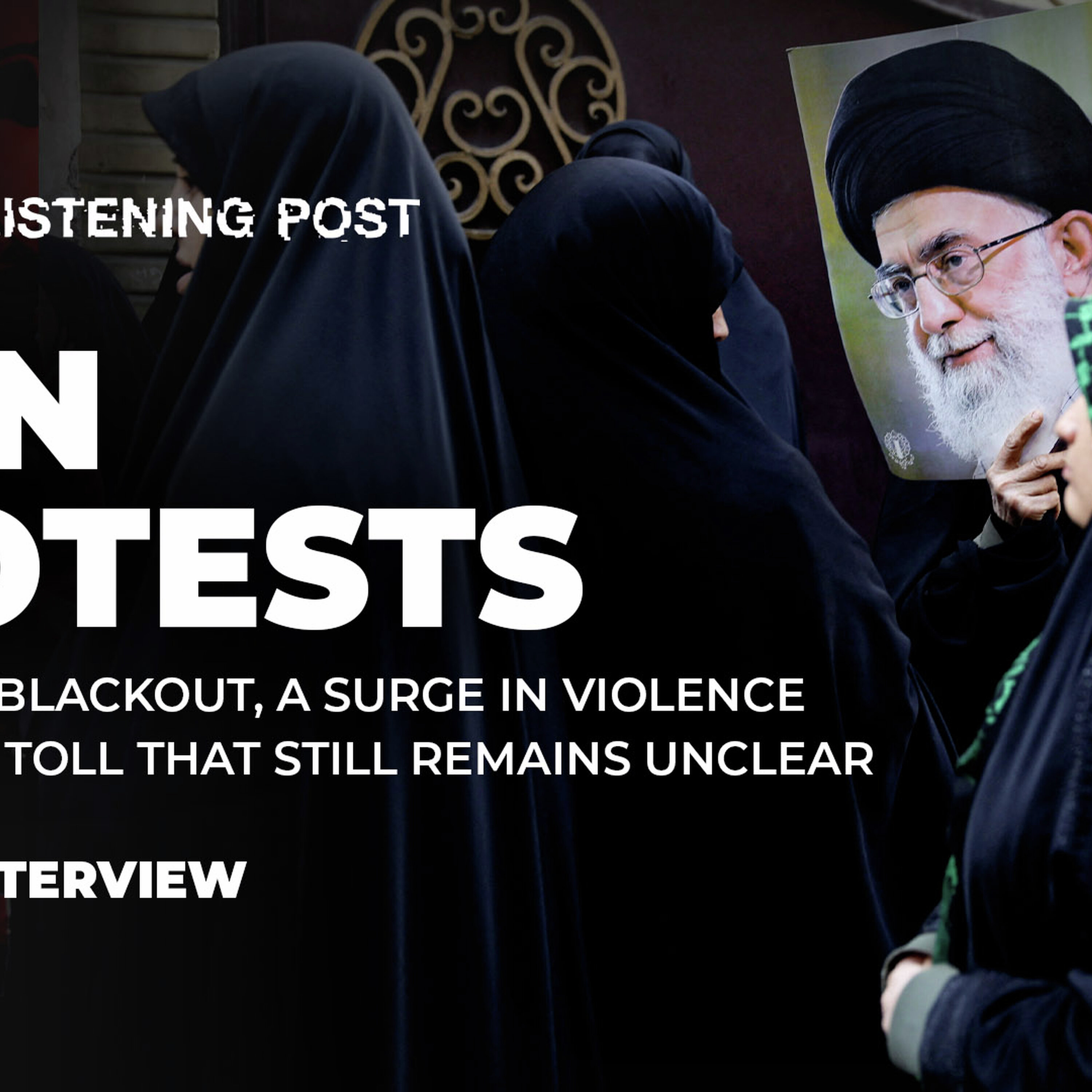
Iran after yet another series of nationwide protests, from the blocking of the Internet to the subsequent crackdown on the streets, we examine the narrative and the players inside Iran and outside who are driving. Has there ever been a more naked reworking of the truth than the Trump team's version of what happened that day in Minnesota?
- [00:52]
Host/Anchor
He defended his life and those colleagues.
- [00:53]
Narrator/Reporter
Around him and the public and artificial intelligence. What we know and what we think we know.
- [00:59]
Cory Doctorow
I'm sitting on your couch next to you as a hologram as opposed to.
- [01:03]
Narrator/Reporter
What we need to know about AI.
- [01:05]
Cory Doctorow
AI is the asbestos we're shoveling into the walls of a high tech society.
- [01:14]
Narrator/Reporter
Nationwide protests in Iran are into their third week. And while they appear, at least for now, to be subsiding, the geopolitical fallout has not. Both the Trump and Netanyahu administrations and their affiliated media have dialed up the rhetoric, with the American President repeatedly threatening Tehran with war should it crack down too violently on the protesters. Now, whether Trump means that or not is open to question, but as anyone and most recently the Venezuelans can tell you, he has shown himself capable of brash and illegal actions before. What complicates this situation further is the prolonged and extensive Internet blackout imposed on Iranians. Not only has it choked off communications there, but it has blocked most of the video evidence of the violence and the estimated thousands of casualties from reaching the outside world, which has left significant parts of this story in the hands of Iranian officials and news outlets there that are not known for deviating from the narrative controlled by the state. Iranian protesters are familiar with the warning signs. As nationwide demonstrations erupted for the fifth time in nine years, they understood what it meant when the authorities cut off access to the Internet. They feared a crackdown was imminent. And those fears were soon realized.
- [02:40]
Media Analyst/Expert
There was a complete Internet shutdown. Suddenly the pictures were reduced significantly and the government had total control of what information was going out, showing the United States and Israel, the two countries that had threatened intervention, that it was not weakened by these demonstrations, that it was very much in power.
- [03:04]
Political Analyst/Commentator
It could also be a veil under which it's committing a large scale slaughter of Iranians. In the early days, the estimates were in the hundreds. Now we're seeing estimates in the thousands. But on a broader media narrative level, state Media often serves the goal of instilling terror in the population and sending a message to the people. Don't come out and protest. It's dangerous for you. You or your children or your loved ones could die.
- [03:29]
Iranian Affairs Expert
We were witnessing new words like rioters or saboteurs from different Iranian officials. Words like terrorist groups or ISIS like behavior. But we have to keep in mind the very causes of these protests, which was the economic challenges, rising prices, high inflation and the drastic devaluation of the local currency. The cause remains out there, whether people take to the streets or not.
- [03:59]
Narrator/Reporter
As Al Jazeera's Tehran correspondent, Tawhid Eh Saadi is equipped to get a signal out. Interviewing anyone else, there is a real challenge. Under the most thorough Internet shutdown Iran has ever seen, even Starlink, Elon Musk's satellite network has been crippled, which, despite the fact that Starlink is officially banned in Iran, appears to be a first. Blacking out the net, blocking the protesters ability to organize and share news online has created more space for official messaging coming out of state controlled news outlets, which the powers that be have invested in heavily. For all of Iran's economic problems, the funding of those outlets has tripled over the past four years. State media have aired around 100 confessions from captured protesters, showing their remorse, possibly under duress. And there was this video. Dozens of body bags outside a makeshift morgue in Tehran and anguished Iranians searching for loved ones gone missing.
- [05:05]
Host/Anchor
This report that Iranian TV did is quite new. They've never done something like that before where they show dead bodies from protests and then they say that some of them were rioters and then others are ordinary people. There's two things that they really want to get out with this. One is to instill fear in people, to not continue to come out onto the streets and to say that people are also getting caught up in the line of fire between security personnel and those Asian provocateurs on the streets.
- [05:49]
Media Analyst/Expert
The Iranian government has shifted focus in the last couple of years by ensuring that its television system is fully up to date as a way to combat social media coverage. That does not mean that the government is not fully taking advantage of the social media space. It has its own influencers. The Iranian government is covering all communications angles.
- [06:18]
Host/Anchor
In previous years during uprisings, the Iranian state has referred to some protesters as rioters. But this time around, they started using the term terrorists. And it signals that the repression is quite hard and they are really taking seriously what Israeli and American officials have been saying publicly, that Israeli spies are on the ground in Iran, part of the much wider war and confrontation between Israel, the United States and Iran.
- [06:57]
Narrator/Reporter
Having just launched one foreign intervention in South America, Donald Trump is threatening another in the Middle East. The President has let the protesters know that he stands with them, warning Tehran not to execute any of them or the US Will act.
- [07:14]
Poet/Artist
If they start killing people like they have in the past, I think they're going to get hit very hard by the United States.
- [07:20]
Narrator/Reporter
Just seven months ago, the Americans and their Israeli allies launched a war on Iran that lasted 12 days, one they said was aimed at eradicating its nuclear program. More than a thousand Iranians were killed. Now Israeli news outlets are hinting that Israel has spies, operatives in Iran stirring the pot. The question is, are the Americans and the Israelis willing to go to war once again, or would they be satisfied with a lesser outcome? Are they just out to further destabilize the Islamic Republic?
- [07:59]
Political Analyst/Commentator
Is it in the interest of the United States and Israel for the Islamic Republic to fall? Certainly, and they make no bones about that. Now, do we see any evidence of their involvement? No real evidence has been proven. That being said, the goal of the Islam Republic, in framing this as the second part of a June war, is to paint the protesters as being either tools or foreign adversaries, to motivate the base, to not see them as countrymen, but as enemies that have to be killed. And then to motivate their own security forces to go out there and kill protesters.
- [08:31]
Host/Anchor
We have to be able to sort of hold multiple truths at the same time. Iranians are frustrated with their economic situation, which we have to also understand is tied to U.S. sanctions on the country. Eight years now of maximum pressure sanctions. So the currency crash is directly related to the sanctions on Iran. But because America and Israel seem to be so insistent that they are involved in these uprisings, the state is responding in kind. You know, it takes two to tango. And the Americans are being very loud about the fact that they are involved in this.
- [09:03]
Iranian Affairs Expert
We have been hearing a twofold message from Iranian officials. On the one hand, Iranian foreign minister, saying that Iran is ready to talk, looking for what they call a meaningful conversation rather than a dictation of the US Demands. On the other, we have the Iranian supreme leader who says that the other side, quote, unquote, the enemy was planning war against us. So there is a cloud of mistrust in between.
- [09:32]
Host/Anchor
Is the Iranian regime about to collapse?
- [09:36]
Narrator/Reporter
Once again, some news channels in the west have been platforming a name from the past who sees himself as a leader in waiting. Reza Pahlavi the exiled son of the Shah who was toppled in the Islamic Revolution of 1979.
- [09:51]
Iranian Affairs Expert
This time, people are on the streets.
- [09:52]
Cory Doctorow
To put a final end to this regime.
- [09:55]
Narrator/Reporter
Pahlavi has not lived in Iran for almost half a century, nor has history treated his father and his hated secret police, the Savak, kindly. But there, Pahlavi is calling for resistance, Including on Persian language opposition news channels based outside Iran, like Iran International, which comes out of London beyond the reach of the authorities in Tehran. However, Pahlavi's prominence says less about him than it does about the state of the opposition in Iran, where, despite yet another round of mass protests, there is no consensus on an alternative on who to rally around on the path forward rather than a way back.
- [10:50]
Political Analyst/Commentator
There's been this organic nostalgia that's risen up in society. What happened? Starting about 10, 15 years ago, we started having these much more slick, sophisticated media operations, Manito TV as well as Iran International, and they started supercharging that organic nostalgia into a meta narrative that divided everyone between pre1979 and post 1979. And it shows that the track record of the Islamic Republic over the last almost 50 years is such that the pre1979 period looks better in comparison. Right.
- [11:26]
Media Analyst/Expert
The Western media has focused on Reza Pahlavi, but the memory of the media is short because never has he developed a platform that has carried beyond each of these different uprisings. He has simply ridden on the wave of pro protests in Iran. And although there will be cases where demonstrators will be shouting support to Reza Pahlavi, it's hard to determine whether that is for him or simply the greatest insult possible to the Islamic Republic.
- [12:02]
Host/Anchor
You know, regime change or revolution is not just vibes. It doesn't just run on people being angry about something. It actually requires real shifts to happen on the ground. Pahlavi doesn't have that kind of sway in Iran, no matter how much money they're pouring behind him. But we're going to continue to see him nonetheless.
- [12:24]
Narrator/Reporter
In the U.S. the shooting in public of a woman two weeks ago by immigration officers has spiraled into a case of outright lying that is remarkable even by the standards of the Trump administration. His officials are defending the killing, and they're being backed up by by the administration's social media accounts. Ryan Coles has been across this.
- [12:44]
Ryan Coles
The Trump White House has a signature style when it comes to public communication, especially on social media. Their posts are habitually crude, often have no factual basis, and can be racist. In defending the killing of a woman in Minnesota by Immigration and Customs Enforcement, or ICE officers. The Trump social media team has added an AI generated government spokeswoman to the mix.
- [13:07]
Host/Anchor
I'm here to set the record straight on false reporting surrounding our brave law enforcement.
- [13:12]
Ryan Coles
In that video, in post after post and in various interviews, the Trump administration has flatly contradicted video evidence in multiple clips filmed by onlookers showing an ICE officer shooting that woman in a car.
- [13:26]
Host/Anchor
This officer was hit by her vehicle. She weaponized it. And he defended his life and those colleagues around him and the public.
- [13:33]
Cory Doctorow
To all ICE officers, you have federal.
- [13:35]
Political Analyst/Commentator
Immunity in the conduct of your duties.
- [13:37]
Ryan Coles
In an interview with CBS News, the channel bought out just months ago by Trump allied businessmen, the president justified intensified immigration raids.
- [13:46]
Poet/Artist
Hundreds of thousands of murderers in our country's killers. ICE is trying to get them out.
- [13:51]
Ryan Coles
Since the killing, there has been a surge of citizen videos documenting the tactics of ICE agents. Harassment on the streets, intimidation and aggressive arrests. Donald Trump's team can say what it likes, but those videos take those arguments and any pretense that these are targeted operations and destroy them.
- [14:09]
Narrator/Reporter
Thanks, Ryan. Read the news. And the rise of artificial intelligence technology is typically framed as inevitable. We are told that AI is a force that cannot be stopped, just managed. Headlines ask whether AI can make the world richer while companies pour hundreds of billions of dollars into data centers, chips, and models ready to transform everything from media to medicine. But behind the fanfare lies a deeper story about who controls the narrative on AI and who among us is at risk should those utopian promises fail to be kept. Cory Doctorow is a writer, journalist, and longtime technology critic. He has spent decades chronicling how the hope that accompanies the emergence of new technology often ends in disappointment. Cory Doctorow. Now taking apart the story we are being told about AI, how scrutiny has taken a backseat to the hype, and what's really at stake here.
- [15:07]
Cory Doctorow
I'm Cory Doctorow. I'm an activist and a journalist and a writer. I've worked for an American nonprofit called the Electronic frontier foundation for 25 years. I've written more than 30 books. But you know what's going to cause the collapse of the stock market? The two most boring initials in the world, AI. The reason that firms that currently employ creative laborers are so excited about AI is not because they want to make funny memes, right? It's because they want to zero out their wage bill. People who have a company called Open Artificial Intelligence, which is neither open nor artificial nor intelligence. There's a kind of bullying way of extinguishing opposition by trying to make you turn off your imagination. It was really pioneered by Margaret Thatcher, who coined this term. Tina. There is no alternative. She said it so often that people sometimes called her Tina Thatcher. And by this she means stop trying to think of an alternative.
- [16:18]
Narrator/Reporter
The world is responding and adopting AI.
- [16:20]
Cory Doctorow
Faster than ever before. Tech bosses, they're great practitioners of Tina. They want you to think that the only possible way to arrange human affairs is the way they've arranged them. You know, Mark Zuckerberg wants you to think that you can't have a conversation with your friends unless he gets to listen in. We're having this conversation in the future.
- [16:37]
Ryan Coles
And like I'm sitting on your couch.
- [16:39]
Cory Doctorow
Next to you as a hologram and we're just there and we have this full sense of presence. Sundar Pinchai, the guy runs Google, artificial Pokemon Intelligence. He wants you to think that you can't search the web without him knowing what color underwear you're wearing. Tim Cook, the guy who runs Apple, he wants you to think that there's no way for you to have a reliable device unless he gets to take 30 cents out of every dollar you spend while using it and give it to his shareholders. Today we're raising the bar once again. This is obviously nonsense. It's a cheap trick. In fact, calling it a cheap trick is kind of disrespecting a good hard working cheap trick.
- [17:15]
Narrator/Reporter
I think it will be able to do anything that any human can do.
- [17:19]
Cory Doctorow
I guarantee you there is not a single application that you can think of that is not going to be made better by AI. I said many years ago, AI is the most profound technology humanity is ever working on. If you're not engaging AI actively and aggressively, you're doing it wrong. You know, AI is a label historically that we've used to describe a lot of different technologies. Generally someone comes up with something kind of cool like an expert system, say, and we declare it to be AI because AI is this sort of dream of, you know, making an intelligent software agent or maybe a robot or maybe something super intelligent.
- [17:57]
Host/Anchor
I could ask, hey Meta, what am I looking at? And it will get that information instantaneously. Absolutely. So we find this is a really great benefit. If you're outside side, if you're looking at a world around you you're trying to understand, you're looking at architecture. This really just makes your, your discovery in your day to day a little bit richer.
- [18:20]
Cory Doctorow
It just continues to go higher.
- [18:22]
Political Analyst/Commentator
It is opening at a $5 trillion market cap.
- [18:26]
Host/Anchor
Shares of Amazon jumping today to a new record high after announcing a $38 billion compute dealer deal with OpenAI.
- [18:32]
Cory Doctorow
There's a kind of paradox of having a monopoly, especially a tech monopoly. So while your monopoly is growing, your stock enjoys something called a high price to earnings ratio. So that's the ratio of how many dollars you're bringing in versus how many dollars your shares are worth. So you get these multiples. A mature company might have 5 to 10, even if it's very bullish. 15 to 1 price to earnings ratio. But if you're growing, no one knows where the growth is going to stop. And if you're Elon Musk, you can convince people to award your stock price to earnings ratios of more than 200, which is amazing. There is only basically one way to.
- [19:18]
Narrator/Reporter
Make everyone wealthy, and that is AI and robotics.
- [19:21]
Cory Doctorow
So you can see how tech bosses would want to pull out all the stops to convince people that their monopoly can grow. The way that they do that is they say, well, there's another market over there, we're going to take over that market too. And so it's always better to claim that you're going to conquer an imaginary market because nobody knows how big that market is. You can claim that that's a 3 trillion dollar, an 8 trillion dollar, 12 trillion dollar market. So claiming that you're going to conquer AI, well, you've got lots of room for growth. And so we got that with crypto and we got it with Blockchain, we got it with Web3 and we got it with NFTs, we got it with XR and AR. And you know, not all of these are nonsense. I think a lot of them are, but like, it's not like a, an 11 trillion dollar market. That means that your stock valuation shouldn't fall and so you have to keep chasing the next thing. And the. A slew of layoffs have raised fears that AI is already whacking corporate jobs. UPS has now cut 48,000 from their payrolls. Amazon 14,000 could go as high as 30,000. Microsoft 9,000, 4,000, Salesforce 1800 target. I think that there's something about AI that really enchants bosses. So I think bosses really live in fear because they know that if the boss doesn't show up for work, the job site just keeps humming. But if the workers don't show up, then everything shuts down. One of the things about AI is it is it promises a factory without workers, a studio without writers, a movie without actors. It kind of fulfills the boss fantasy of just like you and a computer and no one else you're not going to lose a job, your job to an AI, but you're going to lose your job to somebody who uses. So in automation theory, we have this idea of centaurs and reverse centaurs. So a centaur is a person who is assisted by a machine. So a reverse centaur, well, that's someone who's been conscripted to be an assistant to the machine. There's a really interesting example of media reverse centaurism from summer of 2025, I believe it was. The Sun Times published its summer guide. We've all seen these summer guides, right? 10 hot beaches to visit this summer. 10 movies to go to this summer. 10 books to read this summer. And someone noticed that on the list of books, most of them were hallucinations. They didn't exist. They were attributed to real writers. And writers were like, I never wrote that book. I'm not planning to write that book. I don't know where that book came from. And it was all under one guy's byline, this one freelancer and he'd written like 10 of these lists as well as all kinds of articles and so on. And that guy said, yeah, I used AI. I feel really embarrassed about him. I'm ashamed, honestly. And I felt bad for him. He was the Internet's main character for a day. I felt bad for him because it's really clear that his bosses said, you are writing a 64 page supplement, a job that would have historically taken dozens of skilled workers. You alone are going to write it. We should remember that just because an AI salesman can convince your boss to fire you and replace you with an AI doesn't mean that the AI can do your job. Are you worried about the AI fraud if the current high valuation of AI tech firms turns out to be a bubble talk? All this AI bubble talk, I don't think it's an AI bubble and I don't think there's too much fraud. I don't know when the bubble's going to burst. They can keep it on life support for, for a long time. It just can't last forever because they keep finding new suckers to give them money to throw in AI and they're going to run out of suckers someday and the AI is going to stop. And what that means is we will have taken people who do jobs that are important and that we rely on and we will have fired them and replaced them with chatbots who are bad at those jobs. And then we will have switched off all the chatbots and the people who used to do the jobs. They will have become discouraged, as they say in labor economics. They will have retrained, they will have exited the job market, they will have taken early retirement. We won't get them back. The process knowledge they have. That process knowledge is going to be gone. It's going to take decades to recover. We are going to be removing the AI from our systems for generations and we're going to be rebuilding that process knowledge for generations. This is why I say AI is the asbestos we're shoveling into the walls of a high tech society and that we're going to be removing it for generations to come.
- [23:55]
Narrator/Reporter
And finally, two weeks into 2026, conflicts are surfacing, voices are rising, crackdowns are taking place, and the Internet is doing what it does best, spreading the word with a little attitude thrown in. This past week, while Donald Trump was fixating on Greenland once again, the White House posted a cartoon on X imagining a race between the US and its geopolitical rivals to acquire the territory. The pushback on social media came in many forms. The video we will leave you with this AI concoction from an online creator. Demon Flying Fox depicting what a resistance in Greenland might look like, complete with an interesting and diverse cast of characters.
- [24:41]
Poet/Artist
O ancient land of ice and stone Kalala noon forever a home A hungry giant wants to take our shore to drink the oil and eat the oil. Now hear the Goliath go through the deep and wake every soul from their sleep. Greenland defense front stay tall orange and reaches but his fingers freeze and fall. Let the drums mark this day no more strangers lead the way the bear, the hunter the spirits rise to pluck the greed from the stranger's eyes we carve the to B like the hunter goes Tear the foul spirit from our sacred coast.
- [25:37]
Cory Doctorow
It.