← The Listening Post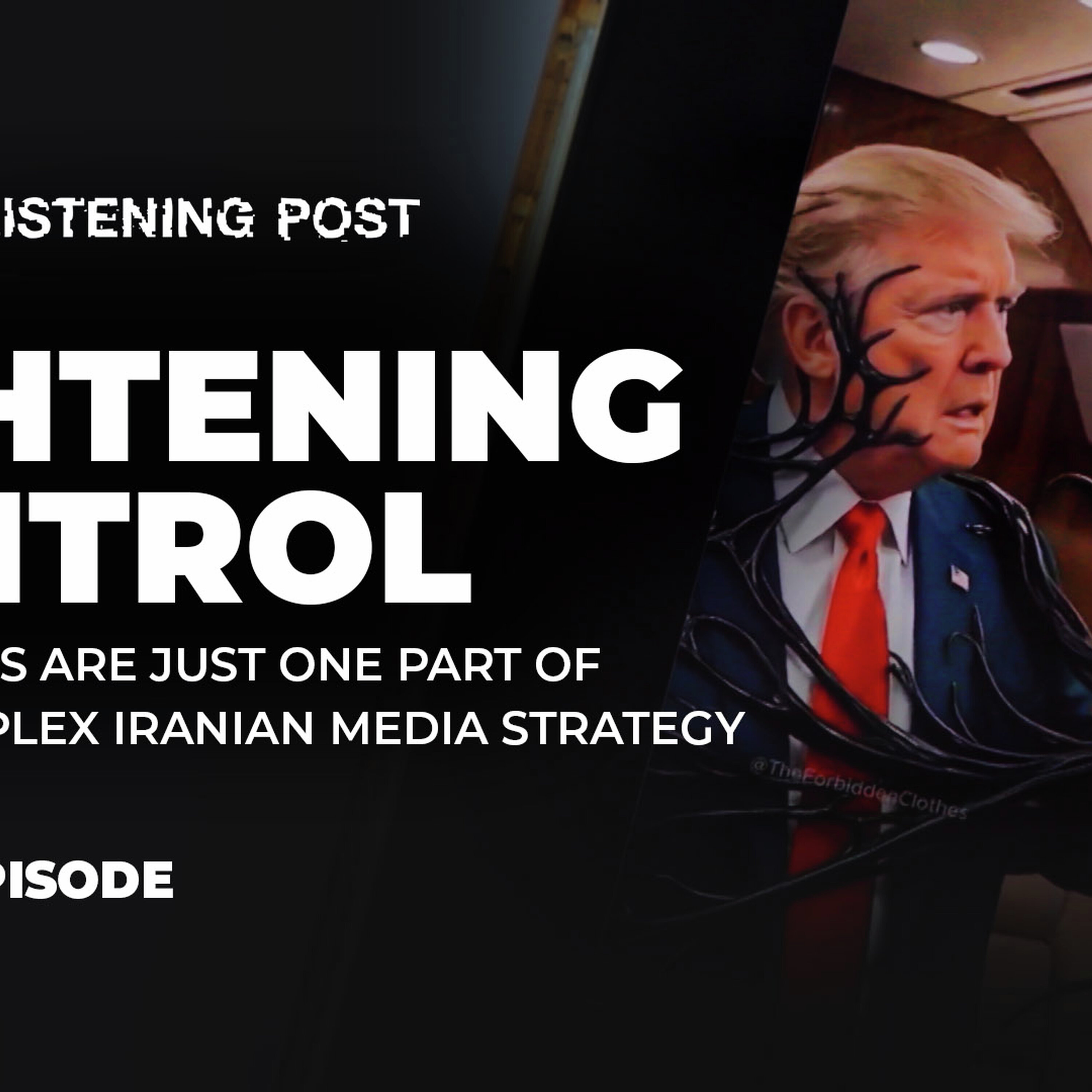
Loading summary
Transcript36 lines
- [00:01]
A
This week on the take, we're marking one year since a pair of devastating earthquakes hit Turkey and Syria with a new digital interactive. Listen and watch stories of survival, recovery and coping with the grief@al jazeera.com earthquakes Again, that's al jazeera.com earthquakes
- [00:28]
B
it's been almost eight weeks now of the war on Iran. What is happening inside the country? What kind of messages are coming out? And how are Iranians coping? With no Internet, just an intranet, Israel's war on journalism has been turned to Lebanon. It killed another reporter there this week and it was no accident. Plus Pakistan, its new role as a mediator in the peace talks over Iran, how that story is being reported and at whose expense, Nearly two months into the U. S. Israeli war on Iran. Our focus this week is on what is happening inside Iran, the messaging, the continuing clap down on the Internet there and the larger information war. Iran's external communication strategy is primarily aimed at Western audiences. It appears coordinated, disciplined. The message has been, we are the victims, the US And Israel the oppressors. And it is a narrative that has proven to be surprisingly effective. But behind the carefully curated meme like AI videos and the strong nationalistic rhetoric lies the brutal domestic side of the propaganda war. An internal crackdown that has led to hundreds of arrests and an Internet blackout that has left a population of 90 million people cut off from the outside world. This war has Iranians caught between a rock and a hard place, a repressive government and foreign powers that claim to be bombing them to a state of liberation. That the Iranian state, with a leadership that can be so authoritarian and repressive, has proven so adept at weaponizing humor and AI animations is an ironic feature of this propaganda war. We are having very great negotiations with Iran. This is an example of that. If Iran doesn't come to negotiate, we're going to bomb them. It was posted this past week by Iran's Farce news agency.
- [02:34]
A
So where are the Iranians?
- [02:36]
B
This is from Iran. It provides a simple yet effective summation of the current state of negotiations between Washington and Tehran. All right, then I will extend the
- [02:50]
A
ceasefire at Pakistan's request.
- [02:54]
C
They're trying to show a President of the United States who is detached from this world. He's just talking to himself, arguing with himself, coming out with his own conclusions. But there's nobody in front of him. So they're trying to stress that the President of the United States isn't up to this job.
- [03:15]
D
What stands out is how coordinated and disciplined that messaging has been. They've treated communication as part of the theater of war. They go viral quite easily and it allows Iran to bypass the traditional media gatekeepers entirely. They're not trying to convince editors or analysts of anything. They're trying to operate within a fragmented, platform driven media system abroad.
- [03:47]
E
They most certainly have been successful in their consistent messaging. But here's the big but millions of ordinary Iranians back home are fed up with the regime propaganda and the government of Iran has once again and isolated the majority of the Iranian public.
- [04:07]
B
That reference to the Iranian government's isolation of its own people pertains to one of the longest Internet blackouts the world has ever seen. Iran is a very wired society, but its more than 90 million citizens have been cut off from the outside world for almost two months now, since the day the war began. The authorities say the blackout is security related, designed to ward off cyber attacks from the outside, particularly from the Israelis. It has also completely blocked any access to information and reporting from the outside world. Iranians can still communicate internally via an intranet, but they are doing so amidst an intense crackdown in a climate of fear. State controlled news channels are doing their part by broadcasting confessions that appear to be forced Iranians accused of spying for foreign states or selling information to the international media.
- [05:20]
F
Whatever access Iranians had to outside information has been completely shut off. And very few people inside the country believe the state media. Over the last five, six years, Iran has become increasingly authoritarian now that authoritarianism has turned into a police state. And so one of the things Iranians complain about, their inability to access information, much of which, given war conditions, is
- [05:57]
C
quite essential when Internet is caught in Iran, that's the international Internet. However, there is another parallel Internet, which is the local one and that has local websites, local services, messaging apps used by Iranians to communicate amongst each other. For us journalists, we have a certain privilege which is using a certain card to use Internet. That's the way most journalists communicate or use social media. But each and everyone who is using such SIM cards, his or her details are with the Ministry of Information.
- [06:36]
E
What history has shown the Iranian people is that after any conflict, the regime becomes more aggressive and more stiff, stifling toward any form of dissent. Everyone's watching everyone, and people are quite frankly intimidated to make the slightest wrong move because they fear arrest. One of the greatest fears for the Iranian people in the start of this war was that they will be left with the crumbles of a regime that is at its most hardline and emboldened form. And in some ways that's precisely what has happened?
- [07:11]
B
Iran's system of government is layered, and as this war has shown, it is resilient. The US Israeli attacks began with the assassinations of several senior political figures, necessitating changes at the top. Yet the state's command structures have soldiered on. At the apex of those structures is the clerical establishment, closely aligned, the Revolutionary Guard Corps, the irgc, a powerful branch of the Iranian armed forces, independent of the regular military. And with diplomacy so central to this crisis, Iran's bureaucratic establishment also carries influence. Since the war started, some hardline elements have grown louder. President Trump and sections of the Western media seem to have interpreted that as a sign of imminent collapse. That would be an oversimplification, to put it mildly.
- [08:08]
D
The Islamic Republic has always operated through multiple sectors of power, and their messaging has never been fully uniform. I would be careful not to overread this as a clear power struggle at the top. There is always power struggles within any state, and Iran is not an exception.
- [08:28]
E
I know from sources that the speaker of the Parliament, Mohammad Bar Khalib, one of his tasks is essentially to contain and convince the hardliners why it's necessary to engage with the United States and come to some sort of a deal. For the Iranian regime, their ultimate goal is survival. And that's why, unlike Donald Trump, they don't want a quick deal, a quick fix.
- [09:11]
B
The centerpiece of Iran's information war remains the AI videos. It keeps churning out political messaging, meme style, designed to rile Americans, particularly Donald Trump's MAGA base, over the President's lack of a coherent speech strategy, his irascible behavior, and the Epstein file. Iran is portraying itself as David standing up to America's Goliath. The team reportedly responsible for many of these videos is called Explosive Media. It is based in Tehran, and one of its operatives spoke with the BBC and appeared on CNN saying he was honored to work for the homeland.
- [09:58]
A
We are committed to the Islamic Republic.
- [10:00]
B
That's our belief, our point of view as an industry. AI generated political slopaganda is in its infancy. Who knew that it would have such an impact so quickly and that Lego characters would be enlisted and sent to the front lines of a propaganda war?
- [10:19]
E
These videos, the reason they're successful is that they're light and they touch on very serious and complicated points, but they simplify it. And Lego, who doesn't like Lego? It's playful, it's childish, it's innocent. And the Iranian regime is tapping into something so universal with their messaging that is only there to serve their purpose.
- [10:46]
F
For the last several decades, the Iranians have consistently lost the media battle. Whatever soft power Iran once had has been rapidly eroded by ill conceived and poorly articulated statements by quite archaic and deeply authoritarian and autocratic political figures in Iran. And we're seeing a generational shift, a tectonic shift also in the way that Iranians have presented their message, takes that action, defeat.
- [11:24]
D
What helped are these AI Lego videos to Iranian civilians? That's a very good question. These Lego videos have very little value. They are largely intended for international audiences because they understand the power of public opinion, more democratically oriented nations such as the United States, and the power that plays in this war. And so that's the front they're engaging in with those videos.
- [11:58]
B
In Lebanon, the ceasefire brokered by the United States has simply not held. Israel has ended its bombardment of Beirut, but has kept up its attacks on southern Lebanon, claiming to target Hezbollah fighters. But those attacks have also killed civilians. And this past week, a journalist, Meenakshi Ravi, has been on this story.
- [12:18]
G
The killing of Amal Khalil in the southern Lebanese town of Athiri unfolded the way so many Israeli assassinations of journalists in Gaza have. Minute by minute, hour by hour, in a pattern that has become shockingly familiar. The surveillance, the strike, the obstruction of rescue, and then the denial Israel's insistence that it does not target journalists, medics or rescue workers. Khalil, a well known reporter for the Lebanese newspaper Al Akhbar, said in interviews before that she has repeatedly received threats from the Israeli army and intelligence. This past week, Khalil was dispatched to Atiri to report on airstrikes there when a car in front of her was hit by an Israeli drone. She and her photojournalist, Zainab Faraj, took shelter in a nearby house and immediately contacted her editors and family to say they were trapped. Lebanon's president issued a statement calling on the Red Cross to reach them. Soon after, though, the Israelis bombed the house where the journalists had taken refuge. What followed were repeated Israeli strikes on the Red Cross crews sent to find them. Under continuous fire, emergency workers managed to evacuate Zaynab Faraj, but the danger forced them to leave Amal Khalil behind. She was declared dead hours later when rescue workers were finally able to return. Khalil is one of at least 14 Lebanese journalists killed by Israel since October 2023, in addition to the more than 250 Palestinian journalists killed across Gaza and the west bank. In the same period. Last month, Israel admitted to deliberately targeting and killing three Lebanese journalists. Its justification was that one of them, Ali Shoaib was a Hezbollah terrorist who, posing as a reporter. No evidence was provided. Israel was subsequently caught using an AI generated image of Shoaib in a Hezbollah uniform in an attempt to discredit him posthumously. For journalists doing their work in countries under Israeli attack, the danger is not only being caught in the crossfire, but being placed in Israel's crosshairs.
- [14:27]
B
Thanks, Meena. Over the years, Pakistan's political and military establishments have been difficult for any journalist there to defend. Its army chief, Asim Munir, was deeply unpopular. Its government, which was narrowly returned to power after a bitterly contested election, was widely seen as illegitimate. And its most popular politician, Imran Khan, has been held in the notorious high security AW Diyala jail where he remains. But today, Pakistan's diplomats are at the center of one of the world's most consequential stories. They are hosting talks between the US And Iran, brokering ceasefires, earning the very public praise of Donald Trump, and making headlines around the world. There is some self interest at play here due to Pakistan's reliance on oil from the Middle east and therefore the state of the Strait of Hormuz. But this is a PR moment that the Pakistani establishment and its people could not have predicted and one that's obscuring a great deal. To help us make sense of how this story is being told inside Pakistan and what's being left out, we're joined now from Karachi by Amber Rahim Shamsi. She is the editor at a digital news platform called Nukta. Ms. Shamsi, from where you're sitting in Karachi, how big a story is Pakistan's mediation role between the US And Iran domestically? How much is the Pakistani public tracking it and what's the mood at home over it?
- [15:58]
A
Thank you for having me. This current conflict and hopefully its resolution is really purely simply in terms of petrol prices. The government has been adjusting them on a weekly basis. They've gone high, inflation has risen. But at the same time, I think that there's also hope that if Pakistan is able to successfully mediate a long term ceasefire or deal or agreement of some kind, it would hopefully potentially also lead to an improvement in people's lives. So I think it is a combination of where you see that there's a pride that I see in people that Pakistan has become so prominent on the global stage as well, being talked about in very positive terms. But obviously at the same time, you know, there is that hope that this would lead to an improvement in people's lives. If this doesn't lead to that, then I'm Afraid all the gains that Pakistan has made, not just internationally, but I would say that the current regime that has the gains that it's made with people, you would fritter that away.
- [17:00]
B
The last time that the Pakistani media had such a significant moment in terms of PR was last year, middle of last year, during that confrontation with India. Pakistan held its own. Now its army chief, Asim Munir is at the center of these talks. Talk to us about his role, how it's being framed and what does it mean politically, given that he leads the army, not the civilian government.
- [17:26]
A
Yes, Field Marshal Asim Munir does indeed lead the army and he became Field Marshal after the May conflict between India and Pakistan. The current regime, which is headed by a civilian government, but is obviously, I would say the supreme power or the most powerful figure in Pakistan has traditionally been the army chief. We have a civilian government as a facade, but we do have a strong army chief who is front and center in terms of whether it's foreign policy, whether it's in terms of governance or even economic policy. What the make conflict between Pakistan and India did. And Pakistan successfully rebranded itself, the army chief successfully rebranded itself. And we entered a new phase in Pakistan's, I would say domestic politics, but also its international image.
- [18:20]
B
So here we have Pakistan positioning itself as an international peacemaker. Meanwhile, it's fighting a war with Afghanistan that barely registers on Pakistani primetime television. Like last month, Pakistani jets hit an addiction rehabilitation facility in Kabul. At least 143 people killed. How is that airstrike and the broader conflict being covered or not covered in the Pakistani mainstream news media?
- [18:47]
A
It isn't being covered in the mainstream. The only news that we get are from security agencies and security sources. Afwan Taliban ka Kabul Me Drug as Patalpar Hamleka propaganda. Nobody is really talking to reporters who are trying to dig a little deeper. So I'd say that the situation with Afghanistan is just not being discussed. I think the mood in Pakistan as well is a little bit of fatigue in terms of Afghanistan. We've also had lots of deportations of Afghan refugees or immigrants. That's been continuing for the last two, three years. So really a very hard line policy towards Afghanistan. Very careful. And I think the Pakistani public as well, I see that while there's very little sympathy as well, you see that more along the border areas where there's direct trade between Afghans and Pakistanis, where there's a lot of sympathy. There's obviously a lot of ethnic, you know, obviously affinity as well. But broadly in the rest of Pakistan, might say that the Pakistani public as well has really moved on and would like that, would like the Afghanistan matter as well to be settled.
- [20:03]
B
Meanwhile, the former Prime Minister, Imran Khan has been in jail for two and a half years now. By many measures, he remains Pakistan's most popular politician. His family says it is concerned about his health. The coverage of him has been suppressed by the authorities there. Does a story like this one, Pakistan as peacemaker, reduce the prominence that Imran Khan is getting even further?
- [20:30]
A
Absolutely, Richard. I do think that this story of how Pakistan has become so prominent on the international stage, its role as a peacemaker negotiating between Iran and Washington, I think that story has actually flipped the script. So, for instance, when you saw that the make conflict between India and Pakistan allowed Field Marshal Asim Munir and the current regime to rebrand itself and to use the opportunity in its contacts with the Trump administration, leverage that for domestic consolidation as well as international relief and connections and relationships, what this current negotiating or peacemaking role, what it has done for the current regime, is that it has been able to flip the script a little bit. So one of Imran Khan's appeals to his public, to people who, you know, his voters, his supporters, has always been that he is a respected name on the international stage. So he would bring a sense of pride to a very battered Pakistani psyche. International pride, this moment for Pakistan as peacemaker, has flipped the script. It has demonstrated for some Pakistanis that, all right, just this particular role that Shabazz Sharif, Isaac Dar and Asim Muni have played in terms of how they're managing their relationships, and brought Pakistan a lot of pride, this current regime has been able to demonstrate is that you can restore some national pride without Imran Khan.
- [22:10]
B
Last question for you, and you've touched on the economic angle, but I just want to get back to it here. For many Pakistanis, the reality right now is rising energy bills, they're dealing with power cuts, the tightening grip of IMF conditions. Now, against that backdrop, how does this government make the case that its role as a mediator in these peace talks really matters? Does geopolitical prestige have any currency with Pakistanis when the cost of living crisis is so bad?
- [22:43]
A
I would say that it is temporary. The mediation role and the benefits that we could get from this mediation role are absolutely temporary. I mean, there's no price. You can't quantify pride. And I don't think that it will last if it does not translate into substantial economic benefits. So the current cost of living, inflation, petrol prices, power cuts, these are all a result of the current conflict between Iran, the Israel and the US and the control over the Strait of Hormuz or the closure of the Strait of Hormuz. So some of these will go away. So I would say that under the current IMF stabilization program, you saw that inflation had been going down. There is some positive movement in terms of, for instance, exports, obviously not enough. What we need is big investments. Stability, especially with Iran, is absolutely necessary for a very key project. The mediation is not just about branding or prestige. The mediation efforts are really crucial to Pakistan's stability and economic growth, so that there is a trickle down effect to the people who are skeptical of this government's legitimacy.
- [24:05]
B
Omber Rahim Shamsi, the editor at the digital news platform Nukta, thank you very much for speaking with us here at the Listening Post today.
- [24:14]
A
Thank you, Richard.
- [24:16]
B
And finally, Israeli soldiers, war crimes and the issue of accountability. Last week, an image emerged online from Israeli occupied South Lebanon. It showed an Israeli soldier taking a sledgehammer to a statue of Jesus Christ. Then came the outrage on social media, forcing Prime Minister Netanyahu to condemn the act. And the soldiers involved have been jailed for 30 days. Consider for a moment what lessons other Israeli soldiers will take from this, along with what they've learned since October 7, 2023. They can slaughter countless Palestinian civilians in Gaza, including tens of thousands of women and children, post evidence of their war crimes online with impunity. They can kill hundreds of Palestinian journalists in Gaza. And now they are killing Lebanese journalists too, with zero accountability. But if they destroy a Christian statue, which is not a living thing, and risk offending Donald Trump and his evangelical base in America, they might end up behind bars. This is a story that informs us of who and what really matters to Israeli politicians. One last point, and we have no evidence of this. It's just a guess. The prison conditions for those soldiers won't be overly harsh.