← The Listening Post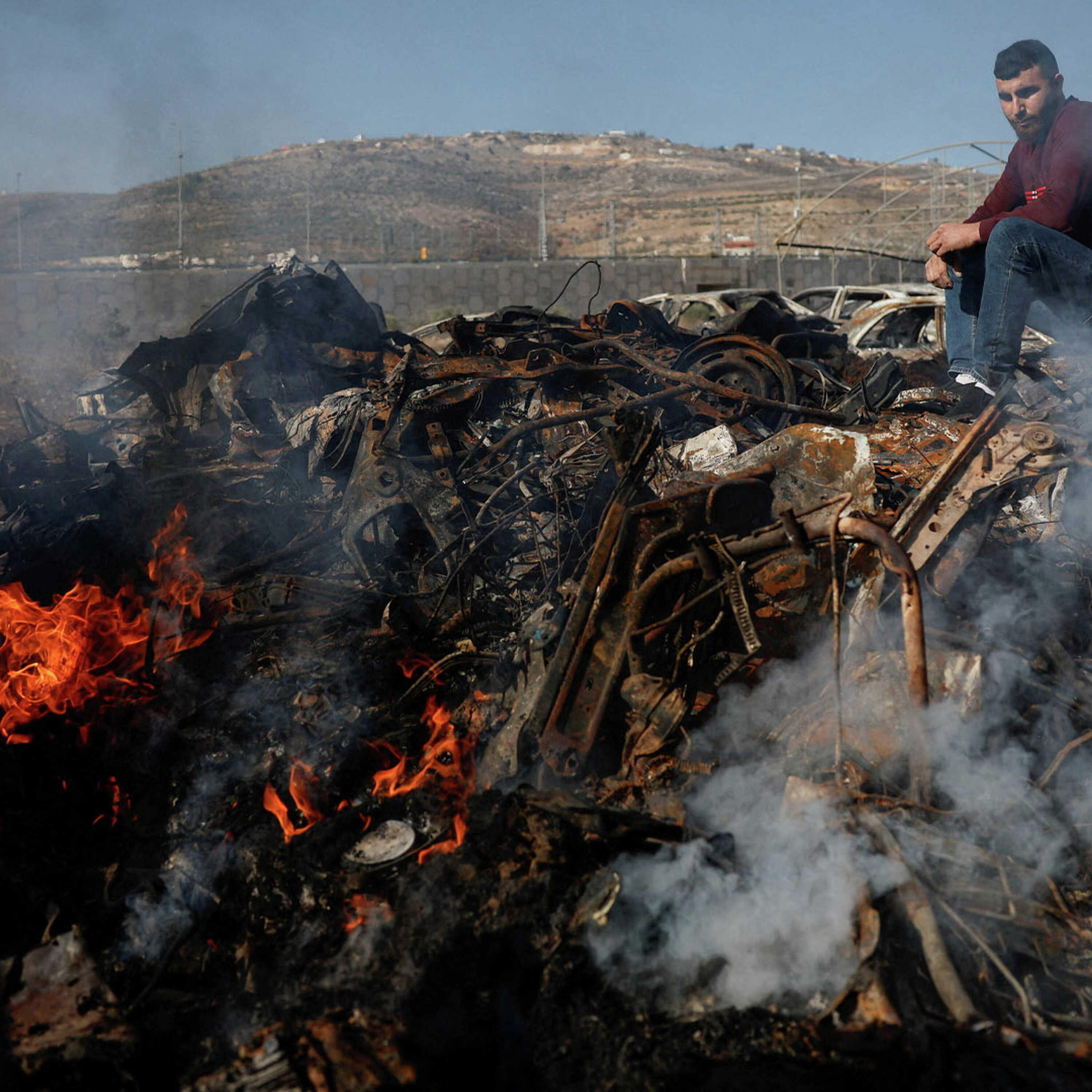
The Listening Post
Israel is rampaging through the West Bank - why isn't there more coverage? | The Listening Post
00:23:58
Loading summary
Transcript43 lines
- [00:01]
Host
This week on the take, we're marking one year since a pair of devastating earthquakes hit Turkey and Syria with a new digital interactive. Listen and watch stories of survival, recovery and coping with the grief@al jazeera.com earthquakes Again, that's al jazeera.com earthquakes.
- [00:28]
Main Narrator
Israel accelerates its violence on the West Bank. It's a story of annexation that rarely gets the attention of the international media. And when it does, the coverage falls woefully short. Venezuela. The White House is making noises about invading the country. Overthrowing its leader got Maduro's attention, and certain US news organizations are pushing that narrative. Plus the defossilization of planet Earth and the energy companies out to stop it by drilling down into the information space. We start with a news story that's getting nowhere near the amount of coverage it should. The extraordinary surge in Israeli settler violence in the west bank, the de facto annexation that is taking place there, the scale of it, the beatings, the. The killings, the arsonists setting Palestinian homes on fire, is unprecedented. Most of the video that we're seeing has been shot by Palestinians documenting what they can, filling a gap that should never have been theirs to fill. But for the Western mainstream media outlets that have largely stayed or shied away from this story, the relatively few reporters who have gone to the west bank are getting a taste of what Palestinians live with in every day. The intimidation, the beatings. And when the big outlets do drop in, the way this story is told tends to detach the crimes the settlers are committing from the occupying state, Israel. Israeli settlers don't wear uniforms, but they are enabled by soldiers who do, and they are benefiting from international news outlets that far too often keep looking the other way. Even in a place like the west bank, where the Israeli settler attacks on Palestinians can appear to be random, creating a chaotic effect that can be tough for journalists to track. The data doesn't lie. The evidence is there. According to the un, the escalation in violence is unprecedented. The beatings, the killings, the arson attacks, the thefts of land. More than 260 such attacks in October alone, the highest number ever record. It is a pattern that has continued through November, documented in the videos that keep flooding social media. Shot by Palestinians doing a job that international news outlets have largely failed to do.
- [03:06]
Expert Analyst
What we're witnessing in the west bank right now is actually unprecedented, the highest monthly tally of settler attacks since the UN's Office for Coordination of Humanitarian affairs started counting. A lot of these attacks targeted the olive harvest, when a lot of Palestinians were out in their Fields harvesting this year's produce. But what we've seen in the last few weeks cannot be explained solely by the fact that it's harvest season, that the numbers are so much higher than we've seen in the past.
- [03:34]
Local Witness/Reporter
The fact that we are seeing more documentation come out from the phones of civilians really shows you the vacuum of media coverage in the region. And when civilians are documenting, they are risking their lives, risking being shot at either by the settlers or the army. But this is their last offering for the world to know what's happening here. It just shows the media coverage vacuum that is here.
- [03:59]
Palestinian Activist/Journalist
It's lost on nobody that they're facing a genocide there, and the world is just not paying attention. They don't know what's happening. And for the most part, people don't fight back against the violence. People know that if they are to injure a settler, they might be killed. The settlers will come back to the village the next day and, you know, collectively punish the whole village, burn homes to the ground, kill people who had nothing to do with it. And so all they can really do is document it and show the world.
- [04:29]
Main Narrator
Beyond attacking Palestinians, Israeli settlers are going after journalists. A few weeks ago, on November 8th, masked settlers armed with sticks and hammers attacked a group of Palestinian reporters covering the olive harvest in Beta, injuring at least five of them. Intimidation and violence are among the many tools the Israelis use to stifle journalism, along with the checkpoints, roadblocks that control traffic across the west bank, and the arbitrary arrest of Palestinians, thousands of whom are jailed despite never being charged with a crime. Various tools that engineer a silencing of voices that Israelis see as Palestinians first and journalists second. The blacking out of a story they do not want the world to see.
- [05:21]
Palestinian Activist/Journalist
The settlers have shown that nobody's off limits. They clubbed and beat a Reuters journalist who was clearly wearing a press uniform because they wanted journalists to know that you're not safe here. When I was running from this mob of masked settlers, I was shouting, press, American press. It certainly didn't stop them. And so it's a pretty clear scare tactic. They want journalists to be afraid to cover it. They want them to know that they're not safe.
- [05:49]
Field Journalist
So, for example, when I get stopped at these checkpoints, I generally do not say I'm a journalist and just kind of try to move through as quick as possible. Because as soon as you say you're a journalist, they're like, okay, who do you report for? What do you write? What are you doing here? And generally, if you say you're going to one of these locations, they're not going to want you to go and report on this until they stop you and hold you up and maybe search you.
- [06:12]
Expert Analyst
The Israeli government clearly wants to limit reporting on settler violence and more generally on Israeli policies in the West Bank. We saw that with the banning of Al Jazeera in the west bank. The army regularly disrupts the work of Palestinian journalists and international journalists. It prevents them from reaching certain areas. Sometimes it attacks them. This hasn't stopped journalists from reporting, but there need to be more journalists reporting on the west bank, both local and international.
- [06:41]
Main Narrator
And unlike Gaza, Israel has not locked journalists out of the West Bank. So the international news organizations that do not send reporters in must not find the pogroms taking place there newsworthy. And when they do focus on the story from a distance, the framing often separates what the settlers are doing from the policies of the Israeli state.
- [07:04]
Palestinian Activist/Journalist
We did hear from Israeli President Isaac.
- [07:07]
Main Narrator
Herzog, who condemned this arson attack that we saw yesterday. He blamed a handful of very dangerous.
- [07:13]
Host
Individuals in between the attacks. Life here appears to go on as normal.
- [07:18]
Field Journalist
But the presence of the settlers just.
- [07:20]
Host
On up on the hill is changing the way people operate.
- [07:24]
Main Narrator
That disconnect the notion that these are rogue settlers out for themselves as opposed to doing their government's bidding does not reflect reality. The UN and Amnesty International, among others, have been explicit on this point that the attacks are state backed, as evidenced by the Israeli soldiers who are often there protecting the Sephiroth.
- [07:47]
Expert Analyst
Almost every time we see settlers attack, we see videos showing Israeli soldiers who are in the area doing nothing to stop it and not arresting the settlers who have just carried out an attack. The army is not in the west bank to maintain the peace. It's there to protect the settlers. This is apartheid in action. If Israel wanted to stamp out settler violence, it could do it tomorrow. And the fact that it doesn't do that should reveal that that it serves the state's agenda.
- [08:14]
Field Journalist
A lot of the time these settlers are armed by Israel themselves and Israeli settler politicians like Ben gvir, who we saw a surge in the beginning of Israel's assault on Gaza in 2023 with weapons and weapons permits being handed out to these Israeli settlers. And not only are they armed, the Palestinians have no way to protect themselves. And on top of that, they're a lot of the time protected by the Israeli military, who is also armed.
- [08:43]
Local Witness/Reporter
Settlers have been armed with drones with quad bikes with M16s by the Israeli army. This is happening with settlers having joint communications with the Israeli army when they even invade towns and villages. They know exactly the routes to take. They know how many Palestinians are there. This is not random. It is not impulsive. It is coordinated and it is premeditated and planned. What we are seeing is a military and settler symbiosis.
- [09:11]
Main Narrator
Journalists, be they Palestinian, Israeli or international, need not conduct deep investigations to expose the fact that the settler violence is state backed. All they have to do is go online, check out the Instagram or Telegram accounts of two of the Netanyahu government's most far right ministers, Itamar Ben GVIR and Bezalel Smotrich.
- [09:46]
Palestinian Activist/Journalist
People are hearing what Ben GVIR and Smotrich and you know, these other ministers are saying every day, defending these violent settler attacks, flaunting that they can do whatever they want, that nobody is reigning them in something that people might not recognized because of the just severe lack of coverage of the west bank, where it's becoming undeniable that the settler violence is part of a state project with international media.
- [10:15]
Local Witness/Reporter
There isn't a linking that this is the military with the Israeli settlers. To again frame them as they're acting alone is really costing Palestinians their lands, their resources and their lives. This is malpractice. This is inability to do a basic Google research and cover it to your audiences properly. This is inability to do your job. And now Palestinians are facing the most unprecedented and intensified attacks they have ever faced in the West Bank.
- [10:49]
Main Narrator
Over the past few months, the Trump administration has been dialing up its rhetoric around a potential military intervention in Venezuela and the removal of President Nicolas Maduro. And that language is now echoing through parts of the US Media. Ryan Coles has been tracking this story.
- [11:07]
Ryan Coles
Donald Trump has made no secret of wanting Maduro out. And according to reports, some senior Pentagon officials presented him with a range of military options last week. Almost on cue, the New York Times ran a column this past Monday by Bret Stephens arguing the case for overthrowing Maduro. In it, Stevens pointed to Venezuela's ties to America's enemies and the country's mass exodus of refugees as grounds for intervention. This is the same Bret Stephens who championed the Iraq war back in 2003 by pushing the weapons of mass destruction lie and fear mongering about the possibility of Iraq's nuclear capabilities. Over on Fox News, the coverage has been unapologetically jingoistic, including this on the continuing US Strikes on Venezuelan boats and the Trump administration says are trafficking drugs.
- [11:57]
Main Narrator
That's on top of all the coke boats getting smoked to pieces by the week kilos of cocaine are washing ashore. It's got Maduro's attention. He's the dictator of the narco state, a very bad hombre.
- [12:08]
Ryan Coles
That term narco state has been used by Trump officials, making the case for intervention. But in many of the strikes, the US has failed to release any evidence showing the vessels were carrying drugs. For his part, Maduro is being rather flippant about the media attention he has been getting in the US these past few weeks. But for many Venezuelans, this is no joke. Under Maduro, they've endured hyperinflation, near economic collapse, political oppression and mass migration, conditions driven by his government's mismanagement, but also deepened by years of U.S. sanctions. So when Washington talks about saving Venezuela, does anyone really think, given its track record there and across Latin America, that a U.S. military intervention will help?
- [13:02]
Main Narrator
Thanks, Ryan. COP the annual global climate conference wrapped up its 30th summit this week, and for the first time, it shone a particular light on a different front in the climate debate. Information Beneath all of the pledges and negotiations lies a deeper truth. The climate crisis has not been driven just by rising carbon levels, but also by decades of manufactured doubt, most of it coming from the fossil fuel industry. And that comes in many forms. Advertising, sponsored academic research, big money pumped into the PR side, all meant to affect how we see fossil fuel. Elisa Morgera is the UN Special Rapporteur on Climate change. A few months ago, she produced a report with a section in it on what she calls the playbook of climate obstruction, on the ways fossil fuel companies manipulate the global information ecosystem, from academia to advertising to the media. We asked her to unpack that report to tell us why, as she puts it, the world now needs to defossilize.
- [14:12]
Host
Often they say that when you learn that you've been lied, your understanding of the world changes. And this is really the point we are at. We are now understanding that we've been lied time and over again about the main cause of climate change in the context of climate change, even indigenous peoples. My name is Elisa Morchera. I'm the UN Special Rapporteur on Climate Change and Human rights. And my role is to clarify state obligations to protect human rights in the context of climate change.
- [14:55]
Main Narrator
You the parties now stand to promote the effective implementation of the convention. The United States has agreed to reduce the output of so called greenhouse gases by 7%. There are those who argue this will make US business less competitive.
- [15:15]
Local Witness/Reporter
More than 10,000 delegates, including scientists, government.
- [15:18]
Host
Officials and activists, are taking part in COP15.
- [15:22]
Commercial Announcer
The talks, called COP19, come after last year's round saw little progress on a green climate fund.
- [15:29]
Main Narrator
There are not very many heads of state or government. What does that say about how these.
- [15:34]
Host
Talks are, are seen and how seriously the issues are being treated?
- [15:40]
Main Narrator
The COP30 climate summit officially opened in Brazil yesterday.
- [15:44]
Host
It is really significant that after 30 years of COPS, we are catching up what has been at least 60 years of climate disinformation that was in fact put in place over time with evolving strategies by the fossil fuel industry. And the realization has been that 60 years of that disinformation has made progress on climate change very, very difficult. So in my report this year to the Human Rights Council, I have relied on a large body of independent research that has called out the playbook of climate obstruction by the fossil fuel. It is very deeply embedded in PR and advertising. In fact, we don't realize that we are exposed daily, if not more, to advertising either directly or indirectly related to the fossil fuel industry.
- [16:47]
Expert Analyst
Our premium products industry, leading technology and.
- [16:51]
Main Narrator
Friendly hospitality help you go the extra mile.
- [16:54]
Host
Shell experts. They're working on a wind project that could power 6 million homes. Let's think about like sports sponsorship as well. Most of our major international events have sponsorship from fossil fuel companies. The messaging we're getting is that we can't live without fossil fuels, that there is no real alternative, that may be very dangerous, that may not allow us to live in prosperous ways. The industry already had back then, their own scientists telling them that their activities would lead to climate change to a planetary crisis. And they still decided not only to go ahead with their activities, activities to this day, we're expanding fossil fuel extraction everywhere in the world and to keep the public away from this information. And not only that, but actually actively disinforming them. So they will take them longer and longer and longer to figure out that direct link between fossil fuels and this planetary crisis of climate change, nature loss, toxic pollution, and crucially, economic inequality. The fossil fuel industry has also exerted significant influence on academia and research. This is also part of the playbook and a way to disinform and misinform the public. On the one hand, they have attacked and smeared climate scientists, but on the other hand, they've also manufactured science that is not accurate. And this has happened through funding to universities, to think tanks with strings attached, asking them to produce research, for instance, on either giving a sense that there are some benefits to certain fossil fuels, or that there is a way for the fossil fuel fuel industry still to contribute to what they call transitional fuels, which serves to distract from that imperative, scientific imperative, and in fact legal imperative of phasing out fossil fuels. There's been also investigative journalism really tracing down to seven major media companies who were not only supporting fossil fuel advertising, but in fact producing themselves in house content for fossil fuel companies. So clearly these are all like a very complementary and misleading practices. They really make even experts struggle to get to the truth. In my report, I mentioned also a few recommendations around criminalizing actions related to this information, including potentially for PR firms and media. It is a very bold recommendation and it's really meant to start a debate into understanding how we can create a stronger framework of accountability. And the idea is really showing that on the one hand of the course, we need to protect freedom of expression. Everyone who has their positions or doubts about climate science and about climate action is free to share this. But this point about preventing climate disinformation is about the undue commercial influence in our public debates. So in my report I used the term defossilized knowledge and information systems. And this was really to show that we need to be very proactive in responding to the playbook. But also we need governments to create legislation around, of course, greenwashing, but also requiring all private actors to be transparent about any funding they may receive from fossil fuel companies. We have a human right to information. The information needs to be trustworthy and it needs to allow all of us to understand whether our governments and whether companies are truly considering our human rights media, big tech PR companies who may still be working with fossil fuel companies. They should be aware that you are essentially contributing to human rights harm and to the prevention of the protection of everyone's human rights in the context of the climate crisis.
- [22:00]
Main Narrator
And finally, this past week, after months of delays and political contortions, every member of the US Congress but one voted for a bill forcing the Justice Department to to release the Epstein files, the cache of email correspondence, images and videos about Jeffrey Epstein and his friends in positions of power. In a surprising 360 degree turn, Donald Trump then signed that bill into law. But signed and sealed does not mean delivered. The Justice Department has the power to put off the unsealing by as much as 30 days. There are also loopholes in the bill, including a provision for active investigations that could allow much of the material to remain classified. When pressed on a timeline for the release, and on whether the administration was just kicking the can down the road, Trump's Attorney General, Pam Bondi, sounded like a broken record.
- [22:55]
Host
And we'll continue to follow the law. We will continue to follow the law with maximum transparency.
- [23:02]
Main Narrator
This is anything but transparency. It's unclear what law Bondi's even referring to the other thing that we're seeing in the mainstream coverage of this story. U.S. outlets are all over material pertaining to pedophilia and the rich and powerful for good reason. But they're not nearly as interested in angles like Epstein's political ties, particularly those to the Israeli state, his relationship with its former prime minister, Ehud Barak, and how that tied into the Kremlin and the U.S. s position on the Syrian civil war. The possibility that the Epstein files will expose how not just politicians could have been compromised, but that US Foreign policy may have been as well. For more on that, watch this space, although it may take a while.
- [23:58]
Commercial Announcer
This is the story of the One As a maintenance supervisor at a manufacturing facility, he knows keeping the line up and running is a top priority. That's why he chooses Grainger, because when a drive belt gets damaged, Grainger makes it easy to find the exact specs for the replacement product he needs, and next day delivery helps ensure he'll have everything in place and running like clockwork. Call 1-800-GRAINGER click granger.com or just stop by Grainger for the ones who get it done.