← The Listening Post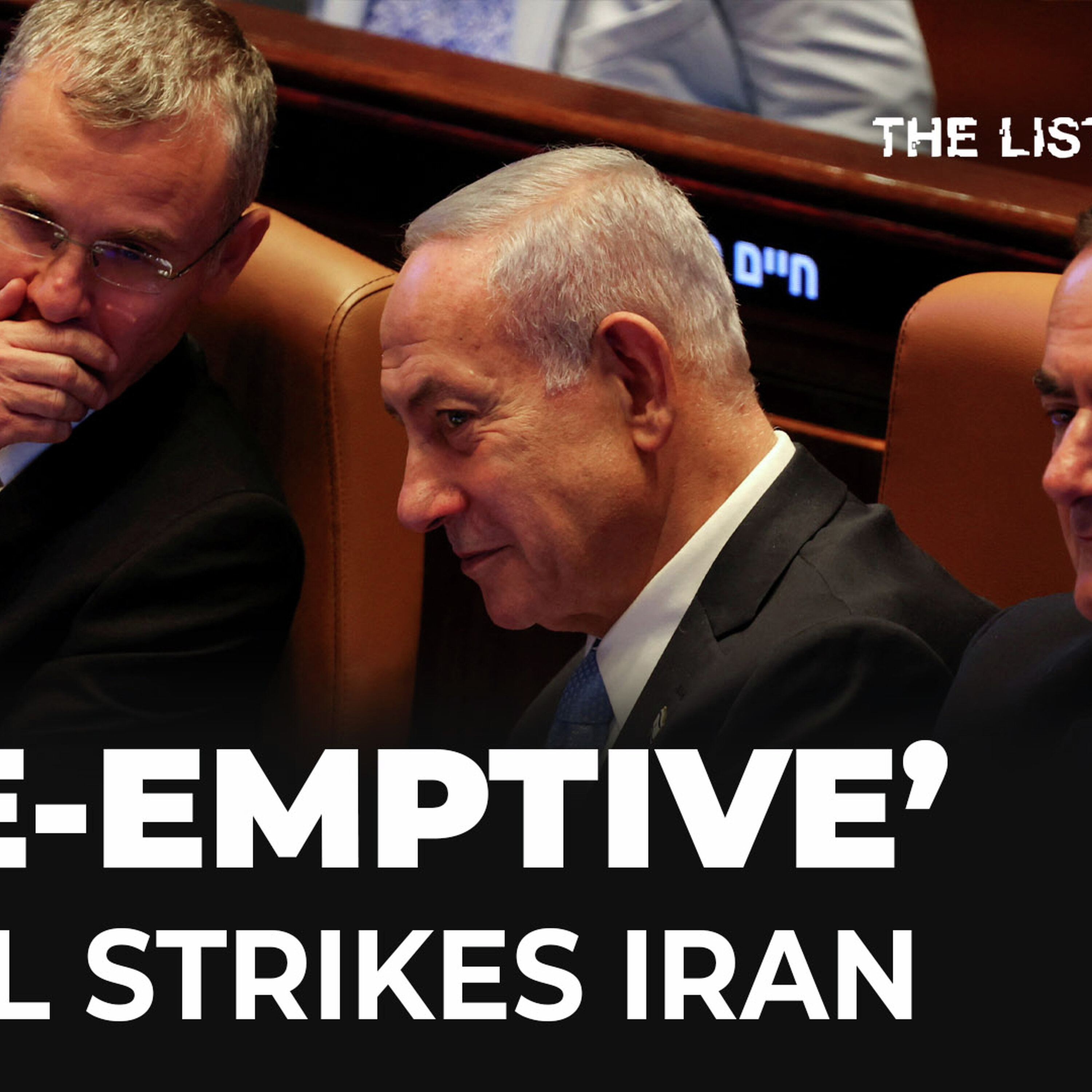
The Listening Post
Preemptive strike? The media and Israel’s attack on Iran | The Listening Post
00:25:12
Loading summary
Transcript56 lines
- [00:00]
Narrator
This week on true crime reports, up to 100,000 children go missing in China every year, a number that links back to the 1970s and the one child policy. This story is about one of those children and the mother who spent decades searching for him. Hear the full story on True Crime Reports. Subscribe and listen wherever you get your podcasts.
- [00:32]
Negar Mortazavi
This week on the Take, we're marking.
- [00:34]
Host/Reporter
One year since a pair of devastating earthquakes hit Turkey and Syria with a new digital interactive. Listen and watch stories of survival, recovery.
- [00:45]
Narrator
And coping with the grief@al jazeera.com earthquakes.
- [00:50]
Host/Reporter
Again, that's al jazeera.com earthquakes.
- [00:59]
Main Narrator/Anchor
What comes next after Israel's stunning attack on Iran? And what's with the headlines? Why are so many news outlets preemptive Israeli strikes going along with the Netanyahu government's act of aggression. Prepare to get less news about the genocide in Gaza, not that the Israelis are changing their ways. Instead, they're imposing a communications blackout and the unrest on the streets of Los Angeles, the security response, the power struggle that's driving it and the chilling precedent the Trump administration is trying to set. We begin with what Tehran is calling Israel's declaration of war against Iran, strikes on more than 100 targets, major ones including nuclear facilities and missile sites, as well as the assassinations of several senior military commanders and scientists. Iranian officials have promised their people a powerful response. Anyone paying attention to the rhetoric coming out of Israel recently could have seen this coming. There were some unmistakable signs of a buildup to war. After the attacks, Israeli officials got busy briefing journalists on, quote, the, the scale and sophistication of the strikes, including some details on how Israeli operatives had smuggled drones into Iran. They were also making the case that the assault was justified, that it was somehow preemptive because Tehran was closer than ever to building a nuclear bomb. One person who was tracking the narratives that preceded all of this and what has been reported since is the journalist Negar Mortazavi. She is the host of the Iran Podcast and she joins us now from Washington, D.C. Ms. Mortazavi, first of all, thanks for joining us here at the Listening Post today. Let's start with this. Israel has labeled this as a preemptive strike, and that framing was picked up by a number of Western news outlets without so much as attribution. What do you make of that? What is that language concealing and what does it reveal about the news outlets that are using it?
- [03:19]
Negar Mortazavi
Well, legal scholars are saying that this language actually means a lot in international law. And it's very deliberate when you launch A preemptive strike. Essentially you are attacking an enemy that was about to imminently attacking you. So preventing an imminent attack. And you need to show proof for that imminent attack, which I don't think the Israelis have produced yet.
- [03:42]
Main Narrator/Anchor
They have enough fusel material for six or eight bombs in a very high grade of enrichment as well as weaponizing it into a bomb. So Israel has no choice but to attack.
- [03:59]
Negar Mortazavi
This goes against the latest reporting and continuous reporting of US intelligence which have said until very recently that they don't think Iran is weaponizing its nuclear program or building nuclear bombs. But it seems like this is something especially in the Western media, American media, this language was picked up.
- [04:18]
Main Narrator/Anchor
Iran was continuing to enrich uranium towards higher enriched uranium that would be capable of fueling a nuclear weapon. That for Israel was a red line once.
- [04:29]
Negar Mortazavi
It's not a preemptive strike. It's an attack on a sovereign land, on a sovereign nation, on the homeland of another country. And the response and reaction to that in an international community and according to law will be very different. And this is something that I've seen legal scholars talk about and really challenge that notion. And also the media coverage that has been sort of leaning or in a way showing a bias toward the terminology that's coming from one side of this.
- [04:58]
Main Narrator/Anchor
On Friday, immediately after the strikes, the Israeli military posted a video titled Declassified in Iran's nuclear Plan saying that Iran had accelerated its uranium enrichment program in recent months and could obtain a nuclear weapon, quote in a split second. How anchored in reality is that claim?
- [05:21]
Negar Mortazavi
Well, we have to understand something producing the material, enriching uranium that can then potentially be used as the fuel for a nuclear bomb once you decide to weaponize your program. These are various different steps. Now the timing must be short, but the way this is framed is that there was a split second in an imminent attack of a nuclear bomb about to be launched and that really isn't the case. Yes, they have come close to it as what is considered a threshold state. But that being a threshold state or potentially producing the fuel that can then be turned into a bomb is different than a weaponized program and the actual nuclear weapons. Iran is still a signatory to the npt, the Non Proliferation Treaty under the un. It's still a member, it still collaborates with the UN nuclear watchdog, although there have been some challenges there. But at the end of the day it's a state that does not have a weaponized program and is under international monitoring. A full on war with Iran is something that the Israeli Prime Minister Benjamin Netanyahu has been asking and calling and pushing for, publicly and privately for the past 20 years since the US invasion of Iraq. He's been saying that Iran should be also another target. And he's been trying to push for the U.S. in fact, to do a similar scenario and go to war with Iran. So that's one side of it.
- [06:55]
Main Narrator/Anchor
They're willing to kill people around the world and especially in the Middle East. And given a nuclear weapon, we fully would expect that they would use it.
- [07:06]
Negar Mortazavi
And then also sort of the demonization, the dehumanization of Iran, Iran and Iranians, not just the government but also the population in the media by senior officials, has impacted media coverage. I would say it has created a bias, sort of a leaning or a filter that some journalists and media professionals don't even understand that they're covering this country, Iran, with sort of this bias. And I think this has added sort of a fuel to this fire that would then prepare these strikes to be portrayed as preemptive.
- [07:45]
Main Narrator/Anchor
Give us an idea, if you would, of what you're hearing on Iranian media outlets. So many of them under some element of state control. How are they dealing with this moment? What's the spin? How are they reassuring Iranians right now?
- [08:03]
Negar Mortazavi
Well, the demonization goes both ways. So the Iranian media also do cover these regional issues with a clear bias. As you said, the state has a lot of control over most of broadcast media to some extent, non broadcast print media, newspapers, there isn't much independent journalism. And so that in itself creates a bias within that media landscape. Referring to Israel as the Zionist regime, talking about this as terrorism, trying to focus on the civilian casualties, calling those who have been killed, the commanders, calling them martyrs who have given their lives for their homelands or for the nuclear program, the scientists that have been targeted, all of that has been part of the discourse of the Iranian state media and continues to be since the attacks. One difference I would indicate though is that this mostly remains within Iran's borders. Iranian media don't have that kind of global influence. And sort of this doesn't really trickle down from Iranian media beyond Iran's borders into any other influential media space. Whereas the other side, which is Israel and the United States, US Media coverage really impacts global media coverage, especially in the English speaking world. And so when you see that bias from media in the US that are supposedly independent, not state tied, holding truth to power, that impact trickling down to the global media space has real political and global consequences. Whereas in the Iranian media, what I'm trying to explain is that they really are the underdog when it comes to the military landscape, but also in the media landscape. So yes, that bias may be impacting an Iranian audience and a small audience beyond, but they don't have that sort of a global reach for that bias to be influencing any other major audience basis.
- [10:05]
Main Narrator/Anchor
Let's just focus on one thing that tends to be missing in the news coverage. That there is one country in the Middle east that does have a nuclear arsenal and that that is Israel. That is seldom mentioned in the coverage. Why do you think it's typically absent from the discussion and the coverage?
- [10:23]
Negar Mortazavi
Well, I guess media professionals have to answer that question. That's a big question. And it also speaks to sort of the bias of the coverage of these conflicts towards one side. Absolutely. As you're saying, Israel is the only country in the region who has a nuclear arsenal. And this is something that first of all, as a matter of policy, they don't acknowledge. But just because they don't acknowledge doesn't mean that that's not a known fact. And then also in the United States, they don't really officially acknowledge that because that could potentially impact US Policy towards that country which is the US Closest ally in the region. But if you ask an average American, for example, who they think is the only nuclear power in the region, they would think it's Iran. They would think it's Iran who is the only party in the region who has a nuclear weapons program because of this bias that is embedded in the coverage. And Israel rarely comes up unless the person has specific knowledge and extra knowledge of the region of global politics and non proliferation. It's a known fact within the professional community, but it's just a fact that isn't very much spoken and that has been embedded in the media coverage. And as a result of that, you see that the average American, because of this bias in the media and the political discourse is doesn't have enough knowledge about what's going on and how the foreign policy decisions of the country are shaped. So I think it's a serious problem. I think media organizations need to address that. Why this is something that's become an inherent bias. I understand. If it's part of the political discourse, politicians have all kinds of motives and reasons for hiding facts. But why the media goes on with that and sort of has this bias embedded really is a big question.
- [12:16]
Main Narrator/Anchor
We're going to leave it there. Negar Mortazavi of the Iran Podcast, we're very grateful. Thank you for speaking with us here at the Listening Post today.
- [12:25]
Negar Mortazavi
Thank you so much.
- [12:27]
Main Narrator/Anchor
In the same week that Israel declared war on Iran, it intensified its siege in the West Bank. Additional military forces have moved into that territory and all Palestinian towns are under complete lockdown. In Gaza, where aid stations meant to feed starving Palestinians have turned into killing fields, communication systems are now being targeted and cut off. Meenakshi Ravi has been tracking this story.
- [12:54]
Narrator
This past week, phone and Internet services virtually collapsed across Gaza. Israeli forces, which have over the past 20 months systematically targeted key infrastructure such as water, roads, healthcare and power systems, took specific aim at the telecommunications network. Transmission stations, communication towers and cellular facilities were repeatedly bombed and Israel targeted the last fiber optic cable route serving central and southern Gaza. Journalists in the war zone sounded the alarm early in the week.
- [13:26]
Main Narrator/Anchor
We know that Israeli army bombing this line to cut the Internet connection. Now I will use ESIM that will catch the Internet from outside Gaza.
- [13:36]
Narrator
Using data packages on digital sim, CAR or esims, Palestinians posted messages about dwindling connectivity and the struggle to get information out. The United Nations Palestinian relief agency UNRA posted this. Israel's military has actively prevented technical teams from getting access to Internet infrastructure. The Palestinian Telecommunications Regulatory Authority issued a statement saying digital isolation is intensifying despite repeated attempts to repair damaged networks. For the people of Gaza, this choking off of communications has been one of the most persistent fears. This is how they see it. Given the kinds of war crimes Israel has been willing to commit, knowing that the video evidence was coming out and going viral, what might Israeli forces do to Palestinians there under the cloak of a communications blackout?
- [14:26]
Main Narrator/Anchor
Thanks Meena. The images emerging from Los Angeles this past week have captivated Americans and not in a Hollywood way. Federal agents in body armor loaded with guns and grenades. Police on horseback, a brute show of force in response to protests against raids conducted by the Federal Immigration and Customs Enforcement agency known as ICE. In a city that is nearly 50% Hispanic or Latino and one that's turned into an ideological battleground for President Donald Trump, one where he seeks to enact his vision for America, shutting down civil unrest by deploying thousands of National Guard troops and hundreds of U.S. marines, all without the approval of California state government. This story is replete with made for TV moments that feed directly into Trump's MAGA base, amplified by right wing media that brand immigrants as criminals, demonstrators and as insurgents. And there are legal precedents at play here, potentially dangerous ones that could have a long term effect on freedom of speech and democracy in America. The story on the streets of LA can be viewed through different lenses, various editorial angles. Undocumented immigration is at the heart of it, often with a racial component, there's the jurisdictional question, the power struggle between the Trump administration and America's richest, most populous state. Or it can be boiled down to the personal, the people in power and what they bring.
- [16:05]
Political Analyst 1
Trump is a TV president. He knows television. Television is what brought him to the White House. He understands spectacle, he understands putting on a shower.
- [16:17]
Main Narrator/Anchor
He.
- [16:17]
Political Analyst 1
He understands the way that people consume reality through the media. The big question for Trump is going to be, is the public going to end up siding with him?
- [16:30]
Political Analyst 2
Governor Gavin Newsom is a very, very interesting guy. He is very politically savvy. So part of what he's doing here is trying to grab the spotlight nationally for presumed run for president in 2028. So any chance he gets to face off against Trump is something that he's going to do.
- [16:51]
Main Narrator/Anchor
Unconstitutional, illegal act, his mess. We're trying to clean it up.
- [16:56]
Political Analyst 2
He will step into the breach, step onto cameras.
- [16:58]
Main Narrator/Anchor
Democracy is under assault before our eyes.
- [17:02]
Political Analyst 2
Stand up in front of microphones and call Donald Trump a dictator and a.
- [17:06]
Political Analyst 1
Fascist, an unhinged President of the United States. That's inciting violence.
- [17:12]
Main Narrator/Anchor
The crux of Gavin Newsom's argument is that this is a clear case of federal overreach, a clearer case of Donald Trump trying to accumulate more power. Demonstrators first took to the L A streets just over a week ago upon learning that Latino areas were being raided by ICE agents. ICE is the federal agency for Immigration and Customs Enforcement. Enforcement that's making good on Trump's promise to deport undocumented immigrants, often without a hint of due process. Some of the anti ICE demos, not all, descended into acts of violence and looting. By then, the President had already ordered thousands of members of the National Guard into Los Angeles, along with hundreds more US Marines, ostensibly to provide the LA Police Department with backup. It is not an easy story to report on. This Australian correspondent was doing a live hit about the security forces using rubber bullets when she took one in the lake. Other journalists have been taken off the streets by men in uniform. Okay, come back, okay?
- [18:24]
Political Analyst 1
Do not come back.
- [18:24]
Political Analyst 3
Do not come back, okay, gotta be arrested.
- [18:27]
Main Narrator/Anchor
That has created, created less room for reporting, more room for confusion and the disinformation that is already out there.
- [18:35]
Political Analyst 3
This, you know, right wing MAGA media world has been just promoting these, these sorts of conspiracy theories that the Trump administration is very happy to latch onto. Essentially saying that the demonstrators in LA were being paid to, to engage in these riots with the police. Right?
- [18:52]
Political Analyst 2
Paid terrorists took to the street.
- [18:55]
Political Analyst 3
These narratives that these demonstrators are violent Clashing with the police that they're being paid off by some mysterious dark money groups without any proof that that is going on.
- [19:05]
Host/Reporter
It's really important, you know, for the media to be covering not just this militarization by the Trump administration, but the peaceful response of communities that are fighting back. We've seen these really horrific images of them face to face with the National Guard, but we've also seen images of people showing up with flags and showing that they want to be there to protect, protect their city. They're not trying to set up a dispute with the federal government. That's what Trump is doing. People are trying to say, no, we want to protect our immigrant neighbors. And that's a really important part of.
- [19:34]
Main Narrator/Anchor
Their narrative, one that fails to square with the narrative circulating in the MAGA world that Donald Trump created. Stories of urban decay, lawless streets crammed with undocumented immigrants, committing crimes against innocent Americans.
- [19:52]
Host/Reporter
They're killing our citizens.
- [19:54]
Main Narrator/Anchor
They're literally raping our little girls. Sometimes politicians manufacture a crisis that they can use to flex some muscle, appear authoritative and sometimes authoritarian. These are animals. They proudly carry the flags of other countries, but they don't carry the American flag, they only burn it. By repeatedly describing immigrants that way, Trump then uses the issue to project strength, dominance and control, focusing on societal tensions, political divides that elements in the right wing media are all too willing to exploit and exacerbate.
- [20:33]
Political Analyst 1
Chaos in Los Angeles, stores looted, cars.
- [20:37]
Main Narrator/Anchor
Burnt to a crisp and American flags torched. Anarchists and dirt bikes are waving Mexican.
- [20:42]
Political Analyst 1
Flags around lake while the city's engulfed in flames.
- [20:46]
Political Analyst 2
One of the reasons that I expected this collision to occur is because for too long, California's local and state officials have promulgated new laws, new statutes, new regulations, new policies that have encouraged illegal immigration. So the fact is that many of us who grew up in California know or suspect, we know people who are here illegally, and they are people who go to our churches, they go to our schools, they live in our neighborhoods sometimes. But it's also true that alongside those same people who tend to be quite conservative, surprisingly, you'll find real criminals who have been in the country for a while. So Trump's response has been first to lead with, I think, the lawful detention of people who are targeted for deportation. He ran on that, promised that that was what he was going to do, and is now doing it.
- [21:38]
Political Analyst 3
Let's be clear, being undocumented in the US Is not a crime. It's just a civil infraction. But by continuing to push this narrative, the Trump administration is justifying its program of mass deportations. It now has a quota, telling immigration officials that they need to arrest 3,000 people per day and put some through deportation proceedings. Right? That's 1 million arrests per year. And so in order to justify that, they are pushing forward this narrative that that all undocumented immigrants, all black and brown people on the streets of LA of New York are inherently criminals that need to be repressed, that need to be arrested and deported.
- [22:16]
Host/Reporter
So much of what this president is doing is in order to show his own power. This president is sort of obsessed with the pantomime of having the military at his beck and call and being able to use it as his own private army. What's happening in LA is absolutely a manufactured crisis and an escalation by this president. This is something he has had his eye on for years.
- [22:38]
Main Narrator/Anchor
When accused of politicizing the National Guard in order to police protests and of the dangers that that could pose to a democracy, Donald Trump's reaction was typical. He doubled down. Rather than pulling those forces out of L. A, he authorized a nationwide deployment to cities where other anti ICE protests have taken place, and to some where they haven't even happened yet. That is the precedent that has Americans who value their freedom of expression, which is supposed to be constitutionally protected, so concerned.
- [23:14]
Political Analyst 1
He didn't just say, I'm going to deploy the National Guard in LA where the protests are happening. He said, I'm going to deploy the National Guard anywhere where there might be ICE protests. So that basically gives him license to put troops into every single American city before anything's even happened. Now, whether Trump actually makes good on that, we'll see. But there's a reason why many legal scholars have point to this as brazenly, wildly unconstitutional.
- [23:46]
Host/Reporter
President Trump came to power with quite a lot of different resources from social media, very troubling narratives, particularly about immigrants, that made people believe that he would bring law and order. This is really the opposite of that. It's the upending of rule of law. And I think the president is going to try to expand his use of the military in other cities that are saying, no, we don't want your policies. No, we object to what you're doing. And it is a really dangerous precedent. I don't think that's going to stop.
- [24:16]
Main Narrator/Anchor
With la, because this is no longer just about Los Angeles or California or Gavin Newsom. It's about freedom of expression in America, how far Donald Trump is willing to go to suppress it, and whether Americans will let him. One final note. Twenty months ago, on October 7, 2023, Hamas launched its infamous attack. It was in response to Israel's suffocating occupation, apartheid practices, and the displacement of so many Palestinians from their lands. The domino effect that followed produced a genocide that has completely destroyed Gaza and horrified anyone following that story. It has also had an intensifying no holds barred effect on Israel's occupation of the west bank and turned the politics of neighboring Lebanon and Syria upside down. And then this week's attack on Iran, aspects of which were unprecedented. This conflict has now moved into uncharted territory. The next few weeks will provide more pivotal political moments and, if recent history is any indication, plenty of questionable journalism. We'll be keeping our eye on all of it here at the Listening Post.