Loading summary
Transcript38 lines
- [00:01]
Podcast Host
This week on True Crime Reports.
- [00:04]
Bradley Martin
Esmond.
- [00:05]
Podcast Host
Bradley Martin, a leading anti poaching investigator, was murdered in his home in Nairobi in 2018. To this day, no one knows why. Was it because of his work? Or was it a different reason altogether? Hear from Esmond's friends and colleagues in True Crime Reports. Subscribe and listen wherever you get your podcasts. This week on the Take, we're marking one year since a pair of devastating earthquakes hit Turkey and Syria with a new digital interactive Listen and watch stories of survival, recovery and coping with the grief@al jazeera.com earthquakes Again, that's al jazeera.com earthquakes.
- [01:01]
Investigative Journalist
We'Re getting into.
- [01:23]
Human Rights Advocate
Mustache this was.
- [01:35]
Investigative Journalist
The targeting and the killing of journalists at an unprecedented level that we hadn't seen before. They are trying to paint Palestinian journalists as not journalists at all in order to be able to kill them.
- [01:50]
Human Rights Advocate
Al Jazeera journalist Anas Al Sharif has just been killed in what appears to be a targeted Israeli strike.
- [01:55]
Media Analyst
If you know that you can get away with murder, you will do it again and again and again.
- [02:09]
Human Rights Advocate
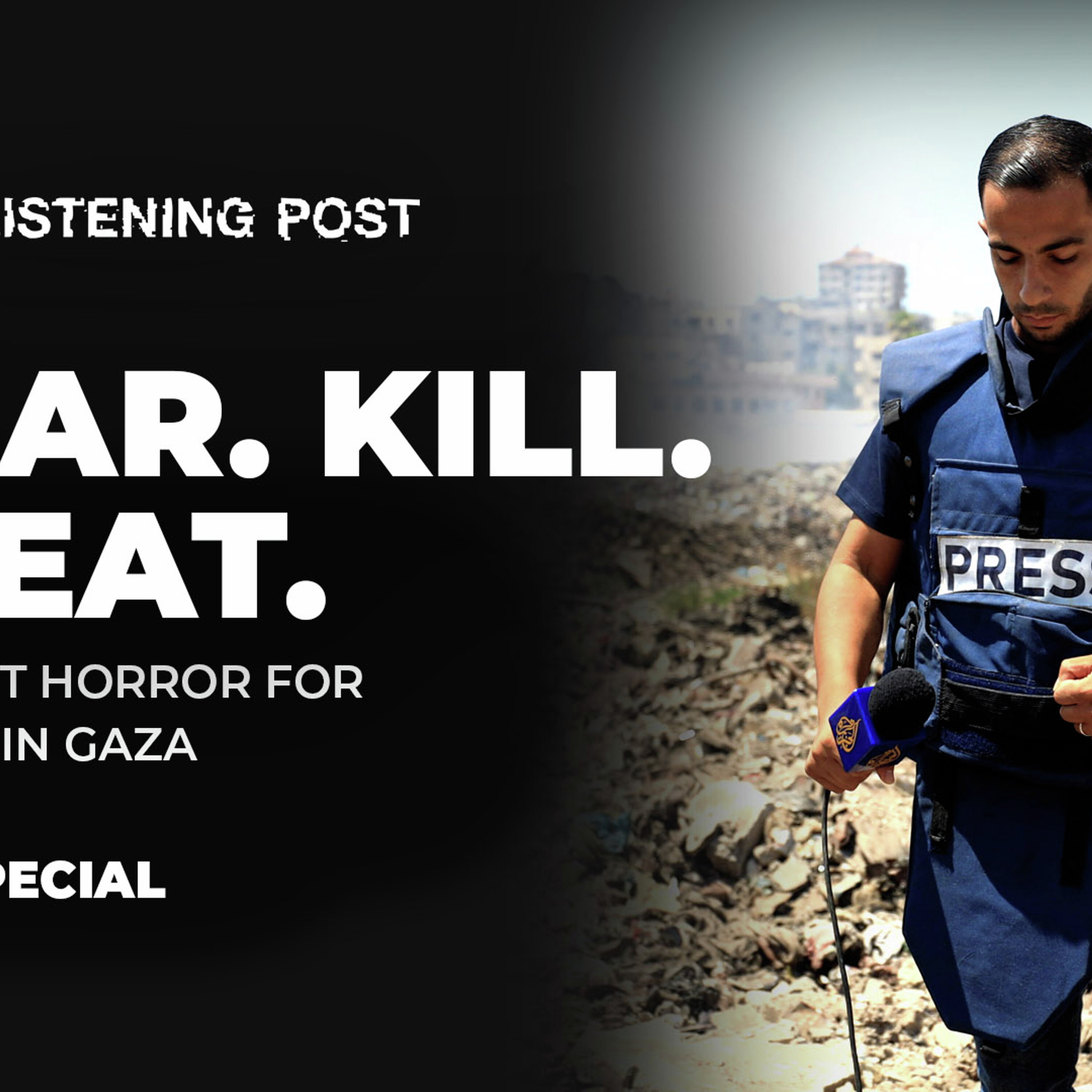
Last year at this time, on the first anniversary of the October 7 attacks and one year into Israel's genocidal response, we focused on its systematic targeting of Gaza's hospitals and medical care and how that story had been reported. On this, the second anniversary of October 7th, we're examining the Netanyahu government's annihilation of another institution, journalism, how it has massacred Palestinian media workers at such a shocking rate, one the world has never seen before. According to one NGO, the Committee to Protect Journalists, in the first 10 weeks post October 7, Israel had already killed more media workers in Gaza than had ever been killed in a single year anywhere. Having locked the international media out of Gaza, the Israelis clearly had a plan to silence journalists inside the Strip, in many cases permanently, to keep news and information from coming out. And Palestinians saw it coming. All the signs were there from the start.
- [03:14]
Bradley Martin
After October 7th, you had Israeli parliamentarians, including the Foreign Ministry, and then amplified by Israeli media, suggest that Palestinian journalists in Gaza somehow had prior knowledge about the October 7 attacks or that they were working for Hamas in Gaza.
- [03:37]
Human Rights Advocate
Not all people who present themselves as being journalists are indeed journalists. Many of them are Hamas and Islamic.
- [03:44]
Bradley Martin
Jihad members, very much part of the broader frame that the Israeli government has tried so hard to push over the last almost two years. Okay, so if there are no innocents in Gaza, then of course by definition Palestinians operating as journalists in Gaza are also not innocent.
- [04:07]
Investigative Journalist
They have always tried to discredit, to obfuscate to claim that this is not real journalism, that they're biased, that in fact these aren't even journalists. Coverage by Palestinian journalists has always been viewed by Israel as a threat because. Because what Israel commits in Gaza with the scorched earth campaign, with relentless airstrikes, with the demolition of entire cities and towns, if this coverage gets out, it's impossible to refute.
- [05:24]
Human Rights Advocate
Israel was killing Palestinian journalists long before October 7th. Typically in the aftermath of those targeted killings, like the shooting of Al Jazeera's Shireen abu Akle in 2022, Israel's response would follow a pattern, a playbook. First deny responsibility, then blame Palestinians, then purport to, quote, unquote, investigate the incident. And very rarely, only when the killing had become old news, the Israelis would admit culpability but insist it was some kind of operational mistake. The change since October 7th is the stated intention, the way Israeli officials have prepared the ground for those killings. That and changing the playbook. Systematically turning the families of Palestinian journalists into fair game. Like the case of Al Jazeera, Arabic's Gaza bureaucracy, whose wife, 15 year old son, 7 year old daughter and 18 month old grandson were all killed within three weeks of October 7th after fleeing to a so called safe zone. Another one of his children, Hamza Dahdu, a camera operator for Al Jazeera, was killed in January 2024 by an Israeli missile strike. We asked Dahdu if he believed his family members were targeted and in order to silence him, to pressure him to stop his reporting on what was quickly turning into a genocide. Rubama Tasawarana Hijara Al Hadidna Banay.
- [08:44]
Investigative Journalist
There'S been reporting that has shown that Israel knows exactly who it is targeting. Acts of collective punishment by the Israeli military have continued since the beginning of the war until today. As the war progressed and more journalists were being slaughtered and there was no consequences for Israel, their response became increasingly brazen. We started to see that after the journalist was killed, the Israeli military would then claim that this wasn't a journalist at all, in fact that they were a militant. We saw this in the killing of Hamza Dahdukh and Mustafa Zaraya. After they were killed, Israel initially apologized. Then they proceeded to claim that both Hamza and Mustafa were in fact militants and produced supposed documents showing that they were part of Hamas militant wing or Jihad's militant wing. Those documents were proven to be unsubstantiated by press watchdog groups and the United Nations. We saw the same thing in the killing of Ismail Al Ghul, an Al Jazeera journalist in July of 2024 in an airstrike that decapitated him. They later claimed that Ismail Al Ghul had received military ranking from Hamas in 2007. Ismail Al Ghul was 10 years old at the time. That's how ridiculous these claims are.
- [10:05]
Human Rights Advocate
The Israelis have killed all sorts of media workers in Gaza. Reporters providing critically important local news coverage, keeping Palestinians in search of safe havens, informed, as well as journalists working for news outlets on the outside. However, no news organization has been targeted the way Al Jazeera has. The late Anas Al Sharif. Sharif, one of the very few reporters who refused to leave northern Gaza, worked for the network's Arabic channel. Sharif's hard hitting first person reports early in the genocide quickly earned him the attention of the Israeli authorities. The kind of scrutiny that can amount to to a death sentence.
- [10:56]
Media Analyst
Journalists have been contacted on their mobile phones by Israeli military or Israeli authorities warning those individuals to stop reporting. We understand that Anas Al Sharif had such threats all the way back in November 2023. Of course, just a month later, there was an attack on his home in which his father was killed. Anas Al Sharif was repeatedly smeared as being pro Hamas, sympathetic to the cause. What we didn't hear during that period, to our knowledge, were any specific allegations that he was a terrorist.
- [11:45]
Investigative Journalist
This evolved by October of 2024 when Avicha Adrei, the Israeli military spokesperson in Arabic and a very prominent figure online and on the air, who openly names Palestinian journalists, taunts them, incites against them, threatens them. He started to call out Anas Al Sharif by name and say that he was a terrorist. Not calling him a Hamas propagandist anymore, but calling him a militant and a terrorist, and that he was on essentially a hit list.
- [12:32]
Media Analyst
We know that Anas Al Sharif was very frightened and he genuinely believed that the smears against him were a precursor to his murder. And that proved to be the case.
- [12:49]
Investigative Journalist
Israel's military says it's killed prominent Al Jazeera correspondent Anas Al Sharif.
- [12:54]
Media Analyst
Five other journalists were killed in that attack. Israel has made no attempt to explain why it felt justified in killing not one journalist whom it alleges is a terrorist, but all six journalists, five of whom it has given no explanation for. You can link that directly to a failure to hold Israel accountable for any of the record number of deaths of journalists over the past two years.
- [13:20]
Investigative Journalist
Israel has deliberately targeted important journalists who are covering what's happening on the ground, who are leaders in their society, who are heroes in their society, and it has tried to crush Palestinian society. And part of that crushing is to kill the very journalists who are covering the genocide. Israel right now is conducting a stated ethnic cleansing campaign in Gaza City. Right before it started, it killed Anas Al Sharif and five other journalists. It basically wiped out Al Jazeera's Gaza City media team. We know a lot less about what's happening in Gaza City because there are fewer journalists there because they have been killed.
- [14:02]
Bradley Martin
We know that right from the start. Right after October 7th, there was a special military unit set up, the Legitimization cell. And one of its tasks was to find information with which to smear Palestinian journalists in Gaza. That was its role. It was a PR role to inflict reputation damage on Palestinians who are doing their job reporting Israel's genocidal war in Gaza. And they were told this is according to sources who spoke to 972 Magazine. This task is important to Israel because it will give us time, it will allow us to prolong the war. And so now we see the purpose of these smear campaigns. It's not just to discredit them, it's it's to buy more time to carry out their genocidal war.
- [14:57]
Human Rights Advocate
Wael Dahdu has endured the loss of scores of his family members. He has seen dozens of his colleagues at Al Jazeera and beyond smeared, targeted and killed. He has questions for the people Dahdu watches on Israeli news channels, the ones who call themselves journalists, supposedly reporting on a genocide while advocating for it, at times participating in it, and not just through incitement. Madhanakul and Mudiya Philistudio Madhanakul Lisah Rafa Kajil Israeli Fijanub Libnan Ala Sabina.
- [16:35]
Investigative Journalist
The.
- [16:35]
Human Rights Advocate
Narrative the Israelis have put out there on Palestinian journalists, that they are not credible, that they're mouthpieces for Hamas or even Hamas operatives would have struggled to gain any traction without the help of Western media outlets. But they have provided it. Journalists at news networks and so called newspapers of record have failed to show sufficient solidarity with their Palestinian colleagues, in effect othering their them and their reporting on a case of genocide.
- [17:05]
Media Analyst
It's been a huge source of anger and disappointment that the genocide has not been covered in a way that we would cover a similar situation elsewhere. That language is used that continually and perpetually dehumanizes Palestinians, that diminishes what's being experienced, that casts doubt on the veracity of individuals.
- [17:35]
Bradley Martin
Obviously international organizations like the BBC cannot.
- [17:38]
Media Analyst
Go in and so Al Jazeera, using.
- [17:41]
Bradley Martin
Local people there, are they able to.
- [17:44]
Media Analyst
Operate truly Independently, I am surprised that people were less willing to do the work that we all believe is necessary as a journalist, to ask the difficult questions, to ask for proof, to ask for evidence. Our job is not simply to parrot what we're told, to quote one side and the other side. Our job is to go and investigate, to understand what really happened.
- [18:10]
Investigative Journalist
When they covered, for example, Evan Gershkovich, the Wall Street Journal reporter who was wrongfully imprisoned in Russia, the headline and the lead would say these charges are widely seen as fabricated. They do not engage in that kind of narrative when it comes to Palestinian journalists. This kind of double standard is what enables Israel to continue. The New York Times, after Ena Sharif's killing, put out a piece about Al Jazeera that was headlined what to Know about Al Jazeera, the broadcaster targeted by Israel. The article then goes on to talk about how governments in the Arab world, some of the most repressive governments towards press freedom in the world, treated Al Jazeera. Can you imagine if five New York Times journalists were killed in an airstrike and then Al Jazeera put out an article saying, the New York Times, the paper that angers governments around the world, this is shameful and has allowed this killing to continue.
- [19:13]
Bradley Martin
One would have to conclude, unfortunately, when you look at Western media in an establishment sense, in an institutional sense, higher ups, senior executives, that they don't see Palestinian journalists as the same as them. They don't see them as equal. They don't see them as equally professional, because otherwise we wouldn't see what we're seeing. Obviously, Western journalists are reporting in countries that are allied to Israel, where governments treat Israel in a particular way. And the second thing is that particularly since 9 11, we have Muslim and Arab people more widely cast as essentially an enemy within, as inherently suspicious, as inherently violent. These two narratives, together with the huge effort the Israeli state, an army has made to discredit Palestinian journalists, it just creates this cloud of suspicion. And that in itself places Palestinian journalists in Gaza in a different category, and it is not an equal one.
- [20:51]
Human Rights Advocate
For two years, Palestinian journalists in Gaza have had the toughest assignment on the planet. They've had to endure the unthinkable, what had been the unimaginable, to document the massacres of innocence, endless stories of suffering, death and displacement, crippling hunger, the leveling of homes and neighborhoods that those journalists grew up in, the wiping out of families and memories they grew up with, all while staying on the job and producing stories that are harrowing enough to take in, let alone put out. And they have done all of that while being smeared sometimes by other journalists, then hunted down by the Israeli military and killed, all because the Israelis do not want the truth to come out.
- [21:51]
Bradley Martin
Foreign.
- [22:51]
Investigative Journalist
We're talking about journalists who are in their early 20s, who know that they are being targeted, that they are being hunted to such an extent that most of them have written letters to be published after their killing. Hossem Shabet did this, Enez Sharif did this. So they understand that they have become a target by the Israeli military and still they refuse to stop their coverage. I interviewed Enos E. Sharif in September of 2024, asking him, why do you continue to do this coverage? And he said, sometimes I despair, but sometimes I believe that, that maybe this image, this report, this coverage of this attack will make the difference, will make the world pressure Israel to stop. I think what we are witnessing is the bravest act of journalism in our lifetimes, that these journalists in Gaza refused to leave Gaza. They refused to stop their coverage, despite being killed in unprecedented numbers.
- [23:56]
Media Analyst
I don't think it's possible, impossible to overstate the impact that this unprecedented level of killing of journalists has had globally. Impunity spreads. Impunity spreads. Because if you know that you can get away with murder, you will do it again and again and again. And if you can get away with smearing journalists, if you can get away with arresting, if you can get away with killing journalists in order to control the narrative, and you know that there will be no repercussions, not domestically and not internationally, then you will continue to do this. And this has and will embolden governments everywhere to continue to target the messenger.
- [24:43]
Bradley Martin
We have an entire generation of Palestinian journalists who have been lost in Gaza. The cost him as well, is future looking. Journalism is a form of evidence gathering. It's a form of documentation. And so when it comes to, as it surely must and will, when it comes to international courts trying to hold Israel to account for this genocidal war, we have now lost scores of people who were capable and equipped to give testimonials to those courts and who now cannot because Israel has killed them.