Loading summary
Transcript78 lines
- [00:00]
Bretzky
What's up baby? It's Bretzky and I'm here to tell you that spinquest.com is giving out free sweeps coins. All you gotta do is purchase a ten dollar coin pack and guess what? They're gonna give you the coins from a thirty dollar coin pack that lets you play all your favorite games like Blackjack, Wanted, Dead or Wild. And we're talking real cash prizes baby. Spinquest.com Spin Quest is a free to play social casino void where prohibited. Visit spinquest.com for more details.
- [00:31]
Narrator/Host
This week on the Take we're marking one year since a pair of devastating earthquakes hit Turkey and Syria with a new digital interactive Listen and watch stories of survival, recovery and coping with the
- [00:45]
Al Jazeera Correspondent
grief@al jazeera.com earthquakes Again, that's al jazeera.com
- [00:54]
Narrator/Host
earthquakes what is the point of all the AI warnings we're hearing?
- [01:01]
Bretzky
My worst fears are that we cause significant harm to the world.
- [01:04]
Narrator/Host
Many of the same people ramping up the anxiety are also hyping new, even troubling AI developments. An edited video and a pressure campaign.
- [01:13]
Dario Amadei
We as a humanity have a common enemy.
- [01:16]
Narrator/Host
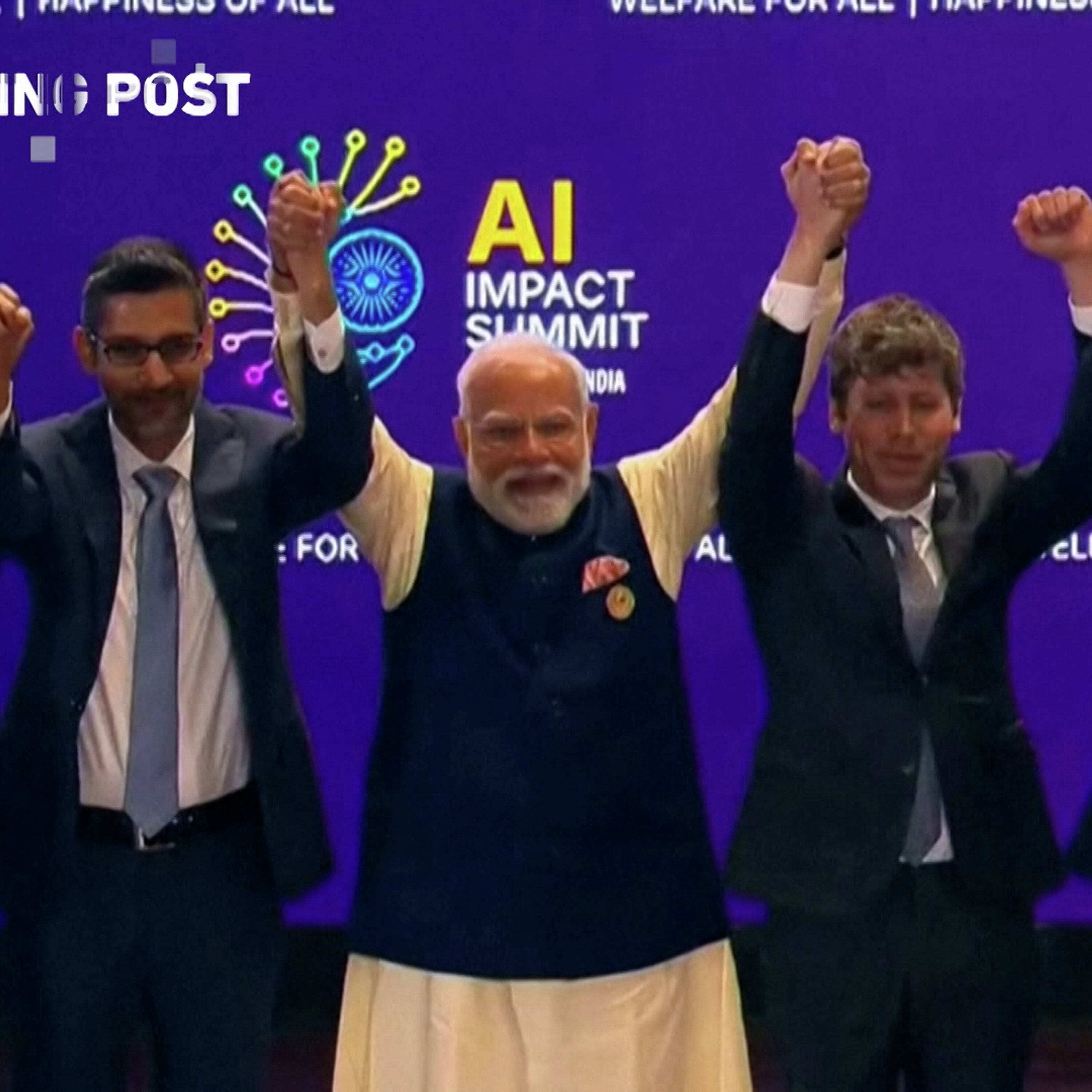
The UN's Francesca Albanese is being targeted for her outspokenness about Israel's genocide of Palestinians. And a group of African reporters were invited out to Israel. Why didn't they disclose to their audiences that their journalism was sponsored. The world of AI generates news in waves. Upswings of euphoria, nosedives of sheer panic. So far this year, the mood has tilted sharply towards alarm. Even amidst the spectacle and choreographed optimism of the AI Impact Summit in New Delhi, one of the biggest AI conferences in recent months, CEOs and evangelists were sounding alarm bells. The message isn't complicated. The pace at which AI is developing is out of control. The risks are all coming at us faster than was predicted. Large segments of office based analytical and creative work are under threat. AI generated misinformation is widespread and increasingly difficult to detect. Guardrails on the use of AI in surveillance and warfare are being weakened. So what exactly are these warnings accomplishing? Industry leaders insist the genie can't be put back in the bottle. More critical observers would say the truth is the money. The AI gold rush means there's little incentive to slow this ride. Except of course, for the small matter of the future of humanity. The travelling global AI circus rolled into New Delhi this past week. CEOs, investors and influencers gathered in India for a two day summit, the sixth large scale international AI conference of this year. On stage, Daria Ahmade, the scientist CEO of Anthropic one of the world's leading AI firms, didn't mince his words.
- [03:03]
Bretzky
And there are only a small number of years for AI models surpassing the cognitive capabilities of most humans for most things.
- [03:12]
Narrator/Host
This has been something of a running theme for Amadi recently. In January, he had written an essay nearly 20,000 words long. He said AI could be the single most serious national security threat we've faced in a century, possibly ever. In February, Mrenank Sharma, a safety researcher at Anthropic, resigned publicly, writing in his open letter that the world is in peril and that AI was not making things better. The next day, AI startup investor Matt Schumer posted a cautionary essay on his social media. It was viewed 84 million times on X alone. Just the day after that, the New York Times published an I quit column by Zoe Hitzig, a researcher at OpenAI, the company behind ChatGPT. She flagged the danger that her former employer was sliding into a world of manipulative monetization just eight weeks into 2026. And a series of AI red flags.
- [04:11]
AI Industry Analyst
What we're seeing right now in the number of AI warnings, whether it's from Anthropic, whether it's from researchers that OpenAI, I do think that there is a lot of substance to what they're saying because number one, these are the people that actually have access to the data. And then the other reason I think these should be taken seriously is that these warnings really strip away plausible deniability should these systems go on to do harm. These leaders in the space are already going on the record to say that these are dangerous and we're looking for some type of guidance.
- [04:57]
Technology Expert
The first three and a half years of the AI revolution have been transacted through chatbots like ChatGPT or Claude. And really what we saw over the winter period of 2025 and into early 2026 was a fundamental change in how we interact with generative AI that I think will be as significant as that initial chatgpt moment. We have this concept of agentic AI, which is effectively a self controlled, self acting AI that makes us closer than ever before to this idea of artificial general intelligence, which is the idea that actually these things don't need human oversight anymore. And they worry that that's just one small step away from basically AI controlling itself and maybe enslaving us.
- [05:46]
Narrator/Host
The risks of AI aren't hypothetical. Just last year, Grok, the AI chatbot on Elon Musk's platform X, allowed users to generate sexualized images of real people. It sparked alarm and even criminal investigations around the world. AI video manipulation is now pervasive. If computer generated deepfakes had already made seeing is believing questionable, AI's generative tools have spawned a crisis of authenticity.
- [06:14]
Bretzky
By the way, I'm an AI too.
- [06:17]
Narrator/Host
Then there's the use of AI in war. Drones that target, surveil and swarm based on AI instructions. Programs that draw up lists of supposed terrorists based on AI analysis. None of these risks even touch upon the problems of agentic AI, artificial intelligence that can simply outrun its human programming and take its own actions.
- [06:40]
Dario Amadei
Sometimes I do find it a bit disingenuous when the same CEOs building these advanced technologies also claim that AI has a 20% chance of killing us. Or AI exhibits signs of manipulation or lying or deceitful or self replication.
- [06:55]
Bretzky
My worst fears are that we cause significant we, the field, the technology, the industry, cause significant harm to the world.
- [07:03]
Dario Amadei
Realistically, if an AI system were capable of doing all these things that they're testing these models for, we just simply wouldn't deploy it. It's sort of like, you know, you drew monsters on your wall and now you're hiding underneath your bed.
- [07:16]
AI Industry Analyst
The leaders of these companies, whether it be Anthropic or Gemini or OpenAI, they could, if they felt that these threats existed, they could just stop developing. Instead, they're continuing development. They're making hires to try and really aggressively monetize. Because these are businesses. It is not their job to heal the world and make it a better place. It is their job to make money and more money and more money. Whether it is ethical or whether it is unethical.
- [07:56]
Technology Expert
The idea that AI companies are going to self regulate themselves just I think isn't really realistic. Not least because they're making money hand over fist. So we need governments to do more about this. The problem of course, with that is that actually governments aren't well equipped for this. Politicians with the best will in the world aren't overly tech literate. So really there's kind of like an imbalance here in the arms race. You have the AI companies that have some of the strongest and brightest minds to understand this, and they are the ones that we're having to rush to as governments because we can't really afford to get the expertise that we want in house.
- [08:34]
Narrator/Host
One arena where AI's impact has triggered the loudest alarms is in the jobs market.
- [08:39]
Technology Expert
So white collar work, you know, a lawyer or an accountant, or a project manager or a marketing person, most of those tasks will be fully automated by An AI within the next 12 to 18 months.
- [08:52]
Narrator/Host
That warning from Microsoft's AI chief went viral at the start of this month. And he's not a lone voice.
- [08:59]
Bretzky
There will of course, be totally new jobs and many existing jobs will entirely go away.
- [09:04]
Narrator/Host
Warnings about AI's impact aren't coming from the industry alone. In 2023, screenwriters and actors, actors in the US went on strike. One of their demands was regulation on AI use in film and TV. In 2024, the International Monetary Fund reported that nearly 40% of global jobs are exposed to AI risk.
- [09:26]
Technology Expert
With generative AI. I think that people are sounding a massive alarm on it. And I think what's interesting and what's different about this is what kinds of jobs are being affected. This is very much a white collar revolution. It is research skills, it is data aggregation, it is making linkages between large sums of information and trying to invent novel new things that are going to be affected. And that, frankly, is jobs that I have, jobs that many of us have. And I think that is why we are so concerned about it.
- [09:58]
Dario Amadei
This conversation about the future of work is happening as all of these companies are being driven to monetize and they're pushing more and more and more and more tools specifically targeted to industries. So Anthropic recently released an AI paralegal tool, and now there's concerns that the paralegal industry will be taken away. Number one, if you are so concerned, then be part of figuring out the solution. You cannot say, I'm going to point out the problem, but somebody else has to come in. Number two is that there are ways to build these technologies and tools so that they are not intended for to replace humans, that they are meant to augment the kind of work people are doing.
- [10:36]
Narrator/Host
The conversation around AI tends to swing to extremes, saying there's more than 10%
- [10:40]
Bretzky
chance that this just kills us all.
- [10:42]
Narrator/Host
Such framing serves clear business interests. It can drive investment and influence regulatory debates.
- [10:49]
Investigative Journalist
Dario Amadei talks a lot about the
- [10:51]
Bretzky
potential dangers of AI and has repeatedly called for its regulation.
- [10:55]
Narrator/Host
The less airtime that is given to the AI reality that exists between world saving breakthroughs and world ending catastrophes, the less serious debate there is about it, and less meaningful action to address how AI is actually shaping everyday life.
- [11:12]
Dario Amadei
So when you talk about, you know, AI is 20% chance of killing us all or no white collar jobs will exist in 18 months. It puts into play a sense of paralysis that distracts us with a bunch of theater and distracts us away from the things that we should be talking about violations on human rights, copyright infringement, illegally sourced data right models that are actually harmful to our planet. Now those are actually things we can write laws about, we can have policy on, we can meaningfully engage with.
- [11:44]
Technology Expert
The problem really is that actually even the AI companies themselves don't know fully where this path athletes, there are lots of different options of where they think it could go. One of them is the really scary AI doomer scenario. I think that's pretty unlikely. But there are other equally concerning paths. This will change your job, this will change your education. We're settled in to this AI moment and you can't really go back from it. So you have to learn how to use it, knowing that this is going to be here in all of our lives for years to come.
- [12:24]
Narrator/Host
Francesca Albanese, the UN Special Rapporteur for the occupied Palestinian territories, has found herself at the centre of a political firestorm after a manipulated video of a speech she gave went viral. Ryan Coles has been following the story.
- [12:39]
Bretzky
Several EU states have called for the resignation of Francesca Albanese, all because of comments she never actually made. The controversy began after Albanese spoke at a conference in Doha, the Al Jazeera Forum. An edited clip of her remarks was then circulated by the executive director of a pro Israel advocacy group called UN Watch. The manipulated clip made it appear as though Albanese had described Israel as the common enemy of humanity. This is what she actually said.
- [13:07]
Narrator/Host
We now see that we as a
- [13:10]
Dario Amadei
humanity have a common enemy and freedoms.
- [13:15]
Narrator/Host
The respect of fundamental freedoms is the
- [13:17]
Dario Amadei
last peaceful avenue, the last peaceful toolbox that we have to regain our freedom.
- [13:25]
Bretzky
The altered video got more than a million views on X and it clearly struck a chord in European capitals. French Foreign Minister Jean Noel Barrot led calls for Albanese's resignation. He was supported by Germany, Italy, Austria and the Czech Republic. None of the officials of those countries thought to check the authenticity of the video. Albanese spoke out on France 24.
- [13:47]
Narrator/Host
I've never said that.
- [13:48]
Dario Amadei
I've said something very different, but of
- [13:50]
Narrator/Host
course it's been manipulated so as to
- [13:52]
Dario Amadei
corroborate the defamation against me.
- [13:55]
Bretzky
Current and former UN staff have publicly rejected the allegations against Francesca Albanese, calling them part of a wider smear campaign targeting both her and and the UN itself. This is not the first time Albanese has faced this kind of criticism or had her remarks taken out of context. As a result of her advocacy, she has faced constant smears, political pressure and even economic sanctions from the us. Despite the backlash, Albanese remains in her post and is continuing her work. She consistently calls out Western governments for their complicity, and last year released a report naming the corporations and institutions that have benefited from Israel's war on Gaza. Her office is now preparing a report on the role of the media through the war.
- [14:38]
Narrator/Host
Thanks, Ryan. For decades, the Israeli government and pro Israel organizations have sponsored trips for politicians, celebrities and journalists, inviting them to visit the country and, as they put it, tell the real story about Israel. In the past, those invitations largely targeted figures from Western countries. But since October 7, there's been a noticeable shift. Increasingly, African journalists and social media influencers are being flown in for carefully curated tours of Israel. The objective is to shape coverage in African media and influence audiences across the continent. The results, however, are not guaranteed. They've been mixed, especially in cases where journalists have questioned these junkets and the tension between accepting an all expenses paid visit and maintaining editorial independence. That scrutiny has prompted a new development, the growing inclusion of a religious component in these tours. The Listening Post's Nick Muirhead reports on the African journalists taking part in these fully funded, tightly managed visits to Israel.
- [15:42]
Investigative Journalist
In April last year, three major South African news outlets, the Sunday Times, the Citizen and Biz News, published stories about Israel written by journalists who had just been there. But for many South Africans, there was something about the editorial approaches in each of the reports that seemed off. What they weren't being told was that the trips had been sponsored by the South African Jewish Board of Deputies, the sajbd, an organization with close ties to Israel. That funding may never have come to light had it not been for Hassan Logat, an activist who connected the dots.
- [16:18]
Hassan Logat
When I heard originally that the Sunday Times had undeclared a trip to Israel, I looked through the article and saw whom did they interview? Victims of the concert where the attacks took place. One person in the west bank representing Fatah, not actually in the Gaza Strip. Former generals. I started following each of the newspapers to see whether these names were repeated. I then found oh, Citizen interviewed the same people. Oh, then I went and I found in Biz News they interviewed the same people. Then I wrote to them to say, listen guys, this is rather strange. You all interviewed the same people. So were you all there together? And if you were there, who paid for you? And then receiving some replies which appear to hide some of these answers, I thought it was best to lodge a formal complaint with the Press Council of South Africa.
- [17:15]
Investigative Journalist
The Press Council upheld Logat's complaint and called the failure to disclose the sponsorship a serious breach. But it stopped short at upholding the second part of Lorgat's complaint that the omission was deliberate. And when he repeated that assertion on
- [17:31]
Narrator/Host
air, what I've tried to show is
- [17:33]
Hassan Logat
this is a conspiracy, that they worked in collusion.
- [17:36]
Investigative Journalist
The editor of the Sunday Times, Makudu Safara, called in with his side of the story.
- [17:42]
Makudu Safara
I've never spoken to the Citizen. I don't even know the people at business. I don't even have a business with them. Anything that has to do with Palestine and Israel.
- [17:51]
Hassan Logat
When the editor of the Sunday Times was asked by Chris Vicks, why is it that you do not disclose this? He said mswami, the writer, he forgot
- [18:01]
Makudu Safara
to put the thing at the bottom of the piece.
- [18:05]
Hassan Logat
Look,
- [18:07]
Technology Expert
he forgot.
- [18:08]
AI Industry Analyst
I just want to make sure I heard you correctly.
- [18:09]
Hassan Logat
Yeah. All these guys, the Citizen people, all of them have over 100 years high level journalistic experience. How can they miss the basic, the 101 of journalism that you have to declare your funding? How can they miss it? How can you say we forgot?
- [18:27]
Investigative Journalist
It's a valid question and one that I wanted to put directly to Sophia, the Sunday Times editor at their newsroom in Johannesburg. Can you see how suspicious that looks that not one, not two, but three news organizations all failed to disclose that their news gathering trips had been funded?
- [18:46]
Makudu Safara
Look, I can't speak on behalf of the other media houses. I don't know what happened in those media houses. I can speak to you about the internal processes here. The he needed to put the line at the bottom of the story. He didn't put it. We as the editors, we should have seen it. We didn't. That's a genuine human error.
- [19:07]
Investigative Journalist
So were there any sort of conditions or expectations attached to the funding, any
- [19:13]
Makudu Safara
whatsoever, the communication within the company is that where anyone goes on a trip, the condition is that there's no promise that is made in this particular case. They didn't speak to me. They spoke to Mr. Msomi, who is a very credible, experienced journalist and he came back, he wrote what in my view is a balanced story. And the piece was aptly titled Two sides of a Tragedy.
- [19:44]
Investigative Journalist
Only it isn't really Two sides of a tragedy. Palestinians are unable to pay journalists to go to Gaza where Israel continues to lock out the international media media and tell their side of the story. The Israelis, on the other hand, have been doing it for years, typically with journalists and influencers from the West. But since October 7th and the waning of international support, their focus has shifted to Africa. Alongside South Africa, Israel has sponsored delegations from Rwanda, Cameroon, Morocco and then in November last year, there was Ethiopia, where at least 20 media workers went to Israel on funded trips. Ethiopia is a Christian majority country with deep religious ties to Israel, a tightly controlled media, and importantly, a recent history of journalists echoing state narratives during its own brutal war where mass atrocities were carried out in the Tigray region.
- [20:43]
Media Critic
When you look at some of these organizations that were invited, they were some of the most genocidal news outlets when it came to the 2020 Tigray War and genocide. And so one would surmise that they weren't going to have any kind of critical coverage or criticism of any sort from these so called journalists, I'll say. And so then they were going to just parrot their propaganda.
- [21:15]
Investigative Journalist
Images posted on their social media media feeds show that many of the Ethiopian journalists visited Christian heritage sites. They were given access to politicians and taken on tours of Israeli newsrooms. And in all the reports that we reviewed, there was one thing in common. They all lacked a Palestinian perspective.
- [21:34]
Media Critic
They talked about the hostages, they talked about October 7th, this one documentary, almost more than half of it was this one individual who was at the festival on October 7th talking about in excruciating details about what was happening. They did not speak to a single Palestinian person. They would go up to the fences of Gaza and then say. It was just completely whitewashing genocide, completely one sided narrative, completely erasing Palestinians as if they don't exist.
- [22:19]
Investigative Journalist
We contacted several of the Ethiopian journalists who traveled to Israel last year to give them an opportunity to respond to the allegation that they were whitewashing a genocide. They either ignored the request or declined to comment, as did members of the next delegation that went to Israel from Kenya. Only they weren't journalists. They were a group of mostly evangelical Kenyan social media influencers who seemed all too happy for the opportunity to produce content from the Holy Land.
- [22:48]
Al Jazeera Correspondent
So you can understand why Israel would come to a country like Kenya, which has a majority Christian population. And the influencers who went to Israel were all well known online. Born again Christians who profess their faith, loudly create Christian culture, content, Christian music and so on. So these groups of people would be best suited to go to Israel, because part of the narrative around Israel is that this is where Jesus was born, Jesus died. So Israel utilized it to draw in people, to make them go and sanitize the image of the country. I'm looking at where Jesus was barren.
- [23:25]
Investigative Journalist
Finding allies in the media while your country stands accused of genocide, regardless of requires every tool at your disposal. And Israel appears to have learned that faith can be more powerful than persuasion. When journalists and influencers view Israel through a religious prism rather than as a state accountable for its actions. It can deflect everything else, including Palestinians, whose story is lost in a curated tour of the Holy Land.
- [23:54]
Al Jazeera Correspondent
Religion is what absolves Israel from whatever crimes it may be committing, because to many people it is a holy land first and a state after. So there is this demarcation of understanding in terms of how Israel is viewed. For Christians, the fact that Israel is committing atrocities is irrelevant. Israel for them is the birthplace of Jesus and they Therefore support Israel 100%
- [24:16]
Hassan Logat
Christian Zionism remains one of the critical weapons, so they tie it so close to the faith, to the historic Israel, not this one. That is doing what it does so that it can make this a clear fight between Western civilization versus Islamic terrorism. That is their strategy. There is money, there is changing hands, and this investment is long term, and this is what we have to watch for.
- [24:47]
Narrator/Host
Finally, the debate over whether AI belongs in newsrooms was in many ways settled some time ago. Since at least 2023, publishers such as Axel Springer in Germany and outlets including the Washington Post, CNN and Al Jazeera have integrated generative AI into parts of their editorial workflow. But normalization doesn't mean there are no surprises left. The extent to which some newsrooms are willing to rely on AI can still unsettle. This past week, a column by the editor of a Cleveland based news website went viral. He argued that skepticism, even outright rejection of AI handling entire segments of journalistic work amounts to, quote, fear of the future. The column was written after a potential reporter for the website pulled their name out of the running when they were told the role would involve very little writing. According to the editor, the outlet employs AI rewrite specialists who turned reporters field material into drafts. By removing writing from reporters workloads, he wrote, we've effectively freed up an extra workday for them each week. The reaction to the column ranged from anger to despair to weary acceptance. After all, there is little to prevent AI companies from building tools that reduce or remove the human element from journalistic work. And increasingly, even institutions that might otherwise scrutinize the spread of AI appear ready to embrace it.
- [26:18]
Bretzky
Forget whatever plans you have this weekend because you're staying at home and playing on spinquest. And there's never been a better time
- [26:25]
Technology Expert
to sign up than right now.
- [26:26]
Bretzky
New users get $30 coin packs for just $10, all the table games you love, with hundreds of slot games and real cash Prizes. That's at spinquest.com S P-I-N Q U-S-T.com Spin Quest is a free to play social casino void where prohibited. Visit spinquest.com for more details.