← The Listening Post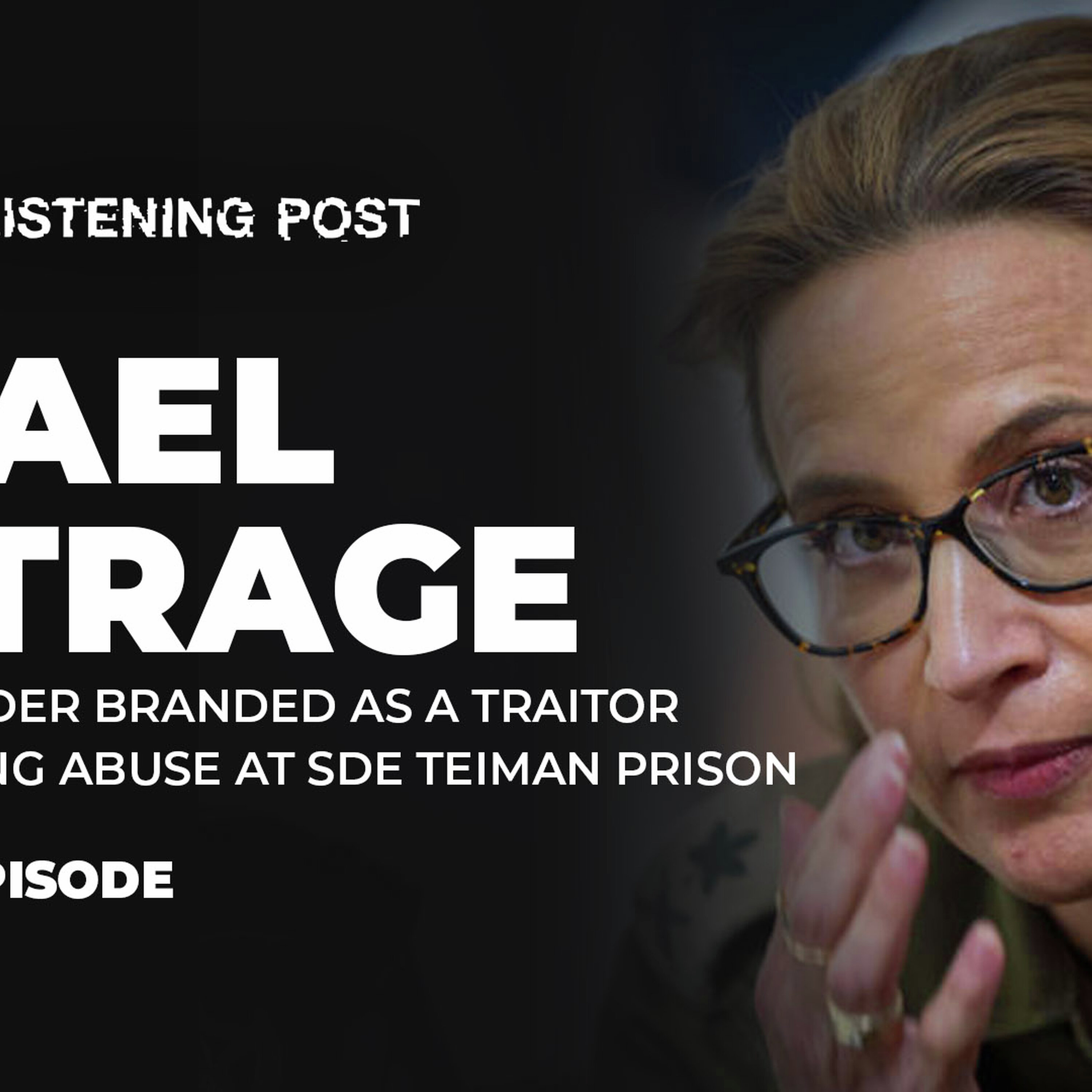
Loading summary
Transcript42 lines
- [00:01]
Narrator/Host
This week on the take, we're marking one year since a pair of devastating.
- [00:05]
Co-host/Reporter
Earthquakes hit Turkey and Syria with a new digital interactive Listen and watch stories of survival, recovery and coping with the grief@al jazeera.com earthquakes Again, that's al jazeera.com earthquakes Foreign.
- [00:33]
Main Reporter/Analyst
Israel, where war crimes committed against Palestinians are considered a PR problem. We dig into what happened at that Israeli prison, the leaking of the video and the spin doctors now working overtime in Tel Aviv, Sudan, where journalism and accountability are among the many casualties in northern Darfur. And what's in a nickname in Kenya, where the political space is full of them? The answer is a lot. The Israeli government is dealing with what it calls a public relations disaster, a case that according to any legal system, is a clear cut war crime. First, a warning to our viewers. This is the story of at the heart of it is a leaked video showing Israeli soldiers in the process of torturing and sexually assaulting a Palestinian prisoner. The video is sickening to watch, even though the Israelis use their shields to hide what they are doing. And the resulting uproar in Israel has not been about the abuse, it's been about the exposure and the woman who leaked the footage, the Israeli military's chief prosecutor, who is now being branded as as a traitor. She's been arrested while the accused soldiers have been cast as some kind of victims. Dig a little deeper into this story and it reveals so much about Israel's PR playbook when it comes to war crimes and cover ups, when potential moments of reckoning turn into battles over optics. And it provides yet another glimpse into an Israeli society that is unwilling or incapable of coming to terms with, with what it has become. To hear the Israeli prime minister tell it, this particular story could prove to do unprecedented damage to Israel's global reputation. Was Benjamin Netanyahu referring to the indictment issued against him by the International Criminal Court for his alleged war crimes? There are other people, like the prosecutor in the Hague that seeks to handcuff us. Was he talking about his security minister taunting Palestinian prisoners last week, celebrating their abuse, predicting that death awaits them? Or was he citing these images from Gaza, filmed by Israeli soldiers, documenting and savoring on social media a genocide? It was none of the above. Netanyahu was talking about this video showing Israeli soldiers hiding behind the COVID of their shields, brutalizing a Palestinian prisoner, raping him, and the fact that the video was released to the world by an Israeli.
- [03:32]
Commentator/Analyst
You can clearly see that they're doing something to this person. There are obviously charges brought against them for really horrifying violence, but you can't actually see any of that on the video. What you can see is a bunch of people covering up something that looks very, very violent.
- [03:50]
Expert/Analyst
Israel always tries to position itself as civilized vis a vis the uncivilized. And so for them, rape is considered as the sort of ultimate act of barbarity. That's why the Israeli public and Netanyahu are so upset with the leaking of that footage, because it positions them in a place of barbarity, because there is still in Israeli society this idea that the Israeli army is bey barbarism, that they maintain this moral standard.
- [04:23]
Main Reporter/Analyst
There have been two stages to this story. Stage one took place more than a year ago with the release of this video from an Israeli prison, State Tayman. In August of 2024, it was leaked anonymously to an Israeli news network channel. Right wing Israelis, including politicians, then showed up at the prison and broke in, demanding that no soldiers be prosecuted, regardless of what the video showed. It took six months, but the soldiers were eventually charged, although not for rape, for, quote, aggravated abuse. At the time, no one knew that the leaker of the prison video was Yifat Tomer Yaroshelmi, the top lawyer at the Israeli military, the same official who later brought the charges. Stage two began 10 days ago when Tomer Yadoshalmi revealed she was the source of the leak and then resigned. A few days later, she went missing, was reported to be on the run, then turned up and was arrested under charges including breach of trust and disclosure of official information. Do not mistake Yifat Tomer Yarosheli for your typical whistleblower. Before exposing what happened at State Tayman, she had played a big part in covering up Israeli war crimes in Gaza by blocking the prosecutions of the officers and soldiers involved.
- [05:59]
Expert/Analyst
It depends on who you ask, but since you're asking me, she was a willing part of Israel's genocidal machinery Gaza. She actively prevented any kind of serious investigation into Israel's crimes from being opened, even though there was evidence galore. Why did she decide to leak this video? I think because she was outraged at the moral indignity as much as because this was turning into a political scandal that would end up at her doorstep.
- [06:28]
Commentator/Analyst
And it's also possible that she understands as a very experienced lawyer, that Israel is increasingly accused of war crimes and there is an open case against it in the Hague and the icc, and that if she didn't do this, that she could be tried as well for being a part of covering up the crimes that the IDF has Committed.
- [06:47]
Expert/Analyst
We see this at the heart of everything Israel does. That belief that it should be allowed to conduct military operations in whatever fashion it likes, to build settlements, to demolish homes, to bomb entire neighborhoods, to bomb other countries, that there should be no accountability. And this is the situation in which the former Israeli military advocate General finds herself in. It is a witch hunt. They are after her. There are people who talk about lynching. One wonders, you know, if her life is still under threat even now.
- [07:25]
Main Reporter/Analyst
Of all the deranged reactions this story has produced in Israel, it would be tough to top this one from its Minister of Defense, Israel Katz. Katz called it a case of blood libel, referring to the age old antisemitic tropes used to accuse Jews of killing for pleasure. Even though the video was shot in an Israeli prison on an Israeli camera, was leaked by an Israeli prosecutor to an Israeli journalist working for Israel's Channel 12, Guy Peleg, who then informed the Israeli public. Channel 12 now says that because of the blowback, it has had to hire security protection for its reporter. And Peleg has come under fire on his own channel for doing something that not nearly enough Israeli journalists have done since October 7, 2023, his job.
- [08:31]
Commentator/Analyst
This kind of shows the difference between a real journalist, which is rare in Israel, and then two of the people who were kind of attacking him. One of them is a reporter and they basically were just upset that he was reminding people that this isn't some kind of made up story and basically they didn't want to hear it, they didn't want to see it. So this is the culture and the atmosphere.
- [09:05]
Expert/Analyst
Having seen this short video clip, this classified footage, one wonders if one was allowed to look at all the CCTV footage in all these detention centers holding Palestinians. Just what we would find out. We've only just seen one piece of footage, but if you had access to all the footage of the last few years and Indeed prior to 7th October 2023, what would we discover? Because the allegations of torture, abuse, sexual abuse have been going around for years.
- [09:40]
Main Reporter/Analyst
Not that the coverage in the international media has come close to reflecting that mainstream Western outlets that routinely speak truth to power domestically continue to treat a genocidal Israeli state with kid gloves. Editorially. When the Israeli captives were freed by Hamas, those outlets feasted on that story, describing them as hostages. The Palestinians released by Israel, who are typically labeled as prisoners, attracted relatively little coverage. Today's return of the last living Gaza hostages has also triggered the release of hundreds of Palestinian prisoners and detainees. But the culprits in the State Tayman sexual assault case know that the relative impunity they get from international journalists may not extend to the international justice system. Which is why when they showed up in front of the cameras this past week, flanked by their lawyers, four of those five soldiers wore masks, hid their faces.
- [10:43]
Expert/Analyst
They're concealing their identity because it's become derrick for Israeli soldiers to conceal their identity in the west bank and in Gaza as well. They know that the world accuses them rightfully of war crimes, and they conceal their identity to show the world two things. First, you won't outsmart us. And second, we don't care. You go ahead and accuse us of much as we want, we'll do the smart thing and conceal our identity so you won't be able to convict us.
- [11:08]
The prime instigator of this assault has been going around on Israeli tv, on social media, giving interviews. That really summarizes how much Israeli society will stand behind an army that has committed genocide in Gaza. And the fact that the Israeli public is much more outraged that this footage was leaked rather than what was happening in that footage. And that tells us everything we need to know about Israeli society.
- [11:46]
Commentator/Analyst
I don't like to compare the treatment or the suffering, but, you know, there's Israeli hostages that were released a few weeks ago from Gaza, and they're already sitting, singing and dancing on tv. And I'm not sure that somebody who has gone through abuse in an Israeli prison is able to recover as quickly.
- [12:05]
Main Reporter/Analyst
After a punishing siege that lasted 18 months, the Sudanese city of Al Fasher fell to the rebel militia, the rsf, at the end of last month. What came next was pretty much what anyone following this conflict had been dreading. Mass atrocities under a near total media blackout. And the few sources of information we do have are painting a grim picture. Ryan Coles is here with more on that.
- [12:29]
Field Reporter (Ryan Coles)
Al Fashr, the capital of North Darfur in western Sudan, was, until it fell nearly two weeks ago, the last stronghold in the region of the Sudanese armed forces, the saf. Since its fall, RSF fighters have posted videos of themselves rounding up and executing civilians. They have also targeted the handful of journalists who stayed in the city to document the siege. This video shows journalist Mohammad Ibrahim, who worked for Al Jazeera Mubashir, shortly after RSF fighters captured him. There's been no proof of life since then, and his feed on X has gone silent. With journalists either killed, captured, or forced to flee, news organizations are relying on satellite imagery, eyes in the sky, to understand what's happening on the ground. These images show the scale of the violence. Mass graves, burned out neighborhoods, even bloodstains visible from space. The Humanitarian Research Lab at Yale's University School of Public Health is leading much of this documentation. It has identified sites of mass killing and body disposal. Warning that the emerging pattern of violence may rise to the level of genocide. The Sudan Doctors Network says that in the three days following Al Fasher's fall in, at least 1,500 civilians were killed, one of the deadliest periods since the war began in 2023. With the RSF now in control of every major city in Darfur, the prospect of Sudan's eventual partition grows ever more real. And with the number of journalists dwindling by the day, the question becomes who will be left to report what happens next?
- [14:04]
Main Reporter/Analyst
Thanks, Ryan. Turning to Kenya now and the subtle but often cutting art, Nicknames are a form of political satire, usually boiled down to a word or two. They're used all around Africa, but no one bounces them off politicians the way Kenyans do. Just ask the president. William Ruto, otherwise known as Zacayo or El Chapo, along with many other nicknames. Since taking office in 2022, then walking back, his campaign promises to raise living standards and support small businesses, Ruto's reputation has taken a hit. Kenyan journalists do have some freedom to hold power to account, but they cannot go as far as satirists can with quality nicknames that are used to critique, question and mock Ruto's leadership. Most of them are devised by younger Kenyans online, individuals who are more difficult to censor and whose messaging tends to stick. The Listening Post's Nick Muirhead now on William Ruto, the Kenyan president with a long, growing and politically problematic list of nicknames.
- [15:12]
Political Analyst/Narrator
And now, ladies and gentlemen, William Ruto isn't the first Kenyan president to be given a nickname, but he has certainly racked up the most. And if that sounds like a sign of popularity that every nickname is a mark of affection, think again. More often than not, it's how Kenyans take potshots at their president.
- [15:33]
Cartoonist/Commentator
This man started off getting names when he was deputy president, and the most famous name was Arap Mashamba. Arap is son of and Mashamba is land. Son of land. Not really son of land as such, but somebody who grabs land.
- [15:49]
Narrator/Host
Zakayo is a figure in the Bible who was a tax collector. Zakayo is a nickname that was given to Ruto in relation to the first moves that he made when he became became president was to increase taxes.
- [16:01]
Co-host/Reporter
El Chapo. It was the time that he was promising to provide chapatis, which is a form of bread for Kenyan school children.
- [16:12]
Political Analyst/Narrator
William Ruto has spent more than three decades climbing Kenya's political ladder. For years, he sold himself as the hustler, a savvy outsider who could shake up the system.
- [16:22]
Co-host/Reporter
Why do you call yourself the hustler?
- [16:24]
Political Analyst/Narrator
Because I am. I am the athlete in chief. Since taking office in 2022, Ruto's government has raised taxes, borrowed heavily, and presided over a deepening cost of living crisis. It left Kenyans feeling hustled and earned Ruto the nickname Kusongo, borrowed from the 1980s song about a man who abandons his family.
- [16:54]
Narrator/Host
The speed at which the nicknames are coming is reflective of the speed at which politics is transforming in the country. The presidency makes a decision and the public responds by calling them out, by calling him out. But they're not able to do it directly. They have to find a way of doing that that is humorous, that can sort of stay ahead of the anger and the wrath and the possible retribution.
- [17:19]
Cartoonist/Commentator
I've used nickname throughout my career as a cartoonist to kind of protect myself from accusations of libel or public slander. In the recent past, I've also kind of intensified my use of just adopting what the public is offering. Remember, you cannot protest every day, so society will still keep up the heat. And the only way they can do so is through labeling him with names.
- [17:45]
Co-host/Reporter
Humor is usually a product of absurdity when there's a clash or a contradiction between what is real and what somebody's talking about. So that contradiction is what is captured by the nicknames. It's a reaction to lack of trust and just being fatigued by how much the president is telling us he's going to do this, he's going to do the other, and then it's not done.
- [18:15]
Political Analyst/Narrator
The use of humor to challenge power isn't new. It's part of a long tradition, one that galvanized under Daniel Arap Moy, considered by many to be Kenya's last dictator. He ruled under the slogan Nyayo Footsteps, a promise to follow in the path of his predecessor, Jomo Kenyatta, the country's first leader post independence. But as Moi's rule grew more authoritarian, Nyayo turned into a nickname with a meaning closer to trample than footsteps. Nicknames that pack a punch while giving a measure of protection extend far beyond Kenya's borders. In Nigeria, President Bola Ahmed Tinubu is mockingly called t pain, a jab at his painful austerity policies. Who is suffering in the building? Nigeria in Uganda Finance Minister Matia Kasaija is dubbed as Minister of Enjoyment for laughing off the country's economic crisis.
- [19:13]
Expert/Analyst
Colleagues, money will come.
- [19:20]
Political Analyst/Narrator
And in Tanzania, after the recent crackdown following the disputed election, President Samir Soluhu Hassan was nicknamed IDI Amin Mama, a reference to Uganda's infamous dictator, IDI Amin. Across the continent, catchy nicknames are cutting inflated egos down to size.
- [19:39]
Narrator/Host
It's important to remember that the figures of the executive in a lot of African countries are building on these long tradition of this quasi godlike figure who should not be challenged, who should not be undermined. Giving the political figure a nickname is a way of looking directly at the sun, is a way of bringing the sun down to earth, is a way of bringing that powerful executive figure back down to earth.
- [20:03]
Co-host/Reporter
What is so strong, striking about this particular era is the disconnect between the African leaders and the youth. And the only way to capture that absurdity is through nicknames. And that's what the young people are doing.
- [20:20]
Political Analyst/Narrator
Last year, youth anger over new taxes and government excesses grew online until it spilled over onto the streets. The government responded with a brutal crackdown, mass arrests, abductions and online surveillance. By the end of the year, more than 60 people had been killed. The media were targeted as well. Stations critical of the president were threatened with closure. Protest coverage was banned and reporters threatened. But where the government can squeeze traditional information spaces online, ridicule is harder to reach. And so Ruto earned himself a new wave of nicknames. Kathinji the Butcher Must Go, a call for the end of Ruto's presidency. And one tam, a prediction that Ruto will only serve one term.
- [21:07]
Narrator/Host
The nicknames Wantam and Must Go are different because they are a call to action. It's an invocation of a broader political project, of a broader political ambition. Kenyans online are probably one of the most organized and vocal national constituencies, I would say, in the world. This is a digital constituency that has bullied former President Kenyatta II so much on social media that he deleted his social media accounts.
- [21:39]
Co-host/Reporter
What was so striking about the Moi era was the silence. There were so few people speaking. But now when you speak, when you speak on the Internet, you have immediate interaction with the public. You have people sharing what you're saying. I think it's also the Kenya government as a whole does not know what to do with a well informed, vocal population with access to the Internet.
- [22:12]
Political Analyst/Narrator
We requested an interview from the President's office but got no response. Having failed to quash the nicknames, Ruto has since tried to co opt them. He now dances to Kusongo, the song about the man who abandons his dependence. He laughs off Zako, the biblical tax collector, and he's even trying to flip one tum, one term into one more tum, one more term. But will it work? Unlikely, because good satire rarely flows down from power. It rises up from the people, from those who turn frustration into laughter and laughter into defiance.
- [23:01]
Cartoonist/Commentator
When I was a kid in elementary school, other kids used to call me the big eyed one. And it really bothered me for a while until I told myself, but anyway, I can't do anything about my eyes. And they became my signature in my work and I'm recognized for that. So Ruto is using basically the same kind of thing. It's a way to kind of brush off the ridicule, throw some of the ridicule back at you.
- [23:24]
Narrator/Host
One reason why Ruto embraces the nicknames is that he's trying to take power from them by laughing at the joke, by showing that he's in on the joke, that it doesn't hurt him, trying to reduce the impact of the joke. It almost does the opposite. I think it almost says to the public that we know that you're listening now, that you are actually paying attention to things that we say about them.
- [23:46]
Co-host/Reporter
The Kenyan elite have become so mediocre. They have nothing that is original. And so what they are doing is copycutting or mimicking the young people. I think there's a hunger and a thirst among young people to understand why we are where we are. It's a thirst that I had not seen in young people. The current generation that is drawing a lot of empowerment and solidarity and creativity from laughter will eventually graduate to political creativity that will result in. In fundamental change. And that's why that kind of mimicry will not work.
- [24:32]
Main Reporter/Analyst
And finally, Zoran Mamdani made history in New York this past week. He is now the city's mayor elect, which, depending on your ideological perspective, is either an historic breakthrough or a national crisis. And you can put the New York Post in the latter category. The tabloid owned by Rupert Murdoch had been going after Mamdani for months to no avail. And this was the Post's front page on the day after the election, depicting Mamdani, a democratic socialist, as a Marxist, a communist wielding a hammer and a sickle. Anyway, here's the best part. Even though that front page was designed to attack Mamdani and rile his supporters, it turns out they're actually loving it. The paper sold out at newsstands, which almost never happens anymore, and copies of it are now going on ebay for as much as $350. The message that the buyers are sending Rupert Murdoch that despite Mamdani's election victory, capitalism is alive and well in New York. Who'd have thunk.