Loading summary
Transcript52 lines
- [00:01]
Host/Anchor
This week on the take, we're marking
- [00:03]
Political Analyst
one year since a pair of devastating
- [00:05]
Host/Anchor
earthquakes hit Turkey and Syria with a new digital interactive. Listen and watch stories of survival, recovery and coping with the grief@al jazeera.com earthquakes Again, that's al jazeera.com earthquakes
- [00:28]
Narrator/Reporter
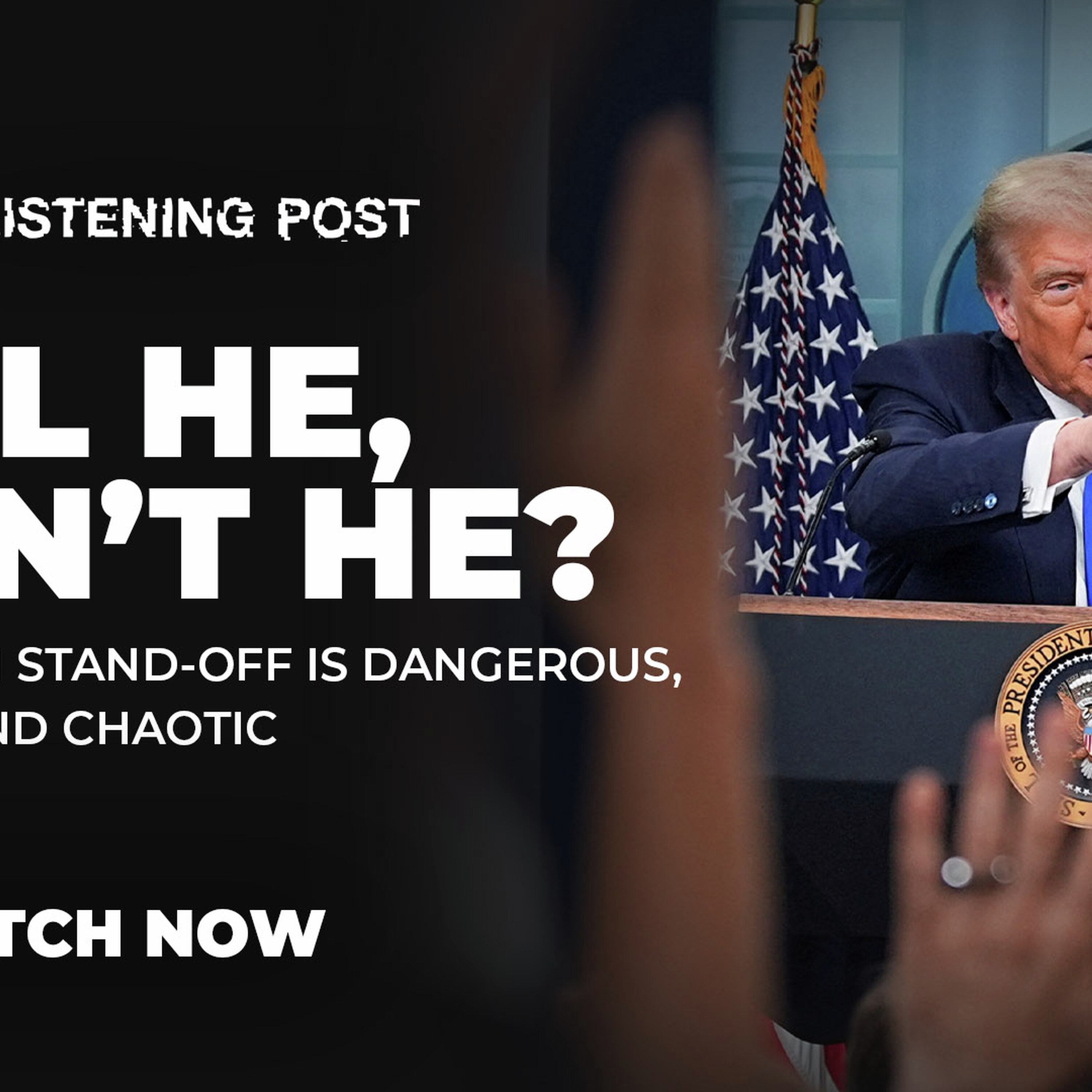
the American military has its sights set on Iran. Once again, we examine the media messages around the story, including one that does not stand up to scrutiny that the Islamic Republic is a nuclear menace. More than a friend, a brother, brothers in arms and ethno supremacy. India's prime minister travels to Israel to embrace the Netanyahu government and spreading the word of a Christian God, hoping it gets them to the political promised land, Brazil. And the evangelical influencers looking to take power. For more than a week now, the United States has been threatening military action against Iran. Deadlines have been floated, consequences threatened, and yet at the time of this recording, no shots have been fired, missiles launched or bombs dropped. The negotiations continue over the future of Iran's nuclear program, which, if the Trump administration is to be believed, is at the core of this dispute. Not Israel, which has long wanted to take down the leaders of the Islamic Republic. Not oil, which Iran has an abundance of and not the Epstein files, which Donald Trump keeps deflecting attention away from. 20 odd years ago, Americans were told that another oil rich state in the region, Iraq, posed a clear and present danger. We know how that ended. This time around, Tehran's reply has been telling the Iranian media, which are mostly state controlled, have been focusing on the Epstein scandal, reminding the world that one of the reasons that President Trump is talking tough abroad may be because he is under the gun at home.
- [02:17]
Political Analyst
President Trump is putting the pressure on Iran.
- [02:20]
Narrator/Reporter
It's going to be a bad day for Iran, very bad.
- [02:22]
Political Analyst
The administration has been really vague on what its objectives are. The reason for that is they themselves don't know what their objectives are.
- [02:33]
Political Commentator
A lot of this is that Donald Trump is making it up as he goes along.
- [02:37]
Narrator/Reporter
I will never allow the world's number one sponsor of terror, which they are by far, to have a nuclear weapon.
- [02:44]
Political Commentator
I think Donald Trump is a little high on his own supply right now.
- [02:47]
Military Analyst
So we could be sleepwalking into this conflict. That could have potentially huge ramifications, not unlike the Iraq war and potentially even worse.
- [02:59]
Narrator/Reporter
If you've been tracking the news on Iran, finding it difficult to get a grip on the story, you are not alone. Between the rhetoric coming out of Washington, the military buildup, the nuclear angle, the latest protests in Tehran, the negotiations taking place in Geneva and The journalistic tendencies of Western media outlets, news consumers are up against it. And there is a lack of coherence combined with an eerie familiarity in the White House's messaging on the supposed threat that Iran poses. In that Iran's nuclear program has been weaponized, but by Washington in the same way that Iraq's WMDs, its non existent weapons of mass destruction, were post 9 11. The Israeli Prime Minister Benjamin Netanyahu has been warning of the impending threat of Iranian nukes for decades. If this regime were to acquire nuclear weapons, this could presage catastrophic consequences. Time is is running out. He has repeatedly described the danger as more and more imminent. It's only a few months, possibly a few weeks, before they get enough enriched uranium for the first bomb. One would think Netanyahu would have been relieved last June after the 12 day war that the US and Israel launched on Iran when President Trump declared that Iran's nuclear weapons ambitions were done for. Iran's key nuclear enrichment facilities have been completely and totally obliterated. Yet there was Trump at the State of the Union address this week saying the nuclear threat was somehow back starting it all over. We wiped it out and they want to start all over again. The thing about propaganda, however, it's not supposed to be this confusing.
- [04:52]
Political Analyst
It is clear that Iran's nuclear program does not pose an imminent threat to anyone. The military dimensions of its nuclear program, according to US Intelligence itself, was abandoned several years ago. What it is doing is what we call hedging. It's amassing all the necessary raw materials in order to make a dash for a bomb, should it one day make the political decision to do so. But there is nothing that indicates that Iran has made that political decision.
- [05:25]
Political Commentator
Today, Iran's nuclear program is being used very similarly to how Iraq's supposed WMD program was used in 2002. A supposed threat that is hyped with misinformation. You can have Witkoff say they're probably
- [05:42]
Narrator/Reporter
a week away from having industrial grade bomb making material.
- [05:47]
Political Commentator
Journalists need to say, well, how do we know that? How do we don't have inspectors on the ground? And I think we would find that this is just empty rhetoric. Facts just really don't matter anymore.
- [05:56]
Media Critic
What nuclear program are they talking about? That American political commentator Mark Levin, he had written, Iranians are going to have biological and chemical warheads on their ballistic missiles. Oh, come on. So nuclear warheads are now out of the game and now biological or chemical weapons have come out. It is exactly the scenario that was used for Iraq and everybody knows it.
- [06:22]
Narrator/Reporter
They believe today that they must destroy the West. Those nuclear ICBMs aren't aimed for Tel Aviv or Jerusalem. They're aimed for New York and Los Angeles and Chicago.
- [06:34]
Media Critic
This is the sort of propaganda that has been going on for at least three decades. And the good thing is that on social media people have woken up and I said, you are looking for an excuse, justification to attack that country.
- [06:51]
Narrator/Reporter
Nevertheless, the war hawks seem to have the upper hand in Washington and the ear of the White House. They are backed by some well funded, influential elements of the Iranian diaspora. Voices advocating the overthrow of Iran's leaders and the installation of Reza Pahlavi, the exiled son of the former shah. That diaspora is in temporary cahoots with an even better funded pro Israel lobby, which argues that given the recent anti government protests in Iran, now is the time to strike. Iran is as weak as we can remember. The Pentagon would beg to differ, as evidenced by some clearly coordinated leaks this past week to three major US News outlets, all of which headline the risks that an attack on Iran would create
- [07:41]
Political Commentator
when these leaks have come out. Donald Trump's been very fast to go up on truth social and to say, no, there's nothing to worry about here. You know, this is a complete lie. We have the most powerful military in the world. So I think it's very much a matter of managing that media narrative. But the President has backed himself into a corner in part by laundering this through the media where the expectation is now he has to strike because. Because he has hyped it up so
- [08:06]
Political Analyst
much, it's critical for Trump's generals to be able to outline what the risks are. What is more interesting is the scale and the timing of the leak, the fact that every major news outlet came across this information and the fact that every major news outlet wrote about it, because people within the US Administration are worried about such a military campaign. So they are choosing to notify the public so that the public could restrain the President.
- [08:36]
Military Analyst
The leaks are highly significant given that there is a broad perception in Washington that a war with Iran could be low cost.
- [08:45]
Narrator/Reporter
President Donald Trump's top general is highlighting the potential risks with striking Iran.
- [08:51]
Military Analyst
We saw that with the June war, the US Just went in for a one and done strike where he claimed that they obliterated the nuclear program. But now Trump has amassed this massive military force, threatening a big war.
- [09:04]
Narrator/Reporter
If Donald Trump has cranked up tensions over Iran in order to divert attention away from the Epstein files, the poisonous effect those lurid revelations have had on his administration. Tehran refuses to play along While Western news organizations do seem distracted, focusing on all the military hardware heading for the Middle East, Iranian outlets are keeping the Epstein story front and center. The Islamic Republic's supreme leader, Ali Khamenei has done his part, describing Epstein island as a symbol of Western decay, framing the Epstein story for which not a single US political figure has taken the fall, as proof of what he calls the moral collapse of liberal democracy. And social media, there is pulling no punches, branding the Trump administration, the Epstein
- [09:57]
Media Critic
regime, the Iranian media, they thoroughly covered the story and whenever a new batch of Abstein file is released, they show them to people. And Iran's leader, Ayatollah Ali Khamenei, in his recent speech, he also referred to abstinence that President Trump links with Abstein. They tell people, look, these are a bunch of perverts, pedophiles who are now trying to cover their own skin candles by opening a new field, which is a war on Iran.
- [10:48]
Military Analyst
When it comes to the Epstein files, the Iranian government has tried to capitalize on that in its own propaganda efforts against the United States. They made a big deal out of in these recent rallies for the anniversary of the Iranian revol. For Trump. Whether or not the Epstein files are the main driver for him seeking a war against Iran, that's unclear. But they are definitely trying to capitalize on this in their own propaganda, in their own kind of disinformation efforts.
- [11:31]
Narrator/Reporter
That's the other thing about propaganda. Sometimes rarely, but sometimes it turns out to be true. Prime Minister Narendra Modi sent a clear signal this past week that India stands with Israel. His visit to the country was just a second by an Indian prime minister. The first took place nine years ago. It was Modi then too. Taraq Nafa has been following how the trip unfolded.
- [11:59]
Correspondent
Narendra Modi's visit this week was a carefully choreographed display of solidarity.
- [12:05]
Narrator/Reporter
Narendra, my dear friend, these are not just words I would almost venture to say more than a friend, a brother.
- [12:16]
Correspondent
The Indian Prime Minister was presented with a newly created state honor and he delivered an address to the Israeli Parliament, the Knesset.
- [12:25]
Narrator/Reporter
Let us ensure that the friendship between India and Israel remains a source of strength in an uncertain world.
- [12:36]
Correspondent
Ahead of the trip, the Jerusalem Post ran a front page welcome for Modi with a hello in Hindi. Television networks in both countries went all in on the celebratory atmosphere. Back in India, opposition politicians and activists criticized the visit. The Modi government brushed that aside but did react to critical reporting. It ordered the ex account of journalist and author Azad Issa to be withheld in India. Issa has written extensively about New Delhi's ties with Tel Aviv. Those ties now run even deeper. As a result of this visit, Modi and Prime Minister Netanyahu signed agreements to boost already significant military partnerships and joint weapons manufacturing deals. For Netanyahu, this visit could not have come at a better time. Israel faces growing international isolation over its genocidal war and ethnic cleansing of Palestinians. India's unwavering support for the country allows him to project an image of strength.
- [14:04]
Narrator/Reporter
You didn't flinch, you didn't waver, you didn't give excuses.
- [14:10]
Correspondent
This was a visit loaded with symbolism, a relationship reinforced through lucrative arms deals and a meeting of two leaders with a shared worldview and ethno religious vision for their countries.
- [14:24]
Narrator/Reporter
Thanks, Tarek. It has been nearly two years now since Jair Bolsonaro fell from power in Brazil, yet the political turmoil that he unleashed is still having an effect. Bolsonaro's policies mixed law and order with some Christian principles selectively applied. He is now in prison for plotting a military coup, and the right wing movement that he started finds itself adrift. Potential successors are vying to inherit Bolsonaro's spot. They tend to be young, evangelical and hyper Online Brazil's evangelical movement has spent decades messaging through the media. What began with radio broadcasts of sermons, then preaching the word through Gospel TV, has grown into a sprawling social media machine fronted by young evangelical politicians who are adept at creating viral content that ricochets across social feeds, mobilizing followers and voters in ways that old school politicians cannot match. The Listening Post's Nick Muirhead now on Brazil's evangelical influencers and the political space they're looking to take over.
- [15:53]
Brazilian Evangelical Expert
The man behind the sketch is 27 year old Brazilian Lucas Pavanato. On the surface, he looks like a digital influencer with faith. Forward content. Isn't just performing for cliques. He's an evangelical politician who was the most voted candidate in Brazil's 2024 municipal elections. He belongs to the Parcido Liberal, the party once led by former President Jair Bolsonaro, now the backbone of Brazil's far right opposition. And he isn't alone. Fellow Parcido Liberal MPs Nicolas Fajera and Ana Carolina Campagnolo cut similar figures online. Young ultra conservative evangelicals with millions of followers across their platforms. Together, they represent a new hybrid politicians who communicate like digital influencers. And so many like new age televangelists.
- [17:12]
Host/Anchor
When we look at the social media of these three people, it's difficult to distinguish between the politician, the Religious figure and the digital influencer. This makes sense, given that this is exactly what their political strategy to navigate these disparate worlds. It's a strategy that takes place especially within the right wing and the far right. It's a new communications trend within Brazilian politics.
- [17:39]
Sociologist/Political Scientist
And what we notice in these three figures is the way that they emulate pastoral speeches and preach to their followers that a good Christian should be doing what the Bible says. That's known as dominionism, a brand of theology that maintains that believers should govern society according to biblical principles. And they have all been able to grasp very well the concept of being against the liberal status quo, pressing those moral panic alarm buttons. Against abortion, drugs or feminism. They have mastered certain online communication tools the old school televangelists only started using much later.
- [18:37]
Brazilian Evangelical Expert
Brazil's televangelists have been refining this ultra conservative message for decades. Their churches didn't just preach, they built a parallel media universe. Radio pastors, gospel pop stars, even primetime soap operas. And today, Brazil's second largest television network, Recogi tv, is owned by an evangelical bishop, Edir Macedo. It's a media ecosystem that fuses celebrity status with religious authority. Authority. And it's now being spearheaded by digital natives like Pavanato, Fajera and Campagnolo, who understand that faith can be turned into political currency. And their ranks are growing.
- [19:27]
Brazilian Political Commentator
The 21st century saw a very strong presence of evangelical figures in the media. And new ones keep appearing. Figures like Raquellina. She's a pastor and radio producer from Sao Paulo who has a lot of influence. If you imagine someone who works as a concierge in a tower block, they spend the whole night sitting there in reception listening to her. And what's interesting is that the production of podcasts and web based TV has led to increased evangelical content. Given that people can make an Internet show with just a mobile phone.
- [20:08]
Sociologist/Political Scientist
The second most popular YouTube channel in Brazil belongs to an evangelical bishop, Bruno Leonardo. He's an emissary delivering a message to his supporters. But in the evangelical churches, there is no pope to tell you what to say. The message can be readily customized. Anybody can adapt it to whatever their need is, however they want to. So Nicolaes, Anna, Carolini and Lucas have all been very good at understanding this and converting it into political capital.
- [20:47]
Brazilian Evangelical Expert
These influences inherited an audience that had already been primed to receive their political message by the former president. When Jair Bolsonaro emerged, emerged as a national political figure, evangelicals recognized an ideology that chimed with their theology. Bolsonarismo, built around traditional family Values, nationalism and religion. Prominent televangelists opened their platforms to Bolsonaro. In return, they gained political backing. For the first time in Brazil's history, evangelicals, now more than a quarter of the population, became an electoral force that could not be ignored. And the alliance, forged through media faith and mutual advantage, helped Bolsonaro gain and sustain the support of nearly 70% of Brazil's evangelicals.
- [21:43]
Host/Anchor
Traditionally, the big figures in the evangelical community in Brazil would always support those in power. What started to happen in the 2000 and tens is evangelicals would pick a political side that would better represent their ultra conservative values. Bolsonaro, who was a federal congressman at the time, understood that evangelicals would back whoever really put their conservative values at the forefront of their political agenda for Brazil. So when he entered the presidential race, he associated himself with various evangelical figures who are all quite dominant, both in terms of their media presence as well as their ideals.
- [22:22]
Brazilian Political Commentator
This all led to the building of very close ties between Bolsonaro and the evangelical community, relationships which were nurtured. Bolsonaro was seen at church and in religious media. Figures in the evangelical media sphere, such as Edir Macedo or Silas Malafaya, strengthened their public image amongst evangelicals and by aligning their own profiles with that of Bolsonaro.
- [22:51]
Brazilian Evangelical Expert
Outside their own media ecosystem, evangelical voices are largely sidelined by Brazil's mainstream media. They are rarely seen as serious religious and political actors or as the growing constituency they represent. That underrepresentation says less about the media zone oversight and more about where Brazil's evangelical audience is headed. With nearly 8 in 10 Brazilians getting their information primarily online, the evangelical digital space is getting bigger and more politically relevant. And the message sent by dominating figures of this space is clear. Command the feed and you command the vote.
- [23:31]
Brazilian Political Commentator
Lula's administration is looking for online based communication that can connect connect with the public in the way Pavanato, Ferreira and Campagnolo do. The Office for Communications was Even reformed in 2024 precisely to engage with the general public. Online, Lula is somewhat of an analog figure. These political influencers, they're showing you how they have lunch and next thing you see is them launching into a tirade against feminists. They've managed to bring the aesthetics of online communication into the political sphere.
- [24:11]
Sociologist/Political Scientist
All those people who are glued to the Internet, watching videos on their feed, no longer depend on the mainstream media. So now we have this ready made online ecosystem and evangelical right wing influencers are being replicated. You even start seeing influencers who've moved here into the evangelical ecosystem and who are using evangelical discourse to acquire political power. Voices who can form a conservative cluster of considerable political strength. They have really high flying objectives. They want to go all the way to the presidency.
- [24:51]
Narrator/Reporter
And finally, U.S. democrats held a press conference just prior to Donald Trump's State of the Union speech this week. Alongside about a dozen survivors of Jeffrey Epstein's sex trafficking ring. They were there to put pressure on the president.
- [25:05]
Media Critic
Today, the world will see Donald Trump have to face these survivors. Right there in the House.
- [25:11]
Narrator/Reporter
Gallery, one example of an Epstein connection who has faced little accountability. Trump's Secretary of Commerce, Howard Lutnick, who lied about his ties to Epstein. He then attended the speech shaking hands with people. Last November, more than 500 members of Congress voted to pass a new law compelling the Department of Justice to release all the Epstein files. Just one congressman voted against it. Donald Trump then signed the bill making it the law. But more than 3 million files remain sealed by the DOJ. And in his 1 hour and 48 minute speech, Trump steered clear of the topic, which, given that his name comes up thousands of times in the files that have been released, is no surprise. Members of Congress, the state of our Union is strong. What remains to be seen in an increasingly authoritarian America? Will the media keep pressuring the White House to do what the law demands and release those files? That will tell us much more than a marathon speech ever will about the real state of that Union.