Loading summary
Transcript47 lines
- [00:01]
Host
This week on the take, we're marking one year since a pair of devastating earthquakes hit Turkey and Syria with a new digital interactive listen and watch stories of survival, recovery and coping with the grief@al jazeera.com earthquakes Again, that's al jazeera.com earthquakes.
- [00:28]
Narrator/Reporter
We'Re examining the coverage of three news stories this week, all tied to Donald Trump. The land grab in Greenland is off the table, at least for now, but not before Trump threatened and alienated some of his allies. The US President's Board of Peace want a seat at the table? It'll cost you a billion dollars. And what about the news that we're not seeing on the Epstein files? We talked to an online investigator about the team of volunteers digging into the story. Welcome to year two of Donald Trump's second stint at the White House and the accompanying rise in America's neo imperialist tendencies. Having toppled Nicolas Maduro in Venezuela, the president then turned his attention once again to to Greenland. Once dismissed as a fantasy, Trump put the idea of acquiring the world's largest island back on the table, saying it was about the U.S. s national security interests and access to minerals and energy. A simpler way to look at it, a show of American force where power, not sovereignty, determines international borders. Publicly, the West, NATO countries included, formed a united front. But privately leaders were scrambling, reverting to familiar language when dealing with Trump through flattery that feeds his ego. This latest crisis may have been averted, but for many Greenland will remain a test of whether the international rules based order still holds or if it even applies to Donald Trump and his allies outside of America. Spare a thought for headline writers everywhere who this past Wednesday had their work cut out, racing to keep up with Donald Trump. His plans to take over Greenland. Or was it Iceland? When I told them about Iceland, they loved me. The implications for the people there before Trump backed down but said he hadn't, declaring victory in the face of a diplomatic defeat. That was after Trump posted this map on Truth Social, alarming America's allies. It was a hegemonic dreamscape showing Greenland, Venezuela and Canada all under U.S. control. Even American news outlets prone to mythologizing the U.S. as a global force for good have struggled with the implications of this story. Maybe we're the bad guys and these allies are getting a daunting awareness that the most powerful person in the world is a danger and threat to it and making the world order unstable. And that means we're all in a lot of trouble. We're going to have total access to Greenland. We're going to have.
- [03:15]
Political Analyst
His statements are a little bit annoying, right? But he's they're also dangerous because of the position he holds. There's no doubt that he has imperialistic ambitions. He is conducting what China has been accused by Europe of conducting for a very long time, which is wolf warrior diplomacy, which is do what I ask you to do or I'll punish you.
- [03:38]
International Relations Expert
His understanding as a leader is the idea of a king from fairy tales, that he can practically do what he wants and not just within his country but all over the world. And if there are constraints and restrictions, then he has to test it. And this looks like a test run to see can he get away with the territory of a NATO partner because no one else can do it. The we are the only ones who can provide security or do things in the name of what is good for the American people.
- [04:12]
Narrator/Reporter
Donald Trump insisted this is about national security, not natural resources. Greenland's wealth of rare earth and critical mineral deposits, which are coveted by the technology sector. Trump says the US Must keep Russia at bay, even though the American military has had a base in Greenland and full access there for 75 years. The President will be for forgiven, however, for thinking that American imperialism is on a roll following the attack on Venezuela. The very public seizure and perp walking of its president, which Trump's allies reacted to with a collective shrug of the shoulders. So why not pit American power against international law over a frozen island the US has never really needed until it suddenly did? But there is what Greenland is worth and what it's worth to Donald Trump.
- [05:08]
White House Correspondent
His social media output being matched by spokespeople from the White House, both on social media, at press conferences, rhetoric that's kind of a schoolyard bully.
- [05:17]
Political Analyst
The president has made his priority quite clear.
- [05:20]
Ellie Leonard
He wants the United States to acquire Greenland.
- [05:22]
White House Correspondent
He thinks his psychological need for Greenland like this is really not about national security. It's not really about keeping Russia and China at bay. It's not really about rare earth minerals or strategic supremacy in the Arctic. What this is really about is about Trump's own psychology and his psychological need to own a place.
- [05:44]
European Affairs Commentator
The toppling of Nicolas Maduro in Venezuela has put wind in the sails of Trump and his administration. They have marveled at the power of the US military and the violence it was able to inflict on a country that is not even really a third rate power, more like a fourth or fifth rate power. And the obsession with Greenland is in a similar vein. America is suddenly a power on the world stage again and now we can bully the rest of the world.
- [06:13]
Host
The President had noted that he could use tariffs on these countries to apply some pressure.
- [06:19]
European Affairs Commentator
US President Donald Trump is threatening to.
- [06:21]
Narrator/Reporter
Impose tariffs on countries that oppose his plan to take over Greenland. Donald Trump's previous threat to place trade tariffs on many of America's NATO allies for reserv resisting his plans for a takeover provoked an unusually blunt counterattack. The use of tariffs against allies is completely wrong, But talk is cheap. And Donald Trump exposed that by releasing some private text messages from NATO's Secretary General, Mark Rutte, and certain European leaders who were talking tough publicly while making nice privately on that NATO angle. The reality is that the military alliance and the role it has played in the war in Ukraine has robbed the EU of much of the leverage it can use against Washington, thereby increasing America's power.
- [07:29]
European Affairs Commentator
Europe really has few cards to play in this situation. They want the United States to keep sending arms and supplying the war in Ukraine because they cannot actually sustain that level of mobilization and resources. At the same time, Europe has weaned itself off Russia as an energy supplier and become more dependent on the United States. So Europe has actually become more and more reliant on the very country that is now trying to repel.
- [07:56]
Political Analyst
In Macron's text, he calls him a friend. By leaking that text, Trump is trying to show the world that Europeans are groveling, that they are all essentially dependent on him. What it definitely means is that you cannot conduct diplomacy the way you used to. Now anybody writing a text to Trump or talking to Trump, any of the leaders will have to, you know, kind of go to their communications person first and, and make sure that if it is leaked, they're not going to be in trouble.
- [08:25]
White House Correspondent
This discrepancy between the private and the public really reveals that the European leaders are at a loss for how to deal with Trump because we don't know what he could, you know, what he would do next. So they are really trying all the different avenues rhetorically to try and engage him.
- [08:45]
Narrator/Reporter
Still, credit where credit is due, whether Donald Trump intended to or not, he has laid bare the fiction that is international law. The vaunted Western rules based order. The Canadian Prime Minister Mark Carney put it this way. We knew the story of the international rules based order was partially false. That international law applied depending on the identity of the accused or the victim. Because where was the moralizing from all those leaders about the importance of international law during the genocide in Gaza, or when America attacked Venezuela, targeted its oil, abducted its leader, most of them stayed quiet, set aside their so called Western values until the empire came at them. History will judge those figures and the news organizations that have provided them with COVID accordingly.
- [09:42]
European Affairs Commentator
Europeans are talking a good game now, saying what Trump is doing is imperialism and that it violates international law. And all of that sounds good, but it will ring hollow because two years of Europe steadfastly backing an orgy of criminality and violence in Gaza has done profound damage to the idea of international law. And it was just a few weeks ago that European leaders were scrambling to either say as little as possible about Trump's toppling of Maduro in Venezuela or, in the case of Macron, actually actively cheering it on. And now they turn around and wrap themselves in international law again.
- [10:24]
International Relations Expert
We are losing a system that, with all its flaws and still provided more than the sheer execution of power, that the winner takes it all and those who have the means to do what they want, exploit, dominate, do all the horrible crimes that we have seen in the past before we established an international order, to just dump it because it's imperfect. And to go back to the execution of power means there are three global powers that can execute is certainly not a global order that can address the challenges of the 21st century.
- [11:07]
Political Analyst
We've got to look out for how the world responds to Trump and takes him on and when will it do? So let's see, you know, let's get him for dinner, let's give him a big party, let's, you know, pay him more compliments. Or are they actually going to say, look, this doesn't work, instead of just looking at how to plug these gaps to think about how to respond to the president of the most powerful country in the world, and if that president turns out to be so unabashedly, shamelessly imperialistic.
- [11:43]
Narrator/Reporter
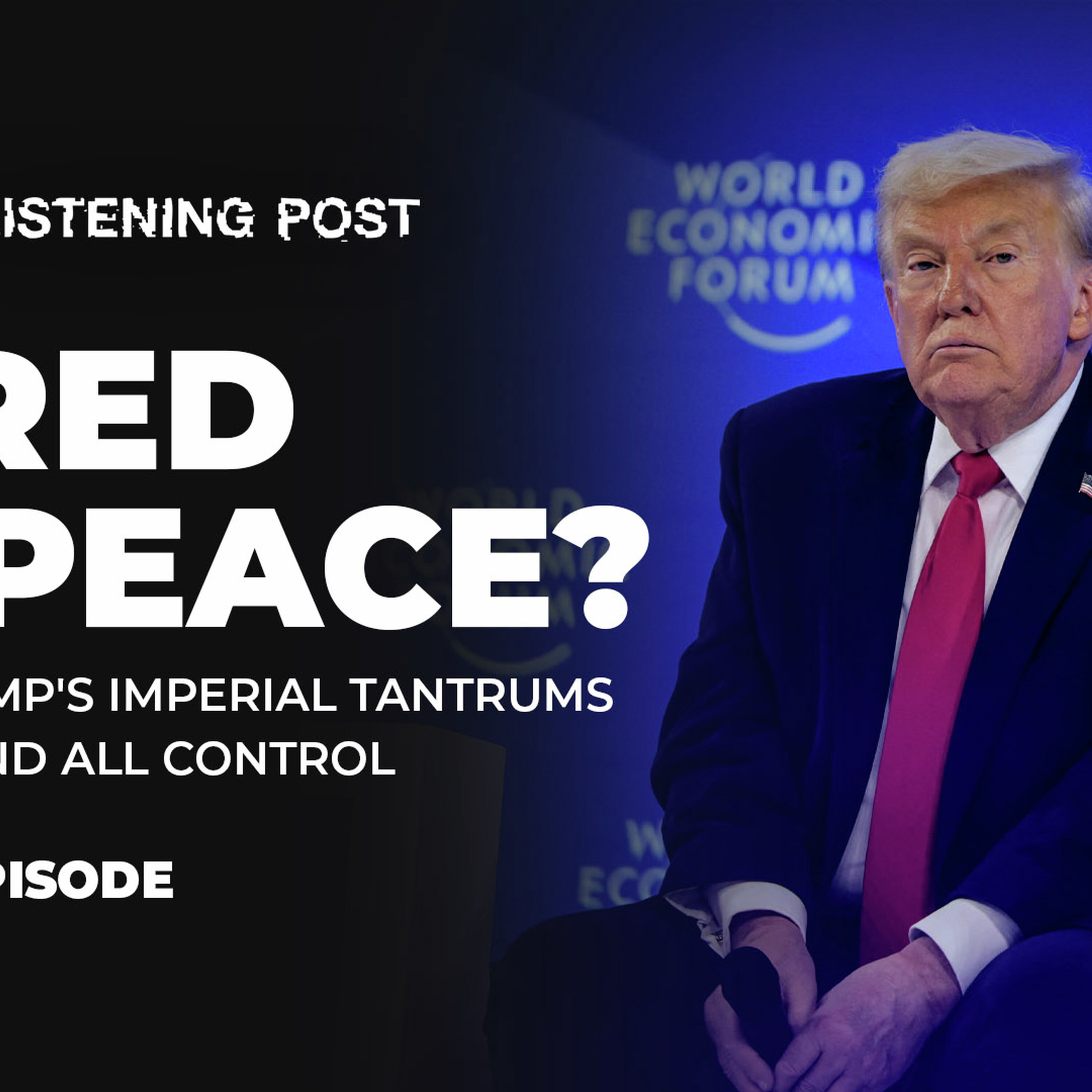
Donald Trump's much publicized by him Board of Peace was launched in Davos this past week. The ceremony was carefully staged. It centered on the president, his overblown peacemaking credentials, and it featured a PowerPoint presentation on the development of the so called New Gaza. Meenakshi Ravi is here with more.
- [12:03]
Host
This week's peace board ceremony in Davos maxed out on theatre and spectacle, yet it could not obscure some notable absences. The leaders of France, the uk, Germany, Italy and Canada all either declined invitations to join the board or said they needed more time to consider it. Israeli Prime Minister Benjamin Netanyahu, who has overseen Israel's war on Gaza for the past two years, was also invited. He agreed to join but could not attend the ceremony. He's been indicted for war crimes by the International Criminal Court and Switzerland informed his office that should Netanyahu set foot in Davos, they would have to arrest him. The absurdity of his involvement summed up the absurdity of the entire enterprise.
- [12:44]
Narrator/Reporter
We're going to be very successful in Gaza.
- [12:47]
European Affairs Commentator
It's going to be a great thing to watch.
- [12:50]
Host
The board will be chaired for life by Donald Trump, who holds exclusive powers, including the authority to appoint his successor and a sole veto. An executive board focusing on diplomacy and investment is made up largely of Trump family members and close associates. Broader membership has so far been by invitation only. Countries seeking more than a three year seat have been told to pay a $1 billion fee for permanent membership.
- [13:15]
Narrator/Reporter
I know it's a little risky to be investing in a place like this, but we need you to come. Take faith, invest in the people.
- [13:20]
Host
At the launch ceremony, Trump's son in law, Jared Kushner, unveiled a redevelopment vision for the Gaza Strip, including images of high rises, a coastal tourism zone, data centres and manufacturing plants, which he claimed could be built within three years under the right conditions. The United nations disagrees with that timeline, suggesting it could take up to seven years just to clear 60 million tons of rubble from an area littered with unexploded shells and missiles. Land that must be demined. In his presentation, Kushner set aside those reality checks and addressed anyone raising doubts over the rosy outlook he laid out.
- [13:56]
Narrator/Reporter
And then finally, I'll just talk to people on the media and on the social media, which is just calm down for 30 days. I think that the war is over. Let's do our best to try working together. Our goal here is peace between Israel and the Palestinian people.
- [14:09]
Host
Notably absent from Kushner's speech was any reference to the role Palestinians would have in their future, apart from Hamas. Disarming that omission was not surprising. The Board of Peace, which emerged from negotiations for ceasefire in Gaza, has no mention of that founding cause in its charter. And even the ceasefire itself has hardly been worth the name. Nearly 500 Palestinians have been killed by Israel since it went into effect.
- [14:33]
Narrator/Reporter
Thanks, Meena. Between the Board of Peace story Greenland and prior to that, Iran and Venezuela, a theory has been making the rounds that Donald Trump is out to distract attention away from another big story, the Epstein files. Trump's Justice Department was ordered to publish those documents more than a month ago. It has only made 1% of them public material that has been heavily redacted. Members of Congress have tapped into a second source, the Jeffrey Epstein Estate, to try to get more information as the Trump administration has been Flooding the Zone with news that mainstream outlets have been chasing. Another unconventional team of investigators has been digging into the files to see what's there. They are led by Ellie Leonard, published on Substack, and doesn't even come to this from a journalistic background. She joins us now from New York City. Ms. Leonard, now you're a writer, you're an author. Your background is actually writing fiction. So what was it that pulled you so deeply into these Epstein files? How much of that was driven by what you were seeing or what you were not seeing in the mainstream media coverage in the U.S. well, I've always.
- [15:42]
Ellie Leonard
Been really passionate about politics and the things that are going on. And I was starting to hear the story of Epstein. I really hadn't followed it. I knew his name, and I started to hear these details about interactions between Epstein and Donald Trump. And I thought, you know, I'm a practical person. I'd really like to see what evidence we actually have that we can hold in our hand that shows interactions between Trump and Epstein. And I just started detailing, and I just started adding it up and then putting it in chronological order. And at the end, I thought, you know what, I'll just put this on my sub stack and just see what people think. And people went wild over it. And I thought, man, people must really want to know what's going on with this story. And so I went from there, and I just started to do some really deep dives into the history of Epstein.
- [16:28]
Narrator/Reporter
And what kind of methods did you rely on for that? How do you go about digging into this material? Walk us through how you do it and who is doing it with you now.
- [16:38]
Ellie Leonard
So in the beginning, I was looking at a lot of older articles. There's a lot of exposes on Epstein from before he was actually on trial. So I was reading some of these older Vanity Fair articles and reports that had been done in, like, the New York Times. And then we started to get these piles of Epstein files, and some of them came from the Epstein estate, and some of them came from the doj. And I just thought, you know what? I've got a couple hours at night after my kids go to bed. I can just start scrolling. And so I started to read these files just one at a time, time scrolling through. And I didn't use any AI. I just wanted to have my eyes on it. And as we got more information and I started to post more kind of detailed analysis of this stuff, I thought, you know what? I need more help. I can't do this all myself. This is thousands and thousands of pages. And my substack had grown by that time. And I thought, you know what? Maybe we could crowdsource this. Maybe we could all do this together. And so I put the word out. I pulled all the files and put them in a Dropbox just so they couldn't be redacted further. And I just started asking people and sending them the link. I said, you know what? Let's look at this together. Let's put our heads together and see what we can find. And they have found a ton of stuff.
- [17:47]
Narrator/Reporter
So they just go on the substack, they go to the box, they click on it. So what kind of stuff are they coming out of this with?
- [17:54]
Ellie Leonard
Well, I mean, people are seeing records that I don't think we were meant to see, necessarily, or they hoped we wouldn't see.
- [18:01]
Narrator/Reporter
We're covering the new developments and the fallout from the big headline this morning involving President Trump's former personal attorney, Michael Cohen.
- [18:08]
Ellie Leonard
We actually found this email that indicates that Michael Cohen was asking for something called a Rule 35, which means he was asking for lesser jail time after being in prison by giving information. And the information that was indicated was that Donald Trump had information about Jeffrey Epstein, and he was willing to share that. So that was something that someone from my substack, one of my followers, handed to me and said, I want to remain anonymous, but would you send this off to the right person? I sent it off to someone else. They sent it off to someone else, and then it became big News in about 24 hours. But for me, kind of on a. On a passion level, a lot of what I look for and what I think is important are things that are receipts for things that the survivors have said in order for them to receive justice, they need receipts. And so you have someone like Virginia Giuffre, who passed away almost a year ago, and in her book, she swore up and down that there were things in Epstein's house that existed, like a surveillance room where he could keep track of the entire house from a single room filled with screens. This was something that they denied. Well, now in the files, we have pictures of the actual surveillance room. So there's just a lot of things in these files that you say, okay, I can see it in front of me. I have physical evidence. Virginia was telling the truth, and we can move forward with this case.
- [19:26]
Narrator/Reporter
The Trump administration has not made this easy for you. Congress set a deadline for the Justice Department to release those Epstein files in full. We're now more than a month past that deadline. We've seen roughly 1% of the files. But beyond all the procedural delays, the redactions, in what other ways are you seeing this material being hidden from public view?
- [19:50]
Ellie Leonard
I think they're just making it complicated to access. When, when they released, like, let's say on December 23rd, they released something called Batch 8, and that was about 30,000 pages. When they release something like that, they say, okay, the public can look at documents, here they are, but they will release them a single page at a time. So they're really hard to go through and actually look at, and then look at the next page, and then look at the next page. And so something that I've done in order to make it more accessible to people is combine all the pages into something like a PDF so that people can look and they can just scroll down. But they, they want to make these things really, really hard to read and access and get through in hopes that we give up or we don't understand. And so part of my platform is just to make things more accessible now.
- [20:39]
Narrator/Reporter
This investigation you're conducting has also introduced a cooperative model of journalism. And I find that interesting that you tell the people who are working with you, don't start at the beginning of the file, start at the middle, or start at the end. So who are some of the people who are contributing to the work that you're doing? What kind of backgrounds do they come from? How does that collective effort function in practice?
- [21:03]
Ellie Leonard
It's really amazing the level of, or the variety of skill that has landed in my inbox. I have paralegals, I have lawyers, I have doctors, I have psychoanalysts. I have people who are really good at digging through metadata and computer analyzing. Just all skills that I don't have. And when you put all these things together, different people discover different things. I had a woman the other day who made a video on YouTube that showed how she could analyze font and the size of font and the spacing of font in order to unredact some of these highly redacted documents. Most of the redactions are not survivors. They're actually people involved on the legal side of things or their co conspirators. And so that's really, really helpful for us to analyze these documents with these extra skills that I don't have.
- [21:54]
Narrator/Reporter
Now, all these people who have joined your ranks, the ones working with you, how do you even know that they are what they say they are? That their expertise is in fact, real? Are you able to fact check them and their output?
- [22:08]
Ellie Leonard
I wish I could at this point, I have thousands and thousands of people helping me out. The thing that fact checks them is just what they're able to do. If somebody comes to me and says, I'm a psychoanalyst, that's great. I don't know if you're a psychoanalyst or not, but if you can comb through the files and give me some information on the files, it has to do with psychoanalysis and it pans out, then that works enough for me. But I don't have the ability to fact check every single person that comes along.
- [22:37]
Narrator/Reporter
All American journalists are familiar with the Trump administration repeatedly flooding the zone, overwhelming the news media, possibly to distract, possibly to deflect. In this case, are we kind of seeing the roles reversed, Ellie, with citizens turned investigators flooding a space that the Trump administration has tried to keep hidden?
- [22:58]
Ellie Leonard
I do think that independent journalism is flooding the zone. And something that we're starting to see over the last probably two, three months is that the Trump base is shrinking. People are getting very tired, they're getting a little bit uncomfortable. Things that they thought were outside of their realm of possibility are kind of inching closer. And so we're starting to see that base shrink. And in the meantime, we're seeing this independent journalism world grow. I really stepped into it kind of toward the beginning. I was just a fan, I was a follower. I followed people like Jim Acosta and others who had left network television. And I've really looked up to them and learned from them in this process. And so to be here and watch this team grow and start to work together and feel kind of, kind of like a tight knit family as we all fight the system, it's felt like we've gotten a lot of our power back, and it's a really incredible thing to see.
- [23:54]
Narrator/Reporter
Ellie Leonard, recent convert to the world of journalism. Much respect for what you do, and thank you for speaking with us here at the Listening Post today.
- [24:03]
Ellie Leonard
Thank you, Richard.