Loading summary
Transcript75 lines
- [00:01]
SpinQuest Advertiser
Forget whatever plans you have this weekend because you're staying at home and playing on spinquest and there's never been a better time to sign up than right now. New users get $30 coin packs for just $10, all the table games you love with hundreds of slot games and real cash Prizes. That's at spinquest.com S P I N Q U-E-S-T.com Spinquest is a free to
- [00:24]
SpinQuest Disclaimer Voice
play social casino void where prohibited.
- [00:26]
Al Jazeera Narrator
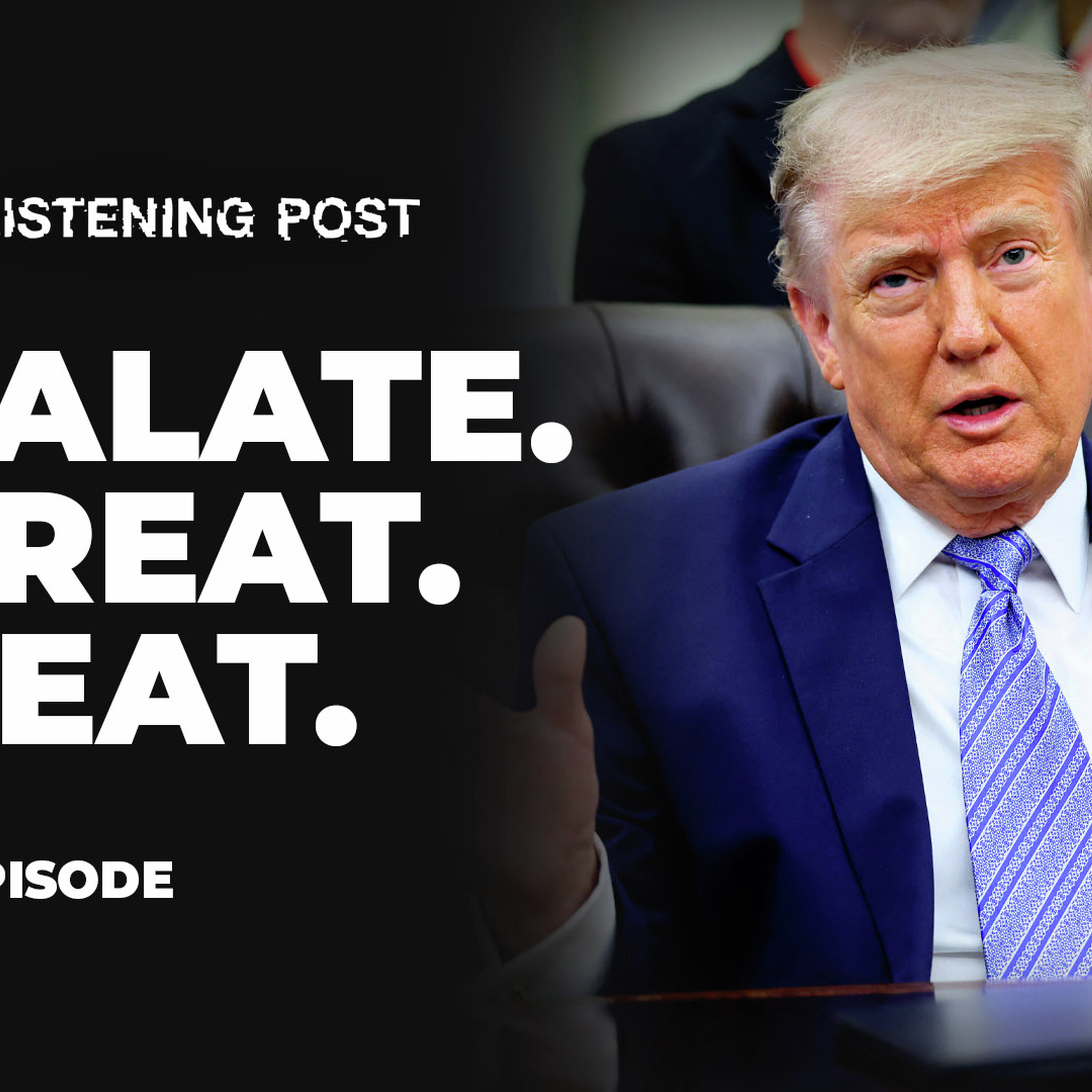
Visit spinquest.com for more details. This week on the take we're marking one year since a pair of devastating earthquakes hit Turkey and Syria with a new digital interactive Listen and watch stories of survival, recovery and coping with the grief@al jazeera.com earthquakes again that's al jazeera.com earthquakes almost three months into the latest U. S. Israeli war on Iran, we examine the information battlefield where Donald Trump is stuck in a loop.
- [01:07]
SpinQuest Disclaimer Voice
Blast the hell out of him.
- [01:08]
Al Jazeera Narrator
He escalates the rhetoric, then takes it back down, then repeats. Narendra Modi encounters an unusually persistent journalist in Norway, a reminder of the Indian prime minister's aversion to media scrutiny, and Kenya, where anti government protests have landed ordinary citizens in the crosshairs of the country's surveillance state. For years, large sections of the American media have had a cozy relationship with Washington and its wars in the Middle East. The pattern adopt the official narrative early and should things not go according to plan, question it later, if at all. In the war against Iran, the questioning stage has been unusually quick in coming. Much of the US Mainstream news media is now pressing Donald Trump on his repeated declarations of victory, his apparent lack of a coherent plan. There are news outlets that do remain aligned with the president's agenda. On Fox News, the dominant narrative goes like the US Is winning, Iran is losing. And its commentators often feed audiences a story quite disconnected from reality. And that reality is that despite the hits that it has taken, Iran's military remains operational. The Strait of Hormuz is still under Tehran's control and the disruption of global supply chains, particularly energy, looks more and more like it could be a long term thing.
- [02:40]
SpinQuest Disclaimer Voice
We've done a hell of a job and I think we're going to be finished with that very quickly. And they won't have a nuclear weapon. We've won this with this war is been won.
- [02:48]
War Analyst
I have three W's for this war. Why, what and when their navy's gone,
- [02:53]
SpinQuest Disclaimer Voice
their air force is gone.
- [02:54]
War Analyst
Why did this war start? Nobody knows. To destroy their army? Didn't happen to Destroy the nuclear program. Didn't happen. What, what is it? Is this another endless war in the Middle east that's going to take years? And when, when is this war going to end? I don't think the White House has the answers to that.
- [03:11]
Al Jazeera Narrator
And when faced with difficult questions, Donald Trump tends to shift the focus to the journalists, asking them. When pressed this past week by David Sanger of the New York Times over Trump's repeated claims of victory over Iran, claims that, according to observers everywhere, do not square with reality, the president lashed out at the reporter.
- [03:34]
SpinQuest Disclaimer Voice
I had a total military victory. But the fake news guys like you write, indirectly, you're a fake guy. I. I actually think it's sort of some treasonous what you write.
- [03:43]
Media Critic
Trump's rhetoric almost mirrors the very state that he is at war with right now, the Islamic Republic. They label dissidents as treasonous. They call journalists spies and punish them by death. Trump can no longer reconcile his narrative of total victory with the fact that Iran is controlling the Strait of Hormuz. So he's criminalizing critique of his strategies to attract attention from those failures.
- [04:19]
Political Commentator
He does, in the context of the Iran war, desire or demand a kind of narrative purity. He wants American media to echo his own rhetoric suggesting that the war has been a smashing success and basically to give him credit as the commander in chief. And anything less than that is being framed by Trump and figures in his administration as not only fake news, but also as treasonous. And that's dangerous.
- [04:53]
Journalism Expert
Well, in a democracy, the media is the only or the main arm for accountability. And it's not surprising the language that's coming from Trump, because it is the way he has dealt with all his issues.
- [05:05]
SpinQuest Disclaimer Voice
I doubled the size of it, you dumb person. You are not a smart person, be
- [05:09]
Journalism Expert
it his own personal accusation of misconduct in the past or on international issues all the way from the Panama Canal to Greenland, now Iran. I think it's typical.
- [05:24]
Al Jazeera Narrator
However, given what he has seen from major US News outlets in the past, Donald Trump might have reason to fear, feel aggrieved, even betrayed, because they do have a track record of backing American wars in the Middle east and continuing that support even as those wars unravel. In 2003, outlets like the New York Times, MSNBC, and CNN amplified the false US intelligence reports about those weapons of mass destruction, helping to justify the invasion of Iraq. President Bush, and he's not alone on this, seriously doubts that UN Weapons inspectors will ever have a free hand in Iraq, that Saddam Hussein will bow to all the demands and give up all his weapons of mass destruction. Those outlets have taken a different approach this time around. As for the podcast space, there has been a fracture on the MAGA side with some prominent figures coming out against the Iran war. But there are still plenty of. Plenty of voices siding with Trump, still attracting big audiences. They hate President Trump and they would rather have an Iranian government with a nuclear weapon killing tens of thousands of its own citizens in the streets. This is a moral and just war that needed to get done.
- [06:37]
SpinQuest Advertiser
Trump is the man of the hour
- [06:39]
Kenya Correspondent
and he needed to be the person to do this.
- [06:41]
Al Jazeera Narrator
We need to open up the straits.
- [06:43]
Kenya Correspondent
We need to take these islands over
- [06:44]
Al Jazeera Narrator
and be done with this. It is the kind of narrative that echoes the output of Fox News, the only one of America's three major cable news networks that is standing with Trump on Iran. Fox, which provides the President with a pipeline to his MAGA base, remains the most watched news channel in the US and it's not even close.
- [07:06]
Media Critic
Look at what the United States is
- [07:07]
Al Jazeera Narrator
just pulling off in Iran.
- [07:09]
Media Critic
The unbelievable precision, the capability. We seem to have done, the miraculous.
- [07:14]
Al Jazeera Narrator
We put some questions to Fox over its coverage. No one at the network got back to us.
- [07:20]
Media Critic
Essentially, the anchors and analysts at Fox News are playing Trump's de facto cabinet. His advisors, the ones pushing escalation now, are the very same ones who counseled Trump to launch this campaign.
- [07:37]
Al Jazeera Narrator
The President has exhibited huge amount of patience, and we've tried to work a deal with these guys, and it just. It doesn't seem possible.
- [07:44]
Media Critic
Fox has essentially constructed a closed information group in which the war cannot fail, and it has very little to do with the reality on the ground. But that is what they're feeding maga.
- [08:00]
Political Commentator
They basically just regurgitate Trump's own rhetoric about how Iran has already been defeated and that it's in a position of surrender.
- [08:10]
Kenyan Activist/Expert
We can obliterate them.
- [08:11]
Al Jazeera Narrator
We still could hit major targets and make sure they could never be a
- [08:15]
Kenyan Activist/Expert
threat to the free world for the next century if we want to.
- [08:18]
Political Commentator
That Iran is just one death blow from surrendering completely, that the US Just has to strike one more time. And that's what they've been going with right now. To what extent this is working, that's another matter.
- [08:38]
Journalism Expert
Many of the channels that are supporting Trump, they're trying to frame this as a major threat to the United States. But when you compare this to what happened immediately after 9, 11, there is a huge gap. People are not willing to invest themselves behind that narrative because they can see through it. And the sooner the administration realizes that, the better, because it's getting nowhere.
- [09:08]
Al Jazeera Narrator
Meanwhile, Iranian state media is churning out content that contests some of the rhetoric coming out of the White House on Donald Trump's argument that the Iranian military has already been destroyed. A video of the Revolutionary Guard Corps preparing for a possible US Ground invasion. And this video of Iranian women doing the same, familiarizing themselves with AK47 machine guns. Then there is the social media content aimed at international audiences that just keeps coming. This post from Iran's Foreign Ministry, a clip from the American film the Apprentice, skewers Donald Trump spelling out why he keeps insisting that the Iran war is going well. It tells the story of Trump's mentor, Roy Cohn, lecturing his young protege on how to spin stories to the media. No matter what happens, no matter what they say about you, no matter how beaten you are, you claim victory and never admit defeat.
- [10:08]
SpinQuest Disclaimer Voice
We're doing unbelievably well. Have a complete victory. We've already, in theory, had a complete victory from the military standpoint.
- [10:15]
Al Jazeera Narrator
Never admit defeat. You want to win. That's how you win.
- [10:19]
Media Critic
That kind of clip outlining his. His own, Trump's own rules of winning. No matter what happens, you claim victory and never admit defeat. This is Iran demonstrating fluency, not just in Western pop culture, but the specific psychology of this president playing into his ego and his understanding of how politics works. It is Trump's credibility gap, essentially, where he claims one thing, where the reality is actually something completely different with Iranians
- [10:58]
War Analyst
officials are trying to do is to cut through the noise and speak directly to the American public. This is something that Washington has done in the past. I mean, the US Has Voice of America, a media apparatus that is supposedly speaking directly to the Iranian people. They have Persian media accounts. And so the Iranians, I think, are trying to adopt that style as well, to speak directly to the American people. And essentially the message is that we're not at war with you and that they don't have anything against the American people.
- [11:28]
Al Jazeera Narrator
The American who millions of Iranians do have issues with is Donald Trump, a president now stuck in a news loop of his own making, neither at war with Iran or at peace, negotiating one minute before threatening the next, getting peppered with questions, issuing daily, sometimes hourly, updates that confuse more than they clarify.
- [11:51]
SpinQuest Disclaimer Voice
Because we've had very big discussions with Iran. The entire country can be taken out in one night. I put it off for a little while, hopefully, maybe forever, but possibly for a little while.
- [12:02]
Al Jazeera Narrator
The question that American journalists do not ask often enough is the same one they missed in 2003 about Iraq. Does Iran really represent a threat to the US or its ally Israel? Another question those reporters should ask of themselves and the news networks they work for is have they helped pave the US military's way to Tehran the way they did in 2003 to Baghdad?
- [12:30]
War Analyst
Wars don't happen in vacuums, and they don't happen overnight with just hard power. Wars are the result of years of dehumanization and creating false narratives. This has happened a lot against the Middle east, portraying Palestinians Palestinians, Lebanese, Iranians as subhuman, as evil as terrorists narratives that the American media has perpetuated over the years. And so when that political discourse becomes ingrained and part of the mainstream thinking and conversation, then wars become very easy.
- [13:08]
Al Jazeera Narrator
On a tour of northern Europe this past week, the Indian Prime Minister, Narendra Modi got a little more media pushback than he is accustomed to. He was confronted by journalists in Norway. Tarak Nafa has been following this story.
- [13:21]
India Correspondent
Narendra Modi's foreign trips are typically tightly choreographed affairs designed to reinforce the Indian prime minister's image both at home and abroad. Modi does not take unscripted questions. Indian officials typically request that direct exchanges with reporters are avoided. But during his visit to Norway, things didn't go as planned.
- [13:44]
Kenya Surveillance Expert
Prime Minister Modi, why don't you take some questions from the freest press in the world?
- [13:48]
India Correspondent
Modi has not held an open news conference in India throughout his 12 years in office and rarely finds himself forced to field questions from foreign journalists. The most persistent reporter at the event, Hela Ling, was later attacked by sections of the Indian media.
- [14:05]
War Analyst
A Norwegian journalist decided that the most important thing she could do will shout at the prime minister.
- [14:11]
India Correspondent
Press freedom groups have warned. India's media has fallen into an unofficial state of emergency during the time Modi has been in power. The country currently ranks 157th out of 180 countries in the world Press Freedom Index, a list Norway has led for years. But for many in India, a cartoon published in Norway's largest newspaper just days before Modi arrived showcased why the country is hardly a paragon of journalistic standards. The paper Afton Poston caricatured the prime minister as a snake charmer beneath a headline describing him as a sneaky and slightly annoying man. The imagery was a blatantly Orientalist stereotype, a reminder that even the world's quote, freest press are hardly immune from prejudice or poor editorial judgment.
- [15:02]
Al Jazeera Narrator
Thanks, Tarek. Kenya is the tech hub of East Africa. Mobile phones are everywhere. Mobile money powers large parts of the economy there, and the country has built a thriving digital sector. But there is a dark side to this. Kenya has shown signs of turning into a surveillance state. Surveillance apparatuses typically start out being aimed at criminals and security threats, but then get turned against voices of dissent. After an extended series of anti government protests in 2024, President William Ruto's administration intensified the monitoring of Kenyan citizens in order, it would seem, to quell political unrest before it surfaced and took to the streets. And what is now emerging is that the tactics being deployed are not always legal. The Listening Post's Nick Muirhead now on Kenya's expanding surveillance state, the players involved and its effect on on the country's democracy.
- [16:00]
Kenyan Human Rights Advocate
The Kenyan state has evolved rapidly when it comes to digitization of state security. We have moved from what was previously targeted surveillance to indiscriminate mass surveillance.
- [16:11]
Kenya Surveillance Expert
On one hand we have the smart cities approach in which surveillance capacity is embedded in public spaces. And then you have the mobile phone as being the main avenue through which the government is able to enact surveillance for different capacities.
- [16:24]
Kenyan Activist/Expert
Someone hacks your phone when you're brought into a police station, or someone taps your phone, or somebody finds your data through a telecommunications company to know your movements and see who you're talking to.
- [16:36]
Kenyan Human Rights Advocate
If Kenya continues down the path of indiscriminate mass surveillance, what we are staring at is a total collapse of democracy.
- [16:50]
Kenya Correspondent
Kenya's democracy, like any other country, remains a work in progress. But there are growing concerns that under President William Ruto's administration, the freedoms that Kenyans fought and died for are being eroded. And they can sense it. As Amnesty International put it in a report last year on government surveillance, this fear, everyone is feeling it. Democratic decline is usually a process, but sometimes it can be defined by a moment. And for many Kenyans, that moment came in 2024 with the youth led anti government protests that gripped the country for months.
- [17:29]
Kenyan Human Rights Advocate
The 2024 protests were a pivotal moment in Kenya's protest organizing. It was the first time we were having a youth led protest because predominantly protests have been organized either by political leadership or what you'd call the tribal leadership. And so it was the first time protest was being decentralized from these two centers of power.
- [17:49]
Kenya Surveillance Expert
They didn't expect this size of protest this quickly, this decentralized. And the response to that, therefore, is to fall back on the mechanisms that they do have to be able to control, to police, to intimidate, which is surveillance.
- [18:03]
Kenyan Human Rights Advocate
This is why we saw what we saw with the protest. The pinpoint geolocation of activists, the social media monitoring the unmasking of IP addresses, all that was because of the escalation that the state needed to find out who the mobilizers were.
- [18:18]
Kenyan Activist/Expert
And this would manifest in abductions, around 82 abductions in three months leading up to December 2024. Those abductions were done at night, they were done in broad daylight. And obviously for someone to come for a little known X user, because of your activism online, they have to know exactly where you are.
- [18:39]
Kenya Correspondent
Of those 82 abductions, most were eventually released, but 29 remain unaccounted for. They simply disappeared. The government denies involvement, but its conduct suggests that this is a story it doesn't want to talk about. Kenya's use of surveillance is expanding rapidly, both in scale and sophistication. A report released in March named Kenya as one of 11 African countries that have collectively spent more than $2 billion on mostly Chinese made mass surveillance systems like CCTV, facial recognition and biometric data collection. Governments often play on fear when explaining to citizens why this technology is necessary to protect them from crime, for example, or in Kenya's case, terrorism. But the rights the Kenyans have surrendered will be difficult to get back. And with weak regulation, there is little to stop these same tools built for security from being turned on dissent.
- [19:39]
Kenyan Activist/Expert
In last year's protests, people who are out protesting were arrested and they were taken to prison. And the charges that were levelled against them were terrorism. Those are huge charges in the country because that means you can be denied bailiffs because you're a danger to the public. The bail amount will be super high, which means you cannot afford it as a young Kenyan. So the implications are major. It means that the primary method of organizing, which is social media, will be removed from the picture because that place is flooded with eyes that could get you at any time.
- [20:12]
Kenyan Human Rights Advocate
Kenya is a country that is reeling from the effects of terrorism. We had a massive terrorist attack in 2013, the Westgate Mall, 2015 at the Garissa University, at the Duseet D2 Hotel. And so when you accuse someone of participating in acts of terror, you basically stigmatize them. You condemn the protest. And I may not be able to live a normal life after participating in a protest, after expressing myself online.
- [20:36]
Kenya Correspondent
Despite Kenya's extensive legal surveillance powers, illegal methods are still being used. There are numerous reports of Kenyans, from prominent opposition figures to members of the media having spyware installed on their mobile devices while in police custody. But the story that keeps coming up is the role of Safaricom, the largest telecom provider in the country with around 50 million subscribers. It Dominates the mobile phone market. IT controls nearly 90% of mobile money transactions, the backbone of Kenya's digital economy. Therefore, it holds vast majority amounts of sensitive data on most Kenyans. For years, Kenyan journalists and privacy watchdog groups have accused Safaricom of giving the security services unrestricted real time access to user data, something that would require a court order. The company has always denied those claims and has been known to get litigious whenever they arise. So the allegation has lingered, never fully proven and not properly dismissed. Then came the trial last year of David Mukhia, an ordinary Kenyan in the dock for sharing an AI generated image of the President in a coffin, charged under the Computer Misuse and Cybercrime act and up against a state prosecution in possession of his private data. For many in the courthouse, it looked like an open and shut case until the defense began its cross examination of a police liaison office at Safaricom, the person tasked with handling requests from law enforcement.
- [22:10]
Al Jazeera Narrator
Were you provided with a court order
- [22:12]
Kenyan Activist/Expert
as far as this case is concerned,
- [22:14]
Kenya Correspondent
for you to provide that data?
- [22:16]
Kenyan Activist/Expert
What he'd given was triangulation data of David's location, David's identity and everyone that David had been speaking to between a time period that was requested and his answer was, was shocking because at that time they had no court order. The order is not there. It's not there. Which means that Safaricom and law enforcement broke the law to arrest him. That was big because it gave an answer finally for how the government could pin your location at any time. He was acquitted of those charges against him. And now there's a big spot Spotlight on Safaricom to explain themselves.
- [23:01]
Kenya Correspondent
We contacted Safaricom to give it an opportunity to respond to the claims in this report. We didn't get a response. But the surveillance story in Kenya is not just about one company holding the data of millions or government increasingly willing to blur the line between criticism and terrorism. Each on their own can hold enormous power. But together they form a system that is undermining one of the pillars of democracy.
- [23:28]
Kenyan Human Rights Advocate
Privacy is a foundational and important right in the context of a democracy. If your financial transactions are tracked, if your movements are traced, if your communication is intercepted, there is nothing else that people can do in such an environment other than to self censor. And once self censorship happens, then free expression collapses. And once the free expression collapses, then democracy collapses.
- [23:53]
Kenya Surveillance Expert
There are so many things that we take for granted in a functional democracy that are almost completely absent in Kenya. And privacy is one of them. The ability to have space whereby you can be critical and you can Meet with other people who are critical and you can develop a language for what it is that makes you dissatisfied with your state and that you can organize around that. That is all predicated on there being a private domain to communicate with other people. And that is what is being attacked by this surveillance regime.
- [24:28]
Al Jazeera Narrator
And finally, this past week, Israeli forces intercepted an aid flotilla bound for Gaza and arrested every activist on board, despite the ships still being in international waters. Then this video was posted by Israel's far right National Security Minister Itamar Ben gvir, showing the inhumane treatment of the activists and Ben GVIR taunting them. The video had serious shock value. The condemnation online was immediate and widespread, including from governments around the world. Israeli officials in damage control mode then piled on Ben gvir, dismissing him as some kind of rogue figure who does not represent, as Prime Minister Benjamin Netanyahu put it, Israel's values. But Ben GVIR is not some political nobody. He has been the Security Minister there for three and a half years and that's Netanyahu currently charged with alleged war crimes and crimes against humanity at the International Criminal Court, talking about values. Absent from almost all of those responses was any real concern for the activists themselves or any acknowledgement that the State of Israel and, and especially the security forces under Ben GVIR treat Palestinians much more brutally than anything seen in that video. Demonstrating once again that for the Israeli government, the problem is almost never about the abuse, it's about the optics.
- [26:00]
SpinQuest Advertiser
Forget everything you had planned for this weekend because you are sitting on your couch and and winning from the comfort of your own home. I'm here with Spin Quest where you can play hundreds of slot games, all the table games you love, and you could even win real cash prizes. New users $30 coin packs are on sale for 10@spinquest.com Spin Quest is a
- [26:22]
SpinQuest Disclaimer Voice
free to play social casino void where prohibited.
- [26:24]
Al Jazeera Narrator
Visit spinquest.com for more details.