Loading summary
Transcript62 lines
- [00:01]
Host/Anchor
This week on the take, we're marking one year since a pair of devastating earthquakes hit Turkey and Syria with a new digital interactive Listen and watch stories of survival, recovery and coping with the grief@al jazeera.com earthquakes again. That's al jazeera.com earthquakes.
- [00:28]
Narrator/Reporter
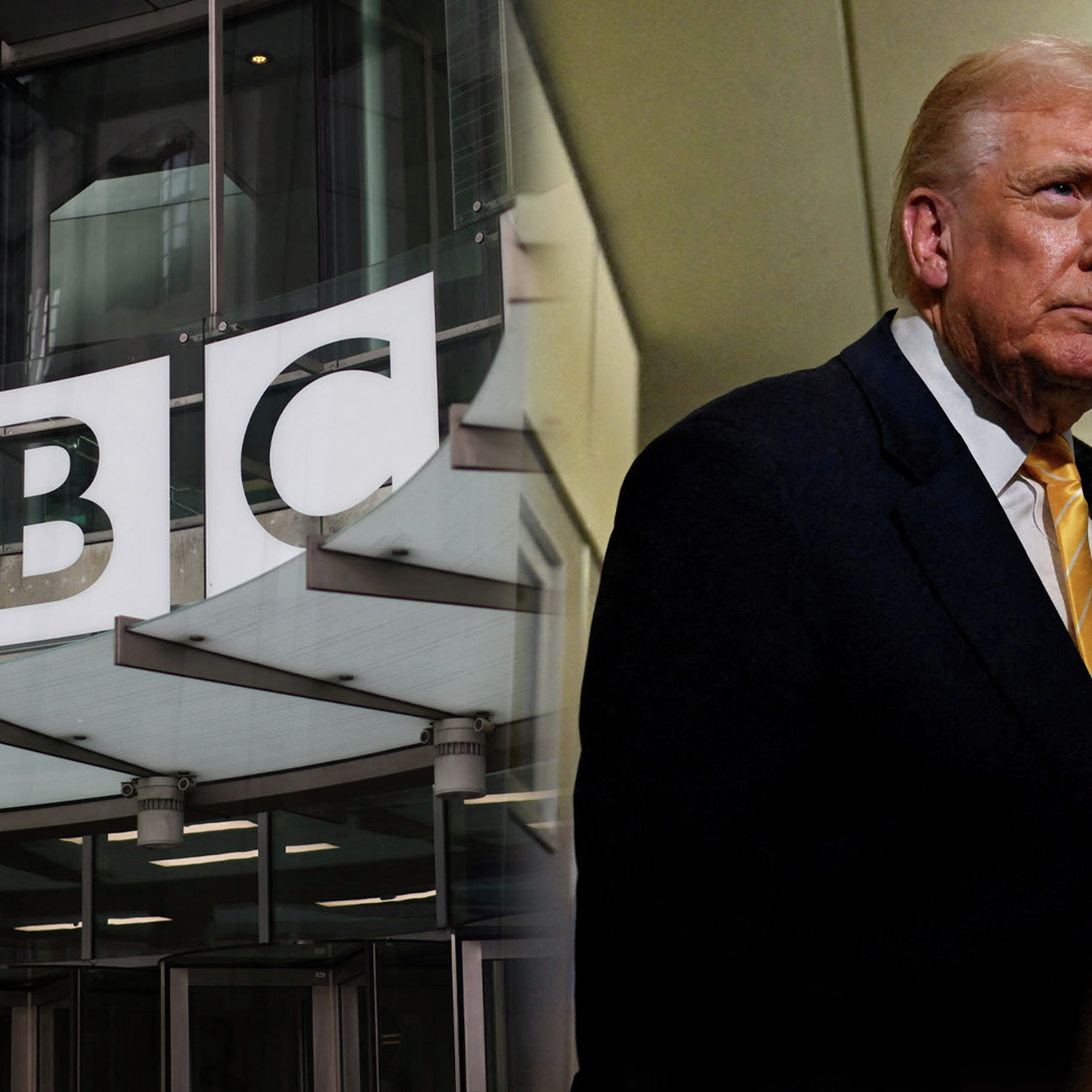
Changes at the top at the BBC, two of its most senior executives have taken the fall. Is the network undergoing a crisis or experiencing a coup, remake, remodel? Syria's leader pays a visit to the White House and makes the most out of every media moment on offer. Plus AI slop the flood of artificial content across social media platforms and the effect it's having on the people taking it in. It has been a tumultuous week at the British Broadcasting Corporation. The BBC, after both its director general and its head of news resigned. Their departures followed the publication of a dossier leaked to a right wing newspaper, the Telegraph. Among other things, the dossier documented how last year the broadcaster misrepresented a speech that US President Donald Trump made on January 6, 2021, the speech that preceded the riots on Capitol Hill. Not one to pass up an opportunity, Trump is now threatening to sue the network for a billion dollars. No US President has ever leaned on the BBC like this before. But there's a larger story here over the future of the news organization, its ability to withstand political pressure on to speak truth to power on stories such as Israel's genocide in Gaza, which the dossier also dealt with. And if certain interests, ideologies, lobbies can mess with the BBC, a publicly owned broadcaster that is meant to be independent, that does not bode well for the network or its viewers. During his first stint at the White House, Donald Trump complained constantly about what he called the fake news industry.
- [02:21]
Donald Trump
When you report fake news, which CN a lot, you are the enemy of the people.
- [02:26]
Narrator/Reporter
This time around, he's added litigation to the mix, suing CBS News and ABC News for tens of millions of dollars for their allegedly biased coverage.
- [02:37]
Donald Trump
Well, ABC paid me $16 million recently for a form of hate speech, right?
- [02:42]
Narrator/Reporter
Trump may have asked himself, why stop at the border? Now he is threatening to sue Britain's public broadcaster, the BBC, for its editorial misdeeds. They defrauded the public and they've admitt the dollar figure 1 billion. And the fallout has already cost 2 of the network's leaders, its director general, Tim Davy, and its CEO of news, Deborah Turness, their jobs.
- [03:08]
Media Analyst 1
It's unprecedented that a sitting U.S. president would attack a British broadcaster like this. But it's all part of the playbook isn't it about the way he has attacked the US media.
- [03:18]
Media Analyst 2
Donald Trump is the head of a foreign state. It shouldn't be the business of the United States government to be dictating to anyone in the including its closest allies, who heads the politically and culturally important institution like the BBC.
- [03:33]
Media Critic/Commentator
Donald Trump has a vested interest in turning the BBC into his lapdog, into a supporter of his political project, and that's why he's suing it for a billion dollars.
- [03:45]
Media Analyst 3
The BBC is always in some sort of state of crisis, but this crisis is far more intense than one they've had for decades. But it's true to say that Donald Trump is extremely litigious, especially about journalism. So I'm absolutely flabbergasted that the BBC should be surprised that Trump is suing them.
- [04:02]
Narrator/Reporter
Of all the things to make executive heads roll at the BBC, critically important political and editorial issues, it was this documentary, which has since been pulled, that did it. And the editing of a speech Trump made on January 6, 2021. The way the producers took two parts of that speaker speech lines that Trump delivered 53 minutes apart and fused them together. The misleading effect that had on audiences.
- [04:30]
Donald Trump
We're going to walk down to the Capitol and I'll be there with you. And we fight. We fight like hell. And if you don't fight like hell, you're not going to have a country anymore. We're going to walk down to the Capitol and we're going to cheer on our brave senators and congressmen and women.
- [04:54]
Narrator/Reporter
That problematic edit, along with several other criticisms of the channel's coverage, was reportedly flagged to the BBC earlier this year in a dossier written by someone the BBC called an impartial editorial advisor, Michael Prescott. But when no action was taken, that dossier was leaked to one of the UK's right wing newspapers, the Telegraph, which has long had it in for the BBC. The paper then zeroed in on the documentary and the way it was edited.
- [05:26]
Media Analyst 1
BBC produces tens of thousands of hours of news and current affairs every year. Of course they're going to be mistakes. Every piece of journalism you know, is, is a mistake waiting to happen. But when we get into to these crises, we lose all sense of perspective of what really is at heart here. An organization that's trying more than any any other to be an impartial, unbiased purveyor of good, accurate, quality news.
- [05:54]
Media Analyst 2
If it had been a president of any other country, I don't think the BBC would be responding in the way way that it has because what's happened is that the sort of hard right in this country has become increasingly aligned with the right wing in the United States. They've taken up Trump as their cause and it wasn't a live political issue until it was brought to the attention of the BBC by the right wing press.
- [06:20]
Media Critic/Commentator
What the past week or so has shown us is that the BBC only really listens to criticism when it comes via the right wing press. Now, for about two years I've been trying to ensure that there's accountability and that this change over the BBC's abysmal Gaza coverage, but because I didn't air those criticisms in the Telegraph as has been done here, they haven't really been heard. And it's a shame to see our public broadcaster held in a sort of chokehold by the right wing press. In the uk.
- [06:53]
Narrator/Reporter
The BBC has also been infiltrated by right wingers packing an agenda. The author of the dossier, Michael Prescott, used to work at the Sunday Times, a paper owned by Rupert Murdoch, before he move into PR and lobbying. His firm has reportedly worked with US tech and media giants with close ties to Trump, including Oracle, owned by pro Israel billionaire Larry Ellison, who has been part of the reshaping of the US media landscape through his family's acquisitions of CBS News and TikTok. Back in 2021, when Boris Johnson was Prime Minister, Prescott was given an advisory position at the BBC. According to multiple reports, he got the job with the help of of a Johnson appointee, a member of the BBC's board which governs the broadcaster Robbie Gibb. Which is why media analysts in the UK choose not to describe what is happening at the BBC as a crisis. They prefer to call it a coup.
- [07:54]
Media Analyst 1
Robbie Gibb has become the lightning rod for this criticism because he has such an obvious and direct link to not just the government, but he. He has an ownership stake in the Jewish Chronicle, he helped co found GB News. Someone like that to be on the BBC board is an obvious red flag.
- [08:13]
Media Analyst 3
Robbie Gibb is a mercurial character in British politics. He's been in a sort of revolving door between politics and the BBC for the last 20 years. He was the head of BBC politics. He then moved when Theresa May became Prime Minister to be the head of Press at number 10 and then he moved back to the BBC as a BBC board member in 2019. He sees himself as a bulwark against supposed liberal bias at the BBC. So the agendas that are top of his mind are firstly Brexit, secondly the Tory party and thirdly, supporting Israel.
- [08:50]
Media Analyst 2
But there are more fundamental issues here. The fact that the BBC is not impartial on key issues, that the BBC isn't independent from government or from other powerful interests. What we need to be doing is taking a bit of a step back from that and thinking about, right, what's the broader context for this story?
- [09:08]
Narrator/Reporter
The BBC maintains impartiality is at the heart of its mandate. Its record on Israel's genocide in Gaza says otherwise. We asked the network why it still discourages the use of the term genocide in its coverage when so many legal experts and NGOs call it that. It replied that, quote, genocide is a precise legal term and there is still a case ongoing in the international courts. But there is no arguing that Starting just after October 7, the BBC allowed Israeli officials to peddle atrocity propaganda about Hamas lies to justify the Israeli atrocities to come. Babies were set on fire, babies were shot in the head. Or to legitimize all manner of war crimes like bombing civilian targets.
- [09:58]
Donald Trump
A home, a school, a hospital that hosts terrorists is not a home, is not a school and is not a hospital.
- [10:07]
Narrator/Reporter
According to Michael Prescott's dossier, the one that toppled those executives, there is a systemic bias at the BBC over Gaza. Not in favor of the Israelis, though, against them.
- [10:20]
Media Critic/Commentator
Far from there being an anti Israel bias at the BBC, as Prescott claims. In fact, the BBC has failed to hold Israel to account across two years of genocide. Now, there's a lot of data to back this up, a lot of evidence, including a landmark center for Media Monitoring report which shows massive disposal disparities in the language used to talk about Palestinians being killed versus Israelis being killed, a massive disparity in how many Palestinians were spoken to on air versus how many Israelis were spoken to on air. So it's very clear what's happened here, and it's very clear that Israel has committed war crimes, crimes against humanity. And BBC news coverage has not accurately reflected that.
- [11:05]
Media Analyst 3
I don't know of a single senior serious BBC on air or off air journalist who has experience in the Middle east, who has not been despairing of its coverage, who does not think that they failed on almost every level. And so the criticism from those who say that the BBC coverage has been broadly pro Palestinian is slightly ridiculous. And so I think the purpose of this dossier, whilst it was right in bringing forth the mistake on the Trump edit, it's also to smuggle in the distortion that the BBC's coverage has been pro Israeli.
- [11:47]
Narrator/Reporter
This past week, Ahmed Al Shada became the first Syrian president to ever set foot in the White House. It was a landmark diplomatic trip filled with photo ops and political theater marking his transition from a US Designated terrorist to an ally. Meenak Shiravi is here with more.
- [12:05]
Host/Anchor
For Ahmad Al Sharad, this trip to the US Wasn't just a political moment in which to open up Syria, long isolated to Washington's much needed support, but an opportunity to continue a process of rehabilitating his image in the West. The entire visit was meticulously choreographed. The video of Al Sharah shooting hoops with US Military leaders in Washington stood out given that just eight years ago, as commander of Al Qaeda's affiliate In Syria, the US had a $10 million bounty on his head. Al Shara sat down for interviews with Fox News and the Washington Post, but the centerpiece of the visit was his White House audience with President Trump.
- [12:43]
Donald Trump
He's a very strong leader. He comes from a very tough place.
- [12:48]
Narrator/Reporter
And he's a tough guy.
- [12:49]
Host/Anchor
The message from all of this was clear. With the fall of Bashar Al Assad, there's been a change in the U.S. s approach to Syria and Al Sharah is there for it, ready to do business. His country is in dire straits. Nearly two thirds of the population still lives below the poverty line. The banking system is in danger of collapsing, and sectarian violence between the Sunni majority and Alawite minorities is ongoing. While the symbolism is striking Syria, at least for the cameras cast as a partner in peace, the country's troubles run deep. It will take far more than a state visit to mend the effects of decades of war, division and economic hardship.
- [13:28]
Narrator/Reporter
Thanks Meena. The social media platforms that you spend so much time on are transforming. Over the past year, a certain kind of video has made its way into your feeds. Low quality, mass produced, artificially generated content, otherwise known as AI slop, short form videos that flood your screens with hyper stimulating, highly personalized visuals to trigger the algorithms and generate revenue for big tech companies. As your social media platforms grow less social and more manipulated, can you even trust your own eyes? What they are seeing now? This is not a story about the dangers of generative AI or deepfakes that's getting all kinds of coverage elsewhere. It's about the flood of AI material on your platform. Some of the most popular and engaged with content that's currently online and the changes that that material is making to us in the process. The listening Posts Elektro Scrivo now on the tsunami of slop, the AI that's invading your feeds and overhauling the Internet as we know it.
- [14:39]
AI Content Reporter
Have you noticed your social Media feed changing Lately, over the past year, there's been an influx of sad cats, bizarre made up characters like Tung Tung Tung Sahor or Ballerina cappuccino. And even the White House has been getting in on the act. Like this video of President Trump dumping diarrhea all over American protesters. The more you scroll, the more it hits you. It's called AI Slop. Cheap, meaningless, high volume content designed for one thing only, to keep you endlessly scrolling. We spoke to one of the people behind it, an AI video creator in the Philippines, and the first thing he told us was that the label slop isn't quite accurate or fair.
- [15:23]
AI Video Creator
I understand where the term AI slop comes from, but I believe it's because some people rely on AI too much to create a good video. When in reality it should be that the idea of the person should lead AI because in the end, AI is just a tool. Creators like me who get viral. I mean, we didn't get viral for no reason. We actually go into a creative process. We don't just type random words and hope for AI to make a good video.
- [15:53]
AI Content Critic
Sometimes AI slop can show a spark of creativity. I agree it could be an outsider art wheat or dark humor, but those moments are really rare. So the larger pattern is regressive. Because social media platforms reward what's clickable, the real creativity easily gets lost in translation.
- [16:16]
Donald Trump
Dad, you got a visitor.
- [16:18]
Narrator/Reporter
Wait a minute, is that these AI slapped content.
- [16:22]
AI Content Critic
They are of course hitting our dopamine, but at the same time, we want to share something new and novel and sensational, so. So that we can make people around us like laughing. But it's going viral and it's actually turning the entire Internet into sort of like garbage yard.
- [16:42]
AI Content Reporter
The rate at which this AI garbage is being churned out is staggering. And it spans everything. Text, images and video. The AI creator we spoke to, Mark Lawrence Gadilao, walked us through his video making process.
- [16:56]
Media Analyst 1
Process.
- [16:57]
AI Content Reporter
A lot of it is done on his phone. It starts with a detailed prompt to ChatGPT describing exactly what he wants to see. He then uploads those images to Cling AI, an AI video generator where the stills are animated. Finally, he edits the sequences in Capcut Pro and uploads them straight to YouTube shorts. It's a relatively simple formula, one followed by thousands of AI video makers around the world. And it feeds the endlessly hungry beast that is the Internet today.
- [17:28]
Donald Trump
There's now just this basically global cottage industry of people who see themselves as AI artists or AI slot makers. I've talked to many of them. They work all around the world. Some are in America, some are in China. They see this basically as a form of gig work.
- [17:50]
Host/Anchor
So I've been able to make over a million dollars a year.
- [17:53]
Narrator/Reporter
Which tool is the best one to make money with? The eye.
- [17:56]
Donald Trump
They know how to use these tools to get a result that is just absurd enough that people have to share it with the goal of making money through these social media platforms, getting attention, getting virality. And maybe 100 of them won't go viral, but one of them might, and they might make hundreds or thousands of dollars from that piece of content. Content.
- [18:18]
AI Video Creator
So my most Profitable month was May 2025, and it was because of the Italian brain rot trend. Every video was going viral. And when I included those characters in my videos, I just got over 20 million views in each good video. And because of that, my revenue obviously skyrocketed. So if I graduate computer science and find an entry level job with my course, usually I would end up in a job ranging from 500 to $700 per month. It's not that bad. But when you Compare it to YouTube's potential, there's a really huge gap. The average income I make with YouTube is ranging from 3,000 to $6,000 a month.
- [19:09]
AI Content Reporter
The AI money machine has sent tech players into overdrive. Just as the consensus on the addictive power of social media was beginning to have an impact. With serious proposals to limit screen time for young people and users consciously putting their phone aside, the AI content boom has spiked. Watch Times Online Meta reported that improvements to its AI content had delivered an 8% increase in the amount of time spent on Facebook and a 6% increase in the time spent on Instagram. CEO Mark Zuckerberg is leaning into the trend. On an earnings call last year, he.
- [19:47]
Donald Trump
Said, and I think we're going to add a whole new category of content, which is AI generated or AI summarized content. And I think that that's going to be just very exciting for Facebook and Instagram.
- [20:01]
AI Content Reporter
AI video creation platforms have also been booming. There's Runaway Cling AI, Google's VO and one of the most popular, OpenAI Sora. The company CEO Sam Altman and the head of Sora, Bill Peebles, were not too fussed about the volume of AI slow.
- [20:18]
Donald Trump
This model is really good about kind of telling a coherent story with like a beginning, middle and end.
- [20:22]
Narrator/Reporter
I mean, some of it will be.
- [20:23]
Media Analyst 2
Slopped to some people and some of it won't.
- [20:26]
AI Content Critic
Social media platforms like YouTube don't really care whether a video contains real thought or if it is just auto generated. What matters most is watch time companies like Meta or OpenAI or Google, they profit from content engagement. So ethics comes after growth and it has created a chip and fast market for attention.
- [20:54]
AI Content Reporter
Both YouTube and OpenAI have pushed back on that charge. OpenAI said across ChatGPT our goal isn't to hold people's attention on the Soar app specifically. It is designed to optimize for creativity and participation. YouTube came back with this. YouTube's business as a streaming service relies not just on engagement, but on delivering high quality content.
- [21:18]
Donald Trump
Most AI slop content is pure id. It taps into something that's really basic in all of us and there's nothing wrong with that, right? Like it doesn't have to all be high literature, high art. But a lot of this content does tend to prey on our emotions because that is the quickest way to go viral. You see a lot of AI content that is racist or sexist or or bigoted in some way that's designed to make you really mad, so you share it. We've always had people trying to troll us into sharing their viewpoints, but now we have people who can do it at industrial scale.
- [22:02]
AI Content Reporter
The AI driven flood of online content is accelerating two trends. First, the onslaught of fake images and videos online. It might be harmless if people believe this AI generated clip of a kangaroo trying to board a plane is real. But when protests, violence or hate speech are fabricated at scale, the consequences could be catastrophic. The second trend being ramped up is the steady erasure of the human element in what we see as we scroll. It's something people have warned about for a while. Now it looks like it's here.
- [22:37]
AI Content Critic
The dead Internet theory says much of the web is no longer human. It's all bots and other posts shaping what we see. It once sounded like a conspiracy theory, but with AI slob, it's becoming reality. About half of what's online already includes AI made element. And many predict that within a few years AI will dominate the entire Internet. So it's a loop in which synthetic content keeps reproducing itself, blurring what's real.
- [23:10]
Donald Trump
You know, in the early days of AI content, you actually saw even companies like OpenAI talking about. We are concerned about releasing this model in the wild. We don't know how people will use it. We don't know what conversations they'll create, what images they'll create. Will they fake people to doing things they don't want to do. And you got more of that sense of morality and ethical quandary from some of those people. A lot of those people who cared about that sort of thing are gone. They've been crowded out in the conversation by the maximalists who want the biggest business and the best opportunities to create this content. Most of the big tech and AI companies feel like this is an existential fight. If they don't win AI, somebody else will. And who knows how much money that company will make.
- [23:58]
Narrator/Reporter
And finally, back to the BBC, its coverage of Gaza and a story that may be headed for court. Rafi Berg, the BBC's Middle east editor for its news website, is suing British journalist Owen Jones for defamation. Jones put out an article last December that quoted 13 current and former BBC staff who say that Rafi Berg, quote, sets the tone for the BBC's digital output on Israel and Palestine to prioritize the Israeli military's perspective on at the expense of its Palestinian victims. Now, Berg makes no secret of his close ties to the Zionist state. In 2020, he wrote a book about the Mossad and did an interview where he gushed about his relationship with the Israeli spy agency.
- [24:46]
Donald Trump
As a Jewish person and admirer of.
- [24:48]
Narrator/Reporter
The state of Israel, then, you know, to know that these people carry out these kinds of fantastic operations, I mean.
- [24:58]
Donald Trump
It'S really, it's what makes you tremendously proud.
- [25:02]
Narrator/Reporter
Berg's lawyers say that Jones article has damaged their client's reputation and sparked a wave of threats against him, including death threats. Jones stands by his reporting and is crowdfunding his legal defense, looking for contributions. The BBC has defended Berg's journalism before, but does the network really want to see this case go to court? Why would it want to have its sorry editorial record on Gaza reopened for examination by a judge? That is why we at the Listening Post doubt that this case ever makes it that far, because Rafi Berg's employers at the BBC will not want it to be.