← The Listening Post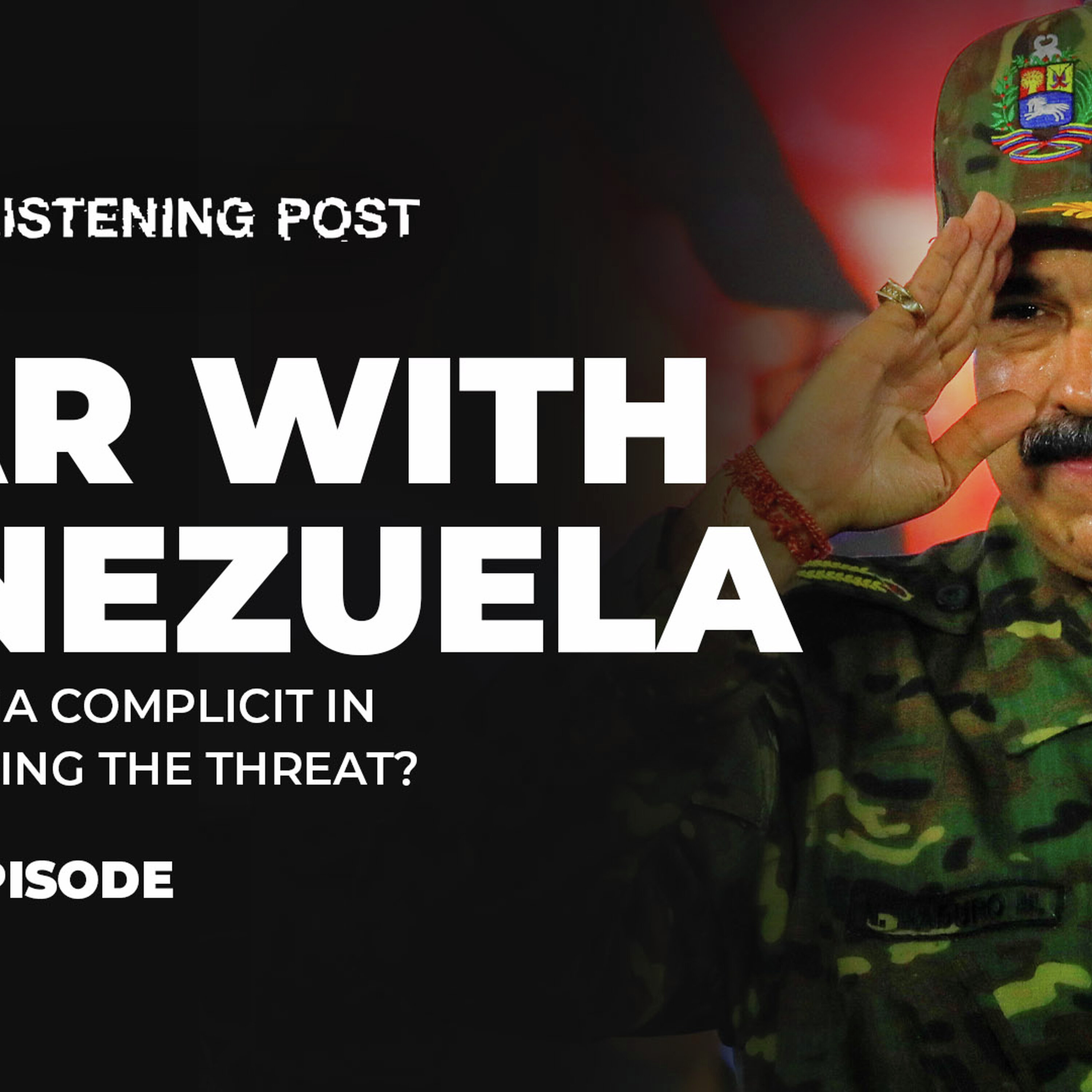
Loading summary
Transcript64 lines
- [00:01]
Host/Anchor
This week on the take, we're marking one year since a pair of devastating earthquakes hit Turkey and Syria with a new digital interactive. Listen and watch stories of survival, recovery and coping with the grief@al jazeera.com earthquakes Again, that's al jazeera.com earthquakes.
- [00:28]
Narrator/Reporter
The Trump administration is using the narco state narrative to justify its attacks on Venezuela. The end game to hook Americans on the idea of regime change. In Caracas, a week of leaks around the Ukraine. Russia talks a possible deal hangs in the balance again. And why settle for the west bank, the Israeli movement to take over Gaza and the settlers who cannot wait to get there. For weeks now, the United States has been on what it calls a counter narcotics mission against Venezuela lethal force policies, including drone strikes against alleged drug smugglers off the country's coast. If only that narrative was accurate. There is no evidence that the boats targeted had any drugs on board. What is well documented is Washington's determination to provoke a regime change in Venezuela, which just happens to sit on the world's biggest oil reserves. The Trump administration's push to frame it as a narco terrorist state, language that many mainstream outlets habitually adopt echoes what we have heard before. And it's reminiscent of the run up to the 2003 invasion of Iraq, when flimsy intelligence and official talking points helped manufacture public consent long before the first bombs were dropped. Meanwhile, in Venezuela, or ordinary people, including journalists, are paying the price. Starting with the historical precedents. The last time America sent this many warships into the Caribbean Sea was 63 years ago, the Cuban Missile Crisis of 1962. It's one of the last chapters in the offensive threat from Cuba. Back then, the US was guarding against a nuclear threat and the Soviet Union. This time the threat is from drug traffickers coming out of Venezuela, or so Americans have been told. It's why the US has bombed Venezuelan boats, killed dozens of people, while providing zero evidence against those targeted. And if that fails to add up for you, a far more plausible explanation was offered by this U.S. congresswoman.
- [02:43]
Political Analyst/Critic
Venezuela, for the American oil companies will.
- [02:48]
Narrator/Reporter
Be a field day because it will.
- [02:50]
Political Analyst/Critic
Be more than a trillion dollars in, in economic activity. She's openly stating, come take the oil. This is a bonanza for US Oil corporations. Usually you had these kind of coup, regime change, fomenting attempts behind the scenes, but now the empire has never been more naked about its intention here, about just stealing the vast oil reserves and they don't care if thousands of Venezuelans die as a result.
- [03:14]
Narrator/Reporter
This story stretches back to 2002 and Presidents George W. Bush and Hugo Chavez. Chavez's leftist agenda did not sit well with Washington, which backed a coup attempt that year that ultimately failed. In 2019, during Donald Trump's first term, the US got behind an effort to replace Chavez's successor, Nicolas Maduro, with a conservative, Juan Guaido, which also failed. Waiting in the wings this time is opposition figure Maria Corina Machado, who was recently awarded the Nobel Peace Prize. The other twist, the US now says Venezuela is a narco state. It has designated a group called the Cartel de los Soles, the Cartel of the Suns, as a terrorist operation. There is no denying that corruption in Venezuela is real. That has been documented by NGOs like Transparency International and the UN's International Narcotics Control Board. But analysts argue that the ties between the state and the drug trade are nowhere near deep enough to justify the bombing of at least 22 boats, the killing of 80 people, and counting attacks that under international law, are illegal.
- [04:32]
Media Analyst/Commentator
This is something in an almost postmodern way that the Trump administration has incepted into reality. This started out the Cartel de Soleils, and as a slang term to describe Venezuelan military personnel who had grown corrupt for allowing the low levels of drug smuggling in Venezuela. A colloquial turn of phrase wandered through journalism over the years.
- [04:56]
Narrator/Reporter
So this group we're talking about, Cartel de los Soles, the drug cartel, Cartel.
- [05:00]
Host/Anchor
De los Soles, Venezuela's infamous Cartel de.
- [05:03]
Media Analyst/Commentator
Los Olais, to now become a fixed idea invention of the Trump administration to. To justify a regime change in Venezuela.
- [05:12]
Political Analyst/Critic
This notion of narco terrorist is similar to just the notion of terrorism in the American mainstream media and Hollywood propaganda. This has always been kind of this villainous character plata o pomo, that agitates people around the notion that, yes, we can go in and we can commit war crimes. It's no different than any other propaganda that sowed the seeds for horrific terrorists US intervention in the past.
- [05:39]
Investigative Journalist
Because the US can't simply argue we want a regime change. They have to argue, as they did in the case of Panama and Noriega, that the leader of the country is a cartel leader, narco terrorist by labeling an entire country and demonizing Venezuelans in the process.
- [05:56]
Narrator/Reporter
The Trump administration's position on Venezuela that it is a narco state, is easy for any journalist to debunk. Far more cocaine comes into the US from Mexico, Colombia, Peru and Ecuador. But none of those governments can satisfy America's addiction to another commodity, oil, the way Venezuela's can. It is sitting on more reserves than any country on the planet, including Iraq, which the Bush administration invaded in 2003, a war far too many American news outlets, the New York Times among them, helped sell to the US Public through the peddling of the WMD lies the weapons of mass destruction that simply did not exist. History has a way of repeating itself. Sometimes it needs a little help. And many US News outlets, even those that can be hostile to Donald Trump, are providing it once again.
- [06:56]
Media Analyst/Commentator
The US Media is now, even as it presents critical coverage, noting the lack of evidence for what the Trump administration is saying, it still tends to default to the terms that he uses, that Maduro is a head of a narco state.
- [07:13]
Israeli Settler Movement Expert
Drug cartels go out of business.
- [07:15]
Narrator/Reporter
So does the Maduro regime.
- [07:17]
Media Analyst/Commentator
That Maduro is involved in drug trafficking.
- [07:19]
Political Analyst/Critic
President Nicolas Maduro, who the Trump administration claims is responsible for trafficking drugs into.
- [07:25]
Media Analyst/Commentator
The US that there are narco cartels operating off Venezuelan soil.
- [07:30]
International Affairs Correspondent (Meenakshi Ravi)
The Pentagon says these forces will enhance and augment existing capabilities to disrupt narcotics trafficking.
- [07:36]
Investigative Journalist
They're not doing investigative journalism. The only one that did investigative journalism was ap when they sent reporters out to where these boats left and documented. These were just ordinary people trying to make a living. They weren't gang members. And that's the sad reality. We focus on political doctrine coming out of Washington that says that they want to kill them. And that's the damage that this language has on a society, on a community.
- [08:02]
Political Analyst/Critic
The New York Times is the liberal bastion in America. All liberals read it. It's their bible. Look at the Iraq war. Look at the New York Times lies for that. What is the New York Times saying today? Bret Stephens arguing there's vital American interests at stake. What are those American interests? Not freedom and democracy. Oil, oil, oil. They're not even trying to hide it anymore.
- [08:27]
Media Analyst/Commentator
The New York Times really never met a war it wouldn't manufacture consent for. Not just in Venezuela during the 2002 coup, but also the Iraq War, the Afghanistan war, the war on terror more generally. So you can really fairly rely on mainstream media, particularly mainstream liberal media, to find a way to oppose the last war, but support the current or the future one.
- [08:51]
Narrator/Reporter
We put that to the New York Times, which published that op ed on the case for overthrowing Nicolas Maduro. Its response? Our newsroom journalists report on the facts and details. Our opinion section offers a range of perspectives and ideas to help our audiences make up their own minds. The Venezuelan media space has problems of its own, long in the making. The suppression of journalism that started in the latter years of Hugo Chavez has worsened under Nicolas Maduro. At the time of Chavez's death in 2013, the Reporters Without Borders Press Freedom Index ranked Venezuela at 117th out of 180 countries. It has since plummeted to 160th with widespread censorship and persecution of journalists. Which is why it was difficult to convince a Venezuelan reporter to talk to us. And the one who did insisted that we hide his identity.
- [09:52]
Venezuelan Journalist (Anonymous)
People have to be very careful of what words they use, what information they put out, what topics they cover. There are subjects that simply need to be ignored. Two radio journalists were suspended recently, their program cancelled because they reported on the Nobel Prize given to Maria Corina Machado. The outlook for journalists is very challenging. Somehow we have to find a way to get the news to the people.
- [10:16]
Narrator/Reporter
With such a severe shortage of independent reporting, it can be difficult to gauge where the citizenry really stands. Venezuelans have already suffered through 10 years of economic sanctions that have crippled their trade sector, hit them hard in the pocketbook. Do they still defend the their defective democracy, where, according to the UN, the last two presidential elections have been neither free nor fair? Or do they stand with a meddlesome imperial power, the one that imposed those sanctions on Venezuela and has designs on its oil fields?
- [10:52]
Venezuelan Journalist (Anonymous)
A recent survey by the Catholic University Andres Bello concluded that 8 out of every 10 people in Venezuela feel a political regime change is necessary. It doesn't have to happen through US Intervention. But some people seem resigned that this may be the only way forward. After last year's elections, the government refused to accept the outcome, which was in favor of the opposition. And there was so much pressure and persecution that took place after that.
- [11:16]
Investigative Journalist
The reality is that most people in Venezuela are against an intervention. There's a small opposition group that supports an intervention. And if you were to look at social media where bots proliferate and where phony accounts dominate, you would be bombarded with welcome signs for U.S. marines. But the average Venezuelans don't want a war because the consequences would be disastrous. As it has been in every country where the US has tried regime change. Whether it's Iraq, whether it's Afghanistan, whether it's Guatemala, whether it's Haiti, whether it's Cuba.
- [11:48]
Narrator/Reporter
The peace negotiation process between Ukraine and Russia has been difficult enough. And that was before a series of leaks this past week complicated matters. Meenakshi Ravi has been keeping up with some revealing developments.
- [12:01]
International Affairs Correspondent (Meenakshi Ravi)
Once again, the pattern that has plagued years of negotiations between Russia and Ukraine has reasserted itself. A potential peace deal, however flawed, is at risk of being shattered by the latest round of leaks. The first came from an anonymous Ukrainian official who released a draft proposal that the White House claimed it had authored. The 28 point document was criticized by for being far too favorable to Russia and for having minimal Ukrainian input. Then came the second leak to Bloomberg News of a recording of a call between Trump's envoy, Steve Witkoff and a Russian official.
- [12:34]
Narrator/Reporter
Bloomberg exclusively reports on a conversation last month. Witkoff advising Putin's aide on how to pitch the peace plan directly to Trump.
- [12:43]
International Affairs Correspondent (Meenakshi Ravi)
The leaks, whatever the source, may have been exposed that the Trump government is negotiating mostly with Moscow, similar to the way it negotiated the ceasefire in Gaza, primarily through Tel Aviv. The disclosures have dominated both Western and Russian media.
- [12:58]
Host/Anchor
If any other adviser of a European.
- [13:02]
Narrator/Reporter
Or an international head of state were caught giving that kind of sensitive information to a foreign leader, they would be arrested for treason.
- [13:29]
International Affairs Correspondent (Meenakshi Ravi)
In Ukraine, there has been anger, but the narrative has been tempered by the reality of how the war has been going.
- [13:44]
Narrator/Reporter
If principy.
- [13:48]
International Affairs Correspondent (Meenakshi Ravi)
That perception that Russia now has the upper hand could explain the shift in Ukrainian public opinion. Gallup polls indicate that 69% of Ukrainians are now in favor of the negotiations, some sort of compromise, compared to just 22% back in 2022 when most still wanted to fight. And that is an indication perhaps of where this story is going.
- [14:12]
Narrator/Reporter
Thanks, Meena. Given the unprecedented rise in Israeli settler violence in the occupied west bank, we are going to rebroadcast a report that we first put out back in March. It examines who the settlers are, how their radical ideology has been mainstreamed by the Israeli news media. Many of them are far right religious extremists prone to violence, living on stolen Palestinian land in the West bank. Despite constituting just 7% of Israel's Jewish population, they hold a disproportionate political grip on Benjamin Netanyahu's ruling coalition government and are now pushing hard to re establish settlements in Gaza. For certain Israelis, in normal times, this movement would be beyond the pale. However, since October 7, 2023, they have been granted center stage on Israeli news channels. We spoke with three Israeli experts on the settler push to colonize Gaza. Two of those interviews were done via Zoom because the Israeli authorities have banned Al Jazeera there. The Listening Post's Nick Muirhead now on the settlers and their allies in the Israeli media.
- [15:23]
Israeli Settler Movement Expert
After the October 7th attack, you know, there were rockets falling in Israel. There were no big events, music, concerts, even weddings. You know, people are very quiet, shocked and sad. And then you arrive to this venue in Jerusalem, 5,000 people dancing and singing like the Messiah is coming. They really See this opportunity, they're happy. You know, they saw October 7th as opportunity.
- [16:08]
Israeli Political Analyst
This is the Victory of Israel conference, one of a number of massive carnival esque mega events held in the wake of October 7th. Attendees could take part in workshops on how to establish a settler outpost and rub shoulders with cabinet ministers. But who are Israel's settlers? And why, when the rest of the country was in mourning, were they choosing that moment to rejoice?
- [16:35]
Israeli Media Expert
So settlers are Jewish Israeli citizens that believe that the entire biblical territory of Israel was promised to the Jewish people by God. They live beyond the Green Line, which is the internationally accepted borders of Israel, despite the fact that it's illegal by both international and Israeli law. And the way they do so usually is a few settlers will go into a Palestinian territory, put an outpost there and expand that outpost. They start to supply them with infrastructure, water, security, electricity. And by this kind of tactics, they create a new reality on the ground.
- [17:20]
Host/Anchor
The settlers are one of the most well endowed sectors in Israeli society. They enjoy some of the most lavish subsidies and state budgets. They are represented by Benvir and Bezalel Smotrich, Minister of Finance, who have been propelled to power through the inclusion in Benjamin Netanyahu's cabinet. So although they are not a mass movement within Israel, they are only 5 or 6% of the Israeli population. Their power is unprecedented. And their ability to wreak havoc in the Palestinian territory is unprecedented.
- [17:59]
Israeli Settler Movement Expert
There are hundreds of thousands of settlers in the West Bank. Many of them live there because it's cheap, because it's affordable. You know, there's no law there for them. They can kill, they can take over land. The public doesn't want to see it and the media doesn't show it. So through the years this has been normalized, that the west bank is kind of de facto part of Israel after October 7th. From the beginning, the settlers were talking about going back to Gaza.
- [18:29]
Israeli Political Analyst
Back because they had been there before the last settler left the Gaza Strip in 2005, when the Israeli government dismantled 21 Jewish settlements dotted across the territory. That plan had been drawn up more than a decade earlier, in 1993, when Israeli Prime Minister Yitzhak Rabin agreed to the US brokered Oslo Peace accords.
- [18:53]
Narrator/Reporter
Enough of blood and tears, enough.
- [19:00]
Israeli Political Analyst
Rabin was assassinated two years later. Not by a Palestinian, by an Israeli settler who saw the Prime Minister's efforts at peacekeeping as a form of betrayal.
- [19:10]
Host/Anchor
This was a point in which the settler movement was experiencing a real political crunch. Most Israelis were supporting Oslo and the settlers were considered the extremists and Those who resorted to to unheard of violence. The settlers movement created a campaign to win the hearts and minds of Israeli publics by doing their own hasbara, that they are not krazos, that it's actually beautiful to live in settlements and is actually the ideal life that every Israeli is dreaming about.
- [19:53]
Israeli Media Expert
One of the things that helped these settlers expand their media networks is the establishment of Israel Today, which is the most read daily newspaper in Israel. And then channel 14, the first TV channel that is very, very much biased towards the.
- [20:19]
Israeli Settler Movement Expert
Now.
- [20:19]
Israeli Media Expert
There is not a major TV channel or a newspaper that don't include at least one settler or two.
- [20:28]
Israeli Settler Movement Expert
For example, Channel 12, the leading channel in Israel. You have Amit Segal, a son of a settler that was very close to Netanyahu. You have of course channel 14 and you have many settler figures there like Shimon Ricklin and Yanon Magal. After October 7th, many, many people were invited to the mainstream media to speak about the plans to resettle in Gaza.
- [21:17]
Israeli Political Analyst
Among those calling for the resettlement of Gaza on Israeli airwaves, one voice stands out. Daniela Weiss is a veteran of Israel's settler movement, Has spent decades spearheading the establishment of outposts on Palestinian land. Today she is the leader of Nakhalla, a radical settler organization and since October 7th, a mainstay on Israeli TV.
- [22:00]
Israeli Settler Movement Expert
She's not hiding her extreme right wing opinions. She will give interview to anyone. She will talk even to Western media, to left wing outlets.
- [22:22]
Narrator/Reporter
She doesn't mind Arabs will not stay in the Gaza Strip.
- [22:26]
Host/Anchor
Who will stay?
- [22:28]
Narrator/Reporter
Jews.
- [22:28]
Israeli Settler Movement Expert
She's very well connected to the ministers, to the army and to the police. And you can see it with the events she organized very close to the Gaza border in a place that is a closed military area. And she managed to get permissions or force the army and the police to.
- [22:43]
Host/Anchor
Allow those events while the war is continuing. We the areas that were liberated with.
- [22:52]
Israeli Settler Movement Expert
Jewish communities, these events were meant to pressure Netanyahu and we've seen their effect. The Israeli military was demolishing entire neighborhoods, not doing fighting, but after it make sure Palestinians are not coming back.
- [23:10]
Israeli Political Analyst
The ceasefire deal signed in October may seem like a setback for vice and the settler movement. However, analysts warn that it could be more like a Trojan horse that enables Israeli developers to take control of significant parts of Gaza. And calling it a ceasefire is misleading. The Israeli military has reportedly committed nearly 500 ceasefire violations since then, killing hundreds of Palestinians. And with settler violence reaching unprecedented levels in the west bank, the project of ethnically cleansing Palestinians from their land is still well underway.
- [23:47]
Host/Anchor
And the message of the settlers has been enforced and strengthened by the obsessive engagement of the Israeli media with the trauma of October 7th. And the message is basically, there's no chance that the Palestinians are ever going to accept any of us. We are all settlers. And this is an incredible boost to the settlements movement.
- [24:16]
Narrator/Reporter
And finally, this past week, Brazil's top court ordered former President Jair Bolsonaro to start serving his 27 year sentence for trying to launch a military coup after he failed to get reelected. Bolsonaro was president from 2019-22, a far right populist leader with a habit of going after his critics, journalists included. Just ask manuela Borges, a TV reporter who back in 2014, when Bolsonaro was still a member of Congress, asked him a question he did not like. She got this response. His tone, provoked by her suggestion that one day Bolsonaro might be held accountable for his actions, caused a bit of a stir. But it was Borges who got the last laugh when that court order came down this week. She went straight to the prison where Bolsonaro is serving his sentence and posted this video on Instagram.
- [25:18]
Host/Anchor
Criminal main chi si aqui la police.
- [25:25]
Narrator/Reporter
And if some of her mockery got lost in translation for you, it would have landed with the audience. It was intended for the now jailed former president Jair Bolsonaro.