← The Magnificent Others with Billy Corgan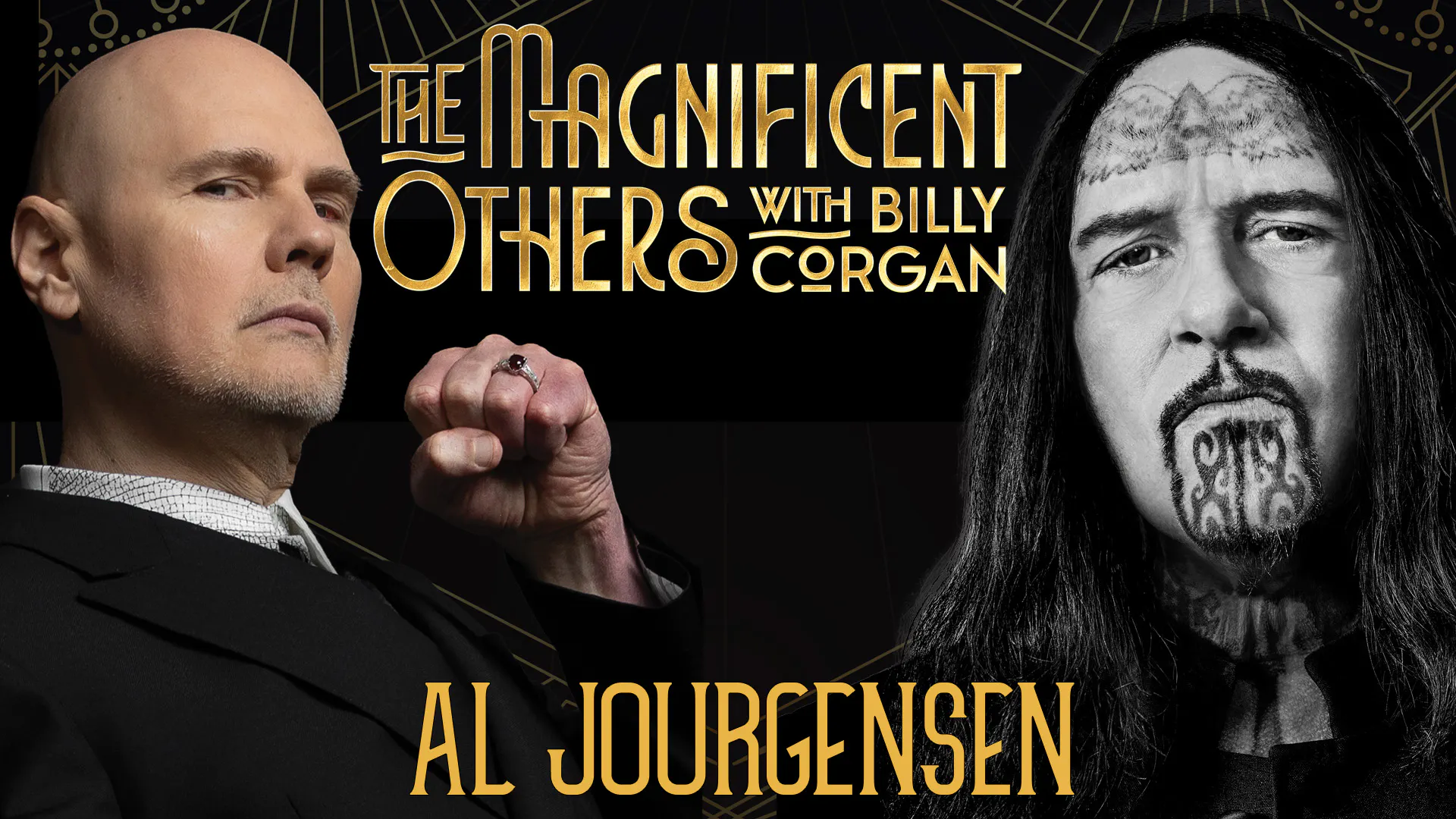
The Magnificent Others with Billy Corgan
Al Jourgensen | The Magnificent Others with Billy Corgan
01:22:59
Loading summary
Transcript575 lines
- [00:00]
Al Jourgensen
They'd come into the A room from the B room with, literally, a bag of cash. I'd have a 38 on the desk. They'd have, like, a couple guys with 45s. We'd count the money. I'd do a house mix, and they'd go on their way.
- [00:15]
Billy Corgan
That's amazing.
- [00:16]
Al Jourgensen
It was like that.
- [00:17]
Billy Corgan
That's amazing.
- [00:18]
Al Jourgensen
And he would do Friday experiments on us. We shoot up this, like, new psychedelic that some university had come up with. Okay, sounds good. I don't think I've ever written a song. I get my songs from the universe. Like, I. I don't know where they come from.
- [00:44]
Billy Corgan
Here we are.
- [00:45]
Al Jourgensen
Here we are.
- [00:46]
Billy Corgan
We're alive. Finally. We're alive.
- [00:48]
Al Jourgensen
We're still alive. Who knew? I mean, seriously, think back to Chicago days. Like, who would have predicted you and me would be sitting here right now still making music? Yeah.
- [00:59]
Billy Corgan
Still being great.
- [01:00]
Al Jourgensen
Yep.
- [01:01]
Billy Corgan
I think you're still being great and happy. Are you happy?
- [01:05]
Al Jourgensen
Big time.
- [01:06]
Billy Corgan
You seem really peaceful.
- [01:07]
Al Jourgensen
I. I love it out here. I really do. I mean, I love going back to Chicago.
- [01:11]
Billy Corgan
Are you a closet hippie? You're living out in the.
- [01:13]
Al Jourgensen
I'm. I'm pretty much a hippie. Yeah, yeah, yeah. Just old hippie. Just do my stuff. Don't cause problems. Pay my taxes.
- [01:23]
Billy Corgan
You know you're gonna make headlines.
- [01:25]
Al Jourgensen
Do the. Yeah.
- [01:26]
Billy Corgan
He said he doesn't want to cause problems.
- [01:28]
Al Jourgensen
Do the occasional Anti Trump album. You know, just keep my head low. It's. It's all good.
- [01:35]
Billy Corgan
So recently you've been touring with Gary Newman, Frontline Assembly.
- [01:38]
Al Jourgensen
Yeah.
- [01:38]
Billy Corgan
Seems like those shows are going really well.
- [01:40]
Al Jourgensen
That was so, so much fun. I mean, I. I never knew that Gary and I would get along.
- [01:46]
Billy Corgan
He's just the loveliest guy, so. Well, total sweetheart.
- [01:49]
Al Jourgensen
Well, on. On top of that. But then we found a love for psilocybin together, so the tour went swimmingly.
- [02:02]
Billy Corgan
It' well, here's the question. Do the synths sound better on psilocybin?
- [02:07]
Al Jourgensen
Yes, absolutely.
- [02:08]
Billy Corgan
You hear the phasing.
- [02:10]
Al Jourgensen
Yes, they do. Yes, they do.
- [02:13]
Billy Corgan
I love that. Hoping for the Masses is the recent album. I was listening to it. Very, very strong. I'm a huge fan. I think I've told you that in the past, but I just think somehow you've reinvented yourself 800 times, but you've always been you, which is interesting. I think you're one of the only people that's been able to do that.
- [02:36]
Al Jourgensen
I'm kind of like a Walmart Bowie. You know what I mean?
- [02:42]
Billy Corgan
I think you're Better than that. But I'll let you define yourself.
- [02:45]
Al Jourgensen
It's like, you know, you reinvent yourself, but obviously don't have the bona fides of Bowie. But like. Yeah, you just keep doing what floats your boat.
- [02:56]
Billy Corgan
Yeah.
- [02:56]
Al Jourgensen
You know, because otherwise it's boring. And otherwise you should get some kind of consultant job or something, you know.
- [03:06]
Billy Corgan
What gives you fire at this point? Because, you know, we've both been through these weird changes in the music business and now we're into streaming land.
- [03:14]
Al Jourgensen
Well, the fire for me right now is the finish line.
- [03:18]
Billy Corgan
Okay.
- [03:19]
Al Jourgensen
Because I'm doing it on my own terms, which is nice that you can get out of like a 40 year occupation and get out on your own terms. And to have Paul Barker back in the fold and to do a final record and tie a final bow on the whole thing and then do a final tour. And really, a final tour, not like.
- [03:42]
Billy Corgan
Not the wrestling version.
- [03:43]
Al Jourgensen
Yeah. Slayer, Motley Crue. Everyone comes back the year later.
- [03:47]
Billy Corgan
You know, I. When you say it's the final. I believe I'm done.
- [03:51]
Al Jourgensen
Yeah. And it's important that it's done because there's really not many more statements to make. I think we've reached the point of our. Of what we built as a genre. And that's about, you know, after that, it's superfluous. I think bringing Barker back in for the last one is going to make it like, kind of retro, but also really cool that we haven't jammed with each other in 25 years.
- [04:20]
Billy Corgan
But there's something about your music that's always got a futurism built in. So even when I listen to stuff, it doesn't. It's hard to explain. You never feel retro to me.
- [04:30]
Al Jourgensen
Well, thank you.
- [04:31]
Billy Corgan
It's a compliment, but I'm saying is somehow you're able to sort of land ahead. You know, sometimes when you watch an old science fiction movie and they're guessing the future, like you guessed the future right. Like, it's scary how accurate you were in guessing the future. You were calling this in the 80s and here we are.
- [04:49]
Al Jourgensen
Right.
- [04:50]
Billy Corgan
So you must feel like Nostradamus.
- [04:52]
Al Jourgensen
Well, it's funny. This is why, like, as much as I hate playing the old stuff live, because, as you know, it's just like, becomes tedious. I want to work on the new stuff. I want to. I want to expose the people to the new stuff. But the old stuff. But then I listen to, like, what's going on and I see the old stuff is current still.
- [05:14]
Billy Corgan
So that's kind of my point.
- [05:16]
Al Jourgensen
Yeah.
- [05:17]
Billy Corgan
No one's really beat you at your own game, and I think that's interesting.
- [05:20]
Al Jourgensen
Well, and that's why we're leaving on our own footing.
- [05:22]
Billy Corgan
Yeah.
- [05:23]
Al Jourgensen
Which is great.
- [05:25]
Billy Corgan
2019, pre scripture. Right.
- [05:27]
Al Jourgensen
Yeah.
- [05:28]
Billy Corgan
A book I contributed to.
- [05:29]
Al Jourgensen
Yeah.
- [05:30]
Billy Corgan
Thank you. That was a nice honor. I told the story about the first time I'd seen you live, but I saw you in the flesh. I was tripping on LSD in the metro and I looked up.
- [05:42]
Al Jourgensen
Sounds about right.
- [05:43]
Billy Corgan
From some sort of LSD revelry. And there you were. And you not only look like Satan, for a hot second I thought you were Satan. And I thought. And I knew it was you. It wasn't like, I was like, oh my God, it's Satan. I was like, oh my God. Al is Satan. Satan is Al.
- [05:58]
Al Jourgensen
Yeah.
- [05:59]
Billy Corgan
So we're forever bonded in that particular.
- [06:01]
Al Jourgensen
Yeah, but it's, but in reality it's so much the opposite. Everyone who knows me knows I'm like the most chill old hippie dude. Like just. Yeah, I, I, I, I don't, I don't want the, like, you know, this kind of like, I'm more like Rivendell and less like Mordor.
- [06:21]
Billy Corgan
Okay.
- [06:22]
Al Jourgensen
All right.
- [06:22]
Billy Corgan
That makes sense. It does. Tolkien All Day, 2014, Lost Gospels, autobiography. Is there going to be more book or is that, is that your one book?
- [06:33]
Al Jourgensen
Well, that, that book was basically pretty weird in the sense that my ex wife set it up with this journalist that just came by with like 2 gallons of vodka and put on a tape recorder and just let me go for a week.
- [06:51]
Billy Corgan
So it's you kind of rambling.
- [06:52]
Al Jourgensen
Yeah, yeah, I just rambled a bunch of. And then, then they had their lawyers all check it out, make sure they weren't going to get sued as, you know, and blah, blah, blah. And they're like, yeah, this all checks out. And so they put it out. Me personally, I've never read the book.
- [07:09]
Billy Corgan
So I haven't read it either. I'm glad you're telling me because I, I didn't know the book existed.
- [07:14]
Al Jourgensen
So you're gonna have a book soon?
- [07:16]
Billy Corgan
Well, I'm working on it, but yeah.
- [07:17]
Al Jourgensen
Yeah. Well, make sure you do it right. That's it. Don't, don't do it.
- [07:22]
Billy Corgan
Are you gonna do it right? If that's not right, what is right? Are you gonna do it right?
- [07:25]
Al Jourgensen
No, I'm probably, I'm just over it. I'm literally like, I've accomplished everything I wanted to accomplish. I've done everything I've wanted to do. I've made enough Money, I'm this and that. I just want to make sure that this last project, this last tour, this last album is really good. And then really, I have no problem saying goodbye to this.
- [07:46]
Billy Corgan
It's very interesting.
- [07:48]
Al Jourgensen
None. Zero. Because I, you know, for instance, like live touring, like, I have friends like, you know, Robin Zander or Billy Gibbons or something from CZ Top, Cheap Trick. They. They keep playing at 75.
- [08:02]
Billy Corgan
I just saw Rick and, and Robin the other day.
- [08:05]
Al Jourgensen
I love those guys. But they still get. It's. It's not for the money. They still get like a rush from playing in front of a crowd. I don't even hear the crowd when I'm on stage. I. I have no idea if we're liked or not liked. Seriously.
- [08:26]
Billy Corgan
I believe you. That's why I'm laughing.
- [08:28]
Al Jourgensen
All I know is whether we did the show that we were programmed to do, that we've rehearsed hard to do. And if we do that, then. So in other words, I don't get like this. I need this rush to come back on stage. I don't even hear it. So, yeah, I don't need that. And then with the studio thing, I really think that we've reached a. A level of. Of what we've done to where do this last record with some new influences. New, old influences with Parker and then just. I'm. I'm happy with that because I. I really enjoy just doing soundtracks.
- [09:14]
Billy Corgan
Yeah.
- [09:15]
Al Jourgensen
And film scores. It's just.
- [09:18]
Billy Corgan
Am I right? Because I feel we're similar. Are you. Do you consider yourself a studio rat first?
- [09:23]
Al Jourgensen
Yeah, absolutely.
- [09:24]
Billy Corgan
I think that's where both of us want to be. In fact, that's where we got to know each other best, was I was working in one studio and you were working the next. We'd kind of come say hi every day. I think if it was up to us, that's all we would ever do, is just be in the studio.
- [09:37]
Al Jourgensen
That's pretty much it. But I don't want to confine it to a Ministry structure, so I'd love to be in the studio. And I own a studio in my house in SSL place that next time you're out here, please come to our studio.
- [09:52]
Billy Corgan
That sounds cool.
- [09:53]
Al Jourgensen
And. And then we'll. We'll. We'll do some stuff, see what happens with it.
- [10:00]
Billy Corgan
So I kind of want to dive in here, so bear with me. First time I saw you live was Medusa's, and I looked up the date.
- [10:08]
Al Jourgensen
Oh my God.
- [10:09]
Billy Corgan
And I was shocked. Medusa's. June 1986.
- [10:12]
Al Jourgensen
86 twitch record. About right. Yeah.
- [10:14]
Billy Corgan
You had short cropped blonde hair.
- [10:17]
Al Jourgensen
Yeah.
- [10:18]
Billy Corgan
Combed back. And you had a crescent earring. I remember this very distinctly. And shockingly, there's videotape of the show online on Medusas. Yeah.
- [10:27]
Al Jourgensen
At Medusa.
- [10:28]
Billy Corgan
Yeah. It's like a VHS from the back of the room. Wow. And you guys were set up on some kind of stage. There was maybe 800,000 people there and I was there. And because I, you know, I was just a young musician, I didn't know anybody, you know, I would go to Medusa's occasion, but I didn't know anybody. Like, I couldn't call anybody. So I bought my ticket and came to see you play. And I'd been listening off the first record and we'll get to that. But the Twitch thing is interesting because that's when you start to make this transition from whatever everybody thought you were going to be to kind of, you were on your way to becoming what you became.
- [11:03]
Al Jourgensen
Whatever I was going to be forced to be.
- [11:06]
Billy Corgan
Sure.
- [11:06]
Al Jourgensen
Sure what I wanted to be.
- [11:08]
Billy Corgan
But I think what's. I think what's interesting about that is I actually witnessed you at this moment of change, if that's a fair word to use.
- [11:16]
Al Jourgensen
Yeah, yeah, yeah, yeah. Well, yeah, there was definitely, definitely a transition going on there.
- [11:20]
Billy Corgan
Right. Did you. I don't want to necessarily go too much into the Arista stuff because it's its own thing. We could talk about it later a little bit, but were you signed by Clive Davis?
- [11:29]
Al Jourgensen
Yes. So absolutely. Up. Up in his second floor office. You had to go up a spiral staircase and sit up there with giant pictures of Janis Joplin and Miles Davis behind him.
- [11:42]
Billy Corgan
And like, I had my own Clive moments. Yeah, I understand.
- [11:47]
Al Jourgensen
It's pretty intimidating.
- [11:48]
Billy Corgan
Hello.
- [11:49]
Al Jourgensen
When you're like 21, 22, you're just.
- [11:52]
Billy Corgan
Like, yeah, I think. I don't know how you feel about Clive, and we could talk about Clive if you want. But I think it's interesting that he saw your talent, you know, at that age. Like, he wasn't wrong about you. You're a super talented person. He saw that. And he does have an eye for talent.
- [12:09]
Al Jourgensen
He does have an eye for talent. But what really pisses me off is that especially during the 90s or the 80s. I'm sorry. Well, the 90s, 90s, it happened as well. But like they, they signed people for their talent and then they just try and crush that talent by putting them into a mold of what, whatever is the flavor of the month. So a lot of the stuff that we did for that. They signed us for. Wound up on Twitch and Rape and Honey.
- [12:44]
Billy Corgan
I didn't know that. Okay, that makes sense.
- [12:45]
Al Jourgensen
Right, Because. But then they signed us for that, but they didn't want to release that. Then they ass producers and makeup artists and cut your hair and this and that.
- [12:58]
Billy Corgan
They put you through the system. Yeah.
- [13:00]
Al Jourgensen
Right. And. And I just decided after that record that, nah, this. This isn't working.
- [13:06]
Billy Corgan
So how'd you extricate yourself from the Arista deal?
- [13:09]
Al Jourgensen
I had to go bankrupt. It was. It was brutal.
- [13:13]
Billy Corgan
That can't be an easy thing to do. Be like, I want out.
- [13:16]
Al Jourgensen
Yeah. At 22 years old and you're already, like, completely jaded and disillusioned.
- [13:21]
Billy Corgan
Not only that, you had enough success on the first record. Imagine. They wanted to just let you walk.
- [13:27]
Al Jourgensen
They didn't. So I had to fight for it. But I knew that that's not the paradigm. And, and, and you know, that I wanted to work within. So. So, yeah, we. I just like got out of there and then concentrated on Wax Tracks.
- [13:42]
Billy Corgan
Yeah.
- [13:43]
Al Jourgensen
To where we had complete freedom.
- [13:45]
Billy Corgan
Yeah. And for those who don't know, Wax Tracks was a localized Chicago label, but really specialized in. In this coming type of music, which now people call electronica or industrial music. But. But at the time, it was like. There wasn't even a word for it, really.
- [13:59]
Al Jourgensen
Yeah, yeah.
- [14:00]
Billy Corgan
And was signing, you know, that's where I first heard Front 242, Front 2.
- [14:04]
Al Jourgensen
4, 2 Liebach, Young Gods, Ministry, Pale Head, Homo, DJs. This. All that stuff came out during that period of time.
- [14:15]
Billy Corgan
And I was in the clubs hearing that stuff, like literally the day it was coming out. So I was at ground zero of what you were creating with Wax Trace.
- [14:23]
Al Jourgensen
Right. That was a fun time in Chicago.
- [14:25]
Billy Corgan
It was amazing.
- [14:25]
Al Jourgensen
Yeah. Yeah.
- [14:26]
Billy Corgan
And it would be interesting because I'd come to Medusa's, you know, whatever, 19 years old, and somebody would say, oh, Al, just put out this new track.
- [14:35]
Al Jourgensen
Yeah. We were just.
- [14:36]
Billy Corgan
It'd be like, is it Ministry? No, it's some other. You know, there's like 8,000 different names and, you know, and you'd buy the record. Or usually it was some hot goth girl had the records. Cause I couldn't afford them. So you go over to her house and it'd be like, you look at the records like Hermes Pan. You know what I mean? You had all these pseudonyms. But it was really interesting chasing the bouncing ball because you. Not only were you productive with what you were creating under the Ministry name, but you were doing all this other stuff, which was similar but different enough that you were like, you know, I would chase you down the different rabbit holes that you were going down.
- [15:11]
Al Jourgensen
You know what was funny is during that time as well, at Chicago Track Studios, we had the A room, and then all the Frankie Knuckles house stuff was in the B room. And the burgeoning paths of rap were starting. And different things.
- [15:30]
Billy Corgan
Even house alone. Chicago.
- [15:31]
Al Jourgensen
House. House. Yeah. So I did so many mixes for those house things.
- [15:37]
Billy Corgan
Oh, I didn't know that.
- [15:38]
Al Jourgensen
No. Because I'm not credited. It was like, literally, they'd come into the A room from the B room with literally, a bag of cash. I told them, I want unmarked dollar bills. And they'd bring in a bag of cash. I'd have a 30 on the. On the desk, and they. They'd have, like, a couple guys with 45s. We'd count the money, I'd do a house mix and they'd go on their way.
- [16:04]
Billy Corgan
That's amazing.
- [16:05]
Al Jourgensen
It was like that.
- [16:06]
Billy Corgan
That's amazing. That's amazing. So illuminate me on this point, because it's a little hard to follow trying to do research. When you did the deal with Seymour Stein and Siren, you made sure that Wax Trax was part of that deal.
- [16:23]
Al Jourgensen
Absolutely.
- [16:23]
Billy Corgan
Can you give me the kind of general version of that? Because I think that's fascinating.
- [16:26]
Al Jourgensen
Yeah. Basically, Wax Trax was going bankrupt because nobody was buying this stuff, but we were their bell cow. And so. And after my experience with Clive and Arista, I didn't want to sign this. So Seymour Stein kept chasing me around the Eastern seaboard, like, literally showing up at every show. And at every show, I'd make a new demand, like, okay, well, if I'm gonna sign with this, then I need a fair light.
- [16:58]
Billy Corgan
Okay. But when he show, when he shows up, are you playing stuff from the first album or new stuff, or what are you playing at? That.
- [17:03]
Al Jourgensen
Both.
- [17:04]
Billy Corgan
Okay.
- [17:05]
Al Jourgensen
Actually, mainly new stuff.
- [17:07]
Billy Corgan
Right.
- [17:07]
Al Jourgensen
To be honest, we. We really hadn't played any of this retro stuff for years up until recently in Pasadena. Yeah. So. And that seemed to work out well. We've updated it and all that. But anyway, Seymour would come by, and then one day he'd come by and backstage, because he's Seymour Stein, he somehow floats between the raindrops and gets backstage and just says, you know, I really want to sign you. And I'm just like, well, okay, I need this. And he'd agree to it. And then. And I'd go, I'll let you know. Then he'd show up in our next show. And then I'd have a new request and they show. And pretty soon it started to get to be a pretty hefty thing. And then finally it was just like, oh, by the way, you got to get Wax Tracks out of debt so we can continue our, like, what we're doing in Chicago.
- [17:58]
Billy Corgan
Right.
- [17:58]
Al Jourgensen
And so that was part of the deal. So I took a lot less money, kept Wax Tracks going, and then we just kept doing like our crazy stuff that, you know, anything from Cabaret, Volterra would be in town or Nits, Oreb, or, you know, you name it, it was all on Wax Tracks.
- [18:15]
Billy Corgan
Yeah.
- [18:18]
Al Jourgensen
Those were. Those were our salad days.
- [18:20]
Billy Corgan
It was amazing. I mean, I was like, I said I was there. It was a really. Use a fancy word, a fecund period, you know, which is basically what grows out of. Right. But you know, Chicago in the, in the, in the mid to late 80s wasn't the cultural hub of the world. We were basically.
- [18:37]
Al Jourgensen
Oh, I mean, well, of course, like with punk rock in New York with the Ramones, Blondie and this and that, and Richard Hell. And then all of a sudden it shifted to like Chicago Industrial. Then we had people like, like I said, like Cabaret Voltaire flew in from Sheffield, England to like, just work at that studio. We had, we had bands.
- [19:00]
Billy Corgan
Were you kind of producing these artists that were coming in or shadow producing.
- [19:03]
Al Jourgensen
In their sessions or working with them or something, but, you know, always, always around.
- [19:09]
Billy Corgan
Were you kind of like, for lack of a better word, kind of doing A and R? You know, we were kind of overseeing.
- [19:14]
Al Jourgensen
Yeah, yeah, yeah, yeah.
- [19:15]
Billy Corgan
So your fingerprints was on a lot of that stuff? Yeah, I always thought that, but I wasn't sure.
- [19:20]
Al Jourgensen
Yeah, but. But you can even take bands like Nine Inch Nails and Filter and things like this. They came to Chicago Tracks because they heard the music that was coming out of there. Like I said, bands from Europe would fly over there to. To record there because they heard what was coming out of there and. And basically I would just block book the room for a year. So whatever was in there was in there. And then we'd figure kind of.
- [19:49]
Billy Corgan
Your call.
- [19:49]
Al Jourgensen
Yeah.
- [19:49]
Billy Corgan
Ah, okay. That makes sense. Explains a lot, because again, I'm just on the other side of it, like, listening either. You know, I'd be at the clubs, I'd hear stuff. Or some girl's apartment, you'd hear stuff. You know, you. I saw some stuff where you're talking about, you know, post Arista, you're. You're poor and you know, but at the same time, you Know, my sense is you were very fully committed to music. Was it like a 24 hour day? Like, were you living it?
- [20:21]
Al Jourgensen
Yeah, it became that for certain. You know, from a four track in an attic to full time block booked, you know, every year. I mean, you know, that. That obviously affects relationships and all that stuff, but, you know, that's why. Yeah, I was fully committed.
- [20:41]
Billy Corgan
Yeah. So you signed with Sire and you start working on what becomes Land of Rape and Honey, right? Is that correct?
- [20:51]
Al Jourgensen
Well, actually, Twitch was the first one, but I. I made.
- [20:55]
Billy Corgan
Oh, sorry, my bad.
- [20:56]
Al Jourgensen
Yeah, Twitch. But, but, but what I had them do, I'm always thinking long term, so. Twitch. I knew I didn't have my chops down yet, and I really liked Adrian Sherwood's production.
- [21:09]
Billy Corgan
So I said, who done big Depeche Mode stuff?
- [21:11]
Al Jourgensen
Right, right, right.
- [21:12]
Billy Corgan
It was pretty cool at the time. Okay.
- [21:15]
Al Jourgensen
Yeah, yeah, yeah. So I was like, yeah, I want that guy to do it. That was one of my final things. When Seymour would come by, go, no, I want a fair light. And next time it's like, no, I want wax track to be bailed out. Next time it's like, no, I want Adrian Sherwood as prod or. And Sherwood wouldn't come there. So I went to London and lived there for a long time, about a year and a half, and got a lot of stuff done there and learned so much. I mean, my whole thing with Sherwood was like, basically, I remember at one point I had so many songs that I just gave him the songs. It was kind of like a Graham Parsons, Keith Richards, like, Wild Horses thing, where they traded it for a gram of coke, you know. Well, I had five extra songs that we had for Twitch that I was just like, they had this that we were doing to keep up at night and work, you know, constantly called Wiz, which was amphetamine sulfate. And so I basically traded five Ministry songs.
- [22:22]
Billy Corgan
Oh my God.
- [22:23]
Al Jourgensen
For some Wiz. Two ounces of Wiz. And engineering lessons from Sherwood, like, literally showed me how to run the board so then he could off like for the last half of that record for Twitch. He was just like, I'm out of here. You know what you're doing, you just take it away. So, yeah, but yeah, it was fun. I mean, it's like once I got to know the board, then I also got to engineer other people, like Lee Perry and stuff like that. Just weird stuff that would come into the studio at Southern Studios in London and just be engineer and get the engineer's point of view. I know I'm not the Producer, but like to run the board and all that stuff and.
- [23:10]
Billy Corgan
Yeah.
- [23:11]
Al Jourgensen
As opposed to being like the. The lead singer or whatever. You wear a lot of different hats.
- [23:16]
Billy Corgan
Yeah, I.
- [23:16]
Al Jourgensen
Sure. You know.
- [23:17]
Billy Corgan
You know, I'm no fan of music intelligentsia, critics. And one of the things that really irritates me is someone who loves and respects you is they don't really understand your contribution to music. They understand your contribution maybe from the ministry side, but I think where you get short shrift, people don't understand your influence as a producer. Like, you've had an influence on me and how I produce my records.
- [23:44]
Al Jourgensen
Oh, I just listened to your last record and we produce the same way.
- [23:49]
Billy Corgan
Oh, thank you. That's a big compliment.
- [23:50]
Al Jourgensen
It's. That was really. This new record of yours is production wise, sound as hell. I mean, it's clean.
- [24:00]
Billy Corgan
Thank you. But back to you. Your contribution. It sounds like such a boring word, but your influence as a producer, I think, is as great as your contribution as a music artist.
- [24:16]
Al Jourgensen
Nobody knows that.
- [24:17]
Billy Corgan
Well, I do.
- [24:17]
Al Jourgensen
Yeah. Yeah. Okay.
- [24:18]
Billy Corgan
Which is why I'm bringing. No, but I'm saying it irritates me. And you don't need me to defend or be your proselyte. But my point is, it irritates me because I think musicians know. Musicians know, and that's all I care about. Okay, good. Well, that's good because. Or maybe not, but I'm saying is you got a mad level of street respect from the music world because we know what you brought to the table.
- [24:41]
Al Jourgensen
And that's perfectly fine with me. Like, for instance, Trent Reznor started out as a roadie for us. He went on. Next thing I know, he's on the COVID of Rolling Stone and stuff, and we're still slogging in the trenches. His roadie was Marilyn Manson, which then overtook him, which was so. It's kind of like this tree.
- [25:05]
Billy Corgan
Sure, but. But you're the og.
- [25:08]
Al Jourgensen
One minute, was I ever bitter about that? I cheered them on. I. I'm like, this is.
- [25:14]
Billy Corgan
How are you?
- [25:14]
Al Jourgensen
Great.
- [25:15]
Billy Corgan
This is a spiritual question, but how are you okay with all that? Cause at times it would annoy me. And it's no disrespect to Trent, but it would annoy me. When you would read articles and they would act like Trent invented this. And you've always given. You know, you've always cited your influence. It's not like you pretended that you invented it. I would say you're the person who put the pieces together.
- [25:38]
Al Jourgensen
Right, right. Yeah, I'm basically. I call what I do Collage rock.
- [25:43]
Billy Corgan
But you're the first person who did it in a way where someone like me who didn't know anything about that type of music went, I understand what he's doing.
- [25:51]
Al Jourgensen
No, for not one second did I ever feel like bitter or anything about the success of other people. I was actually glad to see them go on their way and to carry on what we were trying to do from the beginning of Wax Tracks, which was basically upend music and the music industry. Well, you did well to a certain extent. We're still back to the same old crap now. So it's like, you know, we were a bump in the road. Just like grunge was a bump in the road. This, whatever the bump in the road. Flavor of the month. We were flavor of the month for a while. And that's good, but you have to take it into perspective. And then, especially if you know the people, you know, like, Trent's just a great guy, so why would I be upset with him, you know, doing that? And, and Trent never said like, I invented this stuff. Trent was always very magnanimous and said like, no, I, I, I, I learned my chops from these knuckleheads.
- [26:59]
Billy Corgan
Yeah.
- [26:59]
Al Jourgensen
All right. So, yeah, I mean, I, there's. And the media loves to build these like, feuds and this and that and blah, blah, blah, and nap.
- [27:13]
Billy Corgan
88 land of rape and Honey, now here's Land of Rape. Honey, you're starting to do it your way.
- [27:20]
Al Jourgensen
Oh, yeah.
- [27:21]
Billy Corgan
You're running your world. And now it starts to really work. Yeah, I mean, that must have.
- [27:25]
Al Jourgensen
We figured it out.
- [27:26]
Billy Corgan
But it must have felt pretty good, right?
- [27:28]
Al Jourgensen
I mean, yeah, well, it was a lot of hard work. Trust me. This was, this was taking something that, you know, you were schooled in and just throwing it all out and literally doing. And instead of copying another band or another music or something, I went for authors and William Burroughs and Brion Gison, their cut up method of words to make sense universally by just like just random words.
- [28:09]
Billy Corgan
Is Genesis part of that logic too?
- [28:11]
Al Jourgensen
Or Jen and I have. Yeah, yeah, we. A little bit. But he wasn't part of the sessions. Burroughs was.
- [28:20]
Billy Corgan
I just meant it more in terms of like, let's call it. And it's a little bit of a joke, but like the Psychic Collective kind of heads in a certain direction.
- [28:26]
Al Jourgensen
Absolutely. Yeah. Yeah. No, he was, he was a factor in that as far as influence. But when I decided, no, I'm sticking with this, but back then we didn't have the technology and oh man, that was like, you know, Three weeks for one song. Literally physically editing.
- [28:48]
Billy Corgan
You were way ahead of the technology because you were doing stuff that nobody could do because it didn't work like that.
- [28:54]
Al Jourgensen
School technology.
- [28:55]
Billy Corgan
Yeah, I know. That's what I'm saying. Even in the 90s, when we would try to do certain stuff, it was like, impossible. Possible.
- [28:59]
Al Jourgensen
Yeah. Yeah.
- [29:01]
Billy Corgan
This is kind of at the start of the MTV version of things, right? I'm not crazy, right?
- [29:05]
Al Jourgensen
No.
- [29:06]
Billy Corgan
Yes, Right?
- [29:07]
Al Jourgensen
No, you're not crazy.
- [29:08]
Billy Corgan
Okay. And here comes these terms. Industrial, metal and, you know, industrial or.
- [29:14]
Al Jourgensen
You remember how many different charts they had back then. It was ridiculous.
- [29:19]
Billy Corgan
Yeah.
- [29:20]
Al Jourgensen
Like in the mid-90s, like, I can't even remember the names of all of them, but, like, you'd be number one on this chart of this specific zone. You know, that's what started emo. And this. There must have been 15 different charts. So I. Just stop.
- [29:37]
Billy Corgan
Right, stop.
- [29:38]
Al Jourgensen
Just stop.
- [29:42]
Billy Corgan
So it kind of goes two different ways here in my mind. One is that you were born in Cuba and your family left before the revolution. And I think it's probably a lazy take to say that has something to do with your sort of your views on the world.
- [29:59]
Al Jourgensen
Oh, it's actually spot on.
- [30:00]
Billy Corgan
Okay, hold that thought for one second. And then the other side is. It's about this time that you, maybe because of being inspired by people like Gysen and Burroughs, you start to put yourself through a version of hell. You know what I mean? From my perspective. And I only know you a little bit, but I always saw you in the lineage of that. Like, I am the experiment, you know, I'm willing to put myself through these. Well, you tell me.
- [30:31]
Al Jourgensen
No, I lived the experiment.
- [30:34]
Billy Corgan
That's what I'm saying. Were you inspired by that crowd? Was that part of your thinking, or was that just who you were?
- [30:39]
Al Jourgensen
Well, I think, yeah. That type of thinking got me into the situation where I was the experiment, where I lived with Tim Leary for a long time, and he would try out new strains of MDA or whatever, and I would inject it in front of him and he would take notes, and all this crazy stuff went on. We started out with three guinea pigs. It was me, Mike Scaccia and Gibby Haynes from the Butthole Surfers at Timothy Leary's house. And he would do Friday experiments on us. We shoot up this, like, new psychedelic that some university had come up with. Okay, sounds good. It's like 10 minutes later. You're, like, seeing spiders converge on you and stuff. It's like. It was crazy. But then there were some Good trips too, and all that. But I like being the experiment of it. And I also liked being away from the band at Tim's. Like, I quit the band for about a year and a half and I think Barker and Chris Connelly tried to like, resurrect the band. With Chris Connelly as singer?
- [31:59]
Billy Corgan
Yeah, he seemed to have a faint.
- [32:00]
Al Jourgensen
Memory, but it didn't really go well until I was ready. And then Tim just started. It just gets to the point where like, every Friday becomes like, oh, my God, no, no, no. I'm over this. And so I'm like, hey, guys, I think I'm gonna come back to the.
- [32:20]
Billy Corgan
Band now, but take one step back. Cause I'm fascinated by this. Because unlike probably most people in the world who are a fan of yours, I was actually sort of around this atmosphere around you. The legend of Al in Chicago was probably bigger than the real Al. But the legend took on a life of its own. You'd hear these crazy stories, but from the inside where most people, when they would talk about you, you know, it'd be kind of like a shake in their head, like, can you believe this happened? But I always saw you in this lineage of like, let's call it the Mystic Visionaries or something. Did you see yourself in that way?
- [33:02]
Al Jourgensen
I did after post, Tim. Okay, then it's.
- [33:07]
Billy Corgan
But say like the land of Rape and you tell me. Cause you were there.
- [33:11]
Al Jourgensen
No, we were still trying to find our way. I mean, we did something that was not done before is like basically cross pollinating author techniques with music techniques and this and that. Put it together and this and that and put politics in there too. And, and, and. But we didn't know what we were doing right. And even the next one. Then we started adding more of a metal element when Mike Scoscha joined the band. And we still didn't know what we're doing because we're still clawing our way around trying to figure it. Then by the time that we got popular after Psalm 69 with Phil Pig, everything started falling apart. And, and, and, and I just pretty much. That record is mine. Like, yeah. Ran out of politics, ran out of band members. Just kind of me in a studio. And. Yeah, I mean, a couple people came in and contributed stuff, but I just remember being stuck there for a long time doing Filth Pig and everybody hating it when it came out.
- [34:24]
Billy Corgan
I love that record. In fact, when I first came out.
- [34:27]
Al Jourgensen
That'S what got me dropped from Warner Brothers was that record.
- [34:30]
Billy Corgan
I listened. I don't remember when it came out. But I listened to it for months after it came out. I really liked it. It was like Stuck in My Car was one of those records where I wouldn't take it out of the CD player. And when I first got to know you a little bit, I was like, I love this record. And you were almost like, really?
- [34:42]
Al Jourgensen
I couldn't believe it. It's like everyone hated it, but now everyone loves it.
- [34:46]
Billy Corgan
But it's a great record.
- [34:47]
Al Jourgensen
This is. This is the thing about, like, what you were alluding to before with, like, I always seem to be either two or three years ahead of, like, you said, Nostradamus. Like, you know, so I don't worry on my vocals when I'm singing something political that it's going to be outdated before it comes out. I pretty much. I'm sure what I'm saying is, is it's also a little bit more universal than just like, I hate Trump. I hate Trump. I hate Trump. Or something, you know?
- [35:21]
Billy Corgan
Okay, great loop.
- [35:22]
Al Jourgensen
Yeah. Right. So. So I. I know. I know that's. That's gonna go well. But, you know, the thing with. With. With recording is, like, you're just doing what feels good at the time, especially musically. But what I find is that, all right, so my lyrics are, okay, a couple years ahead of time, but then our music, because we just do what feels good, is never in sync with what flavor of the month is.
- [36:08]
Billy Corgan
Yeah.
- [36:09]
Al Jourgensen
You know what I'm saying?
- [36:10]
Billy Corgan
Yeah.
- [36:12]
Al Jourgensen
So we're always a couple years behind and a couple years ahead. And so ministry has never had that splash hit kind of thing, you know, but we just mind our own book.
- [36:24]
Billy Corgan
I guess what I'm after. I'm not trying to belabor the point, but. But, you know, celebrity is its own weird thing, and you've kicked at it the entire time.
- [36:36]
Al Jourgensen
I hate it.
- [36:37]
Billy Corgan
Okay. That's a fair thing. So. And then on the other hand, and I guess I'm speaking more personally, and again, I only know you a little bit, but it seemed like you kind of set yourself on fire. Is that fair? Yeah.
- [36:51]
Al Jourgensen
Purposely.
- [36:51]
Billy Corgan
Right. Okay.
- [36:52]
Al Jourgensen
Yeah. Yeah. Little child tantrum. Like, meh, I don't want to do this anymore. Guess Celine, I'm moving to Timothy Leary's. I quit the band.
- [37:06]
Billy Corgan
Right. But the mystical side of that, and maybe it's not the right word you would use, but I find that fascinating because in American life, there aren't a lot of people that do that. And let's either live to talk about it or have a work product to demonstrate the path through madness or the keyhole or, you know, Lewis Carroll. You know, you've. As an artist and auteur, you've always sort of shown what you've seen through the keyhole. Right. Is that fair?
- [37:37]
Al Jourgensen
Yeah. I'm just basically going through life with, okay, this is a dated thing, but, like, with a Polaroid camera.
- [37:47]
Billy Corgan
Yeah.
- [37:48]
Al Jourgensen
That's a song. That's a song. That's a song. That's a song. And leave it at that. But trying to make it. So instead of just, like, what has caused a reaction of this photo at that time which dates it, why is the photo making people so. So there's always a level deeper.
- [38:15]
Billy Corgan
Sure.
- [38:16]
Al Jourgensen
Than just taking pictures and doing a song.
- [38:20]
Billy Corgan
Yeah.
- [38:21]
Al Jourgensen
Why am I taking this picture? Why are people gonna be attracted to this picture or repulsed by this picture.
- [38:29]
Billy Corgan
Which is, in my estimation, is the same thing. That's what people don't understand about art.
- [38:34]
Al Jourgensen
Right.
- [38:34]
Billy Corgan
If it engenders love and attraction or repulsion, it's really the same energy. It just goes in different way.
- [38:41]
Al Jourgensen
Exactly.
- [38:42]
Billy Corgan
Directions.
- [38:42]
Al Jourgensen
Exactly.
- [38:43]
Billy Corgan
And, you know, you've been very effective at attraction and repulsion.
- [38:48]
Al Jourgensen
I poke a few bears.
- [38:49]
Billy Corgan
Yeah. But what I'm saying is it's very skilled and part of that and something I admire about you, that I don't have the same faculty. Maybe it's a lack of confidence, but I always feel you've been really okay with what I call perfectly imperfect. And that's like. You say it's a snapshot. You know what I mean? It's like. Like it's a moment in time. And because it's the moment in time, it's perfect. Even if it's chaos or it's in. You know, it's not about, is it in tune? And it's, here's that moment.
- [39:20]
Al Jourgensen
Right. But. But the key question is, why is it that moment?
- [39:24]
Billy Corgan
Yes.
- [39:24]
Al Jourgensen
Okay, so this is where you gotta go. And not only that, I mean, all bands.
- [39:29]
Billy Corgan
Right.
- [39:32]
Al Jourgensen
I have a good friend, Jello Biafra, with the Dead Kennedys, and he was so succinct on capturing the moment of whatever he did. But then, as you listen to it 20, 30 years later, outside of a couple songs, he gets so specific with the snapshot that people of a different generation have no clue to what the references are. So you need to make it more universal. And why you wanted to take the snack.
- [40:10]
Billy Corgan
Are you conscious of that universality when you're working?
- [40:12]
Al Jourgensen
Absolutely. Matter of fact, I've never written a song in my life. I. I literally. I don't know how, but, like, my antenna, you know, gets Transmitted stuff. And then it's my job to translate that.
- [40:32]
Billy Corgan
Yeah.
- [40:33]
Al Jourgensen
And to. And only a couple times in my life have I ever, like, met the transmission that I get. But I've never sat down and wrote a song jammed with people like, well, I shouldn't say never. There's a couple that are like.
- [40:50]
Billy Corgan
But I get you. What you mean. What's funny about that to me is I know you love good song. Like, I know you love good country music. Like, you are attracted to song. It's not like you're like, I don't like the song form.
- [41:00]
Al Jourgensen
Right. No, no. Ab. Absolutely. But, like, for. For ministry stuff, there's very few songs I've ever written. I. I pretty much just borrow from the universe and what they tell me to do, and then I do the best that I can to replicate the transmission that I get. I know it sounds crazy, but that.
- [41:19]
Billy Corgan
It makes.
- [41:20]
Al Jourgensen
Honestly, it makes total sense to me, literally our paradigm.
- [41:23]
Billy Corgan
But that's what I mean by the perfectly imperfect. Right. There's something about your commitment to the space that I've always felt as a listener. Like, I always feel like I. Maybe I'm being indulgent, but I feel like I know exactly what you're trying to say.
- [41:36]
Al Jourgensen
Oh, that's great.
- [41:37]
Billy Corgan
Like, you know what I'm saying. Whatever it is, it's like, okay, I hear you, Al. Like, it comes across. There's a clarity there that's really interesting.
- [41:44]
Al Jourgensen
I hope it's not overbearing. That's what I want to avoid.
- [41:48]
Billy Corgan
Well, usually. Maybe I'm giving you too much credit, but usually when I feel like you're being overbearing, it's because you want to be overbearing. Does it make sense? It's like you're drilling this in my head because you want to drill this in my head. That's part of the chaos factor of it all. You know, from whether it's Sufi music. Repetition is part of the.
- [42:08]
Al Jourgensen
Absolutely.
- [42:09]
Billy Corgan
The disassociative nature of creating some kind of chaos in the brain, or what do they call it when you have two thoughts and you can't hold them in your mind? Cognitive dissonance.
- [42:21]
Al Jourgensen
Cognitive dissonance.
- [42:22]
Billy Corgan
You know what I mean?
- [42:23]
Al Jourgensen
Yeah.
- [42:24]
Billy Corgan
You're good at creating a cognitive dissonance in the Lister.
- [42:28]
Al Jourgensen
Well, it's because it's coming from cognitive distance.
- [42:32]
Billy Corgan
Right.
- [42:33]
Al Jourgensen
In the writer.
- [42:34]
Billy Corgan
Right. So that's why the long arc I'm after is like, you light yourself on fire, and then you're skilled enough as an artist and producer to translate the feeling of being lit on fire into a song and do it in a way that doesn't date. Which is really interesting.
- [42:50]
Al Jourgensen
Thank you. But that. Once again, I. I owe it more to authors and directors. The grass is always greener. Like, I look at authors and. And directors of movies as.
- [43:05]
Billy Corgan
So who are you? Who are on your. Is it.
- [43:08]
Al Jourgensen
And then musicians. I know how it's done.
- [43:10]
Billy Corgan
Yeah. Yeah.
- [43:11]
Al Jourgensen
So it's. You know. Yeah, I'm happy for you. That sounds great. But like that.
- [43:18]
Billy Corgan
So who's on your. Who's on your Mount Rushmore of directors?
- [43:22]
Al Jourgensen
Oh, God.
- [43:24]
Billy Corgan
Kubrick. Does he qualify?
- [43:26]
Al Jourgensen
Yeah. I mean, Kubrick, to me, has to be number two. Jodorowsky has to be number one. Just the fact that he was able to get financing for the movies he wanted to do.
- [43:39]
Billy Corgan
You know that story where he needed financing from George Harrison? Do you know that story?
- [43:42]
Al Jourgensen
Yes, yes.
- [43:44]
Billy Corgan
I'll tell this story since we're talking. So he's got. He's up for a movie. George Harrison comes to. Give him a million dollars for the movie. And there's a scene where George Harrison says, can we remove the part where the person takes a. Or something. And Jodorowsky says, no way. And walks. Walks away from a beetle. Right. It's amazing.
- [43:59]
Al Jourgensen
I know. Well, he was supposed to do a video for. He was actually supposed to do the Just One Fix video.
- [44:06]
Billy Corgan
Oh, wow.
- [44:07]
Al Jourgensen
Warner Brothers and I were talking and. And we had already blown through our budget. We were over. But, you know, back in the 90s and the wild west days. And so I'm on the phone with Jodorowsky, and. And he's in his apartment in. In Paris, a huge apartment. But needless to say, he's like, I would love to do this video, but we have to do the whole thing in my apartment because I don't leave my apartment. So I translated that back to Warner Brothers, and they're going, we're going to send a bunch of junkies to go spend a bunch of weeks in Paris while Jodorowsky won't leave his apartment.
- [44:56]
Billy Corgan
And all this, they're like, makes sense to me, right?
- [45:00]
Al Jourgensen
I mean, smart business decision. But I was crushed because I just thought that he would have done something like.
- [45:07]
Billy Corgan
That would have been cool.
- [45:08]
Al Jourgensen
Yeah.
- [45:09]
Billy Corgan
As I said in our opening preamble, you know, there I am in the Cabaret Metro somewhere in the late 80s, tripping my mind on LSD. And I look up, and you look like Satan. Your physical transformation, you know, I'm not akin to anything that you did to a level consciousness, but you are A performance artist at some quantum.
- [45:34]
Al Jourgensen
Absolutely.
- [45:35]
Billy Corgan
Was that. Because obviously there was also this musical shift into metal, which. From the industrial electronic world of people who did like what you were doing, including me. I loved when you went metal. I totally got it. But there were a lot of people, like, what happened to Dance Owl? You know.
- [45:49]
Al Jourgensen
I know. And there's a lot of metal people that hated our metal. There's a lot of dance people that hate our metal.
- [45:54]
Billy Corgan
Sorry. Just to jump in, but don't you think your work on the. Let's call it the heavier side. I think that's grown very well over time with that crowd.
- [46:02]
Al Jourgensen
And I'm saying that's aged well.
- [46:04]
Billy Corgan
Well. And you look at all the bands that basically were like, I'll take that.
- [46:09]
Al Jourgensen
Yeah. Right. And that's great.
- [46:11]
Billy Corgan
Yeah. Sorry. There was no question in there. But I guess what I'm after is lighting yourself on fire. Now you look like Satan. You know what I mean? You're playing behind chicken wire. There was that whole period. Were you. Did you see it as an artistic provocation that you were happy to indulge in? Or was it some reflection of some other dissatisfaction? Because that's always been this weird thing on you. I feel like I'm on this side of the street, which is.
- [46:38]
Al Jourgensen
You're thinking about my physical appearance.
- [46:42]
Billy Corgan
I'm talking about you've had sort of three musical kind of identities.
- [46:48]
Al Jourgensen
Right.
- [46:49]
Billy Corgan
One you didn't want, one where you were kind of figuring it out. And then kind of the one you've sort of been in since. And each one of those had a.
- [46:58]
Al Jourgensen
That's good. I've never heard anyone put that in here.
- [47:00]
Billy Corgan
Thank you. That's why we're here.
- [47:01]
Al Jourgensen
Three Enochs.
- [47:02]
Billy Corgan
Three Enochs. There you go. But for people who I think are less sort of listening carefully, I saw it as somebody sort of like not an actor taking on a role. But it was like, okay, now we're in this movie. You know, this is the. You know, we're in this part of the fun house. And this look, this aesthetic, this way of playing gigs, this way of releasing music, this way of producing music. This is kind of where I'm attracted. And as someone who's always been. Who chases the feeling. Right. That's what you said. But I guess what I'm after is there's always this thing of like, is Iggy Pop really Iggy Pop? You know what I'm saying?
- [47:45]
Al Jourgensen
Of course.
- [47:45]
Billy Corgan
Is he just some nerd who figured out that people would rather hang out with Iggy Pop than Jimmy whatever his Real name is Osterberg.
- [47:53]
Al Jourgensen
Thank you, but no. Well, he's Iggy Pop. I mean, he's now settled down a little bit, but I can't think of anything truer than the representation of himself.
- [48:12]
Billy Corgan
Sure.
- [48:13]
Al Jourgensen
With his music.
- [48:14]
Billy Corgan
Okay, so to reverse the question, did you become Satan or were you always Satan? I'm not trying to be funny, but I'm saying that character that emerged out.
- [48:25]
Al Jourgensen
Of all think originally. Yes, of course it was. It was also a, you know, a. A reaction towards being controlled by Arista Records in the business that. Oh, yeah, well, I'm gonna do this. You know, a lot of childish tantrums went into that. But then. Then I just stopped caring. And then it's just like, look, whatever's happening with my hair, my. Well, my look's been the same for 30 years. It's. I. I even think, like, some of these. These are like 20 years old. It's like, I don't. I barely changed my clothes. So I stopped caring once I reached a point where I felt comfortable with myself. And so then. It has nothing to do with the music.
- [49:15]
Billy Corgan
Okay. You know, but was it. Was it a. Was it a process for you of finding something, or was it a process of discovery?
- [49:24]
Al Jourgensen
I think it was a process of rebellion. I mean, but.
- [49:28]
Billy Corgan
Sorry, are you still in rebellion then?
- [49:30]
Al Jourgensen
No, I just. I just gave up. So I'm just a natural rebel.
- [49:37]
Billy Corgan
Post rebellion. Post rebellion.
- [49:39]
Al Jourgensen
Natural born rebel.
- [49:40]
Billy Corgan
Well, most people, you know, I'm speaking a little bit more of my own generation because, you know, you pay a different attention to your generation. Cause those are the people that are around in your case.
- [49:51]
Al Jourgensen
Wait a minute. Our generation? How old do you think I am?
- [49:56]
Billy Corgan
Well, you. But see, you were so successful young. That's the thing, Right? So we're not that different. But in my mind, you're a different generation. Even if that's not fair.
- [50:05]
Al Jourgensen
That's crazy.
- [50:06]
Billy Corgan
Cause I was coming to see you.
- [50:07]
Al Jourgensen
What? That's crazy. All right, I'll take that.
- [50:11]
Billy Corgan
You know, my band didn't start till 88. So when I'm seeing you in 86, I'm just some kid who likes music.
- [50:17]
Al Jourgensen
Well, Paul Damore in our band now from Tool.
- [50:21]
Billy Corgan
Right.
- [50:22]
Al Jourgensen
On bass. Tool was just in rehearsals and wasn't even a band yet when they came and saw us at Lollapalooza, which would have been 90, 92. And I accidentally dosed him with LSD. I know it was an accident because I. I'd always put couple drops of liquid LSD in my Bushmills on stage.
- [50:47]
Billy Corgan
Okay.
- [50:48]
Al Jourgensen
And Drink that. And then I, I only drank half the bottle.
- [50:52]
Billy Corgan
This is every show?
- [50:53]
Al Jourgensen
Yeah, yeah. And so then I.
- [50:55]
Billy Corgan
Was it micro dosing or you were trying to get high?
- [50:57]
Al Jourgensen
No, no, I was trying to get high. I, I hate playing live. So anything I can do to make it to where it's like this, like Fellini meets Jodorowsky film for me makes it interesting.
- [51:10]
Billy Corgan
Okay.
- [51:12]
Al Jourgensen
Now nowadays it's a lot more calmed down, but like. So I get off stage and there's these, there's Maynard and Paul. But they were kids. Yeah, but, but like there's only probably. You're the same age as them. It's about eight years separation, but you could just tell they were just like wide eyed kids. And I just like, I felt like that old Pepsi commercial with Shaq coming out of a basketball game going, Handing over a Pepsi.
- [51:42]
Billy Corgan
Yeah, yeah.
- [51:42]
Al Jourgensen
You know, like, here kid, here.
- [51:45]
Billy Corgan
Here's the Bushmill with LSD in it.
- [51:47]
Al Jourgensen
Him and Maynard drank up this. Oh my God. This. Al Jordan gave this to me.
- [51:52]
Billy Corgan
Yeah.
- [51:52]
Al Jourgensen
And then they realized like, oh my God, this is full of lsd.
- [51:56]
Billy Corgan
Oh my God.
- [51:59]
Al Jourgensen
And then next thing I know, they're huge.
- [52:03]
Billy Corgan
Yeah.
- [52:04]
Al Jourgensen
They're on the COVID of Rolling Stone. This and that. So, yeah, I've. I've had a lot to do with like beside the production part and all this just, just kind of like. I'm kind of like the, the, the Tom Bombadil.
- [52:20]
Billy Corgan
I don't know who that is, sir.
- [52:22]
Al Jourgensen
That's a hobbit reference. Okay, for all, all you people out there that, that know this Tom Bombadil, if you've read the books, he was cut out of the movie by Peter Jackson, but he's making a comeback. And Tom Bombadil is just this chilled old hippie that just kind of knows his. And doesn't want to start up, but like starts up anyways.
- [52:47]
Billy Corgan
Is that now or back then or both?
- [52:49]
Al Jourgensen
Both. I, I really think I'm kind of like a Tom Bombadil character. Look him up.
- [52:56]
Billy Corgan
Okay, we talked about this a bit, but I, I still want to explore it a little bit more because, you know, before your success with what is now commonly called industrial music, you know, there was really no sort of commercial value to it.
- [53:13]
Al Jourgensen
Still isn't.
- [53:14]
Billy Corgan
Well, you could argue there is and there isn't. I mean, Rammstein.
- [53:17]
Al Jourgensen
Rammstein is huge, Right.
- [53:20]
Billy Corgan
I saw Rammstein play in a football stadium. 60,000.
- [53:24]
Al Jourgensen
But they also do it smart. Their management and the way Tiller structured.
- [53:29]
Billy Corgan
They're great guys and I'm sure you Know them. They're.
- [53:31]
Al Jourgensen
Yeah, yeah.
- [53:32]
Billy Corgan
Great band.
- [53:32]
Al Jourgensen
But they. They also do it very smart on. On their marketing and how they do stuff. Trent did the same thing.
- [53:42]
Billy Corgan
Sure.
- [53:42]
Al Jourgensen
Very smart on the marketing stuff.
- [53:45]
Billy Corgan
So do you have regrets that when you were sort of in those years, those particular years where there was the commercial focus on you, that you didn't take advantage of it or.
- [53:52]
Al Jourgensen
No, no, no. Well, that's my fault, but I don't consider it a fault. I consider it me. It's just like, yes, I could have been that person. They wanted me to play the game entirely of, like, the interviews. The.
- [54:08]
Billy Corgan
Are you capable of playing?
- [54:10]
Al Jourgensen
I'm really not good at it, man.
- [54:13]
Billy Corgan
Yeah, I kind of got that feeling.
- [54:14]
Al Jourgensen
I. I try. I really do try, but, man, I'm just not very good at it.
- [54:20]
Billy Corgan
Yeah. I used to say, you know, because we've all had those meetings, we go in the boardroom, and there's all the money people in the president.
- [54:26]
Al Jourgensen
Oh, my God.
- [54:27]
Billy Corgan
And they would kind of, you know, they give you the gilded path. If you just go down this little yellow brick road, you're gonna make a lot more money. And there was a moment in my life where they were laying out all the things I was doing wrong.
- [54:42]
Al Jourgensen
Who are they to say that?
- [54:44]
Billy Corgan
Well, thank you. I needed you in that meeting. Oh, no, I hear you. Think about it. You take an artist, first of all, the artist has to figure something out. And if it was so easy, they wouldn't use us. Start there. Right. They would get. People are easy to get along with or pretty or whatever. You know what I mean? Sing, Sing higher.
- [55:02]
Al Jourgensen
Or start a new, like, kind of MGM Studios thing where they can mass produce K pop bands.
- [55:10]
Billy Corgan
Sure. Yeah.
- [55:10]
Al Jourgensen
With youngsters having, like, complete, like, child labor law.
- [55:16]
Billy Corgan
Yeah.
- [55:17]
Al Jourgensen
Issues to make them the new.
- [55:20]
Billy Corgan
I once said, do you ever meet Tony Wilson? A factory?
- [55:23]
Al Jourgensen
No, no, no. But. Oh, God, that would have been on my bucket list.
- [55:28]
Billy Corgan
Okay. So Tony once wanted to interview me for something he was doing for, like, an industry panel. He's like, I'm gonna interview you, and then I'm gonna show this to a bunch of people in the industry in Europe. So this is your chance to say whatever you want to say to the music business. It was very interesting. I'm talking to Tony Wilson of, you know, started Factory and, you know, very ahead of his time. Like, all those contracts with Joy Division, it was all 50, 50. We split the masters visionary in that way. And unfortunately, he's not with us anymore. So Tony said, literally, go ahead. Here's the camera. You can Talk to the entire music business in Europe. What do you want them to know as an artist? And I said, I don't know why you find a needle in a haystack like me or like you, and then you spend the rest of the years telling us we don't know what the we're doing and we're not needles in a haystack.
- [56:16]
Al Jourgensen
That's what I'm saying.
- [56:17]
Billy Corgan
It's the weirdest thing I can figure out. It must be like a pimp ho thing, like, you need me, and if you don't have me.
- [56:26]
Al Jourgensen
You know what? I think you're absolutely right. Only I can protect you.
- [56:31]
Billy Corgan
Only I know the magical secret.
- [56:33]
Al Jourgensen
Right, right. But they pick you out. They suss talent out. But then it's like, it's not only flavor of the month, it's also the egos of the companies themselves.
- [56:46]
Billy Corgan
Oh, yeah, they're definitely. Oh.
- [56:49]
Al Jourgensen
Oh, yeah.
- [56:49]
Billy Corgan
I got. I. I used to call it. You know, you'd meet. I'm the guy who signed Nirvana.
- [56:53]
Al Jourgensen
Yeah, right. It's always like, I'm the guy who signed Nirvana.
- [56:56]
Billy Corgan
Yeah, exactly. I'm this guy that's. I'm that guy.
- [56:59]
Al Jourgensen
But how many guys have you met that have said that?
- [57:01]
Billy Corgan
Like, about 14.
- [57:02]
Al Jourgensen
This is.
- [57:03]
Billy Corgan
And.
- [57:03]
Al Jourgensen
And so what we need to do is get them in, like, some kind of WWE thing and have them battle it out to find out who really signed Nirvana.
- [57:12]
Billy Corgan
Yeah. There you go. At the end, I had a note here, and we talked about Timothy Leary because it's interesting. Did you read the book that Ram Dass wrote?
- [57:21]
Al Jourgensen
Yeah.
- [57:22]
Billy Corgan
How'd you feel about that book? Well, these old hippies, you know, they got an interesting take on things, right?
- [57:29]
Al Jourgensen
Yeah. No, no. I mean, yeah, it's spot on, but, like, my time with Tim was different. He was on his way out the door, and he knew it. He was already diagnosed with prostate cancer. And so it was kind of like he went from hippie ideals to the last couple years to, like, pretty much nihilism.
- [58:00]
Billy Corgan
Really interesting.
- [58:02]
Al Jourgensen
Yeah. I mean, for. You know, I watched the decline of somebody that said, like, you know, I'm not afraid of death, man. It's like, it's just the next realm and this and that, blah, blah, blah. And then as it kept creeping closer, watching him go more into, like, kind of like panic mode. Not public panic mode, but like, inner panic mode.
- [58:26]
Billy Corgan
Yeah. I had the same thing happen with my mother.
- [58:29]
Al Jourgensen
Yeah.
- [58:30]
Billy Corgan
She was diagnosed with cancer, and in the beginning, she was very sanguine. This is my number and this is my life. And at the end. It got really dark.
- [58:40]
Al Jourgensen
This, this. That's why I went back to ministry. It started getting dark.
- [58:44]
Billy Corgan
When you go back to ministry to avoid the darkness, you know, you're in trouble. But what I was after was, you know, and because, you know, you were in close contact with one of these 60s icons. And there's two points I want to make there. One is if. If Leary was. Let's call it the hedonistic side of that, you know, like the merry prankster hipster side. And Ram Dass was the no man. Just gotta sit here and listen to Babaji, you know, say the world is a flower, and you spend eight hours trying to figure out what he meant.
- [59:21]
Al Jourgensen
Yeah, but I think both of those are, like, just so over the top, like, characterizations of them that don't really fit the people.
- [59:29]
Billy Corgan
But in a way, I mean, you tell me. But in a way, you know, our generation kind of went out of a way to smash a lot of that stuff. I think we got sick of the hippie, for lack of a better way to put it.
- [59:44]
Al Jourgensen
Well, I jumped right back into it right at the. Like you said, the height of everyone hating them. I was like, well, they seem to make sense to me, okay? So like I said, I've always been a few years ahead or a few years behind. I'm not sure. But I just know that I go with my gut. And that felt right at the time.
- [60:05]
Billy Corgan
Yeah.
- [60:05]
Al Jourgensen
So.
- [60:06]
Billy Corgan
But I guess what I'm after is because we were the generation that kind of killed the hippie thing, and they were the two, let's call it two icons of that, you know. You know, you're like, it's your Jerry. Or, you know, like, you know, that. That crowd. Like, there's Jerry people and then there's like, I don't know, Carlos Santana people. You know, they kind of go in different directions. I don't know if there's a point I'm after other than were you conscious of smashing that stuff up?
- [60:36]
Al Jourgensen
No. And I also firmly believe that they smashed themselves, okay? All the punk rock stuff that said, burn your Zeppelin records and this and that, all the.
- [60:51]
Billy Corgan
The.
- [60:51]
Al Jourgensen
The UK invasion and the New York, you know, hardcore scene. Burn all this stuff. I was like, I don't know. I still kind of like it, you know, but then I watched them as that a generation, the boomer generation grew. They burned themselves.
- [61:12]
Billy Corgan
That's interesting.
- [61:13]
Al Jourgensen
With their own excesses and their own, like, indulgences and fantasies that, like, they were really making a difference when they were really working for hedge fund managers at that point. So I just watched the sellout of that movement. Just, just as we saw the sellout of the punk movement, the sellout of the grunge movement, the sellout of the.
- [61:39]
Billy Corgan
Yeah, so, yeah, that's a lot to take on because I, I hear you and I agree with you, but it's like, it's sort of like, it's like, like. And you address this in song. You know, I remember in the 80s it was like CNN, here's the government, here's the message. Oh, we're bombing these people over there. Because something, something, something. And you were one of the first artists to come on and call bull on the whole thing. You know, again, kind of Nostradamus. Right. You know, you injected a level of politic in your music that hadn't really been seen since the 60s that I can remember. And last point on that, you knew at that point that a lot of stuff they were saying was bull.
- [62:25]
Al Jourgensen
Absolutely. But I also had the platform without social media back then.
- [62:31]
Billy Corgan
Sure.
- [62:34]
Al Jourgensen
I try and make my themes a lot more universal now. More like about humanity and moral compass than I do about specific right wing, left wing political things.
- [62:51]
Billy Corgan
Sure.
- [62:52]
Al Jourgensen
And this is a conscious effort because really I don't, I don't need the right and I, I don't have space book or whatever, Tic tacies and Instagram and I don't do any of that stuff. But I just. And the reason I don't do any of it is I did have Facebook for like a couple months and I. And I was, wow, this. So I just stay away from it.
- [63:23]
Billy Corgan
Yeah.
- [63:24]
Al Jourgensen
Mind my own stuff. But I am very conscious of when I'm writing lyrics, unfortunately. But actually, in a way it's been good because it's forced me to write more in a universal mode instead of being angry at one specific thing. So you expand your.
- [63:50]
Billy Corgan
Is that. So you don't get sort of trapped in the paradigm they're presenting that.
- [63:56]
Al Jourgensen
But it's also, you know, originally it's like, I don't need this. So I'm not gonna say this. But then by not saying that, you still want to say that. So it forces you to find another way to say that. That's a little bit.
- [64:17]
Billy Corgan
Yeah, I get it.
- [64:18]
Al Jourgensen
You know, that's not watered down, but just more like, whoa, you gotta think about it.
- [64:23]
Billy Corgan
Yeah. So. So I just want to share one thing because it's a cool memory in my mind. As I said before, at one point I was working at Trax and I was in the other room.
- [64:33]
Al Jourgensen
You worked At Wax Tracks.
- [64:35]
Billy Corgan
No, Chicago tracks.
- [64:36]
Al Jourgensen
Chicago tracks. All right.
- [64:38]
Billy Corgan
I don't know if you would remember, but that's when we first got to know each other a little bit. And there was about a two or three week period where we were literally in the studios at the same time. And so once a day I kind of come over. There was a connecting door and I'd come over and you would play me whatever you were working on, which was cool. And I got to see you work a little bit and you were pretty much working on your own. And I have this great memory. It's a story I like to tell where you were telling me about this song you were working on and some of the themes involved. And you said, oh, do you want to hear it? I'd like to play it for you. And you know, it's one of your songs. So it's like it starts, it's like it's concussive volume ssl spike through my brain. And then the vocal comes in. It's like, you know what I mean? But you were just telling me all this sensitive stuff that you were trying to get in the song. And so you play it for me and you know, I'm a fan, so I get it. You know, it's not like I'm shocked by it. But, you know, you play me the song and then you. So did the feelings that I was, you know, did it come across. It was such a contrast in moments because we're having like, we're talking now very, very gently, you know, you know, I'm having this feeling and then rah, rah, rah, rah, rah, rah rah rah rah. Gargling with razor blades.
- [65:54]
Al Jourgensen
Yeah.
- [65:55]
Billy Corgan
So.
- [65:56]
Al Jourgensen
Well, sometimes you need both to make a salad.
- [66:00]
Billy Corgan
Yeah. This is a total nerd question. But I'm asking you, since you're sitting here and I know there's going to be some nerds out there. You've always had an interesting relationship with low end in your mixes. You in that way not always good well, but is very ahead of its time because if you look at modern production, it's more how you've always produced. Very bright, very present and the bass kind of is in there, but it's not like, you know, over the top. That's a total nerd question. But I had to ask.
- [66:32]
Al Jourgensen
Well, no, but then. Then I've done some stuff where I've felt like the bass over took it and. And there was no mids. There was just like highs and bass. And I think that that was Working, like, with Sherwood and. And with the reggae community, like Lee Perry and stuff like that, you really had to know your base. But you also have to know that bass is not going to work, that EQ is not going to work in a metal format. So which do you want?
- [67:13]
Billy Corgan
I see.
- [67:15]
Al Jourgensen
So, yeah, it's literally different types of music, so you have to, like, learn how to combine them. So I've. I've wrestled with the low end a lot.
- [67:25]
Billy Corgan
Yeah.
- [67:25]
Al Jourgensen
And had some hits, had some misses.
- [67:27]
Billy Corgan
Yeah. Because that's. I remember you would play me stuff. I'd come over and visit you, and it was like. It was always shocking, like, the level of, like, forward.
- [67:35]
Al Jourgensen
Yeah.
- [67:36]
Billy Corgan
You know, I don't want to say assault, because that sort of makes it sound like it's harsh. It's a very surgical way of presenting music.
- [67:43]
Al Jourgensen
Yeah. We spent a lot of time on it.
- [67:45]
Billy Corgan
Yeah.
- [67:45]
Al Jourgensen
You know, so when you come by our studio, man, I can't wait to. You gotta come by.
- [67:52]
Billy Corgan
Thank you. I appreciate that. Okay. We're in the. We're in the home stretch. So you've been on this crazy journey, and you're now just an aging hippie, but the wear on your body, mind, spirit, like, where are you at on all that? Because I guess the question is, was it worth it? You know, was putting yourself through a form of hell, was it worth it?
- [68:14]
Al Jourgensen
Well, I mean, means justifies an end. And the end is that I'm quite content. Own a beautiful house here, love it here, don't want to leave here. I've stopped looking at properties in Barcelona and Lisbon for moving. Right. So, yes. Was it worth it? Absolutely. Body toll and all that, you know, that's why I want to get out in the next couple years. It's kind of like if you're taking care of NFL with concussions.
- [68:51]
Billy Corgan
Sure.
- [68:52]
Al Jourgensen
It's like, you know, maybe if you have too many headaches all the time, I should retire.
- [68:59]
Billy Corgan
Right.
- [69:00]
Al Jourgensen
And I'm not saying that I'm having too many concussions or anything, but I'm just saying that, like, over the next couple years, I want to wrap everything up with a bow and. And be able to enjoy a different part of my life as opposed to just doing the grind. But do I regret the grind? Not at all. It's got me to where I am today, and I'm happy with that.
- [69:25]
Billy Corgan
I'm not asking you if you believe in God, but I'm asking you how God relates or doesn't relate in your music, because a lot of your messaging has been against. Let's Call it material or oppressive culture. And obviously there's a religious version of that. And we grew up in whatever that was, you know, the Pedo church and all that stuff.
- [69:48]
Al Jourgensen
Here's the thing. My religion I don't understand, but I know it's there. Am I spiritual? A hundred percent. Like I told you, I don't think I've ever written a song. I get my songs from the universe. Like, I don't know where they come from. Middle of the night, blah, blah, blah. Well, better get up, voice, memo it and try and figure it out in the morning. Whatever. There is a spiritual energy all over this universe. I don't think human beings, most human beings, 99.9% of human beings aren't able to tap into that universal knowledge. I think that's a religion. All this other garbage, the, you know, the Christians, Muslims, Jews, this is all garbage. This is made up fantasy stuff for patriarchal control. Blah, blah, blah, blah. War after war after war. Just that. That's not religion to me, you know, that's just another government form of oppression. So my religion I can't even understand.
- [71:01]
Billy Corgan
Right.
- [71:02]
Al Jourgensen
But I know it's there.
- [71:03]
Billy Corgan
Okay, so to that, because you've obviously done a lot of jurying, chemically fueled and otherwise, is your conception in all that journeying that there is a God or is it, you know, like some people are kind of coming around almost to like a Matrix theory, which is more of like a simulation theory.
- [71:20]
Al Jourgensen
Right.
- [71:20]
Billy Corgan
As someone who's gone literally the edge of consciousness.
- [71:23]
Al Jourgensen
Right. That is a really astute question because I'm struggling with that right now.
- [71:30]
Billy Corgan
Interesting.
- [71:31]
Al Jourgensen
Whether there is.
- [71:32]
Billy Corgan
You'll have to come back and we'll pick that up. Yeah.
- [71:34]
Al Jourgensen
Whether there is just a Matrix or whether there is. I'm not saying a being, like one person.
- [71:42]
Billy Corgan
I always caught the guy in the white beard. Right. You know. Right.
- [71:45]
Al Jourgensen
But. But just a universal energy that through mathematics, somehow affects everything and everyone.
- [71:53]
Billy Corgan
Sure.
- [71:54]
Al Jourgensen
Okay. But then there's the Matrix, which is also mathematics and a universal thing, but that's AI. The other one is real. A real energy, which I don't understand. I mean, no scientist understands it, like quantum stuff. And I've read a few things in Popular Mechanics lately about how like. No. We can all tie into the universe. Like literally know everything that's going on on every planet. I don't know.
- [72:34]
Billy Corgan
Right.
- [72:35]
Al Jourgensen
Could be Matrix, could be something good. And we got to pick.
- [72:39]
Billy Corgan
Like a year from now. We'll pick back up.
- [72:41]
Al Jourgensen
Yeah, yeah.
- [72:41]
Billy Corgan
Because I would love to have that conversation with you because again, very Few people have done as much. Jurying you have on, let's call it the psychedelic realm of consciousness. But also because you've been in culture, and culture, for better or worse, gives you a certain sort of illumination to the human condition.
- [73:01]
Al Jourgensen
Oh, well, I don't. Yeah, but I'm not asking you to agree. But it's a very skewed vision of it, of course.
- [73:08]
Billy Corgan
But it is a heightened form.
- [73:10]
Al Jourgensen
Pampered.
- [73:10]
Billy Corgan
Okay, but it is a heightened form of illumination. Right. You put 5,000 people in a room and they're all putting their eyeballs on you. I don't even care if you're playing a spoon. Something happens.
- [73:21]
Al Jourgensen
Right, well. And at the same time, I'm observing them.
- [73:26]
Billy Corgan
That's what I'm saying. We have a gilded position in that we experience reality in a very interesting way, including how people project on people like us, including how they process reality. You can make a song and tell them, no, this song is about my sister. And they go, no, it's not. Yeah, but I wrote the song. It's about me. No, it's not. Right. I mean, we've all had those weird experiences.
- [73:49]
Al Jourgensen
Yes, yes, absolutely.
- [73:51]
Billy Corgan
So there is a surreal.
- [73:53]
Al Jourgensen
But the real human condition also, like, like I said, we're pampered. We're in our bubble. What are the people in Gaza or Sudan or Ukraine thinking right now of reality? Do you really think they're giving a.
- [74:13]
Billy Corgan
About pop culture or who are the pop stars? Dating?
- [74:18]
Al Jourgensen
Right. Yeah, so there's that too. But then again, once again, the question why. Sure, okay. So that's what I try and get to with my lyrics is why is this happening? Not like, okay, this is happening. Let's react. Why is this happening?
- [74:40]
Billy Corgan
So let's play this game. I like this game. I call it if I Ruled the World.
- [74:43]
Al Jourgensen
Oh, oh, okay.
- [74:45]
Billy Corgan
So. So if you ruled the world, what would you change about the political and I guess, social system of the world? You know, because I certainly know you've always railed against, like, injustice in every form. It's in all your music. And maybe even on some level, you were railing against the injustice that you felt was done.
- [75:04]
Al Jourgensen
Okay, let me do a rapid fire thing. First, term limits on Supreme Court judges. And also probably expand the court at this point. Second, get rid of the electoral college. Third of all, get rid of the filibuster. Fourth of all, make psilocybin legal.
- [75:25]
Billy Corgan
And we're in the neighborhood. Yeah, we're almost there.
- [75:28]
Al Jourgensen
I know. So that's it.
- [75:31]
Billy Corgan
Okay.
- [75:32]
Al Jourgensen
But if I rule the world.
- [75:34]
Billy Corgan
Okay, slight different variation if you could. If. Because everything you said was working within the political system that exists here in America. But if you could install a new political system, would you install a new political system?
- [75:47]
Al Jourgensen
Well, yeah. I mean, that's Citizens United. Get rid of that and make elections to where you set aside a certain amount of money in your budget, the governmental budget for elections, and that's it.
- [76:02]
Billy Corgan
Each candidate take money out of politics.
- [76:04]
Al Jourgensen
And take money out of politics and let people see what people have to say. But that's not going to happen because it's gotten to be the point with AI and bots and. And political agendas that I just don't see this nirvana happening where actually. And not only that, people don't want to run for office that are qualified, and that could change things.
- [76:29]
Billy Corgan
It's a crazy thing because we know there are people out there who would be very, very, absolutely running these systems.
- [76:35]
Al Jourgensen
I don't need this, you know?
- [76:38]
Billy Corgan
Yeah, right. Okay. Okay, last bit. I think it's a nice way to bring it full circle. So personally, because I knew your feelings about your early music, I was definitely shocked. I don't know if that's a fair word. When you did the Cruel World, where you played the. With sympathies.
- [76:56]
Al Jourgensen
Yeah, that was fun.
- [76:57]
Billy Corgan
And then I went out of my way to see your reaction. I watched some of the clips and I thought, has he made peace with this part of his life? Because.
- [77:05]
Al Jourgensen
Yes.
- [77:05]
Billy Corgan
Okay, great.
- [77:06]
Al Jourgensen
Yes.
- [77:07]
Billy Corgan
Can you at least walk me through that a little bit?
- [77:09]
Al Jourgensen
Absolutely.
- [77:11]
Billy Corgan
Can I say one thing as a fan? Because I always like that music. I mean, I was listening to it when it came out.
- [77:16]
Al Jourgensen
Sure.
- [77:17]
Billy Corgan
So. And I get it, because people do this stuff with me sometimes. It's like, if I like it and you don't like it or you don't want to play it, am I supposed to feel weird because I like it? Do you know what I'm saying?
- [77:29]
Al Jourgensen
Yeah, I know. Exactly.
- [77:31]
Billy Corgan
I always thought there was good stuff in there.
- [77:33]
Al Jourgensen
There, you know, there was. It was, but it was like, for me, it was like mixing with one hand behind my back and one eye closed and one ear closed, just like, okay. Kind of like these are the parameters you set. Even though you sign me for something different, I'll do the best I can. And I did at that time, and it did what it did, but I was very angry over the process and. And the paradigm of the whole thing over the years. Blah, blah, blah, blah. Get more and more people coming up, going, man, you know, that first records are all right. So we. We get to And I'm paying attention, but I'm still like, nah, I don't want anything to do with this. I'm. I'm on the bus on one of those late night long hauls a couple tours ago, and the band seemed kind of squirrely. They were like. And then our keyboard player JB comes up and puts something on. Because, like, usually I just go to bed, man. But I was sitting there and they're like, you know, whispering. And then they played this song that. That they did. And I'm like, okay, that's. That's pretty good, man. Whoa, whoa, whoa, wait, that's me. Like, so they had done a version of it. They completely did a bunch of songs for that on their own. Not telling grandpa here. They went behind my back and decided to, like, charge him up with like, a little bit of yeah, yeah. And so they confronted it with me and I was just like. And they're all like, you know, waiting. And I was like, it's actually not bad. Like, the way that they had done these songs made me completely re. Evaluate.
- [79:39]
Billy Corgan
How did they tell you why they did it?
- [79:42]
Al Jourgensen
They were just fans and they were just sick of hearing me, like, always just downgrading.
- [79:47]
Billy Corgan
So it was their way of saying, yes, there's something here, and, yeah, that's cool. I didn't know that part of the story.
- [79:53]
Al Jourgensen
Yeah, yeah, the band, that's amazing. Especially Paul D'Amore and Roy Mayorga were the two cohorts to really get this project going. And then I. I said, okay, all right. I can. I can honestly see something that's, like, usable here and let's pursue it. And then I spent the next three months of my life, like, going back to. I said I'd never go back to again.
- [80:23]
Billy Corgan
Was it simply that it was time and you were ready to make peace with it, or did it help you make peace with it?
- [80:29]
Al Jourgensen
A little bit of both. But I mean, it. It's time. I mean, like I said, 40. As far as, like, the bitterness aspect of people and this and that, that's not me. And so what am I going to hang on to about, like, this first album? It's like, you know, things like Every Day is Halloween is a classic. I mean, that's the first song I ever heard you.
- [80:52]
Billy Corgan
That's what. That's the song that made me a fan.
- [80:54]
Al Jourgensen
That's fine. So, like, why am I, like. I. I think it's because, like, you know, when. When we did the Switch, he almost had to overcompensate to, like, win over the metal.
- [81:06]
Billy Corgan
Heads, sure.
- [81:08]
Al Jourgensen
So you had to really disavow it. And plus, the experience of doing that record wasn't great. So you combine that up, but then you let years go by and time heals all wounds. And I was just, like. I was ready for it, and the band was ready for it. Doing stuff behind my back and just laid it out, and I was like, all right, let's do it. Let's kill this bird once and for all, man. Done.
- [81:32]
Billy Corgan
Well, the thing that strikes me, and I think this is a nice way to end it. It's selfish, but you're here. I remember being at Medusa's about 1985, and that was one of those songs. Every day is Halloween. When that song came on, the dance floor would go. And I know you were there some of those nights.
- [81:50]
Al Jourgensen
Cause I saw you there. Yeah. Crazy.
- [81:52]
Billy Corgan
It was crazy.
- [81:53]
Al Jourgensen
Yeah.
- [81:54]
Billy Corgan
So that's what I remember that you figured out this quicksilver thing and that sounded, you know, was like, what's that synth sound? And the, you know, whatever, the whole thing. So God bless on that, because I'm glad you made peace with it. I know that sounds like maybe a bit fan indulgent.
- [82:11]
Al Jourgensen
I'm actually, like, kind of, like, kind of cocky strutting my stuff now. 1. Like I said, I'm gonna. I'm gonna get you this album, and you listen to it. And I'm really happy with the songs that we chose to redo and this and that. And I think it makes it more appropriate to ministry these days. It certainly sounds like us now, but without taking the original intent of the song away. Like, you know the song.
- [82:40]
Billy Corgan
Sure.
- [82:40]
Al Jourgensen
That's coming on, but you also know. So it's not your grandpa's mix.
- [82:45]
Billy Corgan
Sure.
- [82:46]
Al Jourgensen
It's like this now. So.
- [82:49]
Billy Corgan
Thank you.
- [82:49]
Al Jourgensen
All right. And, God, it's always great to hang with you.
- [82:55]
Billy Corgan
Thank you. Appreciate that.
- [82:56]
Al Jourgensen
All right.