← The Magnificent Others with Billy Corgan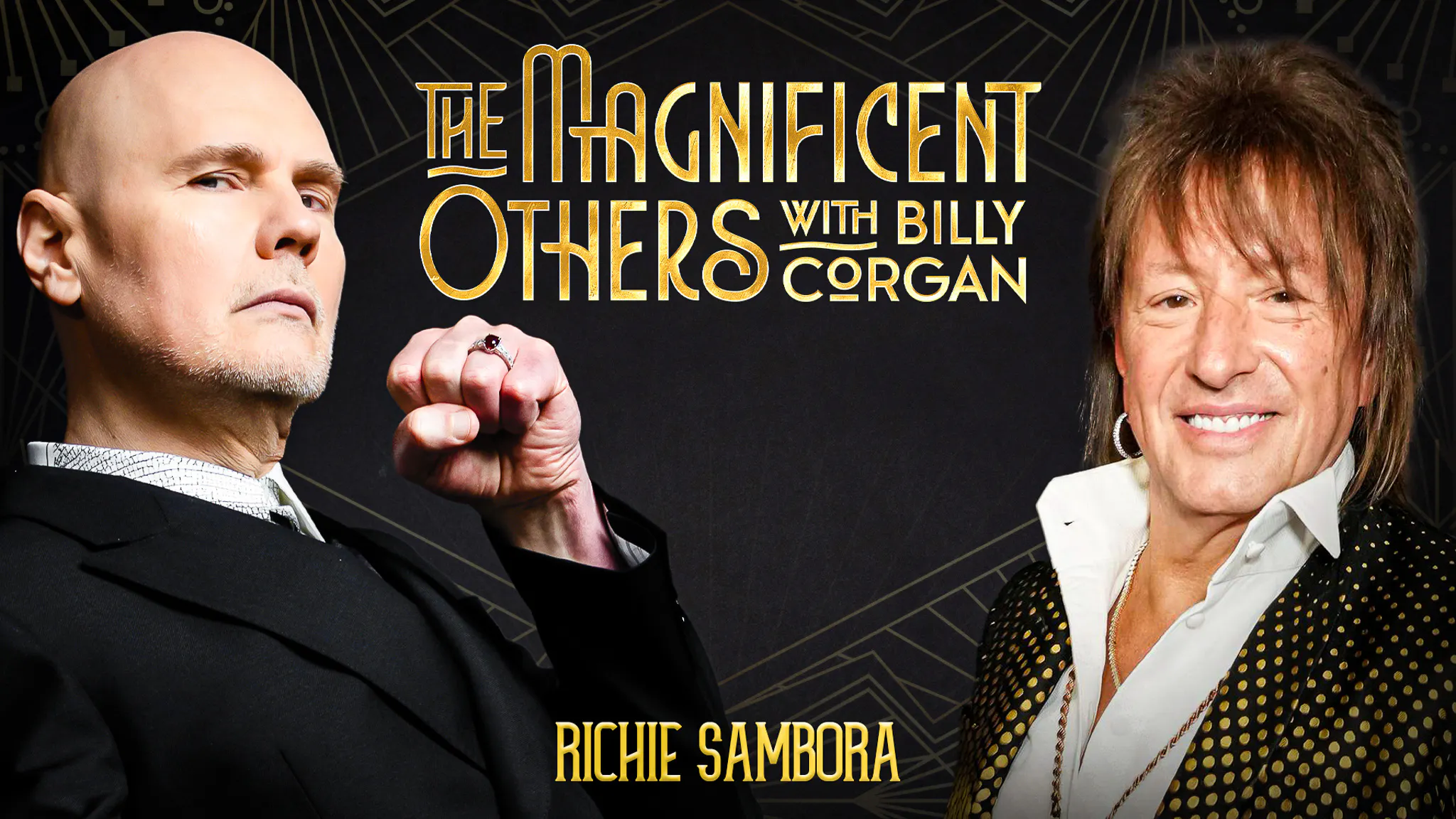
The Magnificent Others with Billy Corgan
Richie Sambora | The Magnificent Others with Billy Corgan
01:06:02
Loading summary
Transcript865 lines
- [00:00]
Richie Sambora
People experience fame and fortune at different speeds and do different things with their lives. So the element of bands core changes, man.
- [00:13]
Billy Corgan
And you know the thing about a lot of indie people, they think playing too good is a bad thing.
- [00:19]
Richie Sambora
Too good is a bad thing.
- [00:21]
Billy Corgan
That sounds like one of your songs. Guitarist, singer and songwriter Richie Sambora is my guest as we explore life after Bon Jovi and the key ingredients that make him into one of the most. Most discussed musicians in the world. The Samboras.
- [00:36]
Richie Sambora
The Samboras, they are the best.
- [00:43]
Billy Corgan
So we would be.
- [00:44]
Richie Sambora
We would be pretty good together, I think.
- [00:46]
Billy Corgan
I think your flamenco playing would be better than mine, but I could fake it. A lot of A minor.
- [00:51]
Richie Sambora
No, we're talking songwriting school.
- [00:54]
Billy Corgan
All right, for folks, let's jump in here. Young William Patrick Corgan stays out all night at the. Then the. What was it called back then? Rosemont Horizon, right by O'Hare in Chicago. 1984, I think was the year. Wow.
- [01:13]
Richie Sambora
Crappy sounding room, wasn't it?
- [01:15]
Billy Corgan
We'll get there. Yes. Notorious. One of the best, right?
- [01:23]
Richie Sambora
Chicago. Every time.
- [01:25]
Billy Corgan
So stay out all night. And I get my Scorpions tickets. I'm 14th row, but I make sure I see the opening band because they have hit on Chicago radio called Runaway. And there you are. So that's the first time I saw you was. I was 17 years old. Pretty cool, right?
- [01:43]
Richie Sambora
We were junkyard. That's amazing. We were junkyard dogs, man. I think, you know, we were young and they gave us 45 minutes to play. So it's like head down.
- [01:53]
Billy Corgan
Yeah.
- [01:54]
Richie Sambora
And all you got.
- [01:56]
Billy Corgan
Yeah.
- [01:56]
Richie Sambora
No. No breathing necessary in the whole thing.
- [01:59]
Billy Corgan
It's like.
- [01:59]
Richie Sambora
It's like. Yeah, 45 minutes plus. Oh, she's a little run away to the Scorpions crowd. No, we got a lot of, you know. I mean, Tico had to wear a batty.
- [02:11]
Billy Corgan
The Scorpions. Crowded.
- [02:12]
Richie Sambora
Like, this is so fun because it would be like nickels and cars coming off.
- [02:16]
Billy Corgan
Is it because they had more of a hard rock crowd at that time, you think? I'm asking you. I mean, I was in the crowd. I wasn't throwing anything.
- [02:25]
Richie Sambora
Hey, listen, man. You know, I'm. I was 15 years old, white kid from the swamp. My first concert was a Black Sabbath man. You know, I saw everything.
- [02:35]
Billy Corgan
What year did you see? Sabbath.
- [02:37]
Richie Sambora
75.
- [02:37]
Billy Corgan
So that was Sabbath. Bloody Sabbath.
- [02:39]
Richie Sambora
Yeah. Great period Sabbath. Yeah. But I liked them from day one, you know. I was a huge fan from day one.
- [02:45]
Billy Corgan
You were og.
- [02:46]
Richie Sambora
Still amazing.
- [02:47]
Billy Corgan
You were og.
- [02:50]
Richie Sambora
But I was. You know what? I was lucky enough to have this train. I lived literally on a dead end street next to a swamp. But I used to cut through the swamp and I could get to the train tunnel in about minute and a half.
- [03:04]
Billy Corgan
Okay.
- [03:04]
Richie Sambora
And it dropped me off in Penn Station underneath the garden. Oh, I saw everyone there was to ever see.
- [03:11]
Billy Corgan
And you know who comes to mind because I love this period of music.
- [03:16]
Richie Sambora
Queen, Led Zeppelin, Elton John, Powell, Deep Purple.
- [03:23]
Billy Corgan
So you had a very.
- [03:24]
Richie Sambora
David Bowie.
- [03:25]
Billy Corgan
F. You had a very high standard of music.
- [03:27]
Richie Sambora
Rod Stewart.
- [03:29]
Billy Corgan
Does it make sense what I'm saying? It's like as a musician, you go, if I'm going to do this, I got to be up in here. Because not everybody has a high standard. I come from the indie world. And you know, the thing about a lot of indie people, they think playing too good is a bad thing.
- [03:44]
Richie Sambora
Too good is a bad thing.
- [03:47]
Billy Corgan
It sounds like one of your songs.
- [03:49]
Richie Sambora
No, it was a different type.
- [03:52]
Billy Corgan
It's a hit. It's a hit.
- [03:54]
Richie Sambora
It's a hit. Ladies and gentlemen.
- [03:56]
Billy Corgan
So there I am. And you know.
- [03:59]
Richie Sambora
How old were you?
- [04:00]
Billy Corgan
17. 17.
- [04:01]
Richie Sambora
17. Oh, you were done? Old enough.
- [04:03]
Billy Corgan
I was playing guitar already. And you guys were. Good band, you know, But I mean, there were a lot of good bands back then.
- [04:09]
Richie Sambora
Yeah.
- [04:10]
Billy Corgan
You almost kind of couldn't be a touring band at that point and not be solid. Everybody could play back then.
- [04:15]
Richie Sambora
Everybody was pretty damn good.
- [04:17]
Billy Corgan
Did you have a sense at that early date that you guys were on this kind of jet stream? Because, you know, it was absolutely. Or you felt it.
- [04:26]
Richie Sambora
Oh, without a doubt.
- [04:27]
Billy Corgan
Tell me, Tell me, because I always love this because you. You and I understand something that very few people understand. There's that feeling where you're like, wow, this is gonna work big time. Right. You feel it in your bones and you see it.
- [04:40]
Richie Sambora
Yeah.
- [04:40]
Billy Corgan
And here it materializes. Right.
- [04:42]
Richie Sambora
Okay, so what were the things as it's materialized?
- [04:45]
Billy Corgan
The obvious.
- [04:46]
Richie Sambora
You know, I really enjoyed it. You know why? Because before that, I worked like crazy and I enjoyed it. I love it. I still do. You know, I. I was in. I was in the studio for the last five days, like 10, 12 hours a day. I love it.
- [05:07]
Billy Corgan
Right.
- [05:08]
Richie Sambora
Completely.
- [05:09]
Billy Corgan
Yeah.
- [05:09]
Richie Sambora
Always did. Well, you're so. It kind of made sense to me.
- [05:12]
Billy Corgan
Let me tell you something, because. Because you may not know this, or maybe you do. Do you know what your rep is with alternative musicians?
- [05:19]
Richie Sambora
My who?
- [05:20]
Billy Corgan
Your reputation. Do you know what your rep is with alternative musicians? You have a very strong rep with alternative musicians.
- [05:26]
Richie Sambora
I do.
- [05:27]
Billy Corgan
You're very respected with the alternative community. That's fantastic because they See you as a musician's musician.
- [05:33]
Richie Sambora
Thank you.
- [05:34]
Billy Corgan
You see what I'm saying?
- [05:35]
Richie Sambora
Thank you, sir.
- [05:35]
Billy Corgan
Where a lot of the rock guys, the alternative community, kind of go, eh, too obvious, too lame, too cheesy. They want it. Too bad. You have a different rep in my world.
- [05:47]
Richie Sambora
Oh, that's beautiful, because I did not know that.
- [05:49]
Billy Corgan
Thank you. Are you kidding? I didn't know you got a real rep. Because people understand where you're coming from. Like, you'll hear people like Bon Jovi, but, Richie, they don't mean Jon. They're saying, you know, the music, that's not for them. But they identify that you in that is something that they get it. So I think it's cool, right?
- [06:11]
Richie Sambora
I could sing.
- [06:12]
Billy Corgan
So even me is my. In my.
- [06:13]
Richie Sambora
That's so good.
- [06:16]
Billy Corgan
Anytime.
- [06:16]
Richie Sambora
No, I really appreciate that.
- [06:17]
Billy Corgan
Thank you.
- [06:18]
Richie Sambora
And, you know, I mean, that's.
- [06:19]
Billy Corgan
I do. So tell me, tell me, what were the things that you were seeing beyond the obvious that told you, like, wow, this is really gonna take off?
- [06:28]
Richie Sambora
Well, our Merchant started. Our Merchant dizing. Started doing, like, three times.
- [06:32]
Billy Corgan
The merch don't lie. The merch don't lie, baby the merch tells the tale.
- [06:37]
Richie Sambora
Hey, it's. It really, you know, besides that. I knew with Slippery was the first time that we were really a band. Really.
- [06:49]
Billy Corgan
Okay.
- [06:50]
Richie Sambora
I mean, we spent years on the road, obviously, and years together and took vacations together. We were idiots. And we didn't have to. We still didn't have good songs because we didn't have an identity yet.
- [07:05]
Billy Corgan
Okay, so.
- [07:07]
Richie Sambora
And I did not have a contract, and I still don't. I never changed it. Probably one of the most interesting deals in the business, by the way. But I just went, look, man, we make this a band. Oh, I gotta, you know, move on. Because it's like.
- [07:23]
Billy Corgan
Was it in the beginning, in your mind, was it more of a construct or was it a band? Does it make sense?
- [07:28]
Richie Sambora
It was a try, Okay. I was in many bands. Record companies would come see, like, three bands in a week, and I'd be in three of them. You know.
- [07:38]
Billy Corgan
Just change your name.
- [07:40]
Richie Sambora
No, I'd be like, no, I'll be playing CBs.
- [07:46]
Billy Corgan
Yeah, yeah, right. I get it. Yeah.
- [07:48]
Richie Sambora
Killed your sleeves off, you know, Rosselford.
- [07:51]
Billy Corgan
He said he saw some flyer recently of your. Your was the Richie something band.
- [07:57]
Richie Sambora
You know, Richie and Friends.
- [07:59]
Billy Corgan
But it was maybe your birth name, your last.
- [08:01]
Richie Sambora
Oh, Richard Moore and Friends. Yeah, yeah, yeah. That's basically what. That's what I'd call my bands.
- [08:07]
Billy Corgan
But, I mean, back when I Got to it.
- [08:09]
Richie Sambora
Anyway, when I got there, I'd say, ladies and gentlemen, it's the Cuban Yacht Club. It's Richard Samborano. The Katy Perry Dancers. Yes, I would change the name.
- [08:21]
Billy Corgan
Okay, but don't jump. Ask my question. So what were the things that you were seeing? Because you have a. You have a front row seat. What are you seeing in the crowd? What are you seeing? Okay, you said the merch don't lie. But what else?
- [08:30]
Richie Sambora
No, it just. It was mania. It got to a point where it was. And it was. You know, people would just realize. Then they go, well, thank God they finally got a good song, for Christ's sake. You know what I mean? After all these years of, like, following them around.
- [08:47]
Billy Corgan
Well, what changed? Okay, so what changed in your mind that made suddenly you went from we didn't have good songs to we had good songs?
- [08:53]
Richie Sambora
Well, MTV had a lot to do with the two. We cultivated MTV and certainly MTV's darling.
- [08:59]
Billy Corgan
Can I tell you.
- [09:00]
Richie Sambora
How are you?
- [09:01]
Billy Corgan
Can I tell you an inside pumpkin show?
- [09:02]
Richie Sambora
You good looking?
- [09:03]
Billy Corgan
Can I tell you an inside pumpkins joke?
- [09:05]
Richie Sambora
Sure.
- [09:07]
Billy Corgan
You know when you're making videos, right, and you've made many too many, you have the meeting and what kind of video do you want to make? And so if they don't have a big budget, invariably somebody wants to do the on the road video. You know, like, there you are backstage. Thank you. There you are backstage. There you on stage pointing.
- [09:26]
Richie Sambora
How many times we done that?
- [09:27]
Billy Corgan
Okay, in the pumpkins. We called it the Bon Jovi video.
- [09:30]
Richie Sambora
There you go.
- [09:31]
Billy Corgan
There we are, stretching before the gig.
- [09:34]
Richie Sambora
But that was true, you know, but.
- [09:36]
Billy Corgan
That was an inside pumpkins joke. We called it.
- [09:38]
Richie Sambora
I don't know what happened to us. We were actually playing Chicago. We're doing two nights at Soldier Field.
- [09:43]
Billy Corgan
Right, Right.
- [09:44]
Richie Sambora
And so me and Bob are friends. Right? So it. He. He's great.
- [09:50]
Billy Corgan
Bob.
- [09:50]
Richie Sambora
Bob, you know, Kid Rock.
- [09:53]
Billy Corgan
Oh, okay. You say Bob, you know, the rest.
- [09:56]
Richie Sambora
Of us just Kid Rock. I just happen to know him, you know, not that that's like no big deal or anything. So anyway, I go, I think we do two nights. If you open up, man, you know, and it'll be good money for an hour. Yeah, you'll be happy.
- [10:16]
Billy Corgan
Yeah.
- [10:16]
Richie Sambora
So as you feel. Yeah, we'll sell out two nights, which we did.
- [10:20]
Billy Corgan
Okay.
- [10:20]
Richie Sambora
And he was great. And he got. We gave him a bunch more gigs because of that. And we do multiple nights.
- [10:27]
Billy Corgan
Where are you trying to get at? Sorry, I'm just trying to understand.
- [10:29]
Richie Sambora
I don't know what was I Trying to get at.
- [10:31]
Billy Corgan
You were. I don't know, you were bragging.
- [10:33]
Richie Sambora
No, I'm trying. No, I wasn't bragging. I was just.
- [10:36]
Billy Corgan
I think what I was trying to get at was how did you get from. You said, we. We didn't have good songs. Then we had good songs then you said video. So I'm just trying to put those pieces together.
- [10:44]
Richie Sambora
Well, I knew we had the best record that we definitely ever made as a band and a best sounding record with Bob Rock, who I still work with religiously. And Bruce Fairburner unfortunately passed away. I said to myself, golly gee, I think we can make 2 million records out of this, right? Worldwide, I'm talking.
- [11:06]
Billy Corgan
Right.
- [11:06]
Richie Sambora
You know, and we'll work our asses off because we did every bit of press back then. It wasn't obviously social media and stuff like that. It was more journalistic, newspapers, everything, whatever it took. And going to radio stations, obviously.
- [11:21]
Billy Corgan
Right.
- [11:21]
Richie Sambora
You know, doing that was a big.
- [11:23]
Billy Corgan
So the demand is there, the interest is there, but you guys are meeting the demand. And as you feeling the demand coming, you're like, we better get even better.
- [11:30]
Richie Sambora
Songs because it's no. Beyond our control on security levels, different things like that. Like things you would never think of. You know what I mean?
- [11:40]
Billy Corgan
People climbing through the sunlight, just like crazy stuff.
- [11:43]
Richie Sambora
And you're just going by your daily job, basically and doing. Yeah, we said yes a lot to mostly everything and everywhere, but we did that beforehand too. Which seeded the garden for when we had a hit song.
- [11:57]
Billy Corgan
Sure.
- [11:58]
Richie Sambora
It was a hit song in 24 countries.
- [12:00]
Billy Corgan
So I had to look this up because I did not know. As an institution, the Bon Jovi Franchise has sold 130 million records. And to quote the lyric, you have seen a million faces and you rock them all. I mean, that's pretty amazing.
- [12:17]
Richie Sambora
Thank you very much. It's more than that, but imagine the piracy, which is insane.
- [12:28]
Billy Corgan
Oh, yeah. No one wants to hear us complain about the money we lost.
- [12:34]
Richie Sambora
It's true.
- [12:35]
Billy Corgan
Yeah. So, yeah. So that. What makes that number even more impressive is if you sold 130 million records that we know of.
- [12:41]
Richie Sambora
I was 17 that year, so I was pretty big. That was. That was. And we toured. You know what it's like when you take it that often. How much money?
- [12:54]
Billy Corgan
Oh, no, you. You guys, back in the day, you toured like, oh, yeah, crazy people. What was the. What was the normal run for you guys when you were young? Like, were you doing four in a row? No, but you're doing four in a row or, you know, because like, no.
- [13:06]
Richie Sambora
We did five shows a week, and however they fit on a routing level, to save that kind of money, we're staying on.
- [13:13]
Billy Corgan
You guys are. Those songs are high vocals. I mean, it's.
- [13:15]
Richie Sambora
It's, you know, so athletic event.
- [13:19]
Billy Corgan
Yes, it truly is. Yes. So you. You. And we understand. It's like, you know, you probably would have played seven days in a row if you could, right?
- [13:26]
Richie Sambora
I mean, I could.
- [13:27]
Billy Corgan
Yeah. Well, I'm. Not that you don't sing, but as a lead singer of my band.
- [13:36]
Richie Sambora
You know what? I. I take that back, ladies and gentlemen. Man. Because I've never done it for that long and been the lead singer, but I've obviously done my own tours for three, four months at a clip and, you know, play where I want to play kind of thing.
- [13:56]
Billy Corgan
Yeah, yeah. No, I'd play seven days a week if I could. It's just.
- [13:59]
Richie Sambora
Yeah, I know.
- [13:59]
Billy Corgan
It's the vocal thing is.
- [14:00]
Richie Sambora
It's the vocal. I. I never tried it, but I still take lessons.
- [14:05]
Billy Corgan
Really?
- [14:06]
Richie Sambora
Of course. Like, me, me, me, me, me.
- [14:10]
Billy Corgan
Or.
- [14:10]
Richie Sambora
No, no. Yeah, all that. All that, yeah. Rigoletto Opera training.
- [14:15]
Billy Corgan
Yeah.
- [14:15]
Richie Sambora
Yeah. I went. I went to Andre Pacelli one day, actually, Denise was here. My assistant, as a surprise, took me to see Andre, and I love him, and he wanted to meet me. And I go back there, and it's just like me and him. Soon as I walked in, he said, come here. And he's blind. He's taller than you, huge and skinny, not built like a normal operator.
- [14:37]
Billy Corgan
Okay. Yeah.
- [14:38]
Richie Sambora
And like, we know each other forever.
- [14:40]
Billy Corgan
Oh, okay.
- [14:41]
Richie Sambora
So he says, I'm a little nervous tonight. I'm a little nervous tonight.
- [14:46]
Billy Corgan
Really?
- [14:46]
Richie Sambora
I got to hit nine high Cs in the second song. It's. It's Aria. Right. He says, I'll show you. Sits down at the piano and just goes, bang. Bangs him out, like, clear as a bell.
- [15:02]
Billy Corgan
Wow.
- [15:02]
Richie Sambora
No problem. And I'm looking at him, I'm going, well, number one, you're not gonna have a problem. Number two, how'd you do that?
- [15:09]
Billy Corgan
Yeah.
- [15:10]
Richie Sambora
Because he had volume control.
- [15:12]
Billy Corgan
It's a different level of chop.
- [15:13]
Richie Sambora
He goes, finish your 30 years, you know?
- [15:17]
Billy Corgan
Yeah.
- [15:17]
Richie Sambora
Just to get 20 years. Just to get opportunity.
- [15:20]
Billy Corgan
Yeah.
- [15:20]
Richie Sambora
In that world. That's tough.
- [15:21]
Billy Corgan
Tough game. Yeah. I got trained by an opera singer once. That was interesting.
- [15:26]
Richie Sambora
Well, you know, what it did for me was. I don't know, it didn't increase too much, except my longevity.
- [15:36]
Billy Corgan
Right. That's what I did learn from the opera teacher. I learned voice preservation. Basically.
- [15:42]
Richie Sambora
It's like going to the gym.
- [15:43]
Billy Corgan
Yeah. Yeah, it does work. Okay. Bear with me here.
- [15:47]
Richie Sambora
I am. Bear.
- [15:48]
Billy Corgan
No, you're gonna have to bear with me now.
- [15:49]
Richie Sambora
There's no bearing going on here. There's no bearing. Let's face it. Kim James Mason.
- [15:56]
Billy Corgan
My. My. My. My goal, as I was telling you a little bit before we started rolling, is, you know, when I bring in somebody that I admire and respect, and you're certainly one of those people, but it. It's like there's 8,000 interviews with you telling variations of the same stories. And to me, what most journalists, If I'm a journalist at this point, miss, is the real experience of being in a big band.
- [16:25]
Richie Sambora
Oh, yeah.
- [16:26]
Billy Corgan
And more than you, they want to hear that. They want to hear the night that the groupie broke in through the skylight, but they don't want to hear about the night you rode on a bus for 16 hours and were bored out of your mind and.
- [16:36]
Richie Sambora
Yeah. And who wants to hear that story? Actually, you know, I mean, entertainment.
- [16:39]
Billy Corgan
No, but I'm saying should be based.
- [16:40]
Richie Sambora
On entertainment, not what's behind it. Sure.
- [16:43]
Billy Corgan
But we experience something different than what most people understand. Our experience is when you were on the road, like, we did tour. When we did one tour, 20 months. You know what I mean? And you guys know you did those tours, like, oh, 18 months, you know.
- [16:56]
Richie Sambora
You know, 62 countries.
- [16:59]
Billy Corgan
Hello. Right.
- [17:01]
Richie Sambora
I'm still okay. Ladies and gentlemen. It's unbelievable.
- [17:04]
Billy Corgan
No damage.
- [17:06]
Richie Sambora
No damage whatsoever. Actually, I sing and play, by the.
- [17:09]
Billy Corgan
Way, I will say sitting, looking at you. You look really good.
- [17:12]
Richie Sambora
Look at me.
- [17:13]
Billy Corgan
Handsome man. Handsome man. It's the jeans, but. So, you know, we could sit here and tell. Or you could tell war stories. And I could say, you know, when Desmond Child, you know, to me, it's interesting and it's important, but at the same time, I'm more interested in your experience of being in the band.
- [17:33]
Richie Sambora
Yes.
- [17:33]
Billy Corgan
And your navigation. Okay, thank you. I'm trying to come at it from a musician's point of view. Yes.
- [17:39]
Richie Sambora
That's good. Fantastic.
- [17:40]
Billy Corgan
So bear with me here. So I'm. Because obviously, there's a bit of controversy, as the English would say, with the documentary coming out. And I want to talk about it, but not probably how most people would want to talk about it, but I'm interested in your version of your story. And what I mean by that is, like, is your story a rags to riches to heartbreak and redemption? Is it you had it all and walked away from it all? Is it local Polish kid makes good and you steal Richie from the Neighborhood. Are you the handsome gunslinger who marries a Hollywood star and has a beautiful kid? You know, I was.
- [18:19]
Richie Sambora
All of that.
- [18:21]
Billy Corgan
All of the above.
- [18:23]
Richie Sambora
I love it. Duly noted. Duly noted.
- [18:25]
Billy Corgan
But it's, you know, when I say it like that, it comes off like a Desmond Child song. You know what I mean? It's got a little bit of a ring to it, but I don't.
- [18:32]
Richie Sambora
Well, where did you think I get some of those lyrics from? Remember some of those stories from?
- [18:36]
Billy Corgan
Very good. But my point of bringing this up this way because I feel like, first of all, you're a respected musician, but I think your real contribution musically is underappreciated. That's my perspective as a musician. To musicians.
- [18:51]
Richie Sambora
Thank you very much. Good work on.
- [18:54]
Billy Corgan
Thank you. But it's a genuine thing. I'm not a compliment giver, but what I'm trying to get at is, you know, it's not like, what do you want to see on your tombstone that's a little grim. It's like, what do you want, people welcome, penniless. You had a great time.
- [19:12]
Richie Sambora
I spent it all. No, I lived. That's what it means.
- [19:15]
Billy Corgan
He lived.
- [19:15]
Richie Sambora
It's just a metaphor.
- [19:16]
Billy Corgan
I get it.
- [19:17]
Richie Sambora
He lived, obviously.
- [19:18]
Billy Corgan
Right. What I'm saying is, what's your version of that story? Because right now, you know, look, we've all been in big bands here, the two of us, you know what I mean? And sometimes the story of the band becomes our story, but it's not our story because, yeah, it gets a bit boring and it's cliche and you're not a cliche.
- [19:41]
Richie Sambora
No.
- [19:41]
Billy Corgan
Right.
- [19:43]
Richie Sambora
Like I said, look, I was out of the band at that point for 12 years. I was actually doing a songwriting clinic at, like, Abbey Road with these young songwriters and stuff like that. And they said, would you sit for a half hour?
- [19:57]
Billy Corgan
Yeah, just a half an hour, I think.
- [19:59]
Richie Sambora
I think an hour.
- [20:01]
Billy Corgan
Yeah.
- [20:01]
Richie Sambora
I don't remember. And I said, all right, you guys get going on that. And walked into that little makeup, and I didn't even know what the premise of this thing was.
- [20:12]
Billy Corgan
Yeah.
- [20:12]
Richie Sambora
I've been out of band for. Seemed like a lifetime at that point.
- [20:17]
Billy Corgan
Yeah.
- [20:17]
Richie Sambora
Most in the way.
- [20:18]
Billy Corgan
That's a long time.
- [20:18]
Richie Sambora
Thirteen years or something, you know? And so I was like, okay. So I was, you know, trying to be funny and. And the questions that were coming at me were unintelligent.
- [20:30]
Billy Corgan
Right.
- [20:30]
Richie Sambora
And did not demand any depth of answer.
- [20:34]
Billy Corgan
Sure. I'm like, I haven't seen the doc.
- [20:38]
Richie Sambora
So I cut up and I. And I talked to the director. Who I really like Deepak Chopra's grandson.
- [20:47]
Billy Corgan
Okay.
- [20:47]
Richie Sambora
And he's talented and hopefully spiritual. You know, I didn't know what you guys are looking for. What are you looking for?
- [20:55]
Billy Corgan
Yeah.
- [20:55]
Richie Sambora
And things like that. Yeah.
- [20:57]
Billy Corgan
And I get it. Like, what's the point?
- [20:59]
Richie Sambora
None of it. None of it really got in the documentary.
- [21:03]
Billy Corgan
Okay.
- [21:03]
Richie Sambora
Right. But.
- [21:06]
Billy Corgan
Well, you ain't the one.
- [21:07]
Richie Sambora
Editing was six and a half hours.
- [21:11]
Billy Corgan
Okay.
- [21:12]
Richie Sambora
It's. Look, so it's the band's 40th anniversary.
- [21:17]
Billy Corgan
Right.
- [21:18]
Richie Sambora
We did some unbelievable things. Mention those things, show how. Like, you're asking me what that feeling was.
- [21:28]
Billy Corgan
Like, that's what I'm asking. That's what I'm saying. What's your version of that feeling? Because that's what's interesting to me.
- [21:36]
Richie Sambora
780,000 happy, happy, happy people rocking for three hours.
- [21:43]
Billy Corgan
Yeah.
- [21:43]
Richie Sambora
You know, taking them through.
- [21:46]
Billy Corgan
Great songs, great playing.
- [21:48]
Richie Sambora
They're coming back.
- [21:49]
Billy Corgan
Yeah.
- [21:49]
Richie Sambora
It's an event.
- [21:50]
Billy Corgan
Yeah. And, you know, the band had its up, and then the band had its down and the band went back up. That's pretty rare, as you know.
- [21:58]
Richie Sambora
Yeah.
- [21:58]
Billy Corgan
I remember. I don't remember what the year was, but somewhere in there, late 90s, 2000, people were basically thought you guys were done.
- [22:06]
Richie Sambora
Oh, yeah.
- [22:06]
Billy Corgan
Like, you know, like, you be you. You become the oldies act thing.
- [22:09]
Richie Sambora
Yeah, but that's just in this country.
- [22:12]
Billy Corgan
No, I get that, but you know how America is. We don't think about other countries. You could be the biggest band in Greece and America wouldn't give two shits. All right, so you know what that feels like.
- [22:22]
Richie Sambora
Because I know I'm selling out stadiums in 52 countries. Okay, so say tragedy strikes and 20 go down.
- [22:30]
Billy Corgan
You're still good. Yeah, right.
- [22:32]
Richie Sambora
Who does that? Yeah, that's where I was at.
- [22:36]
Billy Corgan
Right. But, you know, being there was sensitive. But, you know, this business of music runs basically out of this city, la.
- [22:45]
Richie Sambora
If they.
- [22:46]
Billy Corgan
If. But if they believe it, they believe. And if they don't believe, it don't matter that you sold out in Poughkeepsie. They don't give two shits.
- [22:53]
Richie Sambora
They don't understand it. They're not.
- [22:54]
Billy Corgan
That's what I'm saying. So what I'm trying to understand is in the meta narrative, which is a bit of a modern way of putting it, you know, what's your arc in this thing? Not even related to the Bon Jovi years. Like, what's your arc in this thing? Like, what's your version of your story? It makes good.
- [23:15]
Richie Sambora
I understand. Oh, for sure.
- [23:17]
Billy Corgan
Yeah. But you pick one. Just pick One who.
- [23:20]
Richie Sambora
Gratitude beyond whatever I had to deal with. What I received was way beyond the love and the war.
- [23:30]
Billy Corgan
So your relationship with the fans and what the fans gave you is very high.
- [23:34]
Richie Sambora
Very high.
- [23:35]
Billy Corgan
Right, okay.
- [23:36]
Richie Sambora
Yeah. And also I started to, like, I understood the business.
- [23:42]
Billy Corgan
Yeah.
- [23:43]
Richie Sambora
You know.
- [23:43]
Billy Corgan
Well, you.
- [23:44]
Richie Sambora
You'd done stuff before a couple times, yeah. I had three record deals before I met John.
- [23:49]
Billy Corgan
Right.
- [23:51]
Richie Sambora
So I had. And my best. One of my best friends was going to law school.
- [23:56]
Billy Corgan
Right.
- [23:57]
Richie Sambora
And he owned a studio that I used to work at. His studio musician. And then he went to law school and I joined the circus. I was in college and after two years, I split. A psychology major and my daughter just got her master's in psychology.
- [24:11]
Billy Corgan
Saw that. Congratulations. That's a big deal. What's her discipline in psychology? Does she have one? You know, because some people are union and she is.
- [24:22]
Richie Sambora
Some people deal with trauma survivors still in transition.
- [24:25]
Billy Corgan
Oh, she's in that because she's going.
- [24:27]
Richie Sambora
To be going for a doctorate.
- [24:28]
Billy Corgan
That's amazing. Congratulations.
- [24:30]
Richie Sambora
But you told me she was going to take a break. One of those kids that works the summers.
- [24:34]
Billy Corgan
Okay.
- [24:36]
Richie Sambora
Well, you know, you don't have to do it to him, but I really admire what you're doing.
- [24:39]
Billy Corgan
Yeah.
- [24:40]
Richie Sambora
Because she was keeping up with some very smart people. And.
- [24:45]
Billy Corgan
But also, I think you understand this context. Not every kid who grows up in LA with rock star dad and, you know, Hollywood star mom goes on to do something with your lives. So you must be triple proud.
- [25:01]
Richie Sambora
Yeah. And I'm triple thankful, you know, more for anything, because it just was myself. And I'm a good dad. I pride myself on being a very good dad.
- [25:13]
Billy Corgan
Yeah.
- [25:14]
Richie Sambora
I mean, it's obvious you love somebody.
- [25:17]
Billy Corgan
Yeah.
- [25:18]
Richie Sambora
You love them all the way.
- [25:19]
Billy Corgan
It's obvious in poking around in your life in prep for this, how much you love your daughter.
- [25:23]
Richie Sambora
Oh, yeah.
- [25:24]
Billy Corgan
No, it's humbling because I have A young daughter, 6 years old, just turned 6.
- [25:28]
Richie Sambora
Oh, yeah. But you're good. It's going to blossom. Yeah.
- [25:32]
Billy Corgan
What do they say? Daddies and their daughters. Right?
- [25:34]
Richie Sambora
Yeah. Just. We just spent a lot of time with each other and then when I. We got divorced, she was nine. And I. I went to a child psychologist and went, what are the things I can say and I can't say and those kind of things, you know?
- [25:52]
Billy Corgan
Yeah.
- [25:53]
Richie Sambora
And I went, but this is going to be great because I have an undivided attention instead of having split it with anger and things like that that were existing in the marriage. Right. So it became a different happy life.
- [26:12]
Billy Corgan
That's Interesting.
- [26:13]
Richie Sambora
You know. And I bought a smaller house with us that was only a mile away from her mom.
- [26:18]
Billy Corgan
Right.
- [26:19]
Richie Sambora
So it was like. Not like I was. Yeah, you weren't absconding.
- [26:23]
Billy Corgan
Yeah, get it.
- [26:25]
Richie Sambora
Yeah. So that. And I just really talked to her. But the reprimand that I had with her was more like. Because I'd watch it. What would you feel like if you. That was being done to you?
- [26:40]
Billy Corgan
Yeah.
- [26:40]
Richie Sambora
She was just kind of acting out.
- [26:45]
Billy Corgan
Sure. That's kids. Yeah.
- [26:46]
Richie Sambora
Yeah, I understand that. But I was. That's. I go. Because when I'm gone, you're gonna have to do this yourself. And eventually what would happen.
- [26:54]
Billy Corgan
Yeah.
- [26:54]
Richie Sambora
Would be that sometimes you take a day, sometimes take a week, sometimes it takes a little more. But she go apologizing and work it out with her phone.
- [27:04]
Billy Corgan
Yeah.
- [27:04]
Richie Sambora
So I was. Essentially. Because of all the time I spent on the road. Yeah. Teaching her self. Parent as much as possible.
- [27:14]
Billy Corgan
Yeah.
- [27:14]
Richie Sambora
Without. But you can't do it like.
- [27:17]
Billy Corgan
Yeah, yeah. That's not gonna work. You have to learn self reliance.
- [27:20]
Richie Sambora
You gotta kind of.
- [27:21]
Billy Corgan
Yeah. I'm in this. My kids are young. They're eight.
- [27:23]
Richie Sambora
Yeah. Yeah.
- [27:23]
Billy Corgan
Eight and six. And I'm in that. I'm trying to get them to understand. Like, you're gonna have to figure some of this out on your own. I can't be here all the time.
- [27:30]
Richie Sambora
That's for everything.
- [27:30]
Billy Corgan
Like nine to five dad. I'm not a nine to five dad. You know.
- [27:35]
Richie Sambora
Plus, you need that time for yourself.
- [27:38]
Billy Corgan
That's true, too.
- [27:38]
Richie Sambora
To enrich yourself.
- [27:39]
Billy Corgan
Oh, yeah. You know, and not go crazy. I was listening to your. I think it's your recent single, Believe in Miracles.
- [27:48]
Richie Sambora
I got two more. One that just cut. Of course.
- [27:51]
Billy Corgan
Of course you do. But I'm.
- [27:53]
Richie Sambora
Oh, that one.
- [27:53]
Billy Corgan
Or I'm. Believe in Miracles, please. Yeah.
- [27:55]
Richie Sambora
And that's.
- [27:56]
Billy Corgan
I like this lyric in this song. I really like the song a lot too. Oh, sing a song for our future days A song for the days we sung alone A song for the laughter of tomorrow Help me sing a song of hope we gotta believe in miracles when you dream too much and too high I thought it was really. I felt that lyric.
- [28:17]
Richie Sambora
It seems like that sometimes, doesn't it?
- [28:20]
Billy Corgan
Well, I'm not trying to put thoughts in your brain, so that's why I'm asking you. But it seems like, you know, when you experience, you know, you're playing at 80,000 people in Russia or wherever you were playing. You know what I mean? There's an adrenaline and it's like.
- [28:36]
Richie Sambora
What? Mountain.
- [28:37]
Billy Corgan
Yeah. Right. Okay. Okay, well, at some point, and I'm not even talking about. You leave that situation behind. I'm talking about at some point you're going to be alone on a Sunday. You look in the mirror and you got to like, you got to find something to hold on to. Because once you've achieved those highs and you've felt that dopamine rush, it's. It's not. You're not going to find it in normal life. You're not going to find it going down to grab a coffee.
- [29:05]
Richie Sambora
No, not. Not at all. Not that. But I have found that, you know, because I left the band, obviously.
- [29:14]
Billy Corgan
Yeah.
- [29:14]
Richie Sambora
Just. It was.
- [29:14]
Billy Corgan
You left. You left the band? No one told me.
- [29:16]
Richie Sambora
Nobody heard that. Did you hear about that?
- [29:21]
Billy Corgan
I heard about 13. 13 hours, I think about four hours into the Bon Jovi documentary, they mentioned that you left the band.
- [29:28]
Richie Sambora
It's unbelievable. But here, another. Once again, that it's all perspective. That said, Marcus Aurelius said that it's, you know, it's not a thought, it's a perspective.
- [29:46]
Billy Corgan
Interesting. Which is the difference between.
- [29:49]
Richie Sambora
So. But I have a different perspective.
- [29:52]
Billy Corgan
What keeps you. Because this is what I read in the lyric. What keeps you. Is it God, Is it family? Is it music? All of the above. Like, what keeps you when you really need to refocus.
- [30:06]
Richie Sambora
Obviously it's a. You know, has a lot to do with my daughter.
- [30:13]
Billy Corgan
Right.
- [30:14]
Richie Sambora
It has a lot to do with my love and passion for music. Because I'm self taught.
- [30:20]
Billy Corgan
Yeah.
- [30:20]
Richie Sambora
I read a lot. I like to read. I just got my cataracts done and then it's fantastic. I could read better again. I still need readers, but my. I see stuff that I never haven't seen in my life. I grew up in a swamp in New Jersey, you know.
- [30:39]
Billy Corgan
Yeah.
- [30:40]
Richie Sambora
So that was. I mean, things like that are happening and it's just. And as far as business goes, you know, I saved my money, I did the right thing with it, and.
- [30:54]
Billy Corgan
I.
- [30:54]
Richie Sambora
Don'T have to do it for the money.
- [30:56]
Billy Corgan
Yeah.
- [30:56]
Richie Sambora
You know, that was the main thing. It's like, where did I start? Why did I get into this in the first place? Joy. And you have to do all this stuff and come full circle and you're not quite back to Joy yet. And that's what you shoot for.
- [31:19]
Billy Corgan
Yeah. I read this. Interesting.
- [31:20]
Richie Sambora
Be that free as an artist and not care about these trappings.
- [31:25]
Billy Corgan
I read this interesting piece once by David Mamet, the great playwright, and he said, you know, in the beginning, when you're an artist, you're free. You have complete freedom. And you beg for an opportunity. And invariably somebody says, hey, sign this. And you sign away something. And then you spend the next.
- [31:44]
Richie Sambora
You don't know what is at the time.
- [31:45]
Billy Corgan
Well, you don't realize how valuable it is. And they would have you signing it. And then you spend 30, 40 years of your life trying to get back to that freedom. It reminds me. It's the same thing, right? You came in. Cause you love music. And to me, you know, you strike me, like myself, like we're lifers. Oh, it's just like there's no around.
- [32:05]
Richie Sambora
With our sailboats somewhere.
- [32:06]
Billy Corgan
There's no not.
- [32:07]
Richie Sambora
I don't even have a sailboat. I don't know about you.
- [32:09]
Billy Corgan
We're not David Crosby yet, but maybe we'll get there.
- [32:13]
Richie Sambora
Me and you and I, with the.
- [32:14]
Billy Corgan
Samboras on the yacht, sailing. We'll go down and visit Sammy and.
- [32:20]
Richie Sambora
Cabo and fabulous women in bikinis. Well, that's serving us more than.
- [32:25]
Billy Corgan
That's not a pumpkin song. That's a Bon Jovi song.
- [32:28]
Richie Sambora
All right, you can dress them any way you want, then.
- [32:31]
Billy Corgan
Well, in our songs, they're dressed in goth, you know, flowing gowns.
- [32:35]
Richie Sambora
I like that, too. I do.
- [32:38]
Billy Corgan
Hey, what do they say? Whatever floats your boat.
- [32:42]
Richie Sambora
Yeah. You know, what? With music, there was so much good music that was, you know, coming out when I was coming of age, late 60s, and I was absorbing.
- [32:56]
Billy Corgan
You're just, you know, we're. We're close in age. You're just. You're like my older brother. But my point is. Is.
- [33:03]
Richie Sambora
Which is lovely.
- [33:04]
Billy Corgan
But since I was born in 67. You would have been born 60.
- [33:07]
Richie Sambora
I was born 59.
- [33:08]
Billy Corgan
Okay, so the. The era you grew up musically, I mean, come on.
- [33:12]
Richie Sambora
I hit it. It was the Hendricks and Dylan.
- [33:16]
Billy Corgan
Ridiculous Beatles. And in New York, Stones and in New York.
- [33:20]
Richie Sambora
I mean, and every.
- [33:22]
Billy Corgan
Everybody comes to New York.
- [33:23]
Richie Sambora
Eric Clapton and Led Zeppelin and Jimmy Hendrix. It's like everybody. Everybody works in New York. That's what I'm saying. I. When I said that I had that tunnel, my mother used to let me go to New York City.
- [33:35]
Billy Corgan
Yeah.
- [33:35]
Richie Sambora
Because I never left the building.
- [33:37]
Billy Corgan
I get you.
- [33:38]
Richie Sambora
That's the reason she let me go.
- [33:40]
Billy Corgan
Ah.
- [33:40]
Richie Sambora
And I would go to. I'd stand there in line to get Gabriel tickets and stand there in line to get Zeppelin tickets and. And then go back, and it was like. Like.
- [33:51]
Billy Corgan
Did you ever. Did you ever get tired of meeting your heroes, or does this still. Does it still hit you?
- [33:57]
Richie Sambora
Of course. Every time. Even when I.
- [34:00]
Billy Corgan
Who's. Who's Somebody that you would meet and geek out for.
- [34:04]
Richie Sambora
Oh, anytime I'm with Jimmy Page, I geek out. Anytime I'm with Paul McCartney, I geek out.
- [34:09]
Billy Corgan
Yeah.
- [34:10]
Richie Sambora
Bob Dylan. I'm geeking pretty heavy with him, you know?
- [34:15]
Billy Corgan
I mean, the who, right? Pete.
- [34:18]
Richie Sambora
Pete and Roger. Yeah, those guys. What?
- [34:22]
Billy Corgan
And Pete's so smart. It's like you feel like you're going to science class. It's cool, right? It's one of the great indulgences of.
- [34:29]
Richie Sambora
Our job to be the Rolling Stones.
- [34:33]
Billy Corgan
Yeah.
- [34:33]
Richie Sambora
I was working with Don Juan on my second solo album on Discover Soul. And we're just running a hair late because I was taking on. I'm playing on a Woolly Nelson album. I was playing on all these different records as I was doing that.
- [34:47]
Billy Corgan
Yeah.
- [34:48]
Richie Sambora
And the Stone started their record. So I had the opportunity to kind.
- [34:53]
Billy Corgan
Of, like, hang around.
- [35:00]
Richie Sambora
A dark corner of the Control.
- [35:01]
Billy Corgan
I've heard they're kind of finicky about that.
- [35:04]
Richie Sambora
They don't. They just don't want any people. They got enough. Well, I. Yeah, you would imagine.
- [35:08]
Billy Corgan
I can imagine. So, anyway, so you're hiding in the corner, so.
- [35:11]
Richie Sambora
Yeah.
- [35:11]
Billy Corgan
So did anyone spot you?
- [35:13]
Richie Sambora
It was then Don said, hey, you know, because they didn't think much about Joey. That just wasn't a cup of tea. Yeah, that don't bother me. I saw. I still love them. I don't care what anybody says. I still listen to all their records. Yeah, constantly. They were so well produced.
- [35:30]
Billy Corgan
Amazing.
- [35:31]
Richie Sambora
So well arranged.
- [35:31]
Billy Corgan
It was a great. Jimmy. Jimmy Miller. Jimmy Miller, yeah.
- [35:36]
Richie Sambora
You know, like.
- [35:37]
Billy Corgan
And Andrew Lugaldhol was kind of a visionary. Maybe not the guest producer, but, you know, very interesting kind of vibe.
- [35:45]
Richie Sambora
Their records continue to astound me to this day.
- [35:48]
Billy Corgan
Glenn John Sydney produced. Yeah. He also produced who stuff. Great, great talent.
- [35:54]
Richie Sambora
Amazing talent.
- [35:54]
Billy Corgan
Yeah.
- [35:55]
Richie Sambora
But the songs. Jesus.
- [35:57]
Billy Corgan
Oh, come on. It's not fair. God, it's not fair.
- [36:00]
Richie Sambora
It's not even fair. After a while.
- [36:03]
Billy Corgan
Yeah. And of course, you've heard the stories how they would just party for days and just jam.
- [36:08]
Richie Sambora
And I know they weigh about a buck 25 a piece.
- [36:11]
Billy Corgan
Yeah.
- [36:12]
Richie Sambora
Yeah.
- [36:12]
Billy Corgan
Just kind of songs would emerge out of the morass of this.
- [36:16]
Richie Sambora
I want to see every time. It was one of those bands that I saw every time.
- [36:22]
Billy Corgan
Right.
- [36:22]
Richie Sambora
Had to.
- [36:23]
Billy Corgan
Yeah. Okay. Go back to your story, because it's a good story. So Don was So.
- [36:28]
Richie Sambora
Yeah, they were recording crystal. So then Don said, hey, why don't you listen to some of this stuff? Because I had, like. I got, like, Billy Preston and the Cats.
- [36:39]
Billy Corgan
Yeah. Yeah.
- [36:40]
Richie Sambora
You know Like. Yeah, but it sounds like a band.
- [36:43]
Billy Corgan
Okay.
- [36:43]
Richie Sambora
You know what I mean?
- [36:44]
Billy Corgan
Yeah.
- [36:44]
Richie Sambora
I give good band.
- [36:46]
Billy Corgan
Okay.
- [36:46]
Richie Sambora
I always have. That's not sexual. But. But so. So. So then I was allowed to come in and hang out while they were cutting.
- [36:58]
Billy Corgan
That's cool.
- [36:59]
Richie Sambora
Which was in. So beautiful to watch.
- [37:02]
Billy Corgan
Is this. Is. Is Bill Wyman still in the band at this point?
- [37:06]
Richie Sambora
No, no. Daryl's playing. Daryl who played on my record.
- [37:09]
Billy Corgan
I know Daryl from Chicago. Darryl's lovely.
- [37:12]
Richie Sambora
Lovely playboy. Miles Break.
- [37:15]
Billy Corgan
He's okay.
- [37:16]
Richie Sambora
Yeah, he's just okay. He's just a beautiful cat, too, so. But I'm watching. And it was fun to watch them how they started up. Yeah, Keith was really good. Just getting. He. They all had understudies, which is very interesting. I'm sorry if I'm giving your secrets away, but, you know, Charlie was alive. He had Kelvin. Yeah, right. Waddy.
- [37:40]
Billy Corgan
Right.
- [37:41]
Richie Sambora
You know, and Keith said. Keith had Waddy. And everybody else didn't have anybody.
- [37:48]
Billy Corgan
Okay.
- [37:50]
Richie Sambora
They get a riff and groove going and tape is. They're doing an analogy. I'm looking at Don and I'm seeing piles. You're gonna have to go through that stuff.
- [38:01]
Billy Corgan
Yeah.
- [38:01]
Richie Sambora
Oh, my God.
- [38:02]
Billy Corgan
Yeah.
- [38:03]
Richie Sambora
Yeah. And we're really good friends at this point, Don and I, you know. So then me and Don, Keith would be listening mixes. I'm sitting there. This is surreal. The kids, you know, Brian didn't jump over to push them. Talking about Brian Jones, I went cold.
- [38:22]
Billy Corgan
Oh, yeah.
- [38:24]
Richie Sambora
Brian was great. I thought. I mean, he lat.
- [38:27]
Billy Corgan
Yeah.
- [38:28]
Richie Sambora
You know, I mean, everybody there. So much music there. God bless him. Go big.
- [38:34]
Billy Corgan
Hey.
- [38:35]
Richie Sambora
Unbelievable. I mean, I have heroes. They're all my heroes. They're still my heroes.
- [38:42]
Billy Corgan
Mick's a hero in many regards. Right. We all should be so lucky as we age.
- [38:50]
Richie Sambora
And his business acumen has taught me that it's cool to know the business.
- [38:57]
Billy Corgan
Oh, yeah. Nothing wrong with Know what you're signing away or signing or what you're getting. I don't want to. You know, let's go back to the beginning. But I get the sense that you're.
- [39:11]
Richie Sambora
You can. Billy.
- [39:12]
Billy Corgan
Well, okay. But I read some stuff, so, you know, it's. Who knows what you read, but it was talking about the loss of your father, Adam, and your mother. Is your mother Joan, still alive?
- [39:22]
Richie Sambora
Yes.
- [39:22]
Billy Corgan
God bless.
- [39:24]
Richie Sambora
I stayed with her for five weeks. She's 88.
- [39:27]
Billy Corgan
Amazing.
- [39:28]
Richie Sambora
First thing I did. I'm very proud of this. I'm not bragging. First thing I did when I made money, my father out of the swamp.
- [39:38]
Billy Corgan
Yeah. God bless. And it must have been a problem. Must have been a proud day in.
- [39:42]
Richie Sambora
Your life for me.
- [39:45]
Billy Corgan
Yeah.
- [39:45]
Richie Sambora
The house that I. My partner used to let me stay at and I told him I was going to buy from him. I got some dosh.
- [39:51]
Billy Corgan
Yeah.
- [39:53]
Richie Sambora
And I bought a cash, knocked it down, rebuilt it for my parents.
- [39:59]
Billy Corgan
Right.
- [39:59]
Richie Sambora
And designed it. A boat, couple jet skis. Cadillac at Lincoln.
- [40:05]
Billy Corgan
Nice.
- [40:07]
Richie Sambora
Sold their house, put that money in the bank for them and went, you're done. I've retired you. I'm going back to work.
- [40:15]
Billy Corgan
Wow. Proud day.
- [40:17]
Richie Sambora
Proud day. First thing I ever did with money.
- [40:19]
Billy Corgan
And I tried that with my.
- [40:23]
Richie Sambora
You know what else it does? Shuts them up.
- [40:27]
Billy Corgan
Well, I tried that with my mother. And she told me, no, she didn't.
- [40:32]
Richie Sambora
Take it from you. But my mother tried to. No, you know what? My mother tried to not take it from me too. And my dad was like. My dad was working two jobs, man.
- [40:42]
Billy Corgan
I'm ready. I'm ready.
- [40:43]
Richie Sambora
We were low.
- [40:44]
Billy Corgan
So where's your mom living?
- [40:46]
Richie Sambora
Point Pleasant, New Jersey.
- [40:48]
Billy Corgan
She still wants to be up northeast.
- [40:49]
Richie Sambora
You know what?
- [40:50]
Billy Corgan
She likes the weather. I thought you were going to see Florida.
- [40:53]
Richie Sambora
You know, it's just this place. It's on a river. It's just.
- [40:57]
Billy Corgan
Okay.
- [40:57]
Richie Sambora
Peaceful.
- [40:58]
Billy Corgan
I get you. And that's what she knows.
- [41:01]
Richie Sambora
When I was like 19, I had a partner and he had owned 13 houses you could own in the 70s and write them all.
- [41:09]
Billy Corgan
Yeah.
- [41:10]
Richie Sambora
America was doing that for you.
- [41:11]
Billy Corgan
Yeah. Yeah.
- [41:12]
Richie Sambora
And so it was this beautiful house on the river, but it wasn't that beautiful or big. Very. I. I could take care of it myself.
- [41:21]
Billy Corgan
Sure.
- [41:22]
Richie Sambora
You know, but I had freedom to play at night. My house was this big. My grandparents lived upstairs. We lived here. A kitchen, living room and one bathroom. Thank God, a basement.
- [41:38]
Billy Corgan
So you're down there with the black.
- [41:40]
Richie Sambora
I was down there playing with my bands. And my mother let. My mother, Father let me do that. That was cool. They. They loved music. They were ballroom dancers. They wouldn't. At one point. Yeah, that's how they met. Dancing. So music was always.
- [41:56]
Billy Corgan
I love it.
- [41:57]
Richie Sambora
You know.
- [42:02]
Billy Corgan
I'm not trying to be morbid, but it's.
- [42:05]
Richie Sambora
It's.
- [42:05]
Billy Corgan
It's. It has a personal question. And you can jump around it if you want, but I looked at the dates of when your father passed and I looked at the date of when you left Joby, and it was about five years. Right. And the reason I bring it up is my mother passed away in 96 and five years. Almost like five years to the date. I just lost it. I had this, like, weird delayed reaction. Did that happen to you?
- [42:33]
Richie Sambora
Yes.
- [42:34]
Billy Corgan
It's almost like a bomb went off in my head.
- [42:36]
Richie Sambora
I thought it was a couple times. Puddles.
- [42:38]
Billy Corgan
I thought it was, like, cool, you know, I mean, like, you're good.
- [42:41]
Richie Sambora
I thought that was releasing. Yeah, it was releasing tremendous grief.
- [42:45]
Billy Corgan
Yeah. Did you have a delayed reaction to grief?
- [42:48]
Richie Sambora
Yes.
- [42:48]
Billy Corgan
Isn't that an interesting phenomenon?
- [42:51]
Richie Sambora
I explained that to my daughter. I said, sometimes you'll wake up and everything's going great, and then you'll have.
- [42:57]
Billy Corgan
A thought and then boom.
- [42:59]
Richie Sambora
And puddles.
- [43:00]
Billy Corgan
Yeah.
- [43:01]
Richie Sambora
And it's okay.
- [43:02]
Billy Corgan
Yeah.
- [43:02]
Richie Sambora
It's better.
- [43:03]
Billy Corgan
Your father had cancer, is it? Yeah.
- [43:06]
Richie Sambora
He was a greaser from the 50s. They didn't know any better.
- [43:09]
Billy Corgan
Yeah.
- [43:09]
Richie Sambora
And he smoking the worst, like lucky snow filters.
- [43:12]
Billy Corgan
Yeah. My mother, same thing.
- [43:13]
Richie Sambora
Three packs.
- [43:14]
Billy Corgan
My mother, same thing.
- [43:17]
Richie Sambora
And luckily, I was in investment with the. The head of MD Anderson, which is the largest cancer center in America. I had invested with him in a few different things. He was in this group I was in. And her. And her. You can't get in there for like six months.
- [43:39]
Billy Corgan
Right.
- [43:40]
Richie Sambora
And I happened to be with Denise Richards at the time. And her mother had lung cancer, too. Almost similar ages. And I go, just get on a plane and meet me. And Houston. And I called on a Friday and we were in on that Monday.
- [43:56]
Billy Corgan
Right.
- [43:56]
Richie Sambora
Just her.
- [43:58]
Billy Corgan
Right.
- [43:58]
Richie Sambora
Friends, you know, and business partners.
- [44:01]
Billy Corgan
Yeah.
- [44:01]
Richie Sambora
And a few different things.
- [44:04]
Billy Corgan
So works in, in this. Because again, I, I don't think.
- [44:10]
Richie Sambora
Yeah. But it does come back. I actually wrote a song, Seven Years Gone.
- [44:15]
Billy Corgan
Okay.
- [44:15]
Richie Sambora
About that. And I brought you that album, actually.
- [44:19]
Billy Corgan
Thank you.
- [44:19]
Richie Sambora
I did.
- [44:20]
Billy Corgan
I, I. Because the reason I thought of it is, it's like, you know, people always go to the lowest hanging fruit of any situation. Like, oh, you left your band. Why? What happened? And this. And, and they often miss. Is that there's like a river. There's underlying things going on. Life goes on.
- [44:41]
Richie Sambora
Yes.
- [44:42]
Billy Corgan
Like, we're getting older.
- [44:43]
Richie Sambora
It's the same life.
- [44:44]
Billy Corgan
We're getting older. We got kids. There's other things going on.
- [44:47]
Richie Sambora
I wrote a diamond song the other day, and it said, the poorest and the richest still need an ambulance.
- [44:54]
Billy Corgan
Yeah. Right.
- [44:55]
Richie Sambora
It doesn't. You know, just because you're a rock and roll star or you're a successful musician, you are going to have the same problems that everybody else has.
- [45:07]
Billy Corgan
So in this, if you follow my thought on this, if there's this delayed grief, did you have that moment where you're like, not, what am I doing with my life, but a lot of my life is flying by here. My father's gone, My mom ain't getting any younger. You know. Was there a kind of a cumulative effect for you where, like, well, I need to kind of. Does it make sense the way I'm putting that?
- [45:31]
Richie Sambora
Well, yeah, but no, the definitive cumulative effect literally was I was having a mental health issue with my ex.
- [45:41]
Billy Corgan
Right.
- [45:43]
Richie Sambora
And that was. And I was leaving my young daughter, who was very bright and beautiful.
- [45:51]
Billy Corgan
She would have been around what age?
- [45:56]
Richie Sambora
Just exactly what the child psychologist told me about nine.
- [46:00]
Billy Corgan
Okay.
- [46:01]
Richie Sambora
They're going to start realizing things.
- [46:03]
Billy Corgan
Okay, nine. So you're at this point of like, well, now. Yes.
- [46:07]
Richie Sambora
Explain Lucy, you know that point.
- [46:11]
Billy Corgan
Yeah.
- [46:11]
Richie Sambora
And I'm like, I. I actually enjoyed therapy. I was just like, major. And I went to a child therapist. I said, I'm just brushing up, but what can. And what can I. What would be the proper thing to do for this goal?
- [46:30]
Billy Corgan
Yeah.
- [46:31]
Richie Sambora
At the end of the day, here's.
- [46:32]
Billy Corgan
Where my focus is. Yes.
- [46:33]
Richie Sambora
And she basically says, you can't say nothing.
- [46:37]
Billy Corgan
That's going to be hard for you.
- [46:39]
Richie Sambora
No, it's true. You can, you can. You can say about the time you spend, but not my mom can't say anything about that. They have to realize these things for themselves.
- [46:49]
Billy Corgan
Okay.
- [46:49]
Richie Sambora
And I said, oh, okay. You know.
- [46:55]
Billy Corgan
Right.
- [46:55]
Richie Sambora
It was. It was that kind of thing. And I have a great rapport with her. I mean, we're. We're even closer than ever. I don't know how that can happen, but we just. Just ourselves, you know, like. Oh, it's okay.
- [47:07]
Billy Corgan
Yeah.
- [47:08]
Richie Sambora
Like, there's a bunch of stuff over here that was taken care of for you.
- [47:12]
Billy Corgan
So, you know, if I'm oversimplifying, you're still in process of grief over your father. You're dealing with issues at home. You're in a band at that point for X number of years. You're toured, your brain's out, you know, you've had all the success that anybody could have. Like, at least put me emotionally at the crossroads you were at.
- [47:33]
Richie Sambora
Oh, I felt like John was changing his focus and he often wanted to, you know, be a solo artist. And I go, you make yourself. I made five, I think, you know, and toured.
- [47:50]
Billy Corgan
Yeah.
- [47:51]
Richie Sambora
And enjoyed it, you know, immensely.
- [47:53]
Billy Corgan
Was it he was trying to turn the band and when it was solo band, if that makes any sense.
- [47:57]
Richie Sambora
Yeah, it seemed. It seemed like he was. Well, he was definitely changing directions. I came off the road with the aftermath of Load on record that I did, which was independently released, and I brought you one.
- [48:07]
Billy Corgan
Thank you.
- [48:08]
Richie Sambora
Just because I. I was listening to.
- [48:10]
Billy Corgan
Some of it today.
- [48:11]
Richie Sambora
Just a little. Thank you.
- [48:12]
Billy Corgan
Yeah, yeah.
- [48:13]
Richie Sambora
And it was. I was tuned. I had great musicians. And he said, all of a sudden, no, you don't got to worry about it, John Shanks. And I wrote, like, 30 songs and. Wow. And I went, hello. Oh, that hurt a little bit.
- [48:29]
Billy Corgan
That hurt me.
- [48:31]
Richie Sambora
It hurt. Hello. Now, here's a process of, like, 31 years of it going. Not just.
- [48:37]
Billy Corgan
Well.
- [48:38]
Richie Sambora
Like, you can't even think about it. Well, you did. Okay. The well meter as well. Beyond the meter.
- [48:46]
Billy Corgan
You're in the red.
- [48:47]
Richie Sambora
You know what I mean? And I got nothing for gratitude for the opportunity.
- [48:51]
Billy Corgan
Yeah.
- [48:52]
Richie Sambora
You know.
- [48:52]
Billy Corgan
Yeah.
- [48:53]
Richie Sambora
And that just. It shook me a little bit. But I said, all right. I said, what do you got? And it didn't sound like Bon Jovi sound like the best.
- [49:01]
Billy Corgan
It sounded. What did it sound like to you?
- [49:03]
Richie Sambora
Like, I don't know. It sounded like every song that I didn't want to write or something.
- [49:07]
Billy Corgan
Yeah.
- [49:08]
Richie Sambora
It just. It was.
- [49:10]
Billy Corgan
I hope you take this as a compliment, because I really mean it as a compliment. If you sat me in a room and you said, here's all the Bon Jovi songs. Pick the ones you like and you be okay with on a desert island, and discard the ones that you just don't have any connection to. So I know those songs. Cause I've heard them. And, you know, even I've found deep cuts that I like and stuff like that. And it's one of those things where I've grown to appreciate the band even more as I've gotten older. Maybe at the time, the hair metal y kind of times, you know, the grunge thing, we were all kind of like, ugh. It felt so oppressive to us. You know what I mean?
- [49:51]
Richie Sambora
Yeah. You have to be categorized.
- [49:54]
Billy Corgan
It was in our. Right. But, you know, for us in that generation, it was in our face with mtv.
- [49:58]
Richie Sambora
Oh.
- [49:59]
Billy Corgan
Every time we turned around, you guys had really big hair and you looked really cool and you had hot girls, you know, and we were like, you know, in clubs. So I'm saying everybody was working. Right. But you understand the joke I'm making, which is like, of course, it's a generational thing to just reject whatever is there. It's not even personal.
- [50:15]
Richie Sambora
Absolutely.
- [50:16]
Billy Corgan
Like, I liked a lot of your songs, but it was like, get out of the way.
- [50:18]
Richie Sambora
Yeah. No, but it wasn't cool too.
- [50:20]
Billy Corgan
Sure. But I'm saying, now that I'm older and I look back, there's a lot of stuff there that I really like. I mean, genuinely, I think this is great.
- [50:29]
Richie Sambora
Well, thank you.
- [50:30]
Billy Corgan
Okay. So when I was listening to a lot of your solo work in preparing for today's interview, it was like I had this feeling. I'm getting chills, and I hope you take it as a compliment. I was like, this is the Bon Jovi that I like. Where is this Bon Jovi? And then it's like, it's Richie.
- [50:49]
Richie Sambora
Thank you.
- [50:50]
Billy Corgan
That I like in this mix. The magic is Richie in the mix.
- [50:55]
Richie Sambora
And.
- [50:56]
Billy Corgan
And the musician in me goes. It's that the way you synergize. Blues, pop, other influences. Oh, look at you.
- [51:05]
Richie Sambora
The same thing. My God, you infiltrated so many different genres. And that's what I'd love.
- [51:10]
Billy Corgan
I'm a thief in the night.
- [51:11]
Richie Sambora
That's what I loved about your record.
- [51:12]
Billy Corgan
Thank you. Thank you.
- [51:13]
Richie Sambora
I couldn't wait to see what you were gonna.
- [51:16]
Billy Corgan
How I was gonna destroy my records.
- [51:18]
Richie Sambora
What wheelie you were gonna pull artistically.
- [51:21]
Billy Corgan
Thank you.
- [51:21]
Richie Sambora
No, I mean that you would change your voice.
- [51:24]
Billy Corgan
Yeah.
- [51:25]
Richie Sambora
And why.
- [51:27]
Billy Corgan
When you sing like a Ringwraith, you have to. You have to figure some stuff out.
- [51:31]
Richie Sambora
Sheila. Daphne.
- [51:32]
Billy Corgan
Thank you. Thank you.
- [51:33]
Richie Sambora
All those records were.
- [51:36]
Billy Corgan
We've entered the final stretch of our psychological dissertation here.
- [51:41]
Richie Sambora
Okay.
- [51:44]
Billy Corgan
I want to talk real quick, because I was sort of fascinated and it was hard to find some information. I saw something about. So the band was called message, right?
- [51:54]
Richie Sambora
Yes.
- [51:54]
Billy Corgan
1982. I saw somewhere where it said you were signed a swan song. And then I saw somewhere where it was like, a failed. So give me the story in that real world.
- [52:04]
Richie Sambora
Well, I. I got signed. Song. Song, like, 19 and a half.
- [52:07]
Billy Corgan
You must have been freaking out, man.
- [52:10]
Richie Sambora
What, are you kidding me? I go, did you get to meet. No, not then.
- [52:14]
Billy Corgan
Okay.
- [52:14]
Richie Sambora
Not then.
- [52:15]
Billy Corgan
But was there a con?
- [52:16]
Richie Sambora
Yeah, I was in the studio. Mitch Fox, Sam Azer.
- [52:21]
Billy Corgan
Okay.
- [52:22]
Richie Sambora
And Stephen Marsh was the lawyer.
- [52:24]
Billy Corgan
Okay. And you're in what studio at this point?
- [52:27]
Richie Sambora
Lots of different ones. I was in the power station.
- [52:29]
Billy Corgan
Okay.
- [52:29]
Richie Sambora
I was in. What was the one on 57th doing with church Media?
- [52:34]
Billy Corgan
Okay. Okay.
- [52:35]
Richie Sambora
So a bunch.
- [52:36]
Billy Corgan
Put. Put. Put me in the room with Message, because there's not a lot of information about it.
- [52:39]
Richie Sambora
Well, it started out it was a bunch of guys that had a band in New York, and they were looking for the guitar player. And I got in, and the name of the band was Screaming Mimi's for a while.
- [52:50]
Billy Corgan
Okay.
- [52:51]
Richie Sambora
It was a punky kind of New Yorkers. It's musically finest back.
- [52:56]
Billy Corgan
Yeah, yeah.
- [52:56]
Richie Sambora
Now I believe.
- [52:57]
Billy Corgan
Okay.
- [52:58]
Richie Sambora
Max's and.
- [52:59]
Billy Corgan
Yeah, yeah.
- [52:59]
Richie Sambora
Everything was. I was Playing Guild of Sleuths a couple nights a week, you know, just all around town. And that name wasn't working. And tried another name that wasn't working, but we had the label and she was everything. And they were serious.
- [53:16]
Billy Corgan
Yeah.
- [53:16]
Richie Sambora
And they put up the money.
- [53:18]
Billy Corgan
So did. If it. Did it ever. I know it came out later, but again, that's.
- [53:22]
Richie Sambora
No, you know what?
- [53:23]
Billy Corgan
The information is really messy.
- [53:24]
Richie Sambora
Yeah. No, that never came out yet.
- [53:28]
Billy Corgan
Okay.
- [53:28]
Richie Sambora
But I am planning on recording a song from that era.
- [53:32]
Billy Corgan
What? Why didn't it work? I'm just curious. Because. Because the reason.
- [53:35]
Richie Sambora
The real story is the business. The label blew up.
- [53:38]
Billy Corgan
Okay.
- [53:38]
Richie Sambora
You know, Jimmy and Robert, you know.
- [53:40]
Billy Corgan
Okay.
- [53:40]
Richie Sambora
Yeah. And they were running the label. And Bad Company was on the label.
- [53:45]
Billy Corgan
Right.
- [53:45]
Richie Sambora
With my label, man.
- [53:46]
Billy Corgan
There were a couple other bands that were on the label that were kind of.
- [53:49]
Richie Sambora
Frank Carlo. That's it.
- [53:51]
Billy Corgan
There's a name that.
- [53:53]
Richie Sambora
How do I remember that? I don't know. But you were there, and he was. He was very good. But there was, like, you know, to try to get Peter Green. I mean, Peter Grant's attention was.
- [54:05]
Billy Corgan
Hello.
- [54:06]
Richie Sambora
People would wait a month.
- [54:07]
Billy Corgan
Yeah.
- [54:08]
Richie Sambora
Downstairs at his house.
- [54:10]
Billy Corgan
Really.
- [54:10]
Richie Sambora
What? I'm not kidding. Like, employees.
- [54:15]
Billy Corgan
All right. Final stretch. It's not as cheesy as, hey, look at the camera and tell Bonchobe fans what you want them to know. But I feel like there's, like, let's call it the cheesy version of, like, you know, I still love you. And, like, what don't they unders. Maybe this question? What don't they understand about the story? Like, what's the missing. What's the missing.
- [54:40]
Richie Sambora
I like the first part of that question because I don't like to accuse anybody of not understanding because everybody has their own perspective.
- [54:46]
Billy Corgan
Sure.
- [54:47]
Richie Sambora
On understanding. Right. But all I would say, sincerity, beyond the image, beyond what you might think, beyond what you even might have heard or read. It's. I'm a sincere musician and sincere artist, and I will try my hardest till I'm dead. But, yeah, like Billy said. Yeah, that's it. But it's really.
- [55:14]
Billy Corgan
I love it. That's the you I know.
- [55:16]
Richie Sambora
Yeah.
- [55:16]
Billy Corgan
I don't know you well, but that's the you I know. You're a straight shooter.
- [55:20]
Richie Sambora
You know me well.
- [55:21]
Billy Corgan
Okay. And we. We have mutual friends and they.
- [55:23]
Richie Sambora
I know.
- [55:24]
Billy Corgan
But I speak very highly of you and vice versa. Thank you.
- [55:27]
Richie Sambora
And rightfully so. Right on your end.
- [55:30]
Billy Corgan
That's the part, I guess, but that's the part that sort of annoys me because I see the the clickbaity stuff. And, you know, I see where people like, you know, well, the phone didn't ring and it's like. It's a lot more complicated. And then on another level, it's a lot more simple than that.
- [55:47]
Richie Sambora
You got it. You don't got it. You know?
- [55:50]
Billy Corgan
Yeah.
- [55:51]
Richie Sambora
And if you like. I feel like I was born with it. It was a language I understood immediately. It didn't take me long to teach myself how to do any instrument.
- [56:02]
Billy Corgan
Sure.
- [56:03]
Richie Sambora
And pick it up very quickly. Yeah.
- [56:04]
Billy Corgan
I mean, you can.
- [56:05]
Richie Sambora
I had to go backwards and take theory. To put it the other way. I really had muscle memory and ear.
- [56:14]
Billy Corgan
Yeah.
- [56:15]
Richie Sambora
You know, then notation to go back and learn. That was. I learned backwards, basically. But going out and playing live, you know, and getting paid for it. So going to the gym. Lovely.
- [56:31]
Billy Corgan
Okay. Last thing. When. When you reach that point in the band where you're like, I gotta get the hell out of here. I have that about once a week. So I'm with you. You know what I mean? Where you look and you go, shut up already.
- [56:45]
Richie Sambora
I've had with you.
- [56:47]
Billy Corgan
Right. No, it's not fair to go back in time. But what happens in critical moments in our life and our associations with our. Our bandmates. You know, cuz. Like. And you know this feeling, no matter what we do in life, always be a pumpkin and you'll always be in that band.
- [57:08]
Richie Sambora
Absolutely.
- [57:09]
Billy Corgan
It's weird because the. In the fan's mind, you're in the band even if you're not in the band.
- [57:13]
Richie Sambora
It pisses you off somehow. Because it's hard to get around the image. Sure.
- [57:16]
Billy Corgan
But it's also. On some level, it's a testament to what you've done. Right.
- [57:20]
Richie Sambora
Okay. But I think both of us, at least me and my solo career and you in your whole life had covered so many genres and covered them well.
- [57:33]
Billy Corgan
Thank you.
- [57:34]
Richie Sambora
That you'd be able to go and find a genre in your maturity.
- [57:39]
Billy Corgan
Sure.
- [57:39]
Richie Sambora
As an artist where. An amalgamation of a couple of those categories or just one or two.
- [57:46]
Billy Corgan
Yeah.
- [57:47]
Richie Sambora
Will would be at your access to paint sound.
- [57:53]
Billy Corgan
Sure.
- [57:54]
Richie Sambora
I feel that way about myself.
- [57:55]
Billy Corgan
Yeah.
- [57:56]
Richie Sambora
I feel like I'm. I'm like, well, you're.
- [57:58]
Billy Corgan
You're just as capable as ever. You haven't lost a step.
- [58:01]
Richie Sambora
No, I just like lessened and I was like a whole other thing. Like the guys that stayed in the band. God bless them.
- [58:07]
Billy Corgan
Yeah.
- [58:08]
Richie Sambora
And they were in that groove. I was in no groove. I was in. I was teaching myself and getting into jazz more different areas of music. And it was very enriching.
- [58:20]
Billy Corgan
But the last thing I'm after is, you know, I'm not saying as dramatically as the last day before you step through a door and you're like, okay, I'm done. But I'm saying is there are moments in those situations, and I've certainly experienced them, where you don't feel you're getting the support you need. You feel like you're saying, does anybody hear. See what I'm going through? Can you. Can you. I'm your brother. Can you relate to where I'm at?
- [58:44]
Richie Sambora
Yes.
- [58:45]
Billy Corgan
And it becomes about either dollars and cents or ticket sales or cancellations, and you're like, hello, what up? My name's Richie. And I just, you know, I want to be loved. You know what I'm saying?
- [58:54]
Richie Sambora
Yes, yes.
- [58:55]
Billy Corgan
Okay.
- [58:56]
Richie Sambora
I feel that way. And what I've gained to experience out of many, many years in this business, as you know, is that people experience fame and fortune at different speeds and do different things with their lives. So the element of man's core changes. Man.
- [59:18]
Billy Corgan
Yeah.
- [59:18]
Richie Sambora
And it's like, you know, it magnifies.
- [59:20]
Billy Corgan
And then at some point it can.
- [59:21]
Richie Sambora
Yeah, right. It does. You know, the straight on focus of when you're young and you don't have any other things to bother you or annoyances or things Ferraris or not even. Just the responsibilities.
- [59:39]
Billy Corgan
That was a joke.
- [59:39]
Richie Sambora
But, yeah, but I. I do have Ferrari. But what are you gonna do?
- [59:43]
Billy Corgan
Sorry.
- [59:44]
Richie Sambora
Sorry about that. It's 20 years old. You want to buy it? It's for sale.
- [59:49]
Billy Corgan
Richie's. Carlos.
- [59:50]
Richie Sambora
No, no, I'm only good. But that's true. I think that we, as artists at our age, and, and me being very sincere at every. Right, every second. It's not even the music is the way I spend it, but people should have gratitude for every second and really understand the weight of it.
- [60:11]
Billy Corgan
If you'd gotten some of the support you needed, then would it have turned out different? Or you had to go at that moment? Because it was just. That was the time.
- [60:21]
Richie Sambora
The turning point was obviously my daughter. I mean, right? Daughter looks at you and goes, daddy, I need you.
- [60:27]
Billy Corgan
That's it.
- [60:27]
Richie Sambora
And I go, you know what? I need you too. Did you. In other words, it's like, did you.
- [60:33]
Billy Corgan
Try to explain that to the guys?
- [60:35]
Richie Sambora
Yeah. And plus, they should have saw it. And, and so.
- [60:39]
Billy Corgan
Yeah.
- [60:39]
Richie Sambora
And then. And you know what? We're all friends. Everything is. There's not like there might be some animosity towards me in. In some directions, but I fought for that man, to put that man Together. And then I really wanted us to be abandoned. Help those guys get involved with even the financial and business end of it, which is boring stuff to be talking.
- [60:59]
Billy Corgan
About, but it does matter behind the scenes.
- [61:02]
Richie Sambora
It matters because there is a glue and a caring.
- [61:07]
Billy Corgan
Yeah. You're ultimately a family, whether you want to be or not. And it includes the crew and.
- [61:14]
Richie Sambora
Absolutely.
- [61:15]
Billy Corgan
The guy selling T shirts. He becomes part of your outer world.
- [61:18]
Richie Sambora
Yes. It's. It's. I. I chose to actually be.
- [61:23]
Billy Corgan
Okay, last question. Last question. And I'm not looking for dirt. I'm looking for an opinion.
- [61:29]
Richie Sambora
Because you're looking for dirt.
- [61:31]
Billy Corgan
No, I'm not. I'm not. I'm really not.
- [61:32]
Richie Sambora
He's looking for dirt.
- [61:33]
Billy Corgan
I'm not that interested.
- [61:34]
Richie Sambora
I'm only kidding.
- [61:34]
Billy Corgan
No. Because I think.
- [61:36]
Richie Sambora
You know what? I love this interview, by the way.
- [61:37]
Billy Corgan
Thank you.
- [61:38]
Richie Sambora
And I want to thank you for asking me, because you're a great interviewer.
- [61:41]
Billy Corgan
And now I gotta ask the jerk question.
- [61:42]
Richie Sambora
You could jerk me off if you want. I don't care.
- [61:45]
Billy Corgan
You're a very handsome man.
- [61:49]
Richie Sambora
Stop already. All right, I'll put my intelligent glasses on.
- [61:51]
Billy Corgan
If there's a. In my mind, there's like a. Like a dial sometimes with the decisions we make. Right. So if. If. If a band is 70% music and 30% business or 60, 40. You know what I mean? At some point, did that dial get to become too much about business and not enough about music? Does that make sense?
- [62:13]
Richie Sambora
Yes. But not to me. It wasn't that.
- [62:15]
Billy Corgan
No. But I'm saying, with the people you were in business with, did you feel that they got too much about business and less about music because you as a musician.
- [62:25]
Richie Sambora
No, I didn't feel that. I didn't feel that.
- [62:26]
Billy Corgan
Okay, so you were good with that.
- [62:27]
Richie Sambora
I was. I was good with that. It was more. It was. It was getting stale. It was 30, almost 32 years.
- [62:35]
Billy Corgan
Yeah.
- [62:36]
Richie Sambora
And there was some feelings that needed to be communicated.
- [62:40]
Billy Corgan
Sure.
- [62:41]
Richie Sambora
That were not.
- [62:43]
Billy Corgan
But that's not atypical.
- [62:44]
Richie Sambora
You know, it's not. Especially.
- [62:46]
Billy Corgan
Especially with guys.
- [62:47]
Richie Sambora
Yeah. From New Jersey. Give me a break. So, you know, I don't want to bring my problems to work.
- [62:53]
Billy Corgan
Sure.
- [62:54]
Richie Sambora
They were everywhere anyway.
- [62:56]
Billy Corgan
Yeah.
- [62:56]
Richie Sambora
You know, I didn't even have a publicist, and I was just everywhere, no matter what I did. It was just one of those things.
- [63:02]
Billy Corgan
Yeah. And you were clickbait before clickbait.
- [63:08]
Richie Sambora
I was. Isn't that sexy? But I have a girl now. I have a woman now that I've had now over two years. And we have a Wonderful relationship. And to fall in love at 63 with the wisdom.
- [63:23]
Billy Corgan
Okay.
- [63:24]
Richie Sambora
And she's also smart, and she's also healthy and beautiful and 60. And it's a different way. It invigorates you very much. It's a different way to fall in love.
- [63:40]
Billy Corgan
Yeah.
- [63:41]
Richie Sambora
It's like. It's like, you know, people that wish, they say, well, I wish I knew that. That one. I was damn in high school back then.
- [63:49]
Billy Corgan
What's that line from the Rod Stewart song?
- [63:51]
Richie Sambora
I do know that.
- [63:52]
Billy Corgan
Yeah. I wish I knew now what I knew. Ronnie Lane, I think, wrote that line.
- [63:56]
Richie Sambora
Yes.
- [63:57]
Billy Corgan
Beautiful.
- [63:58]
Richie Sambora
I wish I knew. Yeah.
- [63:58]
Billy Corgan
Well.
- [63:59]
Richie Sambora
But so that kind of happened to me, and it was crazy because I was at my singing teacher's house and I was getting ready to do a show, which was a ridiculous show, but a lot of fun to do, called the Masked Singer.
- [64:10]
Billy Corgan
Okay.
- [64:11]
Richie Sambora
In England.
- [64:11]
Billy Corgan
Yeah.
- [64:12]
Richie Sambora
Hard to costume very well. It's wild you did that.
- [64:17]
Billy Corgan
I didn't see that.
- [64:18]
Richie Sambora
Yeah. And I almost. You can't really win. It's like, who's fooling who?
- [64:22]
Billy Corgan
Yeah. Yeah.
- [64:23]
Richie Sambora
But I got a chance to just go out and sing.
- [64:26]
Billy Corgan
Okay.
- [64:26]
Richie Sambora
Right. And whenever I took that damn mask off, people were going to be surprised.
- [64:30]
Billy Corgan
Yeah.
- [64:31]
Richie Sambora
You know, So I was doing it for a little bit of an ulterior motive.
- [64:34]
Billy Corgan
Sure.
- [64:35]
Richie Sambora
But there were three networks that wanted me in England to be, like, a judge on this. That kind of thing. And I go, that's the hardest one, though. But I think it'll have the most value in the end, you know? And I didn't pick the songs, and they don't want. It's a really wild album.
- [64:56]
Billy Corgan
But they have you sing.
- [64:58]
Richie Sambora
I sang. I opened a show as the first artist, and it's the biggest show on TV there in England with Elvis, Vivi. Las Vegas.
- [65:08]
Billy Corgan
That ain't an easy song to sing.
- [65:12]
Richie Sambora
I gotta admit. I don't listen to anything you killed. I killed it. Then. I did. Well, you at least, you know, Hallelujah. After that.
- [65:20]
Billy Corgan
Okay. That ain't exactly easy either.
- [65:23]
Richie Sambora
I. And that was good. And then they wanted me to do something by a woman, and I said, name it whatever you'd like. So I had Back in Black and Sweet, Sweet Dreams by Annie. You were in She's a Mezzo. That's an A. That's perfect for me. I did have to change the key for Amy, and as a goof, I did a version of if I Could Turn Back Time.
- [65:50]
Billy Corgan
Oh, my God. I think that's where we end right there. I can't top it.
- [65:55]
Richie Sambora
No, no, no.
- [65:56]
Billy Corgan
Thank you. God bless you.
- [65:57]
Richie Sambora
Thank you. God bless you, Billy. It's a lot of fun.