Loading summary
Transcript50 lines
- [00:00]
A
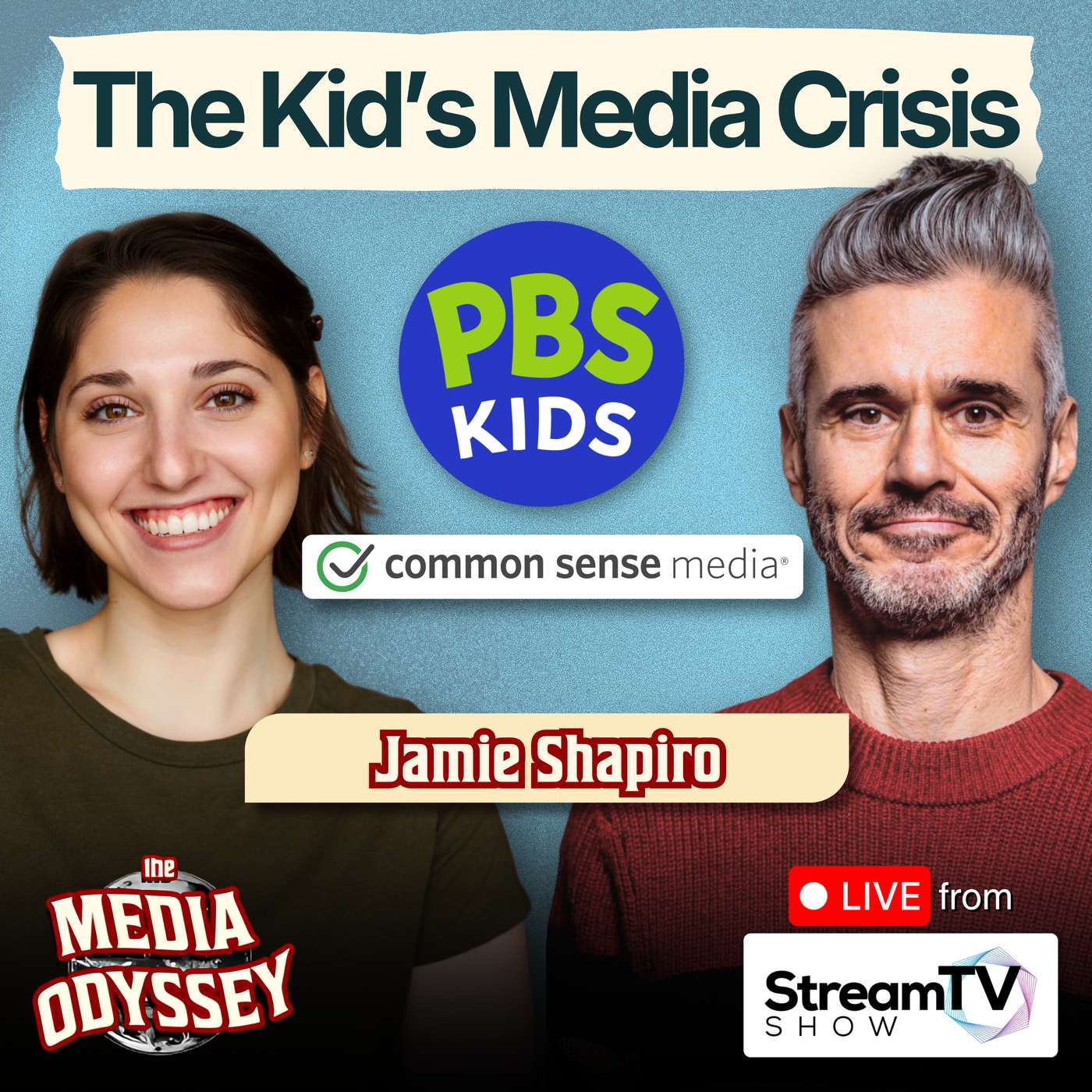
Welcome back to the Media Odyssey. I'm Jamie Shapiro, Evan's kid, and this week we're talking about the kids media landscape. So he thought it was only fitting to bring his kid along. We talked with Andy Doner from Common Sense Media, who Evan partnered with to do a report on the state of the kids content industry. We also Talked to Sarah DeWitt from PBS Kids who gave us more of an insight on why people are saying the industry is totally fucked and what we can do to fix it. So, so lock in.
- [00:46]
B
Welcome to the Media Odyssey podcast.
- [00:48]
A
That is Jamie Shapiro and that is Evan Shapiro. And today we're going to be talking about the kids content business. You may or may not know that Evan partnered with comp. Common Sense Media to run a report on the kids media landscape. So we're going to be delving into some key points from that. But before we do, I'm going to throw to you guys to introduce yourself and what you do. Andy, do you want to start?
- [01:14]
C
I'll start only alphabetically. A is before S. So first. Thank you, Evan. Thank you, Jamie for having us. Thank you for the working us, working with us on the report. Fantastic. So hopefully many of you out there know who Common Sense Media is, but if you don't very quickly. We're the largest non profit reviewer of kids media in the world. We fundamentally do three things and it's got a nice hook to it. We rate, we educate and we advocate to protect and prepare kids in this very strange moment of apps, algorithms and AI. So what we like to say is we are not anti tech, we're not anti industry, we are a pro kid. And so what I do, and a slight plug on this because it's through partnerships that we do a lot of our great work. We are actually, I'm very much pro industry because we love to work with the streamers, cable, vod, satellite, et cetera. That is how we get our ratings and reviews out into the world to help us accomplish our mission. So thank you. Thanks for having us.
- [02:16]
D
Hi everyone, I'm Sarah DeWitt. I'm from PBS Kids. Also really excited to be here. Thanks so much for inviting us. PBS Kids is the public broadcaster in the United States. We focus on Kids two to eight. The fact that we are just us focused is going to be important in this conversation, I think. But we distribute, working with incredible production partners. We distribute episodes, shorts, games, podcasts on our owned platforms alone. We have over 15 million digital users per month, again, US only. And then continue to have another 2 million on broadcast because Kids are still watching broadcast television. And then obviously we partner with a lot of other distribution partners so that we are on YouTube, YouTube, TV, Hulu, the Prime channels. I mean PBS Kids is really everywhere. Kids are, is our goal and to be free without commercials.
- [03:12]
A
Amazing. And earlier today we heard from Evan who mentioned that the state of the kids media universe according to the folks we've talked to is quote, totally fucked. Which also happens to be a great song. Look it up. So we'd love for you all to define what the baseline problem is. Why are people saying that things are totally fucked?
- [03:37]
C
I'll, I'll jump in on this. So I think if we look at this as a market like any other market, there's a supply side and a demand side. So the great news, which I think we're going to come back to is that the demand side is not fucked. The demand side is actually extremely strong. There has never been a moment in time where there's actually a greater thirst for great, high quality, research backed kids media that's out there. There's more devices, there's more interest, there's more infrastructure, there's more broadband than ever that's out there. And we talk about it here. Never before have families and kids raised their hand and said we want great content. So that's there and the infrastructure is there. What is fucked? And that's going to become, I guess the meme of this radio, I guess we can do it radio, we can drop F bombs on radio is. It is the supply side. And we're going to talk a lot about this, which is the, basically the breakdown in the economic model on the production side of the production houses, the streaming platforms to produce great content and to pay the proper commissions to the great work that those who craft great content is. So fundamentally, I think what we're going to talk about, I'll hand it over to Sarah, is this is a supply side challenge. Is there an easy answer? Absolutely not. But we'll examine it from a variety of angles here.
- [04:51]
D
Yeah, we really have felt the bottom drop out of the kids market. I mean it's, what's happening is we had a beautiful few years where everybody was investing in kids. It felt like this like incredible moment for creators. Lots of great content happening. It's good for the whole ecosystem. I mean even if that was competitive to PBS Kids, that's awesome because we need a good thriving content provider environment. But what happened was the streamers figured out that kids content doesn't drive subscribers, it reduces churn. And that wasn't enough for them. And so really a lot of folks have fallen back to ip that's kind of tried and true. And that's really their only kids offering. It's fair to say that the public media space is kind of has been kind of bolstering the whole industry. If you look at the BBC, abc, Australia a lot, and PBS as well, we're the only ones who really continued consistently to commission new content. You may have heard that PBS was defunded last year.
- [05:56]
A
Boo.
- [05:57]
D
Aware of that. Yes. So it means that we're challenged in this respect as well. Public media was kind of keeping a lot of the industry going. Yeah.
- [06:08]
B
So I'll quantify it a little bit from a numbers perspective, you're right. Demand has actually increased twofold amongst parents for high quality content from sources that they trust. And when you think about it, it makes sense. 70% of America's parents of kids under the age of 18 are millennials or Gen Z. 70%. And they just see the world through a different lens. They were raised to be more thoughtful about the content that they're watching. And so they demand better and higher quality, safe content for their kids at a higher rate than any other parent group, including my own.
- [06:42]
A
Yeah, I was watching garbage as a kid thanks to it.
- [06:44]
B
Mostly garbage I produced. And so the demand is high. At the same exact time, over the same period, the number of series orders from the ecosystem has gone down 25%, driven almost exclusively by the streamers. The streamers have a tendency to do this. They come in kids content is one area. Documentaries was another. Remember when streamers are buying premium documentaries? Remember when streamers were buying premium independent film? The second they sense a tick in the algorithm, they yank the rug out from it and they stop ordering it. So they create a demand, they created a market and then they decimate it when it doesn't suit their needs anymore. The problem with the retention thought there is you're not building long term lifetime value loyalty. The reason why it works as a retention tool and it's that hasn't sensed yet that the danger to them is kids are. Kids tend to be a little, you know, simple. They'll watch the same episode over and over and over. Well, okay, I would love to hear that. But that's, that's the thought that people have and they see it in their numbers. But the problem is, is that the algorithm problem that they were talking about earlier, which is, okay, so what's next? Can I find a new title? And once that kid tips over 11, the taste needs change. Suddenly they're watching Stranger Things and K Pop, Demon Hunters and all these shows that aren't necessarily designed specifically for kids. And if you're not keeping them from two to five and the family isn't co viewing, you're losing a loyalty base and they're going to churn out. Last year the, the churn. The total churn for the streaming industry was 89%. They kept 11% net new subscribers of the 175 million subscribers they generated last year. Part of the problem is the lack of kids content. And I'll do one more thing, which is the coppa laws really decimated. And we talked about this with Alimage on stage earlier today. That took $2 billion out of the marketplace that was funding high quality kids primarily on YouTube, but not exclusively on YouTube. A lot of it comes from. I produce it for somewhere else and then I put it up on YouTube. So those things have created an existential crisis in kids content that is really decimating the supply chain because people can't afford to produce it anymore. Sorry.
- [09:11]
D
No, I just, I was going to challenge just a little bit on the kids watching the same thing over and over again because people say this a lot and it is very true for super young kids like 2 and 3 year olds that they'll watch the same episodes. But I think what we're seeing here is by a lot of these streamers focusing so much on a single IP or just the same library, assuming that's going to keep kids. You're seeing this churn and where kids are going is YouTube because there's so much new stuff happening there. And I don't think, I don't think they've put that together. That part of this is driving this. Just very few titles happening on streamers is part of what's driving this big move.
- [09:47]
C
Yeah.
- [09:47]
B
The parents said for kids under, I think it was 7, 88% of those kids prefer YouTube to any other outlet to watch content. Again, you're feet, you're feeding the competition. You're. It's, it's almost. There was a time when mainstream media sold all of its best content to Netflix. And then they woke up one day and Netflix had destroyed their business. Netflix is doing the same thing, which is they're allowing all these kids to leak to YouTube and they're like, where
- [10:12]
C
are all the families?
- [10:13]
A
Well, and they're stealing YouTube's model. So clearly they see that it's, it's working. But let's double click on. To steal his vernacular, let's double click on the Co viewing paradox, because you guys mentioned that demand is there. And I'm curious how many people in this room watch video content with their kids. So for listeners, that's a good portion of the room. So co viewing is, is still very much a thing. And I'm curious to know how you think that's impacting the content that's being produced, or lack thereof.
- [10:50]
C
Co viewing, the behavior, the desire is still there. But practically speaking, what you're up against is a fragmented house where there's a screen in every single room. Actually a plug for Toy Story 5. I had a preview the other day. They do a magical job of actually kind of demonstrating this reality that we're in and how hard it is to actually get the family to all agree. I mean, I'm not going to bring us back to like the 1950s or even, you know, the great, you know, must watch tv, you know, of my generation. That was magical. But there's still this need and this desire to bring the family closer together. I was reflecting on this for this panel and thinking about like two, two things that transpired in my. I have a 21 year old, a 21 year old daughter, and when she was really young, we watched an amazing show on HBO called Classical Baby, which I just think is one of the great animations of all time. And hbo, it'd be great if you got back into kids programming, but that's a little, little plug on that one there. Most recently, the most, a few years ago, she's like, dad, I have a great new show. I want to watch it. I'm like, great. And we sit down to watch it and she' 15 years old and it's euphoria. And you're like, okay, wow. And it was like, we're like two episodes in. I'm like, whoa. Like I got some thick skin. And this is really bothersome to me. And I should have turned it to Common Sense Media before watching that plug for Common Sense Media wasn't working there at that time. And to me, this gets to. One of the core issues is at stake here is that kids are aging up and media is aging down. And what happens is when these platforms are no longer having dedicated kids area, the content is hitting the four quadrants. And when that occurs, kids are watching, you know, heated rivalry right now, which is a great cultural phenomenon. But you're getting like teenage, young, teenage kids watching this. It's not terribly appropriate for that. My daughter actually asked me if I wanted to watch that with her. I'm like, I'm Going to pass on that one. So just a couple thoughts on that. I'll hand it over to Sarah.
- [12:39]
D
Yeah, the Just the coveying phenomenon. First of all, it's really good for kids. I mean, there's a lot, there's well documented research that if a child is watching something with a parent present or even another sibling present, the learning gains from whatever it is are going to be greater. So that is just an incredible thing to know. And it works asynchronously, too. Coming out of. So if you talk about it after they watched it, that still really helps with what they learn. But coming out of COVID one of my very favorite stats I saw was a survey of parents saying, what is something that you don't want to lose from all this time that you had together? And the number one thing was watching movies with my kids. There was something really magical that parents found during that time that they continued and that has affected our strategy.
- [13:27]
B
Movie night came back.
- [13:28]
D
Movie night came back. And I think movie night is still here. And so there may be, like, big fragmentation during the day. Parents tell us all the time we are the number one trusted media brand for kids. And parents say, oh, I don't need to watch with my kids, because I know they're safe on PBS kids, but they will tune in later if we do a movie special. They'll watch, sit down and watch together. And I know also parents are listening. I can't tell you how many parents write in to us to Fred Rogers Productions and say, Daniel Tiger's mom has taught me so much about parenting. You know, so we, we know that parents are in the room and they're hearing it and they are really taking something from it too.
- [14:07]
A
Well, and to talk about Churn also, you know, people don't want to have five different subscriptions. They're really only down to their two priority ones, and then the third constantly is on loop. So, you know, if there's a platform that can cater to the whole family, you're more likely to retain that audience because it can grow with, with the family. Especially, as you were saying, with Millennial and Gen Z parents who are likely only subscribing to two, if not one, at this point. So I want to get into. Unless you had anything to add, Evan. Great. Perfect. Love that. I love silencing him. So how creators and legacy brands worked independently to bypass traditional network gatekeepers and, and find profitability. We've talked about YouTube. How is that filling this, this void?
- [15:04]
D
Well, I think what we as a legacy broadcaster, but who also is really trying to think about, like, how do we continue to really brand build beyond just our own platforms. We are seeing the ways that we can really grow audiences on YouTube and that is a great discoverability for us. It's a way for us also to try to expand our brand across the board. So, you know, when we were defunded last year, back to the US Only. Thank you, Jamie. I'm going to take you with me everywhere. Back to the defunding piece. The. When that happened, we were, you know, because we're us only, we were recognizing that that was really harming us on YouTube because we don't have ads and we are only launching our content in the US it meant that the algorithm was not favoring us. So we started a partnership with pbsd. I mean, we already had a partnership with them around YouTube where they, with the home video rights had the ability to launch those assets globally at the same time that we launched them domestically and in some cases could. Could put ads on internationally. And what that meant is we saw huge uptick in how our content was being served within the United States. We saw tremendous growth just in the.
- [16:23]
B
That's a really important point.
- [16:25]
D
40% growth on YouTube.
- [16:27]
B
Yeah, yeah, it's a really important point, which is the international distribution doesn't just get you new audiences in new countries. It teaches the algorithm about the demand for this content and therefore it lifts all boats. I'm curious, how. Do you mind me asking, how are you Mechanically doing your YouTube and social video distribution? Are you doing it all in house? I know PBSD is handling a decent part of that, but that is oftentimes, you know, partnership deals. How are you, how are you making it happen?
- [16:55]
D
It's a combination. It's working with some of the studios that then help us kind of think about how we can do compilations and that kind of work. There's a new relationship with Fremantle around Arthur really trying to take that brand, which has been around a long time, has huge audience support, to really take that international, do some work with it on YouTube to help help like boost that brand across the board.
- [17:18]
C
Yeah, if I could just jump in, Judy, follow up on that. Just go to the sort of the gatekeeper concept and that being eroded and the direct to family distribution, which in some ways we need to look at. You're like, that's great. You know, creators can go right to families. But I'm going to slightly get in my soapbox for a second here because there's actually some really difficult consequences that's occurred here when there's no gatekeepers. When there's, when there's no or very loose standards and practices divisions that are out there. When. And there's not proper developmental science, clinical psychology and the proper craft that's looking at children as curious like mo like minds to be molded. And when the content is not created in a way that is really thinking about them as impressionable young people who are looking into that content. How the world works, what are the value systems, what narratives are out there. And when those gatekeepers are not there, then children are just, just have access to this endless loop of content. Sometimes it's great, but even that it happens. Then there's an autoplay to the next content, the next content. And part of the concern that we have at Common Sense Media and just generally in the industry is when the gatekeepers are removed. Children who are at their most vulnerable are being fed content without any control. So here's an example out there. Parents, we love when we're standing in the line to pick a prescription so that there's an FDA because they have tested the drugs. When you open your faucet it and there's water that comes out, you're pretty happy. There's an EPA. What's happening right now with YouTube and YouTube is by far the most powerful force. Think about how many mentions of YouTube that occurred just today. It is the defining platform of this moment in time and it's almost a utility but yet the checks and balances are not there. The S and P is not there. And to me this is a very, very serious issue that's out in the industry.
- [19:06]
B
It should be noted that the co viewing was I think was higher when we, when we got the data back, the coveying was higher than we anticipated. It being the lowest platform for co viewing is YouTube. It's half of a lot of the other platforms out there. I don't know why that is. I think maybe perhaps when you're waiting in line with your kid, the kid's got the phone and they're on YouTube and you can't control literally everything or to your point, something gets fed to them that they weren't ready. So it, it there is this conundrum and this, you know, weird opposing ideas happening at the same time.
- [19:38]
D
And you were talking about there being a real problem with the business model that there isn't a way really to support content, high quality content creation for kids on YouTub. I would say it's not just the business model, it's the, I mean the business model is not just bad for Business. The business model is also bad for kids because the way it is constructed is keep kids watching as long as possible. Keep them, like, constantly engaged. We know that there's a lot of AI slop that is getting put in front of kids. And, you know, you would think, yes, that's bad, and we should be trying to. To like, push against that. YouTube Kids is supposed to be able to keep that away, but we know that's getting through the cracks. The American Academy of Pediatrics recently said, like, it isn't just that it's not good for kids. I mean, it's. It's actually harming them. It's teaching them things that are wrong, even when it looks like it's innocuous. So, like, an example is there's like a very realistic video of a flamingo jumping off of a diving board. As adults, we know a flamingo doesn't really do that, but it's kind of fun to see. It's sort of cool. A kid's gonna love looking at this. For a kid who's never seen a flamingo before, they now have a completely wrong idea of what a flamingo can do. And so even if it seems innocuous, it actually can be really harmful.
- [20:57]
A
So what are some things? Not to put you on the spot, but to put you on the spot. And there are a lot of YouTube people here today. What could you do you actually be doing to mitigate some of these, you know, AI slop? What are some of the safeguards that should be put in place in your opinion?
- [21:13]
C
I mean, I'll jump in and I kiss that. And by the way, like, I mean, YouTube, we've partnered with YouTube. At Common Sense Media, we have deep respect. And the respect comes from actually just like the potency and power and the responsibility that YouTube has. So I'll just kind of put that out there. And so I'll talk about one partnership we've engaged with. It's been more on the YouTube education side, but it's an indication of the desire, the will and the vision that this organization does, does have. And so they' they have a product called Player for Education. It's not perfect, but it's an approach in the classroom where upwards of 90% of classrooms use YouTube videos for teaching. That's fantastic. But the core problem is one of discovery and also autoplay and the ads at the end. So they remove the autoplay, they removed the ads. Yay. But still, if you're a teacher with the gazillions of videos that are out there, it Takes a lot of time to find the right video that's aligned with your curricula, that is at the right pedagogy, the right standards, et cetera. So they approached us, meaning YouTube, and we curated, hand curated, along with their engineers and we built a library, a STEM library, an SEL library for those educators and very high quality, diverse content that was aligned with the curricula of those of those educators. I hold that up as an example. Now you may be thinking, what is exactly the business model of that? Therein lies part of the challenge. We're not going to solve it with our 8 minutes and 14 seconds left. It is very vexing on the business model, but there's the will, there's the engineering talent, and certainly there's a need both in the classroom and in the living room for YouTube to approach this.
- [22:43]
D
And I just want to point out, like what you all did was human curation. And this is part of the problem that, you know, algorithms are great and can do a lot. When you're talking about very young children, you've got to have the human there really looking at things and checking to make sure the quality is there, checking to make sure that this is age appropriate and developmentally appropriate.
- [23:05]
B
It's interesting, you know, YouTube and I, and I've interviewed Pedro Pina on stage where he said, we don't make content. That's not what we do. I've also heard executives at YouTube say we never put our thumbs on the scale either. And then they buy the Oscars for, I would imagine, a shit ton of money. That's a technical term. And so they chose to buy NFL Sunday Ticket and curate NFL Sunday ticket as a paid product. So I think one answer, and I wrote about this in the report, is to take kids, YouTube kids more seriously. We had animage on stage earlier today. Gregory threw out a stat 15% of usage. 15% of content on YouTube is kids content almost as much as music. It's 2% of monetization. So they should be taking the monetization question, encouraging new partners in the program, creating better economics there. But then human curation and a real treating of YouTube Kids. It's the number one kids channel in the world. It should be run like a network. It should not be run as an algorithm because the algorithm fails us at times and YouTube needs to take its kids business and its responsibility to kids more seriously. I think if they did, a, they'd make more money doing it, a lot more money doing it, but B, the reward would be a better attitude towards YouTube by parents and educators and other folks out there on the world, which
- [24:34]
A
we know is important. Based on a previous panel about KPI, Keep Passion Index. People are, are voting for their content based on their passion. Which kind of brings me to the next point. You know, I'm gonna let my Gen Z show for a second and say that there are a lot of people that maybe are wondering, okay, well we've talked about the ethics, we've talked about the morals, but let's talk about the bottom line. And for those corporate guys out there, I would say that. And gals guys, I would say that, that this isn't just a retention tool, it's also about boosting your bottom line. There is demand. There is, there's money being left on the table. And you know, I would call out the, the Netflix and the Amazon and the Paramounts of the world and say, you know, you've stopped commissioning this content and it's detrimental to the population, but also you're leaving money on the table. How would you incentivize, both monetarily and ethically these legacy companies and non legacy companies to start creating that content again?
- [25:45]
C
Whoa. The answer is the return has to be there. I mean Ulticus, they're for profit organizations and I'd like to leave you to go back to the original point about the demand being there. And there is a jump ball to user of a basketball analogy out there. So if it's, if YouTube's not going to step up and you have what, Netflix, let's say Disney, Netflix, Amazon and whatever this, whatever the merger of Paramount, cbs, hbo, Nepo, Bros. Yes, that, whatever that's going to be called. I really have to believe that with the demand and the dollars that are out there and with all the ancillary ways to monetize ip, that one of those organizations has a opportunity to become the de facto platform to become the kids place that parents will pay for. And not only as a retention tool, but as an acquisition tool. And I don't want to be naive because we know all the history of that, of creating a walled garden for kids and it doesn't work. But if it's done properly and at scale, I truly have to believe that there is an enormous business to be had by one of those organizations stepping up. And, and you know, you look in terms of a brand perspective, Amazon is very likely could be the brand that steps up. All those pieces are there. You know, the living room, the E Commerce, the connection to the family, the prime could be there. I'd like to Believe that with Paramount, with the property of Nickelodeon, historically, what HBO was able to do, notwithstanding the Sesame experience, I'd like to believe that combined entity when they were sitting down, looking at their vision, that that's something I'm a little skeptical, but I'd love to see that happen. Netflix, we don't know. So I, between those three, one has an opportunity to step up and I
- [27:27]
D
think there are ways that there are ways to partner, there are ways to help more high quality content get through. Again, PBSD works closely with us with those home video rights. There's a PBS Kids subscription channel on Amazon that then supports PBS Kids that puts money back into it and there are people paying for that channel and Amazon is recognizing that as high quality content that parents trust. There are more opportunities like that to recognize where there is really high quality content and find ways to.
- [27:59]
B
Yeah, and I think something else and, and you know, I have this responsibility in the industry to tell people things that are staring them in the face and they're not looking at. There's a shit ton of advertising money that has entered the ecosystem. Netflix, when they started not commissioning kids, wasn't taking advertising. Amazon, when they stopped not commissioning kids content, wasn't taking advertising. Most of these services started as ad free, which was bonkers to begin with. There's so much money that wants to be deployed in kids content as contextual advertising for family and kids brands. It's sitting on the sidelines now because it doesn't have enough places to go. So that's thing number one, the thing number two, and I'm not going to necessarily, this isn't aimed at the streamers as much as it is at the producers. And I have a follow up question for you on this, which is we had Toonstar on stage earlier today and they are using their own proprietary tech called Ink and Pixel to produce at scale, really high quality animated human written, human performed content. But their turnaround is a week. Right. They can get feedback from the consumers and put it up there. They're also driving down the costs to the point where their show is profitable just on programmatic ad sales on YouTube. And now they're turning around and they said on stage they're going to sell it to a streamer. So I do feel like it's a responsibility of the producers themselves to find new ways, especially in animated content to drive down the cost costs and expediate, expedite the the turnaround time, get content out there more quickly. Are you looking at AI as part of your production? Continuum is it something you're embracing or something that you're testing out?
- [29:40]
D
Well, I think, yeah, the public media legacy is always to look at every new technology and think about, like, how can we. How can we be using that in a way that is beneficial for kids in how they use it, but also in how we're telling stories about it and then how we're using it for production? And you can think there are lots of disruptions that have happened in animation. If you think about Maya, you know, like, that already really changed the way that artists work with it. So the Toon Star example is a really good one and it's one to watch. It's also is adult animation and they are getting their advertising on big YouTube, not kids YouTube. But I think that what we really need to do, I kind of feel like we need public media to be looking at AI and to be thinking about how to do this in a way that is going to be responsible. Where are the places where you really need a human to make sure that things are developmentally appropriate? Where are the places where there is an opportunity for this technology to help expediate, but also expedite. Excuse me, I repeated your. Yeah, to expedite. You're going to cut that out. Right. But okay, to expedite, but also to really think about where can we. We learn from this? What are things that we can put out there as best practices for the industry for how we would use this in a responsible way for kids?
- [31:00]
B
Yeah. And if not, you know, if not public Media, who now 54% of kids content is being produced worldwide by public media. And I think if we're going to find a responsible way to use AI in production of kids content in particular, it's going to come from the public service sector. I think. Think we're out of time.
- [31:19]
A
We're out of time.
- [31:20]
B
That went too fast. What did you do? Did you speed up time?
- [31:23]
A
No, I just cut you off and
- [31:26]
B
then don't give Maran any ideas.
- [31:28]
A
Oh, I love Marian. I wish she was the only host of this podcast.
- [31:33]
B
Thank you very much.
- [31:34]
A
Thanks, everybody.
- [31:35]
B
Yes, it was great having you. Thank you very much. This has been the Media Odyssey podcast at the Media Universe Summit. Thanks for tuning in. We'll see you next time.
- [31:45]
C
Sam.