Loading summary
Transcript77 lines
- [00:00]
A
And I heard this unbelievable data point, which is for the last season of Stranger things. Netflix created 1.5 million different versions of their trailer for YouTube and other social video. 1.5 million. There's no way that humans can scale that kind of editing thing. And this is what AAVE is trying to solve.
- [00:32]
B
Foreign. Welcome to the Media Odyssey podcast.
- [00:41]
A
That is Evan Shapiro, and that is Marianne Renchette.
- [00:45]
B
How are you, Evan?
- [00:46]
A
I'm good. I'm good. I'm a little intimidated because there's going to be two French people on the pod today, so I have a petit un peu francais. And so I'll try to keep up with you too, but, you know, we'll. We'll try to put it mostly in English for our American and British audiences as well.
- [01:04]
B
Of course.
- [01:04]
A
Course.
- [01:04]
B
Yeah. Bear. Bear with us. You're gonna have a lot of French accents coming your way. But you. You guys love it. We know you love it.
- [01:12]
A
So I will say this is a. This is a good episode to check out on YouTube on video for a couple of different reasons. One, with all the French accents, we will be captioning it. But then, two, we're gonna be doing a really cool demonstration on screen that is best seen and not heard. So listen to it if you're in your car on your. Or you're on your jog. But then check it out on YouTube as well, because we'll be showing the demo there. But let's get. Let's get into some little bit of news that this is a big couple of news weeks going on right now. Like, it seems like the media universe continues to generate new headlines on a daily basis. Did you see yesterday, OpenAI announced that they're shutting down Sora, which is kind of monstru mental news in the AI and media world. Did you see that fire across the transom yesterday?
- [02:05]
B
Yeah, I thought, absolutely. It's, what, two years in? So I was quite surprised. I have to say, I felt really bad for Disney on this one because the two stroke a deal a few months back. And I think, you know, for Disney was the idea was very much to show that, you know, they were embracing AI, that they were innovative. Well, you know, until next time, we'll have to check back in. I'll be curious to hear Olivier's thoughts or guests. But, you know, we'll say more in a few minutes on that particular topic. But why. Why is that? Is it a money thing? Is it. Is the product not where it should be? What's your take?
- [02:44]
A
I think there's a Number of different contributing factors here. Most notably selling AI tools directly to mass consumers is not a business. There's not a real sound business model in there. And OpenAI is finding this out on a daily basis. We talked about this at the beginning of the year. I predicted that the AI bubble would burst this year. Most notably because selling AI directly to consumers as its own product is not a real business model. You don't pay for email, you don't pay for search. They're wound inside advertising, supported things, but also in other enterprise software. And what they said was we're going to focus our business on enterprise software and not D2C software. So I think that's an admission that maybe I don't. Not particularly that I was right, but that their business model heretofore is a bit unsound. And then the other part of this is I don't believe that there is a true market for movie making in AI. I think it's a great tool as a component of other things. So it's a great editing platform. It's helpful with graphics and stuff, sound and things like that. So it's one color on your palette. It is not the canvas, it is not the artist. And I think people are beginning to find that out. You know, we saw that epic battle between Tom Cruise and Brad Pitt created by some kind kind of AI. I don't know if it was Sora. I think it was another one. But it upset people. It did not make people happy. People didn't go, ooh, cool. They said, oh, this is creepy and weird. And then there's that Coca Cola ad from last year which was generated by Gen AI. And it took I think 70,000 hours or some ridiculous number of human hours of prompting in order to get it to a mediocre version that again, literally every audience member who saw it hate it. So I think this is going to be is the beginning of the end of the last era of Gen AI. And I think we're going to start to see it evolve into an arrow in your quiver, but not a bow.
- [04:50]
B
Yeah, I have to a few things. Last week I was with RTL Ad alliance and they had a trailer and one of the key stats was that 93% of social media videos were AI generated. Right. So there's. One might argue that seeing Sora being shut down should actually go a bit wider than that because I do love, you know, to democratize media, you know, video, put it in the hands of everyone. But right now we don't have any of, you know, the Protection that needs to happen. Like you've just said it, there's potential copywriting infringement, you know, fake news. Like it's becoming so, so easy to create, you know, good ish quality content, video content. So in a way I'm actually happy I shouldn't say that, that they're going to refocus on enterprise. And especially I think it goes very nicely with what I've. What I'm seeing with AI and what I'm expecting AI to do in our space, which is very much to be a B2B play. And to your point, focus on enterprise and be again, you know, and help a support
- [06:04]
A
not replacing the artist, but helping the artist better and faster. But what I find interesting. So Disney was going to put $1 billion into open AI. They're not going to do that anymore. They saw it as a way to accelerate, actually, and I think lean into this new era of creator Dom, which I thought was an interesting move. We talked about that at the time. But then you saw Tyler Perry. Perry basically canceled his entire studio business after watching stuff being made by Sora. I think he looks a little silly at this point because I don't think we're going to see, you know, Guillermo del Toro and Paul Thomas Anderson being replaced by Sora anytime soon. But I think this gets into what the topic of this whole episode is, is how do you keep pace if you're a studio or even just a creator, how not just a creator, but if you're a creator, a solo creator, if you are a creative in any form or fashion or a team of creatives right now, how do you scale social media video at this point? Because we know this, we can't, we can't generate enough clips on a weekly basis to keep up with the pace of social video. And it's a real challenge if you're at Disney or Warner Brothers or If you're a Mr. Beast or Amelia Demoldenberg. How do you satisfy the beast? How do you feed the beast of social video to the point where you can build the momentum you need for your projects? And we have a guest on this week who this is the entire enterprise. This is the whole concept of this business is to take the professionally produced content or creator originated content that you have and help you accelerate to the pace of social video today. Do you want to introduce them?
- [07:49]
B
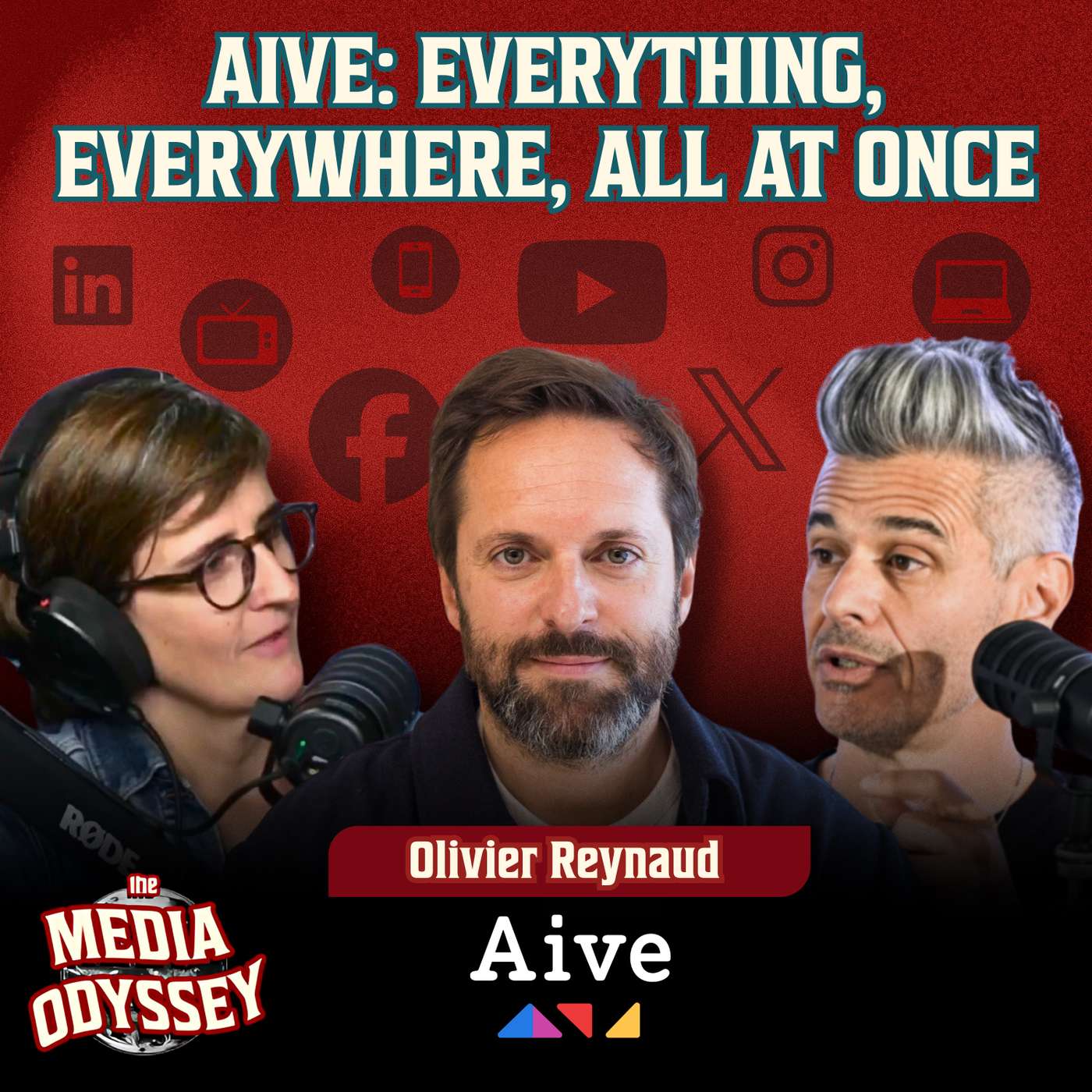
Yeah, absolutely. So we're going to welcome Olivier Renaud. Olivier, welcome. I'll give a quick intro on who you are. You are the co founder and CEO of aave. You're the first Creative intelligence platform for video performance. You've been used by global brands, agencies, media companies, and like Ivan said, it's all about maximizing the video creation process. Historically, you're a successful entrepreneur because you co founded teeds, which is a global leader in video advertising. And so we're excited to have you today. Thank you for being with us.
- [08:29]
C
Hi Maro. Hi Evan. Thank you. I'm very happy to be there. So yeah, I'm a repeat entrepreneur. Also my co founder, Rudy LaRouche. We are both in the video industry since 20 years, so we know very well how video works. Previously I Co founded Tidz.com so we broadcast billions of video daily. So we know the pain point is not about creativity because with AI or without AI we can produce video. But the real pain point is to have an experience tailored for everyone. So large scale personalization for everyone in video. So that's very complex. So that's what we are solving.
- [09:13]
B
And so how did you, when did you start aave? And again, what was that initial? You're talking about pain point. I love when technology actually solve this problem instead of creating more or inventing problems. So what was the genesis of Ape?
- [09:31]
C
Genesis was at TID and also my co founder with adyoulike, the company he was driving, we broadcast billions of video. And we saw that when we personalize video for each social networks, for each media platform, it means not only the frame, it means the duration, it means personalization, the right montage, the audio. We saw that this creative change have strong impact in the performance, in the experience. So we saw it almost 10 years ago. And then after the acquisition of TID, I see that, okay, distribution itself, we fix it, but now makes creativity that will join. How to perform with a video is something to do. So how to adapt a video master for all experience, that's the topic. So at the beginning we think with my co founder Rudy me, I have a creative vision and he has an AI and product vision. So together we have this vision that, okay, we will understand how the video is built in terms of creativity. So transform the video into data. We will be speaking about it after and after. Thanks to this data, we can automate all the versioning, reframe, summarize video optimization for society, networks, localization, et cetera. So that's the genesis. We have the vision 10 years ago. And after we launch with business Angels, we hire dozens of AI engineers and we develop the technology years after years.
- [11:11]
A
So bonjour, Olivier. That's the extent of my French right there. So let's let's go back in time just a hair because TEEDS is a massive platform. It really originated, I think if I'm not mistaken, the idea of radical syndication of advertising. So an advertiser can come to TEEDS and then distribute its ads in contextual programming and content, whether it's print or elsewhere, all over the Internet. So you empowered this multi platform omnipresent distribution that became de rigueur, another French word in advertising, video advertising around the planet earth. Am I getting that correct?
- [11:53]
C
Yeah, we saw the strong problem that everybody is able to broadcast video campaigns for advertising, but also from a TV show and create clips. Everybody can do it, but the reality is nobody know exactly what we broadcast. So I mean, for example, you have a one minute TV commercial from Coca Cola, okay, we adapted for an alpha minute for Society Works, okay, we broadcast it, we have the performance statistics that, okay, it was seen, not seen that this. But okay, his message was seen, his ego was seen, his Coca Cola was seen. What the people, what the guys understand the video, nobody know it. So that's why having this data to understand what is inside the video and makes it when the guy see, for example only 15 seconds, we now are able to say, okay, this is the beginning of the advertising. But they didn't see the brand, they didn't see the message. So right now this creative is beautiful, but it's not adapted to the right people. So that's the problem and that's why we created.
- [13:01]
A
Yeah, so you, you created the opportunity, but at the same time there became this problem. So you enabled people to distribute their video everywhere but there. Until recently, or until let's say the last 10 years, there was a one size fits all creative brief. So Coca Cola would make one to your point, 60 second AD or whatever, and one creative too, you know, one created for the entire world where. So that the opportunity became a problem, which is to your point, I'm not seeing the whole ad or I'm seeing the wrong version of the ad for who I am. So I'm, I'm a, you know, Gen Z or I'm a boomer and I'm seeing the same ad. And that's not what radical personalization on the Internet wants right now. So you've created the solution to the problem you helped create to a certain extent, which is now we're going to take your creative and radically personalize it for the context in which the viewer is seeing it. I just want to bring up one data point. I was with Google last week and I heard this Unbelievable data point. Which is for the last season of Stranger things. Netflix created 1.5 million different versions of their trailer for YouTube and other social video. 1.5 million. There's no way that humans can scale that kind of editing thing. And this is what AAVE is trying to solve. Am I getting, am I understanding this correctly?
- [14:25]
C
Yeah, that's it. So why they produce 1.5 million ads and format? It's because 10 years ago there was, you say one format that fix that fit to everyone. Now There is a 20, 30 social networks with hundreds of formats. So you need to create all this format. Not always millions of format, but you have. But yes, when they broadcast these millions of formats, it's important to have to mix the creative scoring the analysis of what is inside the video. Okay, they produce all this video in few months. But after what is the performance? What is the impact? And can we link the creativity of the video and the performance? And after thanks to this data be able to create new versions. So creative habit testing to better experience. So they did a great part of the job of the need by creating all these video. But the main thing is to broadcast the right creative to the right people. And depending how they consume it, they watch it, they experiment it, adapt it. Thanks to the AI at scale.
- [15:34]
B
Yeah, that's fascinating. So who have been working with you guys who have started using AAVEs so far?
- [15:43]
C
So ay, it's a solution for enterprise. So they use brands, creative agencies and media. So we have many global brands with demanding companies, demanding needs like lv, Mash, Cars company at Stellantis, in Match Group with Mytic, Procter Gamble, Nestle. So huge company that from one video they need to adapt hundreds of formats in multiple countries. Need with all localization and this no creative want and love to do this adaptation versioning. It's madness. So this is brands, agencies, we have pubisys, Omnicom, IPG, AVAs, many global agencies. So we are scaling and deploying our technology inside the team in terms of media. We have Warner Bros. TF1, the number one TV company in Europe. And also we have some first GAFA, we have Meta who is using AAVE. So we are scaling. So every industry that use video need aave because video adaptation is for everyone.
- [16:53]
B
Yeah, that's fascinating. So there's one thing is I love to talk about tech, but very often I love looking at tech. I think this speaks, you know, so many words. So I suggest we take a quick look and do. You've done a demo for us, right?
- [17:09]
A
Right. For our Podcast. Talk about contextual. I think we did a demo. You and Jesse, right, worked. Jesse's our editor and our producer. He's behind the scenes right now. We did a demo for the Media Odyssey podcast with this product. Correct?
- [17:24]
C
Correct. We did a demo based on the past episode of Media Odyssey.
- [17:28]
B
And I think what's important to understand is that there's a lot of video editing tool. And so we're not going to be talking about what AAVE does that a lot of other tools are doing, which is, you know, just like Adobe Premiere, etc. You can, you know, edit your, your, your videos. What we wanted to do, we took a, an already edited video and we were like, okay, how can we play with this to actually make it fit for more social media? How we can, how can we make it fit for local audiences? And so we actually have a tiny bit of a surprise for you, Evan. I don't think you've seen this before, but really? Yeah, we really took our hearts to use this to deliver on that versioning promise that Eve is pitching. So, Olivier, we're going to show the demo right now. Do you want to speak to it a bit for us?
- [18:20]
C
Yeah, exactly. We'll see in the demo how it works. So just to summarize, we don't create the video here. We start from a video master and with aave, we can do all the versioning. And here we'll see exactly from a past episode how we can create a smart clip from specific parts. Aave, take the right parts. Tell you this one is good, help you from an intelligent reframe, summarize localization very quickly and adapted for all society networks. That's what we'll see and hear now.
- [18:53]
B
Okay, so Olivier, this is aave. That's the platform. I'm seeing a lot of stuff in there. Do you want to tell us a bit more about what we can do in here?
- [19:03]
C
Yeah, aave, it's a web solution, so it's not a software to download. Here you can see on the AAVE platform. So previously the video was uploaded on AAVE and transformed into data. So it detects the people, the framing, the colors, emotion, everything. And here, if you can see the video, we can see Evan speaking. We track him. So for the reformat, it's very great. And thanks to data, we detect the people, the track the people, the face, the emotion. So here we'll do a reframe, for example, a vertical format for Centrox. So it's not just crop, it's tracking the right people. So because we have the data here. In this example, we select the right people, the right. So here we selected Evan. And after we click on generate the vertical format and after it will do the adaptation automatically. And each shot, each chapter it's seen, it will readapt and everything can be modified, optimized directly. So here it's the reformat one of the hundreds of features here. This is a localization. So we'll generate subtitle in multiple language. So we want to understand more than 70 language. We can just subtitle in all language.
- [20:20]
A
For those listening really quickly. Yeah, for those listening really quickly. So you know, you'll see a vertical video oftentimes from a podcast and somebody will move out of frame. This prevents that to a certain extent. And but then when, when on the toggle button on localization, there were all these languages for captioning. You don't have to think about captioning for all these different regions. It just automatically generates the captions in these different languages. Is that true?
- [20:45]
C
Yeah, that's true. We have the transcript in all language and after we can translate the subtitle in all language. But after we can do a little more with a voice with the after. So yeah, subtitle. Yeah, we can all customize everything. Like other solution with animation, your font, et cetera. We have all the parameters that are required for demanding agencies and brands. So you can do everything and edit everything like with a perfect pixel. So here we can see the demo that Evan is making. Subtitles with animation. Okay, great. So after you can add your brand template. Yeah, can add the logo just very easily. You have all the asset library and you can, if we have the video animation of the logo with a move file, for example, you can add it like a TV or commercial, but very easy to use. And after we say, okay, is my logo subtitle our place, we have all the safe zone, all the grids, the magnetic grid. So you can add exactly the logo at the right place. Because it's different between an Instagram reel, a TikTok, a snap snap. So we have all this information to have the perfect format for all experience.
- [21:58]
B
That's really cool. I have to say that. Yeah, we've been doing this pretty much manually for the past year and a half and clearly we haven't.
- [22:11]
A
But other people.
- [22:13]
B
Well, our team, it's a collector, Jesse. It's the team, right. I mean, we've been doing the pod for a year and a half. We're easily on all platforms forms when, when it comes to the pods. But all that you know, discovery work that we need to do and you know, that demand for social insta, LinkedIn, etc, it's been hard. Right. So we've been able to do maybe a couple of formats. I don't think it's really perfect. Every time I see it, especially on the subtitles.
- [22:44]
A
We've really decided to cut back on the number of formats because it's. We just feel like we're not doing it well.
- [22:50]
B
Yeah, we can't keep track. Right. We can't keep track. So thank you so much for that demo. Maybe one thing that I want to show before we move on, because the versioning is very much the size, the frame, et cetera, but you've said it. It's also the languages and so you can do subtitles, but. So when we were doing this, we had a bit of fun.
- [23:11]
C
Plus a creative score that show you if the mortgage is adapted for ESO networks and. And what you have to change. So that's really great because it's an AI video copylot. So if it's not adapted, you can see what you have to change or to add through the platform. So it's a copylot.
- [23:29]
B
Yeah. For those who are listening to this, the score is 32%. It says it can be better. I'm thinking when I'm looking at that video, it's because we cut Evan's hair, we don't see Evans hair. So I think creativity, I mean, that's just not good. Right?
- [23:47]
A
How do I give the people what they want?
- [23:51]
B
Okay, cool. So just show us maybe that little thing we did for Evan and then I want to talk a bit more about the data behind everything. And that creative score you've just mentioned,
- [24:21]
A
That is.
- [24:21]
B
That was you in French Canadian. I think our friend Paul McGrath is going to love this. So that was even in French Canadian.
- [24:29]
A
That's not just French. That's French Canadian.
- [24:32]
B
That's French Canadian. It's not French here.
- [24:35]
A
That is unbelievable.
- [24:37]
B
You like this?
- [24:38]
A
Yeah, that was great. I suddenly can speak French. Not just not just French, but Quebecian, I guess.
- [24:45]
B
Yeah. And so what's fascinating and Olivier need. We'll need to talk about that, but so clearly we can hear it still your voice.
- [24:55]
A
Yeah.
- [24:55]
B
You know, so it's, it's, it's really you. It's not like there's a random voice going over you.
- [25:01]
A
That is. How does, how does that happen? Like, I know we want to move on to another thing, but. But seriously, Olivier, how does it take my voice and translate it not just into French, but into an obscure version of French that is just singular to the Quebec province of Canada.
- [25:20]
C
Yes, his voice dubbing. So because we have all the data, all the transcription, all this information, we can after change of tone of keep your tone of voice and adapt in all language with all the control. So that's part of some use case
- [25:34]
A
you can do that is absolutely bonkers. And by the way, that was also talking about what we talked about at the beginning of this episode. It was about AI and that Coca Cola ad too. That's really. That was.
- [25:46]
B
Well, yeah, well done. Right? We. We did that on purpose. I think we did a good job. We wanted it to, to make sense for. For today bit.
- [25:53]
A
So you gotta send me that video.
- [25:56]
B
Oh yeah, we're gonna send it to you. And we have another version with me speaking Spanish. And I'm. I'm hot. I mean, I'm so hot, I love it. But so, Olivier, I think I understand the problem, understand the solution and what I'm seeing right now. And I'm not an expert, right? So the question is, what do you do differently than others? Are you the only one doing that? Or what's your secret sauce? Right? What makes you not just a tool, but an entire creative and intelligent platform?
- [26:39]
C
You're right. We are not another AI tool. We are a creative, intelligent platform for video performance. What it mean? Our huge technology is we transform the video into data. This is our technology MGT for multimodal generative technology. So this is a technology with more than 25 AI models. So each AI model transforms one creative topic aspect into data. We detect the emotion, the framing, the type of object, we detect the scene, the chapters. So all the video, we transform it to data. We doing video to data. So this technology is really huge. It's more than $20 million of research and development. And thanks to this data, when you own the data, we create the data. We can do everything. So we don't generate the first video, we can adapt. So all these hundreds of clicks of adaptation on Premiere Pro, for example, or other software with aeve, it solves very quickly. And also thanks to data, we don't automate everything. We automate around 80% of all the production. So all the repetitive tasks, we automate it. And after the human stay in the loop and through the AV interface can do the final modification, editing in order to have the result. So on it, we can see if this technology have strong proof of performance. We see it because companies that takes two months, three months to do hundreds of versioning, we do it in few days. Only and with better quality at the end. So this is this technology mgt, that is a clear difference, but also with the entire value chain. So we understand the video, we transform it into data, we automate part of the production, the versioning, this is our creative intelligent versioning. And finally we are launching the distribution. So thanks to all this data and the production, we'll be able in a few days to broadcast the right creative file to right person on social networks and have the feedback on the performance and then we able to create more better experience of video. So LDATA is everywhere on AIF platform.
- [29:03]
A
I want to bring up a point here which is last week we talked about the stream, the poll that Tubi and Harris polling does and there was this one really interesting data point that you brought up which is people, younger consumers, all consumers don't mind advertising. They really don't. In fact, I think three quarters of them said I don't mind advertising as long as it's contextual. Contextual to my lifestyle, but also to the content that I'm watching. And you know, that's great. In a, you know, you know, one or two channel world, you can kind of personalize that way by hand. But in a world where everybody's watching something different at different times on different devices, on different platforms, on different social video environments, to contextualize an ad for that many consumers on that many platforms and that those that many environments is impossible. It can't be done at human scale. This is the solution to that, Olivier. This is, this allows your messaging and for individual creators too, this allows your cut downs to match reels and shorts and snap, but also widescreen when it wants to be as well. It really is the radical personalization that today's environment demands as opposed to, you know, let's pretend to make three versions, right?
- [30:24]
C
Yeah. And you point something very interesting that there is a creative fatigue when you adapt. You have the same video for all platforms. So I have an ad or a clip for TV show on all platforms is great, but many people will see the same ad. So there is a creative fatigue. So with a platform like us, you can do creative diversity. You can create stories on the same long format. So that's why we recommend for agencies and that's what they are doing now, not producing a half minute commercial, but a two, three, four minutes video. So with it we can create an entire story. So thanks to this there is no creative fatigue. And after through a, you can manage the experience through all platform. So in this way you are very consistent in terms of creativity on the global campaign and global experience for everyone. And so everybody can have the right experience, the right story fit for all format, all mountains.
- [31:31]
B
And so what I love actually, which is new, so this is what you just said, that you will be launching in the coming days, the extension of the platform. And that I love because what I'm seeing right now is everyone is selling tech to brands, agencies, media companies, studios, you name it. And it's all those bits and pieces that are supposed to be working together but are not. So the fact that you can do a standalone video editing job, then do the versioning, then distribute directly, right? So instead of having a manual, a manual moment where all of those things you've created, you need to push them individually, et cetera, on XYZ platform, being able to do that within your platform, I think that's a super, super smart move. Because you said at the top that we fix distribution, but distribution is still complicated. So you do the creation, you do the distribution. And what I love is the analytics part because that example you gave Evan at the top, right, with a million plus of videos for their latest series, I can't remember which one you mentioned, but yeah, the fact that you can then understand what works, what doesn't and recreate on the fly additional version that actually match that for a particular target audience, a particular country, I think that is fascinating because that's the one thing, right? It is 24 hours. You need to push as many content, as much content as you can. But when that next 24 hours starts, are you just going to go and repeat? You know, ideally you understand what happened the next 24 hours and you tweak and adapt and then you keep at it, right, Olivier?
- [33:19]
A
It takes A, B testing to that, you know, it allows you to do A, B, C, D, E, F, G testing as opposed to.
- [33:24]
B
Exactly.
- [33:25]
C
There is this, but also in terms of data management and security because we are all in one platform and we cover the whole entire value chain of video analysis, production, distribution. For the many company, it's mandatory. If you look about Disney, if you look about MrBeast, when they produce a video, they won't export it and upload it on a SaaS platform video that cost millions of dollars. They won't upload it everywhere. They have to have something very secure, all in one platform. And our technology is proprietary, it's not trained on OpenAI or Amazon or Google. So when a company sends for example the future video of the next smartphone, the first year car or the next movie with hundreds of million of dollars of cost of production. It's secure, it's Safe, it's a SoC2 platform. So it's totally waterproof in terms of media data. It stay here, it don't train outside. All the data stay here. And how it works, I'm not angry to tell you more precisely, this is a technology you created. This is meta learning. Meta learning. It's not one fundamental model that generate video or content because we gather many, many AI models that we own together we generate the data. So we don't, we don't need to train a model like all the other GAFA companies. And to be true, LLM for example, just 5% of all the technology. So all the technology is in house and don't train outside and it stays safe. So that's very important for all the brand agencies and media company for their content.
- [35:10]
A
Yeah, so. And Olivier, feel free to not answer this question, but my curiosity is, is this only accessible for a company the size of Disney or Disco Bros. Or Meta? Or can an individual team like ourselves or creators, is there a scalable version of this that allows the individual creator to use it as well?
- [35:34]
C
So yeah, the solution is right now available for enterprise or brand agencies with this kind of size like Publicis, Disney et cetera, but also available for medium team. So medium size of agency, medium size of brand or maison or media company. It works. But no, it's not, it's not just
- [35:55]
A
for the billion dollar company. It can be for.
- [35:57]
C
Yeah, but it's not, it's not today a solution for individual Kratos at $20 per month, maybe one day, but not right now. I'll focus it for very complex needs. So you upload a two hours movie. Okay, we know we transform everything and for these two hours content of Disney or Mrbeast you can create hundreds of clipping adapted for all social networks but not enough in few days and it will be better done than it was done by human. And that's what we see in all the use case we have with huge campaign.
- [36:38]
A
Well and it's, and it's the number of versions that that allows, that's, that's where the difference between, you know, I mean it human editors are good, but they can't just do a thousand different versions in an hour.
- [36:50]
B
Despite being able to do it. There's the question, perhaps they can be doing, you know, something different with their time, something more valuable. And so the question, I think we've heard you say that you're trying to kill that 80% of repetitive tasks and then you Want creatives to focus on that last mile, that last 20%. So I have a feeling, but I'm interested to have your thought. It feels like you're not seeing AI as a threat to creativity, but really more as a way of augmenting creators, artists, et cetera. Is that the case?
- [37:31]
C
That's the case. This is augmented creativity. To give you an example, we have one of our clients, Mythic for the entire Europe for Match Group. They created a campaign on entire quarter with almost 300 of campaign. So that's not just one try. And so they have to adapt all this format for all social networks with aave. And what is the result? This show that they save almost 80% of the cost of the production. Also in the time of production with AAVE, of the versioning with AAVE, they can produce 4, 5 more content than done with Premiere Pro. So the go to market is really reduced from three months to a few days and weeks. And finally they broadcast and they do campaign on Facebook page and Instagram page and see the results. And all the formats adapted with AAVE have a performance uplift of 50%. So it's 410 faster and it's performing better. So we succeed to match creativity and the performance together. So to answer finally to what MITI can do with this time saved and the cost now they can invest more in the media so they can do more advertising. Also they tell us that they are able to invest more in the production, create more movie more master with creators rather agencies or with dni. And also they are able to give more trainings for their teams. So nothing is lost with this time and the cost saved. With our technology, they can create finally better experience and better performance for all the company.
- [39:27]
B
Fascinating. Okay, so at the top of the episode we had a quick discussion about news and there's always something fascinating happening in the industry. And we just heard that OpenAI is actually closing down Sora, at least the B2C component of Sora after two years in, which means that they're going to stop their deal with the likes of Disney. How are you seeing this move? Is this the right move? What does that tell you?
- [39:57]
C
Generate video right now is a commodity. Many companies do it. There is a Google clink, Runway, etc. All models are really great. Every month it's improving. So now it's not the deal. The deal for OpenAI is to concentrate on the core business for enterprise like Anthropique. So I think it's a good move because for creators they are not lost, they have a Lot of solutions for generation. Maybe that was the beginning, the birth of new social networks. And we saw also there was an AI slope, there was a lot of video generated as Sora that was Everywhere on Instagram, TikTok. It was an AI slope moment. So I think it's a good thing for OpenAI, they will focus more and so it will give the opportunity for other companies to focus on their true value own ways. They focus only on video generation. Just it. So for video generation it will improve in the morph in the. Yeah, we can't continue. But the topic about scale adaptation, versioning at scale and the experience, it's another topic. And on our side, just so we saw, because we have some agencies that use aave, there are agencies that only generate video. So videos that generate can generate only video. With companies like Runway, et cetera, they can use AAVE for all the adaptations. So that's not a big problem for the creative industries. And so for OpenAI, they will focus more.
- [41:37]
B
That makes sense. Right? So there's a lot of things happening for you guys in the next few weeks. You're going to be at ANAB in Vegas. There's at the same time the Adobe Summit. We're going to show for those of you who are watching this or you can go check the show notes, but the team at AAVE is giving us a code so that you can actually have a free pass to go on the show floor. You guys will be demoing. You'll have a booth.
- [42:02]
C
Yeah, we have a booth at NAB show and Adobe Summit. Also at the NAB show. We have some pitch also on many days. So we'll be able to see AAVE live to meet the team because we come with many people. So let's meet us at both events and also we have some free pass to give for nab.
- [42:24]
B
Nice. Okay, cool guys, that was awesome having you on the pod. Olivier, thank you so much. It was really cool. Very cool, very funny. As well as you could see, I really love my French Canadian co host, Yvonne Shapiro. Ivan Shapiro speaking Canadian. French Canadian. Thank you. Thank you for being here. Thank you everyone. This was another episode of the Media Odyssey podcast. That was Evan Chaparro, that was Marianne
- [42:56]
A
Renchett and we will see you again next week.