Loading summary
Transcript122 lines
- [00:00]
A
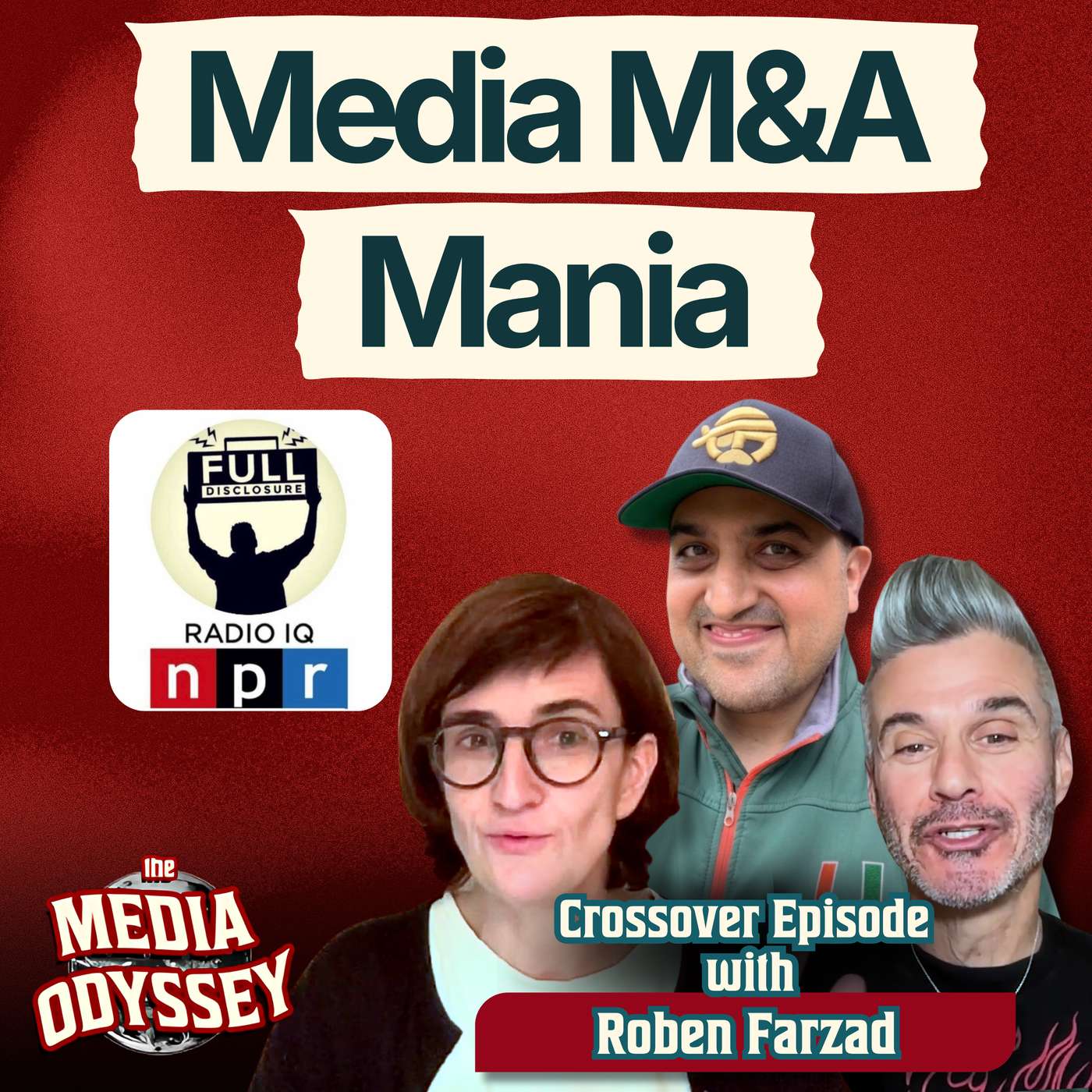
Welcome back to the Media Odyssey podcast and Full Disclosure in a very special crossover episode. That is Marion Ranchette.
- [00:10]
B
And that is Evangel Pyrope.
- [00:12]
C
And this. That is Robin Farzad.
- [00:14]
A
That is Robin Farzad. You jumped on.
- [00:17]
C
I'm Robin Farzad. I'm new here.
- [00:18]
A
See, it's when we rehearse that we fuck it up. Robin Farzad, who is the host of Full Disclosure on NPR and across the Internet. Thank you for joining us. Today we've got a special episode, crossover episode of our two podcasts. This is airing on both feeds, quote, unquote, airing on both feeds. And we're going to discuss a whole bunch of stuff. Welcome.
- [00:54]
C
Thank you for having me. I'm a longtime listener. In fact, several months ago, we had an ice storm here, and I was stuck in my car eating pizza like a squirrel and listening to your voice and Marianne's voice talk about Warner and Paramount and the quid pro quo. And it was just, it was, it was horrifying and comforting at the same time. So that's a memory core memory.
- [01:11]
B
I love, I love that story.
- [01:12]
A
Yeah, it's a great story. And that's actually where we started, kind of like as a lot of our guests get into each other's DMs. But for our listeners who may not know your show, can you please describe what the show's about?
- [01:24]
C
Yeah. Full Disclosure is broadly about the business of culture. I don't know. I mean, everybody has a pod now. My mother, I'm sure, has a pod. My mother listens to me.
- [01:31]
A
I like it, actually. I'm a writer.
- [01:33]
C
My mother in law listened to me. But, you know, I, I was a Wall street reporter for Business Week. I was at the New York Times before that. And I came from a Wall street background, and I loved writing about these things. And as the financial crisis happened, NPR was, you know, calling me to do explainers on All Things Considered on Morning Edition. And by the time I left Bloomberg, which bought our magazine, they're whispering in my ear to go off and build something on my own. So it started off almost as like, as a prototype, was like a fresh air for business, but it's, it's morphed into a much more omnivorous show. So whether, you know, you have academics, hedge fund people, creatives, lapsed cocaine kingpins, anything you throw at me as a
- [02:13]
A
lapsed cocaine kingpin, I thank you for reporting on our community. So admirable.
- [02:19]
C
Thank you.
- [02:19]
A
It's actually a big part of your background. And then for your listeners on Full Disclosure the Media Odyssey Podcast. Maren, why don't you describe. I'm interested. Marian, how would you describe the Media Odyssey podcast?
- [02:31]
B
So the way I pitch it, it's a transatletic friendship and I think we need that. Right? So both you and I were coming from the US and Europe and we're bringing our own perspectives and we, you know, we take a topic, any topic, and we just share our views on this. And I think that what makes it, you know, cool and interesting. Plus, you know, I have a cute accent.
- [02:54]
A
You do have. I do not have a cute accent. We do focus on media, I should say, for your.
- [02:59]
C
From a customer acquisition perspective. From a customer acquisition perspective, Evan, with all that junk on LinkedIn and all the self congratulatory, just razzle dazzle. What so stood out and cut through all of it because you've been on the show several years ago was your galactic snapshots of this changing universe. It was so shareable, so great. I mean you understood visual journalism and then the explainers behind it to cut through the bs. I'm a veteran of that linear T world and these what these guys did and didn't do. And you did LinkedIn, right? And you acquired this, you know, customer at the very least. So, you know, props to you. I think that's how we first met.
- [03:36]
A
It is. I appreciate it. And you slipped in. We slipped into each other's DMs, but that's also how I met Marion. And so I think, you know, the community we've built, I mean, this is a great example of it. And this crossover, as you said, Wonder Twins or super, super triplets powers.
- [03:50]
C
Yeah, yeah, yeah.
- [03:51]
A
So this is a crossover episode that we hatched and we wanted to discuss kind of the things where our two podcasts intersect. So the world of business and the world of business, media and the Cross Atlantic nature of it. And we've got a major topic in the merger of Disco Bros. And Paramount slash Nepo Land that we want to get to. But before we get there, I do want to talk about your background. A little bit deeper than just the Wall street and Business Week end of it. Because specifically a lot of your life is intersecting with the main gravitational forces in culture and the world today. So you were born in Iran. You are also an Iranian Jew, which is a particular experience. And then you escaped to the US during the initial Iranian revolution and then you went to Wall Street. You also became a journalist. What is your take right now on the state of journalism in the US through that prism with regards to the current conflict that's going on, you would
- [04:59]
C
think we'd be all over it. In fact, when it was first breaking, you know, when the Ayatollah was killed, when these various other operations happened. But it's been so famished across cable tv, across print, that it's so frustrating. I was even frustrated with NPR uncovering this, like, why don't we have more people out there? I see some people, it's Jane Ferguson, for example, with News Sphere and others that has embedded reporters. I'm so hungry for that shoe leather reporting, especially with the smartphone being. Even in the developed world being so omnipresent. Why can't we flip that on the way we used to? You know, I remember watching Tiananmen Square and they kicked CNN out. That was the only way to watch that. And now what's invigorating is being able to see a lot of this on Instagram happen live. But as you know, the curation and the verification, they're very difficult. And you don't know what to make from all of that. So I had this hunger to see what was happening in Iran that was so. That's absolutely, you know, shifting the balance of power in the Middle east, like World War I, like rebalancing, but such a paucity of thorough coverage. I mean, I can watch NewsHour in the evenings. I could try to go to BBC News, but here in the United States, that's say it's been a letdown. Even what's happened at the Washington Post, which you've talked about, it's a bit
- [06:15]
A
of a desert to a certain extent with regards to internal coverage. Typically, you're right. During previous events like this, the, the uprisings, we've gotten a tremendous amount of, you know, citizen reporting coming from the country. But now it feels like. And there. And it feels like a chill over the US Media establishment. It just doesn't feel like thorough reporting to, to my taking.
- [06:38]
C
And we're going into treacherous territory. As you've reported, there's Gulf money funding the warnamount deal, right? Warner, Paramount. And to what extent can you report on the Gulf kingdoms, on Saudi and the others? Freely? Because there's clearly a schism with Sunni and Shiite Persian Gulf. Once that money is accepted and once that's funded, it doesn't even have to be explicit. It just has to have a chilling effect. As, you know, if the owner is. If the owner says these things or feels these things, it's like working for Rupert Murdoch, you know, not to go there. And as you know, it's happening right now with Bari Weiss and CBS News
- [07:12]
A
and the Washington Post and its owner and the LA Times and its owner, et cetera, et cetera, et cetera, et cetera. But explain really quickly with regards to the influence of Saudi money behind the Warner Mount deal. As you said, you know, about 50% of the overall acquisition is being funded by foreign interests, including a number of Middle Eastern funds. And to your point, we're watching a realignment in this region along the scale of post World War I. The power shift amongst the ruling class in this region is dramatic. And those interests are currently getting involved in the acquisition of CNN by CBS and Paramount and CBS News.
- [07:59]
C
Yeah. While cnn, as we know, is still an economic asset, it's a declining asset. It throws off a tremendous amount of cash. It, as a chess piece, as a bauble, is so valuable for another country to come in and say that we own. It's just like Al Jazeera and the others. We effectively are the controlling money, even if we're silent money behind that. Are you going to be able to freely go and report, say the Saudis and the Houthis have another attack or some crimes against humanity happen? You are going to be less prone to do that. You're going to be less prone, you know, at 60 Minutes to report on these things because that is your money that is funding you. Whereas no one thinks it's an ideal world, this kind of Warner Brothers discovery apparatus. It's been very feckless, at least in the past. Even under Sumner Redstone in Paramount, they would largely leave this stuff alone. There has been, you know, what was the movie the Insider, about tobacco and
- [08:52]
B
I think one movie.
- [08:53]
C
No, I think it was. There were interventions in the past and there was corporate ownership. Let's not kid ourselves and think that these were puritanical, you know, news gathering, Edward R. Morrow things. But now it's blatant, like 60 Minutes. Absolutely. Do this interview with the disgraced doctor who was in the Epstein Files, like a puff piece, make it look great. Or throwing sand into reporting on the Salvadorian prisons and the situation there. And naturally, if you're kicking up tens
- [09:22]
A
of millions of sand, throwing sand, they cut the piece, they kill the piece. Yeah, yeah, yeah.
- [09:28]
C
But imagine if you're, if you're, if you're writing a check, if you're the kingdom doing that, have you ever just say, oh, no, just go ahead, have fun with it. It's going to be kind of at arm's length? I'm really skeptical about that.
- [09:38]
A
And as someone who grew up and escaped the Iranian. So Iran before the revolution was a relatively, I want to put this in context, progressive state. It was a Western themed culture, relatively free, not really the oppressive culture that it's become since the Ayatollah first took over. And then there was this sweeping shift. What do you see here? Someone, I don't know how old you were when you came over, but when you look at the United States and this kind of chilling acquiescence to an authoritarian figure, regardless of facts and evidence, do you see parallels? Or am I just being paranoid? Am I being kind of a New York bubble liberal, kind of worrying about fascism behind every corner?
- [10:27]
C
You know, I go out to dinner on this fact that Harvard Business School had a satellite campus in Tehran. As recently as 1978, it was that coveted an emerging market. US and Iran were allies. The Shah was flawed. He had a secret police. He was not exactly a torchbearer for human rights. And that, that vexed Jimmy Carter in his final two years in office with everything that happened in the hostage crisis. But it's not what you have now. And the CIA completely missed, you know, the Islamic revolution, the nefarious influence in the Gulf, obviously what's happened in Lebanon and the Marine barracks bombing in 1983. And that we've, we've been enemies now for the better part of 50 years. And what worries, I think a lot of people in the diaspora community is Trump showed up and he talked big, that this will be free, you know, it will be yours to take. And there was this massacre in January, I mean, Tiananmen like massacre by all measures that we're seeing in Iran. And now this idea emanating out of D.C. that we might be okay with a kind of a transactionalist solution a la Venezuela, where we get a strong man an sob. He might not be as religious, he might not be as theocratic as the others, but he will be transactional enough and we can do business with this guy.
- [11:37]
A
Is that even realistic, though?
- [11:39]
C
I don't know if that's realistic. They're crazy. Look, is anything realistic yesterday? You know, we're talking on Monday, but they say that we're thinking that maybe we can get Saudi and others to sign the Abraham Accords and normalize with Israel and Iran. You're welcome too. It's like, what kind of Jedi mind trick parallel universe is this? It's wishful, wishful thinking. In the meantime, people are suffering in Iran. You know, people have suffered in Venezuela in these sanctions. People are terrified. They don't have Internet. And this has largely been a population that has Western aspirations. So I don't know how to play it. And you know, if you're like, if you don't sign the peace deal, we're going to bomb you. It's so it's not even Orwellian, It's Kubrickian, it's Dr. Strangelove.
- [12:24]
A
And just really quickly, on the other hand, you said there was this realignment, kind of World War I esque. And we'll move on to more media focused stuff in a second. But my assessment is what this has done, especially if peace is brokered around the shape that it is now, what we've done in this conflict is handed Iran control of the Strait of Hormuz. They have proven that they can hold onto it against tremendous pressure from around the entire globe. And on the other side of it, if you, if this stranglehold isn't broken, they're going to use that as a tool whenever they want. Am I mistaken in the kind of miscalculation.
- [13:04]
C
I don't know, Evan. I don't even know if all this is a ruse to just kind of punt it till after November and the election and gas prices and bomb them again, maybe into submission. But it seems rich for me to come out and they're proposing tolls for the Strait of Hormuz tribute and then. Yeah, and unfreeze our assets and then we'll talk. So how is that vis a vis the position they were in three months ago? It all really beggars belief and I'm frustrated in that. The coverage. The Times has done a great job. The Wall Street Journal has done an amazing job. But there's so much more we could do with citizen journalism, even with the Internet shutdown. There's stuff that's emanating out of Turkey, people who have fled. And it's frustrating to me because there's so much hearsay and razzle dazzle on Instagram and TikTok and other places. And I wish there were more people who could sort it for me. I wish there were more adults in the room.
- [13:56]
A
A good deal of the lack of coverage around this story or the lack of thoroughness around the story is a sycophancy amongst the media elite in the US towards any administration, to be honest with you. But in this administration in particular, because of the transactional nature of this administration's relationship with business. And that gets us to kind of a lot of the other big stories around mergers and acquisitions in media you've been reporting recently about GameStop's acquisition of eBay. Marian, I don't know if you heard about this story, but this is a really crazy, transactional bizarre tale. Talk about how GameStop came to the idea of buying ebay and why they think that they can, you know, buy a company that's worth 5x what they're worth.
- [14:49]
C
As you know, as your listeners might know, something peculiar happened in the pandemic when we were in lockdown and you had this renaissance, if you will, a rediscovery of individual investor power. There was Gamestop, there was amc, the near defunct movie chain, a handful of other nostalgic names that over Reddit and other places, everybody said they came up with these slogans like diamond hands, I'm going to hold till I die and everything. Just go in there, buy, buy, buy, buy, buy. And certainly hedge fund managers are like these idiots. Small investors are out there, let's short these, let's go. And like you're like an orca swimming into a pot of seals, right? And it turns out that they were able to exact a lot of pain on these hedge fund managers. And it gave that community that was in, in, in lockdown and had nothing to do and had extra money, had stimulus money, had money sitting on the side, zero interest rate policy and everything, like, yeah, we beat them. And then the AMC CEOs like, yeah, our stock's up, let's sell a ton of stock and let's capitalize this otherwise, you know, paper meaningless buzz. And it's amazing to me is that five years after that Gamestop, which was similarly left for that, has an enterprising flamboyant CEO who's out there, who can effectively go straight to social media, is like, yeah, I'm going to make a bid, I'm going to make a bid for ebay. And it doesn't even have to be legit. He can half heartedly, half assedly go on CNBC and say it and he gets buzz and the stock moves up and the battalion of Gamestop mom and pop investors get all excited about it and it forces ebay to have to come and do something and it's just smack talking for smack talking sake. We've talked about certain congresspeople, MTG and others who could go straight to social media and they didn't have to worry about that institutional guardrails. And you're seeing that with the CEO worth quite a lot of money. He's a collector, no love lost for ebay and ebay policy. And he's out there hogging Some headlines, making news, making headway. And opportunistically, if the stock keeps going up. I was singing Air Supply on npr. That's how you make love out of nothing at all. Out of nothing at all. You create buzz and then you sell the stock and that's still a vestige of 0% interest rate in the time of NFTs and others. And there's still some of that out there. You know, like I, I tell you, I love RC Cola, I'm like the last person who drinks it. Am I going to agitate like a whole movement out there to get everybody to unlock RC Cola from Cadbury Schweppes and run its market value up and take out PepsiCo? I mean it's great fodder for a book proposal or screenplay, but it's, you
- [17:23]
A
can use, you can use social media right now to do that.
- [17:26]
C
And it's, you know, this is that, that was that president with Elon Musk. You guys might forget years ago where he said, I have, you know, Tesla, I can take it private. What is it? $420. And then he talks so much smack and so much smack. And the Twitter thing, was he talking smack when he wanted to take it? Turns out he could do it. And the numbers are so enormous now, whether you talk about Musk or the Ellisons and net worth and the hundreds and hundreds of billions of dollars that some of this alchemy is indeed notionally possible, which that's scary stuff. This used to be very deeply regulated SEC NASD territory and now people can come out and get time, a hearing on CNBC and actually move companies by billions of dollars.
- [18:11]
B
And what type of trends are you seeing? Right, you, we were chatting and you said, you know, big value, fewer deals. We've had some numbers thrown at us. Volume of deals decreased by 30%, but the value went up 10%. What does that tell you about what's going on within the media and entertainment ecosystem?
- [18:31]
C
You know, broadly, I think it's a transcontinental thing. There's been a, in terms of the markets, the developed markets, Europe, Canada and the others, Japan especially. I don't know if you've watched the Korean stock market. It's been out of control with Samsung and sk. It's been the best performing stock market by far.
- [18:48]
A
Samsung is up almost by 40% year on year in valuation. It's crazy. It's a trillion dollars.
- [18:54]
C
Look at sk, look at the, look at the cost. B itself I think is up 400. I mean it's crazy. These were dormant markets. In my world, International has not really done anything versus the S&P and Mag 7 for the better part of 15 years. And now, you know, Marion, especially with the bluster over NATO and NATO paying its own way, there's suddenly in shipbuilding and defense companies and others, there's money that's flowing into it, that purse strings are being unlocked. The broader question is can. Can France and Germany kind of cut a lot of the red tape that would allow for mergers like Mittelstadt companies in Germany to do this stuff? This has been a time immemorial question. And Wall street, every year they're like, this is finally the year they get that religion. In Japan, they called it the big bang. Can you cast off the 30 years of doing nothing by finally letting these companies merge and letting zombie companies go away? That remains to be seen. But there is interest, I can tell you, in data centers right now. That's the trend that's eating everything that's extended to power. You look at Caterpillar, right? You look at ancillary companies, Sandisk and the others that are enabling this enormous revolution. Infrastructure, trillions of dollars. Infrastructure stuff. We have a mega merger.
- [20:09]
A
Some of that is based on, on loose accounting, though. I mean, there is this kind of circular loop that's financing all of that we talked about. But Marian loves to focus on a lot of the M and E or M and A around M and E in Europe specific. Specifically, you're seeing MFE assemble across regional coalition or actually, you know, holdco of media in Europe. And then you're watching here in the US the same thing by a different Nepo family. So you've got the Berlusconis, the OG Nepo media oligarchy and then inspiring what's happening here in the U.S. marion and Far Robin, I'm interested to hear the two of you. What are those two things the nepo Ellisons and the Nepo Baro Scones mean to you about the state of, I don't know, consumer choice and you know, competition in media across the Atlantic? Maren, let's start with you.
- [21:09]
B
I think we're coming from two different places. Like Robin said, historically Europe was the, the. It's heavy, heavily regulated, right? So you could just not do whatever you wanted to do. And a few years ago on The French market, TF1 and M6 wanted to, to merge. And at the time it was rejected, right? The, the competition authorities rejected it because they were saying that two big commercial broadcasters going together would be, would be impairing the, the the, the competition within TV advertising. But it, it is true at the time, if you were just looking at TV advertising, they were. What Europe is doing right now, Exactly. What Robin is saying is that they're trying to kind of, you know, open up their mind a little. And the definition of what is, who is a competitor is way different. And so some of those deals that were rejected a few years ago are now being approved. And so one example is in Germany with RTL going after Sky Germany, so offloading Sky Germany from the Comcast NBC group. And this was approved within a year. So they're both, I think, a bit more lenient and bit faster, but I think because they realize it's a question of how media companies in the region can actually survive and thrive, you know, in front of big tech.
- [22:33]
A
But you see this as a net, a net positive, don't you, Maren? Well, this is something, this kind of, kind of cross regional consolidation and operational efficiency is something that you think is necessary for these regional players to compete against the big death, you know, big tech death stars, as I call them.
- [22:50]
B
Absolutely. And now depending on, you know, what merger we're talking about, you know, I'm less, I'm less worried when I see RTL and Sky or maybe a Sky ITV in the UK than I am looking at mfe. Because to your point, mfe, I like it on paper, right, that they want to build a pan European commercial broadcaster. It does make sense provided that, you know, the, they transform the innovate and they don't stay this big, you know, say fat TV advertiser and not do anything else to transform their business. But then within mfe, I'm worried, of course, as anyone should be, about the impact in each of those European markets, given Napo Berlusconi in the back. But Robin, how about you in the U.S. how do you look at those? Would you want to see no mergers or are you happy with some mergers, maybe not others?
- [23:44]
C
I don't understand the impetus. You know, I said it with Evan Offline. It's a very late stage capitalism thing. What did all of the friction and heat of Warner Brothers Discovery accomplish? Right, if the inception was what, 2022 when it became public And David Zaslav in here. David Zaslav, who by the way, has earned unbelievable amounts.
- [24:04]
A
He's been paid over the last nearly a billion dollars. Yes.
- [24:07]
C
Right. So you give yourselves a huge pat on the back for taking this off of AT&T's hands. AT&T saddles you with debt and you convinced the board to let you just pay me on deleveraging and free cash flow and nothing was accomplished. There was round trip, there was a lot of IP that was killed as you know. What was it? Spider Girl initially, what they said?
- [24:28]
A
No, it was Batgirl and then Roadrunner and Roadrunner and Coyote, which is now coming out and a couple of other.
- [24:35]
C
Like we're getting. Oh, we're getting an exciting net operating loss out of this.
- [24:39]
A
I mean. Right. But you know, crucially, some things were accomplished. They destroyed an enormous amount of value. They were worth $60 billion at merger. Then they shed most, you know, more than half of that value. Close to 70% of that value at one point. And the only thing that resurrected the value was the auction that Zaslav had in the meantime. Thousands. Thousands of jobs cost. Thousands of jobs cost.
- [25:03]
C
Oh, and then shareholder value. If this pushes through the amount of debt and deleveraging, I don't think that, you know, the Ellisons are just going to sit back and let it do its thing. Thing. You can imagine cnn. You're going to imagine the studios. You saw what happened with Fox and Disney.
- [25:18]
A
No, right, right.
- [25:20]
C
Yeah. I don't think that, I don't think that European regulators would be as easy as they are on this. In this case, you have a president who's incented. They were, they were just busy, you know, it was going down the gullet. Paramount, that acquisition which was contentious, taking it off of Sherry Redstone. And then they immediately telegraphed that we'd like Warner Brothers too. And the White House is like, if you want Warner Brothers, you better take cnn. And just beggars belief. There's so much disruption, so much destruction. You have talent, people in the industry signing things, begging for regulators to block it. And every indication being that the White House wants to speed this through as early as July 20th. I don't even know if that's humanly possible, but to my mind, Marianne, to answer your question, it's a very reductionist thing. And I don't mean to sound like a kid daddy, why do mergers happen? I understand, I'm cold eyed. But if it only boils down to the stock price, what did this guy accomplish? I mean, he was a caretaker for hbo. You had several great seasons of succession which was signed on before he was there or the White Lotus. And if it's just Ledger domain and deleveraging and getting the stock price back up and round tripping and you extracting the Juice in the meantime, have you no shame? Remember he was yelled off the stage at that commencement speech. Was it at BU or BC when he was there? Some people just don't get it. And so it's my same beef with Elon Musk. And Twitter was the only thing that a fiduciary has to worry about the stock price, not the fact that the site might crash under him, that he's gonna gut 70% of the staff, that he'll allow right wing trolls to come in. Isn't there a more holistic review of these things? Or have we become so, you know, jaded and glazed over?
- [27:06]
A
Well, there's. I mean, there's the more. There's the moralistic, there's the kind of general and traditional and a historic form of corruption, which is I'm enriching myself. So, you know, the Zaslavian, you know, Machiavellian, you know, bullshit flywheel of I'm going to funnel direct cash into my hands.
- [27:26]
C
He's saying, look at the free cash flow. Look at the free cash flow. Look what I've done. By any metric. By any other metric, right?
- [27:34]
A
And a board profit, revenue, growth, you know, any of those metrics, he fails.
- [27:39]
C
He's historically taken the money on the first day of Warner Brothers discovery and put it in the S&P 500 and trounced what they did.
- [27:47]
A
Right, because it rode all the way down and then all the way back up.
- [27:51]
C
But there's a difference between that.
- [27:53]
A
There's a difference between that traditional I'm going to enrich myself and be incompetent at the same time and what seems to be a different type of use of the popular sphere and you know, frankly, financial wealth that you're talking about with regards to Musk and now with specifically regards to the Ellisons, which is, I'm going to utilize these levers. I have all this wealth, all of these connections, all of this relationship I have with the United States government to not only enrich myself, but build a moat around a certain, frankly, population. So I'm going to protect my government contracts. SpaceX. And now he's going to become a trillionaire. So using Twitter and all the other levers that he has, he used it to kind of consolidate contracts for himself and his company to make himself a trillionaire and solidify power with Starlink and a whole bunch of other things. Similarly, the Ellisons have. There's a meeting last summer where the younger Ellison goes to the administration that promises to make changes at Paramount in exchange for the merger being approved. This is recorded. They pay off the White House through settling a lawsuit against 60 Minutes. 60 Minutes. Ellison David Ellison himself negotiates that deal in a kind of quid pro quo thing. And the Colbert firing and the attack on 60 minutes, this is all engineered. Then the next day after that meeting, calls Colbert and fires him, cancels the show, then a couple weeks later leaks a story that the show is not profitable and that's why they cancel the show. Then hires Bari Weiss, gives her CBS News. She immediately goes about attacking 60 minutes to the point where Anderson Cooper quits and now she's going to rejigger the entire show this summer. There's an actual exchange of value between this corporation and this administration to change reporting, change free speech on the network in exchange for specific benefits. And these are not necessarily tied to Paramount. There's the whole AI infrastructure executive order that the White House signed. There's so many different quid pro quos. There's the whole ByteDance and TikTok negotiation the White House did on behalf of the Ellisons. Am I being paranoid or is this actually going on right in front of our eyes? And how dangerous do you think this is for both business in the United States and the media and the social media?
- [30:45]
C
I mean, I'm looking for an analog. I'm looking for an analog. I kind of want to invoke Teapot Dome scandal or Tammany hall or something, but this is on the orders of trillions of dollars, to say nothing of TikTok and the United States and Oracle being involved in the tech stack of the US TikTok right now. That is a tremendous amount of money and in kind of really lackluster defense of the system, at least I could say that it's largely out in the open. When he sues an ABC or when he takes that tribute, it's such BS. It's such like. You went in 60 minutes, you edited this Kamala interview. No, that's routine editing. All that stuff happens or what he did. Take it back to the Venezuela thing. I'm going to extract this guy. I'm not going to hand off the democracy to the Nobel Prize winner or extol her. But we're going to get your oil and it's going to be beautiful. And there's something just delightful about that kind of naked. I don't even know what transactionalism. It's very id. It's reptilian brain and.
- [31:42]
A
And yet the press is not covering what's happening with.
- [31:45]
C
Because how are you going to cover it? Who else is going to cover it? Disney owns abc, right? CBS is now CBS and cnn. How are you going to As a CNN editor right now, how are you going to assign people to cover this? The New York Times is going to do it. And he's had the New York Times in his crosshair, the Washington Post, as you know, owned by a person with unbelievable amounts of fu. Money. And he's decided, nah, actually, you know, maybe his version of Paola was that Melania documentary. $40 million, right? $150 million for the free press. I mean, it was making buzz. It was great, but. And you compare those numbers, Evan, to this thing you published over the weekend. The Colbert show was profitable.
- [32:24]
A
Yeah, it is. I mean, it's just basic United States media network accounting. You have to look at all the revenue levers. It was very clearly, yes, the profit margins were going down year after year after year, as were the revenues. No question that this is an aging and declining asset. But you lied. I mean, you just outright lied about it being not profitable. But then my problem is the Wall Street Journal and Puck don't even bother pushing back. There's not even remotely a modicum of pushback on this.
- [33:01]
C
Just
- [33:04]
A
lie.
- [33:04]
C
I. I think you see some stuff from Dylan Byers, I think you see some stuff from Bill Cohen, and I'll tell you, Oliver Darcy has been amazing about it.
- [33:12]
A
Yeah, that's true.
- [33:13]
C
On his. On his thing. And this is a person who knew CNN on the inside and was jilted, and we've had him on the show. You talk about an Iranian American. That guy's down low. Iranian American. Like, he puts me to shame. I should just go start my Persian food truck. But every week he's out there hammering and taking leaks from CBS News staffers.
- [33:30]
A
Yeah, I read that religiously.
- [33:32]
C
Yeah, so what? Who's going to have the appetite to cover this? The. The, you know, Rupert Murdoch, strangely, has been a better steward of the Wall Street Journal than the New York.
- [33:41]
A
And the New York Post has been covering the fuck out of this story.
- [33:43]
C
Yeah, the New York Post loves that stuff. The New York Post loves giving CBS staffers like used to with Norah o', Donnell, and it's doing the same with Barry Weiss because people love to do this stuff. And the New York Post has lost money on and off. Look, I don't think anybody's buying these media assets for the news cash flows. I think it's overwhelmingly for him. It's this studio streaming business, the super app of Warner and Paramount. But it takes out, as you know, it takes outsize attention, the CBS News division and Tony Dekupel in 60 Minutes and Anderson Cooper and The layoffs that are going to happen at cnn, if this is indeed folded into CBS News and there are very few players on the outside that are willing to poke holes into that. There are many substackers, as we know. But Evan, you know, the bind. How many substacks can you subscribe to?
- [34:31]
A
Well, at least a few. Those represented on this podcast. Anyway. Marion, you're going to ask a question.
- [34:38]
B
No, but what I'm listening to you guys. Two things, right? Number one, you have this thing in the US where you have to personify the companies. You know, we, we've been talking about Zeslav, we've been talking about Ellison. I'm in European media and I don't know if I can name, you know, the CEO of, you know, sky or you know, RTL Group. Well, it so happens that I know. But these people are part of an organization. They don't represent the organization. And so the light is not on them. Right. So there's that thing that you guys are doing that is it's such about ego. You look at the Ellison, you look at Musk, it's about ego. To your point, it's about money. We're very focused kind of head down on trying to find mergence and acquisition. That makes sense. Is it exactly what needs to happen? I don't know. We'll know in five years from now. But to me it makes more sense to put nrtl, nsky, one pay tv, one free together than it is, you know, forget the Allison, forget everyone. But to put two exact studios together, Marian.
- [35:50]
C
And don't you have more protections for studio jobs or studio, what they call redundancies there? Well, here it's. They'll make a faint phrase about, you know, we'll put out 30 pictures combined and then Wall street won't hold them to that over two years. And then over time you'll see what happened with Fox and Disney and you'll see what happened with the Warners in Paramount.
- [36:09]
B
Yeah, but every time those are companies that are, you know, so it's about the ego. I want to get this thing. Or it's about again making something bigger that is exactly resembling what you have already. And so that's where I don't really believe in M and A. I don't see how it's going to advance a Paramount and a Warner to come together. But when you see companies who are, who could be in some way complementary, I do have a bit of hope that something good can come out of it. Does that mean there's not going to Be a single layoff. Doubt it. Most companies are struggling and are going to need to make some cuts, especially the traditional media. That is. Yeah, yeah, that is. That is striking when you look at the US Now, a few things like that are happening here, too. So this thing about CNN and cbs, to some extent we have that. We have our own Rupert Murdoch in France with, you know, Bolo, and he's exactly that. He's embodying that company. And during the Cannes Film Festival, there was a petition against him. And what happened? Maxime Sada, CEO of Canal plus, instead of, you know, trying to quiet things down, et cetera, said, we will not be working with people who have signed that petition. That's like over 2,000 people from the movie ecosystem in France. So those things, those, those mini games, those deals in the past.
- [37:33]
A
There's a parallel here in the U.S. yeah, there are parallels here in the U.S. thousands of members of SAG signed and DGA signed an open letter saying, coming out against the Paramount Warner merger. And so let me pivot it to. And this is a question for both of you, because I feel like you're both more expert in these separate areas than I am. So you've got Ellison here talking about not reducing jobs necessarily disproportionately, and putting out more movies now between the two studios that than than both are putting out now in order to get approval from, let's say, you know, the caucus in California or the House or the attorney general in California. And then they're going to make similar weird promises, I'm sure, in Europe, to get EU regulators to approve this deal, because they also have to approve approve this. And then you've got the House and Senate, the House very likely changing hands, the Senate perhaps changing hands this fall. You know, if this all the timing has to fall into place. But do you think from both perspectives, Marion from the eu, Robin from the US do you think this thing gets through? Do you think that the Paramount Disco Brothers merger gets approved? Maren, let's start with you.
- [38:56]
B
I wanted to start with Robin because I wonder if the center of gravity is in the U.S. i kind of have a feeling that this is much more. It has an impact in Europe.
- [39:07]
A
But if the Europeans wanted to block it, they could, couldn't they?
- [39:12]
C
I mean, if the state AGs wanted to band together and block it, could they could California and Connecticut and the others. My impression, you're racing to get this approved before he officially becomes a lame duck in Donald Trump, because the worm might turn in a certain way, as with Iran. Whereas after November, if you're a U.S. senator, if you're other people, you can invade against this, you can, you can run against this. You can say, we have to have hearings on why this needs to be broken up. So I wonder if after that the Ellisons moderate their positions. You know, there's. There's reporting that Bari Weiss is not long for the top job at cbs. Maybe they.
- [39:51]
A
Because she's incompetent.
- [39:52]
C
She's not a TV person.
- [39:53]
A
Because she's incompetent. I, this. I. In the piece that you mentioned earlier, I not only detailed the accounting that shows that the show is without question profitable. I then outlined just how incompetent all of the decisions Nepo Ellison has made. Hiring Barry Weiss, paying her $150 million.
- [40:10]
C
That's just the edge for her fucking newsletter. 150 million versus what?
- [40:14]
A
Which is more than the cost of the late show. Yeah. And then the, the other. She fucks up the premiere because she gets in the teleprompter and changes the script herself seconds before they go live. And then it's embarrassing. It's like the anchorman. You got to watch that tape.
- [40:30]
C
Yeah. What's happened with China and Taiwan?
- [40:33]
A
And then he can't get into China because he doesn't have a fucking visa. And then they get kicked out of their hotel. She's incompetent. The ratings are bottoming out. They have the lowest ratings for the evening news and the morning show this century.
- [40:48]
C
But I think it's more than. It's an embarrassment. It's more than. It's an embarrassment for the, for the prodigal son. It's not that it's a financial.
- [40:55]
A
Jeff Shell, his hand picked person to run the whole enterprise, gets kicked out because he's a sex addict. Like it's. It's an entire. Like it's a bad look overall. My question though is just mechanically, it's a race against time to get this thing approved before the fall election. Right. Is it? You've got private nonprofit organizations suing to get access to the records of the conversation between Ellison and the fcc. There are other movements afoot. Rob Banta wants to be President of the United States. He's going to make this. Gavin Newsom.
- [41:32]
C
What can the AG in California do? I don't know the other levers. You could pull this. The FCC is kind of bent on waving this through. In fact, post haste, you never see. You would never have seen one. I'm not sure this would pass regulatory muster, period.
- [41:45]
A
Ever.
- [41:45]
C
Right.
- [41:46]
A
Forget about any Other administration.
- [41:47]
C
But again, they're not even. They don't even have Skydance, doesn't even have Paramount, CBS in the gullet, much less digested and amortized. And is saying, I'm going after this thing so you could throttle it. But they're saying we want it done. And the president wants CNN specifically changing hands between now and then. Cnn, I don't think is the priority of the, of the Ellison.
- [42:09]
A
I'm going to put a fun. We do predictions on this show. I don't know about your show. We make. We put our necks on the line, figuratively and literally. Well, figuratively on the line here. So I'm going to ask you, what do you think the odds that this, this merger gets through at all?
- [42:24]
C
I put them at two thirds the odds that it gets through and that there's a, there's a time delay aspect in it.
- [42:30]
A
75% chance this gets.
- [42:32]
C
Or 63. Yeah, I put it at roughly 65% that it gets through. If, you know, in their world, in their perfect world, it would get through by the end of summer, which is unbelievable. I mean, again, we, you know, unprecedented. That just doesn't happen. These mergers take time. Years, years. But they lined up the equity that they were very responsive. There was even like Zaslav, you're not returning our call. He masterfully played Netflix against the other people and got the $31 bid credit to him. The shareholders. The shareholders want that $31 and the president wants it.
- [43:04]
A
But they did vote down his pay package. The shareholders. Marin, what do you think the odds are again? I think the EU is going to take a look at this, but I could be wrong. What do you think the odds are this gets there?
- [43:14]
B
Honestly, I doubt that we'll go against it if it gets approved on your side. I don't think we're going to go fight for this. There's a lot of other things we're not fighting the way we should. Just like talking about taxes at the moment. And it ended up cutting a deal, a very lousy one. So honestly, I don't think they're going to fight it. So whatever happens on your end will dictate what happens on our end. And timing wise, the timing is tricky. But I don't know, who knows? It could go fast if people are putting enough effort on your side.
- [43:51]
C
Evan, I do have sources in the Senate saying that if this does. If, let's say the Dems capture the Senate in 2028, they could go back and bring up hearings about using foreign corrupt practice. What Is it the corrupt practices? If you codified bribery in this case, the payoffs for the 60 Minutes or ABC things or the quid pro quos and everything, and you open up hearings to that, you could theoretically have an agitation for a breakup. But by then, this is really yesterday's news. I think what's really worrisome is the layoffs you would see in news gathering, which everyone is talking about, that that's the fat pinata to whack because there's a tremendous amount of debt to have to bring down. It's like we've seen this story before. Warner Brothers has done terrible things to several kingdoms. We saw AOL Time Warner. We saw the AT&T time Warner catastrophe. We saw Warner Brothers discovery. And now a rose by any other name.
- [44:44]
A
You know, let's end on a big question which we haven't done in a couple of weeks. The question of the week. So you look at all this, and I think there's a lot to be said. First of all, Marion's point with regards to the regulatory protection around media and media jobs is really crucial here. But I think when you look back to the 80s and early 90s and the removal of the Fairness Doctrine and a couple of other major protections, the installation of section 230, really the combination of capitalism and news gathering and journalism has been really destructive for the art form or the science. Is there a way. What is the answer to professional journalism in the era of rampant capitalism? Does. Does journalism need to be nonprofit? Is that the only way? You know, does it have to be public service like NewsHour here in the United States or as it is on public broadcasting in Europe? Is that the only answer financially, long term, for quality journalism? I'll throw it to both of you. Marion.
- [45:52]
C
Orra, it's depressing stuff. How many billionaire backstops have you had? Not worked The LA Times, obviously, the Washington Post. That was supposed to be a panacea, like a patient investor. It was 2007 that Rupert Murdoch came in and bought dow Jones for $5 billion and got the Wall Street Journal. He's been a better parent than most. I'd say the Wall Street Journal now digitally looks great, but there's something sweet, generous about that. That's, you know, hedge funds and brokerage firms and law firms, they all have to have a Wall Street Journal subscription. The New York Times, Meredith pulled off some other crazy thing, you might call it, a lifestyle brand. I think they doubled down on their indispensable. Yeah, their indispensable journalism. They didn't blink with Trump 1 and they were able to capitalize that and now suddenly they have a $12 billion market cap.
- [46:37]
A
But you're there as much a gaming company or are they.
- [46:42]
C
Why do you, why do you covet your New York Times? Do you really cover your New York Times subscription for the food? Is it really for cooking or for Wordle? I think it's for the news. And it's not a janky app. It's something that you're like, yes. So we're not talking about print revenue going away at the New York Times anymore. But I'll say that you look at my sphere, public media, it's not done a great job. It has not leaned into digital at all. I deal with a lot of member stations. Whereas what they know is pledge drives, what they know is the radio pledge drive and how to hit up boomers and late stage Gen Xers for money. And they've always been really skeptical of being kind of digital natives. Meanwhile, we've had people called NPR apostates. They've gone off to Vox Media, they've gone off to the New York Times, right? You think of Lourdes Garcia Navarro, Lulu Garcia Navarro. That was, this is a lot of it out of frustration of things they could not do for a public good.org company that was not a digital native. So they take their act to a for profit company with family protection and everything. And they do amazing things. You see, James Murdoch is buying the Vox podcast network right now. You see the people who went and did the bulwark are getting funded. So it could be, it could be so much better if it wasn't running scared, if it wasn't terrified of the defunding and the CPB thing. It's so necessary, as is Amtrak, as is public transportation. But it's neglected and it's not digital native. Do you know, Evan, that I have never been allowed to tout my show on the NPR One app? They always say just tell them to get it where they get all podcasts. Like, does that really offend stations so much that when you tell them to go to NPR1, this is technology. We're not all beholden to your gigantic antenna anymore. But meanwhile government comes in and cuts CPB funding. I can go on and on and on and on for this. I'm not hopeful. You know, there's ProPublica, there are a handful of other situations.
- [48:38]
A
Well, and you may bring up Oliver Darcy and you bring up, you bring up, there's Semaphore, there's Heather Cox Richardson. There are a bunch of journalists out there going direct to consumer. That could be the other answer to it. And you let people self select to a certain extent, but it does leave out those who can't afford to subscribe to pay journalism. But anyway, this has been a fascinating conversation I have really enjoyed. I'm, I'm glad for our friendship. But I'm also really happy that we've found a way to bring.
- [49:09]
C
I'm sorry I botched. I'm sorry I botched the intro. Maybe I could, you know, cover myself.
- [49:15]
A
People love this.
- [49:19]
C
But you know, in all honesty, I love what you guys do. I love that I could get it on demand. I love that your, your substack is getting great momentum. I love that the pod sounds great. I love that you don't fill it with hydrogenated crappy stuff and fossil fuel ads. So keep, keep doing it. I'm a big fan for my cheap seats.
- [49:40]
A
Thanks so much for being here. So this has been the crossover episode of Full Disclosure and the Media Odyssey podcast. That is Robin Farzad.
- [49:50]
C
That is Evan Shapiro.
- [49:52]
A
Shapiro.
- [49:53]
C
Oh, I messed it up. Shapiro.
- [49:55]
A
You fucked it up again.
- [49:57]
C
That is Evan Shapiro. Can we rewind?
- [50:00]
A
Go back again? And that is Marion Ranchette. Thank you very much for listening. We'll all see you next week on our various feeds.
- [50:07]
C
Thank you, guys.