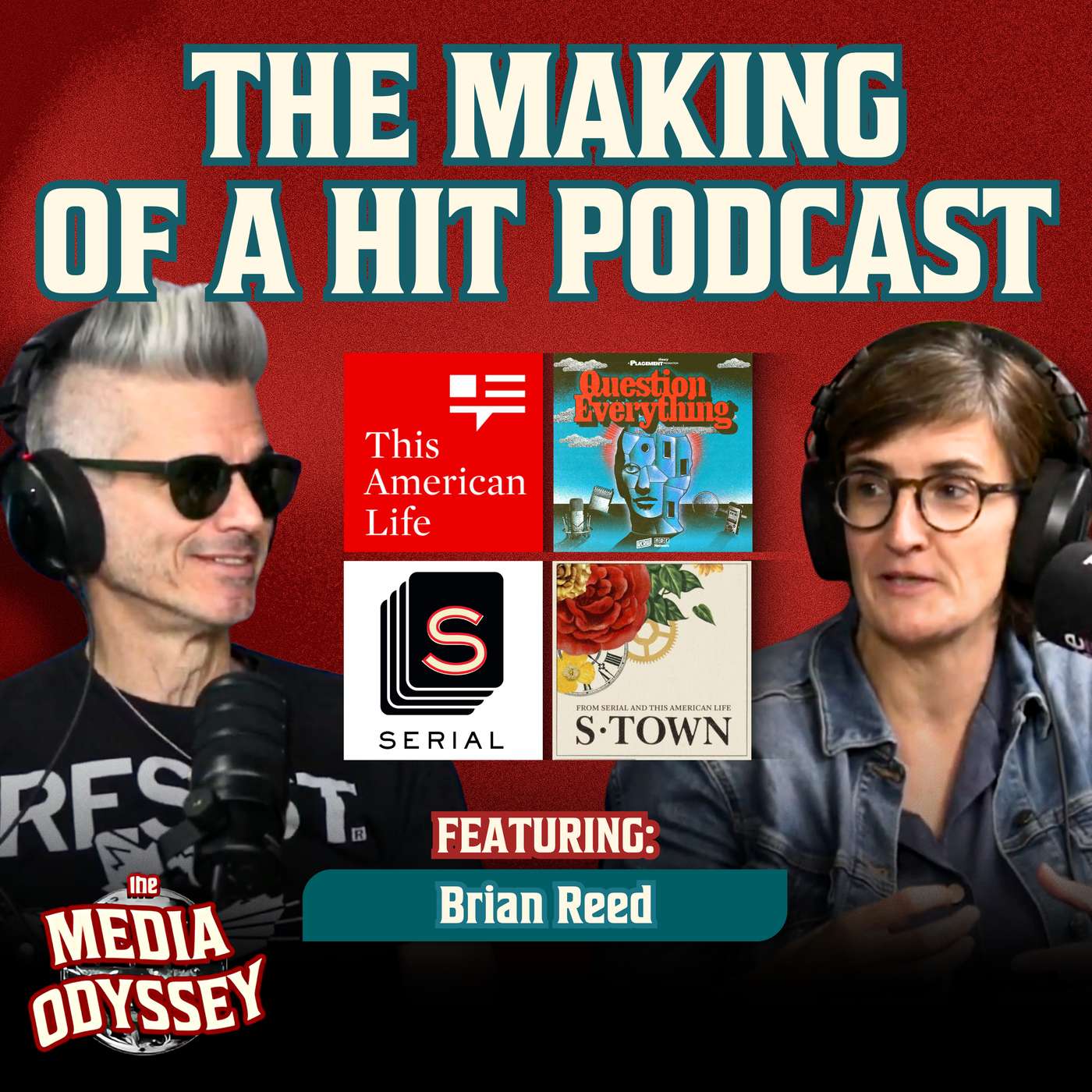
Loading summary
Transcript154 lines
- [00:00]
Brian Reed
I want to hear this show, Cancel Culture, where you tried to get canceled a bunch with your daughter. That sounds great.
- [00:05]
Evan Shapiro
You can. You can. You can download it right now on.
- [00:08]
Brian Reed
You're still here. So I guess it didn't work.
- [00:10]
Evan Shapiro
They tried every week. We did. Our first episode was about Weep. I mean, we did not take it lightly. They. Yeah, yeah. No, it was whether or not I could tell a rape joke. And it was. Yeah, I got out alive. I got out alive.
- [00:26]
Marianne Ren
Foreign.
- [00:39]
Evan Shapiro
This is the Media Odyssey podcast. That is Marianne Ren. She.
- [00:43]
Marianne Ren
And that is Ivan Chaparro.
- [00:45]
Evan Shapiro
And we've got a really special episode of the podcast for both of us, because you and I, Marianne, we're relatively new to the podcasting game for the whole history of podcasting, but on this episode, we have legitimately one of the giants of the art form, somebody who has helped shape current podcasting ethos and has made some of the most important, and I would say, impactful podcasts in the genre's history. Were you aware of his work before. Before we brought him on the show?
- [01:19]
Marianne Ren
So I, of course, knew about cereal. I've listened to many of their pods. Did not know Brian specifically, but that's what I love about this relationship, is that, you know, you're making me discover new folks.
- [01:31]
Evan Shapiro
Brian Reed, who is our guest and we'll bring on in a second. He specializes in what I would call documentary podcasting. And when you look at the breakdown of most popular podcasts of all time, you've got the current wave of a lot of hosted bro podcasts and other types of podcasts out there. But when you look at the grand history of podcasting, documentary podcasts tend to be some of the biggest, most, I would say, paradigm shifting types of shows out there. I prefer. Even though we do a talk show commentary podcast, my favorite form of podcasting is documentary podcasting because it just. I get lost in them in a way that I can't on a chat show. What are your favorite genres? What are your favorite podcasts? I didn't even know to ask you that, to be honest.
- [02:19]
Marianne Ren
So, yeah, on one, I. I actually started, you know, listening to podcasts thanks to that specific genre. So docue pods, you know, for. For lack of a better word, so. And actually, one of the first ones might have been, you know, from serial. So. And then, you know, slowly but surely, I was craving for more and more. What we'll see today is, I'm assuming those are very heavy in terms of production, lead time, et cetera. And it really became a daily habit for me like, to the point where, you know, I know exactly on which day Smart list, which I love, you know, comes out on Mondays and I need a good laugh on Monday. So that's my go to every day. The Daily show, which, interestingly enough, I listen less to the French equivalent.
- [03:08]
Evan Shapiro
So. The Daily. The New York Times. The Daily.
- [03:11]
Marianne Ren
Yeah, yeah, yeah, I said the Daily Show. Sorry about that, but I listened to that one more than I listened to the equivalent by Le Monde. Right. So. And, yeah, I mean, some days I don't even have enough to chew on. And a few of the ones that I've really liked recently are fictional ones, actually. And there's one that I would recommend, but it's in French, but essentially it's about the French presidency. And, you know, it's a serialized, you know, like, drama about. Exactly. About the, you know, in and out of the French presidency that it's a few years old. But, yeah, I'm a. I'm fond of podcasts.
- [03:53]
Evan Shapiro
Well, and. And I've made a number of podcasts over my career. First of all, my introduction to podcasting started kind of in the OG 2007.8 era, and I actually was one of the first people to help turn podcasts into television shows. I did that with Comedy Bang Bang, which is one of the legendary comedy podcasts of all time. Legendary podcasts of all time. Scott Aukerman and his crew. And then we also turned Marc Maron's podcast WTF into a scripted show on IFC as well. And then we went on to turn Harmon Quest into a television show, My brother, my brother and me into a television show. And then more recently, I produced a scripted podcast called National Lampoon's Radio Hour Podcast Cola Scola, who went on to win a Tony Award for o' Mary. Megan Stalter, who is now on Hacks. Whole bunch of really amazing talent that went on to do some really fun stuff. And then in more recent times, I did a podcast with my daughter called Cancel Culture, and it was me trying to get canceled by a bunch of gen Zers. And then more most recently, this is our podcast. So I have a long history with podcasts. I've loved podcasts. But I will tell you that I think one of the reasons I love podcasts to this day is the man we're about to introduce who has, as we've mentioned, had a pivotal role in some of the seminal pieces of work in the art form. So without further ado, so let's bring on our guest, Brian Reed. How are you?
- [05:31]
Brian Reed
I'm good. Thanks for having me and for such a nice introduction.
- [05:34]
Evan Shapiro
Sure, sure. Well, we have to fill time. You have to give them something to fast forward to before the meat of the episode.
- [05:41]
Brian Reed
You know that better. Exactly. I want to hear this show, Cancel Culture, where you tried to get canceled a bunch with your daughter. That sounds great.
- [05:47]
Evan Shapiro
You can, you can, you can download it right now on you're still here.
- [05:51]
Brian Reed
So I guess it didn't work. You're still here in the public eye.
- [05:54]
Evan Shapiro
So they tried every week. We did. Our first episode was about. I mean, we did not take it lightly. They. Yeah, yeah. No, it was whether or not I could tell a rape joke. And it was. Yeah, I got out alive. I got out alive.
- [06:09]
Brian Reed
Wow.
- [06:09]
Evan Shapiro
So you can listen to that now.
- [06:11]
Brian Reed
All right, bless you.
- [06:12]
Evan Shapiro
But anyway, let's talk about your. Your art form, which is truly. I mean, would you call it documentary podcasting or documentary audio?
- [06:21]
Brian Reed
Yeah, it's documentary. You know, I think for a long time, the people kind of in my orbit, which is. I really. I came up at this American Life and that. And that orbit, kind of a public radio narrative podcasting orbit. We stayed away from the word documentary because it sounded stuffy and not fun. But I think the meaning around that, that term has changed over the years since documentaries kind of got a little more entertaining and exciting, you know, and documentary series and stuff. But yeah, it's documentary.
- [06:47]
Evan Shapiro
It's.
- [06:47]
Brian Reed
It's journalism, it's reporting, it's long form narrative, you know, long form nonfiction, but in audio.
- [06:54]
Evan Shapiro
So you were, as you said, you were in the school of this American Life, which is, I would say, if not the most successful podcast of all time. And it started as a radio show, let's be honest, but then moved into podcasting. I would say it's probably the most successful if, if not the most successful, one of the two or three most successful podcasts of all time. And Ira Glass, who's the founder of that, really invented. Didn't invent audio documentaries, but really crafted what I would say the long form podcast and really turned it into what it is. What was it like being in school? You know, how old were you when you got that gig? What was it like working there? You know, just take us back in time to your origin inside that show.
- [07:39]
Brian Reed
I got my start in radio at npr, which this American Life is not technically part of. I could go into all the kind of, you know, arcane structure of the public radio system if you want, but otherwise, I'll spare you.
- [07:50]
Evan Shapiro
No, that's. Yeah, actually, we'll do that. A little later in the show.
- [07:54]
Brian Reed
Yeah, exactly. But I had a fellowship at NPR shortly out of college called the KROC Fellowship, which was wonderful. It was for people who had no experience in radio. And that's where I even learned that, like, radio was a thing you could do. That's where I really started to learn about this American Life. But I was just learning just chops, you know, kind of like how to use the recorder, how to interview, how to make a spot, how to do a news spot, how to do digital. You know, I got stationed in. I was mostly in D.C. but got stationed in Seattle at a member station for a period and did reporting there. It was a great training ground. And then shortly after there, in 2010, I got the internship at this American Life, which was at that point based in New York and was part of. Even though it was part of WBZ Chicago. So this American Life was founded in the mid-90s by Ira with WBZ Chicago. Um, and, you know, there are public radio stations all across the country, and they're all independent for the most part, or part of like, a, you know, a local university, for instance. Like, they're all independent organizations. And I promised you I wouldn't do this. But then they form a board that governs npr, but they can all buy programming on their own from different places. They can create shows and then offer them on the market to public radio stations. And so that's what WBC Chicago did with this American Life. But I started there in 2010 as an intern. And, yeah, I just remember it was just such a. Such a learning experience to take kind of these skills. I'd learned to do more news audio and news radio spots and apply them to story. And it really just suited me. I was a theater major in college and a history major. And I found that that was actually like, the perfect pairing because it was like the kind of research part of history. And I just found that we used terms that were very familiar to me from theater at this American Life. We would talk about characters and bringing characters on stage. Like, the first time you hear a character in tape and stakes and drama and conflict and scenes, that's how we thought about the stories. And that's what I was learning as an Internet. And, yeah, I got thrown into kind of my first couple of big stories, one of which was about. So this was like, 2010. So one of the things kind of right around the time of the financial crisis, and one of the things we were covering was the car industry bailout of that period. And the first Big story I worked on was I produced an NPR reporter who was the auto reporter telling an hour long tale of this car factory called Nummi, which was like this very awesome, interesting collaboration between American car makers and Japanese carmakers. And it was just like going out there interviewing people, thinking about the tape, structuring it, figuring out the order, figuring out how you wanted to tell the story, who the characters would be, and from there, yeah, it just, I loved it and became a full time producer about a year plus later and was there till 2022.
- [11:00]
Marianne Ren
When you joined that team within American Life, how many people were you? How did that start? Right. How did you. What was the premise? What were you trying to achieve initially? And then we can segue into how big you've become. But I think it's interesting to see those early days within that specific show.
- [11:23]
Brian Reed
Yeah, I mean it wasn't even. The show had been. I joined in 2010, so the show started in 94. So it had a bunch of eras before me, you know, and when I
- [11:33]
Evan Shapiro
joined era, where it was converting into a podcast, at this point, when I
- [11:37]
Brian Reed
joined, the podcast exists. So one of my jobs as an intern was to kind of, you know, take the radio show and create the podcast files and kind of figure out all the delivery on a Friday night. I'd be there late, kind of just, you know, doing all the different versions of the show and how we would release them. So it was. And I think by that point, like the podcast audience was getting close to the radio audience, if not higher.
- [11:58]
Evan Shapiro
Were you there when serial first was pitched or brought up? How did that. I think that was really what Marin
- [12:04]
Brian Reed
was, was thinking about was, oh, I see, yeah, yeah.
- [12:06]
Evan Shapiro
Where did that come from and how. Who pitched it? And I mean it's, it's kind of a standard up until that point. This American Life, when you listen to it, there's what, three or four chapters, three or four different stories per episode? This was one.
- [12:20]
Brian Reed
Yeah, I do think at that point, at that point we'd done, we'd been doing more, you know, the show became interested more in the news and applying the lens of personal storytelling, which it had gotten so good at, to current events around 9 11. So before I was there, by the time I was there, they had done, for instance, the giant pool of money, which was an hour long, really kind of canonical exploration of what was happening in the financial system. That really came out, I believe, before the real crash happened in 22, in 2008, and got into a lot of the issues early. And that spawned the creation of Planet Money, which was a podcast at npr. And it was kind of a joint project between NPR and this American Life, using this type of storytelling to talk about pretty complex economic issues and economic news. So they were experimenting a lot with applying telling stories through a personal lens in audio to things that really matter and that were in the news. And so when I was there, that was very much a part of the ideas we were pitching. Yes, a lot of shows would be three acts and there'd be personal stories or an essay. But also like a lot of shows were an hour long documentary that was about something topical or high stakes, like the car story I mentioned that I worked on. We'd done a two part series about a high school in in Chicago that was like undergoing an epidemic of gun violence that won a Peabody. So we were really investing in these kind of long form, hour long or sometimes two hour long stories as well. But really, actually the way serial came about was kind of not directly out of that. We'd also experimented a couple times with a show called this Week, where usually we had very long lead times on our shows. Like it would take three months to do a story that was a pretty serious documentary, sometimes six months for a really investigative one. But a couple times we were like, we just want to do something where everything happened in that week, which at that time, this is pre daily, pretty pre any kind of daily podcast, you know. And so we did a couple experiments where we, you know, planned a bunch and found a mix of both newsy stories and personal things that were happening in people's lives across the country and documented them in the this American Lifestyle just that week. And those were really fun, really hard. And I remember around the time of a retreat we were having maybe like 2013 or something like that, the senior producer, Julie Snyder and Sarah Koenig, who was a producer on the show, were pitching the idea of turning that into its own podcast that would be a spinoff a this Week, this American Lifestyle, this Week podcast. And they pitched it.
- [14:57]
Evan Shapiro
We were not this specifically that story, but just the concept itself.
- [15:01]
Brian Reed
The concept of let's do a weekly show where everything happened that week and we tell it in our personal style. So kind of like the daily, but weekly in a way and like a little more this American lifey and personal. And we were at like a retreat center in upstate New York. Again, small staff, and I just remember people not being into it. Like this sounds really hard. What's the point? I don't get it. You know, like that was the Vibe, if I recall correctly. But it was like the first time we were talking about like let's make another show, you know, aside from Planet Money, that's really in house, that takes our style and applies it to what's happening in the country. That week anyway, fell flat. And shortly after, I believe around that time, Sarah had gotten pitched the story about Adnan Syed. You know, like, like I said, we were doing these kind of long, hour long investigations. Sarah had done a couple great ones like this one called Dr. Gilmore and Mr. Hyde, which was like a murder investigation in the south around this doctor that was really great and, and fascinating. And so she was starting to get pitches that were kind of, you know, in that realm, like wrongful conviction murder pitches. And she got pitched the story about Adnan Syed. And she pitched it, I believe, as structured as a multi part serial and kind of laid out how she thought it could go. And you know, the spirit of this American life is really special where it was at that time, especially one of real invention and kind of exploration. You could try things. And Ira was like, yeah, give it a whirl. We like see, see how it goes. And she and Julie Snyder went off and like worked on the reporting. Dana Chivas was a producer.
- [16:44]
Evan Shapiro
Did they move to Baltimore?
- [16:46]
Brian Reed
No, I don't think so. I mean Sarah lived in Pennsylvania, which wasn't, it wasn't like terribly close to Baltimore. But I don't think she, she moved there. No, but she was there a lot. But like her, you know, her, her interviews with Adnan were on the phone, you know. Cause he was in, he was in jail. Well, he's in jail. Yeah. Yeah.
- [17:06]
Evan Shapiro
I can't imagine pulling a podcast mic into. I guess it happens. I mean, Ted Bundy was not to compare. But so, so the expectations. So she starts making this and then it turns into this, obviously a show that you're going to release. And the expectations at the time were this will do fine. Maybe it'll get a few hundred thousand.
- [17:26]
Brian Reed
I mean I wasn't directly, you know, so I was, I was like working on this American Life, but like kind of we're all in the same office like, you know, kind of like talking about this. My understanding was a few hundred thousand downloads was what was expected and what they were kind of planning, budgeting for.
- [17:40]
Evan Shapiro
And now it's the most listened podcast in the history of podcast.
- [17:43]
Brian Reed
I haven't checked, but it's hundreds of millions of downloads at this point, probably for that one season. You know, it just took off and it was, you know, I Think a lot of times now investigative podcasts are done when they release. That's certainly what we did with S Town, my show, but they were reporting it weekly, like. Like they'd done a lot of the reporting, but it was not.
- [18:04]
Evan Shapiro
It was breaking news every time. And to the point where he just got out of jail, like last month.
- [18:09]
Brian Reed
It's continued for years. I mean, I can't even keep track of the number of times like his conviction's been thrown out and then reinstated and he's been out of jail because of the podcast.
- [18:18]
Evan Shapiro
There's no way that he gets out of jail without that podcast happening. Don't you agree to that?
- [18:22]
Brian Reed
I think probably likely, yeah. I don't know if you can directly prove it, but yes, I think it brought a ton of attention and people looked at the case again and yeah, for.
- [18:31]
Evan Shapiro
And then in the. In the order of things, where does the sale of Serial to New York Times happen in relation to what happened to you, which is you came up with your own version of a serial. So under the label of Serial, you came up with your own show. Tell us the order of all of that.
- [18:50]
Brian Reed
Well, I'd actually started so that you're talking.
- [18:52]
Evan Shapiro
You're talking as much as your memory holds it. S Town.
- [18:55]
Brian Reed
Yeah, you're talking about my show. S Town. So that was a story that I started reporting even before Serial was a thought.
- [19:00]
Evan Shapiro
Oh, interesting.
- [19:02]
Brian Reed
That's a story that was about a listener to this American Life named John B. McLemore and he'd written the show, I believe. The first email to the show from John came in in late 2012, and I noticed it and started corresponding with him. I started talking to him more in earnest about a year later in 2013, and visited him, I think it was 2014, in Alabama. He was from Alabama. So I was kind of like where it was just kind of this little side thing, like it was a really. Not a lark, but pretty speculative as a story. He. This was a man who'd written us.
- [19:37]
Evan Shapiro
Yeah, yeah, go ahead.
- [19:38]
Brian Reed
This a man. He was a listener to the show. He wrote our like listener email address to this American Life and said with the subject line, John B. McLemore lives in Shittown, Alabama. So that's what caught my eye. And then he just had this very kind of excited and interesting and expletive laden writing style. And in his email he was talking about a murder, a couple things that had happened in his area in Bibb County, Alabama, one of which was a murder he said had happened, that someone had gotten away with. Like a local rich kid, basically. And I was like, all right, well, this guy sounds interesting. And if this happened, that's bad, and someone should look into this murder. And again, you have to put yourself in the mindset of, like, narrative podcasts and true crime. Podcasts didn't exist at this point, you know, like, now it seems like, well, yeah, but, like, they didn't exist. Serial didn't exist. And so I started talking to him and looking into the murderer, but also from the first time I talked to him, I was just more interested in him than the murderer. Like, he was such an interesting person and funny and dark and twisted and, you know, surprising. So, anyway, that was ongoing, that investigation. When Serial came out in 2014, and then I picked it back up again in 2015. We did talk about it as, like, another season of Serial when the after serial was a success with the first season about Adnan Sayed, they were like, I guess we got to do another one. You know, suddenly there was, like, a new show without really being planned. And then John B. McLemore ended up dying by suicide in 2015, and that really changed the nature of the story. Things were happening down there in the wake of his death. An estate battle. People were dealing with his death. And so I started focusing more on it right after his death and reporting down in Alabama more and more. At that point, I was also running this American Life, so I was like, half time running this American Life. It's a senior producer and halftime reporting in Alabama. Yeah, you're bringing me back to a time that was busy in my head. And, yeah, gradually we decided to make it its own show and to not do it as a season of Serial. It was like Serial's. I don't know. I can't remember all the reasons, but we just thought it suited the material to really package it as its own thing. It would be surprising. It really still felt like a time. This is a medium that is new, and you can do things for the first time ever that a listener's ever heard. And I could hear as I was reporting this show, like, down in Alabama, the types of interviews I was getting. Just the type of material was very novelistic. It was very gothic, but, you know, just naturally, like, without me having to do much to it in terms of the writing, like, I could hear something in my head that didn't exist yet, and I was like, you know, it's not gonna be easy. But I could picture what it could be, and what that was was like a totally true, rigorously reported audio nonfiction Novel. And, you know, Julie Snyder, who had made Serial with. Who had edited Serial, she's a master audio editor who had edited Serial with Sarah Koenig. She was my editor on this. And we really just. Even from the beginning, we were reading novels and talking about that as a model for something in our medium. With Adnan's Story, they talked about kind of prestige tv, like hbo. They were like, you know, weekly cliffhangers. That was kind of their model. And with S Town, we were like, let's. Let's think about novels as a model. And so we ultimately released all the episodes at once, which was also new. I believe that was one of the first times that happened, and that felt new because that was even new for Netflix at the time. Like, they'd only done that a few times. This was 2017 when we released it, so it was seven episodes. We released them all at once so you could binge them. We labeled them chapters instead of episodes and really tried to give it the feeling both in the writing, the structuring, the producing of a novel. And people thought it was like a bunch of people thought they were fictional characters, but they weren't. It was totally reported and fact checked.
- [23:46]
Marianne Ren
What were your expectations?
- [23:48]
Brian Reed
Number one, I didn't have numerical expectations, but, I mean, it's a weird story. I thought it was gonna maybe have like a cult following, you know, like, it was like, you know, it's a guy in the deep south talking about tattoos and nipple piercings and like, kind of gothic, gory stuff.
- [24:07]
Evan Shapiro
Takes a lot of tw.
- [24:09]
Brian Reed
It's strange and like, yeah, it starts as a murder investigation, but it's not. We really leave that after the second episode, and it becomes like a character study. So I don't know. You know, as a creative person, I really find that you have to make something that you want to hear that speaks to you. You can't be kind of calibrating to an audience. You know, it's like the. I mean, I heard Bong Joo Ho, the director, say this quote, but I believe he was quoting Martin Scorsese, which is like the most. The most personal, is the most creative. And the thing that really speaks to you, and that's our job as creatives, is to kind of trust our instinct that we're interested in something that an audience doesn't know they want yet, rather than trying to calibrate to what we think an audience wants. And so I generally try not to think about that that much, so I was just trusting somebody will find this interesting. I find it interesting enough and if I can try to communicate what that is to them, there'll be a niche audience. But it did quite well, I think, was getting maybe 40 million downloads. But for the first month. I don't remember the exact timeline, but we're in the hundreds now as well for those seven episodes. But it came out about 10, nine years ago.
- [25:21]
Marianne Ren
And you said that you built it as a novel, but actually it's gonna become a TV show, right?
- [25:29]
Brian Reed
Well, hopefully we're in development. Yeah, we're in development at Apple TV as a TV show. And ye. It's been through a few different iterations. It was going to be a movie.
- [25:39]
Evan Shapiro
It feels like.
- [25:40]
Brian Reed
Yeah.
- [25:40]
Evan Shapiro
When you listen to it, it feels like In Cold Blood a bit. Especially at the beginning. It feels like. Which is not a novel, but feels like a novel. It feels like it might be more
- [25:51]
Brian Reed
of a novel than we know.
- [25:54]
Evan Shapiro
Right.
- [25:54]
Brian Reed
Exactly.
- [25:54]
Evan Shapiro
As it turns out, Truman's not the most truthful guy in the world, but. Yeah, but it feels. It feels like a piece of literary fiction to us to a certain extent. It also winds up being. I had never been to Alabama by that point in my life. I've been since, but like Birmingham, Mobile.
- [26:17]
Brian Reed
Okay.
- [26:18]
Evan Shapiro
Montgomery went on a human rights food, music tour of the South.
- [26:22]
Brian Reed
Okay.
- [26:23]
Evan Shapiro
And the Human Rights Museum, which is down there, which is the. Known as the Lynching Museum, is one
- [26:27]
Brian Reed
of the most fun I haven't been yet, honestly, in Montgomery. Yeah, I know it sounds worth a trip.
- [26:32]
Evan Shapiro
Montgomery is a creepy fucking town. There's nothing else to like. Yeah, it's still celebrating the Confederacy to this day, but it's also one of the most notable civil rights landmarks in the country, if not the world. So you have that dichotomy, which I think S Town really captures beautifully. If you have not listened to Serial. If you're listening to this and you can hear my voice and you haven't listened to either Serial or S Town. Listen to both. They don't read anything about either. Just go and listen to them for the first time. Remarkable works of art. So right around this time, or after S Town, Serial gets sold to the New York Times.
- [27:20]
Brian Reed
Yeah, that was a few years later. Yeah, that was 2020. So it was during the pandemic. Yeah.
- [27:25]
Evan Shapiro
Yeah. What was that like? Did that feel like a divorce? Did that feel. Which part did you wind up going with? You know, you were running this American Life Serial gets sold for, I think, $25 million to the new York Times. What? Is that all? How's that?
- [27:40]
Brian Reed
So by that point. So I. I had been Running this American Life S Town came out. I was running it again, editing it, kind of overseeing the editorial direction of it was my job. And then I did another long form investigative series. So that took me away from that job again and that became too hard to do both. So by the time Serial was sold, I was this American Life employee. Serial was kind of like a sister company of this American Life, producing Serial seasons and some spinoff podcasts. S Town was the first. I was then working on another one called the Trojan Horse affair. And in 2020, serial productions, but not this American Life was acquired by the New York Times. And so that included S Town, which was under Serial Productions, and then some other shows Serial and the show I was working on at the time called the Trojan Horse Affair. So I had this experience of working on the Trojan Horse Affair, pre Serial or pre New York Times, and then kind of post. I don't know, it was a weird time in general. Like it was the pandemic. So we went through this kind of change but weren't seeing anybody in person. Like I never went to the New York Times office. Cyril didn't even move to the New York Times office. I was still this American Life employee on loan to this other company that had been purchased by Serial. So, you know, in a time when we weren't seeing each other. So I don't know, it's hard to explain how it was like I was kind of just heads down making something really and writing and trying to figure out this very hard series that I was co reporting with a newbie reporter from Britain, Hamza Syed, who had met at an event who'd pitched me something and became. I mean, it's kind of crazy from his perspective. He was a. I met him the night before he was about to start his investigative journalism master's program. So totally new to journalism. He'd been a doctor in a previous career and. And he pitched me this story about an anonymous letter that had caused all sorts of havoc in England and based in his town, specifically Birmingham, England, that nobody had ever figured out the author of. And he pitched that we should go figure out who the author was. And so we started doing that. We were doing that for years and then suddenly he found himself releasing an eight part series with the New York Times years later, you know what I mean? This random student who pitched me something backstage and we started working on it as this American Life story. And then it was going series through Serial, which was already a big thing for him. And then suddenly it was like the New York Times is releasing his first story that he pitched as a student.
- [30:17]
Evan Shapiro
Well, it had all the elements. It had all the elements. You know, it was about religion, Muslims, you know, there.
- [30:25]
Brian Reed
Yeah. Xenophobia, Islamophobia.
- [30:27]
Evan Shapiro
Xenophobia. Yeah.
- [30:28]
Brian Reed
Racism, misinformation and lies. Yeah, for sure. Yeah.
- [30:33]
Evan Shapiro
It had everything the Times probably loved. Yeah, yeah.
- [30:37]
Brian Reed
So anyway, what I ended up doing is I didn't end up staying at the New York Times after that came out. I ended up taking a break to be with my daughter who'd been born, and then setting out on my own rather than sticking with the times or going back to this American life after that came out in 2022.
- [30:55]
Evan Shapiro
Right.
- [30:56]
Marianne Ren
So you left in 2022, but you have your own company now. Do you want to tell us more about that?
- [31:02]
Brian Reed
Yeah. So I started a company called Placement Theory, an audio production company with another longtime this American Life producer, Robin Simeon. Peabody Award winning, Emmy award winning producer who worked at this American Life even longer than I did, 15 years. And. Oh, I see it in your background. Nice. There you go. Fellow Emmy award winner. And yeah, we really wanted to. We were kind of looking around the landscape at that point. She and I had done this work for more than 10 years each and kind of we're thinking about, you know, if you want to make something really ambitious, if you've done this type of work, audio, narrative, documentary for a long time and you want to kind of push the envelope and really have work, you know, have a place that understands this medium and how to do it specifically. Because at that point, you know, there were a lot of kind of quick entrance rushing into podcasting. After the success of Serial and a lot of other shows, there was a boom and we just found like, yeah, there'd be money or there'd be interest from, from Hollywood studios, but you talk to people and it's like, oh, I'm going to be drag. I'm going to be dragging them along because I'm the one who actually knows how to make this stuff. And they think it's like making a TV show and it's not. It's its own medium. It has its own requirements, its own creative culture, its own kind of supports that creatives need and its own strengths that you want to play to, you know, and really harness that, make it special. And we just weren't finding a place that really had that. Serial had been that place, but now that it was part of the New York Times, kind of the culture of that big corporation wasn't totally what I was interested in. And I know A lot of other people too. And so we decided to start Placement Theory to be that new place, basically because we didn't see a place for people kind of our experience and background to go make something great. We wanted to give creators equity ownership in the studio. So that's a big part of our ethos. And we launched our first show a year and a half ago called Question Everything, which I host, which was kind of a baby of mine that had been brewing for years in my head, where I just started to realize it didn't make sense to keep putting normal journalism out into the world, given the state of how people receive facts in America and elsewhere. And it felt. Started to feel sort of crazy just pretending like everything was normal and we should just keep doing the same work without really turning the lens on journalism and the information ecosystem and just like our trust of each other or distrust of each other first. And so Question Everything is a show that is rigorous journalism, like I've always done, but kind of turns its lens on journalism itself. How it's made, how it gets metabolized in the information.
- [33:54]
Evan Shapiro
So it's investigative journalism. About investigative journalism to a certain extent, basically.
- [33:59]
Brian Reed
Yeah, though we've expanded the lens to tech and other things that, you know and, you know, and just we've responded to the world as it's changed over even just the last year and a half. Just a lot of attacks on the First Amendment, on free speech. So, you know, we're really trying to kind of. But not in a straight news way. Like we're really trying to kind of think about how people get information, how people find the truth. Like what are better ways we can promote the truth, have people trust the truth, have people feel like they're finding the truth. And that's what we're focused on with our show. And then we have others in development, which we haven't released yet. But that's been our. And that show is in partnership with kcrw, which is a member station, a public radio member station in la. So it kind of feels quite familiar, frankly, in a certain sense, because that's how this American Life started was back at WBZ Chicago, and there's kind of a nice tradition of innovative national shows being incubated and started by local member stations in the public radio ecosystem. So this American Life, but also Radiolab at WNYC and Fresh Air at W HYY in Philadelphia. So this feels like a nice part of that tradition.
- [35:17]
Marianne Ren
And you've mentioned that you are an audio production company and I find that super interesting. We can get into the audio versus video transformation happening in your space, but maybe a bit prior to that is how do you make the. The economics work? Right. I feel it's. There's a bit of a mismatch between the. There's like amazing content, super qualitative. And then I always wonder, you know, how do you fund that? How do you monetize? Is it just ads, you know, baked into the program? Can you tell us a bit more about that?
- [35:57]
Brian Reed
I mean, it's hard. We're new. We're figuring it out. Like, we're still figuring out how to get our show profitable. We have the support of a public radio station, which I find really aligned because, yes, we need to be a sustainable show, but they're a nonprofit that has a mission as well, and they're funded largely by listener giving. And so by having a show that, you know, is meaningful to people, that also helps drive revenue that way, which then funds the show. So there's kind of this added layer. But yes, we're. We're selling ads, and we're really focused on our show with kind of more bespoke sponsorships. That's the strategy we've taken in our second year. We reorganized our kind of our model
- [36:39]
Evan Shapiro
too, by the way.
- [36:41]
Brian Reed
We've reorganized our sales teams to really focus on that, and we're starting to get some proof points, which is nice. Yeah. And then I think just something that's been shown across the podcasting ecosystem is that you need to diversify and have listener support or subscriptions as well. So we're looking into that for the show as well, and we'll probably launch something like that soon. So it's like that mix of revenue, basically. But we have this added just layer buffer, just being in the public radio ecosystem, where I can go and pitch on KCRW and say your support of kcrw, which fully supports our show, you know, allows us to exist, allows this journalism to exist as well.
- [37:26]
Evan Shapiro
Well, and. And it's not. And it's not just, you know, this show because you like this show. I mean, this was named one of the top podcasts by Apple in 2025. In particular, I think Marion's question around the monetization of podcasting opens up a larger question around the monetization or the sustainability of journalism itself.
- [37:44]
Brian Reed
Yeah.
- [37:45]
Evan Shapiro
So when you. When you. You. You've taken this show and you've kind of turned the lens, although it's a. A mic on, you know, journalism itself, and then you look at, you know, mystery and Marion, which is this two part episode that really, I think, you know, blew up for you, but also was a really important story about the nature of journalism and in particular local journalism and the importance of local journalism. But so many newspapers and radio stations and even television stations are now shutting down around the country. What has those two episodes, Mystery and Marian, which is about the attack of a local police chief on a local newspaper who was investigating him at the time. Listen to that as well. But what has this investigation of journalism itself taught you about the state of journalism, maybe in the United States, but perhaps around the rest of the world?
- [38:38]
Brian Reed
I mean, so much you mean, but specifically from like a business perspective.
- [38:42]
Evan Shapiro
I don't know. I mean, the sustainability of it. How can journalism, quality journalism survive? You know, something that's not pure red meat. Opinion, which obviously has its place in the world, but that seems to be the only monetizable part of the journalism journalistic ecosystem right now. What has it taught you about both the business and art and sustainability of journalism itself?
- [39:09]
Brian Reed
Here's what I come back to that is useful. Like a very kind of basic thing that, because honestly, it can feel dispiriting. You know, there's a lot like the state of journalism is really rough. Like the economics are bad, Many thousands of local newspapers have gone away. The trust between the public and journalists is incredibly low.
- [39:33]
Evan Shapiro
Yeah.
- [39:35]
Brian Reed
Meanwhile, like the Internet is harder and harder to navigate in terms of knowing what's reliable by the day with AI and deep fakes and social media algorithms and propagandists and bad actors. And then there's a lot of very powerful attacks on the press happening from the highest powerful people in the country. And the media, I think, is arguably getting captured in the US and we've covered that a lot on our show. The idea that, you know, there's the idea that like, you know, the regime, the government administration, really exercises an inappropriate amount of control over aspects of the media ecosystem to make it be more of a megaphone and to stamp out dissenting voices more and more. And there's actually, you know, scholars who've studied the stages of media capture in countries around the world. And like we're hitting them here in the US there's four. One of them is defunding public radio and public broadcasting, which happened last year.
- [40:44]
Evan Shapiro
They did lose that. They lost that case yesterday. I don't know if the money will go back.
- [40:49]
Brian Reed
But the Trump administration, yeah, I mean, that's a good First Amendment win, but that was against Trump's executive order to stop funding public radio and public Broadcasting, but then Congress defunded it. So it doesn't change that. Unfortunately. It's kind of a Pyrrhic victory in a way. Sadly, it could restore a little funding for certain programming. But anyway, so anyway, it can feel really dispiriting. I also like as a show, a lot of media shows, I think they live in the kind of the rarefied world of New York media land. And it's a lot of or DC and it's a lot of inside baseball and palace intrigue. That's not our interest. I really try to get out in the country and talk to people and news consumers and how they're interacting with the news. Are they paying attention to the things I just mentioned? Do they care that public radio was defund it or not? You know, and what I learned from doing that is that people a, they do want truth. They want reliable information. There is a true desire there. So that is a market. You know, they want truthful information, but they feel so tired and burned out and overwhelmed and don't know how to find it. So I don't have a solution. But that to me is a classic problem that a business could be poised to solve, a journalism business. You have a market that wants something and there's a problem, they have trouble finding the thing they want. And so we try to explore different ways that you might get at that on the show. And I think I'm arriving slowly at a grand unified theory of what to do that comes out of all these ideas, but I haven't gotten there yet. And you know, it has to do with different incentives on the Internet and, you know, different ways of presenting reporting. And it has to do with influencers and them presenting reporting. And you know, like one of the things we've looked at a lot on the show are just the rise of influencers and how a lot of people are getting information that way. And I've reported on a number of them and I think there's some journalists who are kind of very anti influencers or kind of derisive about them. I don't feel that way. I feel like they're reaching audiences, you know, and I like many of them are doing them in their styles. Yeah, right. And I find, and I do find, like, I find that when you look under the hood, which I've done a few times now, like I wouldn't rely on them for like my news news, but I think you could with like a little bit of work, like if they invested in, if there was some infrastructure given to them or they Invested in a certain amount of infrastructure, like just kind of journalism, journalistic fact checking, some certain standards. It wouldn't. It would be like 15% extra work than they're doing and it would be reliable. So I think there are opportunities there too, like I've imagined. Like, what if you make an Associated Press out of influencers, you know, and provide support? Like, I think there are opportunities, you know, to explore so that we, you know, that that's what we. Those are the stories we tried to tell on the show. Like. Like, what are the problems? How are they affecting people? And what are the different things people are trying that seem like they might be nuggets of ideas?
- [44:02]
Evan Shapiro
I'm interviewing someone on stage and by the time this episode comes out, I might have already done this. Gaspard G. Who is a journalist and commentator, young guy in France. There's also Hugo Decrypt, who's in France, who's done a really good job of this. You've got the news agents in the uk, but then you've also got people like Don Lemon and, you know, not my favorite Chuck Todd out there, and Acosta, all now, you know, independent journalists out there in the world, somehow making it all work between various inputs. It does feel like a moment where the creator sphere and mainstream journalism can meet in the middle to create a more sustainable, independent world of journalism.
- [44:52]
Brian Reed
Yeah.
- [44:53]
Evan Shapiro
And you, I think you're, you know, your show is a great, great example of this. It is deep investigative reporting. It is quality journalism. You're funding it yourself. Right. I mean, you have, you partner in. In the public radio there, but it's your company that's doing.
- [45:08]
Brian Reed
Yeah, we're indy.
- [45:09]
Evan Shapiro
It is plausible. But we do have to look for new models, I think.
- [45:12]
Brian Reed
No, it's. It's exciting. It's exciting in a way like that. You could find a new way. Like. Like the flip side of the. Of the sadness is excitement, you know.
- [45:21]
Marianne Ren
Yeah, you mentioned influencers, but I think we should talk about creators, because the names you mentioned, Evan, I put these guys in the creator buckets and there's a difference, right. For me, the influencers. So I don't know exactly how many are operating within news, because influencers don't. The business model is essentially someone is paying them to be influential. So I would cast them aside, you know, as a truthful source of truth. But, you know, the names, like, you saw Hugo, Hugo, Hugo Decrypt on the French market, et cetera, et cetera, those are, you know, big teams now in the background. So it's been growing the same way that, you know, you guys grew out of a very small team with cereal. And I put these guys in, in that creative bucket. I do love that idea of saying, you know, they should have more of that tooling to go that one step further. And I think there's a way to do that. We should see more partnership happening between traditional media and those new sources of truth, or hopefully truthful news.
- [46:35]
Brian Reed
I know. I mean, what you find is like traditional media is trying to kind of like copy what they're doing. So they're hiring video coach, like the, you know, the Wall Street Journal is hiring like a creator coach. I think the Times has one now too. They're, you know, bringing on in there. I saw some reporting recently that they've met with different influencers to get tips or, you know, they've been looking at Mr. Beast, you know, like big legacy.
- [46:55]
Evan Shapiro
But then you look at the CNN experiment. If you look at the CNN with the podcasting, it just looks embarrassing. It looks like old people trying to be young. I know, but, but Gaspar G is partnering with TF1 in, in France. You know, you are partnering with public radio. So I think, and by the way, I think Marin and I, and I think, Brian, you would all agree that perhaps public funded media is one of the key answers here to create true independence between, you know, commercialization and fact checking.
- [47:30]
Brian Reed
And I mean, it's, that's what a lot of the creator ecosystem is. It's like support us, you know, basically, you know, it's not public, but it is listener supported or reader supported, you know, viewer supported.
- [47:41]
Marianne Ren
I think what makes a big difference here is the fact that regardless of who. Right. But it's about, it's very much the personal brand, you know, that you're putting out there. I think that's why it works and that's why traditional media is struggling is that those are big companies, they don't have that physical existence. You can't relate to the Bloomberg LinkedIn or whatever, but you can relate to, to Hugo Gaspard and whoever using LinkedIn and other social media to deliver that news. Right. So I think it's, how do you find a way to embody your brand just like creators do?
- [48:22]
Evan Shapiro
Well, and I think one of the key reasons we all love podcasting so much is it feels so personal. Like, you know, Brian, I knew you before I knew you because I've listened to your voice in my ear alone in a dark.
- [48:36]
Brian Reed
I think the audio specifically is like the most intimate of all of them, you know, you know, yeah, Someone.
- [48:42]
Evan Shapiro
And is that why you're so resistant to video?
- [48:45]
Brian Reed
I'm not resistant to video, but I'm aware of the. With the work we make, the realities of what it would take to create a video product. Like, a lot of the work we make, you'd be having to make a documentary, basically, you know.
- [49:00]
Evan Shapiro
Right. Which is much more expensive.
- [49:02]
Brian Reed
Yeah. And so then it is like a different enterprise, frankly, than what we're doing. You know, I think there's. There's certain segments and types of segments we do that translate and we have experimented with video. Like, I'm. I'm down to try stuff. Like, honestly, like, more what I'm interested in is just doing something kind of separate on TikTok. I've been like, experimenting a little. Like, everybody just like, let me do this explainer. Like, there's a lot of things, ideas I have that don't make it onto our, like, show proper, you know, which goes through a lot of editing and we really. A lot of stuff hits the cutting floor, cutting room floor.
- [49:33]
Marianne Ren
But.
- [49:33]
Brian Reed
And that seems cool to me to be able to go on TikTok and be like, here's an observation I have that didn't make it into the show, you know, that came out of being deep inside this reporting, you know. Yeah.
- [49:45]
Evan Shapiro
When you look at some of the biggest podcasts of all time, their audio only this American Life, Planet Money, you know, Serial didn't have video components. And to your point, if they had tried to add video to them, it would have slowed them down and. Or added tremendous expense, which would have made it almost unsustainable.
- [50:01]
Brian Reed
Right. Like, and I think, you know, you have to look at where your audience is like, you know, so we launched with some video with question everything. We do a periodic segment in a wine shop that my co founder, Robin and her husband own in Brooklyn, and we shut it down and get journalists together to talk about different topics, like covering Epstein or we got influencers together a bunch one night that was kind of fun. We just did one on Monday night with a bunch of reporters who are covering the rise of gambling and how it's affecting both sports and reporting in general, which was crazy. I just learned a ton. And yeah, we try to get people a little tipsy and talk about stuff late night. And so we started recording those and we, you know, we invested in it for the first couple and put, you know, cut them down, put them on YouTube. These are two and a half hour segments that were cutting down to like 45 minutes. And it's five or six people so we had like four cameras, you know, so it was a real thing. And we just found that we weren't doing them frequently enough to build an audience on YouTube. And meanwhile, our audience was growing on the traditional audio platform, specifically like Apple and npr. That's where our audience was. And so we made the decision with kcrw. Let's focus on where our audience is. This video stuff is cool, but it's a lot of work. And yeah, when you have a certain amount of resources, those are just the decisions you have to make. So it's not that I'm resistant. I, you know, I definitely feel FOMO sometimes when I just see like podcast clips going around and ours aren't in the mix. And I try to think of ways to do that, and it's not something that's off the table for us, you know, but I do have to, like, prioritize the thing where we have the most audience. That is really our strength, frankly, which is like audio narrative.
- [51:41]
Marianne Ren
Yeah. I have to say that you could treat video as more of a, you know, discovery play. You know, it's shoulder content. So what you said. Right. So there's the main episode, but who, you know, here's that bonus. And then you just take a cam and you, you shot it places and you try to bring people back to, you know, audio platforms to consume the full length episode.
- [52:02]
Brian Reed
Though even I think it's still just awareness. Like, my understanding from just both anecdotally and data I've been made aware of is that it's very hard to convert people from social media platforms to audio to, like an audio podcast. I just think that conversion's really low. I heard a story about some place that, like, collaborated with Kim Kardashian, I believe, on an episode of something, and she posted on her social, like, you know, kicking people over to it. And I don't know how many are on her social, like tens of millions, you know, followers.
- [52:32]
Evan Shapiro
Hundreds.
- [52:33]
Brian Reed
And I believe hundreds of millions. And I believe, like, actually, actually her team, like, may have accidentally posted it twice. So they got like double or something. And the conversion was like thousands.
- [52:47]
Evan Shapiro
Yeah, but that might be more about her audience than anything else.
- [52:51]
Brian Reed
It's consistent with what I've heard, though. I think people are in a different mode. Like, you know, like, you're in it, you're not going to listen immediately.
- [52:56]
Evan Shapiro
I also think comedy podcasts are different than journalistic podcasts are different. Like, it all really. It really is different. I mean, anyway, we can. That's a whole other debate. You can invite me over for wine and we can talk about it.
- [53:08]
Brian Reed
Exactly, exactly.
- [53:09]
Evan Shapiro
Before we let you go, what are the stories that you're working on? Cause I feel like you're at the tip of, of the spear of what's happening in information and truth and journalism in the United States. What are the stories that you're working on right now that have you most excited?
- [53:24]
Brian Reed
I mean, right now we're covering these social media trials that just happened in the last week. You know, this is something we've been covering on the show, which is just how to get social media companies to create ecosystems that are just healthier and like better to communicate on. And for a long time they have not had any kind of real accountability brought on them. You know, there's, there's a whole legal system in the US that really doesn't allow them to be sued. Uniquely.
- [53:58]
Evan Shapiro
Right.
- [53:59]
Brian Reed
And 230, section 230 and these, there were two trials that were just decided in the last week where big losses, the cases were allowed to move Forward past section 230, which was totally rare, and they won significant verdicts. And so we've been tracking those, We've been tracking Section 230 all year. Hundreds of millions of dollars for New Mexico. Yeah, there was a New Mexico case which was really interesting where like the Attorney General did a sting operation basically where he created fake accounts purporting to belong to minors and then saw how quickly like sexual groomers and abusers and predators started accessing those accounts. And so he got a $375 million verdict, a jury verdict out of Meta and they're pushing for more damages for Meta being a public nuisance in the state. And then, and then there was an individual 20 year old who sued Meta in LA and YouTube and settled with Snapchat and TikTok before the trial. But in the trial they won, basically proving that Meta and YouTube created harmful negligent products that harmed her, caused worsening suicidality and depression. And they knew it. And that's what the jury found. And she's the first of thousands of other cases. She's part of this mass litigation. So it's really a big deal and it could change the playing field just for social media. So we're, you know, I have an interview this week with one of the lawyers on that LA case and then next week I did this interview which is one of the most affecting I've done in a long time with one of the upcoming plaintiffs, a 23 year old named Taylor Little who's suing these companies. For stealing their childhood, frankly, like, it was the most incredibly heartbreaking. Like, I feel like you hear these stories, like teenage girls are on Instagram and it affects their body image and some of their direct words have gotten out. But just sitting with Taylor for like, two hours and hearing their story, they're incredibly articulate at explaining just the way that the social media design affected their mental health. It just gave me a whole new way of thinking about it.
- [56:13]
Evan Shapiro
Well, and that's the nuance there. It's not the content, it's the design of the platform. And that's where the loop around section 230 came.
- [56:20]
Brian Reed
Yes, that's the argument. That's why these were able to move forward. These are design cases, product, like, kind of product liability cases, and rather than cigarettes cases. Yeah, yeah.
- [56:30]
Evan Shapiro
Well, this has been fascinating. Yeah. Thank you so much. We want you to come back after you're done reporting on that and talk to us about that in particular.
- [56:39]
Brian Reed
I would love to.
- [56:40]
Evan Shapiro
Really?
- [56:40]
Brian Reed
That's my hobby horse, so. Yeah, yeah.
- [56:43]
Evan Shapiro
No. You are one of the forefathers of modern podcasting. It is really inspirational to watch you keep at it after all this time because it's not an easy thing that you're doing. It is. The economics are not easy either. So thank you for the work that you're doing. Thank you for being with us today. Really appreciate it, Brian.
- [57:02]
Brian Reed
Thank you, guys. This was really fun. I appreciate it.
- [57:04]
Evan Shapiro
So, a great episode. I'm going to see you soon in Lisbon. We're going to hang out there. We're going to drink some port. You have a great day of programming. I have a great day. Three days of programming. You can use Shapiro 10 to get a discount on passes to stream TV Europe, which is happening April 13th through 15th in Lisbon. April in Lisbon. Gotta be there. But you have a question of the week, you said.
- [57:27]
Marianne Ren
Yeah, we haven't done that in a while. And I think I know what is. It calls for this. So it is more for the audience than yourself. Although, you know, you can answer if you feel like it. But what is your favorite podcast? Besides this one, of course. So tell us in the comments. Tell us on LinkedIn, wherever you find us. Tell us what you love when it comes to podcasts. And we're gonna be putting, you know, all the links to Brian's content. Right.
- [57:54]
Evan Shapiro
Yeah, I'm gonna answer. I'm gonna say the rest is Politics is probably my favorite podcast right now, both UK and us from Goal Hanger. What's yours?
- [58:06]
Marianne Ren
I have too many. I think it's gonna have Smartless for the fun, Totemic for the best interviewer ever. And then the Daily for News Daily is amazing.
- [58:19]
Evan Shapiro
Truly a great podcast. Well, thank you, Marian. I'll see you soon in Portugal. Thank you for listening to or watching the Media Odyssey podcast. That is Maren Runchett.
- [58:30]
Marianne Ren
And that is Evans Pyro.
- [58:32]
Evan Shapiro
We'll see you or hear you soon.