Loading summary
Transcript49 lines
- [00:00]
A
And you've stripped away a lot of the overhead that creates the risk, therefore you can increase the speed, therefore you can get to market. And to Luis's point, either fail or succeed much more quickly. But at least you're making shit. Welcome back to the Media Odyssey podcast. That is Marianne Ren Shepp and that is Ivan Shapiro. And we've got a really interesting episode of Media Odyssey podcast this week. We've got something that's focused in a sector that we've talked about recently, which is kids entertainment, also in animation, and coming at both of these genres and these formats from a completely new way or a new point of view and a new experience and finding ways to make kids content profitable in this day and age. Something that I've written about lately and we've talked about. Should we jump right in?
- [01:06]
B
Yeah, absolutely. Can't wait to hear about that new playbook in production.
- [01:10]
A
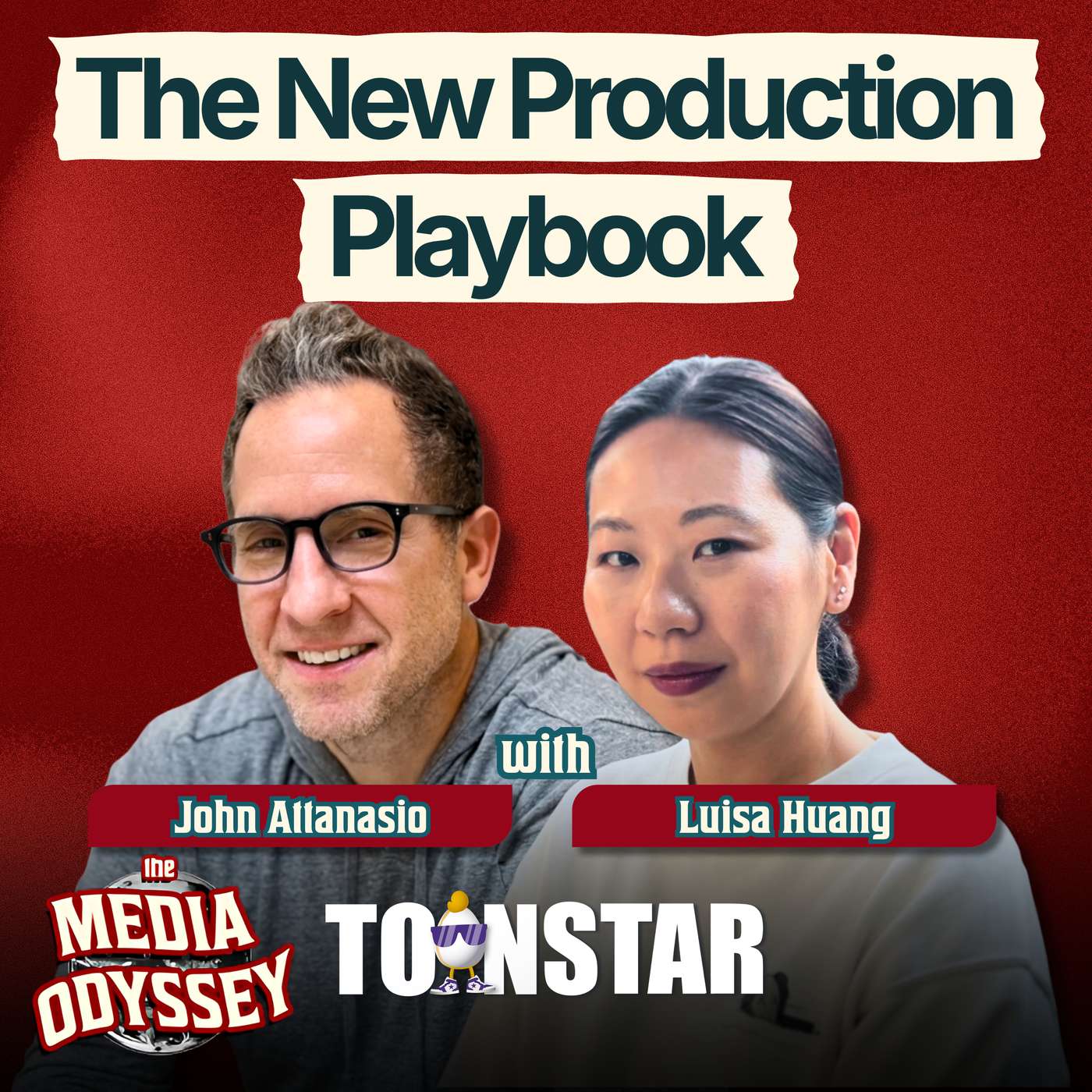
Okay, without further ado, let's bring our guests to the stage from Toon Star, the great new animation studio. John Attanazio and Lisa Wang, you're both escapees from the corporate media world. Is that an accurate reading?
- [01:23]
C
Allegedly. Yes. Yes.
- [01:26]
A
And so what was that? What was the origin story of toonstor?
- [01:29]
C
Yeah, so the. The origin story is we. So Luis and I want to. We're on the digital media team, so we actually. We're part of the team. So Ty Warren is one of the first investors in a company called Maker Studio, which is like one of the, like one of the OG MCNs and post investment. Luis and I were on this team that we were trying to figure out how to integrate it into the kind of broader operations of the studio, which was a really interesting process. People that follow the story probably know where Maker ended up going to Disney for pretty good exit. But for us, it was great because it really gave us early access to YouTube and the creator economy. And so, you know, we. And the true story, we were on the team running on Warner Brothers, saying, hey. And, you know, to be fair, at the time YouTube was maybe like five years old, but we were on the team running around the studio saying, hey, like, YouTube's, you know, a real thing. This, you know, direct to audience, you know, community building has, like, real potential. And so that it was great and really gave us, you know, we became big believers in that from, you know, that experience. The other part of it is like, we're just, you know, I'll. I'll date myself. I'm a, you know, Gen Xer. I grew up with Saturday morning cartoons. My brother's A comic book artist. And both Luis and I, by virtue of the studios we've worked for, have had the opportunity to work on some of the biggest animated franchises. And so it was just, it was weird to us that more people couldn't get animation made. And the reason is that like, you know, if, you know, animation historically just takes a very long time to produce and it's very expensive. And so we kind of put those two things together, one of them being disruptions being fundamentally disrupted by things like YouTube and social media. And then we thought like, if we could come up with a way to really change the way production is done and enable animation that gets produced in a way that is built for YouTube and social platforms, meaning it's fast and it's capital efficient and it's scalable. We put those two things together and the idea was like, hey, could you know, could we, you know, could we go build really like a next gen animation studio? And that was the inspiration for launching Toon Star. And we, Evan, to your point, we got the courage to leave the corporate nest and we launched a studio.
- [04:03]
B
And so how do you guys actually produce content? You've inted to it in terms of making it cost effective, but what is kind of your M.O. when it comes to production?
- [04:14]
D
Yeah, so we, you know, we spent quite a bit of time after leaving the studio kind of focusing on how do you utilize and build technology to be, to enable this, you know, to enable two things, right. So in order to be successful on the direct audience platforms, they really function on, you know, two things. It's like really most importantly is speed and throughput, right? Like you need to have a lot of content consistent and it needs to come quickly. And really also a function of the speed is to be able to really be able to address the content that is a little bit of like a back and forth with the audience, right? Like you need to react to the audience tastes at the speed in which they're really used to. Because in the creator universe they're used to creator is really kind of being like, okay, reading the comments, understanding the trends of what the audience is responding to. So we've built a technology, it's called Ink and Pixel, which is a combination of machine learning. And we also started incorporating generative AI about like five years ago and all of that. And that entire infrastructure is really built with the intention of exactly that is enabling the production to be able to move at the speed of the direct to digital distribution platforms.
- [05:56]
B
Wow, I did not see that coming, I have to say, because I Thought you were using alpha production, but you built your own technology. It's amazing.
- [06:07]
A
Yeah. And this, and this is. I mean, it's proprietary. No one else has access to it. In fact, I've asked John previously if he ever intends to white label it
- [06:15]
C
and he says, I don't think so.
- [06:20]
A
And you've got this great. You've got a hit show. This is not theoretical. This is not just some idea that you've had. You went out there, you greenlit yourself. This is the second guests we have on this episode who greenlit themselves. So you greenlit yourself into this show called Stephen and Parker, which is a massive hit. Yes. Tell us about the show. How many, how long it's been in operation? You're in hundreds of episodes now, right?
- [06:47]
C
Yeah, so, yeah, hundreds of episodes. And yes, Stephen and Parker. Sort of quick background on that. And, you know, that really does speak to our thesis. And it's, you know, to the. One of the first questions around, like, why'd we start Toon Star? And. And, you know, one of the main reasons we started Tunstar is that we felt like this Digital, you know, YouTube and this digital first ecosystem is, is really going to be the birthplace and the springboard to this next generation of like, hit animated franchises and, and franchise ip. And. And so that was, that's what, you know, Tune Store was really built to try to like, support. And so Stephen Parker's like, it's, you know, it's a great example of that. And so we partnered with. His name's Parker James. He's, you know, he's. He started as a Tiktoker and he had probably like around 9,9 million followers on TikTok. And he was doing this like, really cute character. Wasn't animated, but it was. He was using like a Snapchat, like, voice voice changer and Sage filter. And we got connected to him and the more we talked to him, we were like, wow. Like, he just, you know, he had such a great vision for this, this character that's really about this, you know, this. These two brothers and the younger brothers got this, you know, it's, it's. I think it's fair to say he's obsessed with. Obsessed with dinosaurs. And it's kind of what we call it sort of. It's like Dennis the Menace meets. Meets Calvin and Hobbes. And. But he had such a great vision for this world. And the more we talked to him, we're like, wow. Like, we could really see adapting this into animation. And so we greenlit a pilot season we tested it on his TikTok channel. This is where Luisa mentioned we also have distribution technology. It's called Spot. And because we've been around for about a decade, we've got a lot of data from all the digital platforms, YouTube, social platforms. And so we get real time feedback from the audience. The signals came back and they were off the chart. And we're like, wow, this is really working well. And then so we greenlit a brand new channel on YouTube and within the space of about a year, it just, it completely exploded. And you know, in, in in a positive way, it like, you know, fast forward now it's. We just crossed 10 billion lifetime views.
- [09:03]
D
Billion.
- [09:04]
C
It's in five. Right, with a B. Yeah, yeah. To be. Yes, to be, to be. Be clear. It's with a B. So 10 billion lifetime views. It's in five different languages, you know,
- [09:17]
A
200, 200 plus episodes. Right. I mean, and it is a bit of a machine. But to your point, Luisa, from earlier, it is a mix of human capital, AI, machine learning that you're putting together here. You do really marry human art and AI production. Talk about that. What is the process, John, when we talked about this originally, you said there's no way we would have made this show without AI, but there's also no way that you would make it without humans. What is the combination and the collaboration between the two?
- [09:53]
D
Yeah, I mean, when it comes down to it, like, like any story and any, any sort of creator, creative endeavor, it's really about the point of view and the voice of the writers and the creators, and that really is the start of everything. So you have people telling the stories and you have people really driving the stories and the creative. Right. Even the visual look of that show, I mean, that was really driven as a collaboration between Parker and also actual artists. They sat in a room and they talked about what kinds of characters and how he envisioned, how he envisioned the artwork, what he's inspired by, what kind of cartoons he grew up watching and what he, what he really loves himself. And so all of that is like, you know, the, the, the, the, the Stephen and Parker, you know, show is a manifestation of the tastes and the, and the vision and the, and the, you know, kind of like, you know, the, the direction of artists and storytellers. And so all of that is, is piece of people now. Where machines do come in is like, you can't deny the power of technology in being able to accelerate a lot of these processes. Right. And this is true across really like animation from like a historical Standpoint, right? You dial it all the way back. You know, I grew up watching Disney professionally, grew up being in Disney, you know, working at Disney. And you, you know, the history of, like, you know, they invented the multiplane camera, they invented all of these tools and technology because people simply, you know, could not keep pace with the demand and the throughput needed for, you know, what. Where the. Where the art form was going. And I. And we sort of see this is exactly that. It's like, in order to be able to take it to the next generation of the golden age of animation, with the reinvention of the golden age of animation, you have to take and take advantage of the technology that's available in order to accelerate and facilitate storytelling and storytellers. And that is the combination is that storytellers need these tools to be able to accelerate across the board on, you know, kind of every function, right? It really is equipping every single function of the animation process with a technological module partner to, you know, take them from being able to only create, you know, five seconds a day to two minutes a day, right? Like, that's the kind of, like, throughput change that these technologies help.
- [12:51]
B
At the top, you mentioned something about the volume, the cadence. So Evan mentioned 200 episodes. What's the cadence right now of that show specifically? Are you pushing one new episode a week more?
- [13:06]
D
Yeah, it's a great question. It's actually a little bit of a moving target. And that is also kind of like, probably blows everyone's minds. Like, in the traditional system, they're like, hey, we're gonna do 11 minutes. We're gonna do 26 episodes. We're gonna, you know, like, map out the season, break the episodes, do all of that. So, you know, here it's like, no, we do not have, like, a fixed blueprint of what needs to happen on a weekly basis. And the reason for that is this. We have spot. And spot really kind of tells us, like, how the consumer is moving in and out of the channel. And that is really, really important to help us understand the. The behavior. So, like, early on in the channel, what we knew about the audience was they were consuming short snippets at a time. Most of it was happening on a mobile phone. And so you had to push a lot more content that was in that, you know, sub one minute mark, so that it really kind of was this stream, I call it like the Costco sampling. Right? People walk by, you gotta have, you know, you know, really great stuff for them to be able to sample, and then they're like, this is great. I'm gonna, you know, buy the 25 pack of this.
- [14:31]
B
So.
- [14:31]
D
So during that time when we were in the growth phase of getting that started, you really had to, you know, sort of say, all right, this, this week you got to have like three, five episodes of shorts. And that was the volume. And then as you start to see the, the audience move from being samplers into, okay, I'm going to come back and I'm going to have like return trips, you start lengthening those episodes to give them now more context, more story, more of like a, you know, more of the world. And then that moved it into, all right, we got to have like, you know, five minute episodes, like four to five minute episodes on a, you know, bi weekly basis. And then you start to see the recurring patterns. And then you. And then we started seeing the. We started seeing the audience come back multiple times a week re watching the longer episodes. And that told us, like, we need to extend those episodes, really start building out even more serialized content that would then keep them coming back for, you know, like, even longer, even, you know, like even longer sessions at a time. And then so that's really kind of the thing is like, we look at this data on a weekly basis to say, where's our audience base at? Do we have people aging out? Are we grabbing new audiences? Where are they in the life cycle? Are watching it on a television screen? How much of the population's watching it on a television screen versus on a mobile phone? And that really dictates, okay, maybe this week we need to shift a little bit more on the sampling side to be able to draw more people in so that we can move them into the cycle and move them into sort of like return trips versus, like the fandom. So it's really, really dynamic. And so, you know, as a whole, I can say that we're producing content on a weekly basis, multiple episodes a week. Now the format of it is really going to depend on where the audience base is shifting.
- [16:32]
A
Yeah, it's much more of a parasocial relationship than it is IP and audience based. And this idea that you're going to change the clock and cadence of your show, the length and the premiere dates of it based on immediate feedback of your audience, is so antithetical to the way traditional television. I mean, it is a reinvention of the whole concept of television itself. But I'm fascinated on something which is you say, well, you want to kind of encourage the use of these new tools by these artists and the marriage of these new technologies with the creators themselves. But in two cases, Inc. And Pixel and Spot. You're talking about two pieces of technology that you created yourself, two pieces of proprietary technology. And Spot, it sounds like, is an audience listening and measurement and community measurement tool. You build those things both in house.
- [17:33]
D
Yes, so those have been built in house. Ink and Pixel came first. And then we started building Spring Spot, you know, a couple years afterwards because we really started to see the need to be able to do exactly as I described. It's like you need to sort of like shift with what was like the audience is telling you such really important information. And so to not take advantage and not build something that can really help the storytellers and the people in the rooms developing the actual creative. It felt like such a mess. And so we started, you know, going down the path of identifying like, well, what are, you know, what is the critical information? What does help development folks versus like okay, well this is just information about, you know, the speed of like, you know, social click through rates and like, stuff like that is really more marketing centric. And so we started to see like, well, what information really drives and helps storytelling versus what information is about marketing. And then that really kind of like, you know, moved us into building, building something that was more storyteller centric. Because a lot of the information that if you sort of like look at the standard traditional analytics that come from YouTube, it's very marketing centric. Right. So there's like a lot of click through rates, like how is the thumbnail performing? That's all really important information. But that doesn't really help from like a scripting standpoint.
- [19:09]
C
You know, it's a really interesting question. I think at, you know what, what we're doing is linking and we talk about this a fair amount. We're linking production to performance. And you know, Evan, to your point, I think that really is a new way to look at it. And like when we talk about like ink and Pixel and Spot and you put those two things together, we call it an agile, we call it an agile production loop, which is just like, that's a fancy way of saying, you know, now all of a sudden we can do like rapid iterative animation, which is an unlock because historically you just couldn't do animation that fast or do that kind of like, you know, those, those kind of iterations.
- [19:51]
A
But not hundreds of millions of dollars of infrastructure.
- [19:55]
C
Exactly, exactly. So, so that the cost to do that would have been, you know, which would just have been prohibitive. And so now part of it's that unlocked, it allows you to do that. But I think, you know, the sort of. The biggest benefit of that is, like, now you really are tying production to performance and that that's something that doesn't happen a lot in the industry. Things get made. It's all about the budget. Budgets get sort of, you know, sometimes budgets get, you know, inflated. Just because people want a bigger budget, it doesn't mean that it's going to give you a better product, nor does it mean that a bigger budget equals a deeper connection to the audience or, you know, or more engagement. And I think that's what we're really trying to do is like. Is like link and, you know, really directly tether those two things which we've
- [20:46]
A
had success with and in creating the economies that you have and the efficiencies they have, the speed, but also the production efficiencies. We talked about this way back when. You're making art that wouldn't have been made otherwise, so you're making substantially more of it in a quicker loop and you're making shows that just couldn't have been produced otherwise. And now it sounds like you're about to scale this pretty astronomically. You just made a deal with Harper Collins for a series of book IP from them. The first one's called the Friendship List. What's the turnaround time on a new series based on IP like that? From kind of green light to go time? When do you expect to see that? And how many more titles do you think you're going to wind up working on with HarperCollins?
- [21:34]
D
Our sort of target in taking something that is in existence, our goal is always to be able to get something lifted in and market anywhere between 90 days to 90 days. Like, so three, three to three to four months is really like our target. And that's really, you know, that we feel like that's really important because what that also does is it captures, like, when you're in development, you know, there's. There's creative momentum that is. Is happening. And then you're also like, development is happening in. In a world in which they're getting sort of like feedback of, like, what the trends are of the time. And, you know, especially when you're talking about content for content for, you know, teens, tweens, and even kids. And this is the part that I think, you know, people like, forget and it's easy to get lost in like a writer's room and in the development cycle of, like, okay, well, like, we're working on this creative and then like the thing that informs your creative is like your, your sense of like, well, who the kids are when you have in mind in the development cycle. And I laugh, I'm like a lot of times like when you're developing kids content and you're like, oh, like I'm thinking about, you know, this particular nine year old and then you're like in the black hole of development. By the time you emerge from development, your, your, that nine year old that you had in mind is now 12 and 15.
- [23:14]
C
I was gonna say, I was gonna say 15.
- [23:18]
D
So whatever you were developing now it's a completely new set of nine year olds. And I'll tell you, it's just, they're different, right? Like every year because the technology moves so quickly and the world is moving so quickly. Like who knows if Roblox is going to be around in three years time, they could be moving on to another thing. And so that's the kind of stuff you're like, ooh, there's a danger in losing momentum and spending too much time sort of like in this like bubble of like creativity. And I think that's really, that's really the important thing that we're trying to kind of make sure that people are moving quickly and going to market. Because you could lose, you could lose the moment because of just, you know, not paying attention to how much time
- [24:10]
C
sort of like elapses and we'll produce. It's, you know, you do a batch of a few just to get us out the gate. And then that gives us, you know, probably close to a month of audience signals. And then, and then after that batch, then we're on a weekly cadence. And so to give you a sense, I mean we're, we're doing, you know, we're able to do Luisa, what on average like eight minute episodes in, in a week. And, and so when you have, you know, so when you have that kind of like, you know, that kind of speed and you can do that kind of output then, then you can really, you know, you can see what's coming back from the audience and you can make changes to character arcs, you know, season, season arcs. We've got a whole this is conversation for another day that the sad fate of a, of a family. Dog Rip. What was the name of the dog? Rip. What was the dog? Murphy. Rip Murphy. But you know, it's things that you can, you can change sort of in this like near time, you know, sort of like real time production way because you're, you're getting those signals from the
- [25:16]
B
audience at the top. Evan mentioned that the show is profitable. So what's the business model? Are you guys only on YouTube? Are you seeing traction in traditional media like we've seen with shows like the Amazing Digital Circus, et cetera?
- [25:35]
C
Yeah, so our model is we start digital first, so we launch on YouTube and then monetize through initial monetizations, through ads and then brand sponsorships. And then we really see content as the flywheel. So you take in case of Stephen and Parker, the series got to the size that Random House reached out to us and they're like, this is an incredible, incredible ip and we can see this as a middle grade book. And so we did a partnership with Random House. Basically it's a graphic novel series for Stephen and Parker. The first one just launched and then we can tell you pretty confidently, Stephen and Parker is coming to a streamer near you pretty soon. So just like you mentioned, similar to Amazing Digital Circus, Hazbin Hotel, a model like that where those are digital native via IP that then basically extend into off, what we sort of call that like off platform revenue streams. But that's really how we're seeing really content as this monetization Flywheel.
- [26:59]
B
Yeah, I love that. And so one thing that I want to ask you because. So maybe you haven't deep dive into Evan's report on the kids ecosystem, but it was very gloomy. And then we speak with you guys and it's fascinating because you're ticking all of the boxes. You're using tech, it's very data driven, it is fast. At the same time, it's still very creative. It taps into fandom, et cetera. So is this the playbook? And what would you say to others within the ecosystem who are struggling right now and who are looking for a new path? Right. Not everyone will be able to do what you guys did in terms of the technology parts. But what's kind of your, you know, your tip for anyone in this space?
- [27:45]
D
I mean, I think the tip is just to move from, I think move from the mindset of like selling and labor B2B and really sort of like shifting into I am really creating and be and taking the point of view of like being the kind of like creative entrepreneur. Right? Like, it's an entrepreneurial sort of like mindset. And that shift means everything because now you're making decisions around production with the point of view of like, okay, I'm going to figure out what is the right size and what is the right sort of like P and L and cost structure. In order for me to put this out different from, hey, I want to sell you my idea. And then what happens is you're in the waiting game for a really, really, really long time, right? People hold your time. And this is going to be the recurring theme. People are going to hold your time hostage, right? That is what they hold. They hold your time hostage. You pitch, they, they, they say, okay, cool, I'm interested. And then even when they're like, great, I'm going to option it, well, then you're in line to be in this development cycle and that's going to take who knows how long. And that's the thing that people, people don't necessarily sort of like put a thing on. Like, well, how much is that time opportunity cost worth of like, sure, they're writing you a check now. My question is, is that check worth the opportunity cost of the time that they're holding hostage? Because that's literally the transaction in which people engage in versus. I get it, it's not a big fancy check up front. But the opportunity cost of time is also incredibly valuable. And I think people, like, you know, it's just a little bit of a different shift, or actually it's a big shift in thinking about that, you know, in that way. But I think it's like betting on yourself and believing, like believing in the thing that you want to create and saying, I'm going to, you know, do this, and those decisions become fundamentally different, right? And that's what we're here to support. Like we, you know, we're saying, come and work with us. We're here to support that path. We're here to support that infrastructure because you don't have to go to it alone. I think, you know, I think as entrepreneurs, like, we talk about this from the entrepreneurial standpoint. It's like, you know, launching a company by yourself is insane. Like, you're just asking for like, you know, like mental health issues right now. Go find yourself some co founders. Go find yourself a team, right? And that's what we're like, creators don't have to go about it alone. And that's, that's exactly what we're demonstrating, right? Like, Parker, you don't have to be the marketer, the animator, the, you know, like on and on down the list. No, find yourself the co founding, you know, group that's going to help create and really shape this new way to go to market. And that's exactly what we are equipped to do is like, here's an alternative path, right? Like, we're not here to give you brain damage in the waiting game. We're here to say yes. You know, this is, you know, we're going to go to market and we're going to do it quickly. Now, we're not saying it's going to be a guaranteed success. We can't guarantee that you're going to be the next Stephen and Parker. But here's the sell and here's the offer.
- [31:21]
A
We'll be waiting around forever
- [31:26]
D
because we also believe that creators have a thousand ideas. So get to the fail fast so that you can go deploy your next one.
- [31:34]
A
And you've stripped away a lot of the overhead that creates the risk, therefore you can increase the speed, therefore you can get to market. And to Luis's point, either fail or succeed much more quickly. But at least you're making shit. And what I love is that you've taken the hostage, take the time hostage taking out of the process. You're not holding anybody's time, Captain.
- [31:59]
C
That's right.
- [31:59]
A
Really great to talk to you about this stuff. It's going to be great to see you on stage in Denver with me, John, at Stream TV at the Media Universe Summit there, where we're going to have you and YouTube. We're going to talk about the future of animation there. Thank you, guys. It really is inspirational to see what you're doing at Tunestar. There is an opportunity for people to learn from you. I hope they do. Thanks so much. Awesome.
- [32:21]
B
Thank you, guys.
- [32:22]
C
Thank you. Thanks for having us.
- [32:23]
B
Well, another amazing episode with people reinventing the playbook. And have you noticed what comes up every time? Mindsets.
- [32:32]
A
Yeah, it is a green light yourself mindset. Toon Star really building themselves into an independent animation studio. Didn't wait for the green light from gatekeepers, greenlit themselves, went right to an audience, tested and learned, went, you know, did not break the bank, experimented, took the data and grew. Very good lessons here to be taken for everybody out there.
- [32:55]
B
Yeah, it was fascinating. Again, great episode. Super nice seeing you. And for everyone who's been listening, hopefully, this was interesting. I'm thinking that John and Luisa, their DMs is going to be open because I've heard a lot about, you know, collaborating and, you know, kind of building this community. So, you know, feel free to do that.
- [33:14]
A
Their DMs will be burning.
- [33:15]
B
Yeah, I'm sure they will. That was another amazing episode of the Media Odyssey podcast.
- [33:20]
A
That is Evan Shapiro and that is Marion Renshett.
- [33:24]
B
We'll see you next time.