Loading summary
Transcript167 lines
- [00:00]
A
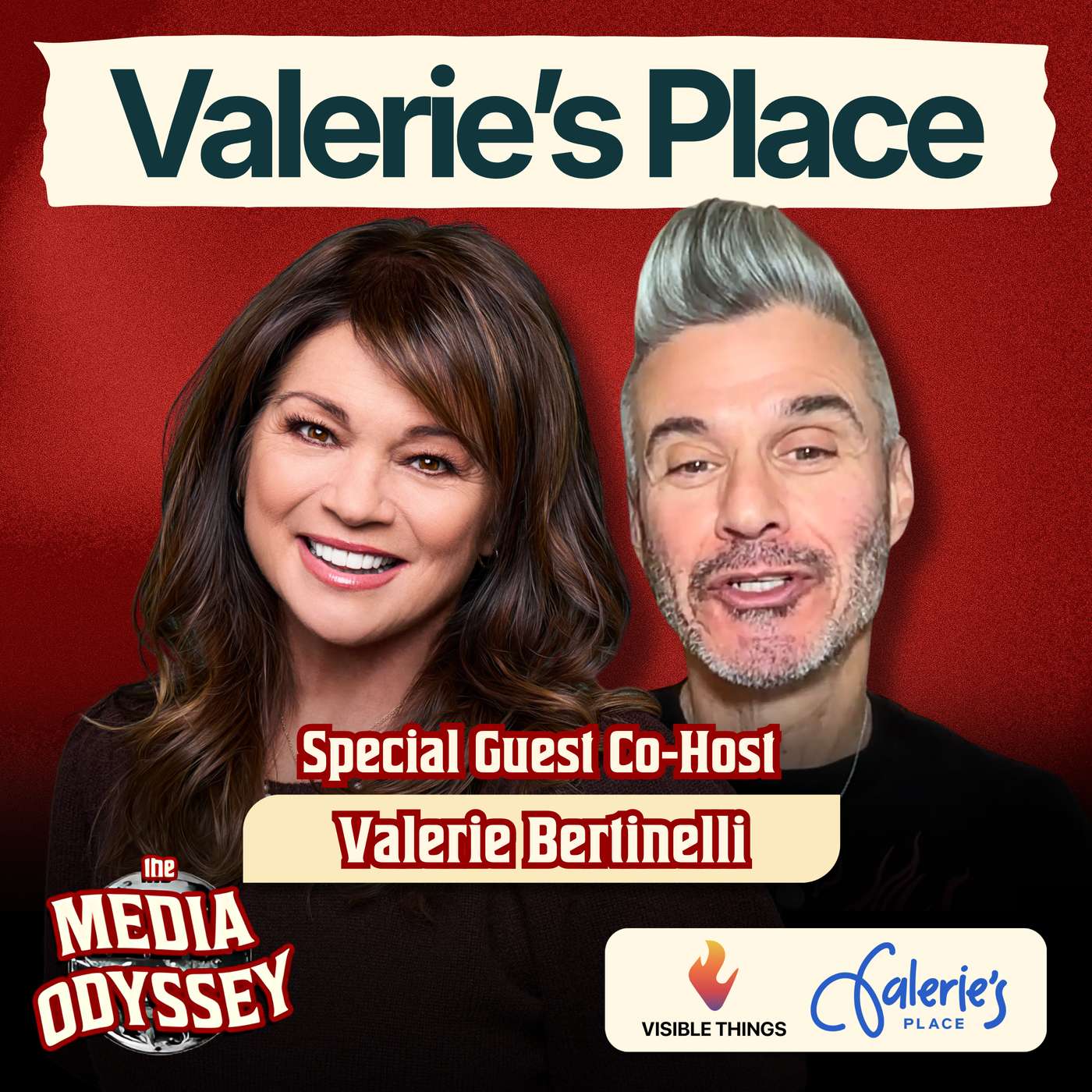
Hey, this is Evan. We've got a really special episode of Media Ossie podcast this week. Marianne Wrenchette couldn't be with us this week because she had other plans and so fulfilling a lifelong dream of mine. That is Valerie Bertinelli.
- [00:16]
B
And that is Evan Shaf.
- [00:34]
A
Welcome to the podcast. It's such a thrill to have you here. I've been a fan for decades, embarrassing us both by our age at this point. And you're obviously a legend in. In many ways of television.
- [00:48]
B
Obvious is a. As a extreme, but. Yeah, but thank you. Arguably icon. I would say arguably.
- [00:58]
A
Jesse, our producer and I were discussing this before the pod and his parents are incredibly thrilled, just like I was when you said yes to be on the pod. So you do have a legendary following. You've been in the popular culture for, you know, almost certainly your entire. Yeah, your entire adult life. Right.
- [01:18]
B
Yeah, I guess that is kind of crazy. Time goes by and you don't even realize it, that you're still, you know, kicking away at what you love to do. And I feel incredibly lucky that I get to do what, you know, and be creative every day of my life. It's, you know, not often that we can do that. So I'm incredibly lucky and we're incredibly
- [01:37]
A
lucky to have you here. I could talk about your whole career. I could talk about a number of different things with you, but we're here to talk about your brand new enterprise, Valerie's Place. And I don't know how much you watch or listen to the podcast, but we spend a lot of time focusing on disruptors in the media space who are adapting to this new moment in what I call the affinity economy. And I feel like Valerie's Place, your new project that you just launched earlier this year personifies the affinity economy 100%. It is really exactly where the puck is going.
- [02:11]
B
I think so too. I think because there's so much media out there, and if I may be blunt, so many billionaires are bankrupting all of their channels that we love. So there's not many places to go where we live anymore. You know, they. They buy up all these things and they. And they incur a lot of debt and then they get rid of all of their content creators, which is. I feel like I've been a content creator since I was 12 years old, except I was making commercials. I was an actor. I'm still an actor, but I was making content and I was doing things that I love to do, and I was under the tutelage of Norman Lear when I first began. So I was very, very lucky.
- [02:50]
A
The legend.
- [02:51]
B
Yeah, that is a legend, no doubt. Not even arguably, but, yeah, I was
- [02:55]
A
lucky enough to meet him one time,
- [02:57]
B
but he's just an amazing icon. Yeah, yeah. And I just think at. In this day and age when we don't have a lot of control over our image or whatever it may be. I mean, image, it's such a tangled word, because there's an image of what people have of you, what they believe of you, and then there's your true, authentic self. And if you're like any human being, you're always looking for your true, authentic self and trying to be the closest to that. And I think what I was able to find online is finding people that think the same way that I think, that are going through the same things that I go through. But I was also held hostage by the algorithm and by what my content. What content Got pushed out to the people that want to see it. And that's where Billy comes in.
- [03:46]
A
Yeah. And so you have this new platform called Valerie's Place. It's a direct consumer entertainment platform, and you've worked with a company called Visible Things to launch this. And we're lucky enough to also have your partner on this, the CEO and co founder of Visible Things, Billy Cooper, who is also himself pretty much of a legend in the television ecosystem. Billy, welcome to the show. Let's get into what the fuck. Visible Things is why this partnership came to be, how you came to be this new kind of Internet entrepreneur from a television background. Give me a little bit about yourself and your co founders, how this thing came to be, and how this fits with Valerie's new project. Sure.
- [04:35]
C
So.
- [04:35]
B
Well.
- [04:35]
C
Okay, so I'm gonna date myself because I think I was driving over here this morning and I had the thought of, why did we come up with Visible Things? Or how do we come up with Visible Things? And there was a, you know, Saturday morning cartoon, Schoolhouse Rock. I'm sure all three of us remember what Schoolhouse Rock. Rock.
- [04:49]
A
Junction. Junction, Right.
- [04:51]
C
But my favorite one was Mother Necessity, which was necessity is the mother of invention. And I think, you know, that became very clear to us. Yeah, yeah. Mother Necessity. What's your name? Anyway? Okay. Nobody wants to hear me sing. So, you know, I think it all became very clear to myself. My other two partners, Andrew Greenberger and Willis Robertson, all three of us met at a company called 44blue. Andrew was the original showrunner on a show called Pitbulls and Parolees for Animal Planet. I then came in as his number two after Season two, Andrew moved on to greener pastures. I then continued to run the show for 18, with 19 seasons, until it was pulled, until it was basically done. When Warner Discovery merged and decided that the sort of outer fringe channels that aren't Discovery or tlc, it wasn't important to continue to do original programming. So the music sort of stopped, and we were all left without a chair. And so the idea was, how do we capitalize on what we felt like were our blood, sweat and tears. Our life work was being sort of thrown on the. You know, I hate to call it the dumpster fire of the streaming wars, but it was one of those things where, you know, we felt like the content that we had made, the shows that we had made, there was still value there. And so, you know, why not figure out a way to go to the people that were involved in the original show, the talent that was sort of, you know, the centerpiece of those shows, figure out how to get that show, the original show, and then make new shows? Because people were still. I mean, Val can attest to this. You know, she had a show on Food Network for, you know, 14 seasons, you know, 10 years. And when the show stopped, people didn't stop asking her, val, when are you going back in the kitchen to cook? They didn't understand where did my Valerie's home cooking? They didn't understand why my Valerie's home cooking was gone. People just wanted. Neither did. Right. And so. And so the idea was, you know, how can we do this? And that was sort of the genesis of the idea behind Visible Things. Finding the ability to giving creator, giving talent, the ability to connect with our audience in a direct way. And the thing. Evan, I mean, you were a network executive, and, you know, I don't know if this was ever a note that you gave, but, you know, on the television production side and the showrunner side, one thing that we always heard was, here's one way to make your show more popular and get more ratings. Find an influencer. Yeah, let's get an influencer in your show. Or, you know, if you're pitching me a show, the way to sell this show is to put an influencer in it. Our idea is, why can't the opposite be true? You know, why can't original, you know, sort of legacy talent, iconic talent, somebody like Valerie who didn't grow up with pointing an iPhone in her face, you know, sort of, but is more accustomed to having the production support, a producer, an editor, a culinary producer, you know, all the sort of bells and whistles that come with a show. Why can't they be in the space that the creators are in? Like, so that's sort of where we sort of figured out visible things needs to sort of live well.
- [07:56]
A
And especially when you look at what just happened this past weekend where you had two youtubers at the top of the box office list beating Star Wars. You know, I think it, the, the worlds of creator Dom and influencer Dumb are merging into kind of the traditional careers of mainstream television and film talent. They're becoming television producers. Ms. Rachel is now on Netflix and Mr. Beast.
- [08:22]
B
And let's not cut these people short. They're all creative people. They're making incredible content, working really hard. And I think there's this, this feeling that sure, they have, you know, millions and millions of followers, but they're not really working. Yes, they are. Do you know how hard it is to make content, especially by yourself? I've done it by myself. Deep looking videos by myself.
- [08:43]
A
Without the infrastructure.
- [08:45]
B
Yeah, without the infrastructure. It is so much, not necessarily easier, but it opens up another part of your brain where you can just be even more creative because you have other people taking care of the other stuff that you're usually doing 100%. So I've done both. I much prefer working with visible things than sitting in my kitchen alone and then editing, you know, for two, three hours afterwards on my phone. It's just so much better. And I get more content made.
- [09:16]
A
More importantly, well, and it was Lear, Norman Lear, not King Lear, who told, who warned you about the invasion.
- [09:23]
C
Right?
- [09:24]
A
He is, he was that this, that this invasion of billionaires was going to disintermediate talent from the audience. Wasn't.
- [09:32]
B
And you literally see it happening even with CBS News today and with all of these different. There's very few billionaires and they're taking over the entire creative world right now. And it's really, for me, I think it's alarming, but.
- [09:45]
A
And it's not in necessarily service of the art. It's in service of some. Something else.
- [09:50]
B
It's not. Yes, because it's not in service of the art. It's in service of the bottom dollar. And the people that make the art are the ones at the very end of the food chain distributed the money to be able to make the art. So the last ones who get paid. Right, right. So I think, I mean, they're too worried about Wall street and worried about, you know, the debt that they incur so. Because they buy too many companies at the same time.
- [10:16]
A
So. Billy, give me an elevator pitch. On Visible Things, what actually is it? Is it. Is it a studio infrastructure for creators or talent as creators?
- [10:24]
C
So Visible Things is we provide the infrastructure for talent and creators to build their own direct to consumer ecosystems. So we are the studio arm if it's needed, and we are also the distribution arm. So we have a technology stack that allows us to give a sort of white glove, white label, individualized platform to each individual person. So, you know, unlike Patreon or Substack or things of that nature, where it's patreon.com, you know, whomever, and you're sort of one of hundreds of one of thousands, what we've built for Valerie is her own destination. It is a digital destination. It's called Valerie's Place. It's its own brand. It exists on web, on mobile, and very soon on smart TVs where. So Valerie is not getting lost in the algorithm and her audience isn't getting lost in the algorithm. It is a direct conversation that she's having with her audience. And so what Visible Things provides is exactly that. And so our tech stack is set up in a way where we can do in success 2, 3, 10, 12, 20 of these, where each one is its own wholly owned ecosystem, catering to a very sort of. We call it a superfan audience. I mean, people could call it a niche audience as well, but it's really catering to Valerie's audience and giving them not only a space that they want to go and connect directly with Valerie, but also give her a ability to connect back with them and have a real conversation.
- [11:52]
B
Well, it's much better than just going on Instagram and doing a live once in a while and talking to your audience. I wanted to basically bring my. My book tour, if you will, to Valerie's Place so that I. We just had our second book group on Monday, I believe it was, and we.
- [12:15]
A
And so this is like a live meetup.
- [12:17]
B
It's a live meetup where I talk to people face to face. It's basically a zoom, like we're doing now, but we invite more people in and these are for our top tier members of Valerie's Place and we have a real conversation. It's not about me, it's about them. I hear about their lives. They get to release things from their chest about whatever this book meant to them. And I like hearing about people's lives. I don't want to talk about me all the time. If I'm a conduit for more people to gather at my place and talk about themselves and with each other. That's what I'm happy to do.
- [12:49]
C
It's an amazing thing to watch also, because the thing that it becomes, you know, we all sort of like, you know, we're also separated right now with social media and, you know, you know, the media, you know, the 24 hour media cycle and all this kind of stuff. And it's so hard to find connection to anybody these days. And so the thing that's great about all the people that are in Valerie's place is they have already when they start and they come in the door and they subscribe. They all have one thing in common. They all love Val and they all grew up with her. They all, you know, they all can relate to her. They watched her on one day at a time when they were, you know, 10, 12, 20, whatever years old. Yes, me too. You know, they watched Hot in Cleveland, they watched her cook, they've read her books, you know, all the things. And so. But everybody brings that one thing. And that one thing is an instant jumping off point. And so, you know, and so the great thing about the book club that, that when Val came to us and we were sort of ideating on what kind of shows we could do because we knew the cooking that was a simple, low hanging fruit Val was cooking. We knew that was going to happen. But as we're talking to her, we're like, val, what else goes on in your life? And she says, well, I've been in a book club with my girlfriends for 30 years. And we were like, let's do that. You know, how can we do that? And originally it started with, originally it started with, you know, just Val. We said, oh, let's do it with the ladies in your book club. And she said, no, no, no, let's do it with the audience. And so it became a different conversation because, you know, yes, I, you know, Reese, Oprah, their book clubs are amazing and they've done wonders for the publishing industry. But the thing that Val wanted to do was go take it a step further and make it a real conversation. And I think that was really cool. And the thing that's been great is we have publishers now reach to us and saying, hey, can Val do my book for? Can she do this next book for the next book club? Obviously, we're sort of keeping it in Val's interest, the books that she wants to read, the books that she likes. And so, you know, but maybe soon.
- [14:34]
B
But it's really lovely. The last book that we picked, the author said, hey, I heard you picked my book. Can I Send you book plates signed, can I do this? Can I make a video? And it was absolutely lovely to have Alan Levy, like, say something about his book Theo of Golden, and, and talk to our audience. So I, it's been lovely and I'm, I just, I have a vision and a dream for how this and where this is going to go in the years from now.
- [15:01]
A
And so, so your, your platform is a membership platform. And, and the ones who get in the book club are kind of like the super members to a certain extent
- [15:09]
C
that we call the, the VIP members, you know.
- [15:12]
A
Yeah, and that's, that's, that's when I say this is a kind of picture perfect example, the epitome of the affinity economy. You know, that is very much what I mean, which is you're, you're taking the energy from your 5 million combined followers on social and you're creating a home for the superfans to come. And the economics wind up being substantially better for you with this kind of niche, smaller audience of superfans than just the clickbait stuff that happens on social media. I think you, you, you, you phrased it real social versus parasocial or some kind of point of view like that. Describe what that means, the difference between parasocial and social. Social.
- [15:54]
B
Well, let me just go back for a minute because I know this is. Billy and I are always like. I'm like, billy, can't we just make it free? You know, because I want to, you know, see, but he's like, you know, it costs money to make the show. It costs money to, you know, hire people to do the show. It costs money for producers. So, I mean, obviously money can't come from, you know, the sky. So it, like I'm always fighting, you know, not fighting. Billy, it's, it's always friendly. He's like a little baby brother to me.
- [16:23]
A
But it's the art and commerce that battle it. All right?
- [16:25]
B
No, absolutely, because the economy sucks right now. You know, in this, in this economy, with this administration, we're all in a
- [16:33]
A
beautiful, this beautiful, big, beautiful economy. What are you talking about?
- [16:37]
C
Well, we said we're not getting political.
- [16:39]
A
Everything, everything's, everything's awesome. Gas prices are, Eggs are low, or
- [16:45]
B
you go to the grocery store. Because we have to go to the grocery store to, you know, make the food dishes that I would like to cook for everybody. But I'm like off on a squirrel. But to get to your point about parasocial and social, parasocial is when there's, there's a, a slight Wall between everybody, as you know, you know, and you start having imagination, dreams, fantasies about these people that you don't really know, you know, what you see on camera. I've kind of taken that wall down a little bit for the last few years with my social media, where I've just decided I'm not going to pretend I'm happy when I'm not happy. I'm just going to be as real as it can possibly be with my audience. And once I started doing that, I started making more connections online. More DMs were coming in that. That said, my God, I feel that way, too. How did you get through this? Or what are you doing? And I would be the same way. It's like, I'm not through it. Do you have any suggestions? And people would send me suggestions. So it's. It's like having another friend to talk to that you open up your world in a way that I still have my dear friends that I've had for over 30 years. I still have my family, my brothers that I bitch to, you know, But I. There's. It's nice being able to make a difference in someone's life because they. They have had a connection to you for a long time, but then they really get to know who I really am. So it was nice starting that. And we started to take the wall down. And with Valerie's place, the wall is completely down because we'll just have a conversation for an hour about a book that turns into a conversation about something else. Like my real book group. I say real, but both book groups are real now. Like my original.
- [18:22]
C
I mean, here, Evan, I'll give you a little anecdote, a little story of sort of the. Our own, sort of the experience that I've just genuinely had with Val in terms of the parasocial versus the social and sort of how Valerie's place has sort of crossed that bridge. So what? And one of the stories that Val was telling us about, and this is in her book, in her Getting Naked book, is when she was doing the finishing touches on her book, Val found a feather in the street. And Val, if I'm telling this story wrong, please correct me, but she found a feather in the street and picked it up. And it saw it as a sign that she needed sort of like, do a little more with the book, tell the story, whatever, all that sort of good stuff. And then as we were recording podcasts, as we started doing stuff for Valerie's place, there was one day that she was looking. You misplaced it.
- [19:07]
B
Right, Right. So the story is I asked specifically for a specific colored feather from the universe, whatever it may be. I do believe in signs. I have three loved ones that have passed, and they've sent different signs. And I said, I specifically. I'm tired of seeing black and gray feathers. I want to see a white feather so I know you can hear me, and I know where I need to go with this, and I'm on the right path, literally. I was between 9th and 10th on 57th street in New York, and I hadn't gone 10ft, and there in everything, I saw a little white feather, and I couldn't believe it. I knew that I was being heard and that I was being looked after and I was on the right path. And then I lost the feather. And I was devastated because I do get attached to things, and not just people. I. Things have meaning for me. It hasn't quite gotten to hoarding, but it could be close. I have to keep an eye on it. But I lost the feather, and I was so upset, and I hadn't seen it for two weeks. I had it in my computer, and I was working on the podcast. And we come back. We had had a long break. I come back after two weeks, and, you know, still a little. I said, I guess I've lost the feather, but I know that you saw me, so I'm happy if the feather comes back. I sure would love it to know that we're still in Connecticut. I started the podcast. We got to lunch, and I hear vacuuming out in the other part of the studio. And I came back from using the bathroom, and I looked under my chair, and there was the feather. The exact feather that I hadn't seen for over two weeks. And that place has been vacuumed. It's been cleaned for the last two weeks, and the feather was still there. So I.
- [20:44]
C
And so. And so where this then picks up, Evan. So she picked. So Val tells the story of the feather on the podcast. We were doing a live event, like, it was sort of Val's, a book club, a book tour. So she'd done on. So when she was selling her book, she went around the country, was selling her book, signing, autographs, whatever. And so we did a live event where people could come onto Valerie's place if they hadn't been able to make it out to one of the events. Valerie tells this story, and then, lo and behold, two weeks later, one of the Valerie's Place members sends her a, you know, like a necklace with a spot with a. You know, a little you know, cylinder, glass, cylinder, to put the feather in.
- [21:25]
B
I had, I had. I'll just interrupt you for a quick second. I had offhandedly said, boy, I wish I had something so I could wear it with me all the time so I'd never lose it again. Just said that. And I'm like, maybe I'll look for something. And that's what.
- [21:36]
A
On the platform. You said that on the podcast.
- [21:38]
C
Yeah, on the platform. And then so. And during the podcast and so one of the mem, One of Valerie's members sent her then, you know, this thing. And it became a moment of connection for this woman who I think Val had met at a book, you know, another event years ago, and she sent a picture and things like that. But when we put it out on social media that, you know, we sent her the video of Val unboxing this thing and opening it, I think it. I wouldn't. It's safe to say that this woman's life had been changed. You know, I mean, she really had like sort of this genuine reaction.
- [22:06]
B
I mean, valved my life because now I get to with me.
- [22:11]
C
And so that I think is just the sort of like little anecdote of how I think this direct connection can work and why it's important for somebody like Val, other talent, other artists to sort of cut through all the layers of streaming networks, executives, you know, whatever, and then have that one to one connection. Because not only do the talent, you know, Valerie's talent wants it, but then also the audience craves it as well.
- [22:34]
A
The audience wants it. And that's. I'm going to go back and push back on Valerie's pushback on making it free. Um, because you have this outlet that other people are paying for the platforms, Facebook, Instagram, TikTok or whatever, and you have a ton of free relationships out there. But there are fans that want more, right? They. They want a deeper relationship, they want an actual social relationship. And what we have found out is that they want to help you produce shows. Like, they want the shows that you made. They want them back. And so they want to be part of that, that whole community and that process. And so this platform is kind of perfectly situated to scratch that itch and
- [23:14]
B
provide that outpost priced it reasonably as well. We've made it so many different tiers that if because of this economy and it's made it difficult, you can still get access to quite a few things for a lesser monthly fee. And the monthly fees are not dramatic. I mean, when you put it together per year, it's Much less than what you would be paying for Food Network anyway, even with the big package and cable and DirecTV.
- [23:36]
A
But now there's. There's no network notes. There's no. There's no, you know, big.
- [23:41]
B
Like, I put on my son's band shirt the other day and I was like, oh, wait, I should ask if I can wear this. I'm like, no, I don't. I can wear my son's band shirt because it's my. Billy's not going to care.
- [23:52]
C
The other, the other outcropping that, the other outcropping that we found and have, you know, it's sort of been not a happy accident, but we knew it was going to happen was because people are paying to be inside of Valerie's place. We've eliminated the trolls.
- [24:04]
A
And that is the other element of it.
- [24:07]
C
And it's such a good, safe place
- [24:10]
B
for everybody, not just me. I don't have to do any blocking. I don't have to. Again, Facebook is moderator. People can be incredibly rude. So I try to stay away from Facebook.
- [24:21]
A
People are rude on the Internet.
- [24:24]
B
Yeah. But another thing that to me recently was because I'm a member of Susbury substack and I, I follow a few people and I pay for a few accounts that like my girlfriend is an amazing writer and she's on Substack and of course I pay to be a member to her substack. But he said people are paying 10, 15, $20 a month for Substack and some people don't even write for more than once a month. And the, the amount of content that we put out, and I'm always like, billy, we gotta make more content. I want people to be fulfilled. And he's the same. He wants to make sure people feel like they're making. They're making the right decision by being here and that they feel like they're getting what they're paying for.
- [25:01]
A
And what's interesting is you can give member benefits like coming to a book club with you that don't cost you anything. Right. Because that live stream is probably the least expensive thing that you're. You're producing. And, and. But people really love it. I. One of the benefits I give out. I do too. Yeah. One of the benefits I give out on my Substack newsletter, Media War and Peace, which you can both subscribe to right now, is the ability to ask
- [25:25]
C
you have a discount code. Right?
- [25:29]
A
I'll give you a discount code. But one of the benefits you get is if you're a subscriber for six months or more. You get to ask me for a one on one meeting whenever you want.
- [25:39]
B
Wow, that's great.
- [25:40]
A
And people. Yeah, people really do dig it. And, you know, not everybody uses it, so the breakage is huge for me. But people, they want to ask for help on their careers or whatever, and that's, it's a great benefit.
- [25:51]
B
But you're feel like you get something out of it too. It's not a one.
- [25:56]
A
Oh, yeah.
- [25:57]
B
This is. And this is, in addition to. It's not parasocial. It is purely a social relationship because we are both benefiting from the connection we're making as human beings. That's the most important thing to me. I'm. I'm not the only one benefiting here. I want them to feel like they're getting a benefit as well.
- [26:13]
A
Yeah. And I learned something from each one of those conversations. Something new comes out of it in every, every case. Even if it's just like you like about my newsletter so I can approve it or whatever it is. But then very often it's like something about the world writ large. But you're providing these services where they get access to you, but you're also to your, to both of your point. Over the course of this conversation, you're making a shit ton of content. So you're making, you know, actual television shows for this platform on a regular cadence. Many of them. Right. More than one cooking show.
- [26:43]
C
Yeah. So we have. So there are currently. Obviously we. One of the sort of core thesis that we realized with Val was we. And this was sort of. She tasked us with this. She said, I'll do this if you guys can do this. Which was she wanted us to get Valerie's home cooking license back from Food Network, which we did. We are in the process of launching all seasons of Valerie's home cooking.
- [27:04]
A
How much did David Zaslav charge you for that?
- [27:08]
C
We're not gonna double. Yeah, yeah, no. So, yeah, he's sitting there with his, you know, his cats. Yes. Yeah, his hairless cats.
- [27:16]
B
Hey, no, no, no dissing cats. Please.
- [27:19]
C
No dissing cats. No, no, no hairless cats. Yeah, no, but, but. So that's the. And part of the reason we wanted to do that was part of what Val was talking about, the value. So when someone opens up Valerie's place, instantly they have access to 172 episodes of Valerie's home cooking. So that right there, that's worth five bucks. You know, five bucks a month. So that's. And then all. Not only that, you get all of the recipes that are searchable. So, you know, you can watch. Watch the episodes. You get Valerie's recipes that she owned. They're her ip. They're now part of Valerie's place. And then beyond that. So we. We now have three different cooking shows. One cooking show is the sort of standard, you know, itk in the kitchen, or stand and stir is what we call it. And it's called Now Val's Cooking. And so that's Valerie with her, you know, and she's just making the dishes from her. She's diving into the archives of her cookbooks. New stuff, old st. Whatever, and that's just sort of her cooking the way everyone's accustomed to it. Another show we did, which is called Reheated. And so it's Valerie and her longtime culinary producer, Sophie Clark. And Sophie was the one behind the scenes helping Val make all of the dishes, all the recipes, all of the, you know, everything that was part of Valerie's cooking and also part of Valerie's cookbooks. And so this is my.
- [28:34]
B
Also my recipe developer. So she's very integral to my cooking world.
- [28:39]
C
And so what Reheated is. It's an opportunity for us to pull down the curtain on what goes into making a cooking show. You know, we show. It's, you know. You know, sort of all the bells and whistles we, you know, when we're doing Reheated and we're doing Valerie's.
- [28:52]
A
How you shoot it and all that kind of stuff.
- [28:53]
C
Yeah, how we shoot it. But also, we rent. We rent. Yeah, we rent a prep kitchen that goes in Val's garage. You know, like, it's in Valerie's garage, and they're out there cooking the prep stuff. And so we do the swaps, but we show the swaps, you know, so it's really a sort of fun behind the scenes. And then what we're filming today actually, is a show Valerie came up with on her own called Meals for One. And this is just. This is what she did before we came along, which is her. Her phone and making herself lunch or dinner. And that's kind of.
- [29:22]
A
But you're not shooting it on a phone now. You're shooting it with a.
- [29:25]
C
No, we're staying. No, Meals for One. Meals for One. We are staying true to Valerie's original video.
- [29:31]
B
I have a particular vision for this particular show, and I want it to be the same. It's a very different take on cooking. It's just. It's more me not talking so much. It's more about the music and the Graphics. And just what you would. What you would see. If I'm home alone cooking, I'm not up looking at the camera and talking to you. But it's. It's more like. It's the.
- [29:53]
A
So it's basically we're a fly on the wall in your kitchen to a
- [29:55]
B
certain extent, pretty much. I wanted to relax you. I want you to watch my videos and have me cook something for you while you get to sit and watch and get relaxed.
- [30:04]
C
And then. Yeah, and then obviously, we have the book. And then we have. Book club. Yeah, no, and then we have the book club. And then we also have. We started a podcast with Val where she. It's called get it? It's Getting Naked. The podcast was an outshoot of her book where she's having sort of real, genuine, honest conversations with mental health professionals, other celebrities, you know, Valerie's friends, you know, anyone connected. And these are sort of. You know, it's sort of not only helping Val's sort of mental health journey on her own, but also then sharing how she's doing it with other people and, you know, all that kind of stuff. So I think it's a great piece. So the last thing that we're doing, and this is a sort of exclusive. I don't know, Val, if you want to give it or you want me to do it.
- [30:42]
A
Breaking news.
- [30:43]
C
Breaking news.
- [30:44]
B
Well, go ahead, Billy.
- [30:45]
C
Okay, so one piece of Val's legacy that we all love so much is her career as a sitcom icon. And I say icon because, Val, you are an icon.
- [30:53]
A
I agree.
- [30:54]
C
Yeah. And so one. Obviously, one show was one day at a time. The other show was Hot in Cleveland. And so we are launching. We are launching a. I guess the only way. It's not a recap podcast, but it's a revisiting podcast of Hot in Cleveland, hosted by Val and the showrunner, executive producer Todd Milliner, called Still Hot in your time.
- [31:16]
B
Yeah.
- [31:16]
C
So Still Hot in Cleveland. Still Hot in Cleveland. Premiering on Valerie's Place in the coming months. We actually record it here at Val's house, but in a very special seque location. Val actually had a pool that they converted into a wine cellar. And so it is the coolest space. Yeah, it's amazing.
- [31:34]
B
And I don't drink anymore, so at least it gets something. We can do something with it.
- [31:39]
C
And so, yeah. And so it's Val, it's Todd, it's, you know, conversations about the show, conversations with their guest stars, their co stars, obviously, you know, Betty. Betty White, you know, talking about Betty. What she was like when she was there, you know, and all this a legend, you know, I mean, like, I mean. So, you know, and it's also the thing that's great about Still Hot in Cleveland. And we've done, you know, one episode so far. We're doing more and all that kind of good stuff. As a lover of the sitcom genre, it is a love letter to sitcoms. It's a love letter to sitcoms, which I feel like is a, you know, especially the three camera, Norman Lear sort of Jim Burroughs type sitcom. It's, you know, it's a dying art, actually.
- [32:26]
B
You don't see a lot of multicams out anymore.
- [32:29]
A
It's interesting. I was just, I was just talking to somebody about this last night. If you look at some of these, I think more successful podcasts, Shoes Off Podcast, a couple of others, they've actually zoomed out and it's shot much more like a three camera sitcom than or like even Call Her Daddy and things like that to a certain extent. So I do feel like the mentality is making a comeback. But both of you had to kind of unlearn certain elements of high end professional television production for this.
- [33:04]
C
What do you mean? We're professional?
- [33:06]
A
No, but you're, you know, there was a lot more fat.
- [33:09]
C
Yes.
- [33:10]
A
In television shows that you worked on than the shows you're working on on this platform. So you had to reimagine the production workflow to be a much lower budget.
- [33:20]
B
Yes. It's more of a skeleton crew. I don't have a wardrobe assistant. It's all my wardrobe out of my closet.
- [33:27]
A
So I do.
- [33:29]
B
This is my wardrobe. I bought this at H and M. So, you know, there is that. You know, would I love for there to be a wardrobe budget? Of course I would. But I also, I care about the economics of it just as much as I do about the creativity and my comfort. And I'm always telling Billy that when Billy is coming to me with anything, I'm like, don't be afraid to tell me anything. Because if we don't have the budget for something, let's just not do it right now or we'll do it a different way. Because I care about everybody profiting and not stressing about what we're doing. We're supposed to be having fun in this part of our life. We're not supposed to be doing anything except having fun and being creative and putting stuff out there.
- [34:10]
C
And Evan, to that point, I mean, the one thing I will say is, yes, we are doing this sort of on A lower end budget and things of that nature, you know, in success, you know, and just to give you sort of what our ultimate goals are with Val. So Valerie has, and what we've sort of modeled our business on. Valerie has 5 million followers across social media. Our goal is to reach the sort of core superfan, the 1 percenters, you know, not the 1 percenter, the 1%. And the 1% of Valerie's social media following is 50,000 followers. 50,000 followers, paying an average of $7 a month. That's $350,000 a month times 12. That's a lot of money. And in success, you know, we've told Val is $4 million a year. Yeah, yeah, in success, we tell Val, you know, we told Val she has a stack of shows that she took to Food Network and all the other places, you know, Travel Channel, whatever. And they all said, no, Val, stay in the kitchen, keep cooking. You know, we've told her that in success we will be able to make those shows and we'll be able to do it the way we want to do it because the subscriber base is paying for the budget of those shows. And then, yes, she will get the wardrobe assistant, she will get the, you know, all the things that she wants.
- [35:16]
A
And don't you find that the audience, don't you find that the audience understands that they understand, like, oh, our subscription is helping Val make this content, she
- [35:25]
C
hopes, I would hope, because that makes
- [35:27]
B
them feel more a part of it and more again, it cuts the wall between parasocial and social.
- [35:32]
C
Yeah. And I do think, yes, and that's. We are still in the early stages. I mean, Val, we launched, you know, just a, you know, three months ago.
- [35:39]
B
I mean, March 1st, so March 1st.
- [35:41]
C
And we sort of considered our first couple of months, we were in beta test only the past month did we launch with apps on, you know, or the apps on iOS and the Google Play Store. And so I think now we're sort of feel like we're out of beta test and we've been that way for about three weeks. And I think, yes, we're starting to see the growth that we were expecting. So, you know. Yeah, and so it is what you're
- [36:01]
A
marketing other, other than Val's, other than Val's channel, is there a marketing budget or is it.
- [36:05]
C
No, there is not. No, it's all we are going for. All organic, social. We, you know, so. And the way we've done this is, you know, yes, there's. So we sort of call it our funnel. So at the top of the funnel is Valerie's social media. Wolfie's mom is, you know, find her on Instagram, on TikTok, on, you know, on Instagram. Below the Valerie's Instagram and her socials is the Valerie's Place social. So in the span of six weeks, we went from zero to a couple. We have, I think, currently about 300,000 followers across social media, all the platforms. So in six weeks, Valerie. The power of Valerie and its Val. And Valerie's Place grew those accounts to 300,000. So now Valerie's marketing her way. We now market to the, you know, the Valerie's Place social media. And then we get them in. People sign up. We do event, you know, live events. Sometimes it's. We'll do a live. And it's free if you. If you give us your email. And now we have, you know, 50,000. Yeah. So now we have 50,000 emails that we market to. And then we have the people that subscribe. And then so it just becomes more, more, more, more, more. And then ultimately, once we have them inside the funnel, you know, inside the, you know, Valerie's Place, then, you know, hopefully we can get them to subscribe.
- [37:16]
A
Yeah. And it follows that whole concept of I'd rather be 9 people's favorite thing than 9 million people's 10th favorite thing. And. And that. That concept there allows you to set these realistic metrics. You know, when I talk to people about this shift towards the affinity economy, the downside of it is you can't. You're not the. The old Hollywood system that we all kind of grew up in is over. And those big checks and that. And that whole infrastructure is.
- [37:42]
B
Oh, those have been gone for a long time.
- [37:44]
A
Yeah. Yeah. The difference, though, is yet to make
- [37:46]
B
the same amount of money that I made on the last two years of One Day at a Time, which ended in 1983. I have never made that per episode since then. And it's been. I've done multiple shows. I've done our shows. I've done movies. Hot in Cleveland. Yes. Hot in Cleveland was on a small cable channel. But I've never, never had the same paycheck as I did back then. And the paycheck has gotten smaller and smaller. I'm not complaining.
- [38:15]
A
And one of the reasons, though, they're
- [38:16]
B
making money, and it ain't me.
- [38:18]
A
Yeah, yeah, but, but, well, but the economics, especially when you talk about shows are like six episodes now, Right. I just watched a really great show called Half man, has six episodes. That's the whole season. And I'm sure some people got paid on that. But think about the crew, think about everybody else. Like, that's a much shorter television season. You were making 22 a year back then. Right. That's the other, you know, big upside of that. But the other major component of that is fragmentation. In 1983, there was basically no cable still.
- [38:49]
B
Then cable came in, streaming came in, a fourth channel, Fox had just started.
- [38:53]
A
Yeah, Fox, Yeah, Fox. You were on cbs and everyone was like, oh my God, a fourth television channel. Holy moly. What are we gonna do? Crazy. Yeah. And then cable came, and then streaming came, and then. Well, actually social came in the middle of all of that. So now that the radical fragmentation of attention and audiences is kind of why the economics don't work anymore, but what's great is you don't need.
- [39:17]
B
Then I have to push back kindly on that. That's not why the economics don't work anymore. I think we have plenty of. I love that we have more variety and we have more places to go. And I, I wish every channel well. And I. And you know, I hope to see more of what I'm doing and I hope visible things can do more what I'm doing with other people. But the economics aren't working because there's only a few. It's just like in everything else. There's a few people, one or two people at the very top that are hoarding all of it. And it's not trickling down because there's no such thing as trickle down economics. There is nothing being given to the content creators, the creatives, all of the. And you can go into any other way of doing this. There's no con. There's no money trickling down to people working at Amazon and, and stuffing boxes. There's no, no people that are building cars. They're not getting the same amount of money at the people that. At the CEO that didn't even invent the fucking car. So there. That's why the economics aren't working. It's not because there's too many channels. It's because too few people are hoarding all the money. And I'm not angry or at all.
- [40:20]
C
And I think the other thing, and I think the other thing also, Evan, that I think Val, we've talked to her about, and you know, and I think I even mentioned this to you is, you know, YouTube's great, you know, Spotify is great, and we actually use them as part of our top of funnel with Val's podcast marketing. But you're renting Your audience, you know, at the end of the day, YouTube, their job is to get you not to watch Valerie's content. Their con. Their job is to get you to watch what's next after Valerie's content and then the notes after that and to. No, but the way they sell ads is to keep you engaged and send you something else. And so it becomes a, you know, you lose the conversation, so to speak.
- [40:57]
A
But the one point of differentiation that I would make here is I agree with everything that you're saying. And Val, I just. I love your voice. So thank you for coming on this podcast. But the. I think what a lot of creators who are the creator economy has shifted dramatically. There's this concept that I have to become the next Mr. Beast or the next Dhar Mann. And those are one of ones. First of all, they're the top 1/10 of 1 of the ones.
- [41:22]
B
That's like becoming the next Julia Roberts or Meryl Streep. It's not going to happen to everybody.
- [41:25]
A
Right. You're just as likely. That's exactly right.
- [41:28]
C
And by the way, both Darwin's going to be. But both dhar Mann and Mr. Beast, in order to up their game. Where did they turn? Reality TV producers.
- [41:37]
A
Yeah, yeah, right, right. That's true. Sean Atkins is now at Dhar Mann. But I do I. One of the things I think is shifted, especially in the creator economy, is you don't need a 400 million followers anymore to make the revenue work to a certain extent. 50,000 subscribers on a pay service does very well. Dropout is a case study that I use a lot. I don't know if you know who Sam Reich is, but it's a. It's not terribly dissimilar build than you're going through right now. So the lesson, I think that you.
- [42:09]
B
He's. I love.
- [42:10]
A
Yeah, he's amazing. Yeah, yeah, he's amazing. And his dad.
- [42:13]
C
I mean, even. Even Instagram caught. Even Instagram caught onto that. Evan, what you're saying. And Instagram caught on to that just a couple of weeks ago. They said it's less about how many followers, it's more about the engagement. And so Val, we were even saying, like, you know, we watched our Instagram go crazy. When we started with Valerie's place, it went from zero to a hundred thousand to 150,000, you know, whatever. And then it sort of like stalled and we were like, what's going on? And then all of a sudden it became that, oh, Instagram changed their thing. They don't want. You don't want followers. You want engagement. Oh, well, that's.
- [42:42]
A
I have two questions for. I have two questions for you to wrap this up. One, what the fuck does this all mean? I'll start with that, Billy. Like, what does this mean for the performers out there, the showrunners out there, the producers out there, the writers out there? What if you. If you had to capsulize it into an elev pitch again? You have three floors, go.
- [43:04]
C
Wow.
- [43:05]
A
No pressure.
- [43:06]
C
You know, for me, I think what this all means is that in order for talent and producers to sort of, you know, control their fate, they need to control the content and control the conversation with the audience. And so I think what we're trying to do is we're trying to give the tools needed to do just that, to own your audience. And that's kind of the elevator pitch.
- [43:31]
B
And may I just put. Because I'm always the advocate for the audience and for the audience to feel like they own you, they're a part of you.
- [43:38]
A
Right, right. I agree with that. All right, one last question for you, Valerie. You have. It's the last meal you're going to cook. What is it?
- [43:48]
C
Can I make a guess, Val?
- [43:50]
B
Yeah, go ahead.
- [43:52]
C
Her mom's lasagna.
- [43:53]
B
Oh, that's very sweet, but no.
- [43:56]
C
Okay.
- [43:58]
A
Fuck Mom.
- [43:59]
B
I mean, I love a good lasagna. No, what I'm gonna do is I'm going to sear a steak, a ribeye to medium, medium rare, and I'm going to saute some greens to go along with it. I just love that meal. And it's the easiest. It takes me 10 minutes to make and it's delicious, it's high in protein and I'm a carnivore.
- [44:24]
C
Val, are we making steak today?
- [44:26]
B
We are. I'm very excited about it.
- [44:28]
C
We're making. Yeah, we're making steak in about 20 minutes.
- [44:30]
B
Sorry, you can't. We're making my mother. My ex mother in Law's version, Mrs. Van Halen's version of ketchup, Mrs. Van
- [44:37]
A
Halen's Version of steak. That's amazing. Well. And what's your son's band's name, by the way?
- [44:43]
B
Mammoth. And they are on tour right now. They're opening for Guns N Roses in Europe. And I'm about to go see him in two weeks. Yeah.
- [44:50]
A
Oh, my God. Holy cow. That's incredible.
- [44:53]
C
Evan, if you have not checked out Val's son, Wolfie, if you have not checked out his stuff, he's amazing. I mean, we were just telling.
- [45:01]
A
I did. I tracked it for a while. And then I just kind of lost.
- [45:03]
C
No, there was a video that just came out of him doing the, you know, the Valley.
- [45:11]
B
He's showing the different techniques of tapping.
- [45:13]
C
Of tapping of how, you know, how Ed used to do it. And it's. I mean, you know, you guys named him Wolfgang. He's Amadeus. I mean, he is a, you know, like, he's no joke, kind of.
- [45:23]
B
You know, he records at 5150 now. He lives in his childhood home, and he writes everything. He sings everything. He plays the. He starts on the drums. He plays the drums, the bass, the guitar. He does everything by himself with his producer, Elvis and Jeff, the engineer. So he is a wonderful.
- [45:43]
A
Wolfgang and Elvis.
- [45:44]
B
Yeah, I know Elvis is an amazing producer, and those two are great together.
- [45:49]
A
And it's really. It's a shame that your family doesn't have any talent in it.
- [45:52]
B
So I don't know where he got the musical talent, but it wasn't from me.
- [45:56]
A
I think I have a clue, so. Well, I really appreciate this. Again, I can't tell you how much of a thrill this was for me, and I hope we can share Emile at some point soon. Billy Cooper, thank you so much. This has been the Media Odyssey podcast. That is the one and only Valerie Bertinelli.
- [46:15]
B
And that is the one and only Evan Shapiro.
- [46:17]
A
Thanks a lot. We'll see you next time.