Loading summary
Transcript218 lines
- [00:00]
A
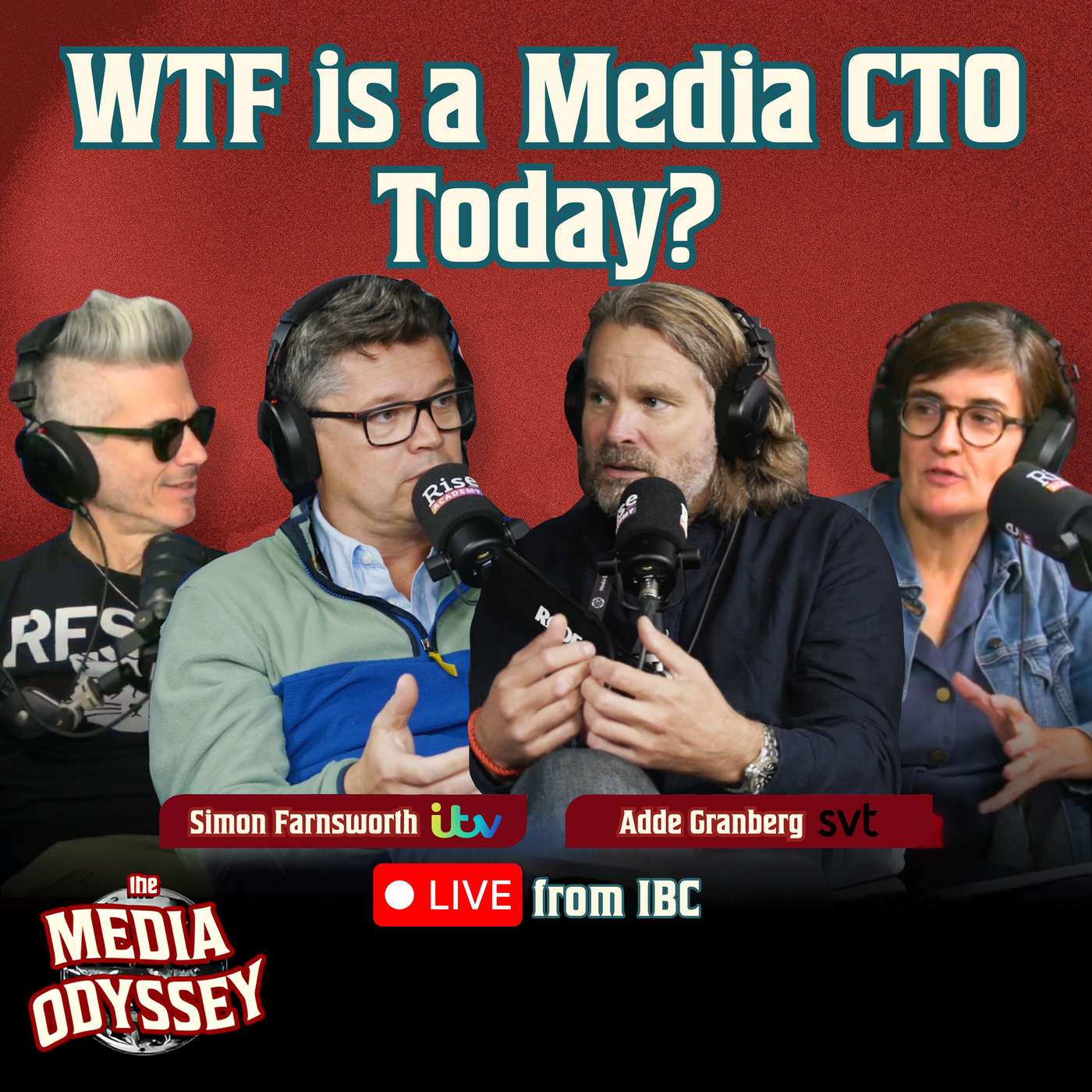
This is the Media Odyssey podcast. That is Marion Reinshett and that is Ivan Shabara. And we're here at IBC again with our second episode from ibc. It's been a really interesting show. I think we've had some fascinating conversations, not just on the pod, but at dinners and around. We've got two great guests, one recovering cto, the other current cto, both for public broadcasters here in Europe and what used to be European shout out, Brexit. We've got Simon Farnsworth from itv and we've got Ade Gramberg from svt. Welcome.
- [00:36]
B
Thank you very much. A pleasure to be here.
- [00:38]
C
Thanks for having us.
- [00:39]
A
So what the fuck does a CTO do for a public broadcaster? That is my great question of the day. Simon, let's start with you.
- [00:49]
C
I think the true translation of the acronym is probably wrong, which should be. It should be Chief Translation Officer, personally. Translating technology to your peers and management board members of actually what the power of this stuff can actually do for their businesses and grow. And then probably also Chief Transformation Officer, because what we're trying to do is drive transformation within our organizations, both from a sort of business model end and an actual operating model end.
- [01:37]
B
And I think from my perspective as well, to adding on to that, I think my biggest concern issue as well is we are in an industry where you don't have any pause. The news should go out always to the audience at any time, at any second, whenever they want it, whenever they want it. And we can't get down. So. So I think that's a new status of our mission as well. It's not only to transform the industry, it's to keep up as well what the audience need at that time that they need it. It's a new thing for especially public broadcasters, I think.
- [02:12]
C
Yeah, I think I heard a really good term this morning which kind of summed it up, is we're driving beyond human scale content creation.
- [02:21]
B
Yes.
- [02:21]
C
You've got to drive an ecosystem that can produce more content to more consumers where they want it at any time, which is something that humans, if you had a load of bodies in an edit suite, just can't do. And the distribution of that has to be at a grander scale, because as you rightly point on your podcasts, the fragmentation of the audience is happening whether we like it or not.
- [02:47]
D
And so why are you here, guys? What do you do at ibc? Is it a must on your conference track? What are you looking for? What are you looking for?
- [02:56]
A
Much easier for these guys to get to it than for me.
- [02:59]
C
But I think it's a great way to see a huge amount of technology in a very short period of time. And there's only this in nab. And nab for us as Europeans is very expensive to get to, similar to your here.
- [03:15]
D
And it's very US centric, I've been told.
- [03:17]
C
Correct. Whereas here we get a lot more Asian vendors. And that comes with its own challenges from a geopolitical standpoint of view. But it's a great way to see a lot of technologists meet a lot of peer groups and discuss actually what we collectively do as an industry to drive this forward. Because the kind of. If I look at the UK market and we go. Channel 4 was a competitor BBC. Wrong question. The competition's coming from the death stars, or what do you call them on your cut? The megastars.
- [03:50]
A
Our friends at Google don't like it when I say that. But yeah, the big tech death stars, the trillion dollar companies. It's very difficult. Marion was just saying to us on the previous episode that there's no way for the public broadcasters to compete with even Netflix on a global scale. Because they have a global scale. Right. They're bringing all content in, but then you add YouTube to it and you add TikTok to it and all this content's coming in. She's hoping her big wish for the industry would be much more collaboration between all the public broadcasters in Europe and in the uk. You look at things like freely, which is an operating system where all the public broadcasters are an operating platform where we're all live broadcast and on demand from the UK, public broadcasters can be found in one place for BBC, Channel 5, Channel 4, ITV. And that's, that's interesting.
- [04:45]
B
But, but I, I need to say as well, what you're talking about now is, is the output of our industry. IBC for me still is more the input, it's production as well. Unfortunately, we haven't gone so far there. The digitalization have happened, the consumer making content for the industry. So we need to collaborate much, much more than we have done before.
- [05:07]
D
Yeah, across the entire chain. Right.
- [05:09]
A
Yeah.
- [05:09]
B
But we are not there. If you look at IBC today, it's still major of the vendors are accelerating their own business, not the industry optimized for their own processes. And now we need to disrupt that totally and they are not there.
- [05:25]
C
You make such an interesting point because I joined ITB 18 months ago, the first thing we did was we launched this digital enablement strategy. Now we were doing digital, we had itvx, we had Freely, we were putting some content, but the content, the downstream process of that was still incredibly manual. And you go, we want to move from doing digital to being digital. And that's a totally different mindset.
- [05:52]
A
From doing digital to being digital.
- [05:54]
C
Yes. As an organization.
- [05:55]
A
Yeah, but I think that's a great phrase and I don't want to, I want to let it rest. There is.
- [06:00]
C
You can have, you can have that for free.
- [06:01]
A
No, but I think it's a. That's the challenge, right. That's the friction is, oh, we're just going to throw shit up on Instagram and now we're doing digital. Whereas you were talking about an end to end solution before we started the pod, about where it just automatically broadcasts a new definition of it out to all the other platforms organically without having to think about it. But you're so far from that right now.
- [06:23]
B
Yeah, but you can go out and see all the stands here. It's very, very few that focus on our audience. They focus on ctos buying a system, optimize it with the quality.
- [06:32]
A
That's what you call the picks and shovels problem. There's this kind of ingrained, institutionalized idea that we have to sell this stuff to people and that's our job. Not make the interface better, make the experience better.
- [06:45]
C
I mean, you don't want to criticize anyone, but you look around you now.
- [06:50]
A
I want to criticize everyone, but go ahead.
- [06:53]
C
It's full of white middle aged males, right? Well, that's not the population.
- [06:57]
D
Look at this podcast.
- [06:59]
C
Yeah, no, exactly. And I'm.
- [07:01]
A
What do you call them? Middle age.
- [07:03]
C
But we're not thinking about a diversified audience. And diversified audiences are consuming content in so many different ways and probably in ways that we don't even know is happening right now.
- [07:16]
A
Right. On Roblox, on Fortnite. These are new areas that are, that are worth explanation. I did a panel yesterday with Teresa Wise from Royal Television Society and I talked about the two different media ecosystems, one for Xers and older and another for millennials and younger. And you know, there is this, I think, institutional belief, and I would say this especially in the UK television ecosystem, but I think you're facing this as well, where you're from. First of all, your two countries really innovated very quickly to stream it.
- [07:50]
B
Yeah.
- [07:51]
A
But then it feel like it felt like that's that, all right, we're done. We're in streaming on these things called social media. We don't do that. That's beneath us. And you know, one of the questions I got Was, well, all the wealth is with the people who are over 50 anyway, so like, shouldn't we concentrate on them? I'm like, holy shit, you don't hear the problem with that question. So what is the resistance? What is the resistance to skipping into this new generation? You both work for very storied organizations in very storied ecosystems. Where is the friction for change when we all know it's necessary? What's stopping us?
- [08:29]
B
I can have a personal more than maybe official.
- [08:32]
A
Yeah, you're very outspoken about this.
- [08:33]
B
Yeah. Because I think we still think that we as a company and platform are the star of the universe, while I think the content that we should do should be the star of the universe. So the entry point to our content, we should expand that. Maybe not on all platforms uncontrolled, but we need to cooperate with the end users much more and release some of the belief that our platform is handling everything for everybody. That's not the case. And as well, the development now in the software industry is so fast. So I think SVT as a company should go to maybe other conventions and IBC to have a look at what's happened on the software industry. Adopt that to the distribution side and really focus on the production side.
- [09:23]
A
Yeah. I mean, you were talking about this earlier, Marion, about the walled garden problem. People want tee that up. Like, what does that mean?
- [09:31]
D
I think what you're trying to say, Adi, is that you're building something amazing in the hope. Well, one, you believe it's amazing, but maybe it's not. That's number one. Number two, you're hoping that everyone will
- [09:44]
A
funnel through that, that destination, that owned and operated platform.
- [09:48]
B
Yes.
- [09:49]
D
And, and so, but the question is, number one, if you were to do things differently, what would you do? Right. Because at the end of the day, you're coming to ibc, you're here to shop for new tech. Are you buying? Are you building? What would make you leaner? And to your point, I think he's
- [10:08]
A
here to stir to the pot more
- [10:10]
D
attuned to what you're saying, which is that it is fragmented. So let's stop treating this fortress of ours that is our platform.
- [10:17]
B
Yeah, but we need to collaborate in different shapes that we have done because I think it's somewhere close to 5,000 different OTT players in the world. 5,000.
- [10:30]
A
That doesn't include social media.
- [10:32]
B
No, that's just television OTT player. That's television content of AVOD as any platform. And that can't be a differentiation though. It needs to be the content and if we cooperate that and let the audience choose and pick what they would like to actually watch and make algorithms around that and really focus on the content. Because we should never ever come up with idea to our boards to say we will build a new terrestrial network because we the future for svt. But we do that when it comes to the digital platform and believe that's the North Star. And I think we're really losing it when we the content is the North Star. And then of course we should gain from the technology. But we are so upset with watching 2110 Standards into our system that have nothing to do with the ordinance. We are born and raised as a tech company. Today we are not a tech company.
- [11:28]
A
We should be a content company, an intellectual property company.
- [11:31]
B
Yeah, yeah. Because this is quite expensive to buy this kind of equipment. But now I'm for those who are only listening, I'm having a smartphone. This is not any TV standards at all, but it can do whatever vendor in here in TV standards can do.
- [11:49]
A
And this costs a fraction to shoot, produce and watch.
- [11:54]
B
And you can do it in one box without any audience at SVT or any other channels to see that it's done. With this one, we were still going here and buy tv standards uncompressed 4k for what reason we make it so complicated.
- [12:10]
C
I mean, I was walking around yesterday and some of the vendors still these massive audio mixing desks, massive hardware, they look cool. They look really cool and they are expensive. I'm kind of scratching my head going, guys, I think you're kind of missing the point here. All this can be done in a software domain. I think our job here, to go back to your point, is to put the most simple tools with the most creative firepower in the right creative hands and then understand where the audience is. Like we at ITV now, we're experimenting. We're putting content on Disney, we're sharing content with them. We put content on YouTube that was more of a commercial fight than it was a desire. We've kind of got past that now. We've got itvx, we've got freely, we're on distributed on way more platforms than we are. And now also thanks to some good lobbying, we've got protection on government. So ITVX now has prominence on all smart TVs. And we're now starting to argue potentially that should YouTube be a platform, should we have prominence on there? We need protection. Because like to your point earlier, us trying to fight toe to toe with Google, good luck with that. When they're taking data from Google Maps, Gmail, YouTube.
- [13:29]
A
Well, and it's the wrong. It's the wrong fight. It's kind of like saying ITV should go to war with sky when you're distributed on sky, that it doesn't make any sense. And if you look at them as the new broadcast standard, not just YouTube, but also TikTok and Instagram. And by the way, the only reason we focus on YouTube so much is because YouTube's the only social media platform that is on TV. But TikTok is coming to the television and Meta is only minutes away from figuring out what their television is.
- [13:58]
C
Spotify will turn podcasts into video documentaries.
- [14:02]
A
And some kid is inventing a rough beast in his garage or her garage right now. Rise. Her garage right now. And that'll be the next TV platform. But I talk to folks in the UK in particular, right? And one of the problems is, as you said, we can take these production standards and put them in the cloud and make it less expensive and faster. But there is also this thing where, well, why should we even put. Let's say you could get a priority spot on YouTube, right? You could get government mandated. What do you call it? Priority Prominence. Prominence. Thank you. But there's so many in your ecosystem who say, well, we don't get attribution when we go there. It's not in our player, so we don't control it. We don't control the relationship with the end user. So we're not going to distribute the nightly news there live when it's on the telly. And my response to them is you're getting zero attribution now. So even 50% attribution, last time I checked, you guys are math wizards. 50 is better than zero, right? So how do you change that mindset? You said you're a chief transformation Officer. It's the culture that actually needs to change.
- [15:12]
C
I think what we're seeing now is the data's starting to show that is what we've seen from YouTube is that we've had very little cannibalization on ITDX with our platform.
- [15:22]
A
Zero, I would argue.
- [15:23]
C
Yeah, yeah. Because your generation analysis that you did. Z's millennium generation gap in media.
- [15:30]
A
Thank you.
- [15:31]
C
They're all. They're all consuming content on different content. Our YouTube revenues are growing fast. Fast. Like. And it is margin. It's money.
- [15:42]
A
It's all new money.
- [15:43]
C
It's all money that from the same content.
- [15:45]
A
Can you repeat that again for the people in the back of the fucking room? Say it again. Your YouTube revenue is growing exponentially year on year.
- [15:52]
C
Yeah, I mean it's still got a long ways to grow.
- [15:55]
A
But it's all additive.
- [15:56]
C
It's all additive. Disney plus is additive. It's consumers that we don't have. And you look at what Netflix has done with TFL in France. Experiment, experiment, learn, experiment, learn, test and learn, test and learn. So we're doing so much more of that now and we're learning a lot. We're getting more data. We're building ad sales packages that incorporate, that incorporate YouTube and people are buying them because they want distribution and actually interesting.
- [16:30]
A
And you're selling it as part of the partnership.
- [16:32]
C
So we've developed this technology called Planet V Ad sales where we control all the data. It's a self service model for agencies,
- [16:41]
A
including a plugin with YouTube as well.
- [16:43]
C
Yeah. So they can buy YouTube through that. We now done a deal with Comcast for universal ads. So we're starting to push into SME advertising because historically ITV's money came from agencies. We had four big deals.
- [16:58]
A
By SME you mean small media, small and medium enterprises. SMEs in the United States.
- [17:03]
C
So for example, so some small coffee
- [17:06]
A
shop can go in the back end and buy $1,000 worth of advertisements.
- [17:09]
C
There was a chain of 35 travel agencies in South Wales. Good on them, doing a great job. We used Genai to create yachts. Cut the creative process from 50,000 dive to 500. We were able to get really targeted of audiences through YouTube, through ITVX. It's money that we wouldn't have had
- [17:32]
A
and those businesses traditionally would have only bought YouTube or Instagram or Facebook because it was too hard and too expensive,
- [17:39]
B
too expensive to do.
- [17:40]
C
And interestingly now what we're starting to do is suck in data from retail loyalty programs, say Walmart in the US or Tesco in the uk. So when you buy this program, we can predict what it's doing at the tills or smartphone.
- [17:57]
B
They start to be like Google.
- [17:58]
A
Yeah.
- [17:59]
C
So what we're able to do is keep the majority of the money rather than pay.
- [18:04]
A
Let's go back and press on that because retail media is going to be one of the fastest growing. It's first of all, retail media on the planet earth now generates more advertising dollars than all television on the planet earth. But the money wants to move to the television set. That's why Walmart bought Vizio. So what you're doing is you're taking the shopping data of consumers and you're creating a predictive model on who the best target is and then you're tracking to understand Whether it turned, you're attributing whether it turned into a transaction, is that right?
- [18:33]
C
Yeah. And guess what? That allows us to do it. Allow us to pour more money into the original content. Pretty creation which allows us to create more premium content, generate more eyeballs across a more distributed, more distributed landscape. Guess what, we're going to have much more sustainable businesses moving forward and all our senior management leadership at ITB are really, really, really starting to get that now.
- [19:01]
A
And it feels like, and I want to turn this to you in a second, but it feels like to us, when you look at ITV studios, BBC studios, it feels like a lot of the innovation I think you hinted at, this is driven by the commercial end of the business. To a certain extent, they're the tip of the spear to test and learn first because they have a financial incentive to do it. But it seems like it's beginning to influence the non commercial end of your business as well. Is that right?
- [19:26]
C
100%. So example, and I don't want this to be misunderstood. Love island absolutely popped on peacock in us this year we've got 27 versions of love island going around the world now.
- [19:41]
A
It's also a massive hit on YouTube too.
- [19:42]
C
One small part of the creation process is historically we'd screened 500 potential contestants. We literally had to create a three minute edit of every person so the producers could look at that and go, right, we want that one, that one, that one. Then you check their mental well being and all that kind of stuff. We used AI this year to just shoot all those screeners. So Instead of doing 500, we did 1,000.
- [20:09]
A
Wow.
- [20:10]
C
UK version, 7% increase on air. Now the producers would argue, oh yeah, we introduced a new game in episode four or whatever and they're right to do that. But there has to be a correlation that these tools can go beyond human scale production to create better on screen products for the same, if not less.
- [20:35]
A
Well, in this case in particular, I mean, reality shows is all about the casting, it's 100% about the cast because you need a good heel and you need a good hero and that's ultimately how it works. You had a wider pool to choose from because of AI, so you actually got a better cast as a result of it. And that probably had a huge impact.
- [20:52]
C
So one of the things we're looking at here, interestingly back to your earlier question is, and I'll come to Ade in a minute because I'm completely monopolizing the conversation, is how about we could take those cameras on those reality sets directly into the cloud. Use Genai to sift through all of that content so that then you could the choice moments create more content for TikTok, more content for YouTube, build that franchise so all ships essentially rise to the top. So we're creating better content for the consumer at a more cost effective price point that differentiates ourselves from the YouTube mass of content. Is that going to allow us to
- [21:35]
B
win more and then you can see the next step. That's why I'm really heading on to the production value chain as well because then you can personalize the content for me or for you depending on Sweden UK we will have two different angles of it and that's impossible today to do with the content, with the processes we have today. But if we go into the cloud for real and adapt to a standard with focus on the end users, devices and distribution chain then we can really do personalization for real. But 100% it's impossible to back. You can't do it.
- [22:08]
C
What we talk about there from a technology perspective, ultimately if you strip it all back, what we're trying to do is get complete control of our data.
- [22:16]
B
Yes.
- [22:16]
C
Video, audio, metadata, take advantage of modern tools like image recognition, speech to text, then your semantic search can be so much more powerful. Consumers can find much more of your content faster in a personalized way. That should be a good thing for a consumer and a good thing for our business.
- [22:37]
B
And that's I think next step for IBC and this kind of convention need to confirm this, this collaboration between distribution and production and one of the industry I used to say need to actually fade out and I think it's the broadcast production industry need to fade out to the advantage of producing a distribution quality to get to that step. And I think we are our own barriers to get there.
- [23:02]
C
Yeah, I think the biggest challenge is change management. We saw what happened in the US right with the writers strikes. It was, it's a massive problem for the industry. But what we've tried to say at ITV is this isn't about taking away jobs, it's putting more creative tools in your handsets. With the right creative talent, surely that's a rocket ship for growth.
- [23:27]
A
Well and to the point you made and you make this all the time is there are certain things that humans shouldn't be doing because it's not scalable from a human standard standpoint, but the reinvestment back into the content. We will ultimately hire more creatives to make more content because we're making the whole ecosystem more efficient. That's the Whole thesis. That's why you change jobs from CTO to cio, right. And you know, you're very outspoken. Like I've had people say to me like he's going to get his ass fired.
- [24:00]
D
Yeah, he got a promotion and he
- [24:02]
A
got a promotion instead. Why? What was the thinking between this new git before about this new gig, both from the organization standpoint, but also why did you agree to take was actually
- [24:13]
B
our CEO that pointed it out to say that you're having a tough time to do this Transformation Officer. As a cto, it's easy for you if you work with innovation, present a table of options and then we can decide how we make the operation handle it. Because we are going to massive shifts when it comes to. To change the way we produce and distribute and make content in the future. I think it's really a massive shift and that makes the company needs to have courage to do that and have me as a speedboat and take some projects around that. So that's what I'm scouting actually when I'm here and then implement it in project forms instead of trying to change the entire company in one.
- [24:59]
D
Drive the boats and then change everything. Can you tell us, give us a few examples of things you've been thinking about ahead of ibc? You know, things that you were looking in particular. And then second question, anything that you've seen here you did not expect and then you're bringing it home and you're thrilled and excited.
- [25:20]
B
We talked about Firefly and Adobe Firefly Story now where you can use AI to actually prompt the story and AI will make your story.
- [25:31]
D
So for those who are listening to us, who may not know what that is, do you mind saying Adobe have
- [25:36]
B
a product now which is Firefly, which is an AI engine that make AI content from speech or from text. But the problem with AI so far have been resilience in actors and shots and everything like that. Now they have sought out that problem. So in next release you can actually do a story. You can do a full story 4 minute story in Firefly just by prompting. Anyone can do that.
- [26:03]
A
And creating the video.
- [26:04]
B
Yes. Everything with speech, with everything from animals.
- [26:07]
A
And it looks like real human beings. It doesn't.
- [26:10]
B
Yes, unfortunately, yes. So that's why I'm really. That's really Game changer. Game Changer scares me actually from one perspective, it really scares me in a good red bed.
- [26:23]
D
Great. Bit expensive was what I heard.
- [26:27]
B
It depends on what you.
- [26:29]
C
Depends on what value you're driving.
- [26:31]
A
No, but I do think there's this Misperception that AI is you just plug this magic box called AI into your operation, it's going to start saving you money.
- [26:39]
B
No, it's not.
- [26:40]
A
And people don't understand there's these all huge costs associated with these software packages and the energy and everything else as well.
- [26:50]
B
We're coming back to that because I think we coming from an industry with boxes doing fixed thing for 10 years and they'll be moving boxes and moving processes. We go into every search cost money now inside sut, every search of searching content, making something cost a few cents because we exploring new things and we're gathering metadata. So that's an issue. But when I get here for real, I'm now seeking how can we disrupt the broadcast standards with 5G technology? How can we get into the cloud and make the production in the exact right format for distribution? So don't have a production format that we are working in the production mode and then have a distribution format. So I would like to make now for real 5G production with 5G connected camera into the cloud. Yeah. Virtual sound.
- [27:42]
A
And the reason for that is you want the standard to be able to adapt onto a phone if necessary.
- [27:47]
B
Yeah. But as well it's so much waste because if we talk about standards, 4k in, in this area here is 4 gig per second. When we talk 4k for the audience in an iPhone or in a television, it's seven megabit. So in the process now we are doing one process for production and a total other process for distribution. And that's a huge amount of money that we need to. That is waste. So we need to.
- [28:20]
C
We've all been in those conversations, haven't we? There's a massive screening room.
- [28:24]
B
Yeah.
- [28:24]
C
We've got a producer going. Maybe there's a 10 meter audio wall. Audio, sorry, a vision wall.
- [28:32]
A
Yeah, it's this massive screen.
- [28:34]
C
I can see a pixel that's out of there. I said yeah, but sorry, but they're kind of watching it on the.
- [28:41]
B
They're watching on a 50000k monitoring. And who at home have a 50000k more?
- [28:48]
A
Well, to be fair, on the other end of it, the cost of television is plummeting. So I can get a better and better television screen for less and less money on an ongoing basis. So the use case has to be to your point. It has to be for both. You have to produce for the television on the wall that looks great and the great sound, but you also have to produce it so that it looks good on an iPhone or worse an Android and sounds good in an earbud. But you need intelligent production design so that it can automatically decide where is this screen going? What's the.
- [29:19]
C
Beyond human scale.
- [29:20]
B
Yeah. And I have a practical example to just understand that we are running every year a big cross country competition called Vossalop at 90km one way. 14,000 people are doing it every year.
- [29:36]
A
Running or driving.
- [29:38]
B
Cross country skiing. Yeah. It's the biggest show.
- [29:41]
A
I hear that's a good sport.
- [29:42]
B
It's fantastic. And it's 14, 15,000 people doing that every year. And it's 3 million people in Sweden watching it. So 30% of people inhabitants watching it. Right.
- [29:55]
A
30% share. Nothing gets anymore.
- [29:57]
B
And we have done that in broadcast standard with helicopters, links uncompressed.4k for every year. And last year or this year we did it with drones over 5G. Everything. The audience loved it. They couldn't see any different in picture quality. And we're getting closer to the skiers. We can have reporters going the entire route and it's done with the total other standards and the audience doesn't see it. And the price was very low compared to last year.
- [30:30]
A
The carbon footprints, you dropped the cost of the show dramatically. And people enjoyed it.
- [30:35]
B
And carbon footprints, investments, everything.
- [30:38]
C
I think this show is sort of the construct of this show is probably an indictment of that. I haven't been here since Pre Covid. Yeah, IBC. Pre Covid. There was probably about 20 OB vans outside the front. None.
- [30:55]
B
No, you have two, actually.
- [30:57]
A
But what's an OB van?
- [30:59]
C
Really quick outside broadcast van. The big trucks that they send to NFL games or whatever else. You can do this stuff at a completely different scale on a laptop, completely different budget now, and arguably produce more.
- [31:16]
B
Yeah, but that's super interesting because in November 2019, I was in a stage on a convent in London saying that remote production, what we're talking about is the future. It was maybe 500 in the audience. Broadcast specialists said, yeah, maybe for the lower tier. 3. Shit. Actually never ever for big leagues, big sports. Three months later, the COVID hits.
- [31:45]
A
It's totally changed.
- [31:47]
B
It's totally changed the industry. During three months. Everybody asked me, how can we do remote production with everything? Because I've done it in 10 years. But the industry wasn't shifting at all if it wasn't for the COVID But
- [32:01]
A
Marion, you and I talk about this all the time. The answers are staring us in the face if we want it. But when a crisis came along, we figured it out. And I think this is. I mean, this is your hometown. You say you're Europe And I'm us. So what is the mindset? Is it the broadcaster mindset? Is the European mindset? What do you see here and is it shifting?
- [32:24]
D
Well, I have to say, when I'm here, I can see that the tech is here and they can do anything, but mindsets are shifting much slower. So when you're saying you're a cto, as in not Technology Officer, but Transformation Officer, I think what you need to do, and I'm assuming this is what you meant, what needs to be done is changing people's mindsets. I mean, people see what's staring in their face, they're not changing a single thing. So when Adi says, or when you say that someone is like, you know, in the nitty gritty of every little thing, as if you. They were doing TV like 20 years ago, I think this is problematic. Right. So I think the number one focus should be on that, making, you know, people management changes. Right. Mindset wise. And again, you've said it multiple times. The big challenge and we're seeing here is that our audiences are not at this event, the audience that we're supposed
- [33:18]
A
to target here at all.
- [33:19]
D
They're not represented. Not in the staff, not in the age wise.
- [33:25]
A
The attendees.
- [33:26]
D
The attendees, speakers in particular, they've done an okay job.
- [33:30]
A
But no, we're all laughing because we're all speakers. But I mean, how many millennials are young gen or gen Zs do we see on stage?
- [33:38]
B
And how many content producers do we see here?
- [33:42]
A
Almost none.
- [33:43]
B
No, because they're using other technology. And I can go back to my point because this is a camera with 5G connectivity. Go out on the stands here and please bring me back one single professional camera with 5G connectivity to it. Because the vendors here would not let in that ecosystem into the ecosystem.
- [34:02]
A
It's dangerous to them.
- [34:03]
B
It's so much money here, which really upset me because you can't find a single camera that can. Do I need to build the system back home to get it work in the proper way?
- [34:15]
D
So do you think that this event, actually a lot of what it represents is whatever thing is wrong with the industry?
- [34:22]
A
Yes, in a way, the middle name is broadcasting.
- [34:24]
B
Yes, yes, we need to remove that word.
- [34:27]
A
Well, actually, we just talked about. I see international convention. That sounds like something different. I actually think rather than change the word, I think we should change the definition of the word. Because broadcasting. If you're on TikTok, going, TikTok, TikTok. That's a, that's a mint. If you're on TikTok, going live. You're broadcasting.
- [34:47]
B
Yes.
- [34:47]
A
If you are screaming to a crowd, you are broadcasting. So if we can adopt all the meanings of that word into that word, then this convention could.
- [34:57]
C
It's kind of like super broadcasting now, isn't it?
- [34:59]
A
Right.
- [35:00]
C
Historically, we'd. You'd go. You'd have your remote channel 1, 2, 3, whatever that was broadcasting. Now we're super broadcasting 1, 2, 3, TikTok, YouTube, Snapchat.
- [35:11]
A
And it has to be that way, right? Because that's the only way you can reach 100 of your audience.
- [35:14]
C
Exactly.
- [35:16]
D
People are still hung up on what it means. I think where I agree on the old definition, people are hung up on what it means. And there's still that, you know, gap between what people consider. Tier one, you've said it. Tier two, premium, non premium.
- [35:30]
B
I mean, the audience is not.
- [35:32]
A
But there's a difference between a definition. Because if you Google broadcasting, it does not mean what we're talking about in the middle of this conference. Right? It is one to many, right? One to infinite. To a certain extent, what broadcasting has come to mean, which is what Amanda Lotz writes about, is an industry standard. Right? An industry production standard. And we have to shake that and go back to the original definition of the work. Which brings me to my most important question. Ade, how's my hair look? Does my hair look good?
- [36:06]
B
Perfect. Perfect.
- [36:08]
A
Always. I'm intimidated because you have.
- [36:10]
D
I love Ade's hair more.
- [36:11]
C
Yeah, pretty sweet.
- [36:13]
B
Both of you. Fuck you.
- [36:14]
A
I'm gonna throw my headphones down. If I didn't think it would mess up my hair, I would throw my headphones.
- [36:18]
D
That's the key for those who are listening and not watching. He looks like a Viking.
- [36:23]
A
He does look like a. He looks like Barry Gibb back in the day. Which is a reference only so many of us are gonna get. So true. We were at dinner last night, right? And I threw a prompt to the room which was, if you could change anything about our industry, what would it be? And we weren't sitting at the same table, so I'm actually super interested. If you could change one thing, not everything, which is what you want to change, pick one thing that would be your highest priority. What would you change? If you were all. If you look like a God, if you were one, what would you change?
- [36:59]
B
But it's quite simple. I can talk about huge of fine things. I would like to remove the broadcast standard into a consumer viewer standard and make production there. Then, if the consumer needs are uncompressed 4k, we go up to that and really for real change that industry and adopt to that.
- [37:25]
D
So you're eliminating everything and starting from stretch from the ground up.
- [37:28]
B
Yeah, but if you ask if you
- [37:30]
A
were starting today, wouldn't you?
- [37:31]
B
Yeah, then I would do that. And if you talk the most watched content are still on YouTube and it's not in broadcast standard and it works fantastic. And then we can accelerate from that. If we need to have what we consider high quality content.
- [37:46]
D
You would want to be, rephrase quality. You would want to be in a creator's mindset. So funny. I've heard again YouTube creators, social media creators, guys in their room with a phone. So you would want to be that. And when you see the speed of how these guys came from this and they actually have full professional gear and a very lean way of producing content, this is what you want to be.
- [38:14]
A
Look at what we're producing here. We're producing on the floor of a convention. Put this out on YouTube.
- [38:19]
D
Four mics, four cameras. There we go. And you were talking about those huge consoles were paying 200 a year for Riverside to record and another 200 to distribute on transistor. This is all it took for us to start a podcast six months ago.
- [38:39]
A
They should give us money instead of us paying them. We just promoted them. Simon, same question. If you could change one thing about this industry, what would it be?
- [38:48]
C
It's one word, it's mindset. Yeah. So it's that these modern day technologies can completely transform the way we distribute content and the mindset that the audience is in many different places. It's not just your big transmitter infrastructure in the UK or in Sweden that we've distributed content that's gone. We all have to get into this mindset that modern day technologies and generative AI is going to completely change. If we don't, it's going to be hugely problematic.
- [39:24]
A
But it's not change for bad. I think that is. I think there's this binary thing, this black and white mindset fear of finding
- [39:32]
C
out fofo if you put the right technology in the right creative hands, it
- [39:37]
A
is a rocket ship for growth and it'll get better.
- [39:39]
C
The content will get a rocket ship for growth.
- [39:41]
A
Yeah.
- [39:43]
C
Growth is job stability, it's job creation. It's good for government, more income tax, more corporation.
- [39:54]
A
There's this perception that technology which is disruptive is gonna eliminate jobs and be bad for our industry. And that by the way that happens every time there's an industrial revolution. The fear is this is gonna cost people their livelihoods and their Jobs. But we've moved from an agrarian economy into a technological economy. And the mindset in a lot of these. You know, in the United States, we still run the television season by the farming calendar.
- [40:27]
B
Yeah.
- [40:27]
A
With the upfront season, the whole television season is still driven by the school year, which was driven by when the crops were ready to be taken out of the field.
- [40:38]
C
You look at the U.S. farm road roll payroll. In the 1800s, it was the biggest employer in the U.S. then tractors came along and combine harvesters came along and whoa. People stopped starving. We had more food.
- [40:53]
A
Exactly.
- [40:54]
C
It was a good thing.
- [40:54]
B
Yeah. But looking in our industry, we never, ever, ever done so much content as now. So we are not in a dying business. I think what we are thinking is that we are in a dying business, but the business overall is exploding. But we are maybe thinking in the wrong way.
- [41:12]
A
Yeah. And when you say we, it is the traditionalists, it is the traditional media players.
- [41:18]
B
It's a mindset question. Yes, it is.
- [41:20]
D
But we get a lot of pushback on that because we talk a lot about mindsets, change, et cetera. But everyone, every time we're talking to people, a lot of people are pushing back. They don't want to change anything. And then you have people who do want to do that, and they're frustrated in companies where they cannot make any changes. So, I mean, where is that big disruption going to come from? Because you guys are trying, everyone's trying, but it feels like we're still a minority.
- [41:47]
A
I do. So last night, Adi is very outspoken. Simon, you've been outspoken here on the pod, but we had this dinner last night with people from various companies, some of my favorite companies, as you said, Simon. And some of the big tech players were there as well, and they were incredibly blunt and honest about the problems inside their own company. I don't know if they'll be as brave when they get back to the headquarters, but I think, Marian, that's the thing is those of us who work in, who are charged with transformation have to be braver because there are no safe jobs in broadcasting anymore. There are no safe jobs in media
- [42:24]
D
anymore, in streaming anymore.
- [42:25]
A
And so if you're going to hold your tongue and try to play it safe, it's probably going to wind up the same for you either way. And if you can take a risk and speak truth to power like these two gentlemen have here, like you do all the time, like I try to all the time, at least maybe you can try to change the mindset. This has been a great conversation. Thank you gentlemen, for coming here, giving of your time. You've been wonderful guests. I wish everybody were as blunt as you are when they come on our pod. Marian, I think we just asked our question of the week. This is our last conversation on Mike at ibc. What's your one big takeaway from ibc?
- [43:03]
D
So I think the biggest takeaway for me.
- [43:06]
A
I'll tee it up again.
- [43:07]
D
Yeah.
- [43:07]
A
So, Marianne, we've been here. This is our last conversation on mic at ibc. What's your one big takeaway from IBC land?
- [43:13]
D
The one thing I think I saw this year I had never seen before in terms of those who were present both, you know, at booth and on stage. We had Snap, we had TikTok, we had YouTube multiple times. And so I think Amazon, there is a bit of a change happening in the way IBC sees itself beyond broadcasting, beyond pure tech. And so I've had discussion with them and their big question for next year, and hopefully they will have us on to help them do that. But they want to find a way to tee it up with a creator economy, the affinity economy, wherever you call it. So we can bring back ADI next year with Novice or anyone, but we're gonna go. I think this is. I think I haven't seen anything that blew my mind. But at the same time, I'm not a tech person, so bear with me. But I will say that I feel that those dreams of being more open and going beyond that. The B word.
- [44:14]
A
Yeah, this. I mean, look, they were brave enough to have each of us here. They knew that I was gonna come and throw truth bombs from stage right. So credit to them. And I think you're right. I think this convention wants to shift into a change convention, into a convening of transformation, as it were. But I think you stumbled upon, if we are gonna change the B in ibc, maybe it's the International Beyond Conference. But I think my one big takeaway is, and it really gelled during these conversations on the pod is I think we have to change or revert the definition of broadcasting to its original intention when it was coined for this business in the first place, which is one to many or many to many. And I think if we can agree to all go back to our headquarters and to our bosses and to our employees and to our peers in the industry and say we need to change, to speak truth, to power, to be brave enough to speak about what we need to do to survive, then I think we can be the change internally in our organizations. This has been super fun I love Amsterdam, you know, I love you, too. And great to see you here. It's been great to do this on the floor of ibc. I hope we get to do it again next year.
- [45:34]
D
100%.
- [45:35]
A
That is Marianne Renchett.
- [45:37]
D
And that is Evange Pyro.
- [45:38]
A
And this has been the Media Odyssey podcast at ibc. Thanks for tuning in. We'll see you again next week.
- [45:44]
B
Sam.