Loading summary
Transcript29 lines
- [00:07]
Nate DeMaio
Hey, folks, it is Nate. Before we get started, I want to ask you to consider two things. I'm talking to you today at kind.
- [00:14]
Narrator
Of a pivotal moment in the history.
- [00:16]
Nate DeMaio
Of this history project that you know as the Memory Palace.
- [00:21]
Narrator
Here's the first one.
- [00:22]
Nate DeMaio
On November 19th, I have a book coming out, and I am delighted about that. For years, I have wanted to collect the sorts of stories that I do in this podcast in a book, like.
- [00:31]
Narrator
Something that you can hold in your.
- [00:33]
Nate DeMaio
Hands, give as a gift, and something that could live on your shelf. As a kid, I grew up loving these old paperback collections of Ripley's Believe.
- [00:42]
Narrator
It or not, also things like where.
- [00:44]
Nate DeMaio
The Sidewalk Ends, the poetry book by Shel Silverstein. It's collections of short pieces that you could turn to again and again. You could find new things every time you took it off the shelf and maybe find that they connect differently this.
- [00:58]
Narrator
Time now that you're that little bit.
- [00:59]
Nate DeMaio
Older or a little bit changed since last time you read it. And I want to make one of those books, you know, but for adults that might have a little bit of that same magic. And I'm excited now to see that if that magic trick works. And so I am here today, days before its release on November 19, to encourage you to order the book, to help it jump out of the gate with some momentum so other readers might find it, especially people who don't listen to the show like you do. So that is thing one and thing two is deeply related. This show, book or no book, successful book or flop, will go on. And it will go on, thanks to listeners like you. Each year, we at Radio Utopia ask you directly to support the work that we do. We are one of the rarest, and I am more convinced all the time in this time of increased media consolidation and corporate nonsense and private equity raiders, that independent media is vital. I look around my industry and I see layoffs and cost cutting at big podcast companies. I see terrific shows getting worse because some corporate suit says they need to come out more often the episodes and more often that the people can make them or at least make them well. Or these shows are just shutting down because some investor needs someone to cut some bottom line to meet second quarter estimates. And that doesn't happen at Radiotopia. At Rodeotopia, what shows sound like, how often they come out, is up to people like me. The people make them. And whether those shows survive and thrive, it's up to you, honestly. Listener support provides the foundation of each of these shows, including mine. It allows me to keep the lights on at the Memory palace, even in times like these, when ad revenue is vanishing. It has allowed me in this last stretch, which has been fairly rough, honestly, to wait out the storm. It is thanks literally to listeners like you.
- [02:55]
Narrator
So if you would like to join.
- [02:57]
Nate DeMaio
The tiny fraction, the select group, the elite squad, who contributes, if you want to do it this time, in this moment, for this show and for the uncertain times here in these United States, it is a perfect time to join them and join us. You can donate to help this show and the work that Radiotopia is doing, the fight we are fighting in this very strange landscape. We are very proud of what we have built together and we would love you to be a part of it. So donate today if you can at Radiotopia fm. Donate and thank you so much.
- [03:43]
Narrator
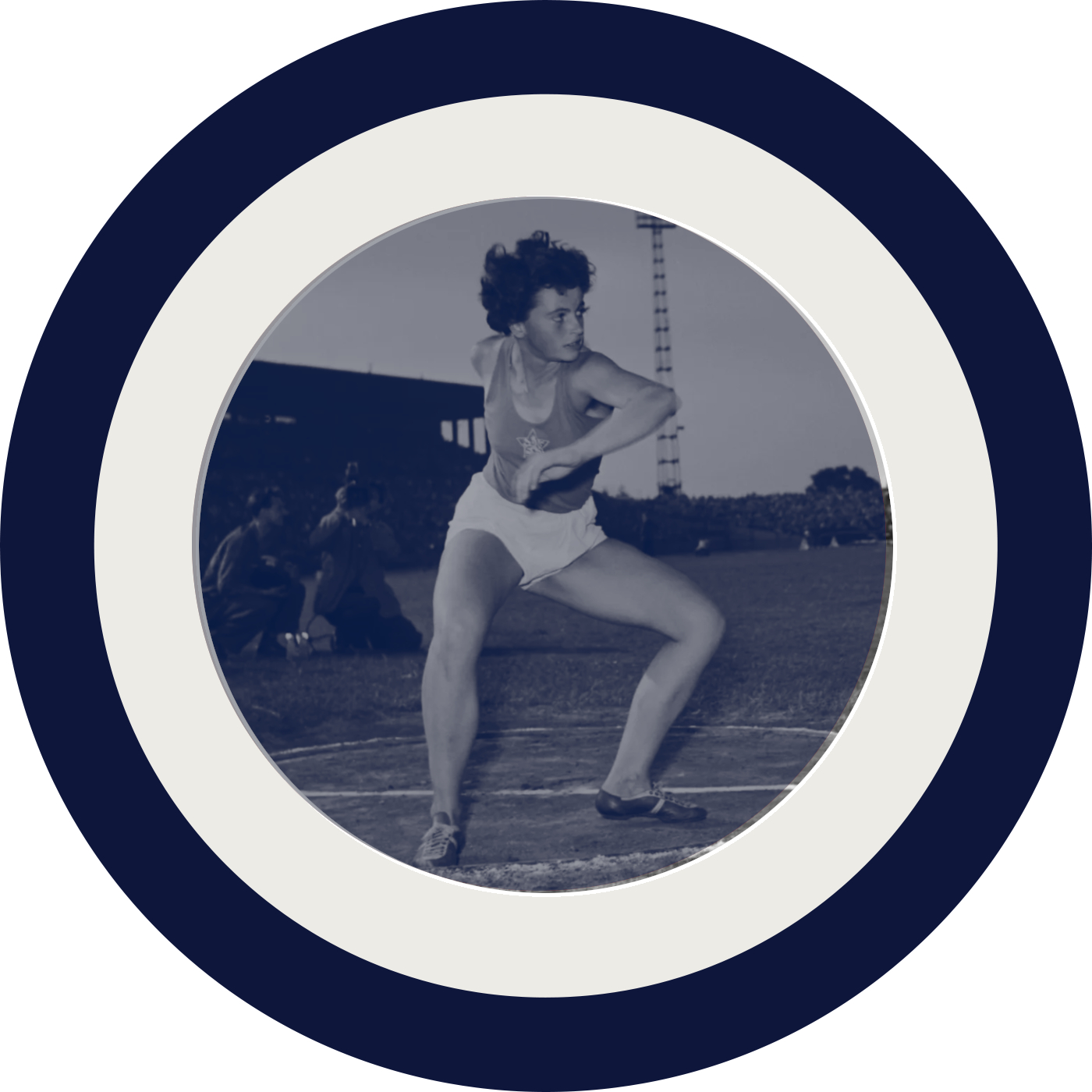
This is the Memory palace. I'm Nate DeMaio. They found a place to put her. She was an exceptional athlete, had excelled at team handball for one of the biggest youth athletic clubs in Prague in the years after World War II, took her basketball team to the finals of an illustrious competition. And the Czechoslovak Athletic Committee had their eyes on Olga Fikotova. Tall and strong, bright and pretty, wide smile, a bob of brown curls. She was a star student studying medicine at an elite university. They had their eyes on her, but everyone had their eyes on everyone. Watching, noticing, asking other people to watch and notice and report back was at the heart of the Czech Communist Party's means to power. They had a file on everyone, but hers was thicker than most. When she was starting high school, her father was disappeared for months, swept up in a purge of former military leaders from the previous regime, jailed without trial by the secret police. After his release, when it was determined he was sufficiently loyal to the new state, the Central Committee kept close tabs on his whole family, especially his headstrong daughter, who had turned down a chance to join the Communist Party. She said she liked to go to church too much. She said she would never be able to fully embrace all the principles of Marxism and dialectical materialism. She didn't want to pretend she could, just to gain social advantage. But she assured her interviewer that she loved Czechoslovakia, that there was nothing she wanted more in this world than to bring glory to the nation while furthering the cause of global communism by winning gold at the Olympics, probably in handball. She was really good at handball, but it could be basketball.
- [05:29]
Nate DeMaio
She loved basketball.
- [05:31]
Narrator
Honestly, either would just they gave her a discus. The Czechoslovakian Athletic Committee had a spot it needed to fill on its women's discus squad. So that's where they put her. She wasn't happy about it at first. She missed her teammates. She missed the freedom of basketball and handball, the fluidity, the improvisation. That was not what discus was about. Discus was just her alone, exploring the confines of a two and a half meter circle. But she found her way even within those bounds. Built her body to crouch and twist and spin and explode. Her coaches helped her find her rhythm by playing the Blue Danube over the speakers of the empty stadium where she practiced each morning. Turned the push, spin throw of the discus motion into a 1, 2, 3 of a waltz. She did it again and again and again until she knew all of it. The feel of her toe on the inside of the outer ring. The sound of her feet in their precise stride. The higher sound made by the brief twist of her planted toe. The angles, her shoulders, her hips, the tension in her forearms, the right pressure of her finger at the edge of the discus. How it felt, how it was all supposed to feel. When the timing was right, when the stride was right, when she landed her toe at the edge of the circle but not over. When the push, spin throw goes. 1, 2, 3. When she just about perfected that odd brief dance within that tiny circle and let that discus go as far as it could soar up and out, however far it could go, turned out to be pretty far. It took her to the other end of the earth, to Australia for the 1956 Summer Olympics. It felt like a dream to have left Prague just a few days before and find herself in the Melbourne sun among people from all over the world, athletes just like her. She was in heaven. And a couple of days in, with a few more days before the opening ceremony and then her own competition. On the game's very first session, she was hopping up the short steps to a supply shed to grab discuses and some chalk and she smacked square into the chest of a muscle bound man. His hands grabbed her shoulders to keep her from tumbling backwards. The letters on that chest read usa. And this happens sometimes. Life can really be like this. If we're lucky, if we're present enough to notice and brave enough and quick enough to act. Sometimes there is love at first sight. Sometimes there is a meet cute just like in the movie. Sometimes you were in the right place at the right time and you are also single. And yes, you do have time right then to take that walk or grab that drink.
- [08:18]
Nate DeMaio
And when they say, well, I hope.
- [08:20]
Narrator
I see you around and you say, yeah, hope so too. You really might, because you're also lucky enough to have your life take place just then in some limited space. You are on the same campus, you work in the same office complex, or you just moved into the same apartment building a couple blocks over from the beach. And maybe, maybe even ideally, there'd be a ticking clock, something to force you out of your normal hesitancy, like you're just there for the summer, or it is your mutual friend's wedding weekend. You will see them around and you will light up when you do. And you won't play it cool because you know your time is short and that life is short. This happens sometimes. And so it was for Olga Fitkova of the Czechoslovak Socialist Republic and Harold Hal Connolly of the United States of America at the Olympic Village in Melbourne for a fortnight in 1956. He was a hammer thrower, which is basically like the discus with a different object and more spinning. He was the best in the world. He was tall and pretty, handsome in an all American, slightly goofy kind of way. A lantern jaw and a big open smile and a face that in just about every photo of him from this era radiates a kind of perpetual stokedness, like everything is going to be all good forever. His arms were different lengths. He told her on one of their first walks after bumping into each other again after that first bump at the equipment shed. The problem during his birth messed up one of his arms. As a result, he kept breaking it and had multiple surgeries. That meant his left arm was 4 inches shorter than his right. Couldn't really play baseball or football or basketball like the other boys, hence the hammer. But there was no professional hammer throwing circuit, so he taught school English at a high school in Boston. And here he was on the other side of the globe meeting a girl. He was all earnest charm and witty retorts. He'd offer to carry her equipment, she wouldn't let him. They'd scheme to bump into each other. Just happened to pass by the field where the other was training. He'd get razzed by his friends. She'd get stern looks from her stern coaches. He was a capitalist, she was a communist. Can I make it any more obvious? It was like a Hollywood movie, though she hadn't seen many American films, were banned in her country. She knew Mouse Mickey, as she called Mickey Mouse in her halting English in a way that would fit right into a Hollywood rom com. But she did see a movie with Hal conspiring to meet and sit in the dark. They rendezvoused at the zoo too. Saw koalas and kangaroos. They came separately, arranged to meet up away from the crowds, went back in different rows on the bus, lest Olga get caught by her official government minders. It was hard for her to explain it all to Hal, not just because of the language barrier or the fact that their circumstances were so different, but because she didn't entirely know what would happen if she were caught. She was forbidden to fraternize with Americans. But would she be kicked off the Olympic team? Would she be sent home? Would she be jailed? Would her family face retribution? She didn't know. She just knew. She was afraid to step out of bounds, but she did anyway, because she had fallen in love. But she also had a competition to win. And so to the ring, tens of thousands in the crowd. The first day of the Games. She and Hal skipped the opening ceremonies the night before so they could rest up. But they listened to the parade of nations together on a park bench on his transistor radio. Olga entered the stadium hoping for the bronze. There were two Soviet women who were sure to throw farther than her. Olga was good, but they were great. The qualifying round that morning was brutal. Dozens of women entered, but only 13 threw far enough to make it to the finals. She slipped in with middling scores. She stepped into the ring for her first real throw, right after 3:00, cameras clicking. She took a deep breath, swung her arm back, kicked her right leg forward, spun on her left toe. 1, 2, 3. And off it flew. She knew it was bad, had felt it the whole time. Those couple of seconds. It would not be good enough. She sat in the grass, watched one of the Soviets send her own discus soaring. She looked out into the crowd, a sea of faces. She wondered if all those people knew just how easy it was to fail. But then she watched the second Soviet champion falter. Maybe there was an opening. All she could do was her best. She crouched and she spun and she threw. And off it went. Her farthest, forever. She was in it again. And then her final throw. Good. Not quite as good, but good enough for a meager lead, one that would surely fall when the Soviet champion made her last throw. Olga lay down in the grass. She couldn't watch. She listened as the best female discus thrower in the world was called to the circle. The grass was cool on her back. She heard sneakers turning on dirt and then the crowd cheering. She didn't realize at first that they were cheering for her. Hal wasn't there to watch. Neither of them wanted to psych the other out. He wasn't there in the evening to see her get her gold medal either and pose for the cameras to stand for her national anthem. The Czechoslovak Athletic Committee members were upset that she didn't sufficiently praise the communist system during her post ceremony press conference. In fact, when she was asked by a reporter where she was going the next day, a Sunday, she said she was going to church. She owed someone a big thank you. That same Sunday, Hal won his own gold medal. And on Monday evening the couple sneaked off to the movies. While they watched themselves win gold medals on the big screen in a newsreel, the audience recognized them. They stood and applauded. And later that night, Olga sneaked off to the American quarters. Hal had found an empty room where they could spend most of the night together. He asked her to marry him. She didn't know how they could, but they were Olympic champions. If they announced their love, who could say no? Her government did. For a while, Hal had applied through all the proper channels, had the Secretary of State himself signing off on all the paperwork. The newspapers followed every twist and turn, every delay and obstacle. He had asked her to marry him. She said yes. Now would her government follow suit? There were weeks of waiting, of Communist Party apparatchiks putting down their feet. But ultimately they acquiesced. They told Olga she could have a private family wedding and then slip away in the next flight out. But when the couple arrived at the church, there were tens of thousands of people there to wish them well. In the United States, people were enthralled. The New York Times wrote this and it is lovely. This poor old world of ours is quarreling, divided and perplexed. The Suez problem is not solved. The H bomb overhangs us like a cloud of doom. The subway during rush hour is almost impossible to endure. The common cold is still with us. But Olga and Harold are in love and the world does not say no to them. They arrived in New York to a hero's welcome. They went on the Ed Sullivan Show. Olga was offered mink coats. The couple was offered a fully furnished apartment, a three week stay in a suite at the Tropicana Hotel in Las Vegas. All manner of products and services in exchange for their personal endorsements. But they said no each time. They didn't want to jeopardize their status as amateur athletes. Olga had her heart set on competing for Czechoslovakia again. She loved her home, but that home rejected her. She became an American citizen in 1960 and would go on to compete for the United States in the next four Olympics, though neither she nor Hal would medal again. Their lives led them to California, where he got a job teaching at Santa Monica High School. She raised their kids while training for her next turn and turn in the circle. She wrote a memoir that came out in 1968, just ahead of the Olympics in Mexico City. That summer, she was elected to carry the flag of the United States in the opening ceremonies. The American Olympic Committee tried to strip her of the honor. They didn't like her outspoken opposition to the Vietnam War, but her teammates weren't.
- [17:22]
Nate DeMaio
Having any of it.
- [17:24]
Narrator
The Soviet flag bearer walked the track carrying his flag in one hand, a show of strength in more ways than one. So Olga did the same thing. She would say it was the proudest moment of her life. She and hal divorced in 1974. There is no Hollywood ending to their love story, but it is an American story leading a life of one's choosing as best as one can. It seems that she chose well again and again. She raised four children, each of them athletes, loved to watch them compete. She coached discus and shot put at a college near her California home. She sold camping equipment. For a while. She organized athletic programs for young children and retired adults, though she herself still worked as a personal trainer at the age of 80. She died in the spring of 2024 at the age of 91 in hospice care at the home of one of her sons. In her memoir, she wrote that she found the United States a restless marvel. She was one too. This episode of the Memory palace was.
- [19:14]
Nate DeMaio
Written and produced by me, Nate DeMaio in June of 2024. This show gets research assistance from Eliza McGraw. It is a proud member of Radiotopia.
- [19:24]
Narrator
A network of independent artist owned listener.
- [19:26]
Nate DeMaio
Supported podcasts from prx, a not for profit public media company.
- [19:31]
Narrator
If you want to drop me a.
- [19:32]
Nate DeMaio
Line you can do so@nate themorypalace us. You can follow me on Twitter and Facebook. TheMemory palace on Instagram and threads thememorypalacepodcast.
- [19:42]
Narrator
And from this day forward on.
- [19:47]
Nate DeMaio
Substack thememorypalacepodcast.substack.com It's a lot of addresses I know. Pick the one that works for you at that substack. It is a newsletter where you will find notes on each episode and photos. I'll also be posting updates about the Memory palace book that is coming out this November. I have a lot of cool things that are happening that I'm very excited.
- [20:10]
Narrator
To share with you all.
- [20:12]
Nate DeMaio
I will also be answering listener and reader questions there as well. In fact, if you subscribe to the Substack Message me send me a question and I will pick one to answer next time out. I might also drop in movie and music and book recommendations along the way, but I won't flood your inbox. But if you would like to follow along, please do so. Just go to thememorypalacepodcast.substack.com or search Nate DeMaio on that site. And thanks always for listening. Radiotopia from PRX.