Loading summary
Transcript3 lines
- [00:02]
A
This episode of Memory palace is brought to you by Progressive Insurance. Do you ever find yourself playing the budgeting game? Well, with the name your price tool from Progressive, you can find options that fit your budget and potentially lower your bills. Try it@progressive.com Progressive Casualty Insurance Company and affiliates Price and coverage match limited by state law not available in all states.
- [00:25]
B
Taking care of your eyes shouldn't be a hassle. That's why Warby Parker is a one stop shop for all your vision needs. Our prescription glasses and sunglasses are expertly crafted and unexpectedly affordable. Stop by a nearby store or use our app to virtually try on frames and get personalized recommendations. Did we mention we offer eye exams and take vision insurance too? For everything you need to see, head to your nearest Warby Parker store or visit warbyparker.com today. That's warbyparker.com this is the Memory Palace.
- [00:57]
A
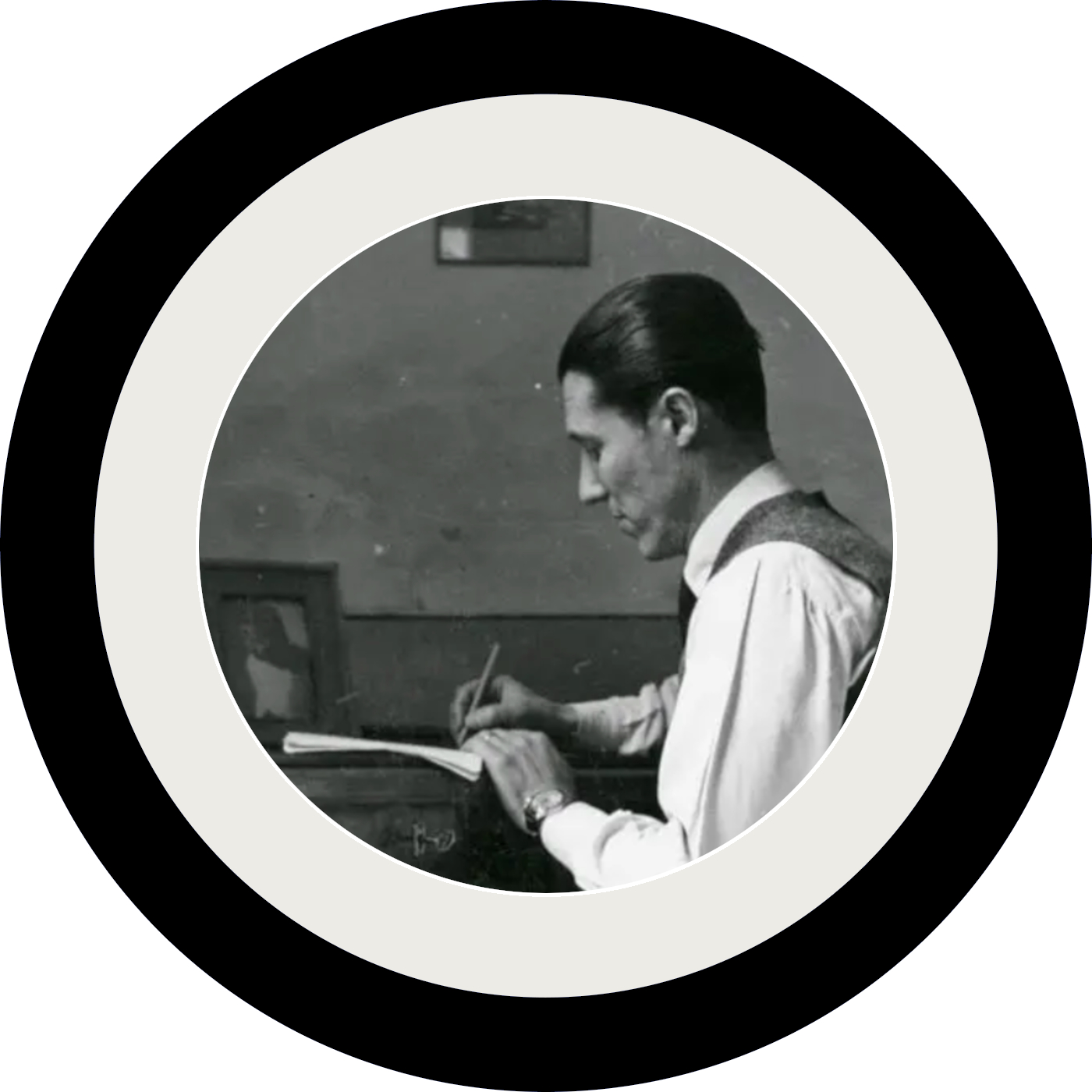
I'm Nate DiMeo. He had to master the pressure. That was clear from his first lesson. If he didn't, if he didn't know how hard he was going to have to push, all sense, all meaning would be lost. Was it think or sink or zinc or kink? It all depended on how much pressure he applied to the pen as it ran across the picture paper, thus determining the thickness of the line. And that was the key, as much as the shape or the swoop, the angle, the direction of the marks he would be making. That was the master stroke of Sir Isaac Pitman when he devised his eponymous Pitman method, which added, along with the lines themselves, the straight ones and the curved ones, the ones of varying lengths which his and other schools of shorthand use to transcribe the sound of words as they are spoken rather than write them out as they are spelled. Sir Isaac codified varying thicknesses of certain lines, which allowed the practitioner to use fewer total pen strokes and therefore get words down more quickly. If you like Nathan Barron were a teenager in New York City at the turn of the last century, perhaps, like him, the child of Austrian immigrants, and you wanted to find a career off the factory floor, upstairs in the office, perhaps, or at City hall or a courthouse, not as the boss. You are never going to be the boss or a lawyer or a judge, one of those important men who did things in this world. But maybe you could work for one of them. Maybe you could learn shorthand, write down what men like that said, keep a record of their important statements, help facilitate, in your own small way, their important deeds. If you wanted that, if you wanted more, you could study the Pitman method. Doing so landed Nathan Barron a job. He would become a stenographer in the New York City court system. He would spend his work days recording everything that was said during official proceedings with pen and paper, leaning over a desk, his pad, his pen wrist elbow placed just so, an inkwell right there, a cloth to dab away blotches or spills, though such missteps were rare for the skilled stenographer. And he was very skilled. So much so that in 1921, at the age of 21, Nathan Barron entered the annual competition held by the national association of Court Reporters. The competition was then just two years old. It had been started out of what the top men in the NACR felt was urgent necessity. Perhaps as an outgrowth of their vocations, these esteemed court reporters prized truth and accuracy, and people had been lying. There had been stories, certainly propagated by various stenographic schools and schools of thought fabrications, or at the very least, exaggerated marketing messages meant to secure students and sell books and differentiate the many shorthand programs that had lately been popping up across the country that promised people like Nathan Barron a way toward white collar work. People were telling stories of superhuman stenographers and shorthand secretaries out there somewhere in mountaintop hermitages or in some misty, mythic Midwestern office, I suppose, laying down transcriptions at 350, even 400 words per minute. This was preposterous. Human conversation, even at its most animated and purposeful, rarely cracks. 250 words a minute. An auctioneer at the top of their profession selling steer or swine at some South Texas stockyard might reach a dizzying 450, this is true. But no human hand, no pencil or pen, no shorthand method, be it Pitman or Gregg or some other system heretofore unknown to the learned men atop the national association of Court Reporters at the the turning of the 1920s, could ever write so fast, certainly not accurately. To claim otherwise was not just preposterous, it was fraud. And so, for the sake of the profession, for the sake of truth and accuracy, they brought together the best shorthand stenographers in the country and set out three a text drawn from literature spoken at 200 words per minute, a judge's instructions to a jury delivered at a crisp 240 in the most difficult discipline, a lively mock legal examination in which an ersatz attorney and witness bantered back and forth at a rat a tat 280 words per minute, like something out of a Preston Sturges picture. And this competition Proved what those men already knew, that there were physical limits to taking dictation. Limits set by the architecture of the human body and of pen, pencil, ink and paper. Now, this isn't a story in which someone will enter, a character will be introduced who will prove these men wrong, will swoop in and upend and therefore expand possibility. It turns out that humans can, in fact, only transcribe so quickly. There are limits to what bodies can do, and excellence is determined therein. Nathan Barron was excellent when he won his first trophy that first year. He entered the national competition in 1921. At 21 years old, he set new standards for both speed and accuracy. He returned the next year and won, and the next year and won. But the next year I would like to enter into the record and into this story new characters. Nine of them, each of them teenagers, the oldest 19, the youngest 15. Each of them students of Ward Stone, Ireland. And each of them entered into the 1924 competition with the express purpose of changing the course of stenographic history. For each of them came armed with the stenotype, the invention of their teacher. A 22 key keyboard, an ingenious invention that allowed the user to type with all ten fingers nearly simultaneously. Initial consonant sounds with their left fingers. Your duhs, your puhs, your th's, your ques, your quesses. Ending sounds with the right fingers, vowels with the thumbs. And further, the machine allowed them to make something like chords and a piano. The word like, or for that matter, hate, for instance, could be made by pressing the three keys that made up the initial consonant sound, the ending sound and the vowel sound simultaneously generating a whole readable word with a single stroke. It was quite a machine, and the kids were very good at using it. And so the first round was won by young human Fanny Schonfeld, her accuracy dazzling in the literary contest at 200 words. The second went to young Clem Bowling, dizzyingly Precise in the 220, which left only the 280. And as the fake lawyer began his fake examination of his fake witness, the gathered members of the national association of Court Reporters felt the pressure, could hear the thunderous gallop of progress at their heels, feel the hot breath of the kids coming up from behind on their necks. And they turned their eyes to Nathan Barron, the best of them, their champion, their John Henry, their last hope at keeping the future at bay. He wrote like the wind. There is nothing in the record that allows me to tell you with any certainty about how Nathan Barron felt after the competition, as he waited for the scores to be tallied for the texts to be checked over, scoured for mistakes. We don't know how his wrists felt after writing all out for five minutes straight. We don't know if he was surprised when he won. But we know that that evening in their hotel in Atlantic City, where the NACR convention and contests were being held, the leaders of that organization knew that Nathan Barron should enjoy whatever feeling he was experiencing, because it was going to be the last time he would have a chance to feel it. Everyone knew it. The machines were coming. They had seen the future there in that hotel by the ocean. That was the last contest they would hold for a very long time. The future came quickly. Within a couple of years, the xenotype was everywhere. You could find it in nearly every courtroom. And boardrooms, find it just about anywhere where important men were doing important things, or at least were saying things they thought were important enough to hire another man or woman to write down. At least until tape recorders came around. Since then, they are mostly found in courtrooms and by people doing captioning for TV. And since the 1950s, when the annual competition held by the NCRA was revived, everyone has used a machine. No handwriter could possibly keep up. And so Nathan Barron never competed again, because he then, in his late 50s, still wrote by hand, still taught the Pitman method, though it had, even among the dwindling number of handwriting devotees, been largely overtaken by other schools of shorthand. He does seem to have had some sort of advisory role with the national association, though, as far as I have been able to ascertain, never held an official title besides that of champion, earned those four consecutive years at the beginning of the 1920s and the beginning of his career and the rest of his life spent in courtrooms. There have been studies done on people like Nathan Barron, professional transcribers, neuroscientists have mapped their brains and found a kind of bifurcation with one area of the brain that's associated with attention and information processing, essentially on fire, and another associated with deep thinking in a calm, almost restful state. The transcribers brain as inverted duck placid below the surface, paddling wildly above. And this has been reflected in interviews with transcribers that investigated the phenomenology of their experience. One court reporter spoke extensively about her ability to daydream, to plan, to make shopping lists, what have you all, while accurately transcribing complicated testimony. She even reported realizing that she had no idea what the result was of a particular death penalty trial, that she had been working on day after day. So lost was she in her own thoughts that she had to look back at the transcript that she herself had written completely accurately, to learn how it had all turned out. There is little record of Nathan Barron's life and the decades he spent writing down what other people said when their lives, however grand or humble, their misdeeds, their marriages, the things they did and the things they witnessed entered the public record in a New York courtroom. There is no record of what Nathan Barron's thought about while he did it, what it was like in that calm part of his mind. There was, though, Nathan Barron there beside him to write any of it down. We do not really know who he was, but we know for a while there he was excellent SA. This episode of the Memory palace was written and produced by me, Nate DiMeo in March of 2026. The show gets research assistance from Eliza McGrawd is a proud member of Radiotopia, a network of independent artist owned listener supported podcasts from prx, a not for profit public media company. Out here in these streets throwing down against corporate content, factories and AI slop, we are doing our best in the fight against the machines. If you ever want to support the show and what I do here you can head over to Radiotopia FM Donate if you ever want to drop me a line you can do so at natememorypalace us. You can. You can also follow me on Instagram and threads, he Memory palace podcast on Facebook he Memory palace and on bluesky aidedimeo. I'll talk to you again. Radiotopia from prx.