
Podcast
The Mobile Home Park Exchange
Hosted by The Mobile Home Park Exchange Podcast · EN
Most investors chase trends. Serious investors build an edge.
The Mobile Home Park Exchange is where disciplined operators and high-agency investors learn how real wealth is built in overlooked, cash-flowing real assets — starting with mobile home parks.
Hosted by Frank Rizzo and Eric Busuttil of Stone Capital Investors, the show breaks down infill strategy, underwriting discipline, operational leverage, structural risk, and capital alignment for investors focused on clarity, control, and long-term cash flow — not noise.
40episodes
Episodes
Newest firstAll episodes
The Old MHP Playbook Is Dead
1w ago00:14:22Tap to summarizeThe old MHP playbook is dead. Institutional capital has flooded into mobile home parks, pad prices have moved, and the easy version of this business is gone.In this solo episode, host Frank Rizzo unpacks how the industry has shifted, why the classic 8-10% value-add deal is harder to find, and two divergent strategies operators are using to adapt: aggregation arbitrage and operational alpha. Frank also walks through a real acquisition in Troy, Alabama, where his team bought at a 5-cap and got ahead of schedule within 60 days by leaning on their operational read of the market.If you're an investor trying to figure out where the edge still exists in mobile home parks, this one's for you.Connect with us: stonecapitalinvestors.comBook a discovery call hereRate this episode and tag us @MobileHomeParkExchange to receive our free After Site Visit Report.
Transcribe →
Is Creative Financing the Answer? Brian Rice on Buying and Running RV Parks
2w ago00:32:57Tap to summarizeIs creative financing really the answer for investors trying to get into RV parks? In this episode, Frank Rizzo talks with Brian Rice, founder of Wise Choice Fund LP, about how he's built a four park portfolio using subject-to deals and seller financing instead of conventional bank loans. But getting into a deal is only half the story. Brian also shares what it actually takes to keep guests staying, from Wi-Fi and on-site management to the amenities that matter most.Book a free discovery call with Frank: https://outlook.office.com/book/DiscoveryCallwithFrankRizzo@stonecapitalinv.com/?ismsaljsauthenabledConnect with Brian Rice: thebrianrice.com | https://thebrianrice.substack.com/
Transcribe →
From Lp to Gp - How Marco Ali Made 90 Offers For His 1st Deal
3w ago00:34:35Tap to summarizeIn this episode of The Mobile Home Park Exchange, host Frank Rizzo talks with Marco Ali, founder of MNA Capital Group, about his transition from passive limited partner to active general partner in multifamily real estate.Marco breaks down why he built his entire investment thesis around North Carolina's I-85 corridor, what it took to close his first deal after reviewing well over a hundred opportunities, and the moment early in ownership that changed how he underwrites every deal since. Frank and Marco also dig into competing against institutional capital, the value of mentorship at every stage of a career, and why real estate is ultimately a people business.Whether you're weighing your first move from LP to GP or looking to sharpen your underwriting discipline, this conversation is packed with insight.Book a call with Frank: https://outlook.office.com/book/DiscoveryCallwithFrankRizzo@stonecapitalinv.com/?ismsaljsauthenabled
Transcribe →
260 Units in 12 Months, No Excuses
Jul 100:42:19Tap to summarizeKarl Kulpak went on a podcast and said out loud where his portfolio would be in twelve months. No hedge, no wiggle room, just a number. Frank sits down with the former state trooper turned mobile home park operator to find out exactly what happened when that deadline hit, and the specific process he used to reverse-engineer his growth target from his own lifestyle needs. A conversation about precision, accountability, and refusing to let anything become an excuse.Want to talk strategy with Frank directly? Book a discovery call: https://outlook.office.com/book/DiscoveryCallwithFrankRizzo@stonecapitalinv.com/?ismsaljsauthenabled
Transcribe →
Built to Hit a Number
Jun 2400:12:17Tap to summarizeFrank Rizzo challenges the way mobile home park investments are pitched and structured. When a 20% IRR headline drives the deal, the operational complexity gets buried — and the families living in these communities are the ones who find out when the rent schedule has to accelerate to make the model work.This episode is about the assumptions operators make, the timelines they build, and the operational honesty that has to be present from day one. Frank makes the case that real value creation starts with the community, not the spreadsheet.Want to connect with Frank and talk through what this looks like in your market? Book a discovery call now: https://outlook.office.com/book/DiscoveryCallwithFrankRizzo@stonecapitalinv.com/?ismsaljsauthenabled
Transcribe →
I don't buy Mobile Home Parks. I invest in the future.
Jun 1700:10:40Tap to summarizeThe label says mobile home park investor. Frank Rizzo says otherwise.In this episode, Frank breaks down why the way most people think about manufactured housing is exactly what holds them back. He unpacks the affordable housing crisis, the stigma operators carry, and what it actually means to reposition a community — not just run one. If you're serious about this asset class, this is the mindset that separates the operators from the owners.Ready to invest in the future of affordable housing? Schedule a discovery call with Frank:https://outlook.office.com/book/DiscoveryCallwithFrankRizzo@stonecapitalinv.com/?ismsaljsauthenabled
Transcribe →
How I Became the Operator I needed to be in 45 Days
Jun 1000:16:34Tap to summarizeFrank Rizzo takes you back to the deal that turned Stone Capital Investors into operators. A 15-hour drive home from South Georgia. A term sheet that nearly ended it before it started. And a 45-day window to raise capital, commit fully to the mobile home park space, and burn the bridge back to everything else.Frank breaks down what it actually took — not the pitch deck, not the revised IRR — but the conversation he had to have with his investors and himself before anyone else believed it.If this episode brought you value, leave a rating and review on your streaming platform and email it to The Mobile Home Park Exchange (info@themhpexchange.com) to receive a copy of our after-site visit report.
Transcribe →
I Had To Lose My Edge To Find a Bigger One
Jun 300:18:23Tap to summarizeThe same identity that builds your business will eventually become the thing holding it back. Frank Rizzo built his career on one principle: outwork everyone. It earned him credibility, deals, and a seat at the table he never had by birthright. But scaling that same mindset led to a hard truth — he hadn't built a company, he had built a job that couldn't run without him.In this episode Frank breaks down the shift every serious operator has to make, why letting go is harder than grinding, and what it really means to build a business that gets better when you're not in the room.Honest, practical, and worth your full attention.
Transcribe →
The J Curve Nobody Talks About: What a Real Mobile Home Park Turnaround Actually Looks Like
May 2700:54:36Tap to summarizeFrank Rizzo sits down with partner Eric Busuttil to go inside the turnaround of American Way, a distressed mobile home park in Hubert, North Carolina.This is the story behind the story — the decisions, the pressure, and the moments that do not make it onto camera. From a property the school buses refused to enter to a community approaching full stabilization, Frank and Eric break down what it actually takes to get through the J curve.They cover the infrastructure challenges, the capital structure, the county permitting delays, the resident transition, and what they would do differently. A rent roll that went from $8,500 to nearly $25,000 a month and an acquisition that refinanced at 4.4 million dollars in under two years.This is not a passive income story. It is a real turnaround, told honestly.New episodes of The Mobile Home Park Exchange are available on all major streaming platforms.
Transcribe →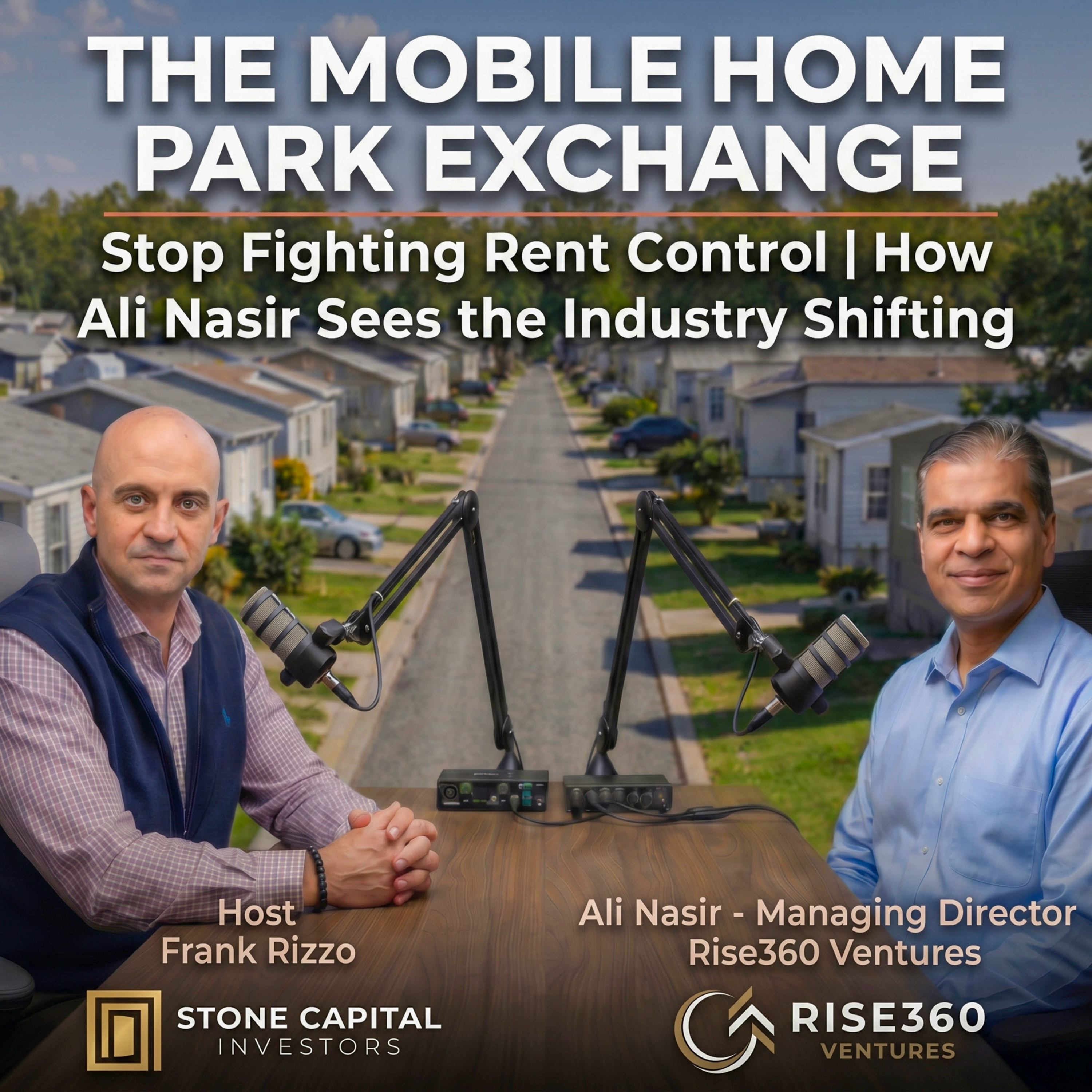
Stop Fighting Rent Control | How Ali Nasir Sees the Industry Shifting
May 2000:56:28Tap to summarizeShould mobile home park operators stop fighting rent control?In this episode of The Mobile Home Park Exchange, Frank Rizzo sits down with Ali Nasir of Rise 360 Ventures to discuss the growing political and operational pressures reshaping the manufactured housing industry. From rent stabilization and public perception to infill, branding, and long-term investing strategy, this conversation challenges many of the assumptions operators have about the future of the space.Ali shares why he believes the industry must evolve, why better operators will ultimately win, and how experienced investors are adapting to a rapidly changing market.
Transcribe →