← The MSing Link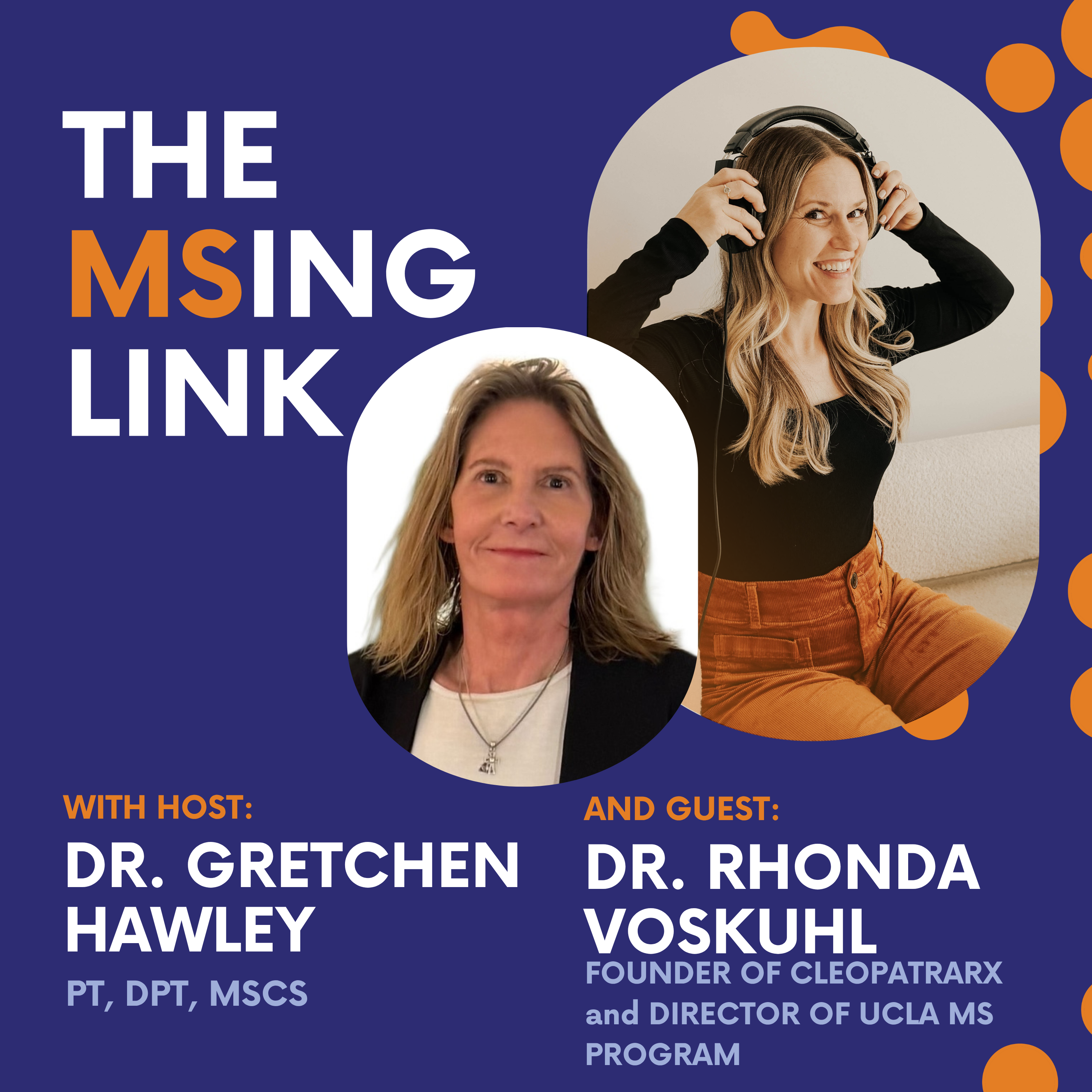
The MSing Link
295. MS & Menopause: Are Your Symptoms Changing…or Are Your Hormones? | Dr. Rhonda Voskuhl
00:45:29
Loading summary
Transcript54 lines
- [00:00]
A
Welcome back to the podcast. Today I am joined by a researcher and neurologist whose work is genuinely changing the way that we think about ms, especially for women. And if you've been experiencing worsening symptoms without new lesions to explain it, this episode might answer a question that you didn't even know to ask. Dr. Rhonda Voskel is a professor of neurology at UCLA, director of the UCLA Mississippi Program, and the faculty neurologist for the UCLA Comprehensive Menopause Care Program. She has spent over 25 years researching how sex hormones affect the brain with continuous NIH funding and over 200 publications in journals like Nature and Lancet Neurology. She's also the inventor behind the treatment that is now available through Cleopatra Rx, a company that she co founded to bring this research directly to patients across the country. In today's episode, we are going to talk about what actually happens to the brain during menopause and why it matters so much for women with Ms. How to tell the difference between Ms. Symptom worsening and what menopause might be contributing to and what estriol is what. Why it's different from estradiol and what the research shows about its potential role in brain protection and cognitive health. This episode is jam packed, so let's dive in.
- [01:42]
B
The big question is, how does someone with Ms. Actually improve their mobility, strength, energy independence? The list goes on. My name is Dr. Gretchen Holley, physical therapist and multiple sclerosis specialist. Welcome to the Missing Link podcast. Tune in as I share the top strategies and exercises to help you gain control over your life with ms, using research driven insights and advice from top industry experts. Whether you're newly diagnosed or have had Ms. For over 30 years, whether you have relapsing Ms. Or progressive MS, this podcast is for you. You're sure to feel empowered and inspired after each episode.
- [02:32]
A
Ready?
- [02:33]
B
Let's dive in.
- [02:41]
A
Doctor Voskel, thank you so much for being here with us today. I was chatting with you a little bit before we pressed record and it's hard to find someone in your area of expertise. So I'm really excited to dive into our questions today.
- [02:54]
C
Thank you so much for having me.
- [02:55]
A
Yeah, absolutely. And before we do dive into those questions, are you okay if I ask you a question from my interview deck?
- [03:02]
C
Sure, go for it.
- [03:03]
A
All right, we'll see. I'm just going to shuffle. Your question is, do you like to plan things out in detail or be spontaneous?
- [03:16]
C
Well, it depends on whether it's something for fun or for work.
- [03:21]
A
Answer both.
- [03:22]
C
Well, yeah, okay. So for work, it's definitely got to be really well planned out, because that's a matter of time and efficiency. And I think to do the best job with the number of minutes or hours that you have on something, that's kind of what I do, I think, with the. With the play, just because I don't want it to be like, work. I try. I try to be a little bit spontaneous. My natural tendency is not to be like, I plan our vacations. I plan everything. And I kind of don't like it that I do that, but it's kind of so natural to me, and I kind of like when people force me to do something spontaneous like, oh, okay. So it's kind of a pleasant surprise when that does happen.
- [03:57]
A
Yeah, I love that. I feel the same about work. Definitely has to be planned out. And it's interesting because for play and specifically, if I'm thinking about travel, I do like for it to be planned out, but I don't like to be the one doing it. Like, I don't want to pick the Airbnb or the flights. Like, just tell me what to do. So I don't think that's considered spontaneous, though. I just want someone else to do the work. You kind of do both.
- [04:22]
C
Well, yeah. I've trusted someone else to do it before. And we've been off in taxis in the middle of nowhere at night. Okay, I'm planning the next one.
- [04:32]
A
Oh, my gosh. That's too funny. Where were you when that happened?
- [04:35]
C
Oh, it's happened so many times until I just said, okay, I'm taking over. That's it.
- [04:39]
B
Oh, my God.
- [04:40]
C
I want it to be so smooth. You don't even know it was planned. It's just seamless, right?
- [04:45]
A
Yep.
- [04:45]
C
We don't even discuss that it was planned. It was just so seamless. That's what I want.
- [04:50]
A
That sounds lovely. That sounds like a dream trip right there. Awesome. Okay, well, thank you so much for answering that. Before we dive in, can you just share? In case people haven't heard of you before, can you share who you are and what you do?
- [05:03]
C
Yeah. So My name is Dr. Rhonda Voskul again. I'm a professor at UCLA Department of Neurology, and I'm the director of the Ms. Program. I have the Jack Scrabble and Dale Chair in Ms. And also the co founder of the Comprehensive Menopause Program. So I'm the faculty neurologist seeing all these menopausal women that may or may not have Ms. Both. And lastly, I'm Co founder of a company, Cleopatra Rx, that came up with a new estrogen treatment for. For menopausal women with or without Ms.
- [05:30]
A
So, yeah, and I am going to ask you that for anyone listening right now, and you're already like, ooh, tell me more. What is that? We are going to get into that for sure. But before we do, I thought we could start off with. You have such a unique perspective because you not only see patients in the clinic, but you also do research in the lab. And that is such a unique approach that not everyone can say. And so I'm curious, what have you learned from your patients with Ms. And from your menopausal patients, whether that's in the clinic and in the lab that might help the people that are listening to this podcast?
- [06:09]
C
I think you hit the nail on the head. That's exactly what I am. I actually coined a term instead of lab work that goes from the bench to the bedside. It starts with a molecule or something. We want to know if it's important. I don't do that. Actually. It starts from the bedside to the bench to bedside. That means these clinical observations, things we know in the clinic to be true. And the question is, why? Why do women have Ms. More often than men? There's a lot. There are a lot of, why is pregnancy good for ms? So there are a lot of questions, why is menopause bad? These are why. Questions that you get from the clinic and you get from the patients. So what I do, I start with those as a foundation so that then I want to go to the laboratory bench. I try to figure out why. Could be this cell or that cell in the brain that's doing poorly, or what's the modifier for that. I'm asking a question of lab that I know has clinical relevance because that's where it was started. That's what the foundation was. So we know that if we find something, at the end of the day, it won't be that, well, this is not relevant to the human condition. It will be because we've actually asked a question that existed in people and patients beforehand. Then if we find, of course, something that is interesting, a way to block something that's bad or a way to enhance something that's good, then what we do is we develop a clinical trial to do that. And we do that in both. First in the mouse models of things and different models of diseases. And then we go to people, of course, like we've done in several cases. I've done clinical trials. So, yes, it's bedside, clinical observations and patients to the laboratory bench to figure it out or disentangle the mechanism of why this happens. And then again to the clinical trial designs to then embrace something that is good or, or block something that's bad. The reason I think it's so critical is though because so much gets lost in translation. Honestly, I really have made that effort to do both because I've seen very smart people follow molecules that ended up not being relevant really to the human condition. Good for science and always good to learn. But again, if it's not helping people at the end of the day, and the day isn't a day, it's 20 years when you do these projects, you've got one life and you have to think really clearly ahead of time what's the end goal and before you start something. So that's kind of my idea to do. And then I think the clinicians, they know it's important and they know it's a big deal, but they don't really have the lab time to go in and disentangle it or figure it out. So you have to have both, you really do.
- [08:20]
A
And I just want to reiterate again how rare that is. It's not common for a neurologist to be able to have that perspective truly of both sides, not just one or the other. And if I'm not mistaken, a lot of your research is on how menopause can affect our brains. Is that true?
- [08:40]
C
That's absolutely true, yes. My expertise has been estrogen in the brain for 20 years, 25 years. Started with MS, then went to healthy menopausal women and actually probably headed towards Alzheimer's, you know, but it's all started with estrogen's effect on the brain and it all started with Ms. Actually. And then we just expanded further to more neurodegenerative conditions that it's relevant to.
- [09:00]
A
So. So can you share what happens to women's brains during menopause and why in particular that's important for women with Ms. To know about?
- [09:11]
C
It's really important for Ms. Women to know about even not knowing the mechanism because they know that their pre existing symptoms get worse. They've said this for many, many years, the Ms. Patients have. And it's also known that aging is bad for Ms. They tend to go from the relapse admitting to the secondary progressives at about 50. Guess what? That's when menopause happens, is 50. It wasn't based on how long you'd had that. It was always said, oh, it's how long you've had MS? How long have you had MS? It's not, it's actually when they hit about 50, that's the problem. And so there's an aging thing that's going on that is bad for Ms. It goes from again the inflammatory phase to the neurodegenerative phase and it goes from relapses to disability accumulation. And it's a continuum, a gray zone the whole time. But it's just transitioning over the decades. That's what's happening. It's been shown that axime menopause can cause advanced biologic aging. There's chronologic aging and biologic aging. So estrogens are good, they're good for multiple organ systems. Loss of them is bad for multiple organ systems, including, you know, heart, skin, bone, brain. And so of course it's not good for Ms. Patient who's got these issues in the brain already of neuroinflammation, neurodegeneration to now lose protective estrogen, an estrogen that's got anti inflammatory and neuroprotective capabilities. That's really bad to lose. And that's what they lose clinically. They say their symptoms are getting worse. They don't have new relapses, they don't have new enhancing lesions. What they have is their symptoms are getting worse. That's a problem because they can't escalate anti inflammatories out of this because it's not an inflammatory problem in the sense of immune cells coming in is actually a neurodegenerative problem. So what they would do, they should stay on their current anti inflammatories and then they would want to add on an estrogen that's been designed to target the brain specifically, not merely it has a little bit of anti inflammatory activities. The estrogen that we've looked at and we've studied for, published so much on, but it's also very neuroprotective. And that means it doesn't just stop the immune attacks, it goes in and causes repair. Repair remyelination, the coating back on the wire, synaptic plasticity, more synaptic connections. This is very important to do things that are neuroprotective and you need both. You need an anti inflammatory and a neuroprotective. EMS patients need both. What happens specifically to the brain, which was your question? Those are the clinical symptoms. I always start with the clinical things. We know that menopause is bad. How's it bad in healthy women? Well, I always say you can't really understand menopause and Ms. Until you understand Ms. And you understand menopause, and then you can understand menopause and Ms. You've got to understand each individual, right? And they say, oh, Lord, behold, no wonder this is the case, because we understood A and B, and that's why the combination of A and B is what it is. So with respect to what does menopause do to healthy women's brains? They don't have Ms. It's not good. Of course it's not good, because we know they're neuroprotective. And so when you lose neuroprotective estrogen, the effect on the brain is that they have cognitive difficulties. One of the big ones in Ms. Is processing speed. Menopausal women also get processing speed issues. That means they can do. They can do these things. They can think through problems, but they just need more time. They need things to slow down. And there's very established tests for processing speed in Ms. And also in menopause, and those are slowed down with both with Ms. And with menopause. Menopausal women also get something that's very common and has problems with verbal memory. They can't think of the word. And so you'll have a lawyer who's trying to make a case, and she can't think of the word. And this is just crazy because got such a vast vocabulary, and all of a sudden she can't think of a word. And it's really embarrassing and undermines her confidence at work. The kids will say, mom, we talked about that yesterday. And that's not good. Also train of thought. So you'll have executives in a boardroom, and they'll be. Or in any kind of a meeting situation, they get interrupted or they. And they can't think of the train of thought. They lose a train of thought. So these are really undermining things that they know. It's not global IQ in these healthy women. It's just menopause. And I say just. But I do think it needs to be taken very seriously. It's not a disease like ms, but it is a condition that is not good to lose something that is that protective and to lose it so abruptly. And they will be with that estrogen for a third of their life. It's not coming back. And it is also more than hot flashes, which we can talk about is more than that. Hot flashes go away on their own. These women have these cognitive symptoms years after that, and they just keep getting worse. It just is no Surprise that when you have something happening like that. And then when you look at why, why menopause patients are worse. You know, I said their disabilities get worse. One of them is definitely cognition, and the other one is fatigue. And these are the kind of things that happen to healthy women. They're happening more to Ms. Women. Of course they're. Because they already have a propensity to have issues with cognition, fatigue. And so there you go. Menopause makes them worse.
- [13:58]
A
I have so many questions. I'm taking notes over here. My first question. So we're talking about menopause. And so another phrase or term that has, I think, been increasingly popular over the last five years or so is smoldering ms, which kind of explains one thing that you mentioned with where your symptoms might be worsening, but there's no new lesions to explain why that's happening. How would someone know if it's smoldering Ms. That they're experiencing or possibly menopause?
- [14:30]
C
Oh, that's. That's a good question. So the smoldering ms, there is a difference between them for scientists and Ms. Doctors. The thing is, smoldering Ms. Is the brain has what's called white matter, and it's where all these tracks are, where the wires are. And they carry. The wires are carrying the messages from one place to another. So there's the axons, and they have myelin around them to connect things. That's the white matter, and that's where those. Those lesions are. Those immune cells come in and cause those Ms. Lesions. They call them Ms. Plaques when they're older and they're scar, but they're Ms. Lesions. They're inflammatory lesions. The smoldering are when those white matter lesions. The edge. The edge doesn't cool down after two months or so. It just continues to smolder. Right. It continues to be inflamed. And sometimes it'll be enough to be seen on an MRI with gadolinium, sometimes it won't. Okay. That's thought to be due to an immune cell that's resident to the brain, which is called the microglia. And that particular microglia is activated. It stays activated. And it's in that. It's right at the edge of that lesion. It's a smoldering lesion. Does that make sense? Now, it may or may not show up on MRI unless you do really sophisticated research sort of things. Research things at universities can do that, but on regular, routine mri, the question is, is that lesion getting bigger? Is it getting an edge? Is it getting Darker. Is it changing in an aggressive way? Right. That's one way to put it. And then the other thing is, though, with menopause, menopause is not affecting the white matter. Menopause is affecting primarily the gray matter, especially in something like an Alzheimer's. But, you know, Ms. Also affects gray matter. So let me back up. Ms. Affects the white matter. As I just said, these lesions, they're new. Some of them calm down after two months, and that's when the gadolin enhancement goes away. On the mri, when the lesions accumulate and you've got lots of white matter lesions, they tend to also. It is associated with also nms, gray matter atrophy, gray mattergional changes. Because these are connections. Think about. These are the connections to those cells living in the gray matter, those who go through the white matter. So you keep damaging and chipping away at those connections. It's bad. And you get gray matter atrophy. And actually, the best biomarker for chronic disability is gray matter atrophy. Gray matter changes. It's where the nerves live. It's not just the extensions of them or the connections between them. It's actually where those cells and they can die. You can lose synapses. So now when you go to something like menopause, primarily is bad for the gray matter directly. The white matter is. Is not affected in itself in menopause. That's the difference. So it's really hard for people to know what it is based on mri. Clinically, what I look at, I see them all the time. I see menopausal women with not Ms. I see Ms. Women with Ms. What I do is pretty simple, actually. So the question is, when a menopausal person with Ms. Comes in and they're getting worse. Right. I would look at the MRI and I'd see, are you getting smoldering lesions? What appears to be smoldering, worsening lesions in your white matter, A or B, are you getting worse new. Are you getting new symptoms? Right. It means they've really got an inflammatory process going on, a strong one. If that's the case, I would consider escalating them. But we don't have something, really, that targets microglia. The tremor that I have does because it's more neuroprotective. The drugs we have now are depleting the immune cells in the periphery. There are some BTK inhibitors. They say they're focusing microglia. I hope those come through at some point, but we'll see if the person comes in and they're having those Worsening of those lesions and it sounds like it's inflammatory, it sounds like it's new activity, then that would be a reason to escalate their anti inflammatory. Right. Again, if they were on a vumerita, they can go to an ocreva, she can go to b cill de places. Some of the best things we have now, you know, and so we'd probably go on up to that if they weren't on it before. On the other hand, if they come in and they're not, they're just not having any change at all on the mri. There's just no new lesions, there's no worsening of previous lesions, there's just nothing there. And when you ask them they're just getting worse and there's just nothing new. That's all I can say. They're just getting worse, they feel worse, their cognition is worse, their fatigue's worse, they have these other signs of menopause too. They got some hot flashes or they have some anxiety, their ADHD is getting worse, they have these mood changes, they have again a lot of verbal memory, not just processing, they got a lot of verbal memory problems, train of thought problems. So there's just a nuance of a difference between them clinically and there's also a difference on MRI about what's actually happening. And so you just have to ask are they really having any evidence of inflammation or not. And so if they don't and the treatment's not going to be to escalate their anti inflammatory, it's going to be to try to find something that's neuroprotective. And there is nothing other than what we have now that we've discovered based on a unique estrogen. That's the whole goal. The field is finding something that's directly neural protective, not only anti inflammatory and preventing immune cells from coming in, but once they're in, making the brain more resilient and protective.
- [19:35]
A
I love that you just gave several examples of symptoms that you might be experiencing that would point to menopause. Because I think a lot of people don't realize, especially more in the earlier phases, they might not realize that they're in perimenopause or actual menopause. And so hearing you say the verbal processing, verbal memory recall, processing speed, those types of things, I think that'll be really helpful for people to hear, for women to hear that if they're experiencing those and they're in a certain age group, then it might be more menopause versus Ms. One question.
- [20:12]
C
Yeah, that's important because the field of Ms. Is really kind of exploding now. It's really big. People are finally recognizing how complicated it is. You know, perimenopause is the age of menopause. It's 51. And so the range has always been thought to be it's about 48 to 54, but, you know, now it really can be 45 to 55. You know, it can be that wide of a range. But now people are saying and showing that Even at age 40, some women are starting to have. They're just having, like, the periods to still get them, but they're lighter, they're a little bit irregular, only by a day. And they're starting to feel kind of this anxiety, this irritability, this fatigue. They're starting to feel like they're not who they used to be. And these women don't know what's going on. And you measure their progesterone levels, it's not a great thing to do because perimenopause is by definition a fluctuation. So before it all stops, which is menopause. And the definition of menopause, by the way, is no period for one year. That's the definition. It's clinical definition. But we know that during perimenopause, what happens is before they all just drop off the map, Progesterone and estradiol drop off the map. What happens is that they go very low. They go very high. So it depends on when you draw the blood, whether you're going to see anything or not. There are other things you can measure, like FSH will go up eventually as a counter to these estradiol and progesterone going down. But I'm just saying that there can be vague symptoms early, even between 40 and 45. I see a lot of them, and they come in, they're having some of these cognitive issues that are having some of these things I was saying, and they don't know what it is. They think, what's happening to me? And I don't know. And it's really been an unrecognized need that's gone. And perimenopause can go on for years, actually. And lastly, it's really important to treat early. It's always important to prevent, prevent, prevent, and to treat early and get on it early.
- [21:51]
A
Yeah. I could tell you a good handful of people just within the last six months or so that I know some have MS, some who don't, but they're around the ages of 37 and 38, and they've been experiencing similar symptoms to what you're describing. And because they're still in their 30s, their doctors were just like, oh, it's not anything. Long story short, they all weren't okay with it. So they ended up going to a functional doctor that just did a full huge panel of blood work just to really dive into it. And it was their hormones, and turns out they are in perimenopause at that age. Have you seen or is there any correlation when you do have Ms. If you're more or less likely to go into perimenopause sooner or get menopause sooner than someone without ms?
- [22:39]
C
That's a good question right up front. I would say no. I would say no. There's not. Not good evidence that they clinically go into it sooner. Some people have looked at a few early biomarkers of menopause. You know, something in the blood. That's something I would usually test. But some of the things that could come up. And they suggested that people are actually looking at that question now, but so far, not really. It doesn't really look like Ms. Throws people into early menopause and also doesn't look like Ms. Causes people to be unable to have a baby, a successful pregnancy. These are important things to keep in mind. We all know what pregnancy can do to Ms. It's very complicated and interesting. But no, it doesn't look like having Ms. In and of itself put you into earlier menopause or makes you less likely to have a child successfully. So those are the good things.
- [23:27]
A
Absolutely. And one thing that you mentioned earlier that I want to come back to is brain changes as it relates to cog fog. That is something that a lot of people with Ms. Experience, but they might not know what it is. Can you explain what cog fog is?
- [23:45]
C
Yeah, there's a lot of terms for it. Brain fog is one of them. Used in menopause commonly with respect to loss of estrogen and getting this kind of brain fog. Well, it is because that's why it's said that way, because they kind of feel like. Like they're in a fog. They're not crisp and sparky like they used to be ready to get up and go to work, but it's such a vague kind of a thing. Right. And then they have this kind of mental fatigue, too. And I know Ms. Patients get a lot of physical fatigue as well, but they get this kind of just not. Not just fired up and not ready to attack, you know, get on something, a task that day. But to be More specific. That's pretty vague actually. What it is are some of these things that I mentioned which were, you know, processing speed. These can be tested by, they have been tested by neuropsychologists. And processing speed, slower verbal memory, train of thought recall, immediate recall. Well, it's actually recent recall. It's within the last day or so. They'll also read things. The focus is off, so they'll read things. They used to be able to read it easily and now they have to reread it. It's like they get good acquisition, but they don't get good retention. There are very specific things and they reside in a particular area of the brain. It's not the whole brain. When you look at the brains of menopausal women who've been menopause for many, many years and untreated with inappropriate estrogen, they can show changes over the years on mri, which are again, not white matter lesions like ms, but what they'll show is atrophy of its dorsal hippocampus, frontal cortex. There's these regions in the brain that are involved, gray matter regions in the brain that are associated with long term menopause, that endoatrophy, or functional connectivity changes between communication one region to another on mri. These things can be shown on mri and sure enough, those regions are involved with these clinical symptoms of cognitive domain. So I say it's cognitive domain specific issues clinically and it's region specific issues on mri. What it's not is it's not global cognition and it's not global MRIs. It'll be missed that way. That's what it is. And then, as you know, just Ms. Has more of a propensity for processing speed issues and those occur in ms, you know, not just during menopause. That's part of ms, processing speed changes.
- [25:51]
A
And yeah, and so you've mentioned a few times that estrogen is important when going through menopause. And especially with Ms. I think a lot of people might not know that there's more than one type of estrogen. Can you talk a little bit more about that?
- [26:10]
C
Well, that's the biggest holy grail right now for treatment. And it's just really a shame that for the menopause, women are half the population. They're all going to be worried about menopause at some point. Right. And we still are talking about estradiol, which is from the late 1990s and early 2000s that had a myriad of problems. That's just a fact. And you can say they were overemphasized or under emphasized or whatever you want to say. But the fact is they were associated with breast cancer, clotting and cardiovascular issues. And so why haven't we moved beyond that? I don't know. Except just hasn't received any attention. Women's health in general, and especially this, Give me a break. We've got a very powerful situation. It's such an abrupt drop in these hormones. We should be able to replace it. We have to replace it safely. And that's not that hard actually, you know, in Ms. I apply what I've learned from Ms. To menopause. So you know, in Ms. Now for the anti inflammatory treatments, the immune circulating blood cells, we now have about 25 treatments, you know that they've evolved over the last 25 years. 25 treatments in MS, all targeting different immune cells. Not all the immune cells, not get rid of all of them. But a particular immune cell, a particular mechanism in immune cell, particular receptor on an immune cell. This is what Ms. Research does. And why in the world they can't do this for menopause, I don't know. But that's what we're doing. It's not rocket science. I'm just saying, you guys, we've been doing this in Ms. Program for two decades, target things specifically, right? And now likes and the Ms. People still need to do it and target brain cells specifically. But they're getting there. Believe me, the Ms. Researchers will get there. But anyway, with menopause, it's just striking that we're still talking about estradiol with all those problems it had. Now with estradiol, they switched from giving it orally to giving it as a patch. And the reason they did is because when estradiol was taken orally, it has converted to a metabolite. It goes orally to the stomach and puts a metabolite changes that chemical structure to something that causes clotting. And so what they did, they made the patch, the transdermal patch, so good. And that really has less of a risk for clotting. When estradiol is taken as a patch instead of orally, you shouldn't be taken as an oral at all anymore. No, not many people would do that or doctors would prescribe that. However, the problem that they really, really I don't think they'll ever get around with, with estradiol is, is regardless of all that's said about overemphasizing or deemphasizing, the biology remains the same and that is that estradiol binds strongly to estroceptor alpha in the breast and that is associated with breast cancer. Why do I say that? Because all the treatments, well, the treatments for breast cancer are tamoxifen, which blocks E Alpha in the breast and aromatase inhibitors, which prevent estradiol from being made in the body so it doesn't get stimulating ear off in the breast. And so you can just imagine treating women with estradiol high dose for a long time. What that's going to do. It's not good. And you can talk all day about whether that data from the early 2000s was overemphasized or not with breast cancer. That's the biology of it. You're not getting away from that unless you give with a different estrogen, which is what we did. And actually, by the way, estradiol patch get away from the clotting because you're using the patch. But that estradiol, that's one of the reasons. What is the reason why gyns will only give it to women for the lowest duration possible, as short as possible and the lowest dose possible? Because they don't want to give high doses. They don't want to give it a long time because they're worried about binding ear off in the breast. Of course they are. They also don't want to give it to women over 60 because cardiovascular risk, they know this and that's why they're smart. And the menopause society has said to only give estradiol again for the shortest duration and the lowest dose possible. And it's, it's the FDA approved to treat hot fluid flashes. I've been on debate stage with the person that showed that it doesn't help with cognition.
- [29:50]
A
Right.
- [29:50]
C
Actually there's some data. It could make it worse. I'm not so sure I believe it makes it worse. There's not data showing that estradiol can help with cognition. So for cognition we have to do something different again. And this isn't going to be just hot flashes for five or three years because we see these women come in and they haven't had hot flashes for 10 years and they're having cognitive problems. Right. It's not all about hot flash. I agree. Hot flashes. Treat them, let people better sleep less night sweats. All good thing, good thing. Not saying they're not mutually exclusive, but it's more than that. It's serious. It's giving me questions for a very long time. So what we've done is because of Ms. Again, Ms. Is the winner here. What we did with Ms. Is it was really interesting to me that pregnancy is so good for Ms. And so this has been known forever. In 1998 was a new England journal article that just clearly said it without a single shadow of a doubt. Mississippi gets better during pregnancy. What happens? They have a 70% reduction in relapse rates. Back in that time it was beyond any drug that existed that it was such a dramatic reduction in relapses in the last half of pregnancy. And in addition, when they had multiple pregnancies it was shown by a different group, like three or more compared to zero or one over a lifetime they had less disability. And so that tells you, wow, something not just anti inflammatory but something that's neuroprotective because you don't get neuroprotection like that just by being exposed to a good anti inflammatory for a few months three times in your life. We know that the anti inflammatories in Ms. Have to be taken for at least five or more years to have any effect on disability. We've got pregnancy and it's really that last half of pregnancy is what it is. And it's really the last trimester. It's so good for Ms. Well then the question is why? That's the clinical observation. Right. And the question is why? Why is that? Well, it's because there's a unique estrogen, estradiol is there, progesterone is there of the menstrual cycle, but there's a unique one made by the fetal placental unit and it is estriol. It's a different estrogen, it's a different chemical structure. It binds the estrogen receptors differently. So the beauty of estriol is the pregnancy estrogen and it binds weakly to estrogen receptor off in the breast. Good. And it still binds a different estrogen receptor called E or beta in the brain. And so that's what I spent a lot of NIH funded research and publications on doing is showing the estrogeptor beta in the brain can be neuroprotective. It causes remyelination in white matter, it causes synaptic repair in gray matter. And so we did, we went then went to clinical trials with estriol. Not estradiol, Estriol. We used that in women with Ms. And in clinical trials we've done three. The first study we showed that it reduced those enhancing lesions by, I mean it was significant, it was like 70 or 80% within six months. And of course that's why they have decreased relapse in the last trimester. Right, there you go. That's why. And so. And we also showed it caused our peripheral immune system to become less immune cells to become less inflammatory. Those correlate with each other. The cool thing was, though, in this early study, it showed they had an improvement in cognition. I was like, an improvement? How could that be? Because, you know, you think if you have less immune attacks, you're going to have slower decline, but it doesn't mean you're going to get better. It just means you have less immune attacks. Right, Right. I started to see something that made it better. I said, ooh, that could be repair. That could be something good. Right? Really good. Not just less immune attacks. And so I had to read a lot about and I learned so much. I read about what's going on with the estrogen and cognition, and a ton of stuff had been written, little did I know on estrogen and learning and memory and how it's so good for the hippocampus and these areas where memories are made and all this processing speed. I was like, oh, okay there, you know? So I said, well, that's probably what's happening. Well, they said, well, it's probably still just a placebo effect because there's a practice effect because there was no placebo. I said, okay. So then we did another trial and it was in Lancet Neurology with 16 sites across the country. And we treated it again with estril versus placebo, and they still got better at 12 months. We showed that they had improved processing speed by objective cognitive testing as compared to placebo taking the same test at the same time. So it wasn't just a practice or placebo effect. They got better than the placebo. In a different paper, we showed that they also the Ms. Patients, when they were treated, Esther, to recapitulate pregnancy benefits, of course, is they had less MRI reduction, they had a less gray matter atrophy. So this is important. And those cerebral cortex atrophy that's associated with cognition. There we go. It's getting better. And the last thing was another paper was we showed serum neurofilant light chin, which is a biomarker for nerve degeneration, There was also decrease with Estril compared to placebo. So we've got a lot of data in Ms. Showing that estriol is so good. And you might ask, well, what happens after pregnancy? It's bad. So when estriol drops after pregnancy, Ms. women are more likely to have an Ms. Relapse within three to six months. They've had something really good. You just take it away. All of a sudden they're more likely to have a relapse after 3 to 6 months. The other thing, even non Ms. Women will have postpartum depression, they'll have anxiety. And I, I think of it like this. It's like, well, you know, it's when estrogens are good, when estrogens are high, things are good. When estrogens are low, things are bad. And it's honestly, it's that simple. When, when they're pregnant and they have very high levels in the last trimester, things are really good. Postpartum things are bad. Also with pms, you know, right before in your period, right before the bleeding, that's when the estrogen and progesterone drop a little bit. It's right before. And they have anxiety, they have, you know, it's just bad for mood, it's bad for cognition when estrogens are low and it's good when they're high. So anyway, that's what we're doing now. We took what we did in Ms. Women and we are treating now healthy women that have menopausal cognitive issues. And they, they know estradiol is not going to help cognition because it's not been shown to and they know they can't take it for that long anyway. This is a long term problem. So Cleopatra Rx is the company started off UCLA patents that I'm an inventor on the UCLA patents that were licensed to by the company. And they're giving estriol, not estradiol, as a treatment for these cognitive menopause symptoms because we've shown that it can be beneficial through a lot of basic science.
- [35:39]
A
Yeah, that was a perfect segue because I was just thinking, I bet this is what led to Cleopatra Rx. Can you explain a little bit more about that? Just what it is, how it's used, where it's available just in for those listening right now that they're like, okay, I need to try this other form of estrogen, right.
- [35:56]
C
So. And it can be used either for, well actually Ms. Women who want to add on a neuroprotective drug to their current anti inflammatory or Ms. Women who are going through menopause and they feel like they're getting worse or just healthy women who are going through menopause and having brain fog issues, brain cognition issues like I talked about. Those are the kind of people who'd be interested in this or who it's been designed for. I would say tailored for. But what we do is we follow a protocol that I've developed On all these years of research that I've done. And just so you know how safe Estriol, first thing, safety first. And so Estril has been used in Europe and Asia for 40 years and shown to be safe. It's called the safest of the estrogens because they know, of course it binds the alpha weakly in the breast. The clotting isn't an issue. So there you go. It's still given orally because it's a different compound. And it doesn't go to the stomach to get that conjugate on it because you can't put that metabolic. It doesn't make that metabolite. So there is no clotting issue because it can't be turned into that metabolite. So it's extremely safe. That's the first thing. Safety first. We're going to give something that's been used forever in Europe and Asia for 40 years for hot flashes, no less. Nobody just checked to see whether it could be good for cognition or Ms. Or whatever. Okay. That's all we're doing. It's a new use for an old drug. But everybody knows about this drug because of that. It's kind of cheap, actually. But you've got to be careful because compounding pharmacies will. They're not great in some sense, in the sense that they have standard reliability and the regulation. So what we've done is you said it's gotta be Estril, not Estradiol. They're hugely different for efficacy and toxicity. So that can never be mixed up. The Estril's gotta be given in the morning. Progesterone. Now we've got a blister pack that we made. These women can't. They don't remember. They don't remember what they took it. And we showed in our Ms. Studies that when they had an improvement in processing speed, they were less improved when their estrogen levels were low. And that's. They were low because they had poor compliance and because they didn't remember. So when we go to these menopausal women, they can't remember. They don't remember where they took it that day or not. And they've got to make sure that they take Estro in the morning and progesterone at night. It's got to be the right dose of Estril tailored for them, the right progesterone tailored for them. Progesterone is always given with an estrogen. Whenever you have hormones, like in birth control pills, it's always give up progesterone with if you have a uterus. So we have a protocol. We tailor the dose of each and the timing of each, and that's done. It's hard to be compliant with that. It's complicated. And you can't explain it to all these different pharmacies. Tom DeGeneres Pharmacies all over the. We're not doing it. So what we did at Cleopatra Rx, this is what the company did. They just took a repurposed drug. We know a lot about a lot of safety, a lot of science, that it's neuroprotective. And for the brain, we made a blister pack. That's like the old days when we took birth control pills. It's one pill. But they do have. They have put in an estrogen or progesterone in there, and they're changing it sometimes by the week, by, you know, fry phase. They'll change it per week even. We're not putting them together in the same pill, but we are making a blister pack. And so when you open it up, it's estrogen in the morning and it's progesterone at night. Or sometimes we do things with placebo, even at certain nights. It's complicated, the protocol that we use, but we make sure it's tailored to each person, their symptoms, what they want, what they need, and we ship it to their house. I started at the UCLA Comprehensive Menopause center at ucla and they're sending me all these people who have cognitive issues. Then of course, I have my Ms. Clinic that I've always had forever. And we've now said it's really not fair to the rest of the country because they don't have access to this. So what are we going to do? They can't all come to ucla. Nobody. They just can't. It's not fair, actually. And then when you get to the scope as big as all these menopausal women, that's just like, crazy. All these people are just being left out. They're in small towns, they are in even urban communities. They're underserved communities. It's just not fair. And the beauty of COVID is it took telemedicine to everybody. So it's really more of an equal playing field. So what Cleopatra Rx did is they created a telehealth platform that I helped say it's got to be this way. We've got a doctor network, a nurse network, and we've got a compounding pharmacy that's got one big east coast, one big west coast manufacturing, they put in the same blister packs and they ship it to people's house across state lines. All the regulations. So everything's done exactly the way that it should be with the dosing. It's just I feel. And then we do a cognitive test, you know, like a six question thing at month zero, 1224. See, we're going to do this the right way. It's got to be done. It's not a clinical trial because we're treating people with a well known drug, repurposing it for cognition. I've done so many clinical trials, I'm just really. You said details are not, you got to do this right, you know, and that's why we have nurses like, it's kind of like a concierge thing. They ask them how are you doing, how are you doing? And we also, how are you doing with your hot flashes? How are you doing with the cognition? We put it all together and we make dose suggestions within the blister pack for this person. It's important, you gotta do it right. I know that from clinical trials. You know, it's easy to fail if you don't really pay attention to the details.
- [40:33]
A
That'd be good to know personally though. Like if I were taking it, I would want to know how my test looks at 106 12. Yeah, that'd be really interesting.
- [40:41]
C
And we signed it to where you won't remember what you said 12 months ago, six months ago, but we will show. You say, well you said this 12 months ago. Now I have a paper coming out either this week or next week. We're showing, you know, just like the Ms. Patients who got better at 12 months, these menopausal women who don't have Ms. Are getting better in 12 months. And I said all along, I said this isn't going to be fast. We're trying to cause repair. We're actually making, we're not making people slow, get worse than they're slowing down, get slow the worsening. We're actually making them going from bad to good. It takes time to repair and it is 12 months. Just like the Ms. Patients came in at 12 months. And so I mean you'll see other things with the Cleopatra Rx blister pax, you'll see in the menopausal women with ms, they'll see that their hot flashes will get better in about two to three months. They'll see that their vaginal dryness will get better about four to six months. These are the usual suspects, but what we're of course, so interested in. In addition, you know, you've got improvement at nine months. They say, well, I think I might be getting some better. And then 12 months saying, I'm better, I'm better. I'm going from. Or a moderate to mild or mild and nothing at all. So it's really pretty cool that this isn't a quick thing. You know, we're talking about brain and repair, so it's not going to be easy. And prevention too, though we also want it earlier the better. It's always earlier the better. Yeah.
- [41:54]
A
This has been such an insightful conversation. I'm so excited for everyone to listen to this. I truly have a full page of notes right here that I was taking as you were talking. So if someone wants to either work with you or look more into Cleopatra Rx to see if it'd be a good fit for them, is there a website they can go to? Where can they find more about you and everything that you're doing?
- [42:18]
C
Websites that are really important. So Cleopatra rx.com is the best because you can go there and you can take that, that those six questions and you can see whether you think you have brain fog of menopause or if some of those questions are also relevant to Ms. Patients too. You can see if you have it or not because these are the questions that are sensitive to people who give them some sort of an Alzheimer's test. They don't have dementia, that's not happening. They'll be insensitive. These questions are designed for verbal memory processing. They're designed for that. And so they can go to the website and they can take the brain fog quiz and they can see how they did and they can make an appointment with. We've done telemedicine across the country now. They can make an appointment with a nurse, she's going to do the usual screenings for any kind of estrogen contraindications. If you had breast cancer, we're not going to treat you. If you had a stroke, we're not going to treat you. If you had clotting, we're not going to treat you. Just. Those are the standard. But otherwise the answer is, yeah, we'll screen you for standard contraindications like anybody would for any estrogen. And then we'll, they'll, we'll move on and the doctor will. We've got a telemedicine doctor group and then they. Whether you're cleared for it and we'll start you. And then the nurses will call you back in a few weeks in a month and say how are you doing? And they can make dose suggestions. By three months they've actually got it on, definitely on target and they just stay forever. And then they don't want to go off, of course, because they feel worse. So that's how we've taken it from UCLA across the country. And then the other place to look for papers and stuff, some of the research is on the cleopatrax.com website. The other one is I think it's on my own, which is. I think it's rondavascomd.com, something like that. But it's my website where I put a lot of the stuff I've done. And that's kind of nice too. A lot of the research papers are on there. So awesome. I think cleanpatrix.com is there and it should get you to the other one too.
- [43:59]
A
Okay, we'll make sure to put all of those links in the show notes for anyone interested so they can go and find you and learn more.
- [44:05]
C
Great.
- [44:06]
A
Awesome. Thank you so much for sharing your time with us today and just your expertise. It's so helpful to not just hear this information, but know that it's coming from a credible source of someone who not just knows the research, but also clinically and is working with people with Ms. So thank you so much.
- [44:23]
C
Sure. Well, thank you for having me.
- [44:31]
A
Thank you for listening to today's show. I am so grateful to have you as a listener.
- [44:36]
B
If you'd like extra resources such as a video of one of my seated exercise classes, my favorite core exercises, and the opportunity to ask me your questions, head head to missinglink.com insider.
- [44:52]
A
That link will be shared in the
- [44:54]
B
show notes along with links to my social media handles. If you loved this episode and think a friend or family member with Ms. Would benefit from listening, please go ahead and text or email this podcast to them right now. Sharing this podcast will help me educate and empower as many Ms. Warriors as possible. Thanks again for joining and be sure to tune in next week for another episode of the Missing Link podcast.