← The MSing Link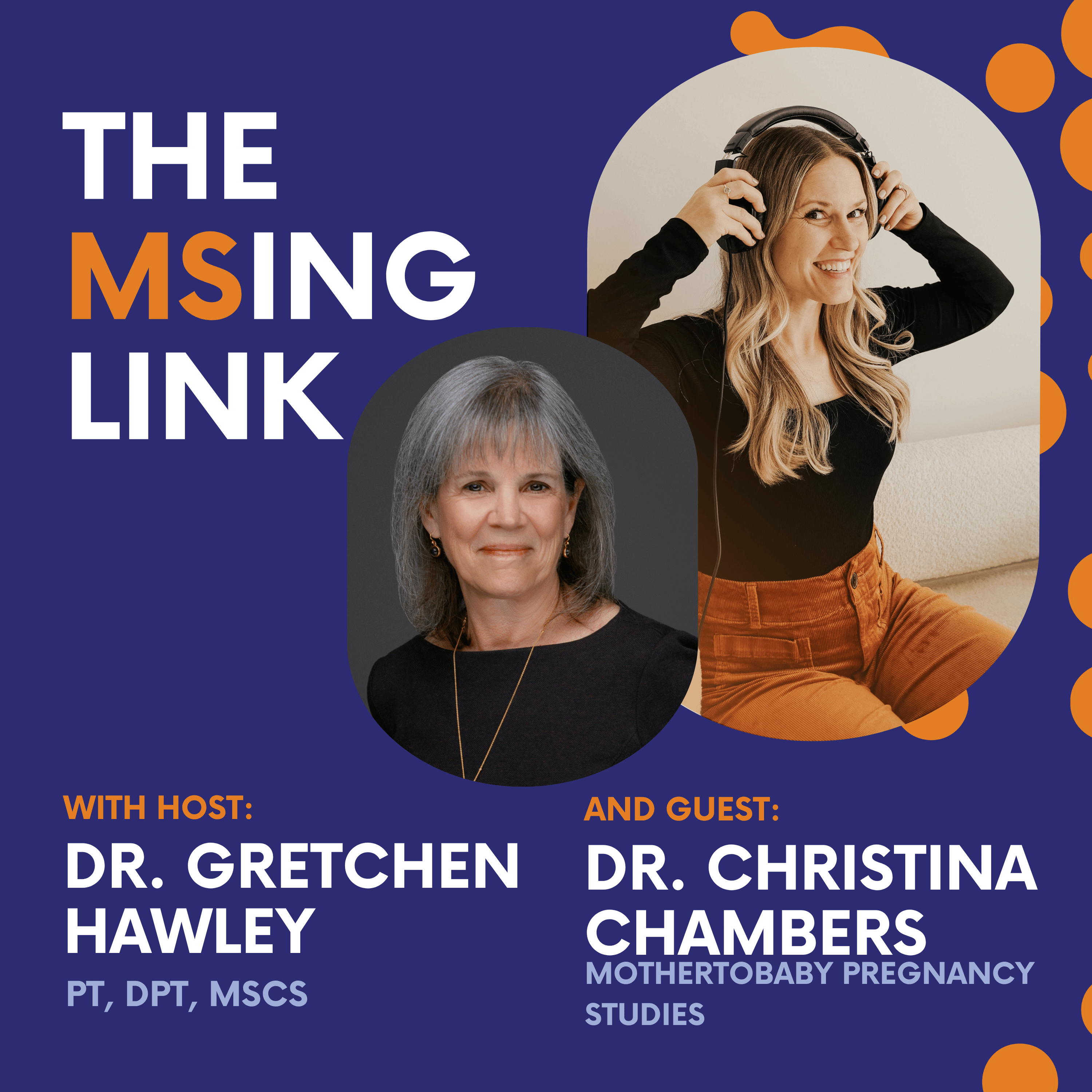
The MSing Link
297. MS and Pregnancy: What Current Research Says About Medications, Breastfeeding & Safety
00:38:30
Loading summary
Transcript64 lines
- [00:00]
Dr. Gretchen Holley
If you have Ms. And you're pregnant or hoping to become pregnant someday, this
- [00:06]
Podcast Host
episode is for you. Because one of the most common things I hear from women in our community
- [00:12]
Dr. Gretchen Holley
is that they feel completely alone navigating Ms. And pregnancy. Their neurologist doesn't specialize in pregnancy. Their OB doesn't specialize in Ms. And finding someone who understands both is nearly impossible. But today's guest is changing that. We have Dr. Tina Chambers with us. She is a perinatal epidemiologist and professor at UC San Diego, where she leads Mother to Baby, a free nationwide counseling service for pregnant and breastfeeding women with questions about medications and chronic conditions like multiple sclerosis. On today's episode, we talk about what to do if you just found out you're pregnant and you're worried about the medications you're already taking, how to think through your Ms.
- [01:01]
Podcast Host
Treatment plan if you're in the planning
- [01:03]
Dr. Gretchen Holley
stages and want to be prepared. And what the research actually says about Ms. Symptoms during pregnancy and medications during pregnancy as well as breastfeeding, and a lot of it might not be as scary as you think.
- [01:18]
Podcast Host
Let's get into it.
- [01:25]
Dr. Gretchen Holley
The big question is, how does someone with Ms. Actually improve their mobility, strength, energy independence? The list goes on. My name is Dr. Gretchen Holley, physical therapist and multiple sclerosis specialist. Welcome to the Missing Link podcast. Tune in as I share the top strategies and exercises to help you gain control over your life with ms, using research driven insights and advice from top industry experts. Whether you're newly diagnosed or have had Ms. For over 30 years, whether you have relapsing Ms. Or progressive MS, this podcast is for you. You're sure to feel empowered and inspired after each episode.
- [02:15]
Podcast Host
Ready?
- [02:16]
Dr. Gretchen Holley
Let's dive in.
- [02:24]
Podcast Host
Doctor Chambers, thank you so much for being here with us. Thank you.
- [02:30]
Dr. Tina Chambers
I'm happy to be here.
- [02:31]
Podcast Host
Absolutely. I've got so many questions, and I'm so excited for people to find out who you are and what you guys do. But before we do, is it okay
- [02:39]
Dr. Gretchen Holley
if I ask you a question from my interview deck?
- [02:43]
Dr. Tina Chambers
Sure.
- [02:44]
Podcast Host
I'm just gonna shuffle, give you a fair chance of a question. All right. Your question is, what was one thing you begged your parents for as a kid and they finally gave it to you?
- [02:57]
Dr. Tina Chambers
Wow, that is a good one. Boy, you took me off guard there. I'll say. As a kid, as a teenager, I begged them for a car. And at the very end of my teenage years, that's when I finally got it.
- [03:11]
Podcast Host
What type of car was it?
- [03:14]
Dr. Tina Chambers
My first car was a Volkswagen Beetle.
- [03:17]
Podcast Host
Oh my goodness. I always wanted one of those cars. What color was it?
- [03:22]
Dr. Tina Chambers
It was kind of a gray color, nondescript, but it was a car and that was good.
- [03:27]
Podcast Host
Oh my God. Yeah, right. Absolutely. Very fun. Well, thank you for answering that. Okay, so let's, let's first dive in and can you tell our listeners who you are and what you do?
- [03:37]
Dr. Tina Chambers
So I'm a, what's called a perinatal epidemiologist. So most people know epidemiologists as people who study kind of the distribution of disease by people, place and time to try to understand is it more of it happening or less and in what places and to whom. So we know where we need to deal with this. And I focus particularly on the perinatal period, the kinds of things that during pregnancy and during lactation when the baby is young, that a mother might be exposed to that could interfere with the normal development of the baby or not. That's my primary research area and I am a professor in the Department of Pediatrics at the University of California, San Diego, and that's where I do my research and work. I think we're going to talk about today, which is a nationwide counseling service for pregnant and lactating women.
- [04:31]
Podcast Host
Yeah, I'm so excited to have you on because I think this information in general around pregnancy and Ms. Is so few and far between and it's, it can be really hard if people don't know about mother to baby to know what is safe and what, what does research show. And a lot of doctors and neurologists don't even know as well. So I'm excited to dive into it. When we think about Ms. And pregnancy, it often feels like there's so, so many unknowns and it, therefore, it can feel super scary. Why do you think this area has historically been so under researched?
- [05:09]
Dr. Tina Chambers
So I'll say, Gretchen, it's not unique to Ms. There are many, many, many chronic diseases that women of reproductive age have that, you know, need to be treated or the disease itself may play a role in the risks or the course of pregnancy. In the big scheme of things, if you talk to a neurologist, you talk to a rheumatologist in their overall general practice, the number of people who are pregnant at any given time is a small number. So in part it's kind of the rarity of the disease and then pregnancy within the disease being even more rare, that it's just not, you know, the most common thing to be able to develop research data or provide information. It's doable and Part of the reason I think that it doesn't get as much attention as it should is in part due to lack of resources being focused on this as a question that everybody deserves to have answered and deserves to have answered and information provided to them in a timely fashion. And that's just has been historical. Certainly in the United States it's been historical that we have not addressed this as aggressively as we should.
- [06:25]
Podcast Host
Yeah.
- [06:25]
Dr. Gretchen Holley
And I want to get into asking
- [06:26]
Podcast Host
questions around medications and pregnancy. But before we do, if someone is listening and thinking about getting pregnant, how far in advance should they really start thinking about how Ms. And possible medications may affect their pregnancy journey?
- [06:47]
Dr. Tina Chambers
Oh, that is such a great question. And it's one of the mother to baby. It's one of our biggest challenges is to try to encourage people to think about these questions long before they ever attempt to get pregnant. The most common situation is either people think I don't need to think about it until I am pregnant. And many people don't plan pregnancy. So it happens. Not that pregnancy isn't welcome, but you know, about 50% of pregnancies in the US are not planned. And so a woman doesn't have a chance then to be able to say what are the things I should be thinking about. So I don't think there's any absolute time period. But I think from the standpoint of a person with Ms. Who is of reproductive age, if you have a thought that you might want to become pregnant in the future or the potential to become pregnant, there's no wrong time to discuss with your provider, what are the things I should be thinking about if I were to want to become pregnant five years from now, or if I were to decided I wanted to become pregnant next year. But certainly in terms of being able to make focused choices about how you want to be prepared for a pregnancy, I would think that maybe bringing this up maybe a year in advance, at least six months, because the kinds of things that if you're talking about changing medications or doing something different in preparation for pregnancy, sometimes it takes a while to make that transition, come up with a plan, and then to stabilize everything before you become pregnant.
- [08:17]
Podcast Host
Okay, that's super helpful. So I have two questions, I'll ask you one at a time. But I would love to know how you would approach someone who comes to you and they just found out they're pregnant, it wasn't necessarily planned, and they're wondering what the heck am I supposed to do? And then my next question will be, what if someone is planning and has that time so, first part, they don't have time. They just found out. What do you say? What do you advise?
- [08:40]
Dr. Tina Chambers
It is the most common presentation that somebody who contacts mother to baby comes with, I just found out I'm pregnant. And it's whether it's a mom who has Ms. Or any other chronic condition or not, the most common contact that we get is, I just found out I'm pregnant. I take this asthma medication, I had a vaccine last week. I work in the garden and I spray chemicals to get rid of weeds. Or I have a chronic condition, and these are the medications I take. And I'm wondering, are any of these things things that I should be worried about? So that is extremely common. And I think one of the important roles that the Mother to Baby counseling service plays is being able to provide a level of comfort to pregnant women who contact us, who are usually come to the table with so many questions, oh, I just found out I'm pregnant. So many questions, with the assumption that everything must be awful, everything that that's happened to me must be harmful. When that's usually not the case, it's helpful, I think, to be able to put in context what has happened. And, gosh, we have some pretty good information about the things that you've already had exposure, and we also have good information about what the consequences would be if you had not been properly treated for your disease during pregnancy. So I think in the context of talking to a pregnant woman who's just found out she's pregnant and has already had these exposures, that by and large, we can generally be quite reassuring for many things. We don't have as much information as we would like. And for some new drugs, we have no information in humans, but we have to explain that this is the situation for many, many medications. So you're not alone. It isn't just your drug that you're taking in your pregnancy. And we can provide some information that sometimes people are just not aware of, like there's a risk in pregnancy no matter what. So if you lived in a bubble and never were exposed to anything, there's a small risk that you're going to have some adverse outcome of pregnancy. That just comes with the territory. And sometimes that's reassuring to women as well, that it's not like you have zero risk if you didn't take this medication or had this disease.
- [11:02]
Podcast Host
Yeah. And when you say information, like we have information on this or we don't have information, are you referring to research?
- [11:11]
Dr. Tina Chambers
Yes. Yes.
- [11:13]
Podcast Host
Yeah.
- [11:13]
Dr. Tina Chambers
So the question that's being posed is can using this treatment or having this disease interfere with what you would like to be the normal course of pregnancy or lactation? And the way we say that it can or cannot or what the risk might be is by research that's done. Certainly it's done preclinically in animal species, but that doesn't tell us the whole story. And then it's done. Hopefully data are collected in human pregnancies so that we can actually can inform, you know, what we know might happen in human pregnancy.
- [11:48]
Podcast Host
Yeah. And that's one of the things that mother to baby does, is that correct?
- [11:52]
Dr. Tina Chambers
Yeah, that is the main focus of what mother to baby does. It's not the pregnant woman or lactating. Mom's clinician can't look at the literature as well. But what mother to baby does is actually support what clinicians oftentimes don't have the time to do. Which is to say we've surveyed all of the data that are out there and summarized it and then kind of applied it to your unique situation. Situation because everybody's an n of 1. So oftentimes we'll have somebody contact us who asks about an exposure in pregnancy. And they assume if this drug can cause harm in some specific way, that it doesn't matter when you take it in pregnancy. While it could be that the time that she took it in pregnancy, there's no possible way it could have the effect that she's worried about explaining that to that individual, her individual circumstance, the dose that she's taking, the timing and gestation and so on, that those play a role in whether or not they're risk associated with it. So that individual level counseling, I think is really what the huge value is of mother to baby resources. And it's also. We can take the time.
- [13:00]
Podcast Host
Yeah.
- [13:01]
Dr. Tina Chambers
So sometimes, you know, an office visit is going to be 20 minutes. And sometimes we have somebody that just needs to walk through it, needs to hear it different ways, wants more information. It needs to not only hear it different ways, but also say it in a way that I can understand this. So there's some kind of an analogy that you can use or something like that. And so being able to take that time and kind of work to build that personal relationship. And again, it's not in replacing in any way, shape or form the obstetric provider or the pediatrician or the specialist, the neurologist, for example, it's complimenting them. And we always offer the opportunity if the provider wants to talk with us or go over what we said. Happy to share that Information that is just.
- [13:50]
Podcast Host
I imagine that people listening right now who are either pregnant or hoping to become pregnant are just like smiling right now with a huge sigh of relief because the fact that they can speak to someone where the focus is Ms. And pregnancy is just. I mean, I feel like I get the chills as I'm saying that because that's, it's so unique. Your neurologist has so much to focus on, that pregnancy is just one small P in all of that. And your ob GYN probably doesn't know about Ms. So combining the best of both and having that call focused on that is just next level service that is not only helpful medically, but also just to feel seen and heard.
- [14:34]
Dr. Tina Chambers
I hear you. I think that's so true. I mean, we wish that for every chronic condition like Ms. That patients could go and see a team of providers that know about the maternal fetal medicine specialist and a neurologist who is knowledgeable about pregnancy and so on. But that's, that's just not available for everyone. So being able to have this additional resource for patients I think is valuable.
- [14:58]
Podcast Host
Yeah, absolutely. Okay, so let me get back to some of my other questions you mentioned a bit ago. Just fears that a lot of women have. What would you say are some of the most common misconceptions?
- [15:11]
Dr. Tina Chambers
It continues to be surprising to me. Sometimes we still hear this today from people, not necessarily pregnant women, but people who say, really women take prescription medications in pregnancy that are just surprised that they don't just stop everything. So that I think just still continues to blow me away that people have that misperception. I think a common misperception too is that if some people bring to the table the idea that if there was anything seen, you know, in a study of rats or rabbits or something like that, automatically translates that that will happen in humans. So there's that misconception, even though in the preclinical studies the product might be given at 50 or 100 times the dose that would be given in humans. And then there also is oftentimes a misperception of risk. So people think, I either have zero risk or 100% risk. And that is a, that's a difficult concept to get across, that we don't know of any drug or agent that does have the potential to harm the baby, that harms 100%. I mean, even thalidomide affected probably 20% of baby pregnancies that were exposed. So even if there is a strong risk for an adverse outcome, it's not everyone. It's not 100%. And so I think that is a misconception that people have and sometimes people have the misconception that not treating is better than treating. If there isn't enough information, then I'd be better off not to use the medication when there are so many chronic diseases that. And asthma is a perfect example that under treating or not treating asthma appropriately in pregnancy leads to an increased risk for all of the adverse outcomes that the mother's worried about in the first place because of poorly controlled disease.
- [17:03]
Podcast Host
Right.
- [17:03]
Dr. Tina Chambers
Wow.
- [17:03]
Podcast Host
Those are some really good ones and really make you ponder because some of those do sound like it'd be a no brainer, like if we don't know, let's just not take the medication. So that's helpful to hear. So we talked a little bit about if someone finds out that they're pregnant right now, what would you say? What about someone who has time and is planning to become pregnant? How do you typically guide them?
- [17:27]
Dr. Tina Chambers
As I mentioned earlier, that's the ideal situation where you have time to work with your clinician and determine what's the best course, course of action in that scenario. Sometimes first of all the person might contact us and want to know, these are the medications that I'm using right now or the other treatments that I'm exposed to. Is there anything that if I were to become pregnant I would want to reconsider whether or not there would be an alternative so we can provide information on that. Sometimes what a mom will come to us with or a potential mom or will go back and get and come back to us is a list of alternatives. So we don't. We're not providing any medical advice and not making any recommendations. But we can say if you say, okay, here are three treatments that my provider says that I might be eligible to take that would be in my clinical situation would be reasonable to consider. Can you give me information about each one of those should I become pregnant? And so we can do that and then the woman can take that back to her provider and say, you know, given this information that can help kind of inform what the clinical decision making process between the mom planning pregnancy and the provider can be.
- [18:42]
Podcast Host
Yeah, that's great. And of course every individual is going to be on a different medication. But is there anything that you can share with us around what current research is saying for specific medications? Some that maybe you come across the most often is people with Ms. Being on and if the recommendation based on research is to continue taking it or stop taking it. And when you mentioned earlier about timing is like how does that work with those specific medications?
- [19:14]
Dr. Tina Chambers
Yeah. So it's. That's a complicated question. And it's a complicated question for a good reason with ms, because there's a lot of new treatments that have come out, thank goodness, in autoimmune diseases in general. Lots of new treatments in the last 20 years, and it takes quite a bit of time to accumulate the data. I think one of the positive things, and your audience would likely tell you this about Ms. And some other autoimmune diseases in pregnancy, is that it may be that whatever treatment is being used prior to pregnancy can be discontinued for a period of time in pregnancy, since the disease itself, and I'm just saying this in general, I'm not a clinician, but in general, the disease itself doesn't tend to worsen or progress in pregnancy. So pregnancy itself doesn't seem to be, you know, exacerbate Ms. And so it's possible that the treatment plan would be to interrupt treatment and then restart or whatever is necessary after the baby's born. That may be the cautionary approach that would be taken in the circumstance where there isn't enough data yet to be able to say, could I safely just continue on this and take it throughout pregnancy. I'll say this as I think everybody can appreciate it's nearly impossible to, to prove the negative, that you can't ever say something is 100% safe. But so what we're doing is accumulating data over time. As drugs are on the market for a longer period of time and more people have used them, there's no evidence. And then we move to, well, there's no evidence of risk, but the data are too sparse. And then we might move to, there's no evidence of a large increased risk. And then we might move to, there's no evidence of even a modest increased risk. So we don't ever get to perfection. But if we can get to that no evidence of even a modest increased risk, that's the place that we would like to be. And it all kind of rests on the numbers from a statistical standpoint. If the drug is not harmful, then it takes you thousands of exposed pregnancies to be able to try to get to that conclusion. If the drug is harmful, if it's really harmful, you're going to know it, you know, with a couple of dozen pregnancies. So it's that how confident are you getting in terms of being able to rule out risk? There are people, ms, and I don't want to generalize, but like everybody else, have comorbidities or have other medications that they use that are older medications. So maybe they take antidepressants or maybe they have to use corticosteroids or whatever. And so there are medications that have been on the market much longer that might be used by Ms. Patients who have these comorbidities or have that need. Where we have a lot more data, we can give a kind of more concrete information about is there any evidence of associated risks for the newer drugs? It's much harder to do that. And so we kind of go with this is what's known with the limited data. This is what we know about how the drug is metabolized. This plays a role in breastfeeding decisions, for example, with the biologics actually in pregnancy, with the biologics that mostly thinking that large molecules don't cross the placenta for most of these products, part of pregnancy, it's only later in pregnancy. And that in terms of breastfeeding, that they're unlikely to get into the baby's bloodstream because of the. It has to go through the baby's digestive tract. And these are medications that are typically not taken orally because they get into the bloodstream through the digestive tract. So there's other things that we can say about those. But if you're asking, is there kind of a safe list of Ms. Medications, I would hesitate to say that.
- [23:06]
Podcast Host
Gotcha. Okay, that's helpful. And what about the fourth trimester? So as soon as someone has the baby. And you just mentioned breastfeeding as well. Is that typically a time where if you stop the medication now, you're good, you can start it right away or not. Especially if you are breastfeeding. What are some of those conversations like?
- [23:26]
Dr. Tina Chambers
Yeah, with a neurologist. I mean, I think that would be part of the plan is if you are going to go off your medication, when is the best time to restart? After delivery? So maybe there's a little waiting period. The breastfeeding question is certainly whether you're taking the medication during pregnancy, throughout pregnancy, or starting in the postpartum period is I'll get on my soapbox here is to me, simplest question to answer. And we just have not put the effort into trying to answer this, and this is global, that many women will choose not to breastfeed because they have to take a medication or will be worried about taking the medication. And in some cases they won't take it because they want to breastfeed and that it doesn't have to happen because it's way more difficult to try to study safety of medications in pregnancy than it is in lactation. Lactation studies are relatively more quickly done and can be done if the will is there. So that being said, there are some data and there's a lot of sort of predictions about whether the infant would be exposed based on how the drug is metabolized by the mom and in breast milk and what might get to the baby. We use a really nice resource called LactRx, which is a compilation of data about medications and breastfeeding that is authored by two fantastic pharmacists who have been doing this for years, and they do it for the National Library of Medicine and for us. And it's a kind of a. A summary of everything that's known. And a lot of times there are reports of 10 women who are breastfeeding between 2 months and 8 months of age on this medication. And this is what was seen. And it gives you some summary of what the pharmacology of the drug is and why we would think that there might be concerns or no concerns. So it can be a really good piece of guidance in terms of at least making recommendations about whether, if the mom chooses to, she could safely breastfeed on that medication. But again, I'm just making a pitch that these are the kinds of data we're working on collecting now, because these questions can be answered and should be answered, rather than just saying this is our best guess at this point in time, so that moms have to make a decision on that basis. But it certainly is a huge question for people in that fourth trimester. And obviously anything we can do to encourage breastfeeding, if the mom is willing to do it by being able to provide reassurance about the medications that she's taking, is important because of the tremendous benefits of breastfeeding for the baby and for the mom.
- [26:14]
Podcast Host
One thing that I have heard and I. So I became an Ms. Certified specialist over a decade ago, and I remember back then hearing that pregnancy was like this safe zone, like, just go off your meds and you'll be fine. And obviously every person is going to be different. Some people do experience that, some people absolutely do not. But what do you know and what can you share with us around symptoms becoming better or worse during pregnancy, regardless of the medication choice?
- [26:48]
Dr. Tina Chambers
Yeah. So I'm not an expert in this area, but as I mentioned earlier, I think that evidence seems to suggest that in pregnancy there may be less related to the Ms. Because of the changes that take place during pregnancy, hormonally and otherwise. There may be fewer relapses than you would have outside of pregnancy, especially in the third trimester. So as you've said, and exactly right, that every person is different, but this certainly can play a role in how a woman with Ms. Thinks about becoming pregnant and how she and her clinician think about what medications might need to be continued. I think true for other chronic diseases like rheumatoid arthritis and. And asthma as well, that there is our subset of people where pregnancy is like the golden time. Their symptoms are better. It's like pregnant all the time. But that's not true for everyone. So some people, it does not get better. It may even be exacerbated. So, yeah, yeah, that's such.
- [27:55]
Podcast Host
I mean, obviously you hope for the situation where your symptoms do get better, but you never know. Now, you've been mentioning how you. You guys know a ton about what research currently exists, but mother to baby also does their own research, is that right?
- [28:10]
Dr. Tina Chambers
That's correct. So our counseling service has existed for more than 40 years and are providing information. But we've also, for that same period of time, recognized that, gosh, we have people who are contacting us who are saying, I have taken this medication. I'm pregnant. What can you tell me? And we say, there's not enough information, but you have sitting in front of you a woman who's taken the medication. Medication. So we have an opportunity to be able to say, gee, we would love to be able to follow you through your pregnancy to see what the outcome is and compare that to somebody who had the same underlying condition and didn't take the medication to answer or to help answer that question that you had for the next person who comes along. And so we started many years ago, more than 25 now, doing the pregnancies, mother to baby pregnancy studies. And so the services, if they have a caller or someone who comes to them who might be interested in participating in the research, gets referred to us, and then we explain to them how it's done. So these are observational. It's basically one observational pregnancy registry. But there are certain medications and vaccines and other exposures that we're focused on. And people who agree to do this agree to be followed during their pregnancy with some telephone interviews where we can gather information about the pregnancy and pregnancy ends. We get information about the outcome of the pregnancy. They give us some information from medical records for themselves and their baby. And then we typically follow those babies and moms for at least a year after they're born to look at how the baby grows and develops. And then in the case of ms, for example, we have an Ms. Study right now we're looking at moms who have taken casimta in the period of time just preceding pregnancy and into early pregnancy. And we're comparing them to moms who have Ms. Who have taken other medications or more nothing in pregnancy. And we look at a wide variety of outcomes, all the kind of range of outcomes that mothers and clinicians are interested in. So we look at is there an increased risk for any types of congenital malformations or birth defects, particularly, is there any kind of specific ones that are seen more frequently? Is there an increased risk for preterm delivery? Is there an increased risk, risk for smaller babies? Is there increased risk for complications of pregnancy or for pregnancy loss? And then how does the baby, as I mentioned, grow and develop in that first year of life?
- [30:41]
Podcast Host
That is so amazing. And you mentioned phone calls. So in order to participate, is it all remote?
- [30:47]
Dr. Tina Chambers
It is, yeah. We recruit women into the pregnancy studies and we've enrolled, you know, probably 20,000 women over the years throughout US and Canada, so they can live anywhere. All of the research activities are done through our coordinating center at the University of California in San Diego, and so done remotely by telephone and some as sort of electronic information shared. It's a commitment on the part of the participant. So the mom is going to spend maybe, you know, 18 months with us and maybe we'll talk to her five times over that period of time and we'll have some email or mail exchanges. But it's a long relationship at an important time in their lives. We feel like one of the things that's really important that we do is that we enroll the mom. We're not just saying, ask your provider to give us all this information. We enroll the mom and the relationship and all of the information that we're collecting comes from her. And most moms do it because they're altruistic, because they want to help the next person who comes along. The other thing that's really important about it, and any mothers who participate, I hope, appreciate this or listen to this podcast, is that when it comes down to it, the only person who knows what the mother took during pregnancy is the mom. So when you talk about over the counter medications or caffeine or whatever, that's not in your medical record, and even medications that are prescribed, oftentimes the mom doesn't pick them up or she doesn't take them, or she doesn't take it as prescribed. And the only person who knows that is the Mom. So in terms of getting accurate information about the whole scope of what happened in the pregnancy, it's a precious resource to be able to actually ask the mom to give us that information.
- [32:37]
Podcast Host
Absolutely. And you had mentioned US and Canada. We do have listeners from all over. If someone is listening from the UK or Australia, is there the plan to expand to other countries or for now, is it looking pretty much just like US and Canada?
- [32:53]
Dr. Tina Chambers
Yeah, we have done these always in US and Canada. It is possible. Our network of mother to baby services has a sister society, the European Network of Touretteish and Information Services, which includes Australia, uk, European countries, some South American countries and Asia. And they in some cases do research. UK for example, does, and Australia does that they collect information on people who have contacted them just like we do. We have partnered with them to do collaborative studies in the past. So we may collect information on, you know, a particular drug and not have enough to say what we would like to be able to know. And we can work with those services if they have information on the same drug to try to say, can we pull this information together to get to an answer. So we currently don't enroll anybody in our study in the US from any countries outside of the US except for Canada, but those other countries do in some cases do that.
- [33:52]
Podcast Host
Okay, that is good to know. Thank you for sharing that. My final question is how can people reach out or find whether it's someone who is pregnant or wants to become pregnant or a clinician, Is there a best way for them to stay informed and reach out? If they do want to connect, by all means.
- [34:10]
Dr. Tina Chambers
We hope that clinicians and women who are planning pregnancy or thinking about it or thinking about lactation questions, that they contact us and become familiar with how the service works. And that's sort of a given. And there are a number of ways of doing it. So if you go to the website mother2baby.org, there is information on how to contact us. But the counseling services provided traditionally has been provided by telephone. But it's also one of the most common ways that people contact us is by live chat. And then we do text and we do some email. There's one service in Florida that sees people in person in a clinic setting. Those would be the ways that somebody could contact us for the counseling service. If people are interested in the research aspect of it, clinicians or patients. The website gives an overview of what's involved. It tells what particular medications and diseases we're studying. So it will describe the Ms. Study that we're doing. Now and what are the various components of it? And there are a couple of ways. Well, there are several ways that somebody can learn more about the study. So they can call the toll free number and we will go over, over what the study is about and see if the person qualifies. A clinician can use a referral form with the permission of their patient and send that via the website to us to let us know that they have a patient who is interested in us providing them with information about the study. Or the clinician can call us and give us that information or email us. So there are a variety of different avenues for people getting to us for the research aspect of it. And there's no, as we said earlier, I don't think there's any wrong time. If somebody thinks, I think it's amazing when somebody says, gee, I'm not pregnant yet, but I'm going to be thinking I'll get pregnant in 2027 and can you tell me what kind of studies might be coming up that I might be eligible for? So to kind of be thinking about it before you're all of a sudden, oh, I'm in the throes of pregnancy, I got to do this and this. And now I have this other thing to think about. It's terrific for us when people are able to think ahead and get some information about a study before, for before the time comes.
- [36:22]
Podcast Host
Absolutely. And even just looking into the research that already exists, if they are in that planning phase
- [36:30]
Dr. Tina Chambers
100%, like we said, that's a great time to become informed. Once a study's done, and this is the proudest time we have, is when the study's completed and it gets published. We have the thrill of being able to send that paper to those 500 women who spent the time doing this to say, look what you did, because you spent those hours sharing your personal information and your baby's information. This is helping other people to make more informed decisions about pregnancy.
- [37:03]
Podcast Host
Yeah. Yeah. That's so powerful. Thank you so much for being with us today. And I will share the website link in the show notes so if anyone is listening, you can just go there to find all of that information. But thank you so much for sharing this with us again. I think I wish I could scream this episode from the rooftops because it just needs to be talked about more. And I appreciate you spending time with us today.
- [37:31]
Dr. Gretchen Holley
Thank you for listening to today's show. I am so grateful to have you as a listener. If you'd like extra resources, such as a video of one of my seated exercise classes, my favorite core exercises, and the opportunity to ask me your questions head to Miss. That link will be shared in the show notes along with links to my social media handles. If you loved this episode and think a friend or family member with Ms. Would benefit from listening, please go ahead and text or email this podcast to them right now. Sharing this podcast will help me educate and empower as many Ms. Warriors as possible. Thanks again for joining and be sure to tune in next week for another another episode of the Missing Link podcast.