← The Naval Aviation Ready Room Podcast with Ryan Keys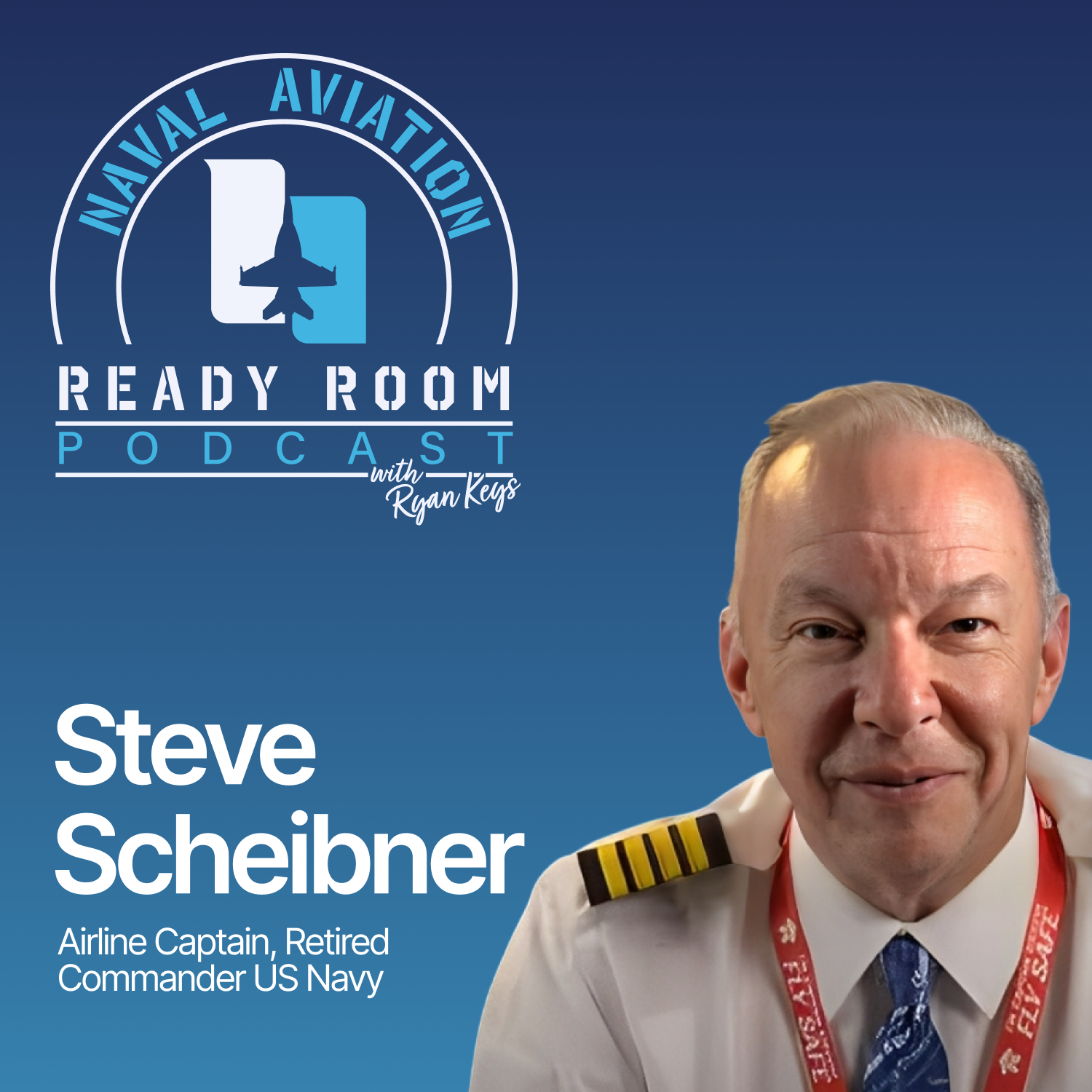
The Naval Aviation Ready Room Podcast with Ryan Keys
9/11's Hidden Story: How One Schedule Change Saved This Pilot's Life | Capt Steve Schreiber
00:50:09
In this episode of The Naval Aviation Ready Room Podcast, host Ryan Keys sits down with Captain Steve Scheibner, former Navy P-3 Orion pilot, Scheibner recounts his extraordinary journey from Cold War anti-submarine warfare missions to a life-changing near miss on September 11, 2001, when a last-minute schedule change kept him off American Airlines Flight 11. His story explores how fate, faith, and naval aviation principles shaped his approach to leadership, purpose, and service both in the cockpit and beyond.
Loading summary
Transcript114 lines
- [00:01]
Captain Steve Schreiner
Later on that night, seven o' clock that night, I finally got home and I went to the computer to see if I could bring up the names of the crew members at American on that flight, because I'm sure I would have known some of them. And when I brought the screen up in front of me, it was the exact same screen I had seen the day before when it had my name listed on it, except now all the names are removed. X ray 1, radio check 1, 2. Welcome to the Naval Aviation Ready Room podcast where the stories, leadership and leading edge technology of Naval aviation come alive. Hosted by retired Navy Captain Ryan Keyes, this podcast takes you beyond mere museum artifacts as he delves into the personal stories, pivotal decisions and state of the art hardware that define the world's most prolific aviation force.
- [00:47]
Ryan Keyes
Welcome back to the Naval Aviation Ready Room podcast. I'm Ryan Keyes, Captain, United States Navy, retired, and Director of Operations and Strategy at the Naval Aviation Museum Foundation. Today's guest has lived a life that reads like a flight plan, packed with adventure, service and impact. Captain Steve Schreiner began his journey as a Navy pilot in the 1980s, flying the P3 Orion on deployments around the world. After leaving active duty, he joined American Airlines where He logged over 12,000 hours and now flies the Boeing 777 out of JFK, taking passengers across the Atlantic and beyond. But C story doesn't stop in the cockpit. He went on to earn advanced degrees in theology, plant a thriving church in Maine and develop training rooted in Navy core values has reached more than 10,000 service members. He's also a husband, father of eight, and mentored a countless young leaders. Today we'll talk about his career in the Navy and commercial aviation, his passion for shaping character and what it means to take lessons from the ready Room and carry them into every area of life. And I will say that Captain Steve is the biggest name that we've had since so far here on the Radio Room podcast. And really the only reason why it happened is I have to thank Kyle Kozad, a retired two star admiral who is the president and CEO of the foundation, who I understand you were squatter mates together in Maine in your first VP squadron. So again, Captain Steve, thank you for joining us today in the radio.
- [02:14]
Captain Steve Schreiner
Yeah, my pleasure. Thanks for having me on.
- [02:16]
Ryan Keyes
Yeah, I'm excited. When you look on YouTube and you go to anything aviation, your face pops up just how you look right now. And it's great because if anyone hasn't seen him on YouTube, you need to get on there and definitely your Analysis and your very insightful commentary on whether it's mishaps or flying the Triple Seven or differences is outstanding. There's a reason why you have over 800,000 followers, for sure. And your character, your energy comes through the videos. So, again, thank you for joining us today. Hopefully, hopefully, it'll maybe increase our rank in the aviation podcast.
- [02:56]
Captain Steve Schreiner
Yeah, I hope so. I hope our audience throws some love your way as well. And thanks for that. The whole Captain Steve thing is rather new to us. We only started about 12 months ago at it, and no pun intended, but the channel took off. And part of it is we're trying to be informational, educational, and a little bit snarky when we can be. Some of the incidents and accidents we talk about are very serious, but the ones that are more lighthearted, we throw a lot of humor in and people seem to enjoy that. I like telling stories and telling jokes, and so let's start talking and telling stories.
- [03:26]
Ryan Keyes
Yeah, I love it. So I want to kind of harken back to, like you said, your time and when you first got in the Navy and got winged. So just tell Doc, did you grow up loving aviation? Why is it naval aviation that you chose? Why vp? Because I'll be honest with you, when I was going through flight school and I was in VT3 in primary and they gave us a little 3i5 index card on where you're. You write down what you want to select. I put P3s, P3s, P3s and P3s. And I got helicopters. So it's just the needs of the Navy.
- [03:58]
Captain Steve Schreiner
Right.
- [03:58]
Ryan Keyes
So, yeah. So how is it that you entered the VP community?
- [04:01]
Captain Steve Schreiner
So the year was 1982, and I was graduating from college and the job market was really tight. Ronald Reagan was president back then, and he was going to, if you recall, double the size of the Navy. And so as I tell people, and this is actually half a joke, but half the truth, they lowered the standards significantly for about three and a half years while they were trying to entice more pilots to come on board. And I was looking for a job, so it was perfect timing. I went down to the recruiter. My best friend went to the Naval Academy. So he was a guy that was like light years ahead of me. From the time he was 13 years old, he knew what he wanted to do. I was just a knucklehead trying to get through life. And when I graduated from college, I had a good time in college. Didn't get the best grades, but didn't enjoy my experience. He Said to me, go down to the recruiter and tell him you want to be a pilot. So I did. I walked down to the recruiter in Philadelphia and I walked in. After some small talk, he said, what do you think you want to do? And I said very confidently, I want to be a pilot. And he laughed at me. He looked at me and he said, you and 40,000 other guys. And I said, well, I don't want 40,000 other slots. I only want one. So he goes, well, I like the attitude. He goes, let's see what we can do for you. You got to take the tests. And so they had a test called the AQT far, not sure what it's called these days. And I went and I took the test and I aced the test. I did very well on it. It's kind of like an IQ test, right? It's just like general knowledge. So he was all excited, so he had me come back down. He said, hey, Steve, you did really well on the test. Let's talk about getting you into the pilot program. Well then once he got ahold of my college transcript, his tone changed a little bit and he said, you had a good time in college? I said, in fact, I did. So they put in a package for me to become an NFO Naval Flight Officer. Now, no insults to my NFO buddies. That's the way it worked back then. I'm not in control of those things. I got accepted to be a snfo, a student Naval Flight Officer. I went down to Pensacola, Florida, was there about a month going through Aviation Officer Candidate School when a couple of my other classmates said, why don't you just transition over to be a pilot? Do you have 2020 vision? I said, yeah. So it was just a single form you filled out while you were there? I filled it out, got a couple signatures. About a week later, I was in the pilot program. So almost everything in my life I've like semi backed into. I absolutely backed into being a pilot in the Navy, but I've loved it ever since.
- [06:16]
Ryan Keyes
That's a great story, actually, to one, I think you're willingness to join at whatever cost it was, you know, I want to be a pilot. Hey, I'll be an NFO too.
- [06:25]
Captain Steve Schreiner
Sure.
- [06:26]
Ryan Keyes
And then to come down here and then into, you know, Pensacola, the cradle of naval aviation, and to go, nope, I'm going to keep my pilot dreams alive and I'm going to go ahead and switch over. So. Wow, that's better be lucky than good sometimes, right?
- [06:39]
Captain Steve Schreiner
Absolutely. There you go. Lucky than Good.
- [06:41]
Ryan Keyes
Yeah. Did you struggle through flight school?
- [06:44]
Captain Steve Schreiner
No.
- [06:44]
Ryan Keyes
You probably did really well.
- [06:45]
Captain Steve Schreiner
I loved it. So I think part of the problem with how we recruit pilots is this. Back then, like I said, it's half a joke that they lowered the standards. But when they were trying to hire more pilots, they were looking at a broader range of people and personalities and backgrounds. Pilots tend to be doers, where engineers tend to be thinkers. Now, engineers are going to get a 4.0 grade point average, and they're going to blow away the academics, but the way they process is different than a pilot. Engineers or thinkers in particular, when there's some sort of a incident that they have to react to, they're going to want to go back to the beginning and line up all their dominoes and start over again. When you're in an airplane that's going 600 miles an hour, you got to know your procedures, but you got to pick it up right from that moment and work forward. So doers, idea people, dreamers, fit into that category a little bit better than your classic thinker. And I'm an absolute doer. So I was really very good at. I loved all of my student flights. I really took to it. Once I could put my hands on the aircraft, I just fell in love with it.
- [07:45]
Ryan Keyes
That's a great way to think about it. I've never really thought about pilots versus engineers kind of like that. And then I guess you kind of have a mix, too, of test pilots who kind of can do both, possibly.
- [07:54]
Captain Steve Schreiner
Yes, absolutely. That's a good blend.
- [07:57]
Ryan Keyes
Yeah. I was not an engineer. I was an English major and still made it through. So you got to VP land up in Maine. Did you choose Maine? You're originally from the Northeast, is that correct?
- [08:06]
Captain Steve Schreiner
Correct. So I met my wife in Pennsylvania in college. And then the Navy starts to move you around. And we wanted to go back up in the Northeast, I think, mostly because that's home and that's what we knew. Brunswick, Maine, is beautiful. It's a great place to go. So we fill that dream sheet. I got props, which is what I wanted to do. Then the. The next step is, do you want to go. Where do you want to get based? Moffett Field? Do you want to get Jacksonville? Do you want to get Brunswick? We put down Brunswick, we got Brunswick, and we moved up there in late 1984. And I joined VP23 at that time, and they were three weeks away from going on deployment. So it was baptism by immersion, for sure. Baptism by fire. I jumped right into the squadron as a knowing Nothing as a no P. And three weeks later I'm on an airplane going over to Rota and Lodges for a six month deployment.
- [08:53]
Ryan Keyes
That's awesome. And primarily doing so this is height of the Cold War time frame. So ASW every day trying to search, detect submarines and track them throughout the time. So that's probably some pretty exciting flying in missions at the time too.
- [09:09]
Captain Steve Schreiner
It was, and you said it. Well, it was the height of the Cold War and Ronald Reagan's mission was to put his thumb on the Soviet Union and just keep the pressure on him. And he did that not only rhetorically, but he did it through the mission of the Navy and the Air Force. And so we tracked Soviet submarines all the time. So they'd send subs out of the North Fleet, they'd come down in the Mediterranean. I think back in the day there was probably five or six Soviet subs patrolling the Mediterranean any one point in time. So we would track them coming in while they were in the med, track them going out and back up. And that type of pressure kept them. They had to keep deploying, they had to keep spending money, they had to keep all those things going. And it was that constant pressure on them from above. And it was a real mission. You know, there was a lot of Top Gun came out, what, 1986 or 7 and. And they had to kind of create a mission. Both Top Gun movies, they've had to kind of create a mission. But there wasn't a war going on at the time. So it was like a manufactured thing. What we did in the P3 community was real world, real time intelligence. It was going right straight back to Washington D.C. because you want to know where all those Soviet boomers are with all their nuclear weapons. You want to keep track of them at all times.
- [10:15]
Ryan Keyes
Yeah, I always said ASW these days is a very underrated mission. It's like it was at its height in the Cold War when I came into the Navy and started flying H60 Foxtrotts with dipping sonar and buoy capability in 1998. 99 after the cold War, but still, you know, still, Russian submarines were a thing back then. Now because of their economic issues and building issues and Navy issues, they've gone down. But we still treat it as a very important mission. But when the GWAT global war on terrorism started, ASW kind of went out the door and they had P3s flying over land doing missions that way. So kind of different.
- [10:56]
Captain Steve Schreiner
Well, and for your audience, you know, ASW is anti submarine warfare and I love that mission. Because there was a crew of, I think it was 12 of us all together on the aircraft. And everybody at each one of their computer stations had a little piece of the puzzle. And tracking a submarine is more of an art form than it is a science. There is a lot of science behind it, but you get a feel for it after a while to do it effectively and do it well. And that's the art of communication with everybody on the airplane. Some people are naturally more forthcoming with information. Other people are more introverted. So as a mission commander, you had to be on the ICS while you're flying the airplane, talking to people in the back, hey, come on, talk to me. Tell me what you see. What's the trend? What are you looking at? And once you get that put together, you're tracking a Soviet submarine in real time. And I just love the mission. I loved being in with other people rather than maybe being single piloted. And there's some advantages of being single piloted. But then who do you get your story right with after you land? And I had 12 guys to, you know, we could make a better story afterwards.
- [11:56]
Ryan Keyes
That's right. That's funny. So a couple or I guess quite a few operational deployments in your short time there in VP23 and then decide and then move on to shore duty after that. Where did you end up going for that?
- [12:09]
Captain Steve Schreiner
So I did three deployments altogether at VP23 and then I moved on to. And at that point I had kind of sort of made the decision of which direction I wanted to go, whether I was going to make the Navy a career. And it's a personal, it's a very family decision. Love the opportunities I had in the Navy. Could have very easily made that a full career for 20 plus years. But then decided, I think I wanted to go to the airlines. The airlines were hiring like crazy. It was just a better opportunity for my family. And staying in the Naval Reserve was like the best of both worlds. So we went down to Corpus Christi, Texas and I flew King airs down there. T44s in advanced training Command helping. And students there were now they had done their primary training in the T34. They're now in twin engine airplane getting their wings out of that. And the hardest checkride I ever got as a student was that final checkride before you earned your wings. And now I was the guy delivering that checkride to students. And it was designed to be overwhelming. And if they can withstand an overwhelming checkride. And they absolutely earned their wings.
- [13:08]
Ryan Keyes
Yeah, for sure. That is, I mean, just Think, how many men and women did you make into naval aviators?
- [13:15]
Captain Steve Schreiner
Right.
- [13:16]
Ryan Keyes
The impact that you had there. That's awesome.
- [13:17]
Captain Steve Schreiner
Yeah. And you, too. You know, those wings of gold are. I don't want to get too misty about this. It's a very elite club, and you've got to keep the standard high. And so everybody, all these years, has kept a very high standard. They don't just hand those things out. You earn them.
- [13:31]
Ryan Keyes
Sir, yes, sir, 100% agree. So you go down there, decide to get out separate, and then go reserves, and then you start your kind of application process for the airlines. Why American Airlines?
- [13:45]
Captain Steve Schreiner
Well, like I said, everything in my life I've backed into. So at some point, you're in the T44 community down there, and it's like the airline training squadron. Everybody in front of you is. They're putting out an application to Delta, United, American, and they're all getting picked off. Delta had the most streamlined process at the time. And from the time you got your first interview to the time they hired you was about three weeks. American was less streamlined. I think it was six to eight weeks before you'd get a acceptance letter. I put in an application at Delta. I had a great resume. I was an instructor pilot, blue card holder in the P3. All the right boxes checked, mission commander, all the right stuff. And the nine pilots in front of me at my squadron down there in Corpus Christi all got hired by Delta. So I was going to be number 10. I have as good a resume or better, and I couldn't even get an interview at Delta. So I was shocked. And so I immediately redid my thing, got more recommendation letters, sent it in again. I got turned on twice, even just for an interview. Well, what was happening internally at Delta at that point was they weren't pumping the brakes on hiring. They put the parking brake on. They had kind of come to a screeching halt on hiring. American was still hiring. They would hire for another year. So I went through the whole slower process with American, got an offer. It was my only offer with a major airline, but I would have picked American, Delta, United. At the time, I would have picked them all equally. When I was doing my interview in American, they said, why do you want to work here? And I said, well, in 30 years, I think there's going to be three airlines. American, Delta, and United. And obviously, I think America is the best because I'm in front of them. And now, 34 years later, I'm at the tail end of that career.
- [15:17]
Ryan Keyes
Well, you got a crystal Ball, you should have bought a lottery ticket that day because those are essentially the three majors along with Southwest and Alaska. But the largest three out of all the majors are legacy airlines.
- [15:28]
Captain Steve Schreiner
Correct.
- [15:29]
Ryan Keyes
Wow. Okay. Why did you decide to stay in the reserves and not fly necessarily in the reserves?
- [15:35]
Captain Steve Schreiner
Well, see, I absolutely love the Navy and I love the P3. So I did fly for the P3 out of Willow Grove for probably the first seven or eight years in the reserves, but then I transitioned to a different job and that prolonged my status. So, you know, like most pilots that go to the reserves, you're thinking, well, I'll hang out here until I get my 20 and then I'll qualify for my retirement and then I'll move on to whatever's next. I was at eight years when I got off active duty. I got a job at a squadron in Willow Grove. Here's how I back into everything in my life. I was there about four months. The new guy and the skipper comes down and all hands meeting, and he says, well, folks, we just got the word from Washington D.C. we're being decommissioned and in six months from now, everybody's going to have to be going someplace else, but we're no longer going to exist. So I had just gotten there and all the senior guys started peeling off and going to different squadrons or retiring and going doing whatever they were going to do next. I said, well, I'm going to hang out here till the end and then I'll make my choice. About five months into the six months of the decommissioning, skipper came back and said, hey, we got a letter from Washington D.C. it says they've taken us off the chopping block. We're going to be around. And I was like the last man standing. I was like one of the senior pilots at that point. So I became the NATOBS officer. I was the only instructor pilot in the whole squadron for a long time. And I was at the top of that heap. So I loved that, did a lot of great missions. The reserves in the 90s and into the early 2000s were becoming more like active duty in the sense that they were filling a much larger and larger role supplementing the active duty. So I did a bunch of years, worked 180 days of drilling days with the reserves, and it was like being on active duty. I was there four days a week, almost every week. So it was a full on commitment mostly because I just loved the Navy and I didn't want to give it up. But at the end of flying around 2000, I was right at the 18 year mark, 18 and a half year mark, and just kind of coasting to get to 20. When I decided to move up to Brunswick, Maine. Now this was back to Maine as a civilian. Now I had an opportunity to start a church. So that's not something that everybody can say that they've had that opportunity. But I had gone to seminary while I was down in Willow Grove, Pennsylvania, got a master's degree in theology and some old friends of ours up in Maine said, hey, would you consider moving back to Maine to help us start a church? And I took him up on that and we moved back to Maine.
- [17:52]
Ryan Keyes
I'll just say right now a leap of faith, if you put it that way. Right.
- [17:55]
Captain Steve Schreiner
It's a leap of faith for sure.
- [17:57]
Ryan Keyes
Yeah. A little dad joke thrown in there.
- [17:58]
Captain Steve Schreiner
That's a good.
- [17:59]
Ryan Keyes
Yeah, thanks. You know. You know, you said you just backed into everything, but then there's another saying. I've heard it says luck is the residual of preparedness. And I'm sure that's what you have done your whole life, right? You've prepared, you've done.
- [18:11]
Captain Steve Schreiner
Well, let's go with that. That sounds better than my. But I'm telling you, I have stumbled into and backed into some of the most wonderful things in my life and they weren't playing ahead of time.
- [18:22]
Ryan Keyes
So now you're essentially juggling three careers. Naval reserve officer, commander in the naval reserves. I assume now you're not a captain yet when you moved up there, still a first officer for American. And what did you start off as? What aircraft?
- [18:37]
Captain Steve Schreiner
I started out as an engineer on the 727, but I was only on that for about four or five months. And then I upgraded to the right seat of the 767 and I was on that for 23 and a half years. Great.
- [18:47]
Ryan Keyes
And then also now establishing a church and trying to build that flock. Right. That community. And oh, by the way, sorry, number four, raising your family over here with you and your wife having eight children, doing all that at once.
- [19:02]
Captain Steve Schreiner
Right. So all of that. There's lots of overlap in my life. And so those things all overlapped one another at the three jobs at the time. And it actually worked out quite well because at American I would bid reserve and I. There was a lot of stagnation in those years. They weren't hiring pilots, so I was at the bottom of the stack. So I actually couldn't hold anything but reserve. And on reserve you're on call to fill in for somebody that can't make it to work either. They're sick or for whatever reason, but you work about half as much. So you get paid a regular salary, but you work about 50% as much. With that being said, it was a perfect job for starting a church. Now, churches in northern New England, it's kind of a remote community. There's not a lot of money to pay a pastor to come in. Ideally, you get somebody that's bi, vocational, they've got a day job, and then on the evenings and the weekends, they work as the pastor of a church. I had the ideal job for that because I could basically be around about 23 days a month and the church wouldn't have to pay me a salary. So getting off the ground with the church, no pun intended, there was an advantage because I had that day job. So we did decide, we prayed about it. We decided to move back to Maine. We uprooted everybody, the whole family, and moved back up there and planted Cornerstone Baptist Church in tops of Maine in July of 2000. And that was a wonderful experience. It's the most challenging job I've ever had. And I tell people I've been in airplanes with engines on fire. I've had multiple emergencies over the years. And the stress that goes with that, nothing compares to the challenges and the stress that goes with being a pastor in northern New England. And it was extremely rewarding all at the same time. So I love that. But we planted the church the first Sunday. We had 28 people. There was a few families wanted to help get started. Most of the rest, everybody was related to me.
- [20:43]
Ryan Keyes
Start with family first. Right.
- [20:44]
Captain Steve Schreiner
But, you know, when people started coming out week after week, they liked it, they would join the church, started to grow. About a year into it, we're at about 100 people attending, which is a very reassuring size for a church, especially at that age. And we just kept moving along. I was there for 10 years, really enjoyed it. But at the end of 10 years, I realized it was time to kind of hand it over to the next person for two reasons. One is the airline was taking more and more time. But I had been asked to write a leadership class for the Navy, and it was taking on a life of its own. And that course, which started out very modestly in the beginning, all of a sudden I'm traveling all over the world being asked to come and teach this class. So you got your obligations at American, you got your obligations at the church, and now in between, I'm trying to fit in, travel to go all over the place and teach a course.
- [21:32]
Ryan Keyes
Yeah. So essentially, you had to separate one from all that. And it was the church that did it. Or that, like you said, though, you passed it on to somebody else to shepherd it along, right?
- [21:41]
Captain Steve Schreiner
Correct. Right. So tell me a little bit about
- [21:43]
Ryan Keyes
your leadership class and kind of what that was about. Why were you selected to do it? What was your interest in doing it? And then we'll kind of swing back to the American Airlines thing.
- [21:53]
Captain Steve Schreiner
So at all the intersections of my life kind of came together in this course. I had that master's degree in theology. I had actually gotten another master's degree since in counseling. And I was working on the staff up in Brunswick now for an active duty commodore. And I actually loved that job. I wasn't flying anymore for the Navy, but I was an executive on his staff and he liked having me because I was a part timer that he could give pet projects to that he didn't have to. I don't want to say this wrong, waste somebody else's time with. He could give it to me and I could take a month and go research something, come back on my next drill weekend and hand him a report or whatever, what he wanted. So he liked having me. I loved being kind of back in the active duty world again. So I wasn't drilling on weekends anymore. Like a drilling reservist. I was actually integrating with the active troops and being a pastor of a church locally to that base. It was ideal. I was having interaction with local young people and everything. So many of them wandered out to the church. It was good. So it was one of those times where I had a report to hand into him. And I was sitting in his outer office waiting to get called in. It was a few minutes past my appointment time and he was a very punctual guy. About 15 minutes late, two folks come out of his office, a man and a woman. Both enlisted in the Navy. And they looked miserable, like they had been crying. And I got called in a minute later and I looked at the commodore and his name is A.J. johnson. And I'm looking at him and he looks miserable, like he's upset. So I think it was the pastor in me that kind of came out. And I just kind of instinctively said, you know, is everything okay? And he said, no, not really. He said, I just had to fire those two. And I said, well, what did they do? And what he said next kind of changed the direction of my life. Well, even to this day. So he said, well, they're married to each other, they have a nine month old child. They decided to go out to Dinner and shopping. They left the nine month old at home alone. No babysitter. The neighbor heard the baby crying. After a while, they looked out, no car in the driveway. They knocked down the door. No answer. They called the police, who called the fire department. They broke down the door. The baby was fine. But three hours later, this couple comes waltzing through the door, and the whole Navy is there to meet him when they walk through the door, right? And so they get confronted with their irresponsibility. And it was their response that caught everybody off guard. Their response was, hey, what's the big deal? Why are you coming down on us? The baby's fine. And after all, everybody else does this. You're just picking on us. And that put everybody back on their heels. And then, as you know, Ryan, the Navy has a very elaborate discipline system that they'll put people through to get their thinking right. So these two went through the whole gauntlet. They went to see the master chief, and then they went through xoi, and then they went to captain's master. So the commodore, the guy I worked for, said I was the last appointment before the unemployment office for them. And he said, I was just looking for them to be a little repentant. And he said they weren't. He said, they were just as dug in with me as they had been with everybody all along. And he said at that point, I had no choice but to let him go. It really broke his heart. This was a great guy to work for. He took it personally. And he said he felt like it was a failure of the system. The system had somehow let these two down. Now at that point, he's looking at me, and as you can tell, I have a natural smirk on my face. I got in a lot of trouble in grade school. And he goes, all right, Shrigner, why are you laughing at me? And I said, well, I'm not laughing at you, sir. I said, but you've asked the same question about 10 different ways. And he said, well, what is that? I said, you keep asking why? And I said, if you haven't noticed now, this is back in 2001. I said, the fundamental question of life has changed from why to why not? And I said, our young couple's asking a fundamentally different question than you're asking. They're not asking why. They're asking why not. It's what I call the new virtue these days. The new virtue isn't whether you should or shouldn't do something. It's whether you can or can't. Is it legal? Will I get away with it, how much trouble will I get into? How much will it cost me to get out of it? Those are the questions that most people ask these days. Soldiers and sailors should be asking the should questions of like, should I do this? Is this the right thing to do? And they weren't asking that question. So as soon as I had that discussion with him, he just lit up and he goes, all right, I got your next job for you. And he said, I want you to write a leadership class. He knew my background as a counselor and a pastor. He said, I don't want to ever have to fire anybody on this base for that reason again. I want you to teach into it. That thing you just told me just now. I want you to write a course, and I'm going to order people to come to it. So I thought, okay, fine. So I did. I put together a class that I honestly thought half the people people would hate. Because you know what sense of training is like, right? You kind of begrudgingly go there.
- [26:15]
Ryan Keyes
Like, yeah, you're ordered to go.
- [26:17]
Captain Steve Schreiner
And I have to sit here and I'm going to let somebody's going to wag their finger at me. So I already knew the perception going in, but I designed something completely different. This was leadership training, not sensitivity training. And the mandate I got over the years, not only from that commodore, but several admirals afterwards, was to write a course of leadership training that taught into issues at home as well as issues at work. Because they were saying this, and this is true, if a sailor's failing at home, he's going to bring that to work with him. And conversely, if he's failing at work, he's going to take that home with him. So there is an interconnection between the two, and we have to pay attention to both. And the other thing was, sailors naive leave when they go home and they take their uniform off, that somehow they're off duty and you're not. It's a 24, 7 gig in the military, and you were a captain. I was a commander, an E2 or an 06. The general public really doesn't know the difference between us. They all know it's a Navy guy in a uniform, or a gal, for that matter. And so we're all kind of lumped in together. We're all interconnected. So I wrote a course, and he started sending people to it. And then the reaction was what caught everybody off guard, because, as you know, you hand out a course critique after every class, and when people turn it over and write on the back, it's usually, make this stop. This was horrible. Don't do this to me again. It was the exact opposite. People loved the class. They felt like they were getting invested in as a human being, in their personal lives without being meddled with. They thought that they were getting training that would make them better as a sailor. And in addition to that, so the number one comments I got over the years were, could you make the course longer? Could I come back again? And can I bring my family back the next time? So we tried to accommodate all those things. We told people, if you want to come back and take it again. If you want to bring family members, do that. There's a guy named Sean Buck, who I think Sean was the commandant of the Naval Academy just recently.
- [28:05]
Ryan Keyes
He was, yeah, he had me in
- [28:06]
Captain Steve Schreiner
several times down in Jacksonville to teach the course. He came, sat through it three times himself and brought his daughters with him a couple of times. So he's a big fan of the course.
- [28:15]
Ryan Keyes
Oh, that's awesome. Wow. And then the impact that you had doing that, and so you just didn't do it on the wing. And Jermaine, then you started traveling around and doing it at that point.
- [28:26]
Captain Steve Schreiner
So words started getting out about the course, and then it was all word of mouth. So I'd get an email or I'd get a phone call from a skipper or a commodore saying, hey, can you come and teach the course? And when can you come? So I was able to work that around my airline schedule and my pastoring schedule very effectively. Cause I'd say, well, I got these two days next month, take it or leave it. And they'd say, yeah, come on in. And then I loved it because I got treated like a VIP every place I went.
- [28:47]
Ryan Keyes
Yeah, here's our instructor. Yes. Who's flown in from Maine.
- [28:51]
Captain Steve Schreiner
But the rewarding part was the sailors, and they really responded well to this class. And that was the most rewarding part of it was I still have some relationships all these years later from people
- [29:01]
Ryan Keyes
that went through the course that's actually outstanding. I mean, that just goes to show you how much of an impact that you had on someone's life. And it could take 30 seconds, it could be an hour. It doesn't have to be a lifetime of someone's impact. It could be instantaneous.
- [29:13]
Captain Steve Schreiner
Absolutely. But that's another thing I backed into. There I was sitting in the commodore's office hoping to hand in a report, and 20 minutes later, I'm on a new trajectory.
- [29:23]
Ryan Keyes
So you said you were balancing reserve time With American, that church kind of goes to the wayside, off to somebody else. And then we kind of. This is around the 2001 time frame, you said.
- [29:34]
Captain Steve Schreiner
That's when the course started. So I taught the course on active duty. Well, as a reservist until 2010, 2011 timeframe. I stepped down from the church in 2010. So in 2010, all I had was American and the course, which was nice. It was a nice relief to the schedule. 2012, I retired from the reserves. I thought the course was done. But then your boss, Kyle Kozed, was an admiral, one star and then a two star. And he called me up one day and said, hey, I really like that course you taught. Are you still teaching it? And I said, well, I'm a civilian now. If you want to have me in, yeah, sure. So he started to make some arrangements, some other guys. And so that as a civilian now, I kept teaching the class. I taught it for free. I didn't get paid. They'd pay for a hotel room and a rental car. But that was about it. It was a give back to all that the Navy gave me all those years.
- [30:19]
Ryan Keyes
That's very impressive. To accept all that personal time, to be able to do that and still pay it forward. That's amazing. So let's go back a little bit to, like I said, turn of the century, I guess, 2000. So where are you at now? In the American Airlines arena.
- [30:34]
Captain Steve Schreiner
So I'm a first officer on 767S. I was based in Boston, started the church in 2000 up in Maine. And then probably your audience is going to go, there's more. Yeah, there's more. Probably the biggest single event in my life took place. And everybody's going to recognize this in a second when you set it up. But on September 11, 2001, my life, my family's life, everything changed.
- [30:57]
Ryan Keyes
How does that affect you today now? Does it still?
- [31:00]
Captain Steve Schreiner
Well, sure it does. And so to give everybody the rest of the story, as Paul Harvey used to say, as a pilot for American Airlines, I was based in Boston. And the first airplane that was hijacked on September 11 was based in Boston. And I was bidding reserve in those days to do the church and the Navy. And the first flight that got hijacked was American Airlines Flight 11. It was a really nice flight. It was an early morning departure, 7:30, I think, in the morning to Los Angeles, stay over in Los Angeles, come back the next day. And I was on reserve. And that trip was in open time, as they say at the airlines. There Is no co pilot assigned to that trip. I had been looking at it for a few days. I think the Thursday or Friday before 9 11, it was in open time. I totally expected somebody to pick that trip up because it was such a nice trip. Stayed in open time all the way through the weekend. And then when Monday rolls around the 10th of September, then they assign it to a reserve pilot. And so I looked on Monday, it was still open and I knew I was going to get the trip because I was the only guy on call. And so that's pretty simple math, right? They're going to give it to me. So at 3 o' clock in the afternoon I did what I always do. I went to check to see if the open time had been filled. Sure enough, that trip, Flight 11 to Los Angeles had been filled. I was the first officer on it. I told my wife, I said, it looks like I'm going to Los Angeles tomorrow. I packed my bags, I set my alarm clock and I waited for the phone to ring. So that's the last step in the process. The computer can assign your name to it, but a real person that's going to call you usually within about 30 minutes to say, hey Steve, I want to let you know you got a trip tomorrow. And at that point it's a done deal. What was taking place simultaneously to that was this Tom McGinnis, another FO at American Airlines, a top gun trained guy, by the way, Navy background. Tom was celebrating his 42nd birthday, I believe it was with his wife and his children. And he had been looking at the trip. He was a line holding pilot so he could have grabbed it anytime. I was a reserve pilot, I couldn't. But he passed on it right up until that last minute. And he looked at it and he thought, you know what, I'm just going to look book one more time because maybe I want to pick up some extra pay. So he called and he went in the computer, he saw my name had been assigned to it, but there's a little code next to my name that says they haven't called yet. So he picks up the phone real fast, calls down to scheduling, says hey, is it too late? Can I still get that trip? They say, well yeah, you can still get it, but you got to let us know. So he talks to his wife, calls him back, says, yeah, I'll take the trip. So at that moment they erase my name off the trip and never call me. They put his name on the trip, they've got him on the phone, that's a done Deal. Later on that night, on the 10th, I went to the computer because they never called, and I thought, what happened? So I went back and I logged in. Some other guy's name was on the trip. All right, I don't care. It's may I get paid to stay home or go to work? So. And it's no big deal. This happens all the time in the airlines, like, constantly. It happens. So the next day I put my Navy uniform on because I was working on this core values course that I was writing, and I went into work at my desk at the Navy base. And of course, 911 is happening in front of us, and we're in the Commodore's office all watching it on the tv. Everybody's kind of semi stunned with what's going on. I never connected the dots because they kept talking about American Flight 11. It didn't register with me that that was a flight I was supposed to be on.
- [34:00]
Ryan Keyes
No kidding.
- [34:00]
Captain Steve Schreiner
Really? Yeah. And so we were so busy that day with contingencies and where we going to war and what was going to happen to the world. And later on that night, seven o' clock that night, I finally got home and I went to the computer to see if I could bring up the names of the crew members at American on that flight, because I'm sure I would have known some of them. And when I brought the screen up in front of me, it was the exact same screen I had seen the day before when it had my name listed on it, except now all the names are removed and all it says on that screen is sequence, failed, continuity, which is a cryptic message meaning the flight never made it to its destination. And when I saw the screen, it just hit me like a ton of bricks. I said, oh, my word, that's the flight I was supposed to be on today. I packed my bags for that flight, and I'm just sitting there staring at the screen, and my wife came around the corner and she said, what are you doing? I said, remember I told you I was going to Los Angeles today? And she said, yeah. I said, that was the first airplane that got hijacked this morning. And it's a moment. It's hard to describe that moment. We just kind of hugged each other for a little bit, didn't really say anything. All these years later, I. You know, you get on an interview that somebody asks you, how did you feel? There's just an empty space, Ryan, where a feeling should be. And I can't describe it. It's just a hole, because you can't be Angry. You can't be sad. There's a missing place. Yeah.
- [35:13]
Ryan Keyes
You can't be necessarily relieved because someone else was in that spot.
- [35:16]
Captain Steve Schreiner
Yeah. You search for a feeling. So 10 years after that, we made a documentary out of my story. And I got asked by the documentary maker, why do you think God spared your life? That's an even better question. And it's not as simple as God left one and took another, or he wanted to do more with me than he wanted to with Tom. That's not what happened here. All I know for certain is I was the one left behind. And with that comes an obligation. You've got an obligation to not go back to what you would call a normal life. You've got to make the most out of the rest of your life. For me, it's making the most out of my relationship with God and furthering the kingdom of Jesus Christ. For others, it might be something slightly different, but I live every day with a sense of purpose and passion because I know that every day on this earth is a gift from God. I'm living on borrowed time, and I can mark on the calendar September 11, 2001, when I started living on borrowed time. So am I driven? Am I passionate about stuff? Yeah. And part of it tracks back to that major life event of September 11th.
- [36:12]
Ryan Keyes
I guess equate it to someone who had a near death experience or maybe who was resuscitated after having a heart attack or in an accident of some way. And yeah, you live your life differently every day from that day forward. At least you hope you do.
- [36:27]
Captain Steve Schreiner
Traveling around with that in my Seat film. That's if anybody wants to look it up on YouTube. It's called In My Seat. It's only 15 minutes long. It's a very good documentary. I travel around with that film and I tell the story and then people come up afterwards and I've talked to hundreds and hundreds of people that had a near death experience, something that they got close to, and they can mark on their calendar. No offense to you as a helicopter pilot, but I've probably talked to a hundred people. No kidding. That were supposed to get on a helicopter and they didn't and the helicopter crashed. So I'm thinking I may have second thoughts about whether I ever want to. On a tour of the Hudson River.
- [37:00]
Ryan Keyes
Yeah, yeah, I know. I blew out just a few months ago.
- [37:02]
Captain Steve Schreiner
Right. So, I mean, every time I see something like that, it reminds me of those hundred people I've talked to that should have been there, but they weren't.
- [37:08]
Ryan Keyes
Oh, my Goodness. At the time. How many children did you have at that time?
- [37:12]
Captain Steve Schreiner
So we had seven children at the time. We ended up with eight. Number eight's a great story. Talk about backing into things for a different podcast. Yep. For seven birth children, we adopted number eight, and he's a great. So the answer is, wasn't seven enough? Apparently we went out and bought number eight.
- [37:26]
Ryan Keyes
Yeah, eight is enough.
- [37:27]
Captain Steve Schreiner
Eight's enough. It is. We went out and bought number eight. That's a good one.
- [37:32]
Ryan Keyes
When did you start talking about this incident with your children and your family, explaining this to them, and did they understand the impact that it had upon your life?
- [37:43]
Captain Steve Schreiner
So most of the older ones kind of lived through it, and they had a sense of what was going on because they're watching the images on TV like everybody else's.
- [37:49]
Ryan Keyes
They were old enough at that time, were old enough.
- [37:51]
Captain Steve Schreiner
Now, the younger ones, I had some that were too young to kind of comprehend it, but because of the progression of my life after that, where I was constantly talking about it, it's almost like Groundhog Day. They had to live through 911 over and over and over again. Where's dad going? Oh, he's going on a trip to talk about his 911 story. Oh, they'd be in a church with me, and we would show the film. So as they were growing up, they've probably seen the in my seat film 50 times, those kids. So they saw the story and then we would talk about it. And every once in a while now they're all adults. We'll have a kind of a candid conversation about how they felt at the time as a child, which is kind of nice. It's very revealing and healthy, I think, as an adult, to say, well, how did you process that as a kid? And sometimes the naivety of childhood and the innocence protects you. The ones that were right on the cusp and a little bit older, they did wrestle with the fact that they could have lost their dad, but obviously they didn't, and so they're grateful they. That they didn't.
- [38:43]
Ryan Keyes
Right. So my father was a Vietnam vet, Marine rifleman and Purple Heart wounded, combat wounded there. And he came home, got the marine Corps in 1968. And it was never one of those things in our house to where we. He never spoke about his time in the Marine Corps or what he experienced there. And I think that. And he still stayed connected to his Marine Corps buddies who lived through that and even went to his former unit. They had reunions. And actually I went to a couple of them with Him. So did you find that the talking about it was helpful to you to process it? Because some people don't want to talk about it. Obviously you did. Your passion and your character, your energy that you have shows that, yeah, hey, this is something you want to deal with and not push into the broom closet and just have it stir in there. But yet. So did you make it a point to always talk about or just happened. That's the way it was and you talked about it?
- [39:36]
Captain Steve Schreiner
Yeah, 100%. I think it depends on how you're wired and what your personality is. Everybody's going to deal with something like that a little bit differently. If I was more of an introvert, I might have kept it more to myself and more introspective. I'm absolutely a verbal guy, as you can tell. I love to talk and that's the way I process things. And all of my kids, by the way, we've all had various tragedies throughout life. My adult kids have had their own set of tragedies and things that are real. Life happens all the time. And we'll be sitting around in a waiting room at a hospital or some emergency room someplace and rallying the troops together. And then invariably one of my adult kids will tell a joke. And it's not an off color joke, it's just something to lighten the mood. And then we all look at each other, we get a laugh and we look at each other and we go, oh, we should be ashamed. We shouldn't be laughing right now. But I think some families, that's the way they process it. Like the reality of what's going on right now is a little too heavy and they try to lighten up the mood. That's just our. The way we do it and it works. And other people wouldn't understand it, but it works for us as well. For me, it's talking about it and it might be a generational thing. My stepfather was in World War II and he made the landing at Omaha beach and he was a corporal in one of those early waves. So he only ever told me one story, but he said, and it's funny because those guys wouldn't talk about it. He said he was in the landing craft. He was back towards the back of the landing craft where the bosun's mate was driving the ship. And he said everybody was peeking up over the top to see what was going on. And he said, I noticed several of the landing craft. The bosun's mates were panicking before they hit sand and they'd Stop short, and they'd open up the gate. And if they opened up the gate in deep water, everybody would push from the back. And all those guys with those 80 pound backs and their rifles and everything, they go right to the bottom. And they either drowned or they got shot in the water. And the only story he told me is he said, I took my.45 out of my holster and I stuck it under the guy's chin. And I said to him, you drive this thing until you hit sand or I pull this trigger. And that was it. And if you saw the first 10 minutes of saving Private Ryan, you know why he didn't want to talk about anything after that. He was a guy who lived through that. But he told me that, and I thought, well, that's real war for sure. You. And I lived through a much more sanitized peacetime thing. I'm not sure I wanted to trade places with him. But he got the job done. Then they hit sand and everybody hit the beach. And he survived World War II, thank goodness.
- [41:47]
Ryan Keyes
So if you go mine, I'm going to tell you my 911 story real quick.
- [41:50]
Captain Steve Schreiner
Yeah.
- [41:51]
Ryan Keyes
Not as compelling necessarily as yours, but I was actually on deployment. I was actually on my second deployment on the USS Enterprise, and we had just pulled out, I think it was Dubai, uae, in the Gulf. And we were going south, we're actually heading home. And we had a scheduled port call for South Africa, Cape Town, South Africa. And we were so excited because we were going to go do the shark cage diving. And then we could. That all of a sudden happened. I was on duty. I was the SDO squadron duty officer that day. In the morning, from 06 to noon, I went back to my state room after even lunch. And then the guy who relieved me, who was my roommate, Rob Hawthorne, called me up, said, dude, turn on the tv. Turn the TV on. And got to see the second plane go in and could feel the boat actually turn around just like that and just start screaming off towards Pakistan and park 100 miles off Pakistan. And three weeks later, OEF started dropping bombs in Afghanistan. So, yeah, it was, you know, it got extended in our deployment. And the funny thing, too is that when I interviewed Charles Gillum, who's the director of the museum here, he was on that same deployment with me. So, yeah, like I said, small Navy.
- [42:57]
Captain Steve Schreiner
Yeah. And your life changes in an instant. And you go from that world of, you know, I don't know if that's when you grew up, but you went from that world of training and kind of something might happen out there. And they were training for to somebody flipped the switch and all of a sudden it's real and you're headed, you're steaming off there and pretty soon you're gonna start taking live ordinance, dropping bombs, doing the real thing. But we are the best trained, best equipped military on the planet. And let me just share one thought on that because in the course I taught that leadership class, I said, we talked about trust and trust being such an important component to leadership. And the reason that our military is the most effective military that's ever walked the face of the earth is because we train people and we trust them with the mission. We don't micromanage them. The Soviets used to send a political officer on every ship so the skipper wouldn't steal the ship and sell it to somebody. We don't do that here. We trust lieutenants with multimillion dollar airplanes and bombs and a mission to go out and adapt and overcome and get it right. That is absolutely devastating. Every other major, the Chinese, the Soviets, the Russians, everybody else, they have a central command and control climate. Unless the guy in the Kremlin is saying do it. The people out in the field don't have the freedom. It's just the opposite with us. We get given a mission, stay within the parameters, go get it done. And that's worked out very effectively over all these years.
- [44:19]
Ryan Keyes
I 100% agree. Decentralized command and control, that's the Navy strength for sure. That was born back in the 1700s. You know, we were first starting. That has been constrained a little bit today by technology. But you're right, it is the biggest basis of how well we do our job in the Navy.
- [44:37]
Captain Steve Schreiner
Absolutely.
- [44:38]
Ryan Keyes
That's awesome. And to hearken back to any submarine warfare soon thereafter. When we went off the coast of Pakistan, we didn't know what Pakistan was going to do. And they have submarines. So we actually flew around with live mark 46 torpedoes actually for a few weeks because we didn't know the situation at that time.
- [44:55]
Captain Steve Schreiner
Yeah, the Mark 46, is that the 98 pound weakling? Was that that torpedo?
- [44:59]
Ryan Keyes
Yes, it was the airborne torpedo. And the Mark 50 was the larger airborne air launched torpedo. Yes. Mark 46 and Mark 50.
- [45:08]
Captain Steve Schreiner
Yeah, the Mark 46 had. We called the 98 pound weakling because it had 98 pounds of explosives in it and it would get the job done. But it wasn't like a 10 kiloton whatever.
- [45:17]
Ryan Keyes
No, definitely not.
- [45:18]
Captain Steve Schreiner
We get the job done.
- [45:19]
Ryan Keyes
Well, we're getting close to a finishing time here, but I do Want to hear kind of about American Airlines a little bit more and how you've progressed through your career there. So you said you're a 76 FO. I assume you moved to captain after that, Possibly line check airman after that as well. But now you're a Triple 7 captain and are you still based out of Logan or how has that progressed now?
- [45:42]
Captain Steve Schreiner
So I'm based in Charlotte now. So my three bases were New York, Boston and then down to Charlotte. I live in North Carolina. I would have loved to have done the check airmen thing. I love instructing, I love being a teacher. But because of when I get hired, in my career progression, I was mostly a career first officer. I did that for almost 30 years just because at one point I got some quality of life and I enjoyed it. So I went from the right seat of the 76 to the right seat of the Triple 7, which was a good pay raise and really great quality of life. And I stayed there until I could go to the left seat of the Triple 7. So I've been doing that for about the last five years. Really love being a captain on the Triple 7. I've got two months to go and then I time out at age 65 and then it's full time Captain Steve all the time. That's going to be my next job.
- [46:29]
Ryan Keyes
Is the world ready for that?
- [46:30]
Captain Steve Schreiner
I don't know. We're going to find out. So people are wondering, is Captain Steve going to go away when I retire? No. In fact, I'm going to get more time to do Captain Steve and we've got a lot of great ideas.
- [46:39]
Ryan Keyes
Is that right? So not going to fly for a non age restricted business afterwards, hanging up the wings for the final time.
- [46:48]
Captain Steve Schreiner
I might have done that had Captain Steve not come along. But Captain Steve is a full time gig and we've got more things that we want to do with it. So we're trying to expand the channel. We're going to roll over and have some additional channels as well. So the hope is kind of a network of aviation related and some other issues, some other spinoffs as well.
- [47:07]
Ryan Keyes
Well, I'm excited for that. I can't wait for it.
- [47:11]
Captain Steve Schreiner
Well, you guys are getting your feet wet in this venue, so again, all the best to you and I hope your channel continues to grow.
- [47:16]
Ryan Keyes
Thank you very much. I appreciate that. I've been listening to podcasts for quite a few years, probably since like 2009, 2010 timeframe. I always wanted to kind of start my own and then when I got down here to the foundation. I pitched it to KC when I was interviewing and the VP had always wanted to start one as well and just happened to back into that too. And lo and behold, it was marriage made right then and we finally got it off the ground and hopefully it still keeps on going up, especially with great guests like yourself, because like I tell people, great guests shadow a poor host. So, yeah, I just need more of you, which is great.
- [47:52]
Captain Steve Schreiner
That's kind. Now, you mentioned your boss, kc. Have you interviewed him yet?
- [47:56]
Ryan Keyes
He doesn't really want to do it in front of a camera. Interview. Well, I keep working on him. You know, he wrote an awesome book, Relentless Positivity. Relentless Positivity for. And he does, obviously a lot of fundraising and getting out and about for the foundation and maybe in the future we'll be able to get him on here.
- [48:13]
Captain Steve Schreiner
Well, he's got all my admiration and respect. He's a terrific guy on every level. You can think about that for sure.
- [48:19]
Ryan Keyes
I totally concur. Well, again, sir, thank you very much for your time, your stories, your insight, and I hope that the listeners and watchers here can really get something from it. As you said, maybe isn't as good, as dramatic as a 911 story, but maybe it makes them appreciate their everyday life a little bit more to go out and do better.
- [48:41]
Captain Steve Schreiner
Absolutely. Thank you, Ryan, for having me on the program.
- [48:44]
Ryan Keyes
Yeah, you're welcome. What an incredible conversation with Captain Steve Schreibner. From maybe deployments to the Orion P3 Orion, to commanding the cockpit of a triple 7, to teaching the next generation of leaders about core values, Steve's life is a powerful reminder that aviation is only part of the mission. The real impact comes from the character, discipline and integrity we carry beyond the flight line. Steve has shown us that the same principles that guide us in naval aviation, teamwork, honor, courage, commitment, can transform families, churches and communities. HISTORIA proves that leadership doesn't end when the flight hours stop. It continues every day in the way we live and serve. On behalf of the Naval Aviation Raver podcast, I'm Ryan Keys. Thanks for joining us. Until next time, stay sharp, stay ready. We'll keep pushing the limits of what it means to lead. Thank you for joining us on this flight through history and innovation here at the Ready Room. We hope today's episode inspired you with new insights and the incredible stories that make naval aviation so extraordinary. If you enjoyed the journey, be sure to subscribe, leave a review and share the podcast with your network. It helps us reach more listeners like you. Don't forget to visit the National Naval Aviation museum in Pensacola, Florida. Or explore our online resources@navalaviationmuseum.org to dive deeper into the stories we've shared. Follow us on social media for updates, behind the scenes content, and a sneak peek at upcoming episodes. Until next time, thanks for listening to Ready Room. See you on the next flight.