← The Naval Aviation Ready Room Podcast with Legends and Leaders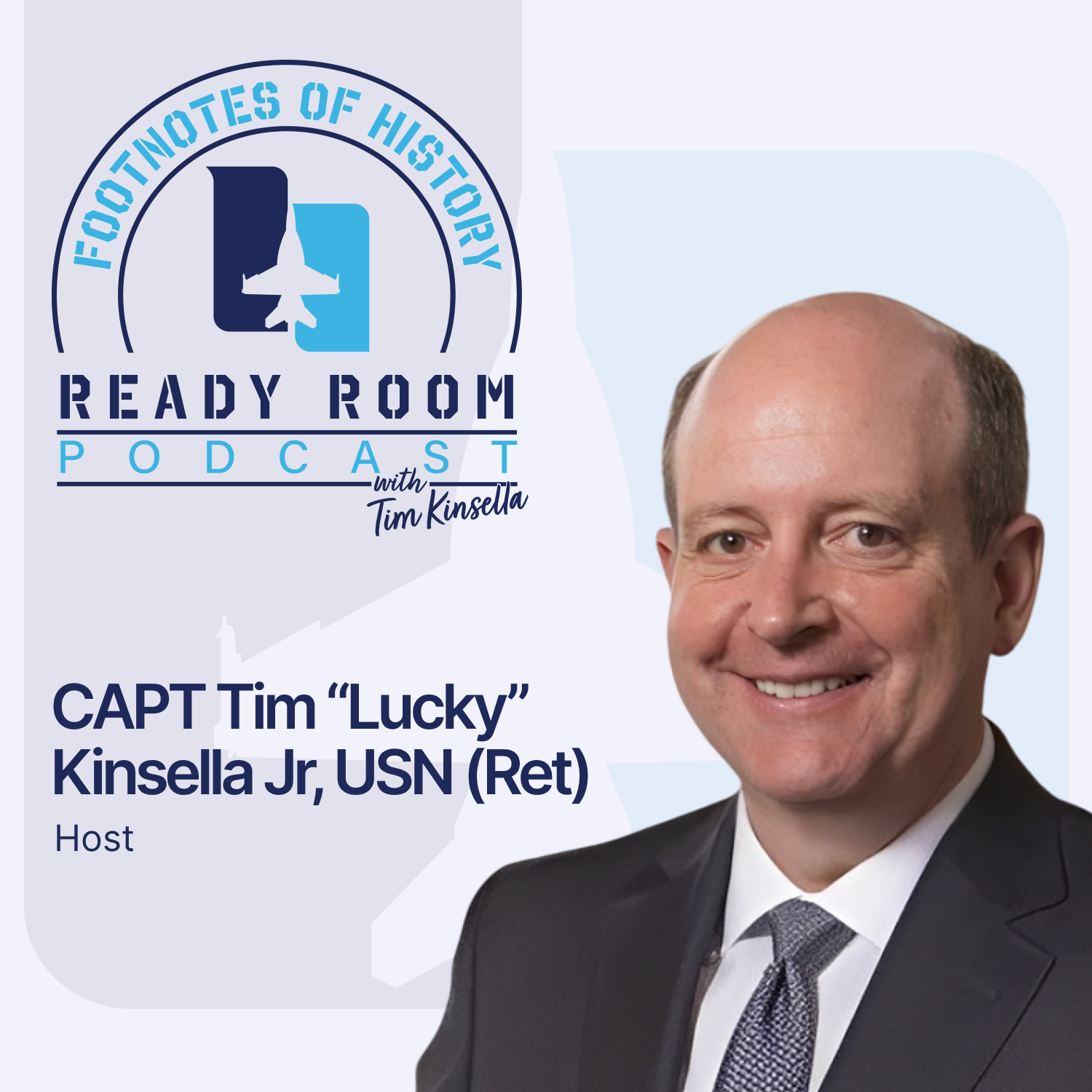
The Naval Aviation Ready Room Podcast with Legends and Leaders
A Navy for Two Oceans: How Congress Helped Win Midway
00:11:41
In this Footnotes in History mini episode of The Naval Aviation Ready Room Podcast, Captain Tim “Lucky” Kinsella, U.S. Navy (Ret.), tells the story of how a quiet congressional decision in 1940 helped determine the outcome of the Battle of Midway. The Two Ocean Navy Act was passed while the United States was still officially neutral. It committed the nation to the largest naval expansion in its history, not in response to an attack, but in anticipation of a war many feared was coming. Two years later, that decision shaped the strategic choices of both Admiral Chester Nimitz and Admiral Isoroku Yamamoto and helped tip the balance of the Pacific War.
Loading summary
Transcript4 lines
- [00:01]
A
Two years later, when Admiral Chester Nimitz sent three battle scarred aircraft carriers north of Midway Atoll to face the Kido Butai, which was the most powerful naval force that Japan had ever assembled, in fact, one of the most powerful the world had ever seen. Well, when that happened, that act of Congress was very much in the room.
- [00:23]
B
You know, the big battles, the famous names, the headlines. But what about the stories history forgot? I'm Ryan Keyes, host of the Ready Room podcast, and in this special series, Footnotes of History, retired Navy Captain Tim Kinsella discusses the obscure, the overlooked, and sometimes downright unbelievable chapters of military history. Here's lucky.
- [00:47]
A
A Navy for Two Oceans, How Congress helped win Midway. If you were an American in the summer of 1940, the world would have felt like it was coming apart at the seams. France gone. The Low Countries, gone. Britain hanging on by its very fingernails under the leadership of Winston Churchill. And the United States officially at peace, technically neutral, but emotionally deeply, deeply anxious. And yet, in July of that year, Congress passed what was then the largest naval expansion in American history. It didn't happen during a war, not after an attack, but in anticipation of something dreadful. And it had a wonderfully blunt name, the Two Ocean Navy Act. Now, that doesn't sound dramatic, it doesn't sound romantic. It doesn't sound like something you'd make a podcast about. It sounds like something you'd find under a subheading in a filing cabinet. But yet, two years later, when Admiral Chester Nimitz sent three battle scarred aircraft carriers north of Midway Atoll to face the Kidu Butai, which was the most powerful naval force that Japan had ever assembled, in fact, one of the most powerful the world had ever seen. Well, when that happened, that act of Congress was very much in the room. So this is a story about how wars are often decided by before anyone starts shooting. And how an act passed in Washington helped make one of the most audacious naval gambles in history not just possible, but rational. So for decades, American naval planning, it rested on a very comforting assumption, and that was that the United States would only ever have to fight a war, at least a naval war, one war at a time. That meant one ocean, one enemy, and one decisive theater culminating in one decisive battle. That was very Mahalian. It was right out of Alfred Thermahan's book, the Influence of Sea Power in history. But by 1940, that assumption had collapsed. Germany's blitzkrieg through Europe wasn't just a military shock, it was a strategic earthquake. Because if Britain fell, the United States faced A nightmare scenario. Hostile Europe, dark, dominated by Germany, and an expansionist Japan in the Pacific. That meant two oceans, two powerful and ruthless enemies, but with only one navy. And suddenly, the math didn't work. And this is where two men step into the story who rarely headline war histories. Two politicians enter. Senator David Walsh of Massachusetts and Congressman Carl Vinson of Georgia. So Walsh, he was chairman of the Senate Naval Affairs Committee. He, he was cautious by nature. He certainly wasn't a warmonger, and he was not an alarmist. Very stoic, very stead. But Europe's collapse, it shook him. He warned the Senate in 1940, the oceans are no longer moats, they are highways. And they can carry enemies as well as commerce. Carl Vinson, who would later be called the father of the two Ocean Navy, he was even more blunt. Vincent believed in preparation the way other men believed in gravity. He once put it this way, the time to build a navy is before war breaks out, not after. So they understood that if America waited until it was attacked, it would already be too late. So they did something very unfashionable. They asked Congress to spend billions during peacetime on a war that hadn't started. Now, hovering just behind all of this was President Franklin Delano Roosevelt, a figure that should be familiar to all of us. So while Franklin Roosevelt didn't write the Two Ocean Navy act, technically, no one doubted whose fingerprints were all over it. You see, Roosevelt had been Assistant Secretary of the Navy during World War I. He followed naval affairs obsessively. He understood shipbuilding timelines in painful detail. He knew how long it took to build a ship. He knew the manpower it took. He knew the industrial might that was required to build a fleet, the that America needed. And privately, he was convinced that war was coming to America. Publicly, however, he had to be very, very careful because the country was divided. We may not think of it now in hindsight that everybody in America was behind our entry into World War II, but that wasn't the case. Isolationism in America was a very powerful force. It was led by an American hero, Charles Lindbergh, the first man to fly solo across the Atlantic. And also in 1940 was an election year. So Roosevelt, he didn't shout, he didn't scream. He didn't try and bully his way through. Instead, he used his famously magnetic personality to nudge, to frame a picture and to reassure doubting lawmakers that this was the right thing to do. In fact, this was the only thing to do. In his message to Congress, he said, we cannot base the defense of the United States on wishful thinking, with little debate or dissent. Thanks to his cajoling, and thanks to the work by Senator Walsh and Congressman Vinson, the bill was signed into law by Roosevelt on July 19, 1940. And in so doing, America had chosen its path. That act authorized 18 aircraft carriers, seven battleships, 27 cruisers, 115 destroyers and 43 submarines, all at a cost of over eight and a half billion dollars, which was an enormous sum way back in 1940. I mean, we can't even get one aircraft carrier authorized. But nowadays, imagine trying to do 18. Most of the ships authorized in the bill, they wouldn't arrive until 1943 or later. But the certainty that they would arrive, it changed everything. By the spring of 1942, both sides understood the same truth, that the war was a race, a race against American industry. Admiral Isoroku Yamamoto understood this better than anyone in Japan. He had lived in the United States, he'd studied at Harvard, and he was a naval attache at Washington. So this was his job. It was his job to know American industrial might. He had studied American production intimately, and he knew all about the Two Ocean Navy Act. Japanese intelligence had also tracked US Shipbuilding closely, and Yamamoto knew that these ships were coming. And he knew. He knew in his bones that Japan could never, ever match America's industrial might. His famous line about awakening a sleeping giant. It may be disputed word for word, but the sentiment was absolutely real. Yamamoto wasn't afraid of the US Navy as it existed in 1941. He was afraid of what Congress had decided it would become. That was the entire premise behind the attack on Pearl harbor. The to knock out American sea power in the Pacific and win the war before hundreds of warships started coming down the slipways of American shipyards. That's why Midway mattered so much to him. The goal wasn't just a tactical victory. The Japanese had to finish the job that they didn't finish in Pearl harbor and knock out the carriers they failed to get. It was to win the war early, before American shipyards could roll out a constant stream of naval might. For Admiral Chester Nimitz, the brand new commander of the Pacific Fleet, the logic ran in the opposite direction. When he took command right after Pearl harbor, he inherited devastation, defeatism and chaos. But he also knew something very, very crucial. You see, Nimitz had spent a lot of time in dc. He was the head of the Bureau of Personnel at the Navy Department in Washington before going out to the Pacific Fleet. So he was intimately familiar with the politics of Washington. But he also knew something crucial. The mighty Essex class carriers were already under construction, thousands of pilots were in training, and shipyards were expanding at a dizzying rate. And importantly, Congress had already accepted the cost of a long war. They were in it for the long haul. So when intelligence revealed that Yamamoto's plan to strike Midway, Nimitzi faced a choice. Hold back and concede the initiative or commit nearly everything that he had. So he gambled. But not because he was reckless, but because the nation had already decided it would not quit. Nimitz knew that if he failed at Midway, that he would have the might of American industry right behind him. He knew that American ships would be coming down the slipways to replenish what he had lost. But if he lost, he would also lose the initiative. Now, at Midway, American pilots, they paid a terrible price. But in a handful of minutes, the pride of the Kidu Butai were raging infernos destined for the bottom of the ocean. The Kaga, the Hiryu, the Akagi and the Soryu. Four Japanese carriers destroyed that Japan could not afford to lose. The Japanese would never have the initiative in the Pacific again. The race against time it was over. By 1943 and 1944, the promise of the Two Ocean Navy act had arrived with a wallop. The American fifth and seventh Fleets, the largest naval forces ever assembled in the history of mankind, would inexorably move westwards across the Pacific, crushing everything in its path. Essex class carriers overwhelming task forces. And losses replaced again and again and again on that conveyor belt of American industry. The Japanese just couldn't keep up. Their pilots would stay in theater until they lost their lives. American pilots would go out, they'd servitura duty, and then they would come home again to train new pilots. It was a constant stream of replacing lost pilots and repairing battle scarred ships and aircraft. Now this wasn't improvisation. It was the delayed impact of a decision made back in 1940. The Tuotia Navy Act. It didn't fly planes, it didn't sink ships. There wasn't anything romantic, but it ensured that courage would not be wasted for lack of preparation. At Midway, sailors and airmen fought the battle. But long before that first aircraft launched into the sunrise against its Japanese carriers, the United States had already chosen. Through Walsh, through Vinson and Roosevelt, they'd chosen not merely to fight a war, but to endure one. So friends, that's it for today. And as always, thanks for listening. And until the next time, thanks for joining me. As we explored the part of history that happened before the, the history everyone remembers.
- [11:24]
B
Thanks for tuning in to the Ready Rooms miniseries Footnotes of History hosted by Captain Tim Kinsella, where you experience the obscure, the overlooked, and often unbelievable chapters of military history. Don't forget to like, subscribe and leave a five star review. Fly Navy.