← The Naval Aviation Ready Room Podcast with Ryan Keys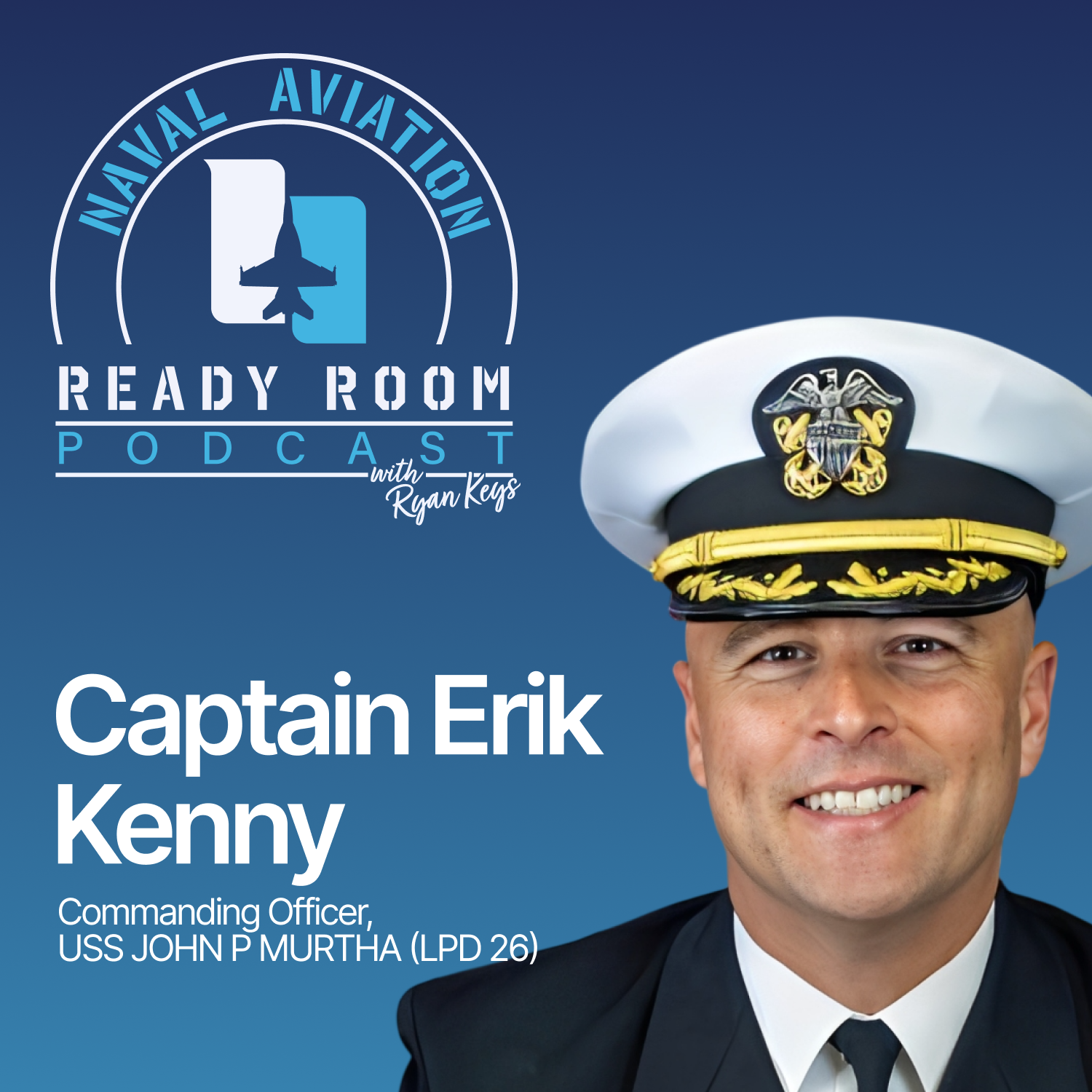
The Naval Aviation Ready Room Podcast with Ryan Keys
Artemis II Recovery Mission with the USS John P. Murtha | Capt Erik Kenny
00:56:25
Loading summary
Transcript110 lines
- [00:00]
A
We went ding, ding, ding, ding. Integrity arriving because they named the capsule Integrity and it was awesome. That's where you saw the astronauts kind of sitting on the side of the helicopter dangling their feet and they broke on this huge smile.
- [00:13]
B
X ray 1. Radio check.
- [00:14]
A
1, 2.
- [00:16]
B
Welcome to the Naval Aviation Ready Room podcast where the stories, leadership and leading edge technology of naval aviation come alive. Hosted by retired Navy Captain Ryan Keyes, this podcast takes you beyond mere museum artifacts as he delves into the personal stories, pivotal decisions, and state of the art hardware that define the world's most prolific aviation force. Today's episode takes us into the intersection of naval aviation surface warfare leadership and the evolution of command at sea in today's Navy. Joining us in the ready room is Captain Eric Kinney, Commanding Officer of the USS John P. Murtha, LPD 26, whose career spans both high performance aviation and large scale maritime command. Eric began his career as a naval aviator, rising to the ranks of strike fighter community and ultimately the Strike Fighter Squadron 14, where he ultimately served executive officer and commanding Officer leading one of the Navy's frontline strike fighter squadrons through demanding operational deployments Board selected for the AVN pipeline, Eric completed the Navy's rigorous nuclear power school, expanding his technical expertise and leadership capabilities in one of the most demanding training environments in the fleet. After a successful completion of Nuke power School, Eric became the Executive Officer of the USS Carl Vinson for two years and then is now currently serving as Commanding Officer of USS John P. Mirth, an amphibious warship capable of projecting power, transporting Marines and supporting global operations from the cockpit of a strike fighter to the bridge of amphibious warship. Eric's journey reflects adaptability, leadership under pressure, and evolving demands of modern naval command. Eric, welcome to the radio room.
- [01:50]
A
Thanks, Ryan, for having me.
- [01:52]
B
This has been a scheduling challenge because this is probably the most famous Navy captain right now. Actually everyone is coming to meet him and shake his hand due to the command, his current command of the MRTHA that recently picked up the Artemis 2 mission astronauts off the Pacific off San Diego. We'll get to that eventually. But really, let me just harken back real quick as to how we connected. So you were Naval Academy roommates with Alex Armitas, Right? Former seal. The Blues. Now close.
- [02:22]
A
We were classmates. We were flight school roommates.
- [02:24]
B
Oh, flight school roommates. Got it. Flight school roommates who is currently Deputy CAG for CAG 7 on the bush. Yep. And so Eric reached out to me and said, hey, I think I might have maybe a compelling story, which is actually very compelling. I just Want to give some people some background if they didn't know this? Because a lot of people are surprised by this when I talk to him here at the museum. Every aircraft carrier in the United States Navy is commanded by either a naval aviator or a naval flight officer. And it could be any one of those. It could be a strike fighter pilot, an E2 pilot, E2 NFO, a growler, NFO, a helicopter pilot. It's a myriad. But it has to be a winged aviator of some type. A lot of people don't think that. They think they're surface war crossers because it's a ship. Not true. Because it's a naval aviation capital ship. So part of the process is once you're a commanding officer, your name gets essentially put in at a board to be selected for the nuclear power pipeline. Some people have trepidation when that happens because they know that they could be picked for that when maybe that's not what they wanted to do. Right. I want to be a pilot or I want to fly whatever it is. Aircraft Carrier command wasn't really in my sights, where some people are 100% bought into it, right. They'll submit what's called a pick me letter and say, yeah, hey, I want to do this. And they're full in. But the reason Eric's story is so great is that I don't think it's a secret, is that, you know, he had trepidation when he was selected for this pipeline. I know personally have friends who turned it down. And I was like, no, thanks, don't want to do it. And you're essentially taking yourself out of the running for major command at that point of something else. But Eric decided to jump right in and join the nuclear Navy. So that's what we're going to chat about right now. So enough of me. Eric, over to you. But I do want you to start with kind of your evolution, though, from graduation, flight school a little bit, and talk me through kind of your career progression a little bit before we hit the nuke side.
- [04:20]
A
Absolutely. Yeah. So I think very standard progression, you know, post graduating from the Naval Academy, go to flight school. I did get a chance to go to grad school before flight school. Fortunate to have that opportunity. Went to the University of Maryland and got a business degree, but then went to flight school. You know, normal through there, get to my JO squadron, VFA 25, the Fist of the Fleet. And I think I was very fortunate to have some phenomenal leaders in that squadron. But then my CAG and my CAG Specifically, I had Animal Williams and Rhett Butler, who literally were giants in the Air wing and the entire squadron, the Air Wing. And this happened throughout the rest of my career too, really up through kind of command. You know, when CAG walks in the ready room, you know, everyone stops over what they're doing. Hey, CAG can get you a cup of coffee. We're going to get a jet for you. It's the, you know, the best jet and the best parking spot. And, you know, everyone is just, they were amazing people. They're falling over themselves and take care of cag. And, you know, that changed a little bit throughout my time in naval aviation. But for the most part, I think that holds true. Everyone kind of knows when CAG walks in the red room. So to me, just as a young jo, like, that's something I aspired to be. If I was going to hang in the Navy for a while, I want to be this guy. I mean, someone that is, you know, revered in the air wing. And they were good at their profession and weren't just good, they were great. They were inspiring. All these things that to me, were very important as a young jo. Conversely, everything that was wrong with naval aviation was the carrier's fault. You know, it was the big XO's fault, the captain of the ship's fault. And anything that we complained about, we had an easy target and we pointed at the ship. Some of it was probably true, some of it probably wasn't true. But as a young, impressionable jo, that was very impactful on me. I didn't even realize at the time, right. But I want nothing to do with the ship. I'm a fighter pilot. You know, that's my Persona. Now fortunate enough, I get to get picked up to go to Top Gun. I graduate from Top Gun, go back to the FRS as the SFTI there
- [06:09]
B
at 106 or 122.
- [06:12]
A
So initially 125, the Legacy Hornet FRS on the west coast. And while we're there, we merge with 122. So actually scribe and I link up again there. We actually were Jos in the same air wing together, but we link up again as the SFTIs together in 122. We spend our careers are together pretty much the whole through, but I'm at 122 and you talk to FRS Paddles and every successful CQ debt was because of the great work of the phenomenal FRS paddles that go out there and do great work. Every unsuccessful FRS EQ debt was, you know, the boat screwed us the captain wouldn't work with us. Right. I mean, again, all like, influencing, like, under the hood influenced my opinion of the AVN pipeline. You know, move forward, become the training officer, VFA 151. The vigilantes. I relinked with Rooster Loughran, who was my department head when I was a 50. He was now the CEO of. He's a phenomenal leader and great mentor of mine. And nothing's really different there. We get extended. A couple times I learned something that's going to play out in New Power school a couple years later. Rooster tells me as I show up, he's like, hey, this is going to be the best deployment ever. We can't extend because we got to go in the yards or running out of nuclear fuel. We get out there, it's like, we're extended. I'm like, what happened? I thought we had run out of nuclear fuel. Turns out we could change the denominator a little bit and it's all safe. But at the time, I didn't understand how that worked out. My wife is hard to explain. I thought you weren't going to get extended. Well, we got extended like four months.
- [07:33]
B
That's foreshadowing.
- [07:34]
A
Absolutely. Yeah. But again, you know, kind of feelings there. Go become a department head in VFA 14. The top hatters there. I get to work with Dietle Duff as my commanding officer at the time. A great American, just someone that I look up to in so many ways. And he's the first one in my career path that gets selected for AVN that I'm close to, that I understand. And I remember thinking like, poor guy, he's gone. Or I don't know what he's thinking, what he's doing, but just I kept an eye on him. And he's a very close mentor of mine. You know, we talk throughout the process and still think that he was crazy for selecting that he put a pick me letter and that's what he wanted to do. I'm like, I can't believe he did that. But fast forward, I go to joint staff, Pentagon, J8, do two years there, kind of outside of naval aviation. And I realized there that if I'm good at one thing, I'm bad at another thing. I'm good with people. I'm good at operational problems. Operational chaos is like my expertise. I'm not good at policy. I'm not good at staff work, to be honest with you. It was the first time, you know, I was talking to Dietle. The AVN pipeline. While a lot of sea Time is there. There's not a lot of staff time there. And there's a lot of an opportunity to make difference in people's lives. Take maintenance, problems, people problems, the things that I actually enjoy about the Navy, and keep doing that in a larger and larger scale, but I'm still like, no way. Not going to do it. Can't do a deal. No. Sorry, CAG is it. That's my game plan. So get to my XOCO tour, which
- [09:00]
B
is not a small thing in of itself. I mean, being selected for command in the strike fighter community. I've sat on command boards before, and I mean, it's psycho. I mean, 20 selection rate out of the whole group, you know, of people who get to go. So, I mean, that is an achievement in itself. There's sometimes the ultimate level for some people, ultimate goal for some people.
- [09:19]
A
And that was partially my plan, too. Like, I got to go command, go back to the Top Adders. I always say I didn't do well as a department had. I got to re. Fly and go back and try it again at the top Adders.
- [09:29]
B
Yeah. Do over.
- [09:30]
A
Yeah, exactly. But Top Hatters, you know, the history. They were founded in 1919. The oldest squadron the Navy. There's just so much history. There's so much amazingness. I was there for the 100th anniversary. We did it down there in Pensacola. And the museum. Vice Admiral Carter, then the superintendent of the Naval Academy, former CEO of the Top Adders, came as our guest speaker. I mean, everything about that tour was everything I ever wanted to be. I bleed Top Hatter black and red. It's a squadron that will be with me for the rest of my life. And people always joke I still bring my top hat with me everywhere I go, you know, bought a lot of events. I will never let that go.
- [10:02]
B
So I'll show you how old I am, is that. My first two deployments were in CAG8, which had VF14 and VF41 when slap shot was the CO of 14. And then they transitioned, right, left. CAG8 actually moved from Oceana out to Lamore, transitioned to Rhinos and then became Strike fighter squadrons. And then Slap Shot actually was the Strike Group Commander when I was skipper of HS11 on my deployment in 2012. So. Yeah, and he's a great guy, so great connection.
- [10:34]
A
Yeah, I never met him before. I never met him afterwards, but he was a great speaker that day. And, you know, long line there of great commanding officers.
- [10:40]
B
That's awesome, man. Yeah, you're part of that history. Your name's on the wall.
- [10:43]
A
It is. I'm far from the top of it, I promise you that. But yeah, some great guys ahead of me. But on that deployment, you know, I went up to the bridge every once in a while. Let me just see what's going on up here. What's all this like AVN talk about carrier CO talk. And it was a little interesting, but not enough still to the point where I do not have a fit rep in command and what that says, you know, recommend for avn. Because I was dead set. I was afraid if I put that on there I was going to get picked up for the AVM pipeline. I was pretty dead set on being a CAG as we get near the end of that tour. I'm actually trying to make a play at that time to be the FRS co because I think that is in the VFA community, the most impactful job you can have. You have both incoming CAT ones as well as a huge cadre of junior officers that are on the fence of staying and getting out. And you can really turn the needle there on where naval aviation is going. So I really thought that was an important job. But that made me getting lined up with that made me nuke eligible at that time. And I remember I CAG talking to me and he's like at that time it was Gump young was the first 43. We got a lot of great classmates out there, man.
- [11:41]
B
Class of 95, man telling you a lot of great dudes.
- [11:44]
A
Yeah. You know, Gump tells my CAG at the time Cruiser Christie, does he realize he's going to be nuke eligible? I'm like yeah, yeah, yeah, that's fine. But I know they need an F R S SEO I know this is going to work out great. And long story short, board meets and I get picked up for AVN right away. I get a lot of congratulation phone calls, my wife's crying in the background, my kids are crying in the background. I don't know.
- [12:04]
B
Tears of joy?
- [12:06]
A
No, not so much. I'll be honest with you. Right.
- [12:08]
B
Because you've been downplaying it the whole time, right?
- [12:10]
A
Yeah. I mean I didn't think it was a real option. I was like, hey, this could happen. But I'm pretty sure like if we're going to get selected for something here, it's going to be that for our CEO thing or we're going to go to D.C. and do some Pentagon job. This AVN thing like eh, don't worry about it. Well, time to worry about it right? And it was tough. It was a tough decision. Right? But I don't know, maybe it's like the deep rooted Naval Academy midshipman side of me. At some point, you know, my wife and I sit down after, we kind of like calm down that weekend, and I'm like, you know, who am I to turn down an opportunity to command a capital warship in the United States Navy? If they're giving me that opportunity, like, I think I need to do it. One of my old mentors had once told me, like, you ever have the opportunity to command, you never pass it down.
- [12:48]
B
No matter what it is.
- [12:49]
A
Absolutely no matter what it is. It doesn't matter if it's a minesweeper, if it's, you know, Special mission command or whatever it is, you are going to make a difference in people's lives. So long story short, I said, okay, hey, let's go do it. And that kind of takes me to the doorsteps of nuke power.
- [13:04]
B
So other than to deal, did you talk to any other one who was in, like, who had been selected like the year before you? Another strike fighter pilot who had gotten picked. So that's my first question. Then. The other one is, I mean, I know this may sound like a bad way to put it, but I understand you sold it to your family like, just that, right? It's like, hey, yeah, I feel this, and I wouldn't say ego, but it's an obligation. Right. I kind of felt the same thing too when I was like, for FRS and major command for the wing. It's like, I feel this obligation, have to do it. To be able to turn this down would just be not within me, within my heart to do that.
- [13:37]
A
I think that's selfish when people turn down personally, like, you're thinking about yourself and not your. The impact to everyone else. Yeah, maybe. I mean, I don't know.
- [13:44]
B
Yeah. So back to my first question. Yeah. So did you see writing on the wall to talk to someone prior to finding out to the board? Or was it like, oh man, I better start talking to someone now? And you had to probably make the decision within a week.
- [13:57]
A
Yeah, it was pretty quick. I can't remember the timeline exactly, but I mean, going into the board, I did talk to DL a few times, like, hey, if this happens, I just wanted to have a few more facts on how this is going to play out. He was in deep draft command at the time, commanding Mesa Verde on the east coast and LPD there. I actually went out to his change of command. So it's the first time I'd ever been on lpd. And I talked to Frosty Snowden, other good mentor of mine. Just a great person that I connect a lot with. Our personalities are very similar. So it was good to talk to him. I talked to Pete Reby, a 96 guy. Not a 95 guy, but 96 guy. He was another good influence. It was after I got picked up. He's just talking about. What I commonly heard from everyone is that Nuke Power School is going to be tough. That's an understatement.
- [14:40]
B
Oh, what was your major?
- [14:41]
A
It's quantitative economics. So math. It's like applied math. And people always ask, oh, I'm a history major. Like Nuke Power School. If you have the basic prerequisites to go, they will get you through. It doesn't matter if you were a 4.0 student at your college or whatever the base 2.0 student, whatever it is, it's going to be extremely hard. It's going to be difficult because of the rate at which it comes. The school portion is six months long. It should be in a probably two year program. But Navy just needs to get you out the door and get, you know, it's really a jos. They need to get moving, you know, after the fleet, we can't afford to give them two years. So it is something that it comes fast and furious. I commonly joke I'd rather go to Sears School for six months than back to Nuke Power School. But I mean, it was tough. I'm telling you, it's hard. But the common refrain I heard from everyone in the fleet that was ahead of me, especially the guys that just got there, like stick Thompson, C.P. jackson, all these just great guys that I'd known throughout the VFA community, they're like, yeah, man, it's tough, it sucks, but it is completely worth it when you finally get to become a big xo. And at the time, again, just the trepidation I had with the whole program was like, I don't know if they're actually right or what they're doing now is just better than Nuke Power School. So anything is better than Nuke Power School at that rate. And I tell this to people because, you know, people are scared of the new Power School aside, they are there to work with you. I promise you they will get you through. It's going to be hard. But the things that we're the most proud of in our lives are the things we've worked the hardest for. I mean, look back at anything you've Done. Right. And I put new Power school near the top of that list.
- [16:08]
B
Did you run in Trevor Prouty at all Mensa while you were going through a new power school?
- [16:12]
A
Yeah, Trevor was just one or two classes behind me. We were in Charleston together. Mensah. He's a wicked smart guy. It's hard for everybody.
- [16:18]
B
Yes. He and I know each other really, really well. He did work hard. And so, you know, it is not just sitting there and crunching numbers and learning about the nuclear cycle or steam cycle or whatever it is. I mean, you are standing watch, right, at an actual nuclear reactor with sailors who are qualifying as well in order to go be nuclear qualified sailors in the fleet, on submarines or on aircraft carriers, as well as junior officers who are going through the same thing. It's this big team concept. You're like standing watch it like midnight doing that, right?
- [16:48]
A
Absolutely, yeah. So the nuke power like pipeline portion of it is. It's six months of academics, just straight academics, five days a week, taking a test every week. And it's tough. You know, I put in a lot of hours in that Rickover building. When you graduate from there, you go to prototype, which for the JOs I think is like 22 weeks for the were commanders generally at that time. For the commanders going through, it's about 17 weeks, a little bit shorter. But it is 17 weeks of we're standing watch on a submarine there in the Charleston harbor there on whatever river that's on Goose Creek. Yeah, that sounds right, Goose Creek. And we are standing watches just like the enlisted sailors, just like the ensign and jgs. And that was all in the Rickover model. I mean he wanted us, he wanted everyone in the Navy nuclear power program to not just have the academic rigor to understand and run nuclear reactors, but understand all the watches, stand all the watches, like know what your sellers are doing, become an absolute expert at the nuclear reactor. Now I would argue, you know, I don't think anyone will ever be a full expert, but I mean that is the goal is to continue to drive and learn everything you possibly can and also how to leverage the people around you. So when, if you don't know something, you speak up, ask for help and get it going.
- [17:54]
B
I mean because when you are on the carrier, said skipper XO or the captain and the XO are both aviators and with the nuclear power school, but then you have a reactor officer as well who's normally an O5 swo 06. Oh, okay. Who has had command as well of a non nuclear powered ship. And then they become a RO reactor officer and they lead the reactor department and kind of run the system and are responsible for that department.
- [18:21]
A
You're right. Yeah. So the reactor officer, right. We had John Barrantos and Jamie Hopp. Jamie and I think are great friends, I'll say that at least. He may not say that, but he was the reactor officer on Carl Vinson with me. And he taught me more about Navy nuclear power than I probably learned in nuclear power school. He's just such a great mentor, great teacher. It's the finer points of just a little bit of the aircraft carrier stuff that, that you don't get in the books necessarily. And with just years of experience. He was a destroyer captain previously came on it's a spot promote to 06 for the reactor officer. So if they're not 06 and they show up, they'll be 06 when they get there. And they are just quickly talking about carrier, the way carrier runs generally. Say the EXO runs the flight deck in below the captain. Kevin runs everything obviously. Right. But the captain, you know, really takes care of what's going on the flight deck, you know, the overall operations of the ship and the reactor. So the RO and the captain are like tied together while I get involved, I stay informed. It is a very close relationship between the R.O. and the captain.
- [19:15]
B
Okay. I never heard that before. That kind of delineation. That's helpful. Got it. So let's go back to the board. Right. So when you're selected for the AVM pipeline, you're guaranteed three things, right? Nuclear Power School, XO of Aircraft Carrier and then Deep Draft Command. And then you actually go to another board inside that board, the waterfall as they call it. Because there's a pool of qualified people over here who have been XOs and deep draft command. There's only 10 aircraft carriers. And so yeah, I think it's like 20 to 30 essentially to choose from to fill those 10 slots. Because this is one of the things where you do not fleet up. So in a strike fighter squad and helicopter squad and naval aviation, I think destroyers does the same thing is that you become the XO and then after amount of time you become the CEO. Whereas in aircraft carriers you come in this way and be the xo, then you come out, then you come in and be the CEO this way and come out. That's not vertical, it's horizontal. So just to clarify that for people. So yes, you're guaranteed those three things. So you got the Carl Vinson as your XO tour and that was in San Diego as well, right?
- [20:14]
A
Yes, yep.
- [20:15]
B
Which is not bad. And especially from Lamour, not to have anything against Lamour. My parents actually were born and raised in Visalia, which is close to Lamour there. So I spent lots of childhood summers actually in the Valley Valley, San Joaquin Valley, which is great. But San Diego has its own kind of thing to it too, which is great. So you get the Carl Vincent and then you're going to be there, be the XO for two years. Heads and beds, all of that. And I'm sure I remember seeing the big XO run around with his hair on fire about stuff because like you said, you are essentially just day to day operations, you know, of the care, working with the operations officer and the strikeout and everything. And not even including having the flag officer embarked on on the ship as well. So tell me about your greatest time as the EXO and your worst time as the exo.
- [21:00]
A
It probably took me a while to get to the worst time because I'm truly someone that like moves forward. Like I don't dwell on negative things. And that sounds like a buzzable line, but it really is. It's my personality. But I will tell you so yeah, I will go to the big EXO job. All of I've really seen in my career are big exos that weren't having fun. And honestly, I'm not saying they weren't having fun, I just didn't see it. Right. And some of my big exoskeleton were not VFA background, so they didn't cross pollinate with the VFA community much. And I just didn't see it. So you know, I went in with the mindset of I want to go and I want to show people this is fun, I want it to be fun. I don't want to show them it's fun. I want it to be fun. I want to enjoy. I enjoyed my command tour so much in my O5 command. I wanted to take that and move it forward. So how did I do that? Well, I wanted to go from the airwing perspective. I wanted to fix all the things I complained about during my career. Right. You know, why are the bells going off all night long? Why are we making loud 1mc announcements all the time? And some of those things can't go away. But we made some real change. We've been talking circadian rhythm in the Navy now for about a decade. Well, if it's going to be a thing, and it really has to be a thing, right. We have to preserve sleep where we can, you know, there are times we've got to make announcements. There are things that have to happen. But some of those routine, you know, announcements, bells, whistles, we can probably start dialing that back. We can adjust hours in the galleys to make sure that people are getting fed, right? If they're not being fed, they're not getting taken care of. And just along with that is the opportunity in command. In O5 command, you've got 200 sailors that work for you and you get the opportunity to impact their lives as big XO, you've got 3,000 sailors on an aircraft carrier. And I, bottom line, a lot of stuff is big xo. And what I thought was really interesting, the difference between O5 command in a squadron and the 06 triad on an aircraft carrier is if you look at the Venn diagram of O5 command and squadron wise, the Venn diagram of a CO and exO overlap almost perfectly. Like there's nothing that the XO is doing, the CO is not doing. There's a few little things here and there's. But we were pretty much lockstep with everything. A carrier, the Venn diagram between CO and xo, I mean, they touch a little bit. But I was given so much autonomy. I mean, honestly, at times I thought too much autonomy to just run the ship. And I'm fortunate to have had two phenomenal captains that taught me really well. Slider, Miller, Gucci, Thomas, were. I always take carrier SEO as. As two jobs. One, run a nuclear power aircraft carrier and combat operations. And number two is train the xo. Those are two very important jobs. One is all encompassing of everything that goes into carrier aviation. The other one is, it is, you know, micro scale, making sure I understand all the. I mean, there are acronyms, there are things that I showed up to the aircraft carrier. I mean, I got sat through every meeting with a pen and would wear my pen out. What does that mean? What does that mean? What's it mean? And afterwards I go to Slider or to Gucci, like, what was all of that? You know, and they were great. They were me just a couple of years ago and they knew I didn't know any of that stuff. So just phenomenal teachers, you know, fortunate to have those guys. And then what it taught me, you know, if I'm, you know, we're fortunate enough to command an aircraft here is like, let your XO run like, you've been selected for this program for a reason is what they would tell me. And I embodied this. And it put pressure like Good pressure on me. Like, you've been selected to be here for a reason. Like, go, execute, right? Go make it happen. Run the ship. And the captain doesn't have time to do all of that. And honesty. He's worried about big problems, big operational problems. He doesn't always have time to get in the detail of some of the sailor ism things going on. He gets into some of it, obviously, but not always. So it was just an incredible feeling to like be given the opportunity to just run the ship. Like I said flight deck and below, like it was mine within like 90% of it, you know, I mean, obviously cabin's going to trump me on a lot of stuff or anything he wants to trump me on. But it was just, it was awesome feeling and the ability to just make people's lives better, like deciding when we're going to have liberty expire. You know, we always talk about Cinderella liberty, like, well, maybe we can do it at 07 the day we pull out a port overseas. We could do it, right? Prove me wrong.
- [24:42]
B
Some risk, but yeah, that's right.
- [24:44]
A
Yeah. So opportunity to do some of those things. And I think it worked for the most part there. You know, sometimes I got bit on it. But that's what leadership is. I mean, eat risk for your sailors, right? Eat the risk and take the lump on the head. And you have to know the risk you're assuming. Right. But it's fine. I'm okay with that. I'm okay with taking a couple lumps if that's making the ship better and the sailors better. And you know, ultimately that's how I felt. And I walked out of that big XO tour saying that was probably the best tour I've ever had in United States Navy. It's hard to surpass command. Command is in and of itself an amazing thing. But it's like one Alpha. I mean, it was that good. And it was just because of the feeling I got for making lives better, making Aval aviation better. It was great. Yeah.
- [25:23]
B
That's your personality, right? Like you said, you're a leader and you've probably wanted to go beyond just 200 people or inside the cockpit, right? So I mean that's. It was 14 single seat squadron.
- [25:32]
A
Seat squadron. Okay.
- [25:34]
B
And then doing that with a smaller group of a wardroom and now expanding, like you said, to this huge ship. Much greater leadership, you know, challenge. I remember one of my old, my first CMC at the FRS would say, I always asked him. So he was an air crew, 53 crewmen and made master Chief, I was like, why didn't you go, you know, do the. Not say normal route but become a maintenance master chief? Why'd you become cmc? And he said, because helicopters are easy and people are hard and he enjoys working with people. And I was like, man, that's such a great answer. I still use it today. So I'm going to take that one, though. I'm going to bother one. Eat the risk for your sailors. That's a good one. I like that. Sometimes it doesn't taste good, but sometimes it does.
- [26:11]
A
Yeah, it's worth it. I think it's worth. In the long run, for sure.
- [26:13]
B
That's great. So successfully complete that. And then that's step one, nuke power school. Step two, XO of a big deck or of a carrier. And then step three, deep draft command. And some historical context here again, real quick. So back when the Navy had oilers, ammunition ships, AES, AOs, AOEs, other replenishment ships that were commanded by the Navy or owned by the Navy rather than the USNS Maritime Force side, they would send nuke guys to that for their D draft command. Then we kind of shed that. And so there was this big question of, ooh, what are we going to do now with the nuke power guys? Again, their deep draft command. And so, oh, we're going to do LPD command now. And what's interesting is that some ships were nuke power or were not, and now they become nuke power. So you and I talked about. So Tugger Roach, so Tony Roach, he was another HSC guy. He and I were instructors together back in San Diego. And he was the second CO of Mertha and then the first exo. And so that's the way it happened back then when that ship came online and he was a nuke. And so it was just a deep draft or a major command for him. And then it transitioned into the nuke power world. And honestly, I don't know if all of them are. If every LPD is now nuke power or if it swaps between. Like surface warfare gets it sometimes, aviators get it sometimes LHAs. LHDs are kind of their own thing. MENSA is actually supposed to go to the. It's either the Woody Williams or the other ESB that's out there, the Polar, the Chesty Polar. And so there's that now, too. So it's all kind of weird. So when you did that, we were able to put in a preference and you're like, I want to stay in San Diego, so I want to you know, not have to move the family, which is probably a big thing. Right. And so now you put in for LPD command or whatever it was, deep draft command. So can you just talk about that real quick? And then we'll shift into command of
- [27:57]
A
that and even, like, talk about the selection to get to Carl Vinson in San Diego as well. You know, there's a lot of people in the United States Navy that think the detailers are out there to screw you over and make your life hard. I've had some great friends, Scribe being one of them. That was a detailer. Just a phenomenal people, I will tell you. They're not out there. They're not going to bed at night seeing, you know, how do I screw this person over?
- [28:18]
B
They have a hard job, man.
- [28:19]
A
Yeah, it's just a hard job. I will say with a very small AVN community that I'm a part of, they try really hard to make it right for us. I'm not saying everyone wins, but I. If I had to throw a number out there, I'd say like 70 to 80% of the guys are getting roughly what they want, location, platform, and they're working really hard. One really nice thing about the AVN community is that early in your exo tour, maybe even before you even get into exo, I found it a couple months after I got into exo, I found out what ship and location I was going to go to for deep draft. That was like two and a half years ahead of time. There's not many times in the Navy where, you know, two years ahead of time, where you're going to next. What that buys is just some stability for your family. Even if you have to move, you know, you're moving, right? It's not. You're not waiting to the end and then like, hey, do I have to move? I find schools. How's that going to work out? They slate you real early, which is, I think, a huge benefit to the AVM pipeline, especially, you know, guys my age probably have kids in school, high school. You're trying to balance all of that to have the knowledge of where you're going to go. To me is one of those things that's intangible to this pipeline that isn't highlighted enough. Could it change? Obviously, people get sick, you know, broken, you know, get fired or whatever. Like, the slate can change. It could always change, you know, but knock on wood, you know, it's been pretty solid for the past couple of years. The details are trying hard. So, yeah, so I put a Request in to stay in San Diego, mainly for my kids. There's ESPs and LPDs out of here. I really wanted an LPD personally because I really believe in their mission. And LPD is like the Swiss army knife for the Navy. It's got so much capability.
- [29:46]
B
Newer ships too.
- [29:47]
A
Yeah, new ship. The John p. Murtha turns 10 this year. So, I mean, so has a new car smell to it. Really?
- [29:52]
B
Yeah. And then I don't fleet up there, right? You come straight in as the CEO and you started that. Don't tell me. I think October of 2024, right, is when you came in as the CEO.
- [30:03]
A
No, I just took command like two months ago, in February.
- [30:05]
B
Oh, yeah, that's what I meant, man. Get my time's all off. That's right. Okay, so now my point was you come in now and you are thrust immediately into a high profile mission. And did you know about that prior how far in advance or before taking command, had you heard about Artemis or you got your first brief on it?
- [30:27]
A
Yeah, so I took command in February, I think probably in August or something like maybe last August. I heard that we were doing the Artemis recovery. I truly had no idea what that actually meant. I mean, I knew that we had to go pick the capsule up. I knew that and the astronauts. But historic nature of that was lost to me at the time. Honestly, up until about two weeks ago, it truly, like I did not think it was going to be as big of a deal as it has been. We'll probably talk about that in a second. But it was important mission. You know, it was high on Third Fleet's radar. When I came in command, we were at the top of the Admiral Wade Commander, US 3rd fleets tasking like we got all the priority. We have this like we call. We called the Artemis Halo over us. Something's broken. Money was coming. I'm spoiled now because if we needed it, we were getting it to make sure we got underway to recover the astronauts. But yeah, to answer your question, I didn't know. And much of that when I slated for Martha, it was only selected maybe a year or two ago. And I don't exactly know when we were tapped, but about a year ago is when they started the workups, the briefings and whatnot. My first real interaction was about two weeks before command because Artemis was supposed to occur before my change of command. It was supposed to launch in January and then February. And then as we got kind of into January, it looks like February was going to slide and there was talk of moving my Change of command. And as we talk about this, my only regret to the entire Artemis mission was that the previous commanding officer couldn't actually recover. I wanted it for him. I honestly did. He's a great guy, Ryan Billington. I wish he had got the opportunity, but it's just the way the nature of this, our timing works. I just step in about two weeks before command. It's obvious that I'm going to now be the commanding officer during the Armist mission. Fly down to Kennedy Space center, and I meet a lot of people, a lot of important people. The director of NASA Recovery is Lily Villarreal. She ends up on our ship through the whole recovery process. She's amazing. I meet the director of Kennedy Space Center, Janet Petro, and I say this one because this, to me, is where, like, my whole mind shift started to change. It's where I realized that it wasn't just another tasking that we get from Third Fleet. I tell her, I say, hey, ma', am, thank you so much for letting John P. M Be a small part of this massive Artemis mission. And she's like, let me stop you right there. There are three parts to Artemis. One, launch the rocket. Very difficult. Right. Two, the lunar mission, very difficult. Three, recovering the astronauts and capture. Very difficult. John P. Murtha is at the center of number three, that the first two go perfectly and we lose the astronauts or the capsule. It's a failure. The goal of getting to the moon and Mars will get pushed back years, decades if that part goes wrong. It was an immediately humbling comment, and it caged my brain right away that, hey, time to lock in. This is more than just another random Third Fleet task. Right. It's a big deal.
- [33:08]
B
Wow. Yeah. You went home last night, that night, and you're like, oh, I'm not gonna be able to fall asleep. And you're just sitting there thinking the whole time, oh, my gosh. Wow. And I mean to. You know, I think one of the things you do as a commanding officer is that when you come in and take over a command, especially if you're not the xo, is that you come in and you have to trust right away.
- [33:27]
A
Right?
- [33:27]
B
I mean, that's the linchpin of leadership, right? Is trusting your people, and it's a little bit easier. And you come in as the XO for 15 months, you take over as a CEO, you know, everybody now. And so a level of trust has been built up over time, whether it's through the example you set, how truthful you are with people, or honest about things, operations, you name it. A lot of stuff builds that trust. Now you're coming in this way to, let's see, 350 people on Martha.
- [33:53]
A
We have 396 right now, so 404, 20, I think, is our BAA or whatever we should have. Yeah, gotcha.
- [34:00]
B
Yeah. So you're coming right in. And your XO was a Swo.
- [34:04]
A
Yeah, 05 Swo.
- [34:05]
B
Yeah, 05 Swoo. Who's coming in there? And you, man, you're stepping in there and you have to immediately trust the crew, right? They've been through the training and everything, but. And they have to trust you too, right? To make the call, make the decisions, take input. So how did you feel about that when you stepped on board that first time and you looked around and saw all these sailors? And where was your level of trust at that time?
- [34:29]
A
Yeah, great point. The whole training track for LPD command, your concept right there is what I spent all my time thinking about. It'd be one thing even in a VFA squadron, if I just got thrust in as the co There'd be some nerves associated with that. But I've done all the jobs in a VFA squadron. I've been opso, mo, safety O, all the JO jobs I've done that. I understand that concept. To get thrust into an lpd, you know, in a community of which I had spent two days on LPD, luckily Noodle Ventomiglia and Stick Thompson, both AVNs who had LPD commands. I said, hey, can I spend a night out there with you guys? I just want to, like, not get lost the day I show up to take command. No, I know almost nothing about this ship. You know, the training track, which is there's. There's only so much you can get from the training track. Definitely I was nervous. All the feelings you can imagine. So what I emphasize to the crew, like, day one, I change of commands on Friday. Monday morning, I meet with the chief's mess, I meet with the wardroom, and I do an all hands call all on that same day. And my message is roughly the same. And I didn't say these exact words, but I portrayed the idea of. I think one of the most meaningful qualities of a good leader is vulnerability to admit when you don't know something. Like, it's okay that I don't know this. You know, I have a lot of experience in life. I have a lot of experience in the Navy. I generally can get a good idea what right looks like, but there are a lot of technical things on board this Ship that frankly, I may not know at all by the time I leave command, honestly. But I have to inherently trust, and I think that's a great thing. I actually just talked to the wardrobe about this after Artemis, about what trust means to me and what we are brought up in the naval aviation to just have such a clear understanding of. When you come to my squad as a new JO and I welcome you the squadron, I'm giving you the authority to take an airplane out and go do it. Go execute. Or with a, you know, enlisted seller, if I give them a CDI call, you know, they're going to do maintenance on something and be the collateral duty inspector. That is very important. And I don't go and double check your homework. Right. I'm assuming it's done right. That's a concept that is not everywhere in the naval community. I would say there's a lot of homework checking going on, but that is not how I lead on this ship. That's not how I'm leading in this wardroom. I inherently trust everyone. And, you know, Captain Billington, I think, did a great job of training up a great crew. And I think I'm really fortunate that I've got some phenomenal department heads. I've got a great xo. I think the bureau sent me there for a reason. They're like, well, this guy can't screw this up too much. We've got all these great guys around him. Whatever. I'll take it. Whatever reason.
- [36:47]
B
That's funny. This guy needs some hand holding, so we need to send them to this place. That's not what happens, everybody. So just letting you know, because of your past performance, people know that you will be able to go there and lead. Right? That's what you've proven your whole career. That's why you were picked. That's the reason why you were selected for it. And I used to, whenever I do welcome aboards, I tell people, look, you're an adult, I'm going to treat you like an adult. And as soon as you don't act like an adult, well, then I don't treat you like an adult anymore. And then the Aussie, the, The. The whole thing of, you know, fool me once, shame on me or you, and then shame on me the second time around. So, yeah, you have to have that trust and you'll hold people accountable when they break that trust. And that's what it's all about.
- [37:29]
A
Absolutely. Yeah.
- [37:30]
B
Okay, so it is kind of funny. So Eric and I were, you know, have been messaging each other for Quite a few weeks or something like that, trying to get a time slot for this. And I thought just randomly, that I would text him because I'm watching the live Recovery and everything at home on Friday night. And I just thought I'd just text him real quick. And I was like, hey, good luck, man. Hope everything goes okay. And then he sends me a text back. I was like, whoa. Wow. And that's how I know he sends me a picture. And then one of the things I talked about before is, so HSC 23 was the helicopter squadron. It's a West Coast Expeditionary squadron from Helicopter C Combat Wing Pacific, which is my sister wing from the one in Norfolk. And I know the CEO of HSC23, Ringelstein, as well, Kevin Ringelstein. Great guy. And so Eric starts sending me pictures, and I was like, oh, my gosh, this is like, live. Someone just took live picture off the ship. And he made the comment how? I was like, wow. So some carriers have WI fi on them, but I wasn't sure how many ships do. In the Navy, I kind of, you know, not around that anymore. I was like, wow, Surprised you have WI fi. I was like, oh, yeah, that's because of NASA. And so when NASA leaves, the WI fi will leave. But I'm glad you're able to send me some pictures and video of the helos landed on the flight deck. Astronauts getting out. I can tell you right now, I sent those to all my friends and totally just was like, hey, yeah, the CEO of the ship sent this, you know, to me. Like, oh, my gosh. Really? It's like, yeah, this is, like, real stuff. This is happening right now. So I can't thank you enough for doing that. And people love that, man. Great publicity for you guys. So what did you guys get underway and then, you know, the timeline. Did it all work out? I know. Like, everyone's like, oh, my gosh, is the heat shield going to last? Oh, my goodness. And then you got to get the divers out there. It was a long evolution, for sure. Do you guys get underway that morning or the day before?
- [39:10]
A
The recovery was Friday. We got her underway on Monday because we need to do some just Navy stuff on the front end. Just some basic phase events. We need to get knocked out. NASA was with us. They loved it. We. We had to do a raz. So, like, they're out there taking pictures. They thought it was the coolest thing they'd ever seen as before. So it's a replenishment at sea. Get ready to get oil or fuel for the mission, we did do like a gun shoot. So, you know, NASA was like, this is so cool, man.
- [39:33]
B
Are you doing this all for us?
- [39:34]
A
Yeah, right?
- [39:35]
B
This is so cool.
- [39:36]
A
Absolutely. That's why we're here. But as we roll up to Friday and I kind of walk you through the day, I think is a great way to look at it. So we briefed the day before. So going into, like the few weeks I'd been there previously and the whole command, otherwise we've been hyping the ship up, hyping, you know, getting everybody, hey, train. The way you fight. This is our why. And, you know, my message had been, it just, it was very simple. Let's bring them home, right? That was our goal. Let's bring them home. So that was our hype going all the way up until about 24 hours prior to splashdown. And I sort of changed the script on everyone. I said, okay, let's just really quick look at the Super Bowl. And there are two teams that go there every year. One wins, one loses. The losing team time and time again. The reason is they buy into the hype over the past two weeks, waiting for the super bowl to start, you know, hearing how great they are, hearing how awesome they are, and they go out on game day and they overperform or try too hard and then they don't execute what they just got them there in the first place. Say, hey, let's stop buying to the hype. Let's calm it down and let's just go and execute and fight the way we've trained. And man, they executed not perfectly, it wasn't perfect. We had made some mistakes, but, man, they executed professionally and precisely. And I could not have been more proud of how well the crew executed that day. We started by putting small boats in the water about noon that day. Six small boats probably saw them all. I won't go into all those details, but they got in at noon. We didn't recover them until 4 o' clock in the morning. So those guys were out there for 16 hours on those small boats. It was a hard day for them. Our deck team, the guys that move all the boats and pull the capsule in, I mean, they worked a very, very long day. You know, we talked about taking care of each other. Like some, you know, people take a knee when they needed to. There was opportunity to do that. We had a little depth on the bench, luckily, because we brought some extra sailors with us to have that depth. But it was tough. I mean, it was a hard day on a lot of People, you know, news coverage starts picking up, you know, pretty heavily around 3 or 4pm as the capsule starting to come in. I think I. We weren't really watching the news. We don't ever have the TV on the bridge. We added on this one day we did, because it was kind of. We're like, hey, there we are. We kind of see.
- [41:37]
B
Good call, Captain.
- [41:38]
A
Yeah, but, you know, we had a good idea what was going on. Tensions start coming up, and, you know, my message is like, hey, just relax. We know what to do. We're good. We feel the capsule with the sonic boom. We see the parachutes open up. Jared Isaacman, the administrator of NASA, the number one guy, he's actually sitting or standing right next to me on the bridge. It was very cool to kind of be with him and see what he was thinking about his concerns. And we get opportunity to talk about prior to splashdown. But he has this iPhone. It's like, amazing app that. It's like, talks to Houston, Kennedy, the astronauts in the capsule. I mean, everyone. And there we are. We hear the astronauts. They're safe. Splashdown. Like, everyone's celebrating. Now it's game on for jpm, for John P. Mirtha, right? It's time for us to jump into action. And our small boats go. They go start the recovery and get the astronauts out. And I'm going to butcher it. But the Navy divers that opened the capsule, they open the capsule, say, thank you for flying Artemis Airlines. Please stow your tables. And, you know, whatever. I'm butchering it. But it was so funny. Like, if you ever get a chance to talk to Navy diver that was there, it was great. They come out, they get them on the front porch. You saw the front porch. I won't, you know, beat that up as a big inflatable thing they put on the front of the capsule. HSC23 came in expeditiously and safely recovered all the astronauts and then brought them out to our flight deck. And this is one of those times of trust where, you know, as a captain, I should be on the bridge, but I turned to the officer of the deck. I'm like, hey, you got it? And I wanted to go back and see the astronauts land. So I think my officer deck, you know, appreciated that trust I put in him on that. I wanted to go back and physically see the astronauts touch down on the flight deck. We got him. We brought them home, man. Mission not accomplished at that point. But feeling really good about the mission success at that point, we shut down the helicopters. It's like, it's eerily quiet on the flight deck. It is near sunset. You don't make a movie better than what I was looking at at this moment. And then, in naval tradition, we rang aboard the mission commander, so Reed Wiseman, mission commander, so we went ding, ding, ding, ding. Integrity arriving, because they named the capsule Integrity. And it was awesome. That's where you saw the astronauts kind of sitting on the side of the helicopter, dangling their feet, and they broke on this huge smile. I got a picture of Vic Glover, the smile that he cracked as soon as we did that, man, it was awesome. And then Reed Wiseman as the first to walk in. As he's walking, you kind of see, like, the stumbling walk that he did. You know, their legs are tired. You know, they haven't. First time they felt gravity, you know, all that. And he just yells top of his lungs. Thank you, Martha. I don't think there's a dry eye on the flight deck. It was just an incredible moment. That was the. How amazing. This all was all, like, hitting me at once again. I did not know this was gonna happen to me. Like, the feelings I was having, the emotion, but it all kind of hits me right there and then. It was great, man.
- [44:14]
B
That dude, that's something you're never, ever, ever gonna forget. I mean, you're one of how many people who experience that ever in history.
- [44:20]
A
Yeah, it was incredible. You know, I flew F18s for 20 years of my life, and I've done some incredible things in F18. I never thought if you asked me at any point in my career, that the coolest thing I was in the Navy was going to be on a ship. I would have thought you were nuts. But I fell into this, right? I mean, for sure. I just share one more quick story with you. I know, I know we're kind of running out of time, but to me, this is the story we're telling, and this is nothing about me. This is just about how amazing those astronauts are. I don't need to tell people that. Everyone knows it, but I get the opportunity. About two hours after they come on board, they're in medical, they're getting poked and prodded. I call my senior medical officer, hey, can I come down? I just want to just, you know, welcome the astronauts aboard. I'm like, you know, fanboying over this. Like, it's so cool, right? So I go down there, I walk into medical, and my SMO says, all right, hey, captain's here. You'd just like to introduce himself to you or say Hi. And to each one of their credits, they all start getting out of bed, and the doc's like, hey, you can't get out of bed. You know, like, you're still getting poked from pride. And they're like, not me and the captain sitting down. It's an incredible feeling at that moment. And just a testament to their character as human beings. The four people that brought humanity together for just a few hours, a few days maybe, really. And who they are as. As people. It was just, to me, like, an incredible moment. And I got a chance to take a picture with them, and I said, what can I do for you guys? And their request was super simple. It was like, can we have some cheeseburgers, some hot coffee? We love the chance to talk to the crew and then maybe go out to the flight deck and take a look at the stars. So the cooks made some cheeseburgers for them, delivered them to astronauts. They will never forget that in their entire lives. They got on the one emcee and gave, like, the most impassioned. It was a short speech. The most impassioned speech. You don't get picked to be an astronaut based on your personality and your public speaking ability. But, man, they picked the right four. Right four. That's for sure. Those guys were just awesome. And then we went out to the flight deck, where this time the word had got out. The astronauts are coming out there. About 200 of the crew probably showed up. I authorized cigars on the flight deck.
- [46:09]
B
Man, that's great. Way to go again, Captain.
- [46:12]
A
Yeah. Yeah. The astronauts maybe had a couple. I don't know. I can't remember. They were allowed to or not.
- [46:16]
B
Naval tradition.
- [46:17]
A
Yeah, it was great. And because we had the NASA wi fi, our sailors were, like, FaceTiming their mom and dad and like, hey, Mom, I'm here with the astronauts. And the astronauts are talking to moms and dads. I mean, it was as awesome as you want it to be. If you wanted to write a script for it to be awesome, this was it. It was perfect. It was great. They spent the night. They flew off the next morning. And then after all the public impressed they did. But we had them for a couple hours and left such an impact on our crew. I. I can't be thankful enough for what they did. I can't be more proud of my crew. I can't be more proud to be an American. I can't be more proud to be a U.S. navy sailor. I can't be more proud of humanity for what we can do when we all Come together and work together. That's exactly what we did.
- [46:55]
B
Well said, my friend. That's fantastic. Great, man. You're glowing, you know, because of this. This is awesome. And I know this ever since I think it was Mondays when we're supposed to do the podcast in the afternoon, and you're like, the Padres are coming on board. And then the air boss just showed up, and then you've had thousands of people.
- [47:13]
A
Yeah. So again, we pulled in Saturday afternoon. Again. At this point, we didn't even realize how much this meant to the world, because we watched a little bit of the news, but we didn't get much news out there. We're working. We don't have time to watch the news. And we end up, you know, Sunday, we're starting to get. People just, you know, can't bring my family by, you know, here and there sort of get a little out of control. So I said, hey, we got to open it up. We're going to make some official policy. Howard opened up to the Navy community on Monday, and we put out a Facebook post on our social media saying that, hey, we're open from nine to three. Military families can come by and take a look at the capsule.
- [47:46]
B
Yeah. Because you guys still had the capsule that wasn't leaving until Tuesday.
- [47:49]
A
No, it leaves here in about an hour, actually. So it's Friday. It's been here all week. So 10,000 people came on Monday to take a look at the capsule and just get a picture of history, because it really. It's historic. And it was a huge amount of work on my crew to support. That was like sort of a fleet week without all the support that comes with fleet week. We just turned it on. Like, it would have been easy for us to just be exclusive with it and shut the ship down. But I thought the right answer was to share this with the world as much as I can. The story I'm telling you, I tell the story to anyone that will hear it. And this isn't because it has nothing to do with me. It has to do with the astronauts, the NASA team, the helicopter squadron, the medical, the divers. Just the integration, just the harmony is just amazing. We've been letting people on. I think by the end of the week, it's going to be up around upwards. Like 15,000 people have come on and take a look at this. It's been awesome. I told the crew, like, this is the cost of being awesome. And guess what, Eric Kenny isn't awesome. And no person on my ship is awesome. But the event that we Were part of was awesome. And it happened to be on our ship. So this is the cost of it, man.
- [48:49]
B
Like I said, memories forever. That's fantastic. So now plan is always normally two years in deep trap, but that can change.
- [48:57]
A
So it's about 15 months is the nominal 15 months? Yeah. For the SWOs in major command, it's 22 months. For AVNs, it's 15 months. That can flex either way, but that is what they target.
- [49:07]
B
Do you know when you get looked at then for CVN command?
- [49:11]
A
Yeah. So once you're in deep draft command, you're officially eligible for carrier command. So this October will be my first look. And then I don't get this October, then hopefully next October we'll see.
- [49:21]
B
Got it. So I'm not, I won't say the person name, but so I sat. I was an assistant recorder as a PXO on a major board and there was a helo guy, actually one of the first few helo guys who do make new command. But it does happen. And he had actually essentially put a don't pick me letter in between his deep draft and his carrier command because he just didn't want to continue. I don't want to put you on the spot too much there, but are you still thinking about wanting to go back to the boat?
- [49:47]
A
Yeah, I mean, sure. I don't not want to do it. We'll say that, right. I. I want to love this tour. And you know, I feel like this could be like a bumper sticker, but it's just the way I function. It's the same way I was in 05 command. It was the same way when I was a training officer in the viggies when I was a department head. You know, everyone said department tour was going to suck. It was to that point my favorite tour in the United States Navy. I loved my department tour. It, I think a lot of it. You know, I was fortunate to work for some amazing people. If I didn't work for some amazing people, that probably could have changed real fast. So I really just want to love this tour. I want to just focus on this tour. Yes, I would like to screen for carrier command. Yes, I would like the opportunity to go command a carrier. I don't expect me putting a don't pick me letter in. I understand there are people that do other people that did it this past year. It happens. It's rare, but it's hard in different ways. Right. Like back to what I said earlier. Some people are better at the policy side and some people are better at the people side and. And life gets in the way. And, you know, my wife, like most people's spouses, probably get a 51% of the vote if, you know, if I'm going to go on to carrier command. So it's a family affair. And I'm fortunate to have, you know, I would say the best spouse in all United States Navy who supports me through this. It's not without struggle. It's not without long nights of figuring how we're going to work, practice, pickup, and all those things everyone else deals with, like we're dealing with it too. But she's the reason I got to keep going.
- [50:55]
B
You know, I actually heard a great quote From a Army 3 star yesterday that said, service members serve, family members sacrifice.
- [51:03]
A
That's 100% true.
- [51:05]
B
Yeah, man, I heard that. I was like, man, how have I never thought of those two sentences before? But that's exactly what it is. He just put it so. Well, great call, man. All right, dude, one last thing. Like I said, I want you to talk about what you did at Lamore.
- [51:20]
A
Yeah, sure. So 2011, I was on the demo team at VFA122, flying around the country, doing air shows. Well, one of my best friends, Matt 11 Low then his wizzo at the time was Beefcake Williams, had an unfortunate accident and crashed and died in a demo practice. Extremely impactful moment in my life that, you know, I hope no one ever has to experience that. But as we all know, that's sort of the nature of our business. It could always happen at any moment. A year or so goes by and people start, like, forgetting 11 and beefcake. And it's natural. We all have to move on. We can't just sit there and wallow in our sadness. We have to move on. But I looked around Lamour and there's really no memorial to fallen aviators anywhere. And if you go to Oceana, you can't go, you know, 10ft without running into something or Norfolk or San Diego. There's a lot. I mean, there's something on every base except for Lamore. There's nothing in Lamore. And I said, we got to do something about that. So one of my best friends at the time, Ben, Julie Charles, another Naval Academy grad, literally drinking beers on his pool deck one night, we're like, and let's find a way to build a memorial. And two dumb pilots started a 501C3 with the help of the most amazing Americans you'll ever meet. Some locals out of Lamore, but name drop them Travis Lopes, Guy Bram, Charlie Meyer, the three of them, a whole bunch of other people, honestly, but the three of them, we start a board, we get help from a lot of different people. We Google bronze statue makers, I mean literally, and we call a bunch of them. We get like these outrageous quotes from a lot of different bronze statue makers. We find one that gives us like a really low ball quote. And we've seen some really bad statues look like some of the athletes have had statues made and they look really terrible. So I don't know what we're buying here, but we sign this guy up, he's going to do it for like cost because he believes in our mission. And then we go to Tail hook and set a little booth up and like ask for donations and we sell T shirts and we end up having some great success of raising money and people get behind us. And to me like again, it started back to like this whole Artemis thing. It started something for 11 and beefcake. In my mind it grew into something so much more. We got to meet so many Vietnam veterans in particular and one of the stats they gave, and I don't, I can't verify this out of his truth that more pilots died from Lamore in Vietnam than any other base in the US And I can't verify that. I don't know where you fact check
- [53:34]
B
that that makes sense. West Coast Master Jet base.
- [53:37]
A
Yeah. And I mean these guys in their 70s and 80s in full out tears hugging their spouses, had to meet Lieutenant Commander Marcus Oen's wife. We've named the Stochian award for the best VFA squadron every year after him. The Medal of Honor winner in just full out tears thanking us for creating this like it was something so much bigger than I ever thought it was going to be. We unveiled it in October 2014. The Blue Angels came and did a flyby. They happened to be at the San Francisco Air Show. We didn't line it up, but they believed in it. They came out, did a flyby, got some awesome pictures of it and it's there, you know, for everyone to go. And now it's actually on Google Maps. You can find that. It's on like aviator memorials there and it's outside the fence line so anyone can go. That was a name drop. Captain Monty Asherman was the CEO of the base at the time. Talk about eating risk. That guy ate a ton of risk. For Ian, Julie Charles to be able
- [54:29]
B
to make that thing happen, man, that's great. I'll tell you man, I think talking about that at the end, a great thing that came out of a tragedy. But I think that just goes to show you how impactful of a leader you have been throughout your whole career. And I know, dude, throughout your time, to be able to have O5 command successfully do that. And now what you've done up to now with Artemis, you know, kind of the. Maybe the. Maybe the bow on top. Maybe not. We'll see. So I'm impressed.
- [54:54]
A
Well, I will say real quick that, you know, people ask, is leadership learned or is it leadership? You know, are you born with it? It is learned. I've learned everything from the phenomenal people I've got to work with and work for in the past. They have formed me who I am. Admiral Manassar, I never worked for him. I love his book and he'll tell you that everything he's learned, he stole from someone else. And I'm exactly the same. Everything I'm saying and doing is all plagiarized.
- [55:17]
B
Yeah. Luckily, it's not copyrighted. So you're fine because I did the same thing, too.
- [55:22]
A
Yeah, for sure.
- [55:23]
B
I love that. All right, my man. Well, I know you have to leave to go to work on LPD 26, so, man, sure. It's going to be a gorgeous day out in San Diego.
- [55:33]
A
It always is.
- [55:34]
B
Yes, it is. All right, well, thank you very much for joining us today in the Ready Room. Eric, it's been a pleasure talking to you.
- [55:41]
A
Thanks, Ryan.
- [55:43]
B
Thank you for joining us on this flight through history and innovation here at the Ready Room. We hope today's episode inspired you with new insights and the incredible stories that make naval aviation so extraordinary. If you enjoyed the journey, be sure to subscribe, leave a review and share the podcast with your network. It helps us reach more listeners like you. Don't forget to visit the National Naval Aviation museum in Pensacola, Florida, or explore our online resources at navalaviationmuseum.org to dive deeper into the stories we've shared. Follow us on social media for updates, behind the scenes content, and a sneak peek at upcoming episodes. Until next time, thanks for listening to Ready Room. See you on the next flight.