← The Naval Aviation Ready Room Podcast with Legends and Leaders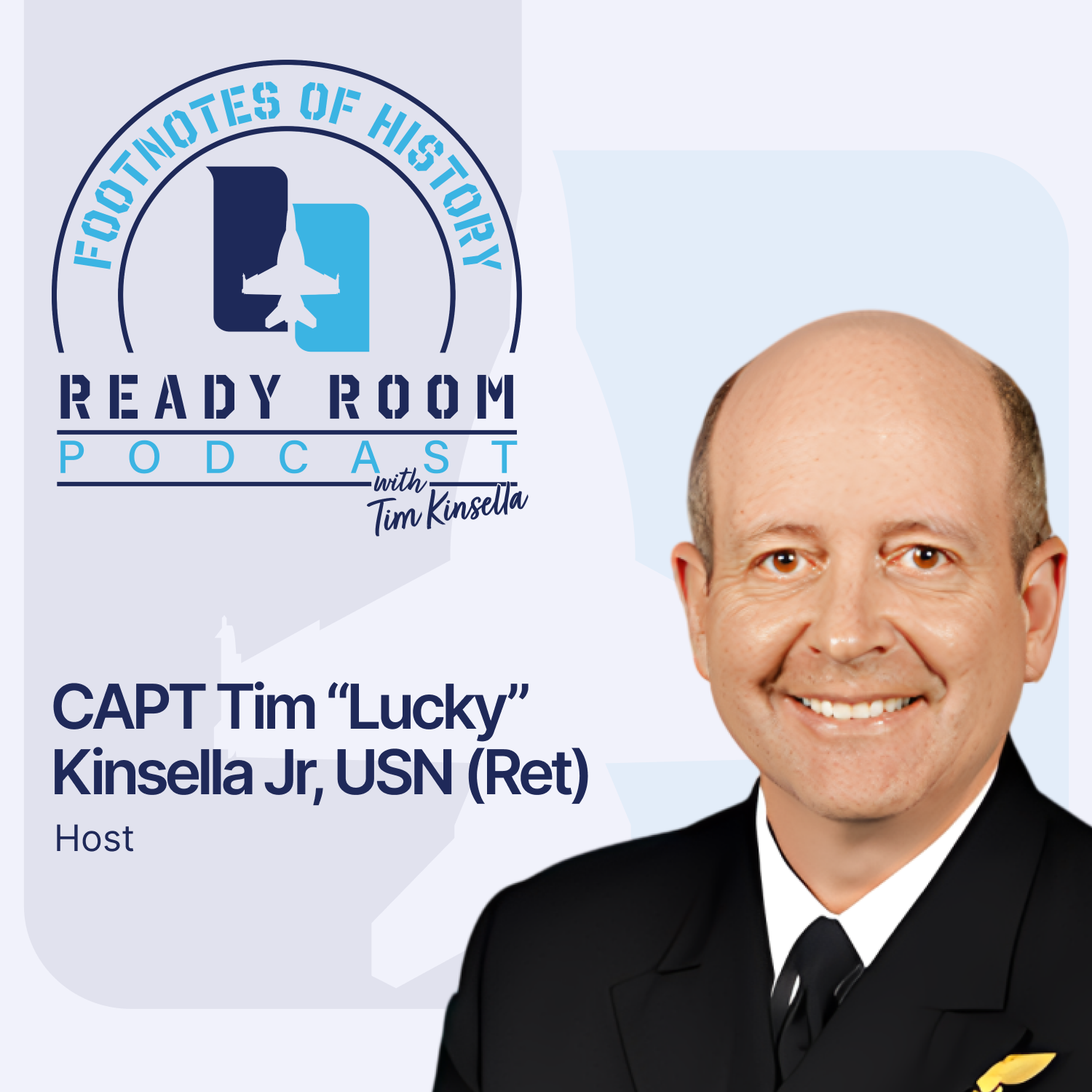
The Naval Aviation Ready Room Podcast with Legends and Leaders
Call the Ball: The evolution of the supercarrier
00:50:10
Loading summary
Transcript4 lines
- [00:00]
A
You're one mile behind a ship and you're already behind the jet. That's the first thing they tell you in the Navy's Landing Signal Officer School. You can never catch up to a carrier landing. You can only get ahead of it by thinking two or three moves in advance. Or you can fall behind it. And if you fall far enough behind it, well, let's just say that the result can be catastrophic. Not someday, but today.
- [00:28]
B
You know, the big battles, the famous names, the headlines. But what about the stories history forgot? I'm Ryan Keyes, host of the Ready Room podcast, and in this special series, Footnotes of History, retired Navy Captain Tim Kinsella discusses the obscure, the overlooked, and sometimes downright unbelievable chapters of military history.
- [00:49]
A
Here's lucky. You're one mile behind the ship and you're already behind the jet. That's the first thing they tell you in the Navy's Landing Signal Officer School. You can never catch up to a carrier landing. You can only get ahead of it by thinking two or three moves in advance. Or you can fall behind it. And if you fall far enough behind it, well, let's just say that the result can be catastrophic. Not someday, but today. The ship is a gray smudge on gray water and closing at 250ft per second. You're watching the ball, a small amber light on the port side of the flight deck, making hundreds of tiny corrections in pitch and roll and power every single second. Your instruments say one thing, your body says another, but your body's lying. Trust the ball. The landing area is slightly longer than a football field and slightly wider than a two lane highway. And it's moving, rising and falling and twisting in a mid ocean swell. And where it will be when your wheels hit the deck depends on wave patterns that started in a storm 3,000 miles away last Thursday. You have approximately 22 seconds from the start of your final approach to the moment you either catch a wire or bolt her off the end of the deck. In those 22 seconds, you will fly with a precision that no computer on earth until very recently could ever match. This is a story about human beings learned to do this. And it is a story about every single person who didn't survive teaching the Navy the lesson that made it possible. But before we can talk about landing on an aircraft carrier, we need to go back a bit and ask the question, why build one? Why spend all that money on an unproven, dangerous, controversial and highly unpopular piece of equipment? The battleship was the queen of the Sea. It had been the queen of the sea since the advent of the Dreadnought. Before that it was the 80 gun ships of the line. The surface navy is where every world power measured its strength. Every major navy in the world measured its power in battleships. In 16 inch guns, an armor plate and the terrifying weight of a broadside that could hurl a projectile the weight of a Volkswagen Beetle 20 miles at a target you couldn't even see. The Navy's admirals, they built careers around battleships. They had studied Mahan. They believed in big gun warfare the way clergy believe in scripture. Aircraft were toys, useful toys perhaps good for reconnaissance, for spotting the fall of shot for the big guns. But certainly not weapons that would ever threaten the capital ship. But not everyone agreed. The British had been experimenting with ship based aviation throughout the First World War. And by 1918 they had developed the HMS Argus, the world's first flat topped carrier with a full length flight deck. They had learned at a cost that airplanes operating from ships could scout, attack and defend in ways that no surface weapon could match. Meanwhile, the Germans had used zeppelins to scout for their high seas fleet. And In August of 1916 A Zeppelin's Warning had saved a German fleet from being cut off by the British. The lesson was plain to anyone willing to read it and that was that the side that controlled the air over the fleet controlled the battle. We all know that to be the case now, but they didn't know it back then. In America a few visionary officers they were reading that lesson. One of them was Lieutenant Kenneth Whiting who had commanded the Navy's 1st Aeronautical Detachment in France during the First World War. He had crossed the Atlantic on a Navy collier called the USS Jupiter and he had noticed something. The ship had enormous cargo holds big enough for aircraft. And In March of 1919, testifying before the Navy's General Board about a 1920 budget, Whiting said something simple and very consequential. He said, we would also like to have right now some sort of ship to take planes around with the fleet. That same month the General Board issued its report. Aircraft, it declared, had become an essential arm of the fleet. Their development was of paramount importance and had to be undertaken immediately. The collier Jupiter was authorized for conversion. She would become the USS Langley, America's first aircraft carrier. But then Billy Mitchell showed up and everything got much, much louder. Brigadier General William Billy Mitchell of the U.S. army Air Service was one of those men who is almost impossible to evaluate dispassionately even a century later. He was brilliant, he was infuriating, he was prophetic. He was egotistical and he was relentless. When he believed in something, he didn't stop. He had commanded all American aviation units on the Western front in World War I. And he had come home absolutely certain of two things. That air power would be the dominant force in future warfare and that the battleship admirals were too proud and too entrenched to admit. It sounds familiar for naval officers. But Mitchell, he wanted to test. He wanted to prove his theory. He wanted to prove it right. He wanted to put army bombers against navy warships and prove publicly and conclusively that aircraft could sink capital ships. The Navy resisted. I think they were afraid. The army senior leadership resisted. But Mitchell was politically shrewd. He had allies in Congress and the public. They loved him. He was a character. And eventually, in the summer of 1921, he got his test. The targets were captured German warships from World War I, a submarine, a destroyer and a light cruiser. And finally, the main event, the SMS Bast Friesland, a German dreadnought battleship that had survived the battle Judge Jutland and was considered virtually unsinkable due to its exceptional compartmentalization and damage control design. Isn't that what they said about the Titanic? It was the kind of ship that battleship admirals pointed to as proof that aircraft were an irrelevance. The tests off the Virginia Capes they were carefully controlled. The Navy had set strict rules about bomb sizes and bombing intervals so that damage could be methodically assessed between attacks. Mitchell characteristically he ignored the rules whenever they suited him. When the moment came to attack the Ost Friesland, his bombers dropped six 2,000 pound bombs in rapid succession, ignoring the signals from the control ship to stop and allow observers to board. 22 minutes after the first bomb fell, the Ost Friesland rolled over and went to the bottom. The reaction was immediate and divided. Navy officers were furious. Partly because Mitchell had violated the agreed test protocols. He didn't play by the game. And partly because the ships had been stationary, undefended and not shooting back. And partly because the result was too embarrassing to acknowledge calmly. Senior admirals argued that the test proved nothing about what aircraft could do against a maneuvering, armed fighting ship in actual combat. And they weren't entirely wrong. A stationary ship with no crew and no anti aircraft fire is not a fair proxy for a fleet at war. Mitchell's claim that aircraft had rendered the battleship obsolete was overstated. But the Navy's denials were also too convenient. The public had watched the celebrated battleship sink in 22 minutes at the hands of army bombers. The program for The Army Navy football game in November 1941 carried a photo of the battleship Arizona with the caption reading. It is significant that despite the claims of air enthusiasts, no battleship has yet been sunk by bombs. Eight days later, Japanese aircraft bombed Arizona at Pearl harbor and put her on the bottom of the harbor where she still rests. In the short run, the Navy's official response to Mitchell's tests was resistance. But privately the admirals got the point. And within days of the OS Friesland sinking, Congress funded the first American aircraft carrier. Some historians credit Mitchell's tests and the political earthquake they created with forcing the Navy to accelerate carrier development simply to prove that aviation belonged to the fleet, not to a separate Army Air force. I personally think it's kind of ironic that it was a Army general that helped kick the Navy into action to get our own aviation force. But stranger things have happened. So one man who understood this dynamic perfectly was Rear Admiral William Moffett, who in 1921 had been appointed the first chief of the newly created Bureau of Aeronautics. Moffitt. He was a brilliant political operator. He watched Mitchell stunt and saw not a threat, but a tool. If bombers could sink battleships, then the Navy needed to build the most powerful aviation force in the world. And that force needed to be naval aviation, under naval control and not absorbed into Mitchell's proposed independent air service. Moffett used Mitchell's own embarrassing demonstrations to argue for more carriers, more aircraft, and more funding. He was, as one historian put it, a man who disguised his true vision of carrier aviation's offensive capability so as not to alarm the battleship admirals while simultaneously working to make that vision a reality. It was a bureaucratic judo of a very high order. So in my career, I spent the vast majority of my operational naval career in aircraft carriers. First as a young lieutenant serving as assistant navigator and then as a department head and then skipper of a carrier based helicopter squadron serving as both ship's company and as part of the air wing. It gave me an intimate knowledge of how our carriers operate. And they are complex, very complex beasts whose operations have to be choreographed with the delicateness of a Bolshoi ballet. So who should we have command these queens of the high seas? And here's something that surprises most people when they learn it. And most people don't actually know this from the very beginning. Every commanding officer of a United States aircraft carrier is required by federal law to be a qualified naval aviator. And it's not Navy policy. It's not tradition, it's not service preference. It is actual Federal law. Title 10 of the United States Code, Section 8162 states it plainly. To be eligible to command an aircraft carrier, an officer must be a naval aviator or naval flight officer, full stop. No exceptions. Except for a carrier that has been inactivated for decommissioning a brilliant surface warfare officer with 30 years at sea. The finest ship handler in the fleet cannot command a carrier. A submariner cannot command a carrier. Only a winged officer may lead one. And the same goes for the executive officer, the second in command, and the navigator and the assistant navigator and the operations officer. Aircraft carriers are capital ships run by aviators. Now. Why is that? The requirement traces its roots to an act of Congress in July of 1921, passed in the same year as Mitchell's bombing tests, and not coincidentally, which mandated that all aviation units within the Navy, at sea or on shore, be commanded by naval aviators. That's all Naval aeronautical stations, which became Naval air stations, all squadrons, all maintenance depots, you name it. The law was later refined and strengthened by the Naval aviation Act of 1926. And the why is partly practical and is partly philosophical. The practical argument is that the commanding officer of an aircraft carrier needs to understand viscerally and instinctively what is happening on that flight deck. A carrier at flight operations is one of the most complex and dangerous environments in the world. Thousands of tons of aircraft moving in a carefully choreographed system where one mistake can kill dozens of people in seconds. And it's happened. It's happened many times. And the co, he must be able, or she must be able to evaluate the risk of operating in marginal weather. He must understand the limits of aircraft, the limits of the aviators. The skipper must know what a pilot is experiencing on final approach and must be able to make the call to shut down operations before conditions get lethal. You can't learn that from reading a manual. You'll learn it by being a naval aviator. By having felt the ball drift high in a crosswind. By having called your own fuel state with 2 minutes left. By having been waved off at the ramp in the dark. By knowing what the wind burbles swirling around the island do to your aircraft right before the critical moment of catching the wire. The philosophical argument goes deeper. The carrier exists for one purpose only. To project air power. Everything else on board the reactors, the catapults, the arresting gear, the combat direction center, the thousands of sailors, the supply chain, the logistics, everything is in service of putting armed aircraft in the sky, putting missiles or bombs on target, and recovering those aircraft safely. A commanding officer who has never flown From a carrier deck cannot fully inhabit the mission the way someone who has lived it can. There was absolute pushback from the surface navy admirals when this came into law. And in some ways, the argument has never entirely gone away. When the law in 1921 first took effect, it created an immediate practical crisis. The navy barely had any senior aviators. I mean, aviation was only a few years old. The most senior qualified pilot in the fleet in 1921 was Commander John Towers, One of the genuine founding fathers of naval aviation, and he wouldn't even reach the rank of captain until 1931. So you could not staff the command billets being created by the new law. So the navy solution was the naval observer course, an accelerated training program that sent senior officers to Pensacola for a crash course in aviation that gave them enough flying time and exposure to qualify for aviation commands without requiring them to earn full wings. So think admiral King. He got his wings like that. Admiral Halsey. Admiral Halsey got his wings when he was in 06. And this created its own resentments. Surface warfare officers, the black shoe navy, as they were called for, the black shoes worn with service dress, Watched as the brown shoe aviators carved out a protected domain of commands that was simply closed to them. By statute, you could be the finest officer in the navy, but if you hadn't earned wings, the most powerful warship in the fleet was permanently off limits. That rankled, and it still rankles in some corners, I think. So the ship driver's argument, at its best, goes something like this. The carrier seal's job is to command a ship. It is to manage 8,000 tons of steel, fuel, ammunition, and human beings in the most demanding operational environment on earth. Ship handling, seamanship, navigation, crew management, damage control. These are the core skills of commanding a ship. A brilliant aviator who has never driven a destroyer at night in high seas in a formation Is not automatically better qualified for carrier command than an experienced surface warfare officer who has spent decades developing exactly those skills. The law critics argue, values community membership over individual competence. But the aviator's counterargument is equally strong. The carrier's ship driving is handled by specialists who are very good at it. When I was the assistant navigator, I was actually in charge of training those. But most of the folks that stand watch on the bridge, Most of them are trained surface warfare officers. The executive officer, the department heads, and the conning officers. They manage the seamanship. What only the aviator skipper can provide is the operational judgment about the air wings. And that judgment, earned in the cockpit across a career, is not teachable by reading and Congress. They settled the argument in 1921 and it has never revisited it. It's here to stay. And that's just the way it is. The wings requirement stands. So every carrier commanding officer in American history has been a naval aviator or naval flight officer. The brown shoes won and the law made certain it would stay that way. So now that we know the how and the why we got aircraft carriers, let's chat a bit about how they matured and developed into the supercarrier we know today. Where did arresting wires come from? Who or what is paddles? What is this ball that pilots like to call? And why are there two runways on a carrier? Well, let's go back to January 18, 1911, San Francisco Bay. The armored cruiser USS Pennsylvania sits at anchor. And on her fantail someone has built a makeshift wooden platform. A civilian pilot named Eugene Ely is about to attempt something no human being has ever done. Land an aircraft on a ship. The arresting system waiting for him is, to put it nicely, improvised. 22 manila ropes are stretched across the deck. And each rope is connected at both ends to a 50 pound sandbag. And the idea is this, that Eli's biplane has three steel hooks bolted to its undercarriage. And when he sits down the those hooks will catch the ropes and drag the sandbags across the deck, friction slowing him to a stop before he goes over the bow. And that's the entire plan. 22 sandbags and a prayer. The bags are carefully weighed and matched in pairs, equal weight on each side so that no single bag pulls harder and yanks them to one side or the other. And someone actually thought this through, which it's pretty amazing that it actually worked. And it did work. Eli, he drops onto the platform, his hooks snag the ropes and the sandbags, they scatter all over the deck. And the aircraft stops with feet to spare before the end. And ladies and gentlemen, the arrested landing had arrived. And from that day forward, every carrier pilot who ever has trusted their life to some descendant of those sandbags, ropes and hooks. So when the USS Langley was commissioned in 1922, her arresting gear, it was a forest of wires running fore and aft along the length of the landing area, about 10 inches above the deck. The aircraft, they had these comb like devices on their landing gear that engaged the wires and created friction, slowing the plane the way like a sled would drag in the snow. There were also transverse ropes weighted with shells and old artillery equipment. It was pretty archaic and it was pretty ad hoc. The whole arrangement was improvised by a young Lieutenant named Alfred Pride, who was given the assignment with almost no resources. He later spoke of how his commanding officer walked up to him one day and he said, you make up a gear to stop the airplanes on the Langley. And he said to him, aye, aye, sir. And that's all there was to that. He said. So Pride, he experimented for years, replacing sandbags with old naval artillery shells dangling from towers, graduating the resistance so that each successive wire applied more and more stopping force to get the plane to come to a halt. By 1929, after years of testing, the Navy abandoned the longitudinal wire system entirely in favor of pure transverse wires. The cross deck pendant system that we still use today. Now made of high strength steel wire ropes with hydraulic arresting engines below deck that absorb the kinetic energy of a landing aircraft in under 300ft. It's pretty amazing that if you've ever been in an aircraft that takes an arrested landing, it's a jarring stop. The cables themselves, they're replaced every 125 arrested landings. And those individual cables, they can be swapped out in about two to three minutes. It's a pretty amazing system. The Tailhook that evolved in parallel at the same time that those cross deck pennants were evolving. The early hooks, they were just simple steel bars that were mounted under the aft fuselage, pivoting down from the aircraft's belly. And that created kind of a dangerous problem because when the hook caught a wire, the arresting load, it pulled the aircraft below the aircraft's center of gravity, pitching the nose down sharply. And so in low slung biplanes, this meant the propeller could dig into the deck. Grumman eventually solved this by moving to a stinger installation, which was a hook extending directly rearward for the end of the tail, which kept the arresting load aligned more favorably. So over the decades, hooks grew stronger, more precisely engineered and even chrome plated to resist wear. The F35's first tailhook was so badly designed, actually, that it couldn't catch wires in any of its initial eight test landings. The geometry was all wrong and the hold down damper was wrong. And it had to be completely redesigned over two years before the aircraft could qualify for carrier ops. So, I mean, even with a century of knowledge behind them, the Tailhook still managed to humble the most expensive fighter program in history. So now let's move along and we'll talk about Kenneth Whiting that I mentioned earlier on the first executive officer of the Langley. Kenneth Whiting is not a household name, but it should be. Whiting was Naval Aviator number 60. Trained by the Wright brothers themselves. He was a submarine commander before he was a pilot. He led the first United States military detachment to France in 1917. And he lobbied the Navy for years to build a true aircraft carrier. He testified before the General board. And on March 20, 1922, he reported aboard the USS Langley as her first executive officer. As I previously mentioned, he had dreamed this ship into existence. Now he had to figure out how to use it. So Whiting, he was a very systematic thinker. He installed a hand cranked motion picture camera on Langley's deck. And he filmed every single landing. And then he had a darkroom installed aboard the ship so the film could be developed at sea and reviewed immediately by the pilots and by Whiting himself. Every mistake was on film, available for analysis before the sunset. And it was, in its way, the first use of video review in naval aviation. The ancestor of the PLAT camera that today records every single carrier approach from a lens mounted in the flight deck. And every single approach is then graded by the LSO and debriefed by the LSO to the landing pilot. So thank you, Kenneth Whiting, for that. But it was something else that Whiting noticed that would leave, I think, a more profound legacy. When he stood at the aft port corner of the flight deck watching approaches, the pilots, they could see him. They could see him standing there. And as they're coming in, he's gyrating his body and mimicking. What they're doing is like, no, come this way, no come that way. And they started using him, his stance, his posture, the angle of his body as informal glide path guidance. And one day when he was trying to wave off a struggling pilot who kept coming in too high, Whiting grabbed the white hats off of two nearby sailors, one in each hand, and he started waving them in broad, urgent signals. The pilot saw it and the message was clear. Wave off. So in that moment, with two borrowed white Dixie cups, hats raised over the Pacific, the landing signal officer was born. And from that improvised gesture grew one of the most demanding and critical roles in naval aviation. The paddles. As American LSOs came to be known for the paddle shaped flags that they used to carry paddles. They were experienced naval aviators themselves, men who understood, and now women who understood from the inside what was approaching pilot was feeling. They knew exactly what that pilot was going through. They weren't just signaling, they were coaching. They were calming. They were guiding. And after 1955, the paddles would be replaced by radio handsets and the optical Landing system. But paddles never stopped standing at the back corner of the deck. Even today, every carrier has an LSO platform on the port aft side and every qualified naval aviator standing on it, watching every approach, guiding and coaching every pilot. Every single landing that comes in is guided by paddles. So thank you to paddles. In fact, the director of the National Naval Aviation Museum now is perhaps one of our most famous paddles. That's Stirling Gillam. He had a wonderful reputation for being a paddles that could coax and guide any struggling pilot into a safe landing. So what was it actually like to land on one of those first carriers? Close your eyes. Try to feel it. You're in an open cockpit. There's no canopy. The wind is in your face. At 80 miles an hour, your aircraft is fabric and wire biplane and the engine is an air cooled radial just feet in front of you, roaring and vibrating in your chest, the wind rustling through the wing support wires. The Langley's usable landing deck is barely 500ft. She's steaming at 15 knots, her absolute maximum, into a 15 knot headwind. And that gives you 30 knots of wind over the deck to help generate lift. That sounds helpful, but it's also troublesome because that wind is gusty and in the seconds before touchdown it will buffet your wings in ways your hands must anticipate and correct. There are no electronic landing aids, no instruments to tell you your glide path, no radio. The man standing at the back corner of the deck is watching you and signaling with his outstretched arms and the angle of his body. You are reading a human being to fly your aircraft. The ship is pitching in the swells. The deck that was at 1 elevation 10 seconds ago is at a different elevation now. Your aircraft has no brakes. None. When you land, you will rely entirely on those wires to stop you. If your hook misses every wire, you will roll down the deck at landing speed and hit whatever is in front of you. There is always something in front of you. A crash barrier of cables waits to stop you. But hitting the barrier is a crash. There is no such thing as a clean barrier engagement and this was considered routine flight operations. They did it every day in bad weather and flat calms and rolling swells. In 1925, Lieutenant Commander Price made the first night landing on a carrier on the Langley in the dark, with essentially no landing aids except guided by a flashlight held by a man on the deck. By 1935, Lt. Frank Akers made the first fully blind, instrument only carrier landing hood over his cockpit. No external visual reference and flying entirely on gauges, the margin for error was essentially zero. As is so often the case in naval aviation, lessons were frequently learned through tragedy. And to illustrate how our modern carrier was born through tragic lessons, In May of 1942, at the Battle of Coral Sea, USS Lexington Lady Lex, a converted battle cruiser, was struck by Japanese bombs and torpedoes. Her crew fought brilliantly. For two hours, it looked like they might save her. But then the explosions began. Not from enemy weapons, but from inside the ship. Lexington had been designed as a battle cruiser and converted to a carrier. And her aviation fuel lines, they ran through the ship in ways not designed for battle damage. When torpedoes fractured those lines, gasoline vapor spread unseen through enclosed spaces. Damage control teams couldn't find it all. And then a spark, the origin was never conclusively determined, ignited the accumulated vapors. The explosion was catastrophic. Aircraft were thrown into the air. The crew abandoned ship. 2,770 men were rescued. The Lady Lex went to the bottom. And with her went a lesson the Navy could not afford to learn again. The Essex class carriers that would bear the rest of the Pacific war were redesigned with that lesson embedded in every spec. Improved fuel system isolation, better compartmentalization, more firefighting capacity, rigorous damage control doctrine. When USS Franklin was hit by two bombs off Japan in March 1945, a strike that by rights should have sunk her, she survived in part because her crew had been trained on the Lexington's terrible lessons. Nearly 700 men died on Franklin that day. But the ship came home. The disaster as curriculum, it's the oldest tradition in naval engineering. So daytime carrier operations, they were dangerous enough. Night operations, they were something else entirely. There was no optical landing system in the early days. The LSO's flags were replaced at night with illuminated wands. But those wands could be blocked by your own aircraft's nose on final approach. The deck had a few shielded amber lights marking its edges, carefully hooded to avoid silhouetting the ship in enemy waters. But that was it. Instruments, fuel, state the memory of what the deck looked like in daylight. And a man with glowing wands standing at the back of the ship you could barely see was all you had. Spatial disorientation was not a risk. It was a near certainty waiting to happen. Anybody who's taken off of a carrier into a pitch black night knows what that feels like. Without a visible horizon, your inner ear cannot be trusted. Pilots call it the leans, the sensation that you are banked when you're not, or level when you're turning and the only check is the instruments you're not. Quite sure you trust either. The accident rate at night was triple, the daytime rate, triple. Which brings us to June 20, 1944. Admiral Mark Mitscher had launched 240 aircraft from Task Force 58 that afternoon, sent at extreme range toward the retreating Japanese fleet in what would become known as the Battle of the Philippine Sea. The pilots knew when they launched that getting home before dark would be impossible, but they went anyway. They tore through what remained of Japan's carrier air groups, and then they turned for home in the dark, fuel gauges dropping, radios alive with voices, calling out how many minutes of gas they had left. Some pilots just switched off the radio. They couldn't listen anymore. Mitcher aboard his flagship, USS Lexington, a second Lexington, the Blue Ghost, named deliberately to carry forward the lost ship's legacy. Mitscher faced the decision, naval doctrine said, absolute light discipline. No lights ever at night in hostile waters. There were enemy submarines out there. But his boys were dying in the dark. Mitscher was himself a naval aviator. He understood in his bones what those men were going through. He turned to his chief of staff, Captain Arleigh Burke, and gave the order. Turn on the lights. Not just the flight deck lights, all of them. Every ship. In Task Force 58, roughly 100 warships lit up simultaneously. Searchlights fired straight up into the sky like pillars of fire. Destroyers shot star shells overhead. Individual sailors stood on the rails with handheld flashlights aimed upwards. One pilot later said it looked like Mardi Gras in the middle of the ocean. Another compared it to Coney island on the 4th of July. Pilots converged from every direction, landing on any carrier they could reach. Approaches were ragged and desperate, and some aircraft crashed on landing, and some pilots ditched just short of the fleet. 80 aircraft were lost that night in total. But of the men who made it back to the fleet, the vast majority survived. Mitscher's lights had saved them. The mission beyond darkness, as it became to be called, made one thing undeniable. Carrier aviation desperately needed better tools for night recovery. The war would end before those tools arrived. But the lesson was written in the Pacific, and it did not disappear. And the catapult. The catapult appeared almost simultaneously with the carrier itself. Whiting made the first catapult launch from a carrier on November 18, 1922, less than a month after the first carrier landing. Early catapults were used. Compressed air, then cordite powder charges, then hydraulic rams. Through World War II, hydraulic catapults served well enough for a propeller driven aircraft. But then the jets came, and the jets change Everything. A jet generates thrust, pure forward force. But unlike a propeller, it doesn't blast air across the wings. A jet needs speed to develop lift. And the early jets were heavy. Heavier airframes, heavier fuel loads, heavier weapons. They needed more launch energy and hydraulic systems could cleanly provide. The cables that transferred the ram's energy to the aircraft had a ceiling. And early jet aviation had already found that ceiling. But it was the Royal Navy who cracked it. The Royal Navy Again, Commander C.C. mitchell conceived of using the ship's own steam to power a slotted cylinder running the length of the catapult track, driving a piston linked to the aircraft's launch bar. Tested on HMS Perseus starting in 1950, demonstrated to American observers in 1951 and 1952, and adopted by the US Navy in April 1952, the Steam Catapult could launch anything from a training aircraft to a nuclear armed heavy bomber. It served the U.S. navy for 60 years. It's still serving us. You'd think that on an aircraft carrier with two nuclear reactors that steam is unlimited, but actually it's not. A carrier skipper has to think about the balance between the steam needed for the catapults and the steam needed to drive the engine turbines if it needs to go fast to launch planes in a no win situation. To help alleviate that concern, along with the intense maintenance steam catapults require on the newest Gerald or Ford class carriers, it has been replaced by EMALs, the Electromagnetic Aircraft launch system, which uses a linear induction motor to accelerate aircraft with a precision and controllability that steam never had. Where the steam catapult was blunt force EMALS is more like surgery. From Whiting's compressed air in 1922 to electromagnetic precision in 2017, the impulse is the same, the engineering is unrecognizable. So by the early 1950s, three catastrophes were converging on carrier aviation simultaneously. Jets were faster and heavier. As we just talked about. The catapult hadn't kept place. And on the landing side, the straight deck design, where a missed wire sent you straight towards a wall of parked aircraft, was killing pilots at an institutionally embarrassing rate. Air wings were losing about a squadron's worth of aircraft per deployment to mishaps. I mean, think about that. You've got what, six, seven, eight squadrons on a ship on a deployment as part of an air wing, and you are losing fully a squadron's worth of aircraft due to mishaps. So what do we do about it? Enter the Royal Navy again. Captain Dennis Campbell of the Royal Navy he was trying to fix this. He was staring at a scale model of HMS Illustrious, he was eating a sandwich, he was sketching configurations of a carrier to solve this problem. He was thinking of elevated deck sections, split levels, ideas that all had some kind of fatal flaw. And then, as Campbell himself described it, right out of the blue it came to me, why not an angled the deck about 10 degrees to port. And that was the whole idea. 10 degrees of geometry. If you offset the landing strip from the ship's centerline, pointing it away from the aircraft parked up forward, then a pilot who missed the wires was head for open sky, not for parked planes. Full power, fly off the angle deck, come around and try again. No barrier, no crash and no carnage. Campbell's colleague Lewis Boddington worked out the engineering HMH Triumph, got a painted simulation in 1952. US Antietam was modified with a real angle deck and began flight trials in January 1953. Every aircraft carrier on earth that operates fixed wing aircraft today he uses Campbell's idea. The geometry of naval aviation was changed forever by a moment of insight during an English lunch. So now the angled deck removed the catastrophic consequences of a missed wire. But it introduced new pressure on the approach itself. On the angled deck, a pilot had to fly a powered approach all the way to touchdown because there was no barrier to save him, he had to be precise from first to last. And the early jet engines, they had notoriously slow throttle response. Your spool up time was long enough that by the time an engine responded to a power input, the aircraft had already dropped below glide path. Ramp strikes hitting the curved aft edge of the flight deck below glide path were the most common fatal mishap in peacetime carrier operations. Through the late 1940s, the Royal Navy documented that it was killing 20% of its carrier air crew. 20%. And that was in peacetime. So now enter Commander Nicholas Nick Goodheart of the World Navy. The World Navy again. Goodhart was one of those people who almost he seems impossibly accomplished in retrospect. He's a naval engineer, he was a test pilot and he is a world champion glider pilot. He had served in the evacuation of Crete in World War II. He'd been hit by German bombs in a ship and he had gone on to test the most advanced naval aircraft in the post war Fleet Air Arm. He understood both the physics of flight and the human experience of flying. And in 1951 he had a clear eyed view of what was killing his colleagues. They needed a system to help guide them on glide path. All the way down to the flight deck. So the story of how he solved it, it involves a compact mirror and a tube of lipstick. Goodhart was working at his desk in the Ministry of Supply offices when he borrowed a small compact mirror from his Wrens secretary. And Wrens were female naval officers, and she was serving as his administrative assistant. He asked her to draw a horizontal line across her compact mirror with her lipstick. He set the compact on his desk at an angle, positioned a small light source a few feet in front of it, and he used a reflected image to simulate an approach path. By keeping the reflected ball of light centered on the lipstick line, as he moved downward toward the desk, he maintained a consistent glide path down to the surface. The geometry was immediately and obviously correct. Science. Goodhart developed the idea into a full proposal. A large concave mirror, gyroscopically stabilized to compensate for the ship's pitch and roll, mounted on the port side of the flight deck. A bright light source shining into the mirror created a reflected ball of orange light visible from miles away. On either side of the mirror, a row of green lights. So if the pilot saw the orange ball above the green lights, he was high. Below, he was low, aligned with a row of green lights right in the middle. He was on glidepath, heading for the wire. The mirror landing system was introduced in the Royal Navy in 1954, the US Navy in 1955. The landing accident rate on US carriers fell by 80% in three years, from 35 accidents per 10,000 landings to just seven in three years. That is not an incremental improvement. That is a revolution built on a compact mirror and a tube of lipstick. Later, the mirror was replaced by the Fresnel lens, a stack of optical cells projecting the same information more sharply and a greater range. The meatball, as pilots call it, is what every carrier pilot hunts for on every approach. And when they find it, they call it into the LSO paddles. Checkmate. Two on one ball. Roger Ball. Reaching back across 70 years to a compact mirror on a government desk in London. So now we've solved how to depart and land on a carrier. So how do we get it to move through? World War II? Carriers burned oil, hundreds of thousands of gallons of fuel oil per deployment. With a logistics tale of oilers and supply ships that was itself a strategic BO vulnerability. Admiral Hyman Rickover, who we've spoke about on previous podcast, the father of the nuclear Navy, saw what nuclear propulsion had done for submarines, giving them virtually unlimited range and endurance, and understood what it could mean for carriers. A nuclear Powered carrier would never need to stop for fuel. It could steam at 35 knots for months. The only limits on its operational reach would be food for the crew and aviation fuel for the aircraft. So in 1958, the keel was laid for the USS Enterprise. The Big E CVN 65, the first nuclear powered aircraft carrier in history and the longest naval vessel ever built. 1123ft from stem to stern, a flight deck of four and a half acres, and her engine room contained eight nuclear reactors. Eight? Why eight? Because in 1958, naval reactor technology was still in its adolescence. The A2W Pressurized Water Reactor that Westinghouse built for Enterprise were powerful for their time, but each one could only drive a single turbine. To move nearly 100,000 tons of warship at 35 knots, you needed four shafts, two reactors per turbine, eight total. It was not inefficiency. It was the frontier of what the physics could do with the reactors of that generation and the space and weight available in a carrier hull. So Enterprise's crew, with the gallows humor that sailors everywhere, seemed to develop in later years. They call their ship the Mobile Chernobyl. Eight nuclear reactors in one hull, in four separate engine rooms, each with its own reactor compartment and containment cell. The nuclear machinery alone required hundreds of specially trained enlisted sailors and officers who had survived Rickover's notoriously rigorous nuclear power school. The engineering spaces below Enterprise's flight deck. They were a labyrinth of reactor vessels, steam pipes, condensers and control systems of staggering complexity. And all that came at a price. The Enterprise cost nearly half a billion dollars in early 1960s money. So much that the five planned sister ships were cancelled before their keels were even laid. She remained the only ship of her class. A magnificent one off. I sailed on the Big E for two deployments, and she was like no other ship in the navy in both design and culture. I sailed on her for her last deployment, in fact. And if you served on her, you know exactly what I mean. What a ship. And eventually the reactor technology improved. The A4W reactors developed for the Nimitz class starting in 1975 were vastly more powerful than the A2W units. Two A4W reactors could deliver the same output as the Enterprise's eight. The leap from eight to two is the difference between a technology in its infancy and a technology in its maturity. The same progression that took a room sized computer in 1960 and put it in your pocket in 2010. The Gerald Ford class carriers now use the A1B reactor, more powerful still, generating three times the electrical output of the Nimitz reactors. On a ship driven by electromagnetic catapults and packed with sensors and digital infrastructure, Raw electrical generation matters as much as shaft horsepower. Enterprise served for 51 years, survived a catastrophic fire in 1969 when rocket propelled bombs ignited off her deck in Hawaii, and participated in virtually every American military operation, from the Cuban missile crisis to Vietnam to the wars in Afghanistan and Iraq. She was decommissioned in 2017. Converting her to a museum, as many proposed, was ruled impossible, partly because of the sheer cost and partly because you cannot simply leave eight nuclear reactors in a permanently moored ship. The mobile Chernobyl required careful, methodical dismantlement. Steel from her hull is being recycled actually into the hull of CVN 80, the next ship to bear the name Enterprise. But that evolution, it didn't stop. It never stops. The evolution of the aircraft carrier is constant. In 2015, test pilots flying the F A18 Super Hornets began evaluating a software package called Magic carpet maritime augmented guidance with integrated controls for carrier approach and recovery. Precision enabling technology. That is the worst acronym I have ever heard in my life. Trust the navy to come up with it. What it does, though, is something simpler and more profound than the name suggests. It takes over the fine motor control of the aircraft during the final 22 seconds of the approach. Not full autopilot. The pilot still commands the flight path. The pilot still looks at the ball, still makes the gross decisions about where to aim. But the hundreds of tiny corrections, the blade pitch, the throttle, micro adjustments, the aileron inputs that keep the wings level in a crosswind, those are handled by the aircraft's flight control computer, Working faster than human reflexes and correcting errors before they grow large enough to matter. Magic Carpet, it doesn't fight you, it supports you. It smooths the approach the way a very experienced hand over years might steady a pen. When it was first evaluated aboard the USS George Washington, senior navy officers who watched it, it astonished them. Student naval aviators, men and women who had just received their wings of gold and never landed on a carrier at night, making approach after approach in conditions that would have broken a meaningful percentage of them under the old system. One observer described watching a student's first ever night trap in an F18 in a pitch black ocean on a moving deck. Fly what the LSO's calls a rails pass. Essentially perfect. Catching the ideal third wire first try. Amazing. The white knuckles and the shaky knees. They were still there. The fear doesn't disappear. But Magic Carpet absorbed the worst of the technical burden, Leaving the pilot's mind free. To manage the things that can't be automated. Situational awareness, emergencies, judgment. It has since been renamed Precision Landing Mode and is now standard equipment. The accident rate continues to fall. On the launch side, EMALS gives the strike group commander options that steam catapults never could. Programmable launch profiles, gentler acceleration for fragile unmanned drones, higher operational tempo. With less maintenance downtime, the Ford can sustain a launch rate that would have been unimaginable on the Langley. And why it matters. Why does all this matter? The aircraft carrier. It's 100 years old, more or less, and people have been predicting its obsolescence for approximately 99 of those years. Battleship Admirals predicted it in the 1920s. Missile technology was supposed to render it irrelevant in the 1960s. The rise of anti ship ballistic missiles have revived that argument in the 21st century. The critics are not wrong to raise those questions. A supercarrier is extraordinarily expensive, and certain threat environments, certain vulnerabilities are real. These are serious debates that deserve serious answers. But here's what the aircraft carrier actually is. Stripped of the debates and the acronyms, it is approximately four and a half acres of sovereign American territory that can park itself anywhere on the face of the earth within days, and from that position project decisive military force in any direction. For a thousand miles. It carries more firepower than most of the world's air forces. It requires no host nation's permission, no base to defend, no Runway to bomb. It brings its own Runway, its own fuel, its own aircraft, its own hospital, its own supply system, and 5,000 sailors who as good at their jobs as any human beings who have ever gone to sea. The United States Navy operates 11 of them. No other nation feels more than two. That asymmetry is not accidental. It is the product of a century of investment in money and in lives and in blood. And it is the most concrete expression of American global strategy that exists. But more than the strategic argument, more than the hardware, this is a story about a particular kind of human courage. The courage not to just fly dangerous missions, but to learn from disaster and keep going. Every sandbag on Eugene Ely's ropes, every fore and aft wire discarded when it proved fatal. Alfred Pride's improvised arresting gear built from old artillery shells. Kenneth Whiting's borrowed sailors hats, the Lexington's gasoline vapors, Mitscher's hundred lit ships in the Philippine Sea, the compact mirror and the lipstick line. The angled deck over a Ministry of Supplies sandwich. Each of these moments represents something paid and something learned. The payment was sometimes metal, sometimes money and sometimes irreplaceable lives. The learning made the next generation of sailors a little safer, a little more capable, a little more likely to catch the wire and come home. And right now, somewhere on a dark ocean, an amber ball of light is projecting from a gyro stabilized Fresno lens on the port side of a supercarrier. 22 seconds away, a young pilot is rolling into the groove, white knuckles or not, flying that ball towards a third wire trap. The LSO is on the platform, the ship is ready, and a hundred years of accumulated hard won knowledge, from sandbags and rope to electromagnetic precision is behind every second of that approach. From Eli's sandbags to magic carpet, from Kenneth Whiting's borrowed hats to fiber optic glide slopes, from eight nuclear reactors and a ship called a mobile Chernobyl to two reactors, an electromagnetic catapults on a Gerald Ford, from Billy Mitchell's bomber sinking an unsinkable battleship to the federal law that ensures every carrier is commanded by someone who has felt the ball drift low in a crosswind. And that, my friends, is the history you didn't know that happened before the history you know. Thanks for listening and if you enjoyed it, please support your Naval Aviation Museum foundation and the Naval Aviation Museum by giving us a share and and a like. Until next time, thanks for tuning in
- [49:54]
B
to the Ready Rooms miniseries Footnotes of History, hosted by Captain Tim Kinsella, where you experience the obscure, the overlooked and often unbelievable chapters of military history. Don't forget to like, subscribe and leave a five star review. Fly Navy.