← The Naval Aviation Ready Room Podcast with Ryan Keys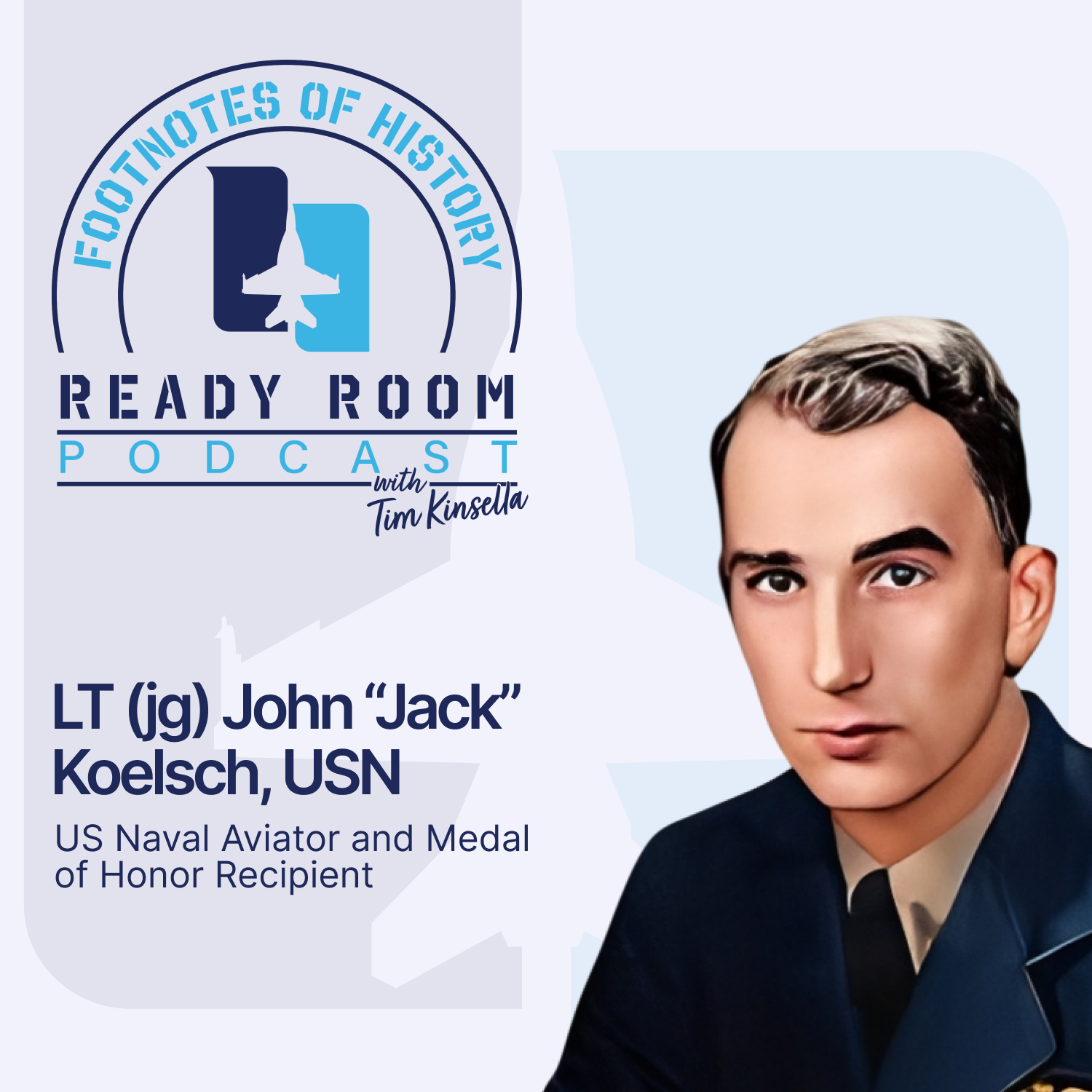
The Naval Aviation Ready Room Podcast with Ryan Keys
Night Rescue in Korea: When One Pilot Said "I'll Go”
00:25:05
In this Footnotes in History mini-episode of The Naval Aviation Ready Room Podcast, host Captain Tim “Lucky” Kinsella, U.S. Navy (Ret.) recounts the extraordinary life, final mission, and enduring legacy of Lieutenant John Kelvin “Jack” Koelsch, the first helicopter pilot in U.S. history to receive the Medal of Honor. From a near-suicidal night rescue behind enemy lines in Korea to his quiet heroism as a prisoner of war, Koelsch’s story shaped combat search and rescue doctrine, influenced the U.S. military Code of Conduct, and left a legacy that continues to guide American service members decades later.
Loading summary
Transcript4 lines
- [00:00]
A
The pilot that was on duty at that time said, let's wait until morning. This would be suicide for us to go in right now. But our friend Jack wasn't having any of that. So he said, I'll go in himself and his crewmen immediately volunteered for the rescue mission. They took off 10 minutes later. Welcome to the Naval Aviation Ready Room podcast, where the stories, leadership and leading edge technology of naval aviation come alive. This podcast takes you beyond mere museum
- [00:29]
B
artifacts as he delves into the personal stories, pivotal decisions, and state of the
- [00:34]
A
art hardware that define the world's most prolific aviation force. Knowing full well the hazards of night flying and the helicopter he flew, the dangers of weather flying and enemy gunfire, his heroism was so extraordinary that he persisted in his mission until shut down. This did not deter him. He continued as the outstanding leader he was to evade the enemy and to attempt to bring the wounded aviator out on foot. When finally captured, he inspired his fellow men by his strong convictions, resistance to enemy treatment, a consideration for his fellow men to the day he died, wracked by sickness, unattended by either medical assistants or friends in the prison camp of an unrelenting enemy. He maintained the highest devotion to duty and heroism, which are in keeping with the highest traditions of the United States Naval service. Hello, everyone, My name is Tim Kinsell and I'm the host with you today of Ready Room podcast, footnotes of history. And today we're going to talk about the pilot who conducted that mission. So what I just read was a testimony by a Marine Corps pilot, a fellow named Major James Wilkins, United States Marine Corps, who was shot down over North Korea behind enemy lines in the Mountains in July 1951. And what I just read, he was writing to an awards board explaining the heroism of the pilot that rescued him. And that pilot was John Calvin Kolch, known to his family and friends as Jack. So why are we going to talk about Jack today? Well, Jack, I think, is a figure that has been largely lost by history, but he's had a tremendous impact on, really on the military as a whole and on our culture here in the United States. So let's dig into it. Who was Jack Kolsch? So, to begin with, Jack was born in London. He was born in London in 1924 to his parents, Beulah and Henry. And his parents, or his father was a banker and he was sent to London by the bank that he worked for to run their offices there. So Jack went to a school in London. They lived in near Chelsea, very posh area of London, especially back in those days. And he went to a very posh school, what they call a public school in the UK because you have to pay for it. But in here, we call it a private school here in the States. And the school he went to was called the Gibbs School, and the Gibbs School royalty went there, Prince Edward went there, and the Kennedy boys actually went there also when their father was ambassador to London before World War II and at the beginning of World War II. So Jack would have known Ted Kennedy and he also would have known Robert Kennedy, who were at the school when he was there. Unfortunately, however, Jack's father very sadly committed suicide in 1938. And so Jack's mother, Beulah, brought the family back home to Connecticut, which is where they were from. Jack had a sister and he had two brothers. His sister called him the most outstanding brother, a leader, a great athlete, an intellectually stimulating someone men admired and followed. Sounds like me. So Jack's mother sent him to a school called Choate, which you may or may not have heard of. And I think the Kennedys may have had some influence in this because that's also where Kennedy boys went to school when the Kennedy family returned from Europe. So JFK went to school there. So he may have known JFK when he was there, who knows? But after Choate, then Jack went to Princeton University. He wanted to get his degree from Princeton and then study law. But then, of course, as we all know, war broke out In December of 1941 after the attack on Pearl Harbor. So Jack's brothers, his two brothers, they joined the Navy. They wanted to be naval aviators because that's what all great men do. And now great men and women. So in 1940, when Jack became of age in 1942, he himself wanted to join the Navy. And so he applied to become a naval aviation cadet. His mother, Beulah, had to vouch for him and sign the paperwork and he was accepted. And while in Princeton, there he did initial officer training and then was sent down to Pensacola to get his wings of gold, which he did receive in the summer of 1944. Following that, Jack was then sent to Neighbour Lair Station, Jacksonville, where he learned to beat a bomber pilot flying the Dauntless. And then he joined an attack squadron up in Quanza Point in Rhode Island. The war ended before Jack could get out to see some action. So he went back to Princeton to finish off his studies and to try and get that law degree that he was working towards before 1950. Then the Korean War breaks out. So Jack, being the good patriot he is he volunteered for service again and he was accepted, except this time he volunteered to fly helicopters. And why wouldn't he? That's what I did myself. So he had a reputation for being an excellent pilot from when he was flying the Dauntless during World War II, even though I was just here stateside. And this. It was the same when he was a helicopter pilot. He got a very strong reputation for being a great pilot. And he was immediately assigned to the USS Princeton, which was out of San Diego at the time. And he was the head of a search and rescue detachment which was part of an attack squadron there on the carrier. So they went over to Korea and they served off the waters of North Korea, where the attack squadrons there would support ground troops who were fighting ashore in Korea. So in the winter there, he found that the carriers in those days would lose. They'd lose a better squadron deployment in planes just due to mishaps. The angled deck hadn't come into use yet. So still, mishaps were quite regular. And if there's something wrong with their plane, pilots would often ditch rather than try and come aboard. And oftentimes the carrier would prefer them that they ditched because they would be in the middle of a launch cycle or maybe so they just couldn't land. So Jack was getting plenty of practice picking up pilots from the cold water. And the helicopter he was flying, it was an Hos3 Dragonfly. Now, if you're not familiar with the Dragonfly, maybe if you've seen the movie the Bridges of Toko Ri, which was made after a book written by James Michener of the same name. And in that movie, Mickey Rooney plays the role of a helicopter pilot, search and rescue pilot, and it's the Hos3 Dragonfly that he's flying. If you recall, Mickey Rooney was wearing a green top hat and a scarf when he's flying. I don't know if Jack was doing that. So Jack realized that, or he found that when he was trying to pick up pilots from those frigid waters in the winter of 1951, that the pilots, they didn't have rescue swimmers like we do nowadays. So the rescue hook would get lowered down into the water and the pilots would have to attach the rescue hook to their own harness so the water was so cold they'd lose dexterity in their fingers. So a lot of them couldn't get the hook onto their harness in time before they start getting into hypothermia. So Jack tried to figure out a way he could fix that. So he came up with a rescue sling. And it's kind of a long strap that was padded that the pilots could just wrap around their body and clip on. And then they get hoisted right, right up into the helicopter. It saved a lot of lives. It prevented hypothermia. And in fact, a version of that sling is what we still use today. We use it in the Navy, Coast Guard and the Air Force for rescuing folks, not just out of water, but if you, if a downed airman has to self rescue, it's usually the best way because it's the easiest. They just put it under their arms and they get lifted right back up. So that sling has saved thousands of lives all over the world in situations, in navies all over the world. So that's one thing that we have Jack to be thankful for, for the innovation of that rescue sling. So soon after the summer and the spring of 1951, Jack's tour of duty was up. It was time for him to go back to San Diego. But he didn't want to. He felt that his place was right there. Using the skills that he had developed in the cold waters off of North Korea to rescue downed airmen. When he was asked, well, why do you want to stay, Jack? He replied, rescuing downed pilots is my mission. To him that was as clear as day. This is where he belonged. This is where he needed to be. So he was transferred to the LST799, which is a transport ship and it was in Wonson harbor just off of North Korea. And it was dangerous duty. It was known as being dangerous duty, extremely hazardous. It was a mission where there were a lot of casualties. They were losing a lot of helicopters in doing that. But Jack figured, this is where I belong. This is where I need to be. I need to be out there helping to rescue my fellow airmen. He wrote in a letter when he was asking for that transfer that he believed that his hard learned lessons and skills were needed, quote, right where he was to save down Dareman. So you've got to respect that. So this helicopter that he was flying, the HOS3 Dragonfly, let me just step back and talk about that a little bit. So just give you an indication of how challenging this thing is to fly. So if you think of yourself as so flying a helicopter like this in bad weather, it's like driving a Model T Ford, you know those old cars that you see in the movies like Bonnie and Clyde drove. So it's like driving a Model T Ford down an icy and bumpy mountainside road in a night snowstorm. With the lights off, you're wearing sunglasses, you got one eye closed, the radio is stuck on max volume. If you have a radio and your passenger is yelling at you to keep the car steady because he's trying to shave with a straight razor, it's not easy. It's a hard helicopter to fly. It doesn't have any of the luxuries that we have nowadays in modern helicopters, like automatic flight control systems and luxuries such as hydraulics or even gauges or even instrumentation to tell you whether you're the right side up or not. So it was absolutely not equipped to fly at nighttime or in clouds, only for day. VFR visual flight rules. That was it. So Jack is on the LST and he's having a cup of coffee in the ready room one evening. It's about 6 o' clock on July 3, 1951, and they get a call that a pilot went down flying an F4U Corsair. A pilot went down behind enemy lines in the mountains near Wotan, which is close to where the ship was. And normally in a situation like this, the pilots would wait until the next morning. They'd let the airmen just hunker down, stay there, and then they go in at first daylight when the weather was better or when it was light, so they have a better chance of survival. So the pilot that was on duty at that time said, let's wait until morning. This would be suicide for us to go in right now. But our friend Jack wasn't having any of that. So he said, I'll go in. So himself and his Crewman, Petty Officer 3rd Class George Neal, they immediately volunteered for the rescue mission. They took off 10 minutes later without getting the notice. Ten minutes later, they took off. Now, if we think of doing a rescue mission nowadays, I mean, you've got hours of planning, you're planning with the entire air wing about how to get in there and how to get out and looking at where the enemy is. And these are pretty well planned events nowadays. Not so much for Jack and not so much in those days. He jumped in his helicopter and just all he had was a compass bearing and a general idea where it was, and he took off into the setting sun. The cloud deck was pretty low, but very, very overcast day. And shortly after taking off, he was met by a formation of F4U Corsairs, who were his rescue patrol that would fly overhead to try and suppress enemy fire as they were going in. Well, the problem was is that sun was setting, it was getting close to nighttime, and the Clouds were getting lower and lower and lower. So he took off into the darkening sky, and the weather is worsening. He popped up over above the clouds, and his rescue cap told him roughly where the downed aviator was. He saw a break in the clouds that would allow him to descend down into the mountains where Wilkins was supposedly waiting for him. And the rescue cap told him, he's like, buddy, you go down there, we can't follow you. You're on your own. He said, got it? I'm going down anyway. And that was the last radio communications that they had with Jack. So Jack spirals down in that what we call a soccer hole. It's just this little hole in the clouds that allows you to get down. So he heads down and he starts flying around the foot of the mountains there, trying to find where Wilkins was. So as they were on their way to the rescue at the time, Captain Jim Wilkins, he didn't give himself much of a chance. He thought he was either going to die from the severe burns that he had all along the right side of his body, or he was going to be found and killed by the enemy patrols that were searching for him. But as Jack got closer, Wilkins, he later said, when he heard that beautiful sound of rotor blades beating the air, he said, I heard a putt putting, and I realized it was a chopper. So I scrambled back down the mountain to my parachute. I got down into the bowl just as the chopper was finishing its first search of the area. Flying at about 50ft, he was way out near the main road. And I figured, there he goes. Because the ground fire was thicker than the overcast. Just then, a burst of ground fire. It rocked Jack's helicopter. But Jack, he managed to keep the aircraft under control. And when Wilken saw that, when he saw the helicopter get hit by ground fire, he said, I figured they would surely back out. Then, by the Lord, he made another turn back into the valley a second time. It was the greatest display of guts I have ever seen. Now, that's high praise of a naval aviator coming from a Marine aviator, I'll tell you that. But Jack, he couldn't land the helicopter because of the sloping terrain. They were down in a bowl at the foot of some hills. So he put the aircraft into a hover, and by doing so, he completely exposed his aircraft to enemy fire. Wilkins later said that the air was thick with enemy bullets. So after dropping the rescue sling down the hoist to Wilkins, Petty Officer Neil, he watched Wilkins put it around his torso. And then Wilkins gave a thumbs up to the which Is the signal that he's ready. And Neil then began hoisting Wilkins up towards the tiny cabin of the helicopter. But then, just as Neil was about to get Wilkins into the helicopter, he's about to grab him, and he's about to pull him into the cabin of the helicopter so he could fly away. The helicopter violently shook from a direct hit to the engine. A bang. And they heard the engine spooling down. So Jackie tried to keep the helicopter under control. They're about 60ft over the ground. But he tried to keep her airborne. But he was forced to crash land into the side of the mountain, which caused the aircraft to roll upside down. And roll down the side of the hill about 150ft. Wilkins was thrown clear, but he crawled back to the wreckage. And when he's there, he saw Kelch and Neil hanging in their seat straps because they're upside down. And he called out to see if they were hurt. Wilkins said that. Jack replied, never mind about us. Are you all right? So Jack then took his survival knife, and he cut himself and Neil free of their straps. And he scrambled over to Wilkins, who, although he was already really badly wounded from the burns, he now had a badly twisted knee. So the situation is pretty hopeless. The North Koreans, they have seen this helicopter go down. They know it's there. They're out searching for them, and they're out for blood. So they're quickly closing in on the crash site. So Jack gathers the two men from the wreck, and he leads them away from the crash site and the sound of the enemy troops. But poor Wilkins can't really move. So Jack puts him on his shoulders and he carries them. He brings them to what they thought was going to be a fairly safe spot over towards the top of one of the hills. And they stayed there for two days without food or water. And once they figured all the enemy troops were clear of the area, they decided that they would go towards the coast. Because if they get to the coast, Then they can travel south along the coast and get to friendly lines. So Jack essentially carried Wilkins 12 miles until they came to a little fishing village. They knew that going into this fishing village was going to be dangerous. They knew it was going to be hard, but they also knew that they were starving. They were in dire need of medical attention, and they needed to rest. So on the outskirts of the village, they found this wrecked little shack where they lay there exhausted and starred bodies down to rest for a couple of hours. Jack decided to take the first watch while the others slept. But only half an hour later, Wilkins, who's in this daze, is. He's delirious. And he's woken from his restless sleep by shouting from outside the house. And he hears Jack Kelch in a perfectly norm and calm voice, responding to the folks who are yelling at him from outside. How do you do out there? Won't you come in? Now, I don't know about you, but that is not what I would be saying. If I figured there was enemy troops with guns outside. It would probably be something like, please don't hurt me. But that was typical of Jack. He was calm, cool, collected. He was the person that everyone looked up to. And he was the one that always brought calm to a difficult situation. So, of course, the folks outside were enemy soldiers. Jack and his comrades had been given away by the villagers who saw them there in the house. So they actually answered Jack's politeness with machine gun fire. They sprayed the house with fire, and then they came storming in. And the three exhausted Americans understandably surrendered. So Wilkins, he recalls that they tied us up and marched us through town with all civilians shouting threats and throwing things at us. During all this time, Jack was constantly pointing out my burns to the Koreans, insisting that I needed hospitalization. I had maggots in my legs, and they looked pretty bad. So finally they gave me two guards and moved me out. I never saw Jack again. So Jack and Petty Officer Neil were marched off to a prisoner war camp. The name of the prisoner of war camp was Camp Number One in a place called Chang Song. And Petty Officer Neal referred to it as a hellhole. He said they were beaten, they were interrogated, they were denied basic medical attention. They were denied food. It wasn't a very pleasant experience for those men. And then in the months of captivity that followed there in Camp Number One and Jack, he continued in the behavior that he was best known for and especially towards his fellow prisoners. He cared for the sick. He gave up his own food for the injured. In the worst of circumstances, he maintained a positive attitude. When confronted with demands by the North Koreans for a public confession so he could be used as propaganda. He refused again and again and again, which would result in. In him being continually tortured and denied essential food and medical treatment, which then caused his health to seriously and rapidly deteriorate. But despite that weakened state, despite him knowing that he probably wasn't going to make it out of there, he continued to give his fellow prisoners inspiration. He continued to be considerate. He continued to be kind, helpful wherever he could. And his fellow POWs especially, there was one in particular, a South African POW that after the war wrote a letter to the Bureau of Naval Personnel about Jack's actions. And he said that Jack's example of courage, dignity and self sacrifice in hopeless circumstances gave them all the will to live and to return home with honor. So when Armistice Day finally came In July of 1953, Petty Officer Neil and Captain Wilkins were among the hundreds of POWs that were repatriated home. But sadly, Jack was not among them. He had died of dysentery and malnutrition only three months after capture. In a White House ceremony in 1955, Jack's mother, Beulah, was given the Congressional Medal of Honor on her son's behalf by the Secretary of the Navy and the Secretary of the Navy's office, mayor in the Pentagon. And Jack's remains were repatriated to the United States. And now he lies in Section 30 of Arlington National Cemetery. And years later, his mother, Beulah, chose to be buried alongside her son at Arlington. I visited his grave. I've been there, and his mother's grave also. And I couldn't think of a more fitting place for Jack to be. So Jack was the first helicopter pilot from any service, any US Service, of course, to be awarded the Medal of Honor. And just a couple of years ago, we got to enshrine his memory in the Naval Aviation hall of Honor at the National Naval Aviation Museum here in Pensacola. So what does all this mean? What does it mean about Jack, and why is he important? Well, Jack's legacy. It's much more than his example of extreme courage, his bravery, his tenacity in captivity. It so captured the spirit of the American warrior that the Department of Defense created a code of conduct that was inspired by his example. In fact, at the beginning, it was called the Kelch Code of conduct, an article 4 in the code of Conduct. It states, if I become a prisoner of war, I will keep faith with my fellow prisoners. I will give no information or take part in any action which might be harmful to my comrades. And it is that very code of conduct that has given strength and courage to American prisoners of war from Vietnam to Iraq. Every service member knows the code by heart. We have to learn it. It was drilled into us. And it was this same of code of conduct that guided Vice Admiral James Stockdale when he was in the Hanoi Hilton during his many years of brutal captivity and torture in North Vietnam, for which he also received the Medal of Honor. So when we talk about heroes, I think that's a word that is often overused. But what does the word hero really mean? I think hero is somebody that performs a selfless act of extreme courage, of extreme selflessness, that is above and beyond the call of duty. And what does that mean, above and beyond the call of duty? Well, that means that if a person had not done that act, that no less would be thought of them. And Jack didn't have to go in that day. He didn't have to get in the helicopter. He didn't have to go on an almost suicide mission. He could have waited till the next morning, but he didn't because he knew that there was an airman out there who was cold, lonely, wounded, probably thinking of his wife and kids at home. And he deserves Jack's best efforts to go out there and get him. So I want to read you, in closing, one last thing about Jack. This was written by Jack's former commanding officer on the USS Princeton. This action was typical of many actions by which Lt. Kolsch demonstrated something far more than bravery. It was an exceptional call of duty in which he, frequently encountering danger, met it with courageous gallantry and with the full knowledge that he was defying death with his own professional skill. It was Lt. Colch's conviction that nothing short of a maximum effort would suffice when another's life was at stake. In the performance of his duties, he made the maximum effort many times. Eventually losing his own life was the final effort. In this case, these efforts were splendid examples of service pride, dedication to duty and exceptional heroism. So we often think of our heroes as people that we put on a pedestal, but I think that actually does them a disservice. Those heroes are just ordinary people. They were ordinary men and women that are faced with extraordinary circumstances, and they made a choice to rise to those circumstances, to do their best. So let's remember Jack Kolsch. Let's remember the contributions he made to naval aviation, to our country, to the Code of Conduct, and to the many that went after him. And that's it for today. Next week, we'll perhaps. I think we're going to talk about how the Two Ocean Navy act affected Admiral Nimitz's decision at the Battle of Midway. So if you don't know about the Two Ocean Navy act, have a read on it and I'll see you next time. Cheers.
- [24:23]
B
Thank you for joining us on this flight through history and innovation here at the Ready Room. We hope today's episode inspired you with new insights and the incredible stories that make naval aviation so extraordinary. If you enjoyed the journey, be sure to subscribe leave a review and share the podcast with your network. It helps us reach more listeners like you. Don't forget to visit the National Naval Aviation museum in Pensacola, Florida, or explore our online resources at naval aviationmuseum.org to dive deeper into the stories we've shared. Follow us on social media for updates, behind the scenes content, and a sneak peek at upcoming episodes. Until next time, thanks for listening to Ready Room. See you on the next flight.