← The Naval Aviation Ready Room Podcast with Legends and Leaders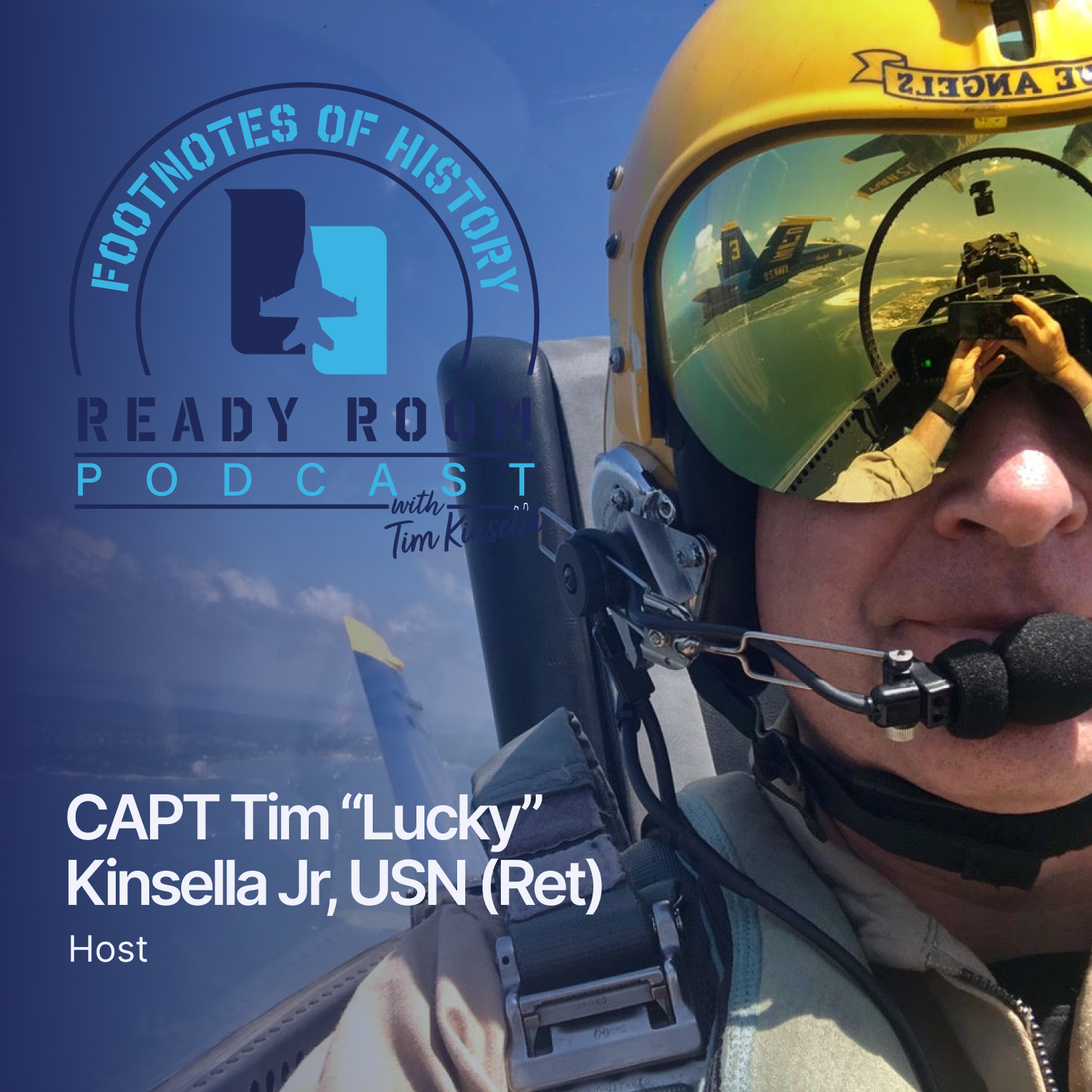
The Naval Aviation Ready Room Podcast with Legends and Leaders
Satan’s Kittens - How the Blue Angels Went to War
00:29:42
Loading summary
Transcript4 lines
- [00:00]
Captain Tim Kinsella
Magda's jet took a direct hit. His wingman watched the Panther pull out of the strafing run, smoke pouring from the engine, then the fuselage catching fire. He was still flying, meaning he was still conscious. He was still flying the jet, even though it was on fire. So despite the fact that his aircraft was burning around him, he continued the attack.
- [00:25]
Ryan Keyes
You know, the big battles, the famous names, the headlines. But what about the stories history forgot? I'm Ryan Keyes, host of the Ready Room podcast. And in this special series, Footnotes of History, retired Navy Captain Tim Kinsella discusses the obscure, the overlooked, and sometimes downright unbelievable chapters of military history. Here's Lucky.
- [00:49]
Captain Tim Kinsella
I live in Pensacola, Florida, just down the road from Naval Air Station Pensacola, a famous place in naval aviation. It's often called the cradle of naval aviation, and it's also the home of the famous Blue Angels. And every Tuesday and Wednesday, the Blue Angels, they fly a practice air show. And that goes right above my house. I can see it outside my window. In fact, they're doing it this morning. But the Blue Angels that everybody sees in the air shows, well, that's one side of the Blue Angels. Well, there's another side. There's a history there. There's a long and deep history and a very proud history of the Blue Angels. Now, there's a few things about the Blue Angels that you probably don't know, you probably don't realize. So I'll hopefully clear up some of those myths for you and maybe tell you a little something you don't know. And there's a few good stories in between. So let's go back. Picture a summer afternoon in Jacksonville, Florida. It's June 15, 1946. The war has been over for less than a year. The crowd at Craig Field, they leaned forward, shading their eyes against a clear bright sky turned electric blue. And then, out of nowhere, six dark Navy Hellcats come screaming low, ever so low overhead in tight formation, so close you could count the rivets. The crowd erupts with cheers and yelps and elderly ladies clutching their pearls in rapturous excitement. They'd never seen anything like it before. This is the debut of what will become the most famous flight demonstration team in the world, the United States Navy Flight Exhibition Team. Later, it'll be the United States Navy Flight Demonstration Team. They don't have a glamorous name yet. That comes a month later. But on this afternoon, they are already something that the country needs, something that has never existed before. And in quite this way, they are sailors who happen to fly like angels. So to understand what the Blue Angels are, what they really are, you gotta understand why they were created. And the story goes back not in the cockpit, but actually in a budget meeting. So again, it's 1946. World War II is over. The greatest military machine in human history is being rapidly dismantled. Millions of men, they want to go home. Congress wants to cut spending. And for the United States Navy, there is a new threat on the horizon. And it's not from Japan or Germany, but from Washington D.C. the Air Force is about to become an independent branch, and when it does, it will compete directly with the Navy for every dollar, every aircraft contract, every scrap of prestige. And Fleet Admiral Chester Nimitz, the man who commanded the Pacific Fleet and the man who accepted Japan's surrender, he understood that naval aviation now had to fight for its life, not over the Pacific, but over Capitol Hill. So his solution, it was brilliant in its simplicity. Let the American people see what naval aviators can do, not in a briefing or in a pamphlet, but right above their heads, where they can see it up close. So on April 24, 1946, Nimitz sent a directive to Vice Admiral Frank Wagner at the Naval Advanced Air Training Command in form a flight exhibition team. Make it spectacular. Make the country remember that these men and, and these machines are worth every single cent. They made the team part of the training command on purpose so the young aviation cadets would be inspired by what they might become. So to lead this team, The Navy chose Lieutenant Commander Roy Marlin Voris. Butch Voris, a World War II combat vet with eight air to air kills, and a man who had honed his flying to a razor's edge in the skies over the Pacific. As Butch said, I just happened to be in the right place at the right time with the right skills. He was given three months, a handful of f6f hellcats, and he got to pick his team. Voris later said his mission was simple. Beat the Army Air Corps. If the blues were better than the Air Force's demonstrations, the Navy would win the budget argument. This wasn't entertainment. It was warfare by another name. So under Butch's leadership, the team they trained feverishly, creating some maneuvers that they were familiar with from combat and some they invented. They gave the Navy brass a demonstration at Craig Field in Jacksonville. And when Butch walked into the hangar after the flight, he recalls that the Admiral stood there shaking his head, exclaiming, you guys are crazy. You're going to get yourselves killed. But it's a great show. Soon after, on June 15, they gave that crowd in Jacksonville the show of their lives. The F6 Hellcats, Dark Navy blue with navy and gold lettering, flown by men who had used those same aircraft to kill in anger, perform maneuvers that had the crowd gasping. Formation rolls, high speed passes, close enough to feel the displaced air on your chest. Butch Force said it's the precision and perceived daring and high risk that you see in the team. We come down to ground level so people can see the types of maneuvers fighters do in combat. I think the public deserves to see what their taxes are paying for the team. During that show, they swept the trophy for the most outstanding performance, and they were immediately invited back. Now that they knew they were going to be a success, they needed a name. So the team, they offered a prize for personnel on base to come up with a name. And the ideas flooded in. There was the Navy Blue Lancers, the Death Cheaters, the Sky Dancers, the Flying Buccaneers or the Skyjackers. I'm glad they didn't use that one. But none of them stuck. Butch felt they just weren't right. So a month later, at an air show in Omaha, Nebraska, right wing pilot Lieutenant Morris Wick Wickendoll, he spotted a name in a column in the New Yorker magazine, the Blue Angel, a supper club in New York City. He brought it to Vorce. Boss, I've got it, I've got it. Wick exclaimed. That sounds great, Vor. Said. The Blue Angels, Navy Blue and flying. The name stuck and the legend began. So that's how they began. But there's something about the Blues that a lot of folks misunderstand. When I was skipper of NAS Pensacola, now the home of the Blues, I was always amazed at how many folks thought the Blues were professional stunt pilots. And that's probably because the glossy brochures, they don't always emphasize this, but it's something that every Blue angel understands to their very core. And in fact, it's a core reason why they do it, why they do what they do, and why they volunteer to do this duty. Blue Angels are fleet pilots first. They're demonstration pilots second. Always, when our nation goes to war, the Blues will trade in their blue flight suits for green and their blue jets for Navy gray. To be selected for the Blues, a naval aviator must have accumulated a lot of hours in tactical jet aircraft. They must be exceptional stick and rudder pilots. Of course, what the selection board really looks at is combat readiness. It's maturity. It's the ability to operate as part of a team under extreme pressure. The same qualities that keep you alive over a carrier deck in the swells of the North Atlantic. They're looking at the whole person, the whole picture. Can they be part of a high performing team? Butch Force. He understood this from day one. His original team, they were all World War II combat vets. Every maneuver they flew in public was derived from actual tactics. The kind of close formation flying that gave you a tactical advantage in a dogfight. The Blue Angels, they were never a circus act. They were a demonstration of what the world's finest naval aviators could do. So by 1947, Flight Leader Lieutenant Commander Robert Clark had had introduced the diamond formation. Four jets flying in tight diamond, wingtip to wingtip, executing rolls and loops in perfect unison. It was absolutely breathtaking. They still do it today. It was also a living demonstration of the spatial awareness and trust in the pilot beside you that carrier aviation demanded. In 1949, the team made the leap into the jet age, transitioning to the Grumman F9 F2 Panther, the Navy's first frontline carrier jet fighter without that massive propeller in front to chew up a wingman. They expanded to six aircraft gave them more room. They introduced the smoke trails from wingtip tanks that would become iconic that they still use a version of today. And the new commanding officer was a World War II ace named Johnny Magda. Lieutenant Commander John Joseph Magda. So Magda. He was a Kentucky boy who became a football standout at Western Kentucky Teachers College. He'd entered the Navy in 1940 at the Battle of Midway. In 1942, he was flying off the USS Hornet. His aircraft ran out of fuel and he ditched in the Pacific Ocean. He and a fellow pilot, they spent five whole days floating in a life raft in the open ocean. He was later filmed being helped from a PBY rescue aircraft by John Ford. Yes, the Hollywood director. The same one that does all the used to do all the John Wayne movies. And John Ford was shooting what would become his Academy Award winning documentary about the battle. You can go online and see it today. It's fascinating. Magda. He appeared in that film. A dark haired young officer squinting into the camera, smiling with the quiet relief of a man who had just cheated death. In his report of the experience, Magda wrote to elaborate on the five days existing in a rubber life raft is a very unpleasant thought to me. So instead I shall endeavor to list a few things which this experience made me realize. He pointed to the need for an extra water supply and signal equipment stored in the raft and the desirability of a large rubber covering to catch water. And provide shade. Fish hooks, a net and bait were recommended as standard equipment on the raft. He wrote. Raw fish may sound repulsive to a well fed man, but when you are very hungry, they are most welcome. The Navy took his advice, and it saved many a downed aviator during the war. So Johnny Magna, he went on to fly Hellcats from the Saratoga. He had five aerial kills, which meant he was a fighter ace. He was decorated with the Distinguished Flying Cross and several air medals for his effort. Now, by 1949, Johnny Magna was the face of the Blue Angels. He was the boss. Life magazine ran a feature on the team. And he was, by any measure, one of the most recognizable naval aviators in America. A showman in the sky, and underneath all of that, every inch a warrior. And then war came again. June 25, 1950. The Korean War, North Korean forces, they pour across the 38th parallel. The United States, still exhausted from the Second World War, finds itself in another war. So Johnny Magda, he didn't wait to be told. He volunteered for combat duty. In fact, every single Blue angel did. The entire team volunteered for combat duty. So on July 30th in 1950, less than a month later, after the war beginning, the Blue Angels, they flew their last air show of the shortened season at Naval Air Station Dallas, Texas. The crowd had no idea they were watching. A farewell. They cheered. They marveled. They drove home and told their families about the incredible pilots who'd flown so low, so close, so impossibly graceful. The next morning, the Blue Angels packed up and they flew their jets to San Diego. The flight demonstration team was officially disbanded. It was, as one writer later put it, a move that has never been repeated by either the Navy or the Air Force. The country's most famous demonstration squadron was sent to war not as individuals, but as a unit, as the beating heart of a frontline fighter squadron. They were re equipped with F9 F2B panthers, essentially the same aircraft they'd been flying in their shoads, but now armed with cannons, bombs and rockets. Magna and his executive officer, Lieutenant Commander Arthur Hawk Hawkins, the Navy's 10th leading ace of the Second World War. These guys were no joke. They trained the rest of the squadron. Former Blue Angels conducted Czech flights and ran carrier qualifications off the California coast. In October of 1950, on November 7th, the Panthers were loaded by crane onto the USS Princeton, newly recommissioned and bound for the Korean coast. The ship steamed for Hawaii, then west into the Yellow Sea into Task Force 77. The Blue Angels were going to war. The men who'd Been trading smoke trail geometry over county fairgrounds in Texas, were now flying combat air patrols over the freezing ridges of North Korea, supporting Marines fighting their way from the Chosin Reservoir to the sea, launching strikes on rail lines, bridges and gun emplacements. The transition to operational jet flying, it wasn't entirely smooth, since it would be the first time many aboard Princeton had deployed with jets. The slightest adverse conditions, insufficient wind across the bow, low ceiling. It led to jets being stood down in favor of propeller aircraft. They were working out the procedures in real time, in a real war. But the Blues pilots, the men who had spent years drilling precision at low altitude under pressure, they adapted fast. Retired Commander Jack Rubke, a former Blue angel and VF191 aviator, later recalled that Korea on that first cruise was not all that exciting. But they were still flying in harm's way. They'd soon fly into a lot worse. So if you can pull out a map of the Korean peninsula, run your finger up the northeastern coast hugging the Sea of Japan, past Wonsan, past Hungnam, all the way up near the Soviet border, there on the coast sits a port town called Songjin. Today it's called Kimchaek. In 1951, it was a vital node in the North Korean supply chain, a port through which weapons, food and reinforcements flowed to frontline Communist forces. And threading through Songjin was a railroad bridge. You cut that bridge and you cut that supply line coming from the Soviet Union down into North Korea. On April 2, 1951, a pair of F9 F2B panthers from VF 191, Satan's kittens. That was a squadron's name, the Satan's Kittens. Love that launched from the deck of the USS Princeton. Each carried six bombs. This time they were not in a routine combat air patrol or escorting attack aircraft. This time they were the attack aircraft. For the first time in the history of naval aviation, for the first time in the history of warfare, jet aircraft launched from a carrier with bombs and went to work on a target. The mission was a success. The railroad bridge at Songjin was bombed. The Naval History and Heritage Command records it as it happened, the first ever bombing mission carried out by a United States Navy jet fighter. The air wing's final actual report for the Cruise, filed in May 1951, noted that the F191's performance in combat had proved the worth and versatility of the jet. Truer words have never been spoken. So think about that. The men who had just months before been threading their jets through smoke trail formations for the delight of county fair crowds in Omaha and Dallas, those same pilots had just written a new chapter in the history of air warfare. Not because they were showmen, but because they were first and always fleet aviators. The Panther had been designed as a pure jet fighter. Nobody had seriously envisioned it as a bomber. But Magda's men, Satan's Kittens, the former Blue Angels improvised, adapted and made it work. Four 20 millimeter cannon for flak suppression, six bombs per jet for the target. They flew low and fast and pressed their attacks with the distinctive aggression of men trained in combat. So now let's go back to a month before Sunjin. The Princeton is operating off Korea's east coast. Johnny Magna, Blue angel number one, the boss World War II ace, the face of naval aviation to the folks back home, is leading a low level strike with rockets and guns against communist positions near Tanchon. This is close in high intensity work. You come in fast, press the attack, pull off hard and hope the anti aircraft crews can't track you. But they tracked Johnny. Magda's jet took a direct hit. His wingman watched the Panther pull out of the strafing run, smoke pouring from the engine, then the fuselage, catching fire. He was still flying, meaning he was still conscious. He was still flying the jet even though it was on fire. So despite the fact that his aircraft was burning around him, he continued the attack. The Navy Cross citation later recorded that he destroyed several gun emplacements and inflicted severe damage on nearby rail installations before his ammunition was exhausted, all while his plane was still on fire. Only then did he turn his aircraft toward the sea. He was 33 years old. He had a wife and two children. He had survived five days in the Pacific. Life raft. He had helped build the most celebrated flight demonstration team in the world. He turned his burning aircraft away from land, away from the possibility of capture, away from the risk of compromise. And he flew it out over open water. His aircraft crashed into the sea and Lieutenant Commander John Joseph Magda was gone. He was posthumously awarded the Navy Cross, the second highest award for valor this country can bestow. He was the first member of the Blue Angels ever killed in combat and the only Blue angel to receive the Navy Cross. His executive officer, Hawk Hawkins, kept the squadron flying. They flew combat missions through the spring of 1951. They carried out strikes on railroads, convoys and gun positions. They flew combat air patrols over Task Force 77. And on April 2, they made history at Song Jin. In October 1951, the Chief of naval operations, Admiral William Feckler, issued the Order reconstitute the Blue Angels. The war was still ongoing, but the Navy had determined that the demonstration team served a purpose that could not be deferred indefinitely. Recruiting morale and public support. They called Butch Voris back, the man who had built the team from scratch. In 1946. He'd been on the verge of retirement, but he came back anyway. On October 25, 1951, the Blue Angels were officially reactivated at NAS Corpus Christi in Texas. They flew the F9F Panther, essentially the same airframe. The men of Satan's Kittens had taken the war. And among the pilots who returned to the team were veterans of that combat cruise. Lieutenant Pat Murphy, Lieutenant Bud Rich, Captain Ken Wallace, who had flown with VF 191 off to Princeton, Korea, had done something to the Blue Angels that no amount of rehearsal ever could. It had proven in blood and jet fuel and bomb craters that these were not performance artists. They were warriors who happened to perform. And the performance, the extraordinary precision, the instinctive formation flying, the cool aggression in tight spaces, it was just combat skill. In a different venue, the team gave their first public performance in June 1952. And the crowds, they showed up. The country watched. And somewhere in those packed grandstands, ordinary Americans were watching. Men who had bombed railroad bridges in North Korea and flown low level strafing runs under fire. And they didn't know it. They just saw perfection. They saw those beautiful blue jets streaking across the sky, and the crowds could feel it in their chests. And here's what the story the Blue Angels of Korea teaches us about what the Blue Angels, what they really are and what a lot of folks don't understand. Every year, the Navy selects the team's new pilots from frontline tactical squadrons. These are men and women who have been flying combat aircraft from carrier decks, conducting real strikes, real intercepts, real missions. They join the blues. For two or three years, they fly the shows, they dazzle the crowds, and then they go back, back to the fleet, back to the deployments, the combat air patrols, the strike packages over real targets with real threats. The Blue Angels is not a career assignment. It's a tour of duty. And those who complete it do not retire to a life of air shows. They return to the sharp end of naval power, the pointy end of the spear, carrying with them the extraordinary precision and discipline that the team forges. The team exists for a purpose that has never really changed since Nimitz put pen to paper in April 24, 1946, to keep the country's eye on naval aviation, to show taxpayers and congressmen and young men and women that county fair is what the United States Navy can do to recruit, to inspire. But underneath all of that is a deeper truth that the Korean War made undeniable that the Blue Angels can be disbanded at any time in any war. And the men and women who fly in those blue and gold jets will go directly back to the fleet and then they will form the nucleus of frontline squadrons. They'll fly combat missions and they will have called upon, press their attacks through anti aircraft fire, with their aircraft on fire until their ammunition is exhausted. And that is the legacy of Johnny Magda. It's the legacy of Satan's kittens. And that's what the Bridges song Jin means. So the next time you stand at an air show and you watch six jets roll into a diamond formation, impossibly tight, impossibly precise, the sound arriving at half a second after the aircraft have already flown over your head and gone, remember that you are not watching performers. You are watching the United States Navy's best holding back about 90% of what they know how to do. The rest of it, they save it for when it really matters. So now I want to tell you about my own personal connection to the Blues. A long time ago, right after I got my wings of Gold, I went out to Monterey, California to visit my folks. They were living out there at the time, and a friend of theirs, they wanted to introduce me to a World War II vet he knew. So along with my folks, we had dinner. He was an older gent, he was bald and he was wearing a navy blue blazer. And I'm not sure I ate anything at dinner that evening because I was absolutely enraptured by his stories of flying the Corsair in the groove behind the carrier and having to stick his head out of the cockpit to see beyond the huge cowling as he's coming into land. He told me about flying against Japanese Zeros. He told me just so many stories, and he gave me all these little snippets of flying that I held with me for years. And he also mentioned that he was a pilot with the Blues back before they flew jets and again when they did fly jets. And I never forgot that conversation. And his name, I didn't really appreciate it back then. His name was Butch Vorce. Now Fast forward to 2018, when I showed up in Pensacola to take command of the cradle of naval aviation and the home of the Blues Naval Air Station Pensacola. I knew I'd be working closely with the Blues. And I also knew that they gave the skipper a ride at the end of the command tour, but I thought that was backwards. So I went to the boss at the time, Commander Papa Doyle, a great friend, and asked if I could fly with them at the beginning of the tour so I could understand them better and therefore help them out better. We could work better, closer together if I understood them. And he agreed. He thought, lucky, that's a great idea. So now, let me tell you about flying with the Blues, because I did an entire air show with them. Gosh, I mean, I don't even know where to begin. So I'm a helicopter pilot by trade. So in a helicopter pilot, you can pull G's once. That's it. And then you're probably going to fall out of the sky. You can fly upside down in a helicopter. But again, once, because you're probably going to fly out of the sky if you do it again or the first time you do it. So I showed up for the brief, and not many people get the opportunity to sit in on a Blue Angels brief. It's amazing. It's like watching a seance almost. The blues, they sit around a table, they close their eyes, and the boss goes over the entire air show, call by call, in real time. And as he's doing it, each of the blues are sitting on their chair, one hand mimicking holding the stick and the other hand mimicking holding the throttle. And then their feet, they're mimicking the pedals. And as the boss is calling out the rolls and the turns, putting on smoke, whatever it may be, they're making those movements with their hands and their feet as if they're in the real jet. They're imagining it all. It's like athletes do before an event. They're imagining it, you know, like Rory McElroy does before he hits a drive on the 18th at Augusta. He's imagining the shot before he does it. So then they took me out and they put me in the jet, in the backseat with one of the jets. And my pilot at the time was a. His call sign was Daryl. He was a Marine pilot with the blues. So we took off, and I knew the hardest thing for me was going to be the G's. As a helicopter pilot, you're just not used to doing it. I didn't pull G's in a long, long time, not since I was in flight school. And I was a little bit worried about maybe feeling a bit nauseous doing it. And I was a bit worried about blacking out or graying out as they call it. So we took off, and I could feel it immediately. And when you pull GS, the Navy teaches to do a maneuver called a hick maneuver, where you hold your breath and you kind of tense your stomach muscles, and it's to force the blood out. This whole pooling in your stomach is to force it out to your extremities and keep the blood in your brain so you don't black out. So I'm doing it, and it's great. And it's about 30 minutes. Well, actually, before I get there, I need to tell you there's three things about the blues that I found are amazing. The first is how beautiful it is up there when you're flying there, and there's those other five jets flying around you, and that beautiful blue angel blue against the clear blue sky and the white beaches of Pensacola. There's one maneuver they do in particular. It's the echelon. I was in the middle jet, so I've got jets either side, and we're doing the big loop, and I'm looking out either side of the jet, and they're spread out either side of me against that beautiful blue sky is just gorgeous. So, number one, it's beautiful. Number two, it's exhilarating. I was laughing out loud in the cockpit. I mean, just laughing with pure joy. It's a feeling unlike any other. Think of the best roller coaster in the world and then doing it for 45 minutes nonstop. And then the last thing was how exhausting it was. It is absolutely exhausting. You've got to be fit to do that. You've got to build up a tolerance for pulling GS. You've got to hit the weights a lot. And I probably needed to hit the waves a little bit more before I went in that flight. I'll tell you, when I finished the flight, I went home and I slept for three and a half hours. That's how exhausting it is at 30 minutes into the flight. And I think I'm doing great. We're pulling GS, we're banking, we're yanking. We're going upside down. It's fantastic. And Daryl up front, he says, all right, skipper, we're going to do a sustained high G turn, meaning we're going to pull G's for longer than normal. It's not going to be a quick one. It's going to be for like, 30 seconds as he's turned the jet to try and get to a rendezvous point. So he says, skipper, you ready? He said, yep. You Got it. He goes, hit it. So I do my hicc thing. Go, hic. And I'm trying to get all that blood out, and I'm thinking, I'm doing it. I'm doing it. It's all good. The next thing I know, I'm in bed. I'm freezing cold, and I'm trying to pull the sheets around me, and my hands are hitting these metal things, and I'm thinking, what's going on? And then I open my eyes and I go, oh, my God, I'm in a jet. I totally blacked out completely. And it took me by surprise. When I woke back up again, Daryl, in his little rearview mirror, he looked back, and he could see that my head had just fallen down. I totally lost it. And he's like, you're all right, Skipper. And I was like, yep, I'm good. I'm good. Because it only takes you a couple of seconds to come back from it. Well, I'll tell you, that wasn't the last time in that flight that I blacked out. It happened three more times, but I never threw up. I never threw up, and I never felt sick, which I was proud of. And so we landed, and it was amazing. It was absolutely amazing. And I'll be forever grateful to Popeye Doyle for letting me do that at the beginning of the tour because we had such a close relationship between myself and the Blues. You know what they needed to help. I could give it to them. I understood what they needed. I understood their challenges. It was really something else. So that's my experience with the Blues, and I just want to finish with. I mean, understand what I tried to explain to you. Johnny Magna. He was only 33 years old when he died. That bridge at Sin that was destroyed way back in 1951. And the blue Angels were foreign just a few months later. But since then, they've performed for more than 500 million spectators. 500 million. And tragically, 26 pilots and crew members have been killed in the team's history. 26. And every single one of them was a fleet aviator first. So, friends, thanks for listening. I hope you enjoyed this podcast. If you did enjoy it, please hit, like, share it. Support the National Naval Aviation Museum foundation and the National Naval Aviation Museum. And as always, thanks for listening to the history you didn't know that happens before the history you know. Take care.
- [29:25]
Ryan Keyes
Thanks for tuning in to the Ready Rooms miniseries Footnotes of History, hosted by Captain Tim Kinsella, where you experience the obscure, the overlooked, and often unbelievable chapters of military history. Don't forget to like subscribe and leave a five star review. Fly Navy.