← The Naval Aviation Ready Room Podcast with Ryan Keys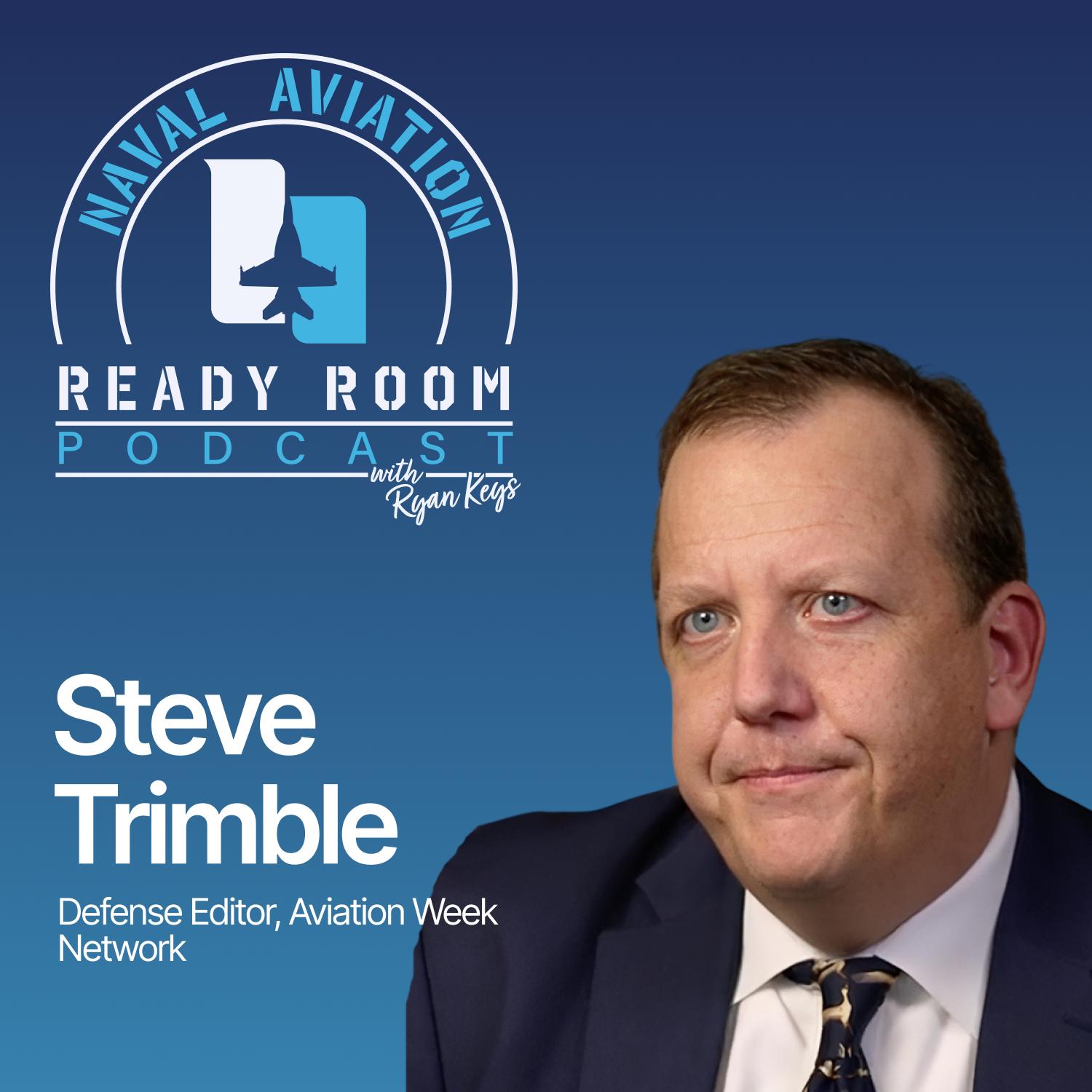
The Naval Aviation Ready Room Podcast with Ryan Keys
The Spy in the Ready Room: How Journalists Uncover Military Secrets
00:51:15
Loading summary
Transcript88 lines
- [00:00]
A
The United States had broken the sound barrier for the first time, which of course was international news and a really big deal. And the Air Force was furious because this was something that they had not authorized. They started investigating the reporter and his editor on charges of treason, which is a very significant thing for anybody to face. One, two.
- [00:23]
B
Welcome to the Naval Aviation Ready Room podcast where the stories, leadership and leading
- [00:28]
A
edge technology of naval aviation come alive.
- [00:30]
B
Hosted by retired Navy Captain Ryan Keyes, this podcast takes you beyond mere museum artifacts as he delves into the personal stories, pivotal decisions, and state of the art hardware that define the world's most prolific aviation force. Today's episode takes us into the intersection of military aviation, global defense strategy, and the journalism that helps the world understand how air power is evolving. Joining us in the Ready Room is Steve Trimble, defense editor for Aviation Week Network and one of the most respected voices covering military aviation missiles in space. Steve grew up in a US Air Force family. We will hold that against him living on military bases around the world. That early exposure to aviation helped shape a career that has taken him across the globe reporting on defense and aerospace developments. He began his career in Washington covering the Pentagon and helped launch the Military.com portal before moving on to report for Jane's Defense Weekly and Flight Global, where he served as US Bureau Chief for more than a decade. Today at Aviation Week, Steve analyzes some of the most important developments in military aviation, from next generation fighters and missile systems to the evolving role of space and autonomous technology in modern warfare. Steve, welcome to the Radio room.
- [01:40]
A
Thank you for having me.
- [01:42]
B
So I feel like every time we have a new guest on here, I say, hey, you're the first one of these to do and you are, I think, by far the first journalist, true journalist. I mean, we've had a couple book authors, but I wouldn't, you know, necess say they're journalists. So you are by far the first journalist that we have had on the podcast. So thank you very much for coming on and talking to us because I think it's going to give us just an interesting perspective that no one really kind of talks about when it comes to naval aviation. You know, those of us who flew and Inside the Wire kind of people. But to see now from your aspect on the outside looking in, I think is what very, very valuable. So with that, I'll actually turn it over to you and just kind of give our listeners a little spiel on kind of how you got into this industry, if you want to put it that way.
- [02:28]
A
Well, that's interesting. Yeah, I mean, I grew up in the Air Force, as you said. My mother was from a Navy family. Heard that she was a retired chief Petty officer and her brother also was in the Navy. So we have that Navy connection. But I grew up on the Air Force and actually I got started just with an interest in journalism from being in high school in Japan, in Okinawa. And I got an internship at the base newspaper, which was randomly assigned. I wasn't looking for it and I didn't know I had any special interest in that. And I loved it. I loved everything about it. I think my first cover story for our little tabloid based newspaper was about the engine for the F15 in 1992. And somehow I made a career of that. But that was not the intention. I went to journalism school and I was all set to go into newspapers. And I did that for just a minute actually after college. But then I, through connections, random connections, you know, those things that life kind of throws at you. I got connected to somebody who worked at Army Times Publishing company.
- [03:27]
B
Oh, okay, Like Navy Times, Marine Times, like, I mean, man, that is a staple in the military services. I mean, for sure. Oh my gosh, you walk into any exchange on base, a px, a bx, an X, whatever, I mean, there's always those. So I think I subscribed to that for a while. I'll be honest with you.
- [03:45]
A
Yeah, that's right. I mean, it was like my hometown paper because we lived in all these different places. It felt like the one then, like the Stars and Stripes. So the chance to cover the military sounded really interesting to me. They had a couple job openings. It was actually for their Federal Times newspaper that I got in the door and I thought I'd move over to one of Air Force Times or Navy Times or whatever one. But then the opportunity came up to launch Military.com and to be part of the team that launched that website back in March of 2000. I started there in January. If you go back to March 2000 and look up the history of dot com 1.0, that was the month that the bubble burst for the dot com. So we had created this great website. I still stand by it. It was, you know, the content strategy we had for it was really good and it survived. But this model we had did not survive. So by the end of that year, it was pretty clear that they were shrinking rapidly. And that's when I found the job working for Aviation Week's website initially. And a few months after that just was really where I got the bug that I wanted to do aerospace journalism. Because I got to go to the Paris Air show for the first time. It was the Paris air show in 2001. And that blew me away. I mean, I don't know if it affects other people the same way, but just to see everything there. The Russians were there, you know, obviously the French were there, the other Europeans, the Brazilians, the Americans and all the best stuff and all the latest stuff. And to see all that in one place. And also it's just nice being in Paris too. That got me hooked on the idea that maybe I should stick this out and figure out how to do this part of it. Yeah, I think my initial was thinking about covering the military itself. Operations, troops, you know, that kind of thing. But after that experience I got really interested in the hardware part of that.
- [05:28]
B
In aviation as a whole. You know, I think as naval aviators or military aviators, a lot of time at least I was very focused on just the military side. Growing up, having military aviation books, commercial aviation never really interested me. And then as I got closer to retirement, I started looking into that world. Cause I have a lot of friends. My academy roommate actually he got out of. He was a P3 pilot, got out of the Navy back in 2007 timeframe. And then he joined Southwest and has been with Southwest ever since. So he's always kind of talk to me about commercial aviation. I'll tell you, that is a world that is so much more broad and intricate and just multi leveled. Much more than military is. The military is a very small aspect of aviation in the sense of. I said size wise, right? Just numbers, technology wise, very different in a lot of ways, but still a wing is a wing, whether it's fixed or rotating. So it's all kind of very similar.
- [06:27]
A
And I did get to cover commercial aviation for several years when I was at flight. I didn't think I'd be that interested in it after covering the military. But for a long time, the market dynamics and the competitive forces and the technology strategies that you saw between Boeing and Airbus and Bombardier. It's a fascinating thing to observe and to have that vantage point that we do in the press for sure.
- [06:51]
B
So one of the things, before we go down to too many rabbit holes, quick question. Where'd you get your journalism degree from?
- [06:57]
A
I went to University of Kentucky. That was home state tuition. Just because of my parents lineage. I went to the Kentucky. They're playing I think right now in the tournament as we're recording.
- [07:08]
B
I think the same. I just checked my bracket. So there you go. For all those basketball fans out there. So we'll keep you too long. That way you can get back to the game. But I do want to go back real quick. So one of the things that when we first chatted, you talked about was kind of, I want to say, the tension necessarily between the military and journalism kind of early on, World War II timeframe and kind of how they work together. And then after World War II, it's a little different dynamic maybe at that point. Could you just touch on that real quick for our audience? I think that historical aspect is very interesting.
- [07:40]
A
Yeah. So I love history, and so it's great to be on this podcast, and especially that intersection of military history and journalism history. It's fascinating to me. And the story of what happened there in World War II between the press and the military doesn't really get told very well, but is absolutely fascinating. So I'm sure Your audience remembers December 7, 1941. And then I think it was about a week later, there was the War Powers act signed in Congress. That law included a clause that established a censorship regime for the American press during a war. And it was interesting how they approached it. The White House reached out to. It was a managing editor for the Associated Press to basically lead the censorship office that reported directly to President Roosevelt during the war. And what he did was he got all of the media organizations at the time, the big newspapers, the radio services, the wire services, got them together and say, we have to do this voluntarily. We don't want to basically impose this from the government and deal with the issue of First Amendment challenges and stuff like that. Let's all come up with our code for how we're going to behave as we cover this war. And they did agree on that. And that's an interesting moment in history, I think, because, you know, it's so foreign to my lifetime how I've understood the relationship between the military and the press certainly since Vietnam, but even before then. And it worked out, for the most part, for the most part, the press abided by the censorship code during the war. There was one notable exception that I love because I spent a lot of time in Cleveland as well. That's where my wife's family's from. And there was a reporter there from the Cleveland Plain Dealer. It might have been the Cleveland press actually at the time, which no longer exists. But he was on vacation in 1943 in Albuquerque, and he found out that the locals were telling him about this town, that this secret town that was based at Los Alamos, and it was led by this world renowned physicist named Robert Oppenheimer, and they're working on some kind of atomic weapon. And he got enough quotes about, you know, in story anecdotes from the local population about this place that during his vacation, he filed a story from Albuquerque to the Cleveland press. And they printed it without going through a censorship review and without censoring the story. And of course, the story gets picked up by the wires. And once it gets picked up by the wires, then it gets picked up by the embassies and the embassies forward around to other governments, governments that are friendly to Japan. All of that took place. And of course, Leslie Groves, so he blew the COVID on the Manhattan Project without quite realizing what he had done. And Leslie Groves, who was the leader of the Lieutenant General leading the Manhattan Project, was so upset with this reporter that he looked into how they could draft him and send him immediately to the front lines in the Pacific. So which was intended as a punishment and potentially a death sentence, until they found out he was about 64 or 65 years old. And so they decided to punish him in a particular way. But they did punish the newspaper. They restricted access to the newspaper for the remainder of the war. So that's how that kind of got managed at that time. And then after the war, that's really where I sort of got interested in the subject, because that's how Aviation Week got involved in the story of censorship and military expectations and media expectations and so forth. So this is 1947. It's two years, obviously after the war. Your audience is very aware of that. And the press thinks war's over. There's no more censorship, there's no more code. If we find out something and it's true, we have the right to print it. You know, it's the First Amendment. Any newspaper trained newspaper reporter is going to tell you that. The military, however, was recognizing that there was this technological competition brewing with the Soviet Union, and they were working on things that they didn't want to reveal, not only to the US Public, but only to the Soviets, one of which was the pursuit of supersonic flight, which, of course, had not yet been achieved by that point. And it turned out an Aviation Week reporter named Robert McLaren got wind that this young Air Force captain named Chuck Yeager had broken the sound barrier on October 14, 1947, and published a story quoting his sources, that the United States had broken the sound barrier for the first time, which, of course, was international news and a really big deal. And the Air Force was furious because this was Something that they had not authorized and expected the media to, even if they had heard about it, to not publish anything on it. And what happened was they referred their complaint about that story to the Justice Department, then led by Edgar Hook. At that point, there was an investigation launched. By the end of December, they started investigating the reporter and his editor on charges of treason, which is a very significant thing for anybody to face. There was a national backlash against that because the belief was, we live in a free country, one of our freedoms is freedom of the press, and if this information was received by the reporter lawfully, then they have every right to report it. The investigation continued for six months while this sort of, you know, the furor, the pressure grew, especially from media organizations on the Truman administration. And Finally, June of 1947, Truman called off the investigation, ordered the Attorney General Hoover to close the investigation and acknowledge and announce that it's true. They had broken the sound barrier. And that really was one of the first cases that established this precedent in the post war environment, in this sort of peacetime but cold war world that was so unusual and foreign to everybody up until then, but that was the world I grew up in and still live in today to an extent. So the military had to kind of reset their expectations about how they read it to the press in this world where they're trying to be competitive, trying to advance the technology and stay ahead of the Soviets. And so they want to keep some things secret, they want to advertise that they have some things and they want to control that, you know, as much as possible, where you have the media, who our job is to find things out and if it's true and if it's lawful, that the way that we got the information, we have the right to print it. So that scenario has played out several times in the course of Aviation Week's history with varying results, is that right? Yes. And I think mostly for the kinds of stories we write, you know, we're not writing about the troops, we're not writing about necessarily big national security decisions, but really the discrete technologies and the things that sometimes we find out about latest classified aircraft, certain capabilities some may or may not have. You know, it's not an easy or simple relationship or process, but I think it's very necessary. And I'm a reporter. I have a cell phone, I have a laptop, I still have paper. Sometimes I don't have a spy agency, I don't have satellites. If it's possible for me to find out something, you know, you're not really keeping it A secret at that point, people know, and it's amazing how much they let slip out there.
- [15:09]
B
That's great. So going back to the history part. So when that broke in 47, and kind of the relationship between the media and the military was kind of reset at that point. Right. Has it then remained the same? Is it essentially still that today that I want to say, opposing principles per se.
- [15:28]
A
Right.
- [15:29]
B
But one, hey, I want to keep it close over here. I want to bring it to light over here. And so has it still transformed over time until today? Or is it pretty much the same from when it kind of broke open from 1947?
- [15:43]
A
I don't know if it's linear. I mean, I will say. I mean, today the expectation is if they want to keep something secret, it's on them to keep it secret. It's generally not on us now, but there are cases where we work with them, you know, if we find out about something and they don't want us to publish it, but they say when we can to publish it, we'll make sure that you keep the inclusive on it. A lot of times we'll work with that, especially if we have the relationship in place with those people. And it's harder to make those relationships these days than it used to be. You know, reporters, we had to give up our place in the Pentagon, and our Pentagon passes under the regime. And I mean, I think that's unfortunate just in that. Because you just can't build those relationships when those moments happen. You just don't get the. We still do. We still have pretty good access, to be honest. But it's not as much as it used to be. There are those moments, you know, where there are ways to. So we get what we need and they get basically what they need.
- [16:41]
B
Right? Yeah. A compromise between the two entities.
- [16:44]
A
Yeah.
- [16:45]
B
Okay. It is interesting. I say it's, I guess, a dichotomy of information control is, I guess, how you could kind of put it up.
- [16:52]
A
You know, every military has a conceal and reveal strategy.
- [16:56]
B
Conceal and reveal. Okay.
- [16:58]
A
Yes. And that is what they call it. Right. And there's somebody responsible for figuring out what we're going to show our adversaries and what we're not going to show them. And it's part of competitive strategy. Right. It's also part of deterrence. You can't deter people if they don't know that you have it.
- [17:14]
B
If no one knows is out there. That's right. Yeah. Just like I think I just saw the first photos of the new Chinese super carrier that is out there. So you're right. I mean, how do we know that they had that capability unless we're seen as believing?
- [17:27]
A
Right, yeah. And China's conceal and reveal strategy is a lot different than ours. They have been revealing a lot more about what they've been doing. Now. I think they also understand that our intelligence capabilities are such that they're not concealed from us anyway. We have our ways, Our intelligence community have ways. I don't think I'd be very surprised if they were actually caught by surprise by something like that or some of the new fighters that they've come out with and flying wing aircraft, because they've come out with so many things, but they've been much more aggressive about showing us what they have and what they're working on, even at a very early stage. The fighters that they've revealed, like J36 and J50, which. Those are their new prototypes for their sixth generation fighters. We still haven't seen the prototypes for our sixth generation fighters, which I know have been flying for about five years.
- [18:19]
B
Really? The F47.
- [18:21]
A
Yeah, the prototypes for that aircraft. In September of 2021, the Air Force said that they had started flying the prototype for that. It was still classified, but the fact that it had started flying was not classified. We also know the program history of what led to that because that wasn't classified either. Right. There was a study in 2012 by DARPA that recommended this family systems approach. 2016, DoD starts this program called the Aerospace Innovation Initiative, which funded prototypes for next generation air dominance aircraft for both the Air Force and the Navy. And then the Air Force confirmed that they had started flying one of those prototypes in September of 2021. And when they finally awarded the contract for the F47 for the Air Force, actually on March 21st last year, they confirmed that there were two prototypes that flown, one from Boeing, one from Lockheed. So obviously Boeing won.
- [19:16]
B
So. Yeah, so this is, I guess, the real nomenclature now for in gad, or however you want to say. Some people say it that way in jad, in gad, whatever.
- [19:25]
A
So the Air Force wanted to pronounce in gad. Navy wanted to pronounce it as in jad. Maybe just a story nobody had too confused who was saying what.
- [19:34]
B
Well, there you go. Different language between two services. And culture. That's what. That's what joint was supposed to solve. Right. But I guess culture wins every time, right? Sometimes is what they say.
- [19:45]
A
Yeah. They can't do the same thing.
- [19:46]
B
Yeah, I know.
- [19:47]
A
Crazy.
- [19:48]
B
So I do want to circle back to that and what you are seeing like the future of NGAD as well as MQ25 as well, specifically for the Navy and any sort of collaborative combat aircraft. But, you know, it's funny you mentioned Jane's. So when I was at school, you know, at the Naval Academy, and I think every source academy, I'm sure does it. Jane's was the bible. I mean, I could never afford when I was in high school a Jane's book because it was always about this big and super thick and has all the tech people don't know what James is. Right. It's a. Essentially a technical description of every weapon system known to mankind in the world. And that's where we would get all of our professional knowledge from, that we'd be tested on, actually, especially as plebes, you know, hey, what are the weapons? Ford aft on Oliver Hazard Perry class frigate. And you'd have to name off blah, blah, blah, blah. And all of that was derived from Jane's.
- [20:40]
A
Well, I mean, it's fascinating story with Jane's. I worked for them. I was the bureau chief US for Jane's Defense Weekly. But that company was founded by Fred T. Jayne. New Hampshire or Virginia, United Kingdom or England.
- [20:52]
B
Oh, yeah. Uk yeah. See. Well, see, there's another one.
- [20:55]
A
And at the time, that was a coal refueling station for the navies of every country. And he had this fascination with naval ships and opsec wasn't quite the way he is today. When the German navy would come in or the Italian navy would come in, he would ask, can I come on your ship and sketch, you know, your gun emplacements and, you know, this. And then he would create these elaborate sketches and get all this information as, you know, all these different ships, and then he compiled them into a book that he called Jane's Fighting Ships. And I think the first. I think it was 1898 or 1899. That was the first edition of it. And then what happened? You know, the phenomenon that that created was, you know, leading up to the First World War, there were several almost false starts where you had politicians, you know, sort of reacting or overreacting or underreacting to different things that were happening and saying, oh, the Germans have a new ship that can go twice as fast as ours or shoot three times as far as ours, and, you know, all these things and. But then there was a public reference that was not classified, that was not a secret or anything like that. You could consult whether you were a journalist or you were in the Navy or you were just a taxpayer, just interested in the topic and see. Well, no, actually here's the spec table on this ship and it doesn't have that kind of speed or maybe it's going to get it in a few years or something like that. And so that's why I still think we do is create that sort of open source database and reference material for not only the mainstream journalists, but people in the industries and politicians as well to look at, to see whether or not things, the claims being made are really that credible when we're at our best. I mean, I hope we're providing that sort of service.
- [22:44]
B
Yeah. And you know, I want everyone, you know, kind of listening if they've never seen it. Like you said, it's not classified information. Right. There's other information out there that does include classifications of whether, if it's speed, altitude, whatever it is. Jane's is very close to that. Very, very close. And so that's why we would always use it. I mean, we'd use it for even like planning for like missile defense systems. Right. Against the SA 2 or the 6 or 8, whatever it is, especially in the helicopter world. And so such a wealth of information. So you were there working for them for how long?
- [23:16]
A
I was actually just 13 months. They were going through an acquisition process at the time, so it got a little stressful to be a worker, be there. And then a job came open to be the bureau chief back at flight. And so I went back to flight at the time and I came back to aviation 2018.
- [23:32]
B
2018. Okay, so talk to me a little bit about what you do actually at Aviation Week. And you know, for everyone out there too, you have a podcast as well, right? Check six podcast that's out there.
- [23:42]
A
Yeah. In fact, that we just recorded an episode a couple hours ago about Golden Dome, you know, just where we sort of see Golden Dome at the moment, where we think it's going, which has been obviously a big plug for us over the past year. Yeah. So my title is the defendant editor and have a broad portfolio. I look at defense around the world, but also in the United States. But it's given me a chance to, you know, I've been to air show China in Zhuhai, the Chinese defense industry up close. It's been several years since they allowed us to do that, but it was a fascinating experience when we got the chance. Got to go to Russia before the Ukraine invasion, of course, several times. Yeah. I've been to Australia, all over Europe and Latin America looking at defense systems and weapon systems as close as they let me.
- [24:32]
B
Yeah. You can look, but you can't touch. One of those kind of things.
- [24:35]
A
You get touched sometimes.
- [24:37]
B
Oh yeah, okay.
- [24:38]
A
You know, it's been fun.
- [24:39]
B
So what platform were you most impressed by that you've been able to see up like real time. Like no kidding. You're standing next to it and you thought, wow, I wasn't thinking that. Man, that looks really cool.
- [24:53]
A
Well, I can say I was in the backseat of a Super Hornet at the Paris Air show and got to fly in that.
- [24:59]
B
Did you really?
- [25:00]
A
Yeah, and that was very impressive. I even got to fly it around a little bit. Same thing with the Gripen. The Saab Gripen, a Swedish fighter, and that one we were over the Baltic Sea, so we got to fly at supersonic, which. So it's the only time I've been able to go Mach 1 plus, you know, wasn't much over a Mach 1, but. And to say, I mean, it's so impressive to be in those platforms, right? The responsiveness and the control systems, the, you know, just like with the Gripen, you're just holding the stick within seconds. I feel like I'm in tune with this aircraft that anyway make. I know exactly what's going to happen and how they program it that way. And that's with all of the modern fighters, especially with fly by wire control systems. You know, you really intuitive response. I got to fly in the Apache in the front seat of the Apache and that's an amazing platform because it's so stable, right. You expect all this vibration and when it goes into a hover, it feels like it's parked on the ground, you know, so it has that very stable platform for accurate gunnery and a rocket launch.
- [26:02]
B
Ooh, I'd like to feel that. So it could be rough at times, like especially going in and out of the hover. I call it the Sikorsky shuffle as you go through translational lift and you come into a hover. Once it's in a hover, it's very stable, but in and out of it is. It can shake you up quite a bit. So that'd be interesting to see what an Apache is like to hover in another helicopter. That'd be cool.
- [26:22]
A
Yeah. Well, I hope you get the chance someday.
- [26:24]
B
Yeah, I doubt that. Who knows? Unless you got some connections for me and then I'll use that. But I don't have any connections. So let's go back then to like I said today, the future, if you want to put it that way. What we have, you know, coming up through the process, the acquisition process, what different countries are looking that. Let's go back to the F47 I guess and kind of get your take real quick and that way the audience can kind of hear where we are. I'll be honest with you, I know a little bit about it. Not much my time was in the Navy. Talked about, you know, in JAD quite a bit. But yeah, if you could just kind of lay that out and kind of see who that goes along along with kind of where we're looking for drones on the. And I don't mean like little itty bitty drones. Right. I'm not talking those, I'm talking. I said captive type drones work or manned unmanned teaming is what we call it because in the H60 community, the MH60 Sierra community or the HSC community, in the Navy we flew the MQ8B and the MQ8C Fire Scout. Right. Which is a helicopter UAS and I was qualified. And that actually is really cool, is neat to learn about. And we talked about man unmanned teaming quite a bit to where the co pilot in the helicopter could have MQ8 right next to him as a wingman and fly them. Right. Never really came to that. But I know that's one thing that definitely the Navy has been looking at for some time.
- [27:43]
A
Yeah, I think They've retired the MQ8s now.
- [27:45]
B
They are, they're all gone now, unfortunately.
- [27:47]
A
Yeah. And there's a lot to talk about there actually. And what's coming up for what they call MHXX, the MH60 replacement. But on the fighter side, I mean the thing to remember is that 20 years ago, the idea in this, you know, was the basis for the F35 or the F18 or the F22, the B2 is that, you know, coming out of the Cold War, what we needed are these unolithic, extremely advanced and capable platforms that complete the entire platforms that complete entire kill chain by themselves. You know, the fine fix track target, NSS engage ss, you know, and with the expectation that they would be able to do that and be able to do it survivably. And so, you know, that led to some very sophisticated and very capable aircraft. Also led to some very expensive aircraft and some very complicated development programs that, you know, took a long time and cost a lot of money. And then as they looked, starting around 2010, 2012, that's when they started thinking, okay, probably in the 2000-30s, we're going to have to replace F22, we're going to replace F18 and the Super Hornet and the Growler. So what do we need in that time period? And they did a lot of studies. I mentioned that DARPA study, it was called the Air Dominance Initiative at the time. And they came out with this recommendation that in that time period threat won't advance much, that it won't be possible to do that where a single platform can complete the entire kill chain by itself. It's going to need help and it's going to need help through the form of these autonomous enablers, flying platforms that you could offload some of the capabilities to. Now, those aircraft, the crewed aircraft at the center, like the F47 or what the Navy will call the calling the F A XX and we'll name later, those will still be able to complete that kill chain, but they won't be expected to in the course of a normal mission. They'll expect it to use one aircraft off board, autonomous aircraft as their targeting sensor and maybe another aircraft that would get even closer to launch the missile or produce some effect that they're intending on whatever the target is. And you're not so concerned if you lose those types of aircraft and so you want to give them enough capability so that they can do that job and do it reliably, but you don't want to give them all the bells and whistles and make them as expensive and something you really don't want to lose from a. Obviously you never want to lose a crewed aircraft because it's human onboard it. But there's also a financial thing, even with the autonomous aircraft, that there's only so many of those things we can afford to lose. And it's very important that make sure they survive long enough to do that mission. If they get shot down, and they all get shot down before they can launch their missiles or find where the target is or something like that, then none of this works. So trying to find that balance is where they are with the autonomous systems right now. On the crude side, like I mentioned, the F47, we don't know a whole lot about that. We've seen a picture that shows or reveals the sort of the nose, the fuselage, the leading edge of maybe a wing perhaps.
- [30:54]
B
Okay, very secretive still.
- [30:56]
A
Oh, yeah. So we don't know what the tail looks like. But what we do know is that the Air Force has said that they want a few things from it. They want to still be able to penetrate any airspace, any form of contested airspace, and to do it survivably. Now, the physics of that are pretty clear about what kind of shape you can't have, you know, so if you've got a VHF3D AESA radar on the ground, like a Chinese JY27A, you're probably not going to be able to have a vertical tail on your aircraft. No matter what you do with the shaping or the radar absorbent materials that you coat it with, it's just going to stick out. So that's what the Air Force wants
- [31:34]
B
to do, hence the B2 and the B21.
- [31:37]
A
Yes, but I'll do supersonic, maybe Mach 2, because you're going to need that for other types of survivability things. So that's part of the challenge. And they want a lot of range because they want to design it to be relevant in an Indo Pacific theater, for obvious reasons. So instead of having the 500 nautical mile combat radius or so of an F22, the Air Force has said that this one will be twice that, at least 1,000 nautical miles plus for combat radius. Now, I can get into the CCAs, the collaborative combat aircraft. But first, the compare and contrast is really interesting, I think with what the Navy wants to do and the limitations they have, how much harder everything is because you have to get it on a carrier and operate it from a carrier. That's right.
- [32:22]
B
I mean, think of the differences from in the F35, the three variants of that. Right? I mean, I know there's a lot of commonality, but then also there's so huge difference, especially between the V stall version and the carrier and the Runway version. So. Yeah, I can only imagine. So real quick, before you go down that rabbit hole. So I was in acquisitions for a little bit, if you want to put it that way. And we always used to use this word called unobtainium. You know, people would just kind of throw that out there. I'm sure you've heard it before. You put requirements in, right? You don't say, I want an F16 that does this. You say, I want a platform that does this, this, this and this. But you just wonder, these requirements that they're trying to put out there, I mean, it just might be Unobtainium. And then the companies will go out, think about it, like I said, create their solution, provide their solutions to the gaps. But to me, I kind of go back to when I was at war college, my paper that I wrote, my. Not say dissertation, my thesis that I wrote. So this was back in 2009, 2010. This is when the Air Force, I went to Air War College. So as Air Force kind of thing was about the replacement for the HH60G, the Pavehawk. Right. For their combat search and rescue helicopter. And they were coming up with it was the hhx, I think it's actually MHX or whatever it is, what they called it. And on my paper, my. I surmised that yeah, they wanted all these bells and whistles that they want that a helicopter couldn't do. And so they, and they had bought Ospreys, but those were AFSOC assets, not for rescuing but for insert extract operations. Right. For special forces. Sof, I should say. And so my conclusion in my paper was you need to buy a Chinook because to me a Chinook was a great replacement. It flies faster, carries more, goes higher than a 60 does. Well, no, they ended up buying more 60s which in my paper I said, you know, they're going to end up buying more 60s is what they're going to do. And they bought the HH60W which is out now, which is very cool, a
- [34:22]
A
very cooped up blackout ghost. But for a minute they selected the Chinook and then it tested and overturned and then they selected it three times. Each time GAO overturned the contract award.
- [34:34]
B
Yeah, I know Sikorsky just kept pounding at the door essentially. And so I go back to now when we talk about these are the things that F47 they want, are they going to be able to do that?
- [34:45]
A
So this is the biggest challenge is how you constrain your appetite because you have this requirement out there and that requirement is informed by the threat and the threat is getting really advanced and very capable. And so you need all this capability and performance and how do you put it into a package that you can afford, that you can develop in a reasonable time period. So if you go back to like the F22, you know, it was born in a tough time, right? The wall had fallen right as the contract award starts going into development. So funding is scarce and it's a little unreliable. But also what they're trying to do at that time is combine three miracles. You're doing this new stealthy super smoke airframe that nobody's ever done before, right? So coming up with a new configuration for a Persona fighter, it's never easy. You're coming up with a new propulsion system which was the F119 pride, win the F119 and you're coming up with this new mission system with a sensor fusion algorithm, another sort of, you know, with an AESA radar which was brand new on fighters at the time. And you're trying to get all Three of those advanced technologies from the beginning to the end, on time, on schedule, while you're dealing with stuff going on in Congress, while you're dealing with stuff going on with these contractors and stuff they can do or what their contractors can do. And obviously they ran into a lot of problems with that. Now, I think the Navy was a lot smarter about how they approached it. On the Super Hornet, they didn't reinvent the airframe. They modified the airframe. They didn't reinvent the engine. They modified an engine, the F404, the F414. They focused on the new mission system, but they broke the radar into two phases. So instead of going with the AESA radar on block 1, they waited for the block 2 and then retrofitted a lot of the block 1s with that
- [36:44]
B
AESA radar as the technology emerged a little bit more.
- [36:47]
A
And as they could sort of shove all that technology down the pipeline.
- [36:51]
B
Right.
- [36:52]
A
And what happened? The Navy got over 500 Super Hornets. They got more than what their program of record was initially. The Air Force got 195 F22s and they wanted 750 when the program began.
- [37:05]
B
I didn't know it was that many.
- [37:07]
A
It was supposed to be the original F15 replacement. It was going to replace all the F15. So as you look at next generation, how do you configure that? Because you still have this thread that informs your requirement, you somehow have to be able to address that threat. And I've seen the Air Force make some concessions. I think the Navy's made some concessions to that based in, you know, this isn't leaks or anything. Like, it's in the public record, and we've reported on it as well. The big thing is the propulsion system, because the propulsion technology was on the critical path for the past decade with this thing called adaptive propulsion. That's where you're, you know, you're coming up with a new core with some really advanced features in the core, but you're creating this adaptable bypass flow. And what bypass flow does is give you fuel efficiency. So when you're in cruise mode, when you're just cruising along at whatever speed you like because nothing's going on, you want as much by aspiration as possible. But when you're a fighter and you're dogfight or you're coming in for releasing your missiles or something, you want acceleration, and that's when you don't want bypass flow. But the propulsion systems until now, and still now don't have that variability built in. You get one Bypass ratio per engine from birth to death. So what they've come up with since 2006, they've been working on this and spent billions of dollars try to create this an adaptive high bypass. Well, it's not high bypass but more bypass flow for those dash mode requirements. But you're putting it back down or you're expanding the bypass flow for crews so that technology is almost there. It's not quite there. They have tested demonstrator engines that were sized to power the F35, which is a 45,000 pound thrust engine, which huge fighter engine because the F35 only has one engine and it's £60,000. So it needs a lot of power and they say it worked. But what happens is when you have that demonstrator engine like that, you've demonstrated it on the ground. It's still about 10 years before you put that into production. Then it has to go into technology and maturity and maturation phase. You got to get into flight testing, you're going to learn a lot of things, you got to make some changes, you got to put it back into flight testing. You know, eventually you get it out. Takes a long time for a new engine, especially one that has this configuration, this adaptive configuration nobody has tried before. Well, for NGAD, you're not going to use a 45,000 pound thrust engine that's too big. Because these aircraft, whether it's Air Force or Navy, I am sure are going. Nobody's told me this, but it just kind of goes to. It's just obvious that they're going to have twin engines.
- [39:50]
B
Oh, go back to twin engines.
- [39:53]
A
Yeah, I think there's a reason for that. The reason it's single engine is because of the Marine Corps requirement for the F35. I don't think the Air Force even wanted that. Yeah, there's a very specific issue that comes up with vertical landings and you need only one engine because the differential thrust. So you want to go, but you can't put two 45,000 pound thrust engine side by side. So you have to come up with a new demonstrator engine and it's going to be in the 30 or 35,000 pound thrust, you know, because that's where the F119 is for the F22. That's where the WS20 is for the Chinese J20. That's really where you're going to see a next generation air superiority fighter. That's the thrust range. Well, now you need to create a new demonstrator engine which they're now in the process of doing, but again, they haven't demonstrated it yet. It's going to be a few years before that happens. Then they need to put into flight testing, then they need to learn some lessons and then they need to put in flight testing again. So it's going to be ready 2036, 2035, maybe. Everything goes well. It takes a long time. So both Air Force and Navy took that off critical path. The Air Force selected a GE engine. They haven't said which one, but I believe it's the F110. It just makes sense. But a new version of it with improvements that we don't know for sure what those are, but probably a lot of the same core improvements that they were doing on the adaptive engines, they can migrate over into the F110. The Navy has also confirmed to us that they're also not going to use adaptive propulsion. So the options available to them, I think for the range that they're looking at and the size of aircraft they're looking at, they're probably going to need an F110 as well, or if not that, an F119. And maybe they can get away with F414 or a new version of F414. But I think the size that they're looking at makes that harder. So that's just one of the things that are happening there. And this goes into the challenges of doing air superiority between the Air Force and the Navy. The Navy's got to get this aircraft on a carrier. Right. The Air Force, to be relevant in the Indo Pacific, wants double range of the F22. The Navy would, I'm sure, love to double the range of the super horn, go from 600 nautical miles to 1200 nautical miles. That would just make things so much easier to operate the carrier in that environment. But you have this constraint on the carrier and that's the catapult and the arresting wire which the Navy publishes on The Ford is £80,000. It's very likely F47 is £100,000 at least.
- [42:23]
B
Oh my gosh. Really?
- [42:25]
A
Yeah, it's more like an F111 sized aircraft for that range that they're talking about for a 1000 nautical mile combat radius. When you add all the fuel that you're going to need and the flow rate and you're going to get a 100,000 pound aircraft. So the Navy's got to figure out, you know, what they can pack into something that can be catapulted off the board with this 80,000 pound limit on that system. And what the Navy has said is that they expect FAXX and the two contenders, whether it's Boeing's or Northrop Grumman's, will be able to achieve 125% more combat radius than what's on the deck already. So if they're talking about The Super Hornet, 600 nautical miles, now you're talking 750 nautical miles. And they're still going to need some more help. I think on range to carry irrelevant against that anti access area denial threat. That's where you get aircraft like the MQ25, you know, autonomous tanker aircraft. We can only carry £15,000 of fuel. So the requirement for it is to offload £15,000 of fuel at 500 nautical miles. Right. So when it's 500 nautical miles from the carrier, it can offload 50,000. Well, the F35C carries £19,000 of fuel internally. So you can really only top up one aircraft if it's an F35C. And this aircraft probably has more internal fuel than that. So this is where it gets really tricky for the Navy to keep that carrier relevant and keep naval aviation relevant in this kind of new environment against these types of threats. And it even extends to the munitions and the next generation munitions. Because in many cases you want them to have as much range as possible and you want them to have as much speed as possible. Because we know the Chinese are doing really well right now in hypersonic missiles. They've got a bit ahead of us and there's a long story about that. But they've got some munitions and some capabilities that the Navy needs to at least a match, needs at least to match, if not exceed, to be relevant in that theater. And again, they've got this problem with the size constraints of a carrier. The weapons elevator is only 24ft or something like that. I'm pretty sure that it could be off. There is an ICE construct there. So the Air Force has a hypersonic cruise missile that they're working on called hacm and it's got a big booster on the back, like an ATACMS sized booster on the back. And then it has this cruiser vehicle that has a scramjet, supersonic combustion ramjet. So you create that fuel air mixture and then you put it into the combustion area. It's not really a chamber in a scramjet and you ignite it. But in a supersonic flow you need so much space, there's a certain length that you have to have in order to complete that combustion process because you've Got to break down the hydrocarbon molecules. You've got to extract the energy out of that and generate thrust before the fuel and air leave the vehicle or it's just going out the back. So it needs to be a swim link. And when you pull that together, doesn't fit a weapons operator. And even if it could, you put it on the wing of a fighter and it doesn't actually shoot the missile. Now it's going jetted in that mode because it can't land on the carrier with that under the wing. And you don't want to do that because these missiles are going to cost a few million dollars each at least. So they're trying to figure out different ways of doing that now. But again, if you're trying to get high speed at long range and you can't go for the longer weapon sizes, you can look at things like solid fuel, ramjet, rotating, detonation, combustion. Those are two. Well, they're not new, but they. Some of them are more mature than others. Haven't really been done before in this context, but there are programs underway to try to get those rapidly matured and available for that next generation aircraft.
- [46:19]
B
Wow, that's a lot. I think about the most too, with the Navy is just the size of the actual aircraft. Just because space is so limited, whether it's in the hangar bay or on the flight deck of the carrier. When we went from essentially baby Hornets to Rhinos to Super Hornets, I mean, it is 33% bigger, probably aircraft I want to see overall. And so it just takes up more space. And to be able to move stuff around on the carrier is always dicey. And so now you're just going to get things that are even bigger, and it's going to make those margins even smaller.
- [46:49]
A
Well, and this is the problem, or this is the challenge. I'll put it like this for the Navy as well. Again, with collaborative combat aircraft, that's an area, again, where the Air Force is leading. When we say collaborative combat aircraft, that's the new term of art for this new class of autonomous aircraft that are part of that family of systems that we talked about earlier, that they'll have these certain discrete capabilities that will allow them to help. The F47 or the Navy version of that is to complete the mission. So the Air Force, they got big runways, they got lots of land, they've got hangars everywhere. You know, that's their environment. Navy has a carrier with a fixed hangar volume that's already pretty packed and an aircraft elevator and this Runway environment that is very dense, crowded with people and other aircraft that you have to be very careful when you introduce an autonomous system that may or may not know what it's doing on the ground versus in the air. So that's the mix and just where you can create space to operate two or three of these autonomous aircraft alongside each crewed aircraft. Even the time interval it would take to launch them for carrier. So I'm not sure how the Navy's going to approach that. I do wonder if those with land base basically making like P8s and have them rendezvous. I think that's one solution, but I don't know if that's what the Navy wants to do. Navy's been very close hold about their approach on CCA so far, much more so than Air Force.
- [48:23]
B
So we've kind of reached our time limit here. What I kind of like to stick to. But we need to talk more. I want to talk again later on about hypersonics. I want to dig in a little bit more about it myself and educate myself and then come back and talk to you about it and get your take. Because honestly, you sound like an engineer, even though you're say you're a journalist. I'll be honest with you. So almost like, whoa, this guy.
- [48:42]
A
Yeah. No, but hypersonics is an area that I've spent a lot of time looking at, and the evolution of that, especially over the last several years, has been fascinating to watch.
- [48:51]
B
Great. We need to re attack then on hypersonics. I think so. But with that, anything else you want to close with before we stop?
- [48:57]
A
It's like we were saying, it's a tough time. I mean, the challenges for everyone with the way the threats are growing. And of course, they're growing because our threats are growing as well. Right. So they're responding to that. We have to respond to that as well. But it's just so much harder for the Navy. That operating environment makes it so much everything is a lot harder. So you know that for the aviation community, especially, you know, the physics and the sizes and everything, it's a hard engineering problem to solve, but they're definitely working on it. I do think the F A XX contract will be awarded later this year after several false starts, but it does seem to be on track for that now.
- [49:34]
B
Great. We'll look forward to maybe seeing that. We'll see.
- [49:36]
A
Yeah.
- [49:37]
B
All right, so thank you for joining us on this flight through history and innovation here at the Ready Room, because this was our first one that really did talk about the future of naval aviation. We hadn't really talked about that yet. So Steve, thank you so much for coming on and talking about that. Don't forget to visit the National Naval Aviation Museum of Pensacola. And Steve, you haven't been here before, you need to come down and check it out.
- [49:56]
A
Yeah, definitely love to see the A4 you got there.
- [50:00]
B
I love that we have such incredible aircraft here. It's amazing. 150 different airplanes and ones that actually, you know, flew and did missions. You know, not just necessarily a mock up or anything like that.
- [50:11]
A
So.
- [50:11]
B
So it's great. So please come and visit the museum here in Pensacola. Explore our online resources at the naval aviationmuseum.org to dive deeper into stories we've shared. Follow us on social media. Please like follow subscribe also to the Check six podcast there at Aviation Week as well. So until next time, thanks everyone. Thank you for joining us on this flight through history and innovation here at the Ready Room. We hope today's episode inspired you with new insights and the incredible stories that make Naval aviation so extraordinary. If you enjoyed the journey, be sure to subscribe, leave a review and share the podcast with your network. It helps helps us reach more listeners like you. Don't forget to visit the National Naval Aviation museum in Pensacola, Florida, or explore our online resources at navalaviationmuseum.org to dive deeper into the stories we've shared. Follow us on social media for updates, behind the scenes content and a sneak peek at upcoming episodes. Until next time, thanks for listening to Ready Room. See you on the next flight.