← The New Yorker Radio Hour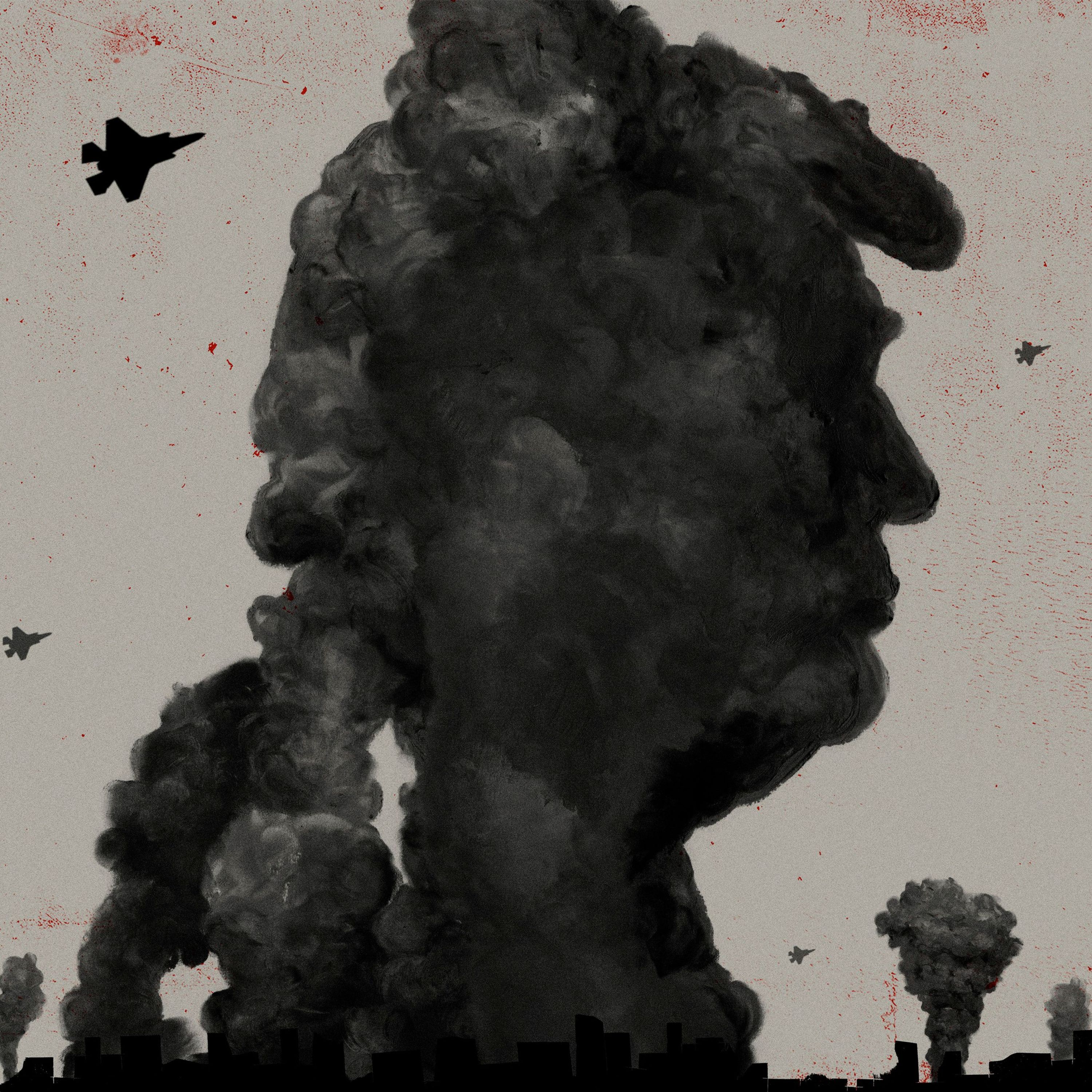
The New Yorker Radio Hour
The Global Fallout of Donald Trump’s War on Iran
00:31:19
As the conflict rapidly spreads throughout the Middle East, the New Yorker writers Dexter Filkins and Robin Wright discuss the stakes for Iran, the U.S., and the rest of the world.
Loading summary
Transcript60 lines
- [00:03]
Narrator/Producer
This is the New Yorker Radio Hour, a co production of WNYC Studios and the New Yorker.
- [00:12]
David Remnick
Welcome to the New Yorker Radio Hour. I'm David Remnick. Last week, Donald Trump launched a war against Iran. And in the days that followed, the administration's rationale has shifted on a nearly daily basis, talking with one reporter after another. The president and his advisors as well as seem to road test ideas and potential outcomes in public, frequently contradicting one another. The administration seems to want things both ways or all ways. Pete Hegseth scoffs at nation building, calling that concept dumb. No more endless wars, he says. And yet Donald Trump apparently wants regime change, an entirely new government in Iran, and he won't rule out boots on the ground.
- [00:58]
Interviewer/Host
J.D.
- [00:58]
David Remnick
vance says Trump won't allow a long war, while Trump himself muses that we have enough weapons to fight forever. There is a very familiar and ominous ring to all of this. To understand where this war may lead for Iran, for the Middle east and for the United States, I called on two of my colleagues with decades of experience covering the region. Dexter Filkins has reported from all over the Middle east and much of the world and his best selling book, the Forever War is a defining history of our campaigns in Iraq and Afghanistan. Robin Wright has reported from Iran extensively over the years and she even met with Ali Khamenei before he became the supreme leader of Iran. Rock the Kasbah is Robin's book about the Arab Spring. After the war began, I spoke with Robin Wright and Dexter Filkins. Well, here we are five days into
- [01:56]
Interviewer/Host
this war and last week I had on the program somebody you both know, Karim Sajjadpour, who is an Iran expert. And very subtly, Karim said a few things. One was that he didn't think it was necessarily a great idea to Martyr an 86 year old leader of Iran, no matter how pernicious his record. And he also said a lot of outcomes could ensue, but what we are most likely to see is a tremendous amount of chaos. This war has spread all over the Persian Gulf region and now even to Turkey. And I want to ask you, Robin, what did the Trump administration intend? Why did it begin, begin this war?
- [02:45]
Robin Wright
I wish more of us knew more specifics because we haven't had very much. Originally there was talk of regime change and it didn't sound as grand or as dangerous as has played out on the ground. I think the danger is that the United States hoped that there would be a protest movement arising from this that would topple the regime and the prospects of that are very limited. And the danger is that killing Khamenei for some will deepen their passions. This could totally backfire on the Trump administration.
- [03:30]
Interviewer/Host
Well, Dexter, I don't even know what the intention was. I've heard the President of the United States say on day one that this was about regime change. Then I heard the Secretary of War, Pete Hegseth, say, this is exactly not about regime change, and it won't go on forever. Then we had the Secretary of State, Marco Rubio, backtracking comments about who got us into this in the first place. He had indicated to some degree that it was Israel that had pushed the United States in. And then the President of the United States said, no, it's actually quite the opposite. Wouldn't the average American be quite right to be utterly confused?
- [04:11]
Dexter Filkins
Yes. I think the cliche in the military is no plan survives contact with the enemy. And that's certainly clear here. To whatever extent there was a plan, I think the goal is regime change, but it's we'll bomb everything that we can. Everything from we'll take out the leadership all the way down to police stations which they're bombing. So I can sort of see how this is being set up for a moment when I think President Trump can say, okay, we've done our part. Now it's up to you, and we close up and go home and whether the regime is still standing. Then we'll see.
- [04:53]
Interviewer/Host
Jaxa, you covered the Iraq war. To what degree does this resemble your experience and understanding of Iraq, and how does it not follow that pattern?
- [05:05]
Dexter Filkins
Iraq's very different from Iran in the sense that it was a broken, traumatized, very fractious society, heterogeneous, very, very diverse groups at odds with each other. And that had all been held together by the kind of the steel frame of Saddam's dictatorship, which we went in and broke. And when we broke that steel frame, it all flew apart. Iran's a very different country than that. I think what worries me here is that we are destroying the state and we are destroying. We're destroying the thing that held the country together. And so without that, without order, without law and order in the streets, what can be accomplished? And I think that's what disturbs me right now.
- [05:51]
Interviewer/Host
Robin, we've heard from the President of the United States that in his understanding that Iran was preparing to attack American interests, preparing to potentially attack Israel, how credible is it, the notion that Iran was preparing to attack American interests, much less the United States? And so the United States launched a preemptive war.
- [06:15]
Robin Wright
It Sounds like wag the dog to me. And it's a little bit like saying Iraq had weapons of mass destruction, you know, creating a pretext for an attack. I don't think there's any prospect that Iran was going to be aggressive against the United States or American interests, including Israel. After the June war last year, Iran, I think, has been much more careful in making its military calculations. It also has been deeply weakened with whether it's military at home. After the protests, I think the government felt vulnerable. So the idea that it was in this weakened state, militarily and politically going to attack the United States is hogwash.
- [07:10]
Interviewer/Host
Let me ask you this. You had the rare experience, Robin, of having met the late Ayatollah Khamenei. What was he like and what does his death mean for the situation now?
- [07:28]
Robin Wright
Well, we had a working breakfast and I remember being very struck by here, the president then of Iran at the Waldorfer story in New York, set to go off to speak to the United nations, the first revolutionary to come to the outside world. And he struck me as rather unworldly, a bit naive. He spoke in a raspy voice. I was struck when the Revolutionary Guards who were protecting him came over to cut up his breakfast meat because he lost his, one of his arms in a tape recorder bomb in 1981.
- [08:11]
David Remnick
Right. His arm was paralyzed and it was,
- [08:14]
Robin Wright
was a microcosm of how much he depended on the Revolutionary Guards as his political base too, because he came in only as a mediocre or mid level cleric without a power base, except a few of his own followers, and had to build something that would institutionalize him, legitimize him. And he did that through the military. And he managed to hold onto power for 37 years because he could always rely on that military.
- [08:49]
David Remnick
It seems that the state is now
- [08:51]
Interviewer/Host
going to put forward a new supreme leader.
- [08:53]
David Remnick
But it also seems that the most important political player still on his feet is Ali Larajani. Now, this is someone that you, Dexter,
- [09:02]
Interviewer/Host
have had encounters with in the past
- [09:04]
David Remnick
and maybe Robin has as well. Lara Gianni is by no means a
- [09:09]
Interviewer/Host
radical departure ideologically from the regime. In fact, he played a key role in the recent brutal crackdown on protesters.
- [09:19]
Dexter Filkins
I met him for the first time, geez, like 20 years ago. He was a national security advisor to Mahmoud Ahmadinejad, the president then. And I arrived in Tehran very late at like 11pm There was a note at the desk saying, Mr. Larajani will see you in his office at 7am Not a good hour normally, not a good hour. And he'd already been there for a couple hours, clearly bloodshot eyes, very driven man, you could see. And I remember he said to me, he launched into a. And Robin probably has a lot of experience with this, but the first thing he did for 10 minutes was launch into a. A lecture about the glories of Persian civilization. And he said something like, you know, we invented algebra when your ancestors were still, you know, dancing naked on the cliffs of Dover, something to that effect. And so there was a kind of. A. Kind of a cultural chip on his shoulder that he had, but a very serious man. And I think the guy that until recently was running the government day to day. If anybody's going to make a deal, I think it's going to be him.
- [10:34]
Interviewer/Host
We've seen thousands and thousands of people come out into the streets, not just recently, but over the years. This has happened periodically, but the other side has all the guns, and it also has the willingness to kill thousands of people, as we've seen recently. So where does the idea of regime change hit reality?
- [10:58]
Robin Wright
We're likely to end up, at least according to where we are now, eventually, with some kind of rump state that has a new supreme leader that still controls the main levers of power, but is weakened and has a population that may be alienated and angry, very angry, over pocketbook issues. You know, water and electricity are in short supply. Life is unaffordable for a lot of people. So the question is based on the people I've talked to in Iran, whether there is a little bit of momentum, because there is a strong sense of nationalism in Iran that dates back 5,000 years, and they've been attacked by the United States. If there's still a rump state in place, then sanctions will still be in place and there'll still be questions about will Iran try to rebuild its missiles, if not its nuclear program. So US Goals, I think, are very difficult, if not impossible, to achieve. And the danger is that you get a sense of chaos, uncertainty, a leadership in place, and people not willing to protest as much because they've lost relatives in the protests in December and January, and they don't know whether the regime that's left will still use the tools against them. I mean, the one thing everybody's been waiting for is any defection from within either the Revolutionary Guard or the conventional military or the police. And that's, in the end, what brought down the Shah when they refused to shoot at protesters and dissidents. After 14 months of unrest, who knows if that begins to happen as this war Proceeds.
- [12:59]
David Remnick
I'm speaking with Robin Wright and Dexter Filkins, both writers at the New Yorker. We'll continue our conversation in just a moment.
- [13:06]
Interviewer/Host
This is the New Yorker Radio Hour.
- [13:22]
David Remnick
This is the New Yorker Radio Hour, and I'm speaking with two reporters who've covered conflicts in the Middle east going back decades. Dexter Filkins and Robin Wright are both writers at the New Yorker, and they've reported from conflict zones all over the world. We spoke last week about the war that the United States, along with Israel, has launched in Iran. Will continue our conversation now. It always strikes me that there's something
- [13:46]
Interviewer/Host
called a Washington consensus that takes hold not only in the capital, but on cable television and the punditocracy, and the one that I'm hearing all the time now is called Regime 2.0. The idea that the United States and Israel have essentially wiped out much of the upper echelon and that somehow, magically, there's going to emerge a figure who's more accommodating, shrewd, less threatening, and that will have something like Venezuela. Well, clearly, it can't be replicated in Iran if that was the plan. Tell me, Dexter, about this notion of Regime 2.0, where it's realistic and where it's fantasy.
- [14:34]
Dexter Filkins
It doesn't seem realistic to me at this point. I mean, there's no evidence of anything like that emerging. It's possible to imagine that, let's say after the United States has pummeled the Republican Guards and all the police stations, the whole apparatus, there's a moment of calm. Maybe there's months of calm, but at some point, there'll be another uprising, and the people, the crowds in the street can take over, overthrow the government. I can imagine that. But I think the regime 2.0 thing is so, yeah, the shooting stops and the bombing stops, and then out of the rubble emerges a group of moderates who reach out to the United States and are ready to take control of the state. And the state as we know it's going to be in ruins and it may not even be functioning. And there may be more radical people who take charge, not less. Maybe the White House gets lucky and it all turns out well. But our experience in the past is that when you roll the dice like this, with the stakes so high, it doesn't always work out so well.
- [15:47]
Robin Wright
There are a lot of young Nelson Mandelas in Iran. There is no African National Congress, which was the infrastructure for Nelson Mandela to create an alternative. It had existed for years, had, in effect, a game plan, a structure. It Had a kind of militia. If the US Wants to see something change, the protests to emerge, it's going to take a while. We're creating a kind of uncertainty with an ill defined endgame that that makes us vulnerable as well as the many countries that Iran has hit.
- [16:31]
Interviewer/Host
Dexter, you speak to people in the Pentagon and other government agencies. Tell me about your impression of Iran's
- [16:39]
Dexter Filkins
military strategy right now as you see the missiles coming out of Iran and going all over the Middle east and all over the region. I think there's a kind of. There's a race going on right now. The Pentagon is going as fast as it can to destroy Iran's missiles, and Iran is trying to launch as many as they can as fast as they can. And who's going to win that race and what's going to get hit in the meantime? And is an oil tanker going to be sunk? Are oil refineries going to be hit? All of which would push the global economy potentially into a recession or something worse?
- [17:20]
Robin Wright
Absolutely. When you think that the Strait of Hormuz, through which one fifth of the world's energy supplies flows, is closed, any US Ship, US Flagship tanker of any nation goes through it has to get permission of the Revolutionary Guards that control the Strait of Hormuz. And Dexter's right, this is going to end up being a global war. And you can already see countries that didn't want to have anything to do with the Epic Fury campaign or the Roaring lion campaign suddenly are sending their warplanes for defensive purposes. Britain, France, Greece has sent fighter jets to Cyprus. That this is already having global impact very quickly, whether it's economically or militarily. And then the question becomes, what's the fallout politically across the world as well.
- [18:20]
Interviewer/Host
You both probably remember when Bill Clinton was in office, he had a meeting with Benjamin Netanyahu, the near eternal prime minister of Israel. And Netanyahu was so imperious with Clinton in this particular meeting that Clinton stormed out and said to one of his aides, wait a minute, who the hell is the superpower here? And Clinton was not the only US President to feel this way. In fact, I think all of them at one time or another have felt this way. What's the influence, Dexter, of Benjamin Netanyahu on this whole operation? Who says he's been waiting? He says he's been waiting 40 years for this moment.
- [19:02]
Dexter Filkins
It looks like it's pretty significant. I mean, there was a moment just a couple days ago when Secretary of State Rubio kind of let it slip and said, well, we had to Go, because if the Israelis were going to go, and they told us they were going to go whether we win or not, and if the Israelis go, then the Iranians were going to hit us. Now, he's since backpedaled from that at 150 miles an hour, but that sounds remarkably like that. The timing of this war was started not by Donald Trump, but by Benjamin Netanyahu.
- [19:35]
Robin Wright
This was clearly an Israeli initiative that Bibi Netanyahu got Trump to go along with. Remember, the United States had been engaged in negotiations, which, again, I thought were almost absurd. You have a Florida real estate dealer and the President's son, who has no title within the administration, neither knowing Iran, trying to deal with a very complicated issue. The last JCPOA Joint Comprehensive Plan of action, negotiated for two tough years by the Obama administration, was 159 pages long. They brought in nuclear specialists from Oak Ridge and Livermore Labs and. And the Iranians brought their counterparts in. And Trump assumed that in three sessions, you could just get the Iranians to say, we'll give up everything nuclear, and then you've got a deal, which is terribly naive. Iran actually has a right to enrich uranium under the National Non Proliferation Treaty for peaceful nuclear purposes. Now, we all believe that they were doing more than that, but that was partly as a reaction to the sanctions.
- [21:01]
Interviewer/Host
But in fairness, if we all believe they're doing more than that, why should it take more than an hour for Iran to say, you know what? We'll give him up?
- [21:10]
Dexter Filkins
Well, but I think that's. I mean, Trump doesn't negotiate. I mean, Trump said essentially, your options are capitulate or be attacked. He went into it thinking there were only two possibilities here and there's nothing in between. So if there's nothing in between, then, yeah, here we are.
- [21:27]
Interviewer/Host
Can I remind you of one thing? Last June, the President of the United States told the world that the United States had obliterated, obliterated Iran's nuclear program. More recently, he told the world that Iran could have an icbm, an intercontinental ballistic missile, capable of hitting the United States, which, unless I'm wrong, is totally untrue. And this is a tremendously politically unpopular action at home that has also split up Trump's own base, the MAGA base. Where do American domestic politics fit here?
- [22:08]
Dexter Filkins
Can you imagine if, God forbid, if the United States lost a ship or took some real heavy casualties, I think apart from how tragic that would be, I think whatever domestic support there is for this would collapse. And part of that, we have to go back to the beginning Here, which is Congress wasn't asked in any meaningful way. There certainly was no declaration of war, despite Article 1 of the Constitution. There wasn't even really. The president didn't give an address to the nation. There was no kind of congressional resolution for the use of force. This is Donald Trump's war. And so he. He's out there alone, and if it goes well, it's great for him. But what if it doesn't?
- [22:56]
Robin Wright
Once we get the costs of this war, whether it's the loss of lives. But for Americans who care most about their pocketbooks, right now, that we're talking about tens of billion dollars already. And remember, Afghanistan and Iraq cost us trillions. We have two aircraft carrier groups, 15 destroyers, basically 1/3 of US naval power and almost half of all US air power now deployed for this Iran operation. This is militarily becoming complicated, and I think there's a race to get it done so some of those ships and warplanes can be deployed elsewhere. This will also be a big pocketbook issue, and that's likely to have a profound impact in November this year, in the midterms as well.
- [23:56]
Dexter Filkins
If you look at, for instance, Qatar, the little state in the Persian Gulf, one of the largest producers of natural gas in the world, just basically turned all the spigots off. And they're a big supplier, the major supplier for Europe, which took the place of Russia in supplying natural gas to them. This is going to start to reverberate through the global economy. And we may not feel it today, but we will certainly feel it soon.
- [24:23]
Interviewer/Host
One of the understandings we had of Donald Trump since he first emerged as a major politician in 2015, going into the 2016 race, was America first, no more forever wars. How was that part of Trumpism abandoned so readily? And this is not the first time. I mean, he's been in office now for. For one year and change. And there's been American bombings of any number of countries.
- [24:54]
Robin Wright
Nigeria, now Ecuador, the campaign to take Greenland that had the Europeans hysterical. Iran, you know, you think about him trying to come up with a plan for Gaza. And so he has become a foreign policy president in ways that I think MAGA folks never fathomed. And that's where he getsbesides. The Epstein files gets the biggest headlines. These aggressions, some of them, many of them even unnecessary or almost whimsical.
- [25:34]
Dexter Filkins
We've all watched in Trump's first year in office, he's gotten everything he wanted pretty much, and certainly he's gotten basically a blank check from the Republicans in Congress, and from the US Senate in particular, everything he wants, no objections. Does that begin to change as the polls begin to change? And does that begin to change if this war goes bad? Do we see the Senate, the United States Senate, come back to life and begin to assert its powers?
- [26:08]
Interviewer/Host
Well, here's a Senator Lindsey Graham of South Carolina has said Cuba is next. They are going to fall. Now, Dexter, should we expect to see military action in Cuba pretty soon?
- [26:21]
Dexter Filkins
Well, I think in some ways this helps answer the question as to why Trump moved on Iran because he had a great run abroad. He took out Nicolas Maduro in a few hours. He took out the Iran, we thought he obliterated the Iranian nuclear facilities. And then, you know, certainly the buzz in Miami is Cuba's next. There's pieces moving around. They're looking at old airstrips they can use. My sense is now all that's on the shelf that they've bitten off, if not more than they can chew, than at least as much as they can handle for now. So it's kind of hard to imagine that, that we would try to do that. We would put more on our plate at this point.
- [27:06]
Interviewer/Host
If I'm Xi Jinping in China and Vladimir Putin in Moscow, how am I looking at the American action, the Trumpian series of actions that have taken place in just 14 months? How am I understanding my leeway on Taiwan or my continuing war in Ukraine?
- [27:28]
Robin Wright
Xi Jinping is laughing all the way to the bank because Trump has violated the UN Charter, which says no member country will challenge another besides the Constitution. This is in the eyes of the international community. Trump has basically changed the international order by violating its tenets. And so not just Xi Jinping and Vladimir Putin, there may be others who feel they can challenge a neighboring state because it's the United States, because it's the country who rescued the world at the end of World War II and has been the policeman of the world. And this action, for better or for
- [28:16]
Interviewer/Host
trouble, often for ill, Absolutely.
- [28:19]
Robin Wright
But the United States has been, at least since the end of the Cold War, the singular
- [28:26]
Dexter Filkins
power.
- [28:27]
Robin Wright
And with that sense of projected, anyway, righteousness, and it's violating all of that.
- [28:37]
Dexter Filkins
I agree with that. But let's say a month from now this is under control, let's say, and however far fetched that may appear to be today, then I think the world does look kind of different. And I think if you're Xi Jinping, you think, God, you know, the Americans mean business when they say they're going to enforce a red line, then they really do it, and you could imagine that it would give Xi Jinping pause. At the moment it looks pretty rough, pretty rocky, but we're still in the middle.
- [29:09]
Robin Wright
One thing that worries me is when you say when this ends, and I don't think this ends even when the guns stop.
- [29:18]
Interviewer/Host
How do you do that?
- [29:19]
Robin Wright
I think that those in Iran who were willing to do a deal have tried it twice, only to have diplomacy aborted midstream by military attacks. So this is where the end game, as we discovered in Iraq and Afghanistan, is never neat and never ends up easily or quickly as we had hoped. When historians write their books about this era, they will look at the United States in terms of our track record in the early 21st century, our utter failure in Afghanistan, the initial experience in Iraq when we decided to withdraw after under the pressure of an insurgency that became isis. It's not just the war in Iraq, it's the first quarter of the 21st century where we haven't managed to achieve very much in terms of our military goals.
- [30:19]
David Remnick
You can read all our coverage of the war in Iran and more from Robin Wright and dexter filkins@newyorker.com I'm David Remnick. That's our show for this week. Thanks so much for listening and see you next time.
- [30:36]
Narrator/Producer
The new yorker radio hour is a co production of wnyc studios and the new yorker. Our theme music was composed and performed by meryl garbus of tune yards, with additional music by louis mitchell. This episode was produced by max balton, adam howard, david krasnow, jeffrey masters, louis mitchell, jared paul and ursula sommer, with guidance from emily botin and assistance from michael may, david gable, alex barsch, victor guan and alejandra decken. The new yorker radio hour is supported in part by the cherina endowment fund.