Loading summary
Transcript58 lines
- [00:00]
Progressive Insurance Announcer
This message comes from Progressive Insurance. Progressive makes it easy to see if you could save when you bundle your home and auto policies. Try it@progressive.com Progressive Casualty Insurance Company and affiliates. Potential savings will vary. Not available in all states.
- [00:20]
Sarah McCammon
Hey there. It's the NPR Politics podcast. I'm Sarah McCammon. I cover politics.
- [00:24]
Danielle Kurtzleben
I'm Danielle Kurtzleben. I cover the White House.
- [00:26]
Sarah McCammon
And NPR's chief economics correspondent Scott Horsley is here, old friend of the show. Hey, Scott, good to be with y'.
- [00:32]
Podcast Promo Announcer
All.
- [00:33]
Sarah McCammon
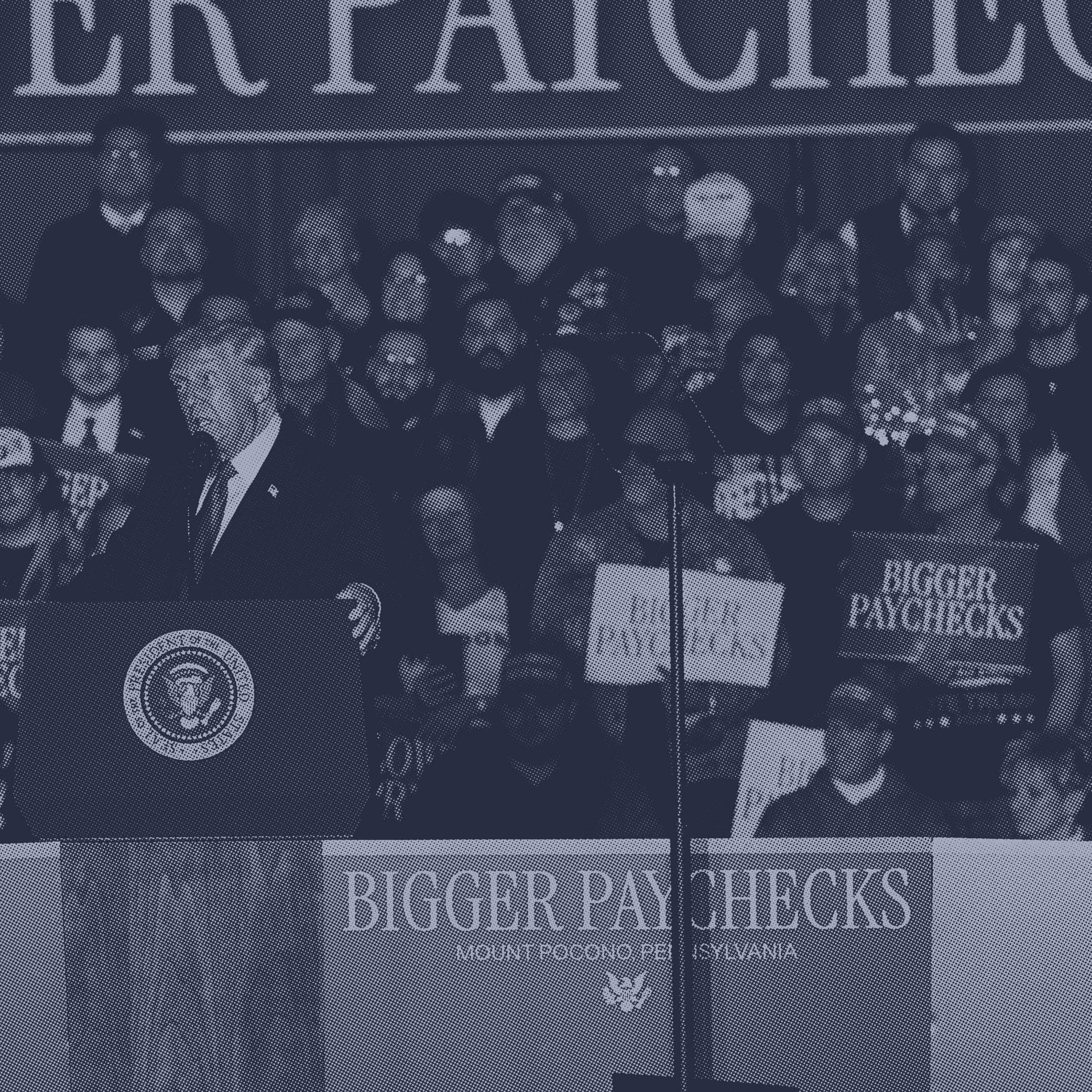
Today on the show, we want to talk about the economy. This year under President Trump, economic concerns were a huge part of why he was elected and they continue to be on voters minds today. And if you ask President Trump, he's been doing a good job so far.
- [00:47]
Danielle Kurtzleben
But I do want to talk about the economy, sir, here at home. And I wonder what grade you would give a. A, A.
- [00:56]
Sarah McCammon
That was from a December interview with Politico's Dasha Burns. Danielle, let's just start there. Why is the White House feeling so upbeat about the economy?
- [01:05]
Danielle Kurtzleben
I think the White House is so upbeat about the economy because Donald Trump is the president. I mean, Trump is upbeat because he is convinced that his policies are great and that he is the best president, the best leader, all of the superlatives. And so, for example, despite the fact that we know that tariffs have pushed prices higher, Trump and his White House really, really hate to admit that and do their darndest to keep away from saying things like that. And look, his administration is also very happy to point you to statistics that aren't looking too bad. And there are some of those, you know, like the price of gasoline has dropped off a little in recent weeks. Wages are keeping pace with inflation. Broadly speaking, the economy isn't looking bad, or at least not as bad as people seem to be feeling. But we do see in poll after poll that the cost of living is a big worry for Americans. Consumer confidence has fallen. So that's why we're having this conversation. That's where this disconnect is.
- [02:04]
Sarah McCammon
Scott, you spend a lot of time looking at economic indicators, which is why you're so fun at parties. You actually are, that notwithstanding. But, but Danielle just talked about the impact of tariffs on prices. Talk to me about the other data you're seeing. Do the economic indicators support this grade of A that President Trump referenced?
- [02:25]
Scott Horsley
Only if you're grading on a big curve. There are certainly positive signs for the US Economy. GDP has held up fairly well. Consumer spending has been pretty resilient. There's been A ton of business investment, almost all of it in artificial intelligence. There's some concern that maybe that's going to be something of a bubble. But for the moment, there's a lot of business investment. The housing market is still in a slump, the job market is weakening, but it's not a terrible economy by any means. The vibe part of it, though, is that the high cost of living really has people ticked off. And that shouldn't be any surprise to this White House, because it was the high cost of living in the Biden administration that helped put Donald Trump in office. I mean, he talked all the time on the campaign trail about how people were unhappy with the cost of groceries. Well, guess what? The cost of groceries has gone up on his watch, not down. Certainly some items have come down. As Danielle mentioned, gasoline is cheaper, eggs have gotten cheaper, but groceries overall are up, electricity is up. The overall cost of living is higher now than when Donald Trump came into office. And wage growth has slowed down a bit. So, you know, workers just feel like they're working hard and kind of treading water and not getting ahead.
- [03:49]
Sarah McCammon
Yeah, this vibes issue was a problem for the Biden Harris administration last year. As you say, it's a problem for the Trump administration now. I mean, how is it that even if on paper the economy seems to be doing largely okay, people just don't feel like it is? What's the disconnect about?
- [04:06]
Scott Horsley
It's the high prices. I mean, that's what people are really unhappy about. And even though inflation has come down a lot from its four decade high back in 2022, prices are still going up faster than most of us would like. The last month that Joe Biden was in office, inflation was 3%. And that's about where it is right now. It hasn't improved very much. And that's got people feeling unhappy every time they open their electric bill and see that it's more than it was. That's frustrating. And they don't feel like the job market is as strong as it was a couple of years ago when we were adding hundreds of thousands of jobs every month. Now we're adding a relatively small number of jobs or in some months, losing jobs. The unemployment rate, it's still low by historical standards, but it's been creeping up. It's especially elevated for young people. While businesses are investing a ton of money in artificial intelligence, I think there's real concern among a lot of people that that might put their jobs at risk. So that's not an unalloyed good. All that investment. That investment's also contributing to the rising price of electricity. There's reasons that people are feeling a little funky, and they're not dissimilar to the reasons that people felt funky in the late, late months.
- [05:28]
Danielle Kurtzleben
The Biden administration also, whenever we're talking about a disconnect between macroeconomic indicators and how people are feeling, I mean, first of all, macroeconomic indicators are just that, they're macro. Right. They don't tell how everyone is doing. And so what you always have to consider in that is that there is some inequality going on. And there was this really fascinating report I was just looking at that came out this month from bank of America that showed, showed that, yes, wages are rising, but bank of America's data showed that high income people are having more wage growth than middle and low income people. So that means that even if wage growth looks good, it doesn't look as good for everybody. And similarly, when you look at tariffs, the costs that are passed through on tariffs are going to hit lower and middle income people more than high income people. So that is also quite possibly a part of what is going on here.
- [06:26]
Scott Horsley
Yeah, I mean, in this case, we have a presidential policy, tariffs, that is directly contributing to the increase in prices. I mean, prices went up a lot under the Biden administration for a whole host of reasons. The war in Ukraine was a big part of it. The reopening of the economy after the pandemic was a big part of it. Certainly the fiscal stimulus with people getting big checks in the mail from the government probably contributed. The government spending probably contributed. But there were lots of complicated reasons why inflation went up in the US and around the world. In the Biden administration, you can point a direct line between Trump tariffs and prices of coffee going up. You know, that's a very simple thing for people to recognize. Donald Trump is a salesman and he is always selling and the product he's trying to sell right now is the economy. But unlike a lot of the stuff he tries to sell, people know what the economy is looking like for them and their families. They go to the grocery store, they know what the cost of milk is. They know what a bag of groceries cost. They're not going to fall for a line that just doesn't match up with their lived reality.
- [07:43]
Sarah McCammon
And, you know, when it comes to prices, I mean, I think it's worth remembering that, you know, about a third of Americans don't have money in the stock market. So even if the stock market is doing well, for example, you know, those Americans are not experiencing that Benefit, but they are feeling what's happening at the grocery stores.
- [07:58]
Scott Horsley
Store. Consumer spending had held up pretty well. But just as Danielle says, with incomes, a lot of that spending, we think is tilted to the upper end of the income ladder. The wealthy people who do feel great because their stock portfolio is in great shape or because their house price has gone up, they're the ones who are doing the bulk of the spending. It's not low and middle income people who are spending. So when we say aggregate spending looks pretty good. Yeah, But a lot of, you know, low and middle income families are really cutting back.
- [08:30]
Sarah McCammon
So, Danielle, in this environment where a lot of people are feeling these prices and feeling pessimistic about the economy, what is the White House doing to try to sell the American people on the idea that Trump's economic policies are working great?
- [08:44]
Danielle Kurtzleben
Well, the White House is trying to do this really, really difficult messaging thing. They are talking about or imposing policies that might help around the issue of cost of living. I'm thinking here about, for example, walking back some tariffs on grocery goods that are not heavily grown in the US Coffee and bananas got talked about a lot in that conversation. Trump has talked about handing out $2,000 checks to everybody. Now, of course, that has not happened yet, but they are making these noises that seem to imply, hey, we know you're hurting and we want to help you. But they also continue to say, hey, affordability is a hoax. Trump has said that multiple times. And so you're trying to do two different divergent things with your messaging and all of that. By the way, it's, it's just so hard not to hammer on tariffs in this conversation because Trump keeps talking about how much he loves tariffs, how heated the tariffs. He really owns them. They're all him. But once again, that means Americans know if they are paying attention, that Trump has this big lever in front of him that he pushed called tariffs, and he could just pull it back and maybe things would improve, but that's not happening. There's one more thing I would add here, is that the White House keeps saying, hey, don't worry, things are fine now, things are great. Of course things are great. But things are going to get really good next year. And down the road, these policies are going to kick in and then just you wait. And they do this on tariffs. They did this with a farm aid plan. But it remains to be seen whether those policies really will actually end up having the intended benefits.
- [10:24]
Sarah McCammon
And if this message continues to not really land the way polling suggested it hasn't, largely so far. I mean, how big of a political problem is that for the president going forward?
- [10:35]
Scott Horsley
Not. Not much of a problem for the president since he doesn't have to run for office again. But it's a problem for every other Republican.
- [10:40]
Danielle Kurtzleben
Yeah. I mean, the president, even if he's not on the ballot in 2026, he presumably wants people in the Republican Party to win because Trump really likes getting his policies pushed through. Well, if this hurts Republicans next year, even if Trump isn't being elected, that still would hurt the president in that sense.
- [11:00]
Sarah McCammon
Okay, let's take a break. We'll have more in just a moment.
- [11:05]
Progressive Insurance Announcer
Support for this podcast and the following message come from Lisa Leesa. Mattresses are meticulously designed and assembled in the USA for exceptional quality. The entire lineup offers premium materials and full body support for restorative sleep. Leesa has been recognized as best hybrid mattress by New York Times wirecutter. Leesa includes free shipping, easy returns and a 120 night sleep trial. Right now you can receive 25% off mattresses. Visit leesa.com and use promo code NPR for an extra $50 off. This message comes from Carvana. Selling doesn't need to be stressful. With Carvana. It's quick, easy and all online. Enter your license plate, get a real offer and get paid. Visit Carvana.com to sell your car today. This message comes from the NPR Wine Club, which has generated over $1.75 million to support NPR programming, whether buying a few bottles or joining the club. You can learn more@NPRWineClub.org podcast must be 21 or older to purchase.
- [12:10]
NPR Fundraising Announcer
What if public radio stopped sounding like this?
- [12:13]
Progressive Insurance Announcer
Live from NPR News in Washington, I'm Nora Ramm.
- [12:16]
NPR Fundraising Announcer
And started sounding like this. NPR is doing everything possible to keep this trusted and free public service going with your support. We will not be silent. Please give today@donate.NPR.org thanks.
- [12:34]
Sarah McCammon
And we're back. I want to talk about one of the cornerstones of the president's economic policy, which, as we have said, is tariffs. He's repeatedly said that tariff is one of the most beautiful words in the English language. Danielle, we've talked about this, but remark just why. Why has the White House backed tariffs so heavily?
- [12:51]
Danielle Kurtzleben
You know, tariffs really seem to fit Trump's worldview. He sees trade and also, frankly, the world, it seems, as zero sum. A trade deficit is bad. A trade surplus is good. If you have a trade deficit, you're a loser. If you have a trade surplus, you're a winner. And he sees the world in Winners and losers. So to me, it certainly just seems to fit how Trump thinks about a lot of things besides that. We know from his first term when he talked about this quite a bit, that Trump does not like the idea of multilateral trade deals, big trade deals where you get a whole bunch of countries together and come up with a big trade agreement you can all agree on. He likes bilateral trade deals. And what he likes about that is the negotiating. He likes the one on one thing of going into a room doing the art of the deal, as he might put it, and quite frankly, strong arming other countries into doing what he would like them to do. We have seen that some this year with him writing letters to different countries saying, hey, guess what, I'm going to impose a tariff of 25% on your goods now, come talk to me and maybe we can come to an arrangement. I think the one other thing I would add is that unlike a lot of other economic policies he could do, Trump has, at least for now, found a way to do tariffs according to his whims. He with the IEPA tariffs, the International Economic Emergency Powers act, those tariffs that he is putting on particular countries, he can do those pretty much when he wants to. Now, the Supreme Court might at some point here say, no, you can't, Mr. President, but for now, he can do as he likes with those, and he very much has.
- [14:29]
Scott Horsley
Yeah. As Danielle said earlier, you know, Trump owns this tariff policy. This was not a tariff policy that was adopted by Congress. This was not a tariff policy that was put to vote the American people.
- [14:39]
Sarah McCammon
This is not a leftover from the Biden administration.
- [14:42]
Danielle Kurtzleben
Right.
- [14:42]
Scott Horsley
Yeah. This is Trump single handedly issuing orders and deciding what the tax rate should be on virtually everything the U.S. imports. And right now, that tax rate is many times what it was at the beginning of the year before Trump came back into office. We have had the President tacitly acknowledge finally that Americans pay these tariffs. When he rolled back some of those tariffs on things like coffee and bananas that we don't produce in this country, he was basically acknowledging what economists have been saying all along, which is that it's not China that pays the tariffs, it's not our foreign trading partners that pay the tariffs, it's American importers that pay the tariffs. And in many cases, they pass some of that cost or all that cost on to the end consumer.
- [15:24]
Sarah McCammon
So we've talked about the downside quite a bit, the impact on costs to consumers. What about the upside? I mean, how much revenue are these tariffs bringing in? According to the White House.
- [15:33]
Scott Horsley
Well, they're bringing in about $30 billion a month for the federal government, but they're not bringing that in from, you know, space or from other countries. They're bringing it in out of the pockets of businesses and in many cases consumers here in this country. So it's just another kind of tax. You know, that's $30 billion in taxes that this president has unilaterally imposed on the American economy.
- [15:57]
Danielle Kurtzleben
And by the way, Trump likes to say that tariffs are bringing in trillions of dollars to the country. Well, if we're talking tariff revenues, no, they're not. Like $30 billion per month. That's what we're getting right now. As of October, according to the Tax foundation, that's a right leaning think tank here in D.C. there were $205 billion of tariff revenue brought in. So the next time Trump says these are bringing in trillions of dollars, just keep that number in mind.
- [16:24]
Scott Horsley
I mean, he's talked about using the tariff revenue to replace the income tax. It wouldn't come close to replacing the income tax.
- [16:31]
Sarah McCammon
How does the revenue brought in compare to the increased cost of goods that businesses and consumers are facing?
- [16:38]
Scott Horsley
Well, it's one to one. I mean, every one of those $30 billion a month is coming out of the pockets of some business here in the United States. I remember talking to a coffee importer in Amarillo, Texas, who said, you know, the sad thing about the tariffs, the worst thing about the tariffs is we've had to raise our prices to cover the cost. And none of that money is going to the coffee growers in Central America or the roasters here in the United States or the baristas who were serving coffee in that shop. And he said, it's just a tax and it feels like we're lighting money on fire.
- [17:12]
Sarah McCammon
So sorry if I'm being dense here, but where is it going exactly?
- [17:16]
Danielle Kurtzleben
The basic mechanics of it are when a ship arrives at the Port of Los Angeles or something, let's say, carrying a big shipment of coffee beans, then the company importing the coffee pays a bunch of money at that point to the U.S. government. And so this is the idea here. The company's bringing the goods in, give the money to the government, but then that company has just handed over a big chunk of money that they haven't handed over before. So how do they make up for that? They come to consumers and say, hey, how about you pay more for coffee? And that's how the money works its way through the chain here. Which also, by the way, means that when you hear the president and his administration talk about, well, maybe we could give $2,000 checks to the American people. What you're doing is just kind of completing the circle there, except very inefficiently. You just took this money from people and now you're saying, well, we're going to give some of it back. Then what was the point in the first place?
- [18:13]
Scott Horsley
One of the sectors of the economy that is supposed to be the beneficiary of this is US Manufacturing. The idea was, well, if the importer has to pay 10 or 20 or 30 or 40 or 50% more for that product that we're going to get from China, maybe they'll open a factory here in the United States and build it. That's the theory that the administration has.
- [18:35]
Sarah McCammon
Advanced in order to avoid that tariff.
- [18:37]
Scott Horsley
Exactly. We have seen very little evidence of that. And in fact, every month I get reports from the factory sector where they say these tariffs have been a nightmare for them. But even with that extra cost, it's still cheaper to bring in the product from China or Mexico or wherever else. So they're not moving their manufacturing back to the U.S. the factories here are simply losing money that then they're not able to invest in their own operation or their own workers. And so we've been losing thousands of factory jobs in the US during this tariff regime, even though domestic manufacturers are supposed to be the ones who benefit from this scheme.
- [19:17]
Sarah McCammon
Is there any world in which the administration would look at this and go, this isn't working, and back down?
- [19:23]
Scott Horsley
Well, they have done it. In some cases, they have backed down a little bit, you know, not a whole lot. But they've finally realized that no matter how high you put the tariff on Brazilian coffee, we're not going to start growing coffee in Iowa. You know, no matter how much of a tariff you put on bananas from Ecuador, we're not going to start growing bananas in Louisiana.
- [19:43]
Danielle Kurtzleben
The interesting thing is going to happen again when that Supreme Court decision comes down about those country by country tariffs Trump has imposed. If, and it's a big if, the Supreme Court says these tariffs are unlawful, the administration would have an off ramp there if they wanted to just kind of slowly back away and say, all right, well, we tried. Our tariffs are unlawful. But the administration has also suggested that, well, there's a whole bunch of other laws we could use to impose tariffs. So at least then they would have a decision point where they could pick more tariffs or no more tariffs. And so I think that's going to be what I would watch for. All right.
- [20:22]
Sarah McCammon
Let's leave it there for now. Scott, thanks as always for being with us.
- [20:26]
Scott Horsley
Oh, it's great to be with you.
- [20:27]
Sarah McCammon
I'm Sarah McCammon. I cover politics.
- [20:29]
Danielle Kurtzleben
I'm Danielle Hertzleben. I cover the White House.
- [20:31]
Sarah McCammon
And thank you for listening to the NPR Politics podcast.
- [20:42]
NPR Fundraising Announcer
What's the best Christmas gift you've ever received? Was it the laughter of your children? The love of a good friend? A smile on your partner's face? Yeah, well, we're not talking about any of that nonsense. We're talking about actual, tangible Christmas presents, that one toy you found waiting for you under the tree and still think about from time to time. Listen to Pop Culture Happy Hour in the NPR app or wherever you get your podcasts.
- [21:03]
Podcast Promo Announcer
AI Data centers use a lot of electricity and you may be paying for it.
- [21:09]
Danielle Kurtzleben
I think it's almost inevitable that ordinary people are going to end up subsidizing the wealthiest industry in the world.
- [21:17]
Podcast Promo Announcer
On the latest Planet Money podcast, how data centers might be hijacking your electric bill. Listen on the NPR app or wherever you get your podcasts. Hi, I'm Zach Mack. You might have heard my series Alternate Realities on embedded. In it, my dad bet me $10,000 on 10 conspiracy theories. He lost, but it turns out he wasn't done trying. I can't believe you want to do this again.
- [21:43]
Scott Horsley
Hey, I gotta win my money back, right?
- [21:46]
Podcast Promo Announcer
This time things went very differently. Listen to Alternate Realities on the Embedded podcast from NPR.