← The OCD Whisperer Podcast with Kristina Orlova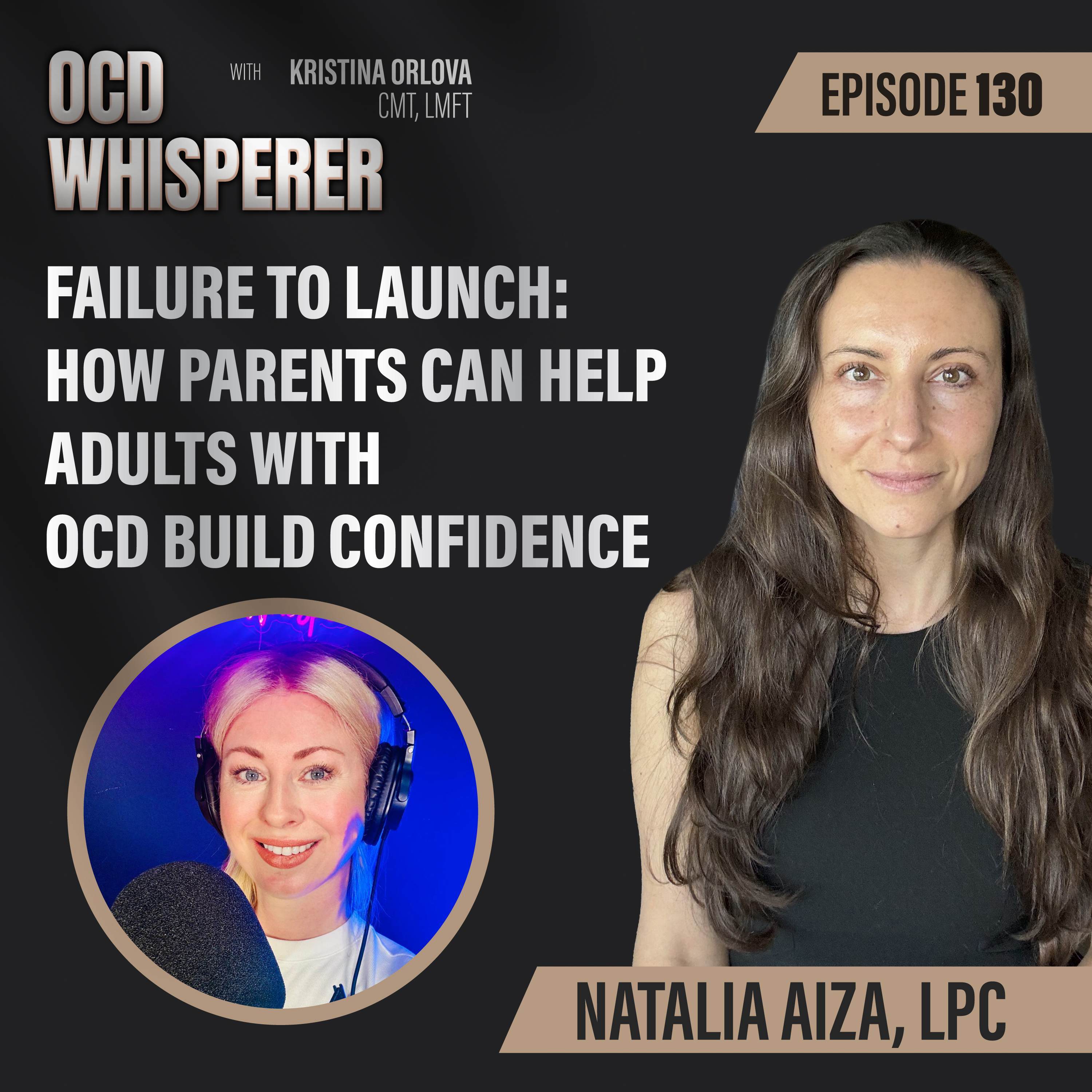
The OCD Whisperer Podcast with Kristina Orlova
130. Failure to Launch: How Parents Can Help Adults with OCD Build Confidence
00:23:39
Loading summary
Transcript29 lines
- [00:02]
A
Hi, I'm Christina Orlova, host of the OCD Whisperer podcast. As someone who lives with ocd, I understand the struggles firsthand. If you're here, you're not alone. Before we start, grab your free OCD survival kit at www.corresults.com to help you take control. That's K O R results.com now let's.
- [00:27]
B
Dive into today's episode.
- [00:31]
A
Welcome to OCD Whisper. Today with me, I have a special guest, Natalia Aiza, who is an LPC and a seasoned therapist, parent trainer, writer, and entrepreneur. Her core missions are to facilitate awareness and healing for those with OCD and to amplify OCD competency among mental health practitioners. She's the co founder of Kairos Wellness Collective, an innovative therapy center that specializes in OCD and anxiety disorders. In the last three years, Kairos has expanded to four locations in Colorado and and has served over 2,000 families and individual clients. Welcome to the show.
- [01:03]
B
Thank you so much for having me.
- [01:05]
A
So, Natalia, you and I actually briefly connected and talked about this whole concept of failure to launch and ocd, and I just think it's a very interesting intersection of those two things, and I'd love to just kind of dive in by asking you the first question is, you know, for anybody listening today, can we explain a little bit of what is failure to launch really mean before we kind of get into the OCD parts?
- [01:28]
B
Absolutely. And I want to use the term failure to launch just to explain for our listeners who we are targeting this to or who we're talking about. However, then I want to discard that. That term entirely because it is a highly stigmatized term. There isn't a lot of agreement on what it actually means. And for me, I prefer to use the term highly dependent adult children. That actually captures what we're see in this community. So failure to launch, definitionally, or the community that we're speaking about right now, definitionally, is young people between the ages of 20 and it can be 50, it can be 60, who are not only cohabitating. The cohabitation piece can happen culturally and it can happen in a healthy way, but they are dependent on their parents for money, housing, and most importantly, emotional stability. So there is, you know, counting on your parents in the way that many adults do. And then there's the maladaptive version of that where you actually would not be okay, you would not be able to function or thrive if your parents were not in that position of assisting you. In these cases, we see a lot of individuals with OCD and the Debilitation caused by the OCD is actually what is keeping them in that orbit of their family of origin. And once we actually treat the ocd, then they can do the proverbial launch. They can actually move on from being highly dependent on their parents. However, the OCD is what really gets in the way.
- [03:24]
A
Yeah. And, you know, I do have to say I've certainly encountered so many families over years of just practicing and myself, you know, treating OCD patients. And a lot of times there is a lot of kind of conversation from family and parents especially, like, what do I do? How do I help? How can we get the kids that are. My kid doesn't see this as a problem or they don't want to. Right. So, you know, everybody, I think, is at different stages of where they are in terms of the person with OCD and kind of what they. They might perceive as an issue or not. And, you know, often hearing things like, can you convince them? How can you. How can you get them to, you know, move forward? I really want to see them succeed. So, yeah, like, what would you say to all of that? How do you address that? Or what's your thought process?
- [04:04]
B
Yeah, I mean, this is actually the community that I'm writing a book for, because so many parenting therapy books are targeted towards parents of young children, and we really do need to support parents of adult children. There's a huge lack in the therapeutic community of providing concrete guidance for these parents. So to these parents, I would say many of the principles of Dr. Leibowitz's space program do apply to this community. In fact, he is conducting a lot of research currently on the ftl, the highly dependent adult children community. He says that is in the millions. He is seeing it as kind of the next big community that we're going to need to support as therapists. And so I would say help is out there. Were developing the mechanisms to create these accommodation plans for parents of adult children as well, or accommodation reduction plans. However, it is all new. It's newly being studied, it's newly being developed.
- [05:21]
A
Got it. Yeah. So, because I guess when you're saying that, like, I'm thinking about when we've generally, you know, CD therapy would talk about, you know, working with a family to help reduce accommodations. Kind of what I'm hearing is we haven't yet, though kind of done enough research to say, hey, here's like an evidence based approach of how we can target that or that can. That really shows consistently over time, some success.
- [05:42]
B
Yes. And that's what Dr. Leibowitz is currently working on. There are some papers out. He is starting to commence a training for working with parents of this community. The ideas are the same. It's, you know, reduce your accommodations, do less for your child, support less and you empower your adult child to feel like an independent adult. The complication comes from the fact that many of these adult children, those neuropathways have been set, especially those that are in their 30s or 40s. That sense that they cannot, that sense that they are incapable of functioning as independent adults has been coded quite clearly. And there's no longer that same sort of societal structure of when you go out on your own, when you push through a lot of those like societal markers of you're 18, you're an adult now and you're still not, you know, thriving independently. The next question becomes how to even time and motivated and how to create a launching structure that doesn't feel infantilizing or disingenuous to the adult child.
- [07:08]
A
And so what have you found so far? What are some ideas or thoughts about that?
- [07:13]
B
So what we create is a version of a family contract. We have each adult member of a family system come up with their main goals. So I just did a bunch of them on January 1st, actually sort of renewed goals of when and how we are going to gain all of the different pieces of independence in order to start thriving. We create a more realistic timeline as well. So for example, if the exposure is going to be to living alone, we would first practice being alone in an apartment for two hours, alone in an apartment overnight. We would practice these, whatever the steps are that are needed. We're going to break it down into many smaller pieces and really deliberately figure out where, where things break down for the child. Most often it's a financial issue. And of course the cost of living is enormous and there are many times where financial independence is very difficult for anyone. However, the inability to consistently keep a job in the OCD community can lead to sort of chronic, chronic inconsistencies financially which then can make the idea of launching and subsiding on your own earnings feel impossible. So we also have to create budgets, we have to create monetary goals as well. Gets very practical, this type of coaching and therapy.
- [08:54]
A
Yeah, that's kind of what I'm picking up because I mean I, I think we can all address that just in general, right? Current modern day life, you know, with, with work, with AI, with all the things happening, right. Like getting a job period. You know, there's challenges and then of course if you have OCD and that's you know, really keeping you from being able to be consistent in showing up for work. Right. To get some sort of consistent income. That's another layer. Right. So yeah, that sounds like a pretty big kind of hefty goal to take on. But not impossible. I mean I, I certainly don't think anything's impossible. But I guess as we're saying this, you know, one thought that comes to mind, you know, is when you have, let's say the highly dependent adult child who, you know, really kind of isn't motivated to do any of these things. Right. Because I think that's the most common barrier that I hear time and time again is can you parents, can you somehow magically convince that adult child to seek treatment or do something and yes, kind of. What's your thoughts on that?
- [09:56]
B
Well, I mean I think that's, that can be everything. The dependence feels comfortable. The dependence feels familiar. The motivation to go out there and hustle and you know, only relying yourself feels, not only does it feel impossible, but feels very uncomfortable, very undesirable. Why would I do that if right now my life is okay, My life feels good. There's always food in the fridge. There's always someone to talk to when I'm feeling frustrated. Unfortunately, the cure here is that parents who really do want to motivate their child to differentiate and launch, they need to make the family of origin home less comfortable. They need to make it less desirable. This is going to be a struggle sometimes because we're re patterning the parents attitude and like what their relationship is supposed to be and for us as parents. And my oldest is 18, so I'm not quite in this community myself. But we do have some loss that happens when our child differentiates and launches. And so sometimes we have to handle our own attachment or maladaptive attachment at the same time that we're supporting our child and, and realizing they can do it without us.
- [11:34]
A
Yeah, immediately when you said that and, and I love that you shared your personal example and thank you for that because yeah, I think there is kind of can be a challenge. Right. If you're a parent and you love your child. So everything in you is all about taking care of them, make creating safety, creating comfort, soothing. And as we all know, you know, what's interesting with OCD is when we're doing that at some point that can become compulsive and parents can be ending up co compulsing, you know, with their child, not realizing that that is happening. And then to feel like you have to cut Some of that off can feel really counterintuitive and like, oh my gosh. But my kid is struggling. Like I'm looking at them visually struggle and you're telling me to reduce or not step in right away. Yeah. So kind of what would you. For any parents listening and even, you know, if they're adult kids listening right now, like, what would you say to either one of those, like, what's something that you want to really remember or kind of carry with you internally, you know, if and why? Let's say you are going to use a strategy like this. I'm assuming it's not going to be like you're going to just do it out of left field. You're going to obviously prepare and talk about it.
- [12:42]
B
Yeah. So just like exposure hierarchies, reducing accommodations is a gradual process. We never are, you know, shaking up a family system in such a way as to feel destabilizing to all of the members or intentionally so. We do eventually break the familial homeostasis, but it's important that we do so in a way that preserves the bonds in the family system. However, if I'm speaking to the parents who are listening, I need to remind myself of this all the time as well. But my job is to prepare my children for when I die. If I'm not preparing my children to live on thrive when I am no longer here, then I am not fulfilling my purpose as a parent. And as I see it, I think that when we really look at modern day parenting, it is in my opinion, overly focused on the relationship and not focused enough on, on growth. So our child's bond to us is lovely, but it is time limited. At some point, their bond to us needs to be far less important than their bond to others of their generation, their own children. And this is the way that life functions. So that is what I would say to the parents, to the adults, to the adult children. I think that the main thing that that community needs to hear is that you absolutely can do this. The anticipatory anxiety of breaking dependency on parents can feel so overwhelming. But just like with all ocd, the anticipatory anxiety is lying to you. It's making you feel like the barriers are so much higher than they are and that the difficulty is so much greater than it is.
- [14:50]
A
Yeah, I think that's true. I think that also for folks with ocd. Yeah, you start to form this. These really false narratives and false beliefs about your own capacity and capability. And. Yeah, and I think the truth is that if you're not experiencing something new and getting some new information in. How can you learn? Really? What can you do? Right. Because you're just not going to know. So if you're just doing the exact same thing, there's nothing new happening. It's just going to reinforce the exact same story that you have versus stepping out of some of that comfort. Like you said, you know, taking a step at a time, progressively in a way that feels challenging enough, as I like to say, not so overwhelming that you're just completely flooded. But it has to have enough challenge so that there's growth. Right. That there's. There's something that you're bumping up against.
- [15:38]
B
Absolutely. And I would say in terms of motivation, both parents and adult children will at times lose motivation for this effort. It will happen. It's okay. It's so much easier to stay doing what you're doing. Most of the time with ocd, we have to. We really have to feel worse before we feel better. And so I just want to normalize that. That feeling of just kind of disappoint, like, for the process, because it is a hard, hard process. It's a formative challenge process. And I don't want people to, like, lose momentum or give up trying because they're not sort of like, initially wanting to go forward.
- [16:29]
A
Yeah. And I think, like you said, the other piece too, is recognizing there's a lot of things to learn here. Right. Like, for example, financial literacy. I mean, that's not something that's generally as eloquently and well taught all around. Right. It. It's interesting, but, like, that's one thing I think all of us can, you know, like, do really well with learning more about that. Right. But we. We don't have some of that. So even learning those basic processes, how. How things work in the financial world now that you have to become some, you know, expert, but at least understand, right. Like, what is a budget, what. Why would you, you know, why would you want to look at, you know, what's coming in versus what's going out or things like that? Right. Those are just more practical skills. On top of, of course, you know, the kind of the OCD internal experience with all the fears and anxiety and everything else that comes with.
- [17:15]
B
Absolutely. One of the things that is, you don't really think about until you're in my field is the fact that most cell phone companies make it advantageous to stay on a family plan. And learning to pay your own cell phone is actually the perfect first step to learning how to Be financially literate because it is a monthly bill. If you don't have money for it, your phone gets shut off. There's like an immediate sort of cycle of response. And then you're able to kind of negotiate that, that saving and preparation because it's a thing that is super important to you. So I often tell families, have them start with their cell phone before it's rent. And a lot of brick and mortar jobs, honestly create more adulting skills than anything else I've seen working at a grocery store, doing a job, that the biggest issues are organizing your time, showing up, and interacting in ways that are difficult for your ocd. These jobs can be a gateway. They can be even more powerful than therapy because it's real world exposures.
- [18:35]
A
I love that. First of all, thank you for those two examples. I think they're, they're brilliant, to be honest. And I think that's a great idea of like, yeah, cell phone. Because it's something everybody these days, especially younger folks, are like, I have to have my cell phone. So to take that on or transfer that responsibility onto them and say, okay, well, let's figure out what you're going to do to make sure you can make that payment. And I think you're totally right. If you're, if you're in those kind of other environments, like a grocery store example you used, you do, right. Like, you have to have a little bit of that different social skill to have those smaller interactions and a little bit of that engagement, as well as, of course, obviously, the responsibilities of what it means to show up on time, which means, when do you have to get up? When should I go to bed? You know, the difficulty, of course, is, well, what if OCD is getting in the way of you going to bed at a reasonable time or waking up and getting out the door? But then what do you do?
- [19:25]
B
Well, it will, it'll try. OCD will try to interrupt and get in the way of any progress that you are making. And the key is to sort of respect the structure. So, you know, just like with our therapy sessions, you know, you get charged if you don't show up, you don't earn money if you don't show up. And you will, will get let go if you don't show up. And so you do learn to respect this, the structure, because the structure will immediately give you feedback, right? And it's a feedback that hurts. So, you know, I think that in order to motivate someone with OCD to work, they need to not have a ton of financial support from their family, because that money needs to be the difference between having a working cell phone. And not all of us have difficulty going to work in the morning some days. And all of us with ocd, it can be double or triple. But the motivation comes because we've learned to delay the gratification of doing a compulsion or avoiding because we know that learning long term showing up is going to be far more gratifying.
- [20:46]
A
I love that. That's a really beautiful approach. And I mean, I know people talk about that, but I love how concrete you are with this example and I think that's really helpful. So for anybody listening here today, parents and similarly, you know, adult children, I really would say take that to heart because I just recently made a post. But, you know, human beings are notorious. Notorious. We're so good at, as I said, mental gymnastics. We can create so many rationalizations, why not to, and et cetera. So it's really important to pause and really kind of relook at your own thought process about something that's leading you to believe whatever you're believing. Right. And really check in. Like, is that really true? Right. Or am I just. I've gotten really good at convincing myself of these things. Right. And now that's actually getting in my own way.
- [21:34]
B
And for me, it's always about doing the thing. If you're ever thinking about the thing and thinking about why you're thinking about the thing or analyzing your reasoning, you just need to do the thing. OCD wants us in our heads. OCD wants us feeling like we can think our way out of ocd, which, you know, you and I definitely know we can't. And so really only change and real world experience experiences shakes up your belief system. Those are the only ways that we can really change. We can't think our way into a change.
- [22:15]
A
Yeah, I love that. Well, I want to thank you for your time and for sharing all this information. And so anybody that's listening to us today, how can they find you?
- [22:23]
B
They can just email me. Nataliaairoswellnesscollective.com I compulsively answer my emails. That's one of the ones that I've left. You can also follow me at LetsTalk OCD. I don't focus on this population in my Instagram. However, I do handle a lot of these OCD issues. I do address some of the inconsistencies that can happen for lived experiencers of ocd.
- [22:55]
A
I love it. Thank you so much for coming on the show.
- [22:58]
B
Appreciate you.
- [22:59]
A
Bye, Christina, thanks for listening to the OCD Whisperer Podcast. Remember, Freedom from OCD is a journey and you're not alone. Visit www.coraresults.com to explore self help masterclasses like Sneaky Rituals with Jenna Overbaugh or ICBT Masterclass with Christina and Abe. Don't forget to grab your OCD CBT journal tracker and planner while you're there. If you found this episode helpful, please subscribe, share and leave a five star review to help others find the podcast. Together we can make a difference. Keep going and I'll see you in the next episode.