← The OCD Whisperer Podcast with Kristina Orlova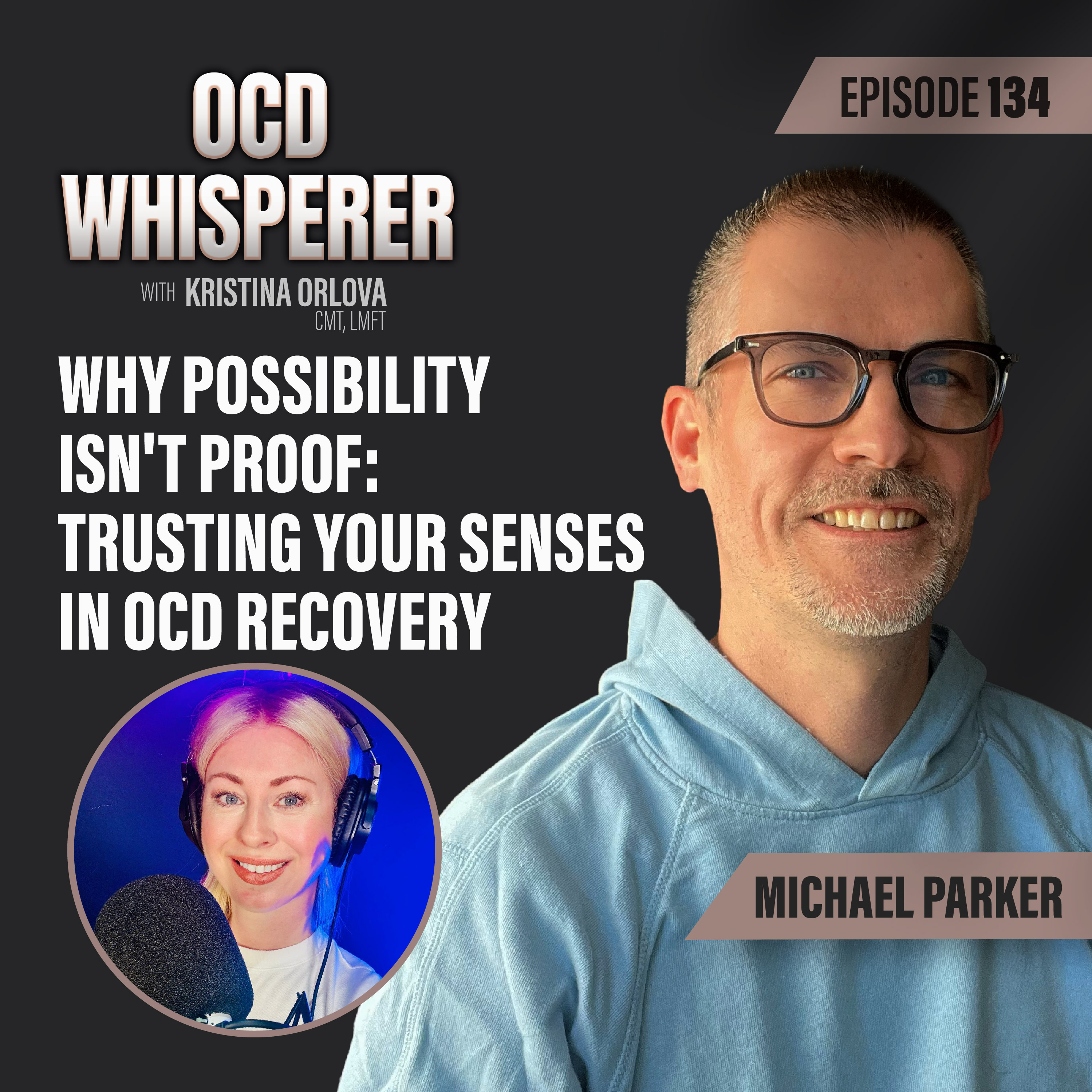
The OCD Whisperer Podcast with Kristina Orlova
134. Why Possibility Isn’t Proof: Trusting Your Senses in OCD Recovery with Michael Parker
00:25:36
Loading summary
Transcript33 lines
- [00:00]
A
You.
- [00:03]
B
Hi, I'm Christina Orlova, host of the OCD Whisperer podcast. As someone who lives with ocd, I understand the struggles firsthand. If you're here, you're not alone. Before we start, grab your free OCD survival kit at www.corresults.com to help you take control. That's K O R results dot com. Now let's dive into today's episode.
- [00:32]
A
Welcome to OCD Whisperer Podcast. Today with me, I have Mike Parker, who's a licensed clinical social worker in private practice in Pittsburgh, Pennsylvania. He's the host of the YouTube channel OCD Space, which focuses primarily on the ICBT approach for OCD treatment. He enjoys providing ICBT as an option for clients with ocd, as well as helping other therapists in the field learn the approach. Welcome to the show.
- [00:54]
C
Thanks, Christina. And I'll say I'm still learning it, too. So it's just constant learning.
- [00:58]
A
It is constant learning, isn't it? Yes. Yes. Let's be honest. Okay. Anybody listen today and right now, tuning in, you know, we both practice icbt. I. I do ERP as well. But, you know, ICBT definitely is. It takes a minute to kind of wrap your head around the concepts and grasp. Yeah. And one of the reasons I reached out to you and wanted to talk to you specifically is because I've seen some posts and I've also seen some discussions you've had about things you can't see, but they know they exist. And this is, I'd say, a little bit for me, slightly personal. More than that, I have a conglomerate of different folks I've worked with over the last two years that I've been offering icbt. And when I put all the different clients together, I'll say there's kind of a general consensus of specifically seems around contamination stuff. I'll just say I'm not for now, because there's other things, of course, but, you know, where, you know, people would say things like, well, but, you know, this stuff is there, right? Like, you know, in park benches, like, there can be people who, you know, or I've seen people who are in that area. Maybe, you know, I have seen some usage of, I don't know, substances, or I've seen people who are intense or something. Like, it's there, right? How. How is it that I can deny that information? Right. Or like, I know people have pets and they clean up after pets, but sometimes, you know, things could be missed and we step on stuff and we walk on stuff. Or maybe I'm at home and Using a bathroom or even surfaces. Like, we do know that there are some degree of germs and things. So it's an interesting conversation because ICB talks about using your senses and kind of other aspects like common sense and knowledge. And, you know, this might be advanced for some folks listening right now, but I'm hoping that we can break this down into, you know, simpler terms to help people understand. How would ICBT address this? If, you know, you do know things are there, but I can't necessarily see it through my senses. What do I do? How do I even wrap my head around that?
- [03:04]
C
Yeah, it's a great question. The first thing I would say is we want to be careful not to try to answer these kind of questions in a very, like, abstract, general sense, because that's where OCD wants you to reason, right? Like, when you just try to answer a question like, well, my senses can't detect anything in this area, so, like, I should worry about this. You know, it's just a very abstract kind of question. And it's true. It's true our senses can't detect certain things, but we have ways of dealing with that. They're already established, you know, as far as hand washing routines or, you know, if it's a religious situation, how much you should pray, what rituals you should do. Those things exist in society and they help everyday people kind of handle that reality that our senses can't detect everything with ocd, we want to make sure that we're really getting into the specific situation our client's talking about, because we know we're really talking about OCD here. And so we've got a client who has a very specific concern. Typically, it could be like dog feces. When I take my dog for a walk, it could be botulism and canned food. It could be something like that. It's usually not just like general, like, all invisible things just drive me crazy. It's. It's a very specific thing. So we're always going to be talking to the client about that issue and then, of course, comparing that to all the areas in life where they are dealing with invisible things just fine without thinking about them. But the other thing we're going to find with our client is they're doing something excessive that they really don't want to be doing too. So. So we have to remind them, the client, well, I get you're arguing the case. You know, why you. You want to think about this invisible thing, but you're also not happy with how you're living right now for Some reason. So we have to probably address that, whether that reasoning is really something you want to keep holding onto or not. And then I think the other thing is that our clients are not just bothered by their rituals. They're really just bothered by being in their imagination so much. It's draining, distressing to constantly be thinking about the poop that's on the park bench. It's exhausting. And it's not fun to just keep going in your imagination all the time. So we want to just kind of lay out that foundation that, like, we have to do something about this reasoning that's really locking you into this doubt right now. This idea that, well, I can't see it, so I should worry about it. What is a different way to kind of think about that? So, you know, what we're going to probably get to is, do you want to keep thinking about what you can't see? And then we get to this kind of ICBT question of like. Or do you want to just trust your senses and trust what you do know and the information you have available? And I think ICBT is a pretty practical treatment. It's got a reputation of being this complicated philosophical thing, but really it's just very practical. It's like, what is reasoning, right? What is healthy reasoning? It's like, it's not getting every piece of information you have available and then drawing the perfect conclusion and knowing everything about your environment. That's OCD reasoning. That's what OCD wants you to do. Healthy reasoning is like, okay, know the limitations of my senses. I know what information I have available, and then ultimately I'm gonna make that decision based on that. So I'm always helping people work on the OCD part of things too. And I think it's okay. I mean, if you don't wanna sit on park benches, don't sit on park benches. That's fine. Like, if you just think park benches are gross, everybody's got a different tolerance, you know, for disgust. And you might just think they're gross, you know, but if there's an OCD part of this where you are getting absorbed in thinking about all the poop particles that you can't, and that's really frustrating you, and you don't want to be living this way. Let's work on that. Let's help you realize you don't need to think about all the things you can't see, and you don't do that in a million other places. You're just doing it with park benches. And if you really want to sit on park benches and stop doing that. Let's realize you don't have to actually concern yourself with what you can't. So you can say that at this point in time, this is the information I have available. And the park bench looks clean. It's got some peeling green and red paint on it. It's cold to the touch. And that's my reality. Why don't I just try staying in reality and just sitting on the park bench and not going into what if, what if, what if? I don't know if that.
- [07:43]
A
Yeah, totally. And I think you know exactly to your point. Right. I mean, I know we opened up with kind of a more broader general. But you're right, right. We. We want to get specific to, well, what is it for you? Because there really is a specific way that people will think about something and kind of apply what they do know. And I will say, you know what I find? It's not like the thought process. There is all kind of disconnected from some truth. There is some elements of truth that are being sprinkled in there. So it makes it really sound and seem very logical. But then this is where there can be stuck points about, well, how much of that information really makes sense right now. Right. And so, like, if. Let's say. Let's talk about for a minute. Let's say a situation where, okay, you know, for example, with COVID things were. Rules were changing, et cetera, but we were kind of all saying, okay, we're going to keep following whatever the protocols are, because that's just what we have right now. Well, here we are now with this. This iteration of where we are, you know, and you're somebody who, let's say, are a little more at risk because of, let's say, age or issues. Right. How would ICBT help somebody sort through something like that if they have OCD and are kind of thinking like, well, no, I feel like I need to do extra and additional wiping all the groceries, wiping all my cabinets, wiping all the floors, washing my hands all the time. If I touch something new, I have to. Because, you know, we know the germs exist. We know that, you know, I'm at this higher risk kind of, you know, than other folks. And God forbid, if I'm somebody who, because of me, this causes somebody else or somebody in my family to get ill. Right. What would you do with that? Even if they say, well, okay, no, I see that. That there isn't there. And I know that I just wiped. Like, I trust that I wiped. But here's this new thing that just came in, or this new item I'm opening, or this. Or I have somebody coming from the outside that, you know, is not necessarily somebody that's always in my home and they're bringing their external things.
- [09:53]
C
Yeah. So that sounds like someone who's really getting caught up in possibility and thinking because something's possible, you know, I should concern myself with it. And we really want to shift to recognizing that you know that. Okay, so your senses aren't perfect, and there's always things that are possible. But is that. Do you want to keep living that way? First of all, you know, is a really important question because you're in a therapy appointment for a reason. Like, you're telling me you're wiping this, and then when the new package comes in, you want to wipe it, but you're also telling your therapist about this. So what is it you don't like about this? Okay. So I just feel like it's excessive. Okay. Yeah. So let's. Let's start there, and let's say that the way out of this is to start to recognize that you're getting absorbed into a new possibility every time a new package comes in the house. And let's figure out the path towards not doing that. And that's just recognizing that there's always some dangerous possibility out there. But you have to make a choice to live a different way. And the choice has gotta be something around. Like, I'm gonna assume I'm okay until I actually get information that I'm not. Okay. And you can put in some precautions. You know, hopefully they're sort of like, you know, so you tell me what you think is excessive. Right. So clearly you're telling me this is a problem. Okay, so you want to cut that, and then you want to cut this out and you want to. Okay, so the path to that is to, let's just say if you do these things, anything beyond that, we're going to call it an OCD compulsion. And let's just say that with each new thing that pops in your life, let's not go into the possibility about it. Let's just say you're going to start taking a new approach to life, which is information telling you you're in danger is actually going to be the thing that tells you to worry about something. And, like, if a new package came into your house and you're feeling healthy right now, and you've done the things that you want to do to keep yourself safe, and it's not excessive, enjoy life and just don't go into the possibility, like, what else are you going to do in life? I know you don't want to live this way. Let's build that motivation to not do that anymore.
- [12:07]
A
Yeah. And I know in icbt we talk about treating inferential confusion. We're talking about really getting clear on obsessional doubts and that those doubts operate differently than kind of the everyday stuff that we might question. Because, you know, everyday stuff we question, we typically, to your point, right, we'll get some sort of information we, we can figure out, like, okay, I think this, or I feel bad about it, I'll do X, I'll do Y. We do it, we move on. We're resolved in that obsessional process that doesn't happen. We. We actually get more disconnected. And so ICBT really talks about, you know, how that process happens and that it's really, it's. It's a way that we're thinking about things. It's a way that we're reasoning so things we're concluding where it leads us to a completely wrong place. And so with something like this, you know, if somebody's just really stuck and they're like, well, okay, like I, I can start to see or notice that I'm getting more caught in my mind. It's not because there's something here now that is necessarily saying anything. What else would you say that they could lean on or would that be enough for them or. Right. Because, you know, I think to your point earlier, too, like, you're saying, look, it's not as overly complex as I think people think, but it is, I think about becoming aware of how this thing works and then having some language to talk about it. So. So that we can, you know, kind of have some agreement. Right, about what's going on.
- [13:33]
C
Yeah, yeah. And so, I mean, the real problem we're talking about here is someone continuously thinking about what they can't see. And that really is ocd, you know, just constantly going into what I can't see. And, you know, I mean, an example, it's not exactly a perfect analogy for ocd, but an example I throw out there once in a while is like, let's just say you bought a new car and you don't want your car to get scratched. Are you concerning yourself with what scratches might be there if you looked at it under a microscope? No. Like, if you see a scratch on your car, you're going to be like, damn, I got a scratch on my car. But you're not. But there's probably all kinds of microscopic scratches. And you don't worry about those. You only worry about the ones you can see, right? Same with poop, right? If you've got poop on you and you can't smell it and you can't see it, who cares, right? So.
- [14:23]
A
That'S all that I'm like, wait a minute, I hear you, but I know somebody listening. I was like, wait, what I care. Wait, that's. That just can't be.
- [14:36]
C
Now, let's make it clear, though. If you really have disturbing amounts of poop on you, you will see it and you will smell it, right? I'm talking about that dust poop that's like three weeks old and was on the sidewalk when a dog pooped, like, three weeks ago, right? And that got on the butt. Who cares, right?
- [14:53]
A
Like, well, that's the question, though, right? How. How then do you help somebody who has OCD recognize, right? Because it's not like we're arguing with it. We're not. But people with that OCD brain, what's. What's. You know, what we do know, right? They could be in that exact situation, see it be like, okay, yes, I agree. Like, I know that, but it's not really that big a deal, and they're able to completely toss it away and move on. And OCD brain is going to say, yeah, but no, wait a minute. But. But it's there and they get really stuck, right? So how. How would I cbt. Look at that.
- [15:29]
C
Yeah. So, you know, I think it's really important to recognize that. I think it's Reed Wilson that talks about OCD as a competitor, right? Like, OCD is a real tough competitor, and this is really hard work. And, you know, there's going to be new arguments by OCD around every corner. And what we're doing is just looking to, like, you know, the thing I like about ICBT is I'm really sitting down with a client, and I'm like, let's figure this out together. Let's figure out what your goals are, and let's figure out what. So, right, what you're telling me basically, is you're walking down the street and you have no visible poop on you, and you don't smell poop on you, and you're thinking about poop. We gotta figure out what's going on there, because you don't do that anywhere else in life. Like, you are not thinking about the fact that we, you know, an existential concern, for example, like, throw out a different theme for someone. So if you started getting Worse, really into philosophy and physics and all that stuff. It's probably a very likely possibility that what we perceive is not really objectively accurate. Right? Because we could say, like, what a bee sees or what an ant sees is like, like just a fraction of what we perceive. And they may perceive things that we don't perceive. Right. So we could get involved in that. Right. Like, what if this reality is just like completely, you know, just not actually what is really going on in the universe. But I don't see you actually worrying about that. So you walk down the street and you don't concern yourself about that. Right? A very, A very real possibility, and you don't worry about it. We want to harness that. We want to say, how do you live in a place of, you know what? I don't care. It's possible, but I don't care in that area. And how do we do this with this issue? And what's getting you stuck in this issue? And usually what we're doing there is we're coming back to a fear about the self. You know, we might have a fear of, like, I just do sometimes think I could be dirty, and that really bothers me. We could have a. Just a strong disgust response to things. And in that sense we might say, okay, well there, you know, let's work on just accepting disgust a little bit in certain situations and trying to, like, not do compulsions to deal with the disgust feeling. And let's introduce some act and some value living here and why you don't want to be spending all your time washing your hands. And so, you know, I think we're pulling things when we get a client who's really stuck and really like, pulled into. I want to keep doing this. I really want to keep worrying about this. We're just pulling in everything we can to work on that motivation to change in that area. But with icbt, I think we're really saying, like, it is okay to accept that you're okay. It is okay to accept that you're clean right now until you get information otherwise. And I don't know any clients that don't really want that and wouldn't buy into that logic. And then we're headed into an area of what we call functional certainty, which is I'm going to live like I'm clean until I actually get overwhelming evidence that I'm dirty. And, you know, and then we're just gradually working towards that.
- [18:48]
A
And then we're talking about, like, that trust, right? Like, getting back to that element of. And I think because with ocd, too, it's such a habit for so long that you think this one way, and it really does take a minute when you're having to kind of reorient yourself and recognize. Wait a second, let me come back here. To being, like, engaging, literally, the irises of my eyes and my little ears and really look at, okay, what's going on here? So I think that's a big piece of it, right? And part of it, too, as we're talking, is that there's a selective process. And that's kind of what we're highlighting too, is that like, hey, look, how about all these areas here? You're not. You're not doing that, and somehow you're trusting everything, right?
- [19:31]
C
Yeah. And then I think, you know, the other thing we get into with icbt as far as a real skill later, later, as we go through the modules, is the idea of reality sensing. And that's when we just start to say, let me only use what I know for sure to reason in this area. So do I. You know, so far, my senses don't detect anything. And then there's, you know, sometimes there's a lack of information about something, so there's just. There's no information. And we want to say that's really good information. Right? So that's another thing we kind of want to address is a lot of clients with ocd, they see a missing piece of information or a lack of information as reason to go into the dev, go into the possibility, go into the imagination. And we want to recognize that normally in life, the lack of information is like, okay, cool, I can move on. And that's really what people are doing about the million other possibilities that exist out there. They're not even on my mind because I have no information telling me that they should be. And so we're really getting a client to buy into that with their obsession as well. And it's not really a hard sell. It's hard to start to put it into practice sometimes. But with icbt, it really is this, like, process of figuring it out, figuring it out, coming back. Let's see what you know. And then eventually, you are seeing behavioral change, and then you're seeing these little jumps in like, oh, I did this, I did this, and I didn't doubt. And. And then we're just slowly building on that. So in a sense, it's like, you know, it's. It's OCD's. OCD, right. So, like, we've all done ERP for many years, and then a Lot of us are doing ICBT now too, and there's certain parts of it that are kind of the same. There's that slow progress, there's that responding to the latest OCD trick. And it's a gradual process. But the cool thing about ICBT is it's the right thing for some people that weren't responding to erp, And I've had a lot of people that it really. It just wasn't working, like there was a contamination concern or something, and ERP didn't work. And we got into the reasoning and that was what was needed. And then we didn't even have to do exposure. And someone is suddenly coming into my office telling me they changed behaviors, and we didn't even, like, set homework assignments or anything like that. So, you know, for. For some clients, it's just so beautiful. I just love it.
- [21:59]
A
Yeah. I mean, I. I think to your point exactly. Right. Everybody's just slightly different. Different. And so finding. And. And I think, too, for the longest time, we really. I don't think I ever really touched the OCD logical or illogical aspects at all. And we would just say it's just not logical. But anybody with ocd and people know, on my show, I mean, I'm open about my ocd, like, yeah, there's still a certain way. I thought there's still certain. Certain processes, they happen really fast, and next thing you know, you're right back in this anxious. Whatever else state you're in that just feels horrendous. And yeah. You know, with icbd, I think it is really helpful to be able to, you know, slow down and kind of start to look a little closer at what am I really doing here versus there. And that's kind of what I'm hearing from you as well is, is being able to start to decipher and create those distinctions that just because I don't see something with my bare eyes that still isn't necessarily indicative of this equals, you know, that degree of whatever it is that I feel like I need to do.
- [23:01]
C
Yeah. Yeah. You know, I. The one last thing I'm thinking to add to this is just that the idea that we're really recognizing possibility as irrelevant without sensory information.
- [23:12]
A
Yeah.
- [23:13]
C
And we want to recognize that that holds true in areas where our senses are really able to detect everything. And the areas where our senses can't detect anything, it doesn't change anything. Right. Because even in an area where your senses can't detect anything, the reasonable, rational way to live is to do that functional certainty. Thing and just to assume you're okay. So, like, you know, a possibility in this area where my senses can't detect things is still just a possibility. Right. So why worry about it? Why think about the possibility? Just because my senses are a little more limited in this area.
- [23:49]
A
Yeah, I mean, I love that. And I think that's a really great point to make. Right. Like, yeah, our senses are not perfect and we do pretty much rely on them in these kind of almost automatic ways that we don't even think about anymore because we've learned them. And so we just do it on autopilot but like in this kind of healthy way. And it's almost like we have to kind of slow down and reexamine that again to re. Remember, reconnect and go, oh, yeah, wait a second, I'm kind of already doing it.
- [24:15]
C
Yeah, absolutely.
- [24:17]
A
Listen, thank you so much for coming on and talking about this. There's always so much that we could talk about when it comes to.
- [24:23]
C
Yeah, yeah, absolutely.
- [24:24]
A
Hi. Cbt, ocd. But for anybody listening today, if they're like, oh my gosh, I love this, I'd love to connect with you or anything else. So where can I find you?
- [24:34]
C
Yeah, you can find my YouTube channel, OCD Space. It's on YouTube. And my website is www.pittsburghtherapyocd.com. and then also I have some trainings, a training for therapists that I've created. And there's a website called ICBT Training Online. And you'll see that with Mike Parker, lcsw.
- [24:55]
A
Amazing. Well, thank you so much for coming on the show.
- [24:57]
C
Thanks, Christine. This was fun.
- [24:59]
B
Thanks for listening to the OCD Whisperer podcast. Remember, freedom from OCD is a journey.
- [25:04]
A
And you're not alone.
- [25:06]
B
Visit www.coraresults.com to explore self help masterclasses like Sneaky Rituals with Jenna Overbaugh or ICBT Masterclass with Christina and Abe. Don't forget to grab your OCD CBT.
- [25:19]
A
Drop tracker and planner while you're there.
- [25:22]
B
If you found this episode helpful, please subscribe, share and leave a five star review to help others find the podcast. Together we can make a difference. Keep going and I'll see you in the next episode.