← The OCD Whisperer Podcast with Kristina Orlova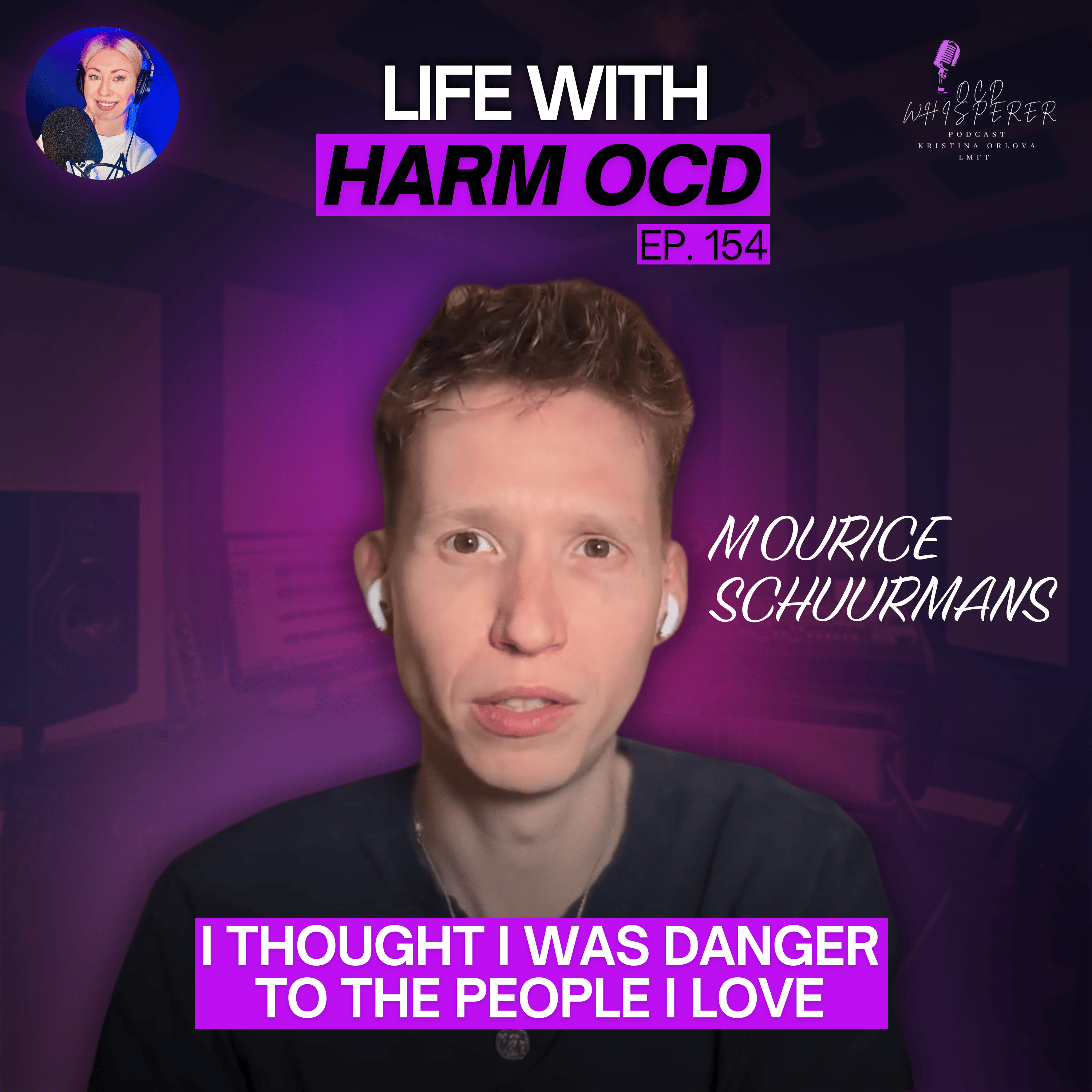
The OCD Whisperer Podcast with Kristina Orlova
154. Life With Harm OCD - “I Thought I Was Danger to the People I Love”
00:23:52
Loading summary
Transcript27 lines
- [00:01]
A
Hi, I'm Kristina Orlova, host of the OCD Whisperer podcast. As someone who lives with ocd, I understand the struggles firsthand. If you're here, you're not alone. Before we start, grab your free OCD survival kit at www.corresults.com to help you take control. That's K O R results dot com. Now let's dive into today's episode. Welcome to OCD Whisperer podcast, guys. Today with me, I have Maurice. Welcome to the show and please tell us about yourself.
- [00:37]
B
Yeah, thanks for having me. I'm Maurice. Many of you guys might note me with Obsessive Maurice. So I built Obsessed Less. It's an OCD app, but also I've overcome OCD myself. I've had it for more than eight years, almost going into nine now. So, yeah, the. That's. That's a bit about me.
- [00:56]
A
Awesome. So part of what I love to hear from people when they come to the show is to share a little bit of your story. Kind of like when was the first. What was the first time that maybe you noticed, like, something wasn't quite right and kind of that journey of figuring out that it's in fact ocd, because I think so commonly we hear people not really even knowing that it's ocd. And then when you finally figure it out, it's such. It's very eye opening in terms of, you know, how it actually works and how a person experiences it.
- [01:24]
B
So I would say it almost took 21 years for me to realize it was OCD. So as a kid, I always had these weird thoughts where I would think my parents would die and how I would treat that is just by thinking, okay, if I think the other way around, then everything will be fine. Right? So death will become living and so on and so on. I kind of outgrew that. But I was always an anxious kid and I was bullied a lot when I was younger until I. Until I was 15. But I had my first panic attacks around 15 when I was really in the height of my bullying. And I was diagnosed with generalized anxiety disorder. That was the first part of my journey. I used to have a lot of health anxiety, so I would think I would die. Any bodily sensations, I would go to the GP to check out, do I have cancer or will I have a heart attack? Mind me, I was 16, 17, so in the prime of my life, so probably a heart attack wouldn't have killed me. But Moving over at 21, I had my second anxiety breakdown, if you can call it that, came Back into the system, if you can call it that. Also was treated for again, generalized anxiety disorder. This went on for a couple more years until I was 26, when yeah, I had sudden onset OCD. So it doesn't really happen a lot, but overnight I developed a harm ocd. So actually I was on a date and then I had thoughts about strangling my date and I couldn't go home. So imagine this, I couldn't go home with the bus, couldn't go home with the train because it was 2 o' clock at night. And luckily she was a psychologist in training and she told me a bit about this might be some intrusive thoughts that you're having. I'm not afraid but. But I sure was. So I called all my friends, called my parents, just trying to reach somebody because I thought I would strangle this girl just based on the thoughts that I was having. So this is a bit of how in a very short recap, my OCD onset came into my life. So this is how I got into ocd. I went home that night, talked to my mom that time I was 26, but the only place I felt home was at home by my parents place instead of my own place. Went home, told her the story and the first thing she said, she said to me is, you haven't really killed this girl, have you? So she, so that's, that was the second trigger and now I can laugh about it, but at that time it wasn't, yeah, it was just, no, it's not funny, of course it. And yeah, I went to the doctor and he directly said, yeah, probably this is something mental, let's get you to see a therapist. And yeah, a couple of months later I was talking to a therapist and they told me it is OCD with a smile on his face. And I just thought what is ocd? OCD is not what I have because I have thoughts about K people, not about putting things straight or you know, putting things on color, just like how I thought OCD would present itself. And then I had to wait another eight months for my first therapy. So yeah, that's a long story short. This is my journey to, towards knowing it was ocd. But in hindsight as a kid I had ocd. You know, the generalized anxiety disorder was OCD health OCD in hindsight. And yeah, when I couldn't take it anymore, it just manifested as harm ocd. And that was something I couldn't deal with at that point. So that's why it became severe instead of moderate and you know, the onset, yeah.
- [04:58]
A
Honestly, there's so much in your story that you just shared, and I think it's really common that, that it gets misdiagnosed and, and quite often you think, okay, it's journalist anxiety just because sometimes things can be not as obvious. But to your point, right, it really escalated. And suddenly you're having these thoughts about potentially hurting this date you're on. And sounds like you're like, well, wait a minute, I'm on this date because I kind of like this person. And now I'm having these thoughts, thoughts. And that just is so out of sync, right? And like, what do you do with that? And, and I know right now, you know, we can kind of laugh for a moment, knowingly almost, because we both know what OCD is. But to anybody listening, you know, it's not funny, right? Because when you, when you have that moment when your mind suddenly kind of runs in some weird direction that you've never experienced before, and it's so loud and intense, I mean, your whole body starts to climb up, your heart usually beats really fast, thoughts are racing, and you just don't quite understand what's happening to you. I mean, it sounds like it's a blessing. You've had, you know, well, of her basically, to give you that initial kind of direction, and then another provider and a doctor. But then you had to wait eight months, did you say?
- [06:07]
B
Yeah, so I come from the Netherlands, as you, as you can hear, probably by my accent. But yeah, we have healthcare. We. Which means, yes, we do. Are. Yeah, we're insured. Everybody is insured. Which means we can get a professional to look at us when we have issues. But the problem is the system is quite, you know, overrun and overburdened. So we usually get a diagnosis after a couple of months. So you have to wait two, three months to get a onboarding. And in that onboarding, usually they assess, okay, what is your. What are your issues? And they will give a first assessment, in my case, ocd. And then you're put on a waiting list and you have to, you know, wait eight months for, for insured care.
- [06:45]
A
So how. What did you do in eight months? Right. I mean, you're talking about having some pretty heavy duty thoughts. So, like, how. How did you get through that?
- [06:52]
B
I didn't. So in my case, it went. It was worse and worse and worse. So at some point I couldn't. My, My, my living space was so small that I could only sit on one chair, look outside the window and not move because I would be, if I wasn't on a chair. I would have intuitive thoughts all the time, so my mind would, you know, just rush. And I would have compulsions all day long, ruminations. I didn't have a lot of outward compulsions. So we. I call it pure. All because I saw a video on YouTube calling that pure. O. But no, I couldn't do anything. And actually my dad did some unknowingly, you know, some exposure therapy on me, meaning that he just took me out to the field. Like my parents have a, you know, a house in. Yeah, between the farms. Anyway, he did. Yeah, he put some hard labor on me, so I had to work outside just to show my brain that I could still be outside without, you know, harming other people. And I would cut trees. It cut trees with a saw. So that also gave me a lot of intrusive thoughts. But my dad just keep pushing me instead to work. He's a bit of an old school guy, so he always thought hard labor will get you, will get you through anything. Um, didn't work. But it did help me go outside a bit more and at least realize on some level that I wouldn't kill anybody when I would leave the chair, if I have to be frank on that. And I did a lot of research, so a lot of YouTube videos, like, I went on Reddit, which wasn't a good idea. So anybody listening, don't go to Reddit. I googled a lot. Don't do that. But then I found Mark Freeman on YouTube. I don't know if you know him, but watched a lot of videos and in general was educated on ocd. At least to know that I wasn't the only one. Right. Because if you get it for the first time, you think you're the only one with these horrible thoughts and these horrible themes and already knowing that there were people out there that could overcome this was something to look out for for me and get me through the hard days. But don't get me wrong, I'm smiling now, but back then I could understand this is a kind of a trigger alarm for people talking about suicide is that people contemplate suicide when they have, you know, such a horrible, horrible time. Yeah. Struggling with their own mind because it is just hell living through ocd. And now I'm laughing and I went through it. But looking back, it was the hardest thing I ever, ever did. And I wouldn't wish it up on my worst enemies. Yeah.
- [09:21]
A
Honestly, that's a really common sentiment. People who, you know, know and have always like actual real OCD we're not talking about, you know, kind of the. The misunderstanding we have in the media of, oh, I like to keep things clean or just touch doorknobs. It's. It's so much more than that. But. Yeah, no, nobody. Yeah, nobody I know ever says, like, yeah, I. I wish people would have this and know this. Like, this is. You don't want this. This is not a pleasant experience whatsoever. So it sounds like you went through eight months of that. And I mean, to your dad's credit, he. He still got you out there. So at least a little bit, you got to see, like, okay, I'm having these horrible thoughts, but I'm. I guess I'm still able to somehow be here and probably still not quite making sense how that's happening or working, but. But you got something which is kind of cool, like a byproduct, not intended, perhaps, but it happened. So. So then what happened? So you got into treatment. Did you get. What kind of treatment did you get?
- [10:15]
B
Yeah, so I got into treatment and we started with erp. So this is the main therapy I had. I've had a lot of different therapy during the last eight, nine years, but it started all with ERP therapy. So really exposing myself to the fears that I was having. Of course, first understanding, you know, what you go through. I heard other people talk about exposure response prevention, and you cannot really do that. The. If you don't know what your triggers are, your compulsions are, and your core fears are. So we first did that, and then it was years and years of hard work, first through erp, and later on I did some. Some other treatments. For example, emdr, which again, is not for the ocd, but for other things in my life that I was struggling with, and some trauma therapy for the stuff I went through when I was younger, the bullying periods. Yeah.
- [11:06]
A
Mm. Yeah. So when you were doing then erp, and I appreciate you also just to go back saying that, yeah, EMDR is not for ocd. I think people really confuse it and think that, Let me. Let me go with that. But nothing indicates or shows so far that we know that that actually is effective for ocd. Exposure response prevention is definitely, you know, first line treatment that is effective. And so, you know, what would you say? Because I know something that I commonly hear from people is, but, God, how long is it going to take? Like, I don't want to have to manage this thing. I, you know, I want it to stop. I want it to go away, you know, and from what I hear is you have to take all this time and all these years, and then you're still managing. So what was your experience?
- [11:48]
B
So that was my first initial thought, right? So when I heard or read that that OCD was chronic, I just, you know, I couldn't handle it. It was just intrusive thoughts about, I have to live like this forever. You know, how can I manage that? And essentially, Mark Freeman opened my eyes by saying that, hey, you know, physical health is the same as mental health, right? It's. It's about taking small steps to, to a healthier life. And now I'm saying this very easily, but it was, it was months and months of contemplating that, you know, small steps will eventually lead to a big outcome. But if you're in the shit, if I can call it that, this doesn't really help, right? You just want the solution and know that, you know, you can cure this right now and get over it. But I guess with everything, it's always the choice, right? Do you want to keep compulsing and keep having these intrusive thoughts, or do you want to work towards slow steps and recovery? And I guess for me, OCD was way, way, way more worse than the thought of not taking small steps toward recovery. Right. And during my recovery, I started to learn that curing OCD isn't the goal. It's about how to deal with these thoughts and accepting that I will never know for sure. And by doing that and taking these small steps also, you won't focus too much anymore on the cure, but more about the process of getting over ocd. And before you know it, even though that might be years for somebody, you're making improvements. And I would say that anybody struggling with this right now, yeah, hang in there and take those small steps, I would say, because. Because you will never know what's on the other end, but you do know what OCD will bring you. And that's not, not very nice.
- [13:31]
A
Yeah. Yeah. Well, there's something also, you said that I kind of just caught, and I want to go back to it for a second because this is kind of what I think is interesting about when you do erp, and maybe we don't talk enough about it, but you mentioned, on the one hand, you know, embracing uncertainty and not knowing something. On the other hand, you also mentioned with doing this work, you also learned, though, like, yeah, I'm not, I'm not harming somebody. Like, I, I, I'm capable of being out here and, you know, working in the field, or once you've done erp, like, hey, I'M engaging with people. So what would you say from doing ERP kind of helped you get some better awareness or insight about yourself because it sounds like something there did happen, that there. There's a switch that occurred or even a separation between you and your thoughts.
- [14:14]
B
Yeah, sure. So there's a lot of. A lot of steps that I went through. Right. So in essence, it's. It's about the, you know, the observant mind, for example, is a concept that people sometimes use, is that, you know, I experience thoughts or I experience feelings instead of, you know, I am these thoughts or I am these feelings. Right. And that. That's by practicing, you know, sitting with those feelings and not doing the compulsions, even though it's a mental compulsion. The other part is, of course, exposure response prevention teaches you to, you know, to search, you know, photo spheres and really expose yourself to it to help your brain understand that there's nothing to fear. Right. And sometimes people come to me and they DM me, okay. But exposure response prevention, I'm sitting with those fears, but the fears are still there. Right. And it's for many people with ocd, they understand that what they're thinking, you know, isn't, you know, making sense, and they have some kind of, you know, insight that, you know, of course. Right. Probably if somebody puts a gun to my head, probably I won't kill somebody. I will never pull the trigger. But the what if is killing you. And the emotions that come with that is the problem. Usually other problems. So your emotions, you can't really tell your emotions to just stop. They have to learn it by going to repetition time and time again until that repetition is, you know, set in stone. And I would say that, yeah, that is what's. That's why sometimes it takes a bit longer to overcome, is because your emotions, emotional sense, I have to. Have to learn that, you know, these fears aren't as fearful as, you know, they tend to tell you if you. If that makes sense.
- [15:41]
A
I don't know. Totally. Yeah. So people actually, you're hitting on something really important. People absolutely struggle with the feeling. Right. Because the feeling is so strong, it's so big that it's. It's like people can't wrap their brain around. Wait a minute. I, like, I can't be with this feeling, though, that, like, this has to go away. So what you're saying, if I understood it correctly, is more like, hey, yeah, when I do exposure response prevention, I'm on purpose kind of inviting and bringing on those feelings and. And practicing intentionally letting the feeling be. However big, whatever it is, just have it be there without having to solve it, resolve it, make it go away, or make it mean something. We don't have to interpret it in some way. We can just allow it. And that over time, by doing that over and over again, it's where, like, the emotions and the brain kind of started to connect and learn. Like, okay, wait a second, this. This isn't as big of a. Of a thing that we thought it was.
- [16:39]
B
Exactly. And when I started OCD therapy, I would just be, okay, I will not have these thoughts anymore. At the end of this road, you know, I won't have these feelings anymore. But let me tell you, I'm not impacted by OCD anymore in the sense that I can say that I have overcome it, whatever that means. I mean, I might relapse, who knows? I don't really care because I know how to deal with it when the times comes. But I still have intuitive thoughts. I still have thoughts about kiss my fiance. I still have thoughts about the weirdest stuff. I still have feelings that come up that I don't want to have. So it's not that I lost those, but the way that I'm dealing with them is completely different. And the way that I'm reacting to them is completely different, which means that I'm not impacted by it anymore. And this is also a lesson I had to learn that, you know, it's not about getting rid of these feelings, getting rid of your thoughts. It's about how we can deal with them and becoming our own therapist, in a sense, in order to deal with them long term. And this is what we want. That's why a quick fix won't work. It's always about the hard work to learn this, I would say.
- [17:44]
A
Well, and I think it's powerful to say that, yeah, as humans too, you're still going to have some thoughts and feelings. But what's changed? And even the way you just said it now you're like, oh, yeah, whatever. I mean, you even adopted this kind of attitude of, who cares? I know to understand those are not as important or relevant as I thought they were. And so now I can have. I can treat them differently. I can have a different relationship and just say whatever to them and not. And not over attend. Right on. Well, okay, I want to pull something up here. So for folks listening, Maurice also has an Instagram account, Obsessed, less underscore Maurice. And so on there too. You've been building an app. So tell us a little bit about this app.
- [18:25]
B
Yeah, so, as I've already mentioned, I had to wait eight months on therapy. And in that time, there's a lot of stuff I went through, for example, Headspace or calm those apps to really, you know, try to understand my brain a bit better and to become calm. But there wasn't really anything that would help people with OCD in this waiting period or when you don't have access or you can't afford therapy and with obsessors, with trying to lower the barrier of entry. So for people to work on their OCD and really overcome it in a way where step by step, you can work on your OCD while waiting on therapy or in between sessions, for example, or not being able to afford it at this point and still do, for example, exposure response prevention in a healthy way, or have something of an OCD companion on your side. That's what we built to help you through these hard times. That's what we want to do with Obsessed, and that's what we're building.
- [19:21]
A
So what can somebody expect if they're in that app? Like if they're having a really hard moment or a hard day and then they want to really spiral out and especially with the mental compulsion pieces where people get really stuck and want to analyze. No, but, but I have to know. I have to figure this out.
- [19:34]
B
Yeah, so. So I had a lot of that. So for me, we added an SOS feature where you can, for example, in the moment you have a panic attack. So you get guided through, through a panic attack in a safe way. So this means it's always following ERP rules. It won't give you reassurance, but it still will go through a panic attack with you, or it will go through an obsession with you or a compulsion. So it will help you abstain from a compulsion, for example, for 30 seconds or for a minute or for two minutes, and you have a pocket companion that goes through it with you. Especially when you don't have a lot of therapy or you don't have a therapist on call, it can still be beneficial to do those exposures. And we want to help people go through these exposures and not compulse, if that makes sense. And the app helps. But that's. It's just one of the parts. Also, we have a companion called Ollie. You can ask all the OCD questions and it will not reassure you, but actually help you, you know, understand what's going on with your OCD in a way that's following again, ERP guide rules instead of it being Reddit. Or Google or wherever you get your information from.
- [20:42]
A
I'm curious now about Ollie. So what do you mean? So like, if I'm going to start writing being Ollie, like I'm worried, like, what if I'm in the wrong relationship and I keep going and I keep writing and a couple, come on, just tell me. But what are the statistics? What do you know? So what will Ali do?
- [20:57]
B
So Ollie will first try to understand, okay, what are the, what are the obsessions? Right, so for example, you, you told me about the relationships of Rocd, for example. It will try to understand what's happening. After a couple of while, a couple of times, Ollie will already know because he remembers what you talked about. But then he will prompt you to, okay, let's take a step back. You know, are you doing any compulsions, for example? And then the user can share that or not. And then Ollie probably will help you go through an exercise. For example, if the need is very high, Ollie will say, hey, let's start with 30 seconds by not doing the compulsion you said you wanted to do. Let's go together. And during the 30 seconds, you can still talk to Ollie, for example, if you're scared, you know, it can help you understand what's happening and by time, you can take it from 30 seconds to a minute or to two minutes. But this is, this is just one, one of the things Ollie can do. Ollie can also help you with an audio guided session, for example, stop the Google. If you have trouble stopping the Google, you will have an audio session that will guide you through some kind of a mindfulness session, if you can call it that again, ERP rules to stop to Google morning wake ups. You know, if you wake up, everybody has been there with ocd. You have dread. It will help you with that if you go to sleep. Essentially everything that happens with OCD in life, Ollie can help you with. And the next step in the app is really building a, you know, a plan to work towards lowering your compulsions. That's, that's done. That's the goal.
- [22:21]
A
I love that. Thank you so much for sharing all that. Yeah, so for anybody listening today, and by the way, I do just want to say that I personally really enjoy all the visuals you create here and all the different ways that OCD manifests and you talk about all the tough things, right from POCD to harm ocd. But if anybody hasn't seen seen this guys, definitely give him a follow. He's got an amazing page. So I want to thank you for coming on the show today and if you can, please tell us if somebody would like to find you. How can they find you?
- [22:55]
B
So they can find me on my socials? Obsess lesscore mar also obsess less.com they can find more about the app. Yeah, I think those two cover it.
- [23:06]
A
Awesome. Well thank you so much Maurice.
- [23:09]
B
Thank you.
- [23:13]
A
Thanks for listening to the OCD Whisperer podcast. Remember, freedom from OCD is a journey and you're not alone. Visit www.coraresults.com to explore self help masterclasses like Sneaky Rituals with Jenna Overbaugh or IC CBT Masterclass with Christina Inabe. Don't forget to grab your OCD CBT journal tracker and planner while you're there. If you found this episode helpful, please subscribe, share and leave a five star review to help others find the podcast. Together we can make a difference. Keep going and I'll see you in the next episode.