← The OCD Whisperer Podcast with Kristina Orlova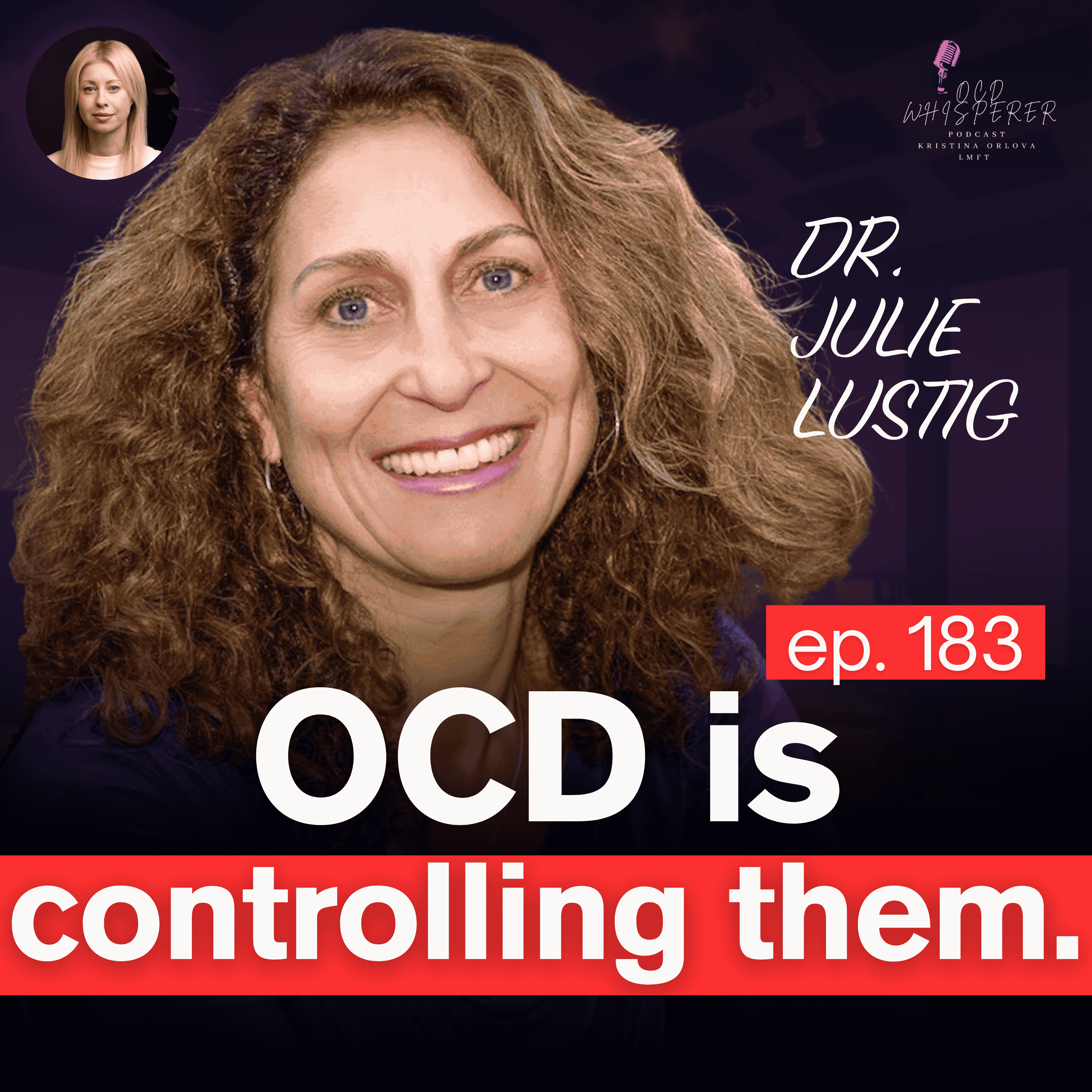
The OCD Whisperer Podcast with Kristina Orlova
183. If Your Child Gets Stuck in Routines, Please Listen to This...
00:26:21
Loading summary
Transcript40 lines
- [00:00]
Apollo Advertiser
Tired of juggling sales tools or spending hours on prospecting just to book a few meetings? Meet Apollo, the go to market platform for finding leads, connecting with buyers and closing deals all in one place. Apollo gives you access to over 210 million contacts and AI that handles all your busy work, finding leads, drafting emails, and even prioritizing your day. So stop paying for five different sales tools when one does it all. Visit Apollo I.O. and sign up free today.
- [00:29]
Cristina Orlova
Welcome to OCD Whisperer podcast where we talk about anxiety, OCD and mental health. If you enjoy these episodes, remember to subscribe and turn the notification bell on today. With me, I have Dr. Julie Lustig and we're going to be talking about childhood OCD and anxiety and I'm going to actually turn it over to Dr. Lustig to give us a little bit about herself.
- [00:49]
Dr. Julie Lustig
Hi. Thank you so much for having me, Christina. It's so great to be here. I love talking about this topic. So I'm a clinical psychologist and I have a center exclusively focused on kids, teens, young adults and parents, and evidence based treatment. And it's called the CBT Tools for Life Center. And we really are focused on both providing treatment to parents, as I said, kids, teens, young adults, you know, with a range of mental health disorders, particularly anxiety and ocd, as well as providing resources. Another part of the center is that I train and consult with professionals who work with these kids who have these disorders to help educate them, train them. Then in addition, I'm on the adjunct faculty at Stanford where I supervise in a clinical pre doctoral internship program for Stanford and the Children's Health Council.
- [01:50]
Cristina Orlova
Amazing. You are our expert with childhood OCD and anxiety.
- [01:56]
Dr. Julie Lustig
That's what I love to do. Yes.
- [02:00]
Cristina Orlova
Hi, I'm Cristina Orlova, host of the OCD Whisperer podcast. As someone who lives with ocd, I understand the struggles firsthand. If you're here, you're not alone. Before we start, grab your free OCD survival kit at www.corresults.com to help you take control. That's K O R results.com now let's
- [02:24]
Dr. Julie Lustig
dive into today's episode.
- [02:29]
Cristina Orlova
Well, okay, so I love hearing that you love to do this and I know I would like to know, how did you get into this? What, what, what drove you? What motivated you?
- [02:38]
Dr. Julie Lustig
Yeah, so it's, it's been like for most people it's been a journey. But all the way back to my undergraduate work, I was very interested in child development and working with kids and understanding kids and that kind of evolved over time to developing and evaluating Interventions for kids out in the community with all various kind of mental health disorders and risk factors. And then I was in adolescent medicine for a while at ucsf where we were training physicians on how to recognize a whole range of different things in kids and how to address them. And I kind of moved from there to a private practice where I started working more one on one, one with kids, teens, young adults and families. And I've treated a wide range of mental health disorders, but more and more was seeing anxiety and OCD and for just over many, many years and started treating more and more and more ocd and then hearing the story about. In the past, the statistic was that it would take about 14 to 17 years or so for someone to get diagnosed.
- [03:53]
Cristina Orlova
Yeah.
- [03:53]
Dr. Julie Lustig
Which just broke my heart because, you know, we can. There's so much help out there for kids. So I became very passionate about treating children and teens early, as early as possible. And that has more recently expanded, as I said, to helping identify kids and teens earlier, you know, with ocd. But I found it incredibly rewarding because it's, it's so treatable. And I just see these just incredible changes and results really life changing for the kids and their families. So it's, it's been extremely rewarding. And I've moved more and more into the OCD work.
- [04:35]
Cristina Orlova
Amazing. Can I ask you a personal question?
- [04:38]
Dr. Julie Lustig
Sure.
- [04:39]
Cristina Orlova
Do you have kids and family?
- [04:41]
Dr. Julie Lustig
I do, yeah. Yeah. So I have, I have two. Well, they're not really kids anymore. I have two young adults, I. Two boys. Yeah. Young adults who are out of the home now. Yeah. Yeah.
- [04:54]
Cristina Orlova
That's awesome. Yeah. I could feel the passion from you. Like you got really. And, and you got lit up really, when you were talking about it. But also I think to your point, I, I know that's a statistic and it really is quite intense. Right. To hear that like that much time goes by before somebody actually gets treatment or seeks out treatment for various reasons. But you were also saying that one of the reasons you're noting is sometimes people don't maybe recognize or see kind of the clues or the signs or something in there. So can we talk a little bit about that?
- [05:28]
Dr. Julie Lustig
Sure, absolutely. I just taught a class recently on this and was trying to help these first psychology turns differentiate what's just developmentally sort of typical kind of things that we see in Kids vs OCD. And for example, for young children, many, many, maybe most have nighttime rituals and routines that they do. And we know that's healthy for kids to have routines and structure and rituals. However, when they become overly rigid and extreme, where a parent cannot. Is it according to the child and the child's ocd, the parent is not allowed to deviate, say, from, from that routine or that ritual. And when they do that, the reaction is very extreme. And there's a repeated pattern of this. It doesn't just happen maybe once in a while. If the child's overtired, it's consistent that the child can't tolerate, doesn't seem to be able to tolerate deviation from those, those rituals or routines. That's, that's an example of something where again, a parent who's, whose child has a good night nighttime ritual would not need to be concerned unless they start to see these, these extreme behaviors. That's just one example.
- [06:53]
Cristina Orlova
Yeah. Can you give us some more things of like, what would be something that as a parent. Right. That you might not be aware. You don't, you're not quite connecting the dots yet. You don't know, kind of walk, walk us through. What would they see, what would they look like, sound like that would give them some clue like, oh, something here is not quite right.
- [07:12]
Dr. Julie Lustig
Yeah, there are a couple. So there's kind of a myth with OCD that you just see anxiety in the kids and that that's the symptom. You know, the child gets anxious if they can't do something a certain way. We also know that and that the compulsions that were more are more familiar things like maybe hand washing, washing or lining things up. There are a lot of sort of stereotype, kinds of compulsions. There are a lot of compulsions that are quite common that aren't as recognizable, such as seeking reassurance from the parents. Of course, again, typical behavior kids do seek reassurance, but when it's excessive and repeated and if they don't get the reinsurance, again, the reaction is extreme. That's, that's a good example of a compulsion that's often missed is seeking, you know, excessively seeking reassurance, say, from a parent. Another one that's very often missed is what we call mental compulsions or mental rituals where sometimes parents will say, oh, I don't see anything happening, but the child in their mind is maybe having to count to 10 or having to do something internally. Those are hard to recognize. And parents have really listen carefully. For a child maybe saying, you know, wait, we can't leave yet. I, I, I need to do something. And they might sit and, and be doing something in their mind again. A lot of times it, it looks maybe just like a, a Routine. But I'll often hear a parent saying, my child's so slow. We're late for school every day. It takes a forever to get out the door. Each thing they do takes, you know, they brush their teeth for 30 minutes and then they have to go through a whole ritual in their room. And so parents kind of, sometimes that's all they know and they get used to it and they, they don't necessarily see it as being ocd, but those are the kinds of things. Things taking along.
- [09:29]
Apollo Advertiser
Tired of juggling sales tools or spending hours on prospecting just to book a few meetings and meet Apollo, the go to market platform for finding leads, connecting with buyers and closing deals all in one place. Apollo gives you access to over 210 million contacts and AI that handles all your busy work finding leads, drafting emails and even prioritizing your day. So stop paying for five different sales tools when one does it all. Visit Apollo I.O. and sign up free today.
- [09:57]
Dr. Julie Lustig
Time. And requiring these ritualized behaviors, seeking reassurance, mental compulsions. Those are some of the things that I see often.
- [10:06]
Cristina Orlova
So, okay, I know that you said that you work with kids directly, so I, I'm definitely very interested and I'm pretty sure people listening are too because you know, we know about for example, space program where it's all about the focus on the parents. But I, I definitely think, let's talk about the. What can you do with the kids? So one is, I want to know, like how old are the kids that you work with? What's that range?
- [10:32]
Dr. Julie Lustig
Yeah, it's a wide range. I've seen kids as young as 3 and 4 years old. Wow. Believe it or not. Yeah. And actually I love treating the little ones because they, they're very responsive to treatment. And you know, I treat people all the way up to about 24, sort of 4 to 24 in terms of OCD. And so one of the, I think one of the first things I do is a lot of psychoeducation of the kids, meaning explaining what is this, what's going on in, in your mind and really help them understand. And then a lot of what we call normalization, just helping them to see that there is nothing wrong with them, they haven't done anything bad, they're not crazy. They're wonderful, amazing kids. I always say your entire mind is creative and wonderful and makes you who you are. And there's this wonderful one little tiny thing that's just annoying and sending these messages, these false alarms and hiccups in your brain. So I, I do a lot of normalizing and trying to help the kids feel okay because they come in often with shame and embarrassment and. Oh, I bet, Thinking there's something really wrong with them. And then. So a lot of explaining what OCD is, which is kind of like a hiccup in your brain that's sending false messages and telling you you have to do something. And then I. I talk about how that. And I draw the. An OCD cycle, the obsession and distress and then a compulsion and then temporary relief, and then they are stuck in that. That loop. But then one of the kind of fun things with kids is we externalize the ocd. And I use a lot of puppets. I have my little puppet here if you want to see it. Oh, I do.
- [12:22]
Cristina Orlova
I want to do.
- [12:24]
Dr. Julie Lustig
Yeah. Often my ocd. This guy here.
- [12:28]
Cristina Orlova
Oh, my gosh, I love it.
- [12:29]
Dr. Julie Lustig
That's a cute kids. But even the teens, you know, and I'll say he comes up and, you know, we give it a name. We always give OCD a name. And then say he's gonna let him tell you what. What to do. You know, you have to wash your hands for ten minutes, and it. It makes it silly. They laugh like you are. We're laughing at ocd, which is really what we want, instead of being terrified of it. It's hard to look at this guy and. And not laugh and smile. So they. They start to. And this is the. The voice of the ocd. And, you know, what's telling them to do all these silly things. And so it really does start to change that emotional response.
- [13:10]
Cristina Orlova
I love that. That was so fun to see it live. And actually, I was going to ask you, what do you. What do you tell the kids? And you kind of already went there. So. Okay. In your work then. I'm dying to know, like, what. What's something. If you think of just this one time you work with a kiddo, that was like, maybe really tough, and then you had that moment of transformation. Can you share with us?
- [13:36]
Dr. Julie Lustig
Gosh, there's so many. Let me think. They're just so, so many. I've seen teenagers, you know, very, very high, functioning, ambitious, incredibly bright, talented, social. You know, teenagers whose lives have just been turned upside down by. By ocd. They're. They're seeing school, and their grades are starting to. To go down. There's conflict at home because they can't get out the door. They're having trouble sleeping, and so everyone's exhausted, and. And. And it's. There's so much distress and turmoil in the whole household. And I Don't have time here to go into detail about the full treatment. But as. As I'm sure you talk about a lot on your show, you know, exposure, response, prevention is the core of the treatment. So I do the education, and I do the externalizing and naming the ocd. And then with a few other steps, we then move into what I call facing your fears or doing that exposure response prevention. And we gradually work our way up a number of steps on a ladder and doing different things. And these kids, these teens, when they come in, they don't feel like they have a choice about doing the compulsions. And there's a lot of language of I have to do this. And parents are saying, well, she has to do this. And we start changing it to, you know, I grab my little puppy. No, you know, no bossy pants says, you know, you have to do it, and let's do experiments and see what happens if you don't. And so the kids will start, you know, the teens will start doing the erp Parents start removing accommodations. And it takes time. It's a slow, gradual process. But I have seen just these dramatic transformations where the teens get their lives back and they're back in school and performing well and socializing and back to their sports. And then sometimes we stop working together, and I let them know they can come back, and I might hear that maybe they've gone off to college and are doing extremely well. And we talk about how it could, you know, it's. It's ocd can come back. I even will use the puppet. It'll come back and bug you. But you have these tools. You know what to do. You don't have to be afraid of it anymore. You know what to do and how to manage it.
- [16:15]
Cristina Orlova
Well, yeah, and like, to your point, right, Because I think when we. When we hear what you're sharing right now, right? And this is. And I mean, I've gotten this. This input as well, which is, gosh, it sounds like, you know, it's just like, almost so easy. And to your point, it's like, no, it's not the journey in the middle that's the hard part. That's the worst work. Right? And like, you were saying, well, how do you do that? Well, you do it by first getting some better understanding of what's happening to you, not taking it so personally, creating a little distance between it and then creating a plan basically of action and literally one small step at a time working on it until you could take bigger steps and bigger steps and bigger steps, and suddenly you pick up momentum doesn't mean you don't probably fall down and go backwards a little bit here and there, I'm sure, right? And then you pick up and say, okay, what do we learn? Let's. Let's go again. And maybe we need to break it down more. We do it together or create some other plan around it. You know, like I remember always telling folks, you know, our goal doesn't have to change, but how we get there might change. So we might adjust our process and journey, but we can still have that be our goal. And some things can take a little longer. And sometimes, too, you know, people can surprise themselves, themselves because you anticipate this, like, bad, horrible thing, and then you. You do the. You do the exposure, the experiment, and suddenly you're like, oh, that went a little better than I thought. Like, oh, okay, well, isn't that cool? Right? And sometimes, of course, it doesn't go well, and you get really flooded and scared and all the feels. But then, you know, you can come back and, okay, let's try it again. And let's maybe try it from a different angle or something smaller or change it up to keep breaking it down.
- [18:06]
Dr. Julie Lustig
Yeah, exactly. And. And I think what I emphasize a lot with kids and teens because, again, they're getting started at such an early age, is that they. They can learn what this really is and have a toolkit to manage it, and they won't. You know, sometimes maybe they'll have trouble accessing those tools or. Or like you said, you know, maybe they're, you know, trying something and it just turns out it's too difficult to use the tools. But they do have that sense. There's something I can do about this. I'm not. I'm no longer helpless and passive. As this OCD just. Just takes control of my life, there is something I can do. And, yeah, sometimes we start with the easiest, simplest things and just work our way up to things that are. Are more and more difficult. Well, it's.
- [18:54]
Cristina Orlova
Okay, I have to jump in here and ask you a question because of course, this is always, I think, on just. This is human nature, which is when you have something that. When you're having a hard day, let's say just. Just. Or a week or whatever the. Whatever the length of time is, but you're hitting a wall. It's just everything feels really hard. You get to the place where, I just can't do it. I don't think I can do it. This is too scary. This is too much. This isn't for Me, I'm sure you've heard something like that. What do you do, like specifically, directly, what do you actually do? How do you help a kiddo kind of move through that place and keep going?
- [19:33]
Dr. Julie Lustig
Yeah, so what I do is fairly structured. So within. With adults, we often call it a hierarchy of, of steps. With kids, I call it a ladder. Same thing. But, you know, it's. It's a ladder of, of steps, again, usually with increasing difficulty. And so one of the things I'll do if, if someone comes back and says, oh, that was just too hard, is I'll talk about, you know, what, maybe that was too big a step on the ladder. And I kind of demonstrate, you know, you can't step too far. You know, you're. You're going to be wobbly. Right. So let's, let's add another step. Step in between. That one might have been too hard. And what I, I think what's important is to, to help the. Help them not feel like they've failed, you know, that they're a failure for not being able to do this or they're doing a bad job. A lot of these kids have very high standards for themselves or maybe for perfectionists. And I want them to be able to come in and say, I couldn't do this. It was too hard. And so I actually kind of reward that. I'm so, you know, reinforce. I'm so glad you shared that with me, I think, and I own a little bit of it, too. Maybe, you know, maybe we picked a step that you just, you know, was too hard or you weren't ready to do it, or maybe this week, you know, it was too hard a week to try that one. So let's, let's try something a little easier. The other thing I talk about is, is in doing exposure response prevention, erp, Again, working with kids and teens, I use a lot of sort of plain language. We're going to do the opposite of what OCD wants or, you know, face your fears and not boss him back and not do what he's telling you. And so if they can't do that fully, I'll talk about. Let's see if we can tweak it a little bit, you know, then you still get a win. So if it's, you know, scrubbing both hands for 10 minutes, as a classic example, you know, could, could we cut it down to five minutes, you know, or we. I often am working on pumps of soap. Okay, you're using 20 pumps of soap. How about we get down to 10 first you know, and gradually, so. So doing something, just something. And I do say, you know, anything you do, that's not exactly what OCD wants is. Is a victory. You know, it's starting to boss it back. So. So that's another thing I do when they're struggling is, you know, maybe. Maybe it was too much. But let's see what's. What's the least thing when the littlest thing you can do and it's still empowering them.
- [22:04]
Cristina Orlova
I love that. Yeah, because you want to have a win, right? You want to have some motivation. And I, I personally, when I first learned the whole, like, the art of doing the opposite, which is, you know, response prevention in action, I personally loved that one. I thought, that is just beautiful. And it doesn't mean it's always easy. I don't want people to think, oh, yeah, just do the opposite. But it does mean be thoughtful about it. Like, how can I not give into that demand? And what can I do? And, you know, sometimes, yeah, it's stressful and you cut it in half. But then as you get better, sometimes you can have fun with it, dare I say, you know, and other times you're like, okay, today is not the day for, you know, having fun with it. Because today maybe I'm more stressed out and there's more going on, but at least I can do a little something where I'm starting to interrupt that pattern and kind of get. Get a little bit of a victory, Right? A little, like, move the needle forward. Even just one degree is already a great thing.
- [22:59]
Dr. Julie Lustig
A little win. And you brought up something that's actually quite important in working with kids and teens that I really emphasize when I teach, which is I bring in a lot of humor, silliness, playfulness. I try to bring in the kids interest. So if they like music and rap music, we'll make. Make a rap about whatever their fear is. If, you know, if they're dramatic, we might do a little skit and act out, you know, something. So just turning it into. To something really silly or write a really silly story that. That exaggerates what OCD is saying. But it's playful, it's silly. And I think a lot of people say, how can you do that? It's such a serious, you know, you know, scary disorder. But I think, again, like the puppet, right? It's a way of trying to. To reduce that fear of those thoughts and just say, they're just thoughts, and we're going to kind of joke about them and be silly and playful as we as we boss them back.
- [24:03]
Cristina Orlova
I love that. I mean I personally, I'm a big fan of humor and you know, life is already serious. There's a lot of heavy duty stuff in it. So any pockets where you can bring a little levity and plus it gives a little distance, you know. And you're dealing with kids like that's the beauty of kids is like they remind you like. Yeah, there's other ways to learn than just this heady cognitive thing of okay, read, process. Er, it's like no, you can actually bring a little play a little, just some other little energy into this, like you said, your puppet, that you externalize it a little bit, just a little distance between it so that you could examine and kind of see it from different angles. And that in itself just brings it down a notch. Yeah, I love that. I love that Dr. Lusting. So I, I really appreciate you coming on here and sharing all this with us. So if there was like a nugget you would leave us with, what would that be?
- [24:58]
Dr. Julie Lustig
Goodness. Gosh, there's so many things. Let's see. I guess a couple of things since especially for the parents out there who might be listening, you know, for their kids and, and teens and, and certainly for any teens out there listening, I would say you're not alone. You know, there are, are millions of people with this. It's much more common than you think. So you are not alone. And I think what's really important for everyone to know is it's treatable. You know, there are treatments for this. People don't have to suffer silently and feel like there's nothing that can be done. We have really effective treatments and a lot of people might see it in their kids or they get the diagnosis and then maybe they wait. You know, I encourage people to really try to get, get help and if you need professional support, try to get that as as early as possible and seek out. Support from someone who really understands and knows how to treat ocd, you know, and do exposure, response prevention and all the evidence based treatments that we have. But there really, there really is help out there and support and there are organizations that, that can support people. So yeah, don't, don't feel like you have to manage this on your own and alone.
- [26:28]
Cristina Orlova
Agreed. I don't think we can say that enough. Thank you so much for coming on the show.
- [26:33]
Dr. Julie Lustig
My pleasure. Thank you for having me. I enjoyed it.
- [26:38]
Cristina Orlova
Thanks for listening to the OCD Whisperer podcast. Remember, freedom from OCD is a journey and you're not alone. Visit www.corresults.com to explore self help masterclasses like Sneaky Rich Rituals with Jenna Overbaugh or ICBT Masterclass with Christina Inabe. Don't forget to grab your OCD CBT journal tracker and planner while you're there. If you found this episode helpful, please subscribe, share and leave a five star review to help others find the podcast. Together we can make a difference. Keep going and I'll see you in the next episode.