← The OCD Whisperer Podcast with Kristina Orlova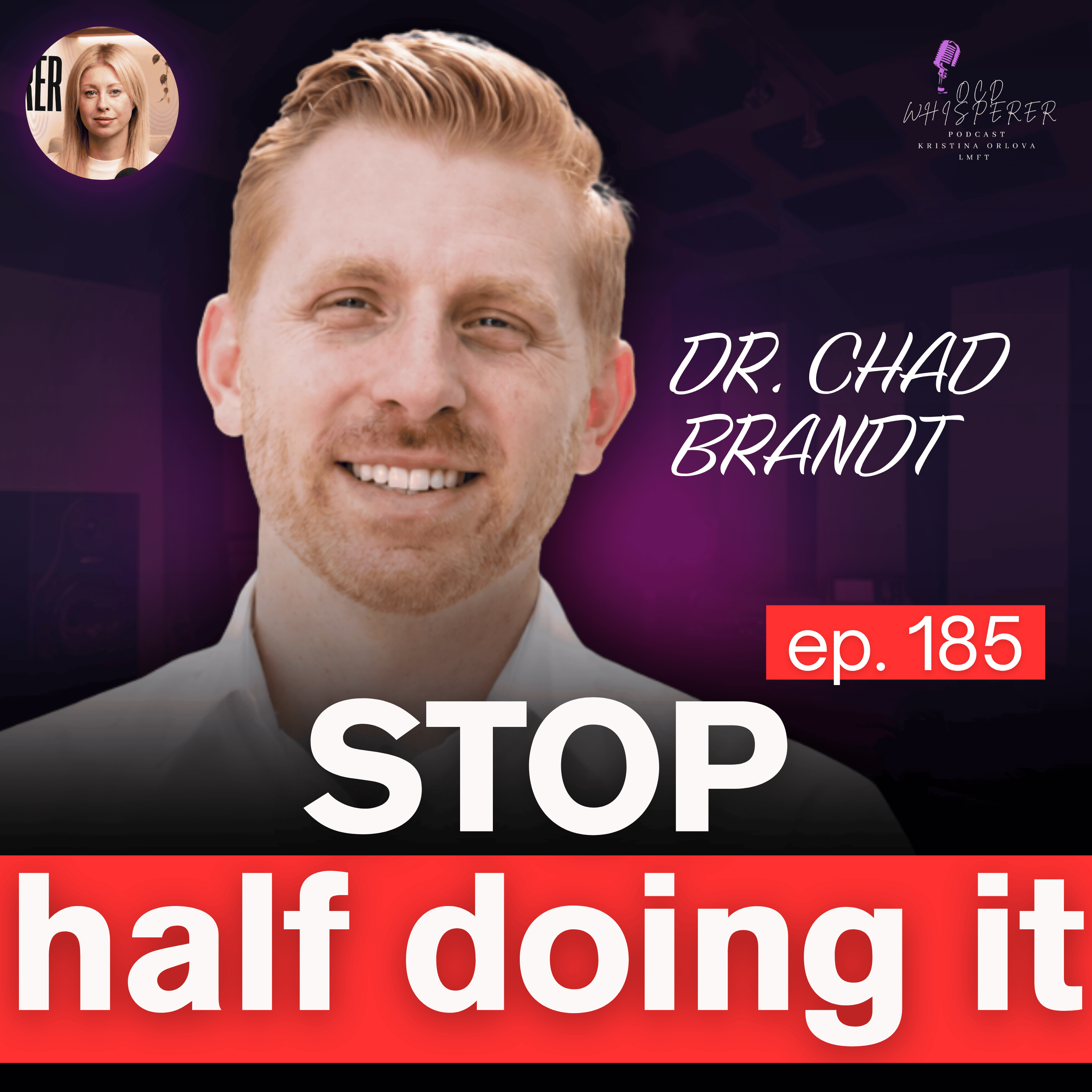
The OCD Whisperer Podcast with Kristina Orlova
185. You’re stuck because you’re doing ERP halfway
00:33:01
Loading summary
Transcript57 lines
- [00:00]
Christina Orlova
Foreign.
- [00:07]
Podbean Announcer
Need a moment to breathe with Podbean's ambient relaxation. Enjoy ocean waves, calming rain, and peaceful nature sounds anytime, anywhere. Whether you're working, studying, meditating, or winding down, your perfect calm is just one tap away. Download the Podbean app today on Google Play and the Apple App Store. Relax with Podbean. P O D B E A N.
- [00:36]
Christina Orlova
Welcome to OCD Whisperer podcast. If you guys enjoy conversations about ocd, anxiety and mental health, please remember to subscribe and hit that notification bell on. So today with me, I have Dr. Chad Brandt, and what we're going to be talking about is what is intensive treatment for ocd? I know people see that online and I think there might be some confusion. What is it? Why? Why would you do it? When would it be appropriate? So we're going to dive into that today. Welcome to the show.
- [01:00]
Dr. Chad Brandt
Hi, Christina. Thank you for having me. I'm really happy to be here.
- [01:05]
Christina Orlova
Hi, I'm Christina Orlova, host of the OCD Whisperer podcast. As someone who lives with ocd, I understand the struggles firsthand. If you're here, you're not alone. Before we start, grab your free OCD survival kit at www.corresults.com to help you take control. That's K O R results dot com. Now let's dive into today's episode.
- [01:34]
Awesome. So, Dr. Brand, if you can tell us a little bit about yourself so people can get to know you before we dive into our conversation.
- [01:41]
Dr. Chad Brandt
Absolutely. You know, I always tell people when I first meet them, you know, tell me a little bit about your ocd, tell me what's going on, and then I'll tell you some personal details about me. Because you're telling me all your secrets, you may as well hear some of mine. So I am a clinical psychologist. I specialize in severe cases of OCD. I got my PhD. I'm from the University of Houston. Did my pre and postdoc training in Houston. I did my postdoc at what was called the Houston OCD program. It's now the OCD Institute of Texas, one of the residential centers for OCD. So I did that in 20, 2016, maybe 2017. Really loved that. Stayed on there as staff. And then in 2019, I got trained in the Bergen four day treatment. And 2020, I started my own practice. And at this point, since 2020, I still specialize in severe cases of OCD. And I just do one on one longer form intensive sessions. So basically at this point, I take one patient per week just doing exposure therapy. So that's who I am professionally. And then personally, I have three young children. Every moment is a joy. And I have a lovely wife. And my wife and I talk about leaving Houston all the time when it's 100 degrees outside and monsooning. But other than that, everything's great.
- [03:03]
Christina Orlova
I love it. Wow. Three kids. I mean, I. Most folks know, but I'm pregnant. I'm six months in, so, like, yeah, working and doing intensive work and being like, with a baby there and three babies, like, oh, yes.
- [03:15]
Dr. Chad Brandt
I'm very fortunate to be the male where I don't have to carry the babies. I can't imagine that part of it. But yeah, no, three children. You know, I. I told my wife, yeah, it's interesting. Yeah. I wake up and I caregive. I go to work and I come home and I care. Give. But it's. It's all worth it. I'm sure you'll find that.
- [03:34]
Christina Orlova
Oh, I bet. Yeah. Well, I mean, we're excited to have a kid, but yeah, definitely that stuff comes to mind. Right. OCD things come to mind. Schedules come to mind. Right. So, I mean, I think kind of if I can't ask you just a question. Well, just for me to know and for the folks listening to. Do you have OCD or you just more treat ocd?
- [03:55]
Dr. Chad Brandt
No, no, I don't have ocd. So I was a really anxious kid. My stomach hurt. Going to school every day, kindergarten through sophomore year of college, before I realized that that was abnormal. I thought all of our stomachs hurt all day long. So sophomore year of college, I decided I really, I should figure this out. This is interesting to me. I haven't figured it out yet. Decided I wanted to be a psychologist. Over the years, because it's been about 10 years now, I've treated severe cases of OCD. So I will have OCD thoughts come up with frequency because I talk about them all day long. Right. With people. I cheat. I know the answer. I know what treatment is. It's. I went to school for years to do it before I had too many of the thoughts. So I don't have diagnosable ocd, but I have been around the anxiety ringer quite a few times.
- [04:51]
Christina Orlova
Yeah. Yeah. Sounds like you've. You've definitely dealt with anxiety because, like, stomach issues is one of those such common kind of fight or flight responses. Right. People get sweaty palms or lots of thoughts, or your tummy issues or your heart's racing really fat, like hard and fast and you don't know what's going on. Something just feels like it's wrong. Well, let me ask you then a question. So what is. So we're talking about severe ocd. So what is the best, I guess, therapy for severe OCD from what you've found so far?
- [05:26]
Dr. Chad Brandt
Yeah. In my professional experience and the scientific data out there would say that exposure therapy or exposure and response prevention therapy is the gold standard of therapy treatment for ocd. So really quickly though, I'm sure everybody here is familiar with it. O. The O of OCD stands for obsession. The thought you don't want. C compulsion, the thing you do to make it go away. D disorder. It bothers you, right? Then you've got exposure and response prevention. Exposure, do the thing that's scary. Response prevention, don't undo it. Right. So ERP is the number one way to treat OCD out there. And the way that I will think about ERP is how, how are you doing it? What's, what's the model? Why are you doing it? Where are you getting people? How are you thinking about the exposures? So that might differentiate a little bit in who you do ERP with. But ERP treatment almost universally is the, the number one way to, to work on ocd.
- [06:24]
Christina Orlova
And then for severe cases, if you're doing erp, because you mentioned also doing really more intensive, like week long intensive with one person. Tell, tell me more about that. Like what does that actually look like? Hours a day, Are you with the person like two hours, three hours, like half a day?
- [06:42]
Dr. Chad Brandt
It can be, can be whole days, usually like nine to four. It's like a full working day that I'm with people. And the way that I'll think about. Yeah, long days. And the way that I'll think about it is you want to get somebody to do an exposure and you want them to, you want to help them to do it. Right. And the way I'll define that is you want to do an exposure that sends the right message into your brain. So if I'm doing an exposure, but I'm only doing a part of it, I'm doing a little bit. I'm saying I'll touch the doorknob, but only with my pinky finger, you know, I'll say a prayer. Wrong, but only a little bit wrong, not too wrong. Right. Your brain's getting this message that says, well, okay, well maybe you can do it, but maybe you can't, or maybe it's too much and you'll get these kind of rebound effects that will come back from that message that you send. So what I'll tell People is we don't have to do an exposure big necessarily. You don't have to do it difficult necessarily. You do have to do it full. You have to do it in a way that sends the right message into your brain. And if you have an hour or even two hours or three hours with somebody and you're really trying to get that model in, that way of doing exposures in and you run out of time, well, now you've sent a mixed message. And now the next session is going to be that much harder. And when I just block off a full working day with somebody, we can do it. It's just me and them. I tell people all the time. I don't employ a second person in my business. If you call my number or email me, you'll only ever talk to me. I like the control. I like to know what people are doing and to have that interaction and to spend that time with them to get the exposures. Right. And to get them rolling ultimately so that they don't need me anymore. Right. And they can say, I get it, I get how to do exposures. I did them with Chad. I get how I can take them home. I get to live my life now. Because that's, I mean, that's the goal of all of this, right? For people to not need us anymore and to go live their lives.
- [08:30]
Christina Orlova
Yeah. So what's the difference? I guess because, you know, I don't know if people listening out there, but, you know, when you talk about what is intensive treatment for ocd classically, maybe people know about, you know, an intensive outpatient program which is typically three weeks, about three hours a day, usually four to five days. But you, I heard you say one week, and now you're talking about a full work day, like 9 to 4. So tell, tell me more about that.
- [08:55]
Dr. Chad Brandt
Yeah, it's just, it's just me and the patient. So if you work in one of the Iops or one of the residential programs, and I worked in one, like I said, the OCD Institute, and they are lovely. Everybody should give them a call. They're lovely. But you, you end up moving between providers, right. You do a group therapy session, which is great for some people, and then you get a time to work on some exposures on your own, and then you see maybe your therapist for an hour. That's great. And then you get maybe some time, and then you work with a staff member, a psych tech, an exposure therapist, whoever depends on the program. Right. You work with somebody else and then maybe you'll take Time. And then maybe you'll get another group therapy. And all of that can be super useful. And for the right person, that's a really lovely way to do treatment. And you end up kind of chopping sometimes, perhaps. Right, I'll get part of the exercise done, or I'll do a little bit here. I'll do the rest tomorrow. I'll do some with Jimmy, I'll do some with Susie. And again, for some people, that's lovely. But sometimes you get these mixed messages in there that say, oh, I can do a little bit of the exposure here, but not all of it. I can do some today, but I gotta save some tomorrow. And when I'm with somebody and I'm with them all day long, there's no breaks. There's no, oh, I'll do a little bit now and a little bit later. That's not the right message, I don't think, from the way I treat ocd. Well, I want that message to be full. I want it to be right. I want it to be fully encased in there. And I want you to get it. I want your brain to get it, and then I want to replicate it, and then I want to run with it. And it's just you and I. There's nothing else to do. We're just doing an exposure. Excuse me. We're just doing exposures. And I can take my patients then wherever I want to. Houston is a gigantic city. Most of my patients come to me from out of town. We can go to the zoo, we can go to the mall, we can go to the airport. We can go find a really lovely gas station bathroom. We can do whatever we need to do to really put that into use in the world.
- [10:42]
Christina Orlova
Okay? So I'll be honest. I know. I just know my audience. I know people listening, Right? On the one hand, it sounds like, wow, okay, something with, like, that long maybe could break my more severe kind of symptoms, Right? But also it sounds like it could be very overwhelming because that's so much time. So, yeah, tell me about that.
- [11:01]
Dr. Chad Brandt
Yeah. The goal is not to overwhelm, right? The goal is to send the right message in. And I'll say, I'll give you an example. My middle son, he's 8, and he just took up basketball, and he's 8, loves basketball, wants to go to the NBA, all those sorts of things, right? And so he wants to be out there shooting hoops all day long, and he wants to go to his basketball practice for three hours and do all those things, and that's all well and good. But if he just runs himself into the ground three hours a day, he'll just be tired. And I'll tell him, and he's young, this is an age appropriate conversation. But I'll tell him it's not about shooting 100 shots just to get 100 shots up. It's about shooting one shot. Right? Right. Get your form right. And when it's good and it really feels good and right then you can, you can shoot more shots later. And if it takes you three hours to get one good shot, that's lovely and it's a great use of your time and it won't necessarily be as overwhelming or as tiring. You're just getting it, you're getting it right. You're getting your form right. So that's what I'll think about the longer days with people. It's about your form. Not just about pounding out 72 exposures in a day. It's getting your form right.
- [12:04]
Christina Orlova
Got it. So like, have you found in your experience, like, do people just get like tire out between, I mean, nine to four, nine to five? It's like, it's literally like an eight hour workday. Right. So like, do you, they take breaks? Do you find people just, okay, I'll, I'll start and with you right there, I feel like, okay, I can do a little bit and then kind of like I pause and I get nervous or you know, anything like that. Just more literally when you're, when you're doing something that long, not too much.
- [12:29]
Dr. Chad Brandt
The breaks are with me. So they're so they're not really breaks. The breaks happen naturally. So let's say a patient comes to me and they get a hotel room in town and I go to the hotel room because I don't have an office. I go into where people are. So go into the hotel room, we'll talk. We'll do an exposure in the hotel room. We'll work it until we get it right. And that might take 30 minutes and that might take three hours. I don't care. Right. And as soon as we get it right, well, now I want to put it out into the world. So let's hop in my car, let's ride, let's listen to some music. Let's talk about your kids. Let's talk about what you're going to do when you go home. Let's talk about your school or your boyfriend or your finals, whatever, whatever you want. And okay, we're at Target now, right? And now we're going to go do whatever we set about in target and we could take three minutes there or three hours there, I don't care. Until we get kind of target. We get that feel for putting it into the world. Okay, great. Now we're going to go get some lunch maybe. And there's, I'm sure, some exposures in lunch and we should take them when they arrive. But it's not about exposures. It's about getting food in so we can go do the next thing, which is maybe, I don't know, the zoo. We got to go touch a bunch of goats. Because there's a petting zoo at the Houston Zoo and I've touched more goats there. I think the goats all know me by name.
- [13:39]
Christina Orlova
I know you can share all the things they've done with lions.
- [13:45]
Dr. Chad Brandt
Yeah, I'm not outing anybody because I've touched all those goats and I take my kids there all the time, too. So it could be, you know, between my kids and my professional life and my love of goats, it's been hundreds.
- [13:56]
Christina Orlova
That's funny.
- [13:59]
Dr. Chad Brandt
That's the day. That's the way the day will look. And it's not about overwhelming necessarily. Is it tiring? Totally. I'm always wiped out at the end of the day. I tell people I'm exhausted. I didn't do anything. I just paraded around and said scary things and pet some goats. Right. I didn't do anything and I'm tired. So it is tiring. But that's not the goal. Right. The goal is understanding.
- [14:19]
Christina Orlova
Got it. And so how long is when we're talking about this intensive? Because you said the word Bergen method too. So can you give a little description of that? Because you said a week. So is it just one week you're working with somebody like this, or is it longer?
- [14:35]
Dr. Chad Brandt
So the Bergen four day treatment is lovely. Everybody should Google it. It's wonderful. They've had just probably two decades now of data and thousands of people. It's a really effective way to treat ocd. And then when I went out on my own in 2020, I like the way they think about OCD. I like the way they think about treatment. The Bergen format is kind of a group on group formats. You might have five therapists and five patients and you kind of come together as a unit of 10, and then you might pair off in units of two, a clinician and a therapist. Right. Going off to do different things and come back together as a group. When I started doing this on my own, there's not the group component. It's always just me and one patient. And then I get more flexibility in how I choose to work. So I just choose what I think is right for the patient. So I'll see kids as young as 10. Pretty rare to see a 10 year old, but I'll see them that young. The days would be shorter. The days might be split between them and their patient. But that model of how we're doing exposures I think is very similar. I might spread that kid over five days or maybe eight days with a weekend in between, depending on the kid. Right. Versus an adult. I might say I want you here for two solid, really full days. You've got a wife and kids and a job and you have stuff to do. You can only take this much time off and I got you. We're going to come in here and we're going to, we're going to really work and we're going to, we're going to get you back to your family. So I get just the flexibility for whatever makes sense for the patient.
- [16:04]
Christina Orlova
Okay, that makes sense. I mean, so, I mean I, I understand these models because I myself have done intensive outpatient program, but I've done the classic like the three week, three hours a day. I've heard about the Bergen and I know that it's like a four day or really just a one week where you're, you're really together for that extended length of time. And I guess the question for you is, you know, do you, and I know this might be subjective, but do you find in general like when people are done, is it successful? Do you see them making better progress? Are they able to really kind of break some of the severe, like the initial reason they came right with the things were severe, that they were obviously impacted in big important ways. And by the end are they able to do more or you notice like they're able to go back to their own homes and use it better?
- [16:55]
Dr. Chad Brandt
Yeah, that's always the goal. I can't promise anybody anything. I really wish I could. I, I will say, when I was trained by the Bergen crew, when they came down and trained a couple of us from Houston, I was really skeptical. You know, I was trained in the States and our model is different than that and why would we change it? And so I went through all the training and I got it, but I hadn't seen it yet. And the first group that I was a part of, I basically shadowed. I did very little therapy. But the first group that I was a part of, at the end of it, I cried. And that's not a Super high bar. I'm, I'm a really easy crier. But I cried. I cried that the change I saw in the patient was so quick and rapid and lasting and so much different than what I had seen before. I cried. On the way home, I called my wife and I said, this is what I have to do now. This is, this is, this is now what I do for the rest of my life. I found it. So my goal is for people to work with me for about a week, three, four, five days, depends on the patient usually. And for them really to never call me again. That would be. In a perfect world, that is what I want. That certainly doesn't always happen. There are follow ups. I'll connect people back in with their therapists or new therapists when they get home if they want. All that we can figure out. But that's always my goal for them to say, I get it, I did it enough times with Chad, I'll take it home and I won't need him anymore. And that, that does happen.
- [18:20]
Christina Orlova
That's amazing. So I just want to make sure, because if people are listening, kind of that, that in summary, I guess like what, what I'm taking away from this is this. You come in, you start, you, you kind of together create your hierarchy. You look at what are the different things that are, that you're avoiding with or that are, you know, creating the OCD cycle and you start to work on those systematically. And you, the, the beauty of what you're talking about is you have time. And it's because you have so much uninterrupted time. Of course, breaks, bathroom breaks, lunches, et cetera. But you have that length of time. So you can really, together kind of step by step, hold them accountable as well as just be right there to together walk through those things and really make sure that if, if somebody's getting stuck or maybe is not understanding something as well, you can pause, you can break that down, make sure they really understand the concept and then actually do it so that that connection association is happening lives.
- [19:17]
Dr. Chad Brandt
Back it up, do it again. What's going on? Why did it happen that way? What's, what's your worry? What's anxiety? What's, what's your brain telling you to get you to not run this exposure the way that sends the right message to your brain? Okay, let's break that down, let's build that up, let's do it again, right? And you can do, you can do that forever until somebody, I'm going to keep saying, like, gets it Right. There's a. There's a feel to it. There's a vibe to it. Right. And you know, OCD therapy in a lot of ways, I imagine to be. Be like sports. You. You know, when you have a good shot in basketball, you know, when it's going in, you know, when you kick that soccer ball, you. You know, when it feels right coming off your foot and exposure feels the same way. And I think everybody that's tried them before knows what I'm talking about. Like, this still feels wrong. This feels. I feel like I'm holding back. I feel like there's a message going in there. I'm not. I'm not not getting right versus. Oh, yeah, that's how it's supposed to feel. Right. That's how. That's how you really take the fight to the OCD versus respond. That's how you do it. So that's the feel that you get the time for. And then what you're looking for is that feel. More so than, say, habituation. Right. Did your suds come up and down? Sure they did. They're probably always going to if you spend eight hours on it. But that doesn't mean you have to feel exactly right.
- [20:30]
Christina Orlova
Yeah, no, that sounds actually pretty interesting, right, because what you're saying is that, yeah, like, you said the form, right. Like, that really stuck with me because I'm visual, personally. And so, like, yeah, if you. Even if you go work out for the first time or you start with a trainer, one of the first things they teach you to not have injuries is get the form. Form, right. It's not about the weight, it's not about the heaviness, it's not about the intent. It's just get the form. Because once you understand how you should move and what that should feel like you've got the right muscle memory in now, it becomes easier to go and do that again. And that's really, what I hear you say, is once you understand the what and the how of ERP and understand your own probably internal arguments or justifications, why not to, or I can't, or all. All that stuff that's going to come up and work through that and then get, like you said, that moment where, oh, this is what this is like in action. Oh, okay. It's like that muscle memory you suddenly get. You're like, okay, I have the feel for this and now let me go again.
- [21:28]
Dr. Chad Brandt
Yes. Yeah. And you're exactly right. And it's interesting because, like, exposure therapy on its face is incredibly simple. Go touch the Doorknob, don't wash your hands. And that is incredibly simple right now. It's significantly harder than that. Same thing as quitting smoking. Quitting smoking is simple. Stop buying cigarettes, stop lighting them on fire, stop smoking them. Right. But, but 99% of quit attempts fail because it's, it's, it's, it's, it's harder than that. And that's the idea is that most people understand exactly what to do by the letter of the law. But how do you get a feel for it? How do you do it right? How do you send that right message back into your brain versus just kind of tolerating and hoping feel better at some point?
- [22:09]
Christina Orlova
Well, I want to ask you kind of what's the most common objection that you've seen personally as you do this work? Because I, for example, often hear things like, well, I just can't. I just can't do that because, you know, like, maybe somebody else could, but I can't. It's too scary. It's too dangerous. It's too much of a risk. It's. But it could, but it might, or I tried before. I failed. Like, all things. Like, like, so what do you, what have you heard? Is it like that? And what do you do with that?
- [22:38]
Dr. Chad Brandt
All those are good ones. I think the idea of, like, this one could be real is, Is very common. And my, my usual reaction to that is like, well, there's only one way to find out, right? There's only one way to find out if this doorknob is going to kill you. Sure. The last 900 doorknobs you touched didn't kill you. And all that could be just a load of. Load of malarkey or whatever. Right? But everybody knows Doorknob number 901 gets you. I don't know. There's only one way to find out if doorknob901 gets you. Let's go get it. Let's go touch it. Let's put our hands all over it, and we'll see if that one kills you. Oh, no, it didn't. Well, 902 must be the one. Let's go. Let's get the next one. Let's. Right. So that's something that I see a lot. In a way, you can try to kind of challenge yourself through it. It's too much. It's too hard. It's too scary is pretty common. I also say all the time that's a testable hypothesis. We don't know that it's too scary. There's only one way to find out if it's too scary. I also know you've had really terrible OCD for 3, 5, 10, 25 years, and you've had panic attacks, and you've done all these different things, and you're still here. So I don't think there's a. Too scary for you. You've been scared for a decade and still alive right in front of me. So I don't think there is a too scary for you. I think we should. I think we should test that out. A lot of it comes down to testing or challenging attacking. I use the term offense versus defense a lot. Once on offense, against the ocd, instead of playing defense, hoping it goes away, let's go attack it. Right? And that'll. That'll get through some of those common. Some of those common roadblocks that you see put up. I also think people generally are better people than they think they are and more tough than they think they are, and they're humans that live on no food for weeks, lost in the woods, and so on and so on and so forth. And I think we can touch all the doorknobs here if we have to. I think you can say that prayer. You don't want to if you have. Have to. I think you can, you know, drive your car by 10 different playgrounds right now if you have to. I. I think you can.
- [24:36]
Christina Orlova
Yeah. Only one way. Yeah. I mean, I agree. I think I. I similarly, I find that, you know, it's like we don't give ourselves enough credit for all the things that we are actually capable of doing. Let me ask you one more question, because this. This. This one I see quite often on the Internet. But is ERP or EMDR better for OCD treatment?
- [24:57]
Dr. Chad Brandt
Yeah. So I would say erp, and there's a lot of evidence that would back that up. EMDR can be effective if and when it turns into exposure therapy. Right. So if I'm having a lot of intrusive thoughts about, you know, harming someone I love, and I do some EMDR that forces me to have and repeat and face that thought a lot of times. Is that emdr? Sure. Is it also erp? Yeah. Yes. Right. That is an exposure. I'm exposing myself to the thought. I'm bringing it out. I'm bringing it out on purpose. I'm looking at it. I'm playing with it instead of running from it. So that's when I think EMDR is effective. But really, at the end of the day, the exposures are what matters and what I'll tell people a lot is the human brain produces words quite well. It produces fears, it produces what ifs. It produces words really, really well. It does not hear words if you very well. It hears actions, so to say to myself 10 different times, this doorknob over here is not dirty. I mean, those words are nice and all or whatever, kind of meaningless. My brain doesn't really take those in. The only thing that really works is to go grab that doorknob. That's what my brain sees. So if your EMDR blends into that, great, you're going to get some of that usefulness. But I think at the end of the day, it's about the exposure.
- [26:16]
Christina Orlova
And just for anybody listening right now who don't know what is emdr, would you mind just giving a quick little snippet explanation of what that is?
- [26:25]
Dr. Chad Brandt
Yeah, emdr, it's a therapy designed for PTSD and the eye movement rapid desensitization.
- [26:34]
Christina Orlova
Desensitization?
- [26:35]
Dr. Chad Brandt
Yeah. Oh, golly, it's the end of the workday. So the idea is if you think about or reprocess your trauma while you, let's say, kind of move your eyes back and forth like you're watching like a pendulum of a clock or like leaves on a tree is where it was originally designed, that you will rewire your brain to process that trauma differently. And again, there are exposure therapies that have you do something very similar, minus the eye movement, where you're reprocessing, resetting, rehashing, re experiencing that trauma. And that can be quite useful. So I think that's what you're picking up on again there.
- [27:15]
Christina Orlova
Yeah, because I know quite often people talk about, you know, exposure response prevention or emdr, and I know, historically, at least from everything I've seen is, is EMDR has not really been shown to be effective for OCD treatment. And kind of like what you just said and alluded to is, it's that, well, you don't have the. You need the exposure element and response prevention. Like, not just the exposure, and then you do the compulsion because you're not. You're actually not learning anything new. But. But if you are in fact allowing the thoughts or the images to come forward and allow them to be there and feel all the feelings that that brings up without trying to get rid of it all, even though it feels hard at times. But, you know, the more like anything in life, the more you practice, the better you get at it over time.
- [28:00]
Dr. Chad Brandt
Yes, yes. And OCD thoughts are, I would say, normal thoughts. We all have them. One way or another, whether or not we like them. It's just, what are you going to do with them now? And I can drive myself insane worrying about my children choking on something in the other room and so on and so forth, or I can be here with you doing, doing this work and I think this is more valuable. Not that my kids aren't valuable, but I trust them. I trust my wife, I trust the universe, I trust whoever. There's a risk there, but I think it's worth it to put more out into the world.
- [28:33]
Christina Orlova
Well, I think you nailed it on the head, right? I'm putting trust into that and into those dynamics and into how I've raised them and what they know, and that's that. And I'm going to leave that there instead of spending my time to continue to ruminate on it and create a whole lot of scenarios in my head about. It's like, no, we're gonna let that be. Awesome. Awesome. Well, I think thank you for coming and talking about the more intensive treatments. I think people might have heard about like the more traditional IOP format, but I don't know that people have heard that much about the four day Bergen method or that you can do intensive work in this way where it's literally like a full work day for up to a week. And I, I do have one more question just because I know people typically want to know this financially, right? How, how is this, Is there any insurance coverage? Not, is it private pay? Is it affordable?
- [29:27]
Dr. Chad Brandt
Sorry, that's a good, that's a good question. And I, I don't take insurance. I wish I could and did, and maybe one day I will, but not today. In terms of cost, it's, it's hard for me to tell you because every person is different, every patient is different. On the, on the, I would just be totally transparent with you on the low end. I've done intensive treatments for a couple thousand dollars, three, four, five thousand dollars depending on how much time we have. On the high end, it's been, it's five figures, 10, 12 plus thousand dollars. Now that would be multiple full days, right in a row to get up to that much. So that is pricey. That is a lot. I understand. Unfortunately, we live in America. The residential treatments are a lot. The Iops are a lot. Regular outpatient therapy is a lot. My hope is that it is expensive and worth it. My hope is you put in a lot of time and effort and energy and money up front and then you need a lot less therapy for days and months, months and years afterwards, I can't promise anybody that, but that's my hope is that ultimately they save some money and they get their quality of life back.
- [30:41]
Christina Orlova
Absolutely. I mean, I know it's a bigger kind of issue and question for everybody, but yeah, I appreciate you just being honest and also just giving folks a range of, you know, what could be. Because you know, what if somebody says, okay, I could maybe put in 3,000, what can I expect for that? And you know, have realistic understanding of, you know, what can you achieve and what can be done?
- [31:02]
Dr. Chad Brandt
Yeah, no, it's important. And yeah, it's a much larger conversation. But if anybody is listening and wants to reach out to me, I'm sure my contact information will be around the podcast here. You can call me, shoot me an email. It's like I said, it's just me. I don't have a front desk person. I will get back to you.
- [31:19]
Christina Orlova
Beautiful. Yeah, I, I, and I personally, I don't know what other things, but I personally think it's great when you still have services like this where you can directly talk to the person. Just because in the modern day age with all the groups and the AI and just so many things, I think it's nice when you can just directly reach somebody and you are actually bringing us to the end which I always ask, you know, if people would like to find you, how can they? You?
- [31:42]
Dr. Chad Brandt
Yes. So you can go to my website, www.doctorchadbrant.com B R A N DT is my name. You can just Google that or put it in chat, GPT or whatever everybody's using these days. I'm just old enough now with three young children that I have no idea what's cool or what people use.
- [31:58]
Christina Orlova
You're funny.
- [32:01]
Dr. Chad Brandt
But just, just Google me. You'll find my phone number, you'll find my email, you'll find my website and just, just seriously, anybody listening, just call me. Just call me or send me an email. I will respond. You don't need money to talk to me. You don't need to put down a retainer to have me hear who you are and give you some options. No matter where you live. I'm more than happy to do it. I used to tell my wife when we started having children, I don't know what we would do if she had to go into residential treatment. My middle son is a type 1 diabetic. She stays home partially because of him, partially because we have three, three children. And if she had to go somewhere for eight weeks, what would we do? I have no idea, not to mention what it would cost. So I'm pretty well connected in the OCD world or I'm happy to connect you to a connection around you. It's just important that people get their lives back at the end of the day.
- [32:50]
Christina Orlova
100%. Thank you so much for being on the show.
- [32:52]
Dr. Chad Brandt
Absolutely. Thank you for having me.
- [32:57]
Christina Orlova
Thanks for listening to the OCD Whisperer podcast. Remember, freedom from OCD is a journey
- [33:03]
and you're not alone.
- [33:04]
Visit www.coraresults.com to explore self help masterclasses like Sneaky Rituals with Jenna Overbaugh or ICBT Masterclass with Christina and Abe. Don't forget to grab your OCD CBT journal tracker and planner while you're there. If you found this episode helpful, please subscribe, share and leave a five star review to help others find the podcast. Together we can make a difference. Keep going and I'll see you in the next episode.
- [33:44]
Podbean Announcer
Need a moment to breathe with Podbean's ambient relaxation? Enjoy ocean waves, calming rain and peaceful nature sounds any, anytime, anywhere. Whether you're working, studying, meditating or winding down, your perfect calm is just one tap away. Download the Podbean app today on Google Play and the Apple App Store. Relax with Podbean P O D B E A N.